Discoveries · No. 8 of 50 · Physics
How James Clerk Maxwell Taught the World to See in Colour
The screen you are reading this on builds every shade it shows from red, green and blue. The science that makes that possible began in Edinburgh, with a teenage student, some coloured paper and a spinning top.
James Clerk Maxwell · 1831–1879Edinburgh · Aberdeen · LondonReading time · 16 minUpdated 2 August 2026
In Brief
James Clerk Maxwell, born in Edinburgh in 1831, produced the first experimental proof and the first mathematical treatment of trichromatic colour vision: the finding that all human colour perception arises from three types of light receptor. Beginning around 1849 with a spinning colour top and continuing with a precision spectral colour box, he measured colour matches numerically, wrote colour equations, drew the colour triangle and explained colour blindness as the loss of one receptor. It matters because every colour screen, camera and colour standard in use today rests on that quantitative science.
Scottish Impact Index (SI Score)
- Global Impact
- 9/10
- Longevity
- 9/10
- Economic / Material Impact
- 7/10
- Originality / Distinctiveness
- 10/10
- Legacy (Built Upon)
- 9/10
- Recognition
- 5/10
Key Facts
- Discovery
- First experimental proof and first mathematical treatment of trichromatic colour vision
- Key figure
- James Clerk Maxwell (1831–1879)
- Born
- 13 June 1831, 14 India Street, Edinburgh
- Key experiments
- c.1849–1860, Edinburgh, Cambridge, Aberdeen and London
- Field
- Physics · Optics · Colour vision
- Key instruments
- The colour top (coloured paper discs); the colour box (pure spectral light)
- Foundational paper
- “Experiments on Colour, as perceived by the Eye, with Remarks on Colour-Blindness”, read to the Royal Society of Edinburgh, 19 March 1855; published 1857
- Major paper
- “On the Theory of Compound Colours…”, Philosophical Transactions, vol. 150 (1860), pp. 57–84 — Rumford Medal, 1860
- Prior credit
- Thomas Young proposed three receptors in 1802; Hermann von Helmholtz clarified additive vs subtractive mixing in 1852
- Modern legacy
- RGB displays, digital camera sensors, colour television and the CIE colour-matching standard
Maxwell in Edinburgh
James Clerk Maxwell was born on 13 June 1831 at 14 India Street in Edinburgh — now home to the James Clerk Maxwell Foundation — and grew up at the family estate of Glenlair in Dumfries and Galloway. He entered Edinburgh Academy at ten, where he befriended the future physicist Peter Guthrie Tait, and wrote his first scientific paper at fourteen. He studied at Edinburgh University from 1847 to 1850, then at Cambridge from 1850 to 1854, and went on to hold chairs at Marischal College, Aberdeen (1856–60) and King's College London (1860–65) before returning to Cambridge in 1871 as the first Cavendish Professor of Physics. He died of cancer in 1879, aged just 48.
Maxwell is best remembered for his theory of electromagnetism, described in a separate article in this collection. But colour was one of his earliest and most persistent scientific passions. He began serious colour experiments around 1849, while still a teenage undergraduate in Edinburgh, and pursued them through Cambridge, Aberdeen and London — roughly a decade of sustained investigation running in parallel with his more famous work.
Colour Before Maxwell: Two Pillars and One Enormous Gap
Newton and the physics of the spectrum
The first pillar was Isaac Newton. In 1666, in his Cambridge rooms during the plague years, Newton passed a beam of sunlight through a glass prism and showed that white light is not pure but a mixture of all the colours of the spectrum. A second prism could recombine them into white again. The prism, Newton showed, did not create colour; it separated it. In his Opticks (1704) he arranged the spectral colours in a circle — the first colour wheel. But Newton explained the physics of light. He did not explain why or how humans see colour.
Thomas Young and the three-receptor hypothesis
The second pillar was Thomas Young. In his 1802 Bakerian Lecture to the Royal Society, “On the Theory of Light and Colours”, Young reasoned that the eye could not possibly contain a separate receptor for every one of the infinite wavelengths in the spectrum. It must instead contain a small number of receptor types. In his words, it was “necessary to suppose the number limited, for instance, to the three primary colours red, yellow, and blue… and each sensitive filament of the nerve may consist of three portions, one for each principal colour.” Young soon revised his primaries to red, green and violet. This is the origin of the trichromatic idea — but it was an inspired hypothesis confined to a few short paragraphs, with little proof, and it was largely neglected for half a century.
Helmholtz and the two kinds of mixing
The third contributor was the German physiologist Hermann von Helmholtz. In two 1852 papers in the Annalen der Physik, including “Über die Theorie der zusammengesetzten Farben” (“On the Theory of Compound Colours”), Helmholtz made a crucial clarification: mixing coloured lights (additive mixing) follows completely different rules from mixing pigments (subtractive mixing). It is why blue and yellow paint make green, but blue and yellow light do not.
A distinction worth holding on to
Yet Helmholtz initially rejected Young's three-receptor theory, because his early experiments suggested three primaries could not reproduce sufficiently vivid colours; at one point he argued that five primaries — red, yellow, green, blue and violet — were needed. So the gap was stark. Nobody had proved that the eye uses exactly three receptors. Nobody could measure colour perception numerically. Nobody could rigorously account for colour blindness. Maxwell set out to answer all three questions, framing his aim as being “to determine the laws of the composition of colors in general, to reduce the number of standard colours to the smallest possible, to discover, if we can, what they are, and to ascertain the relation which the homogeneous light of different parts of the spectrum bears to the standard colours.”
The Colour Top — Turning Colour Into Numbers
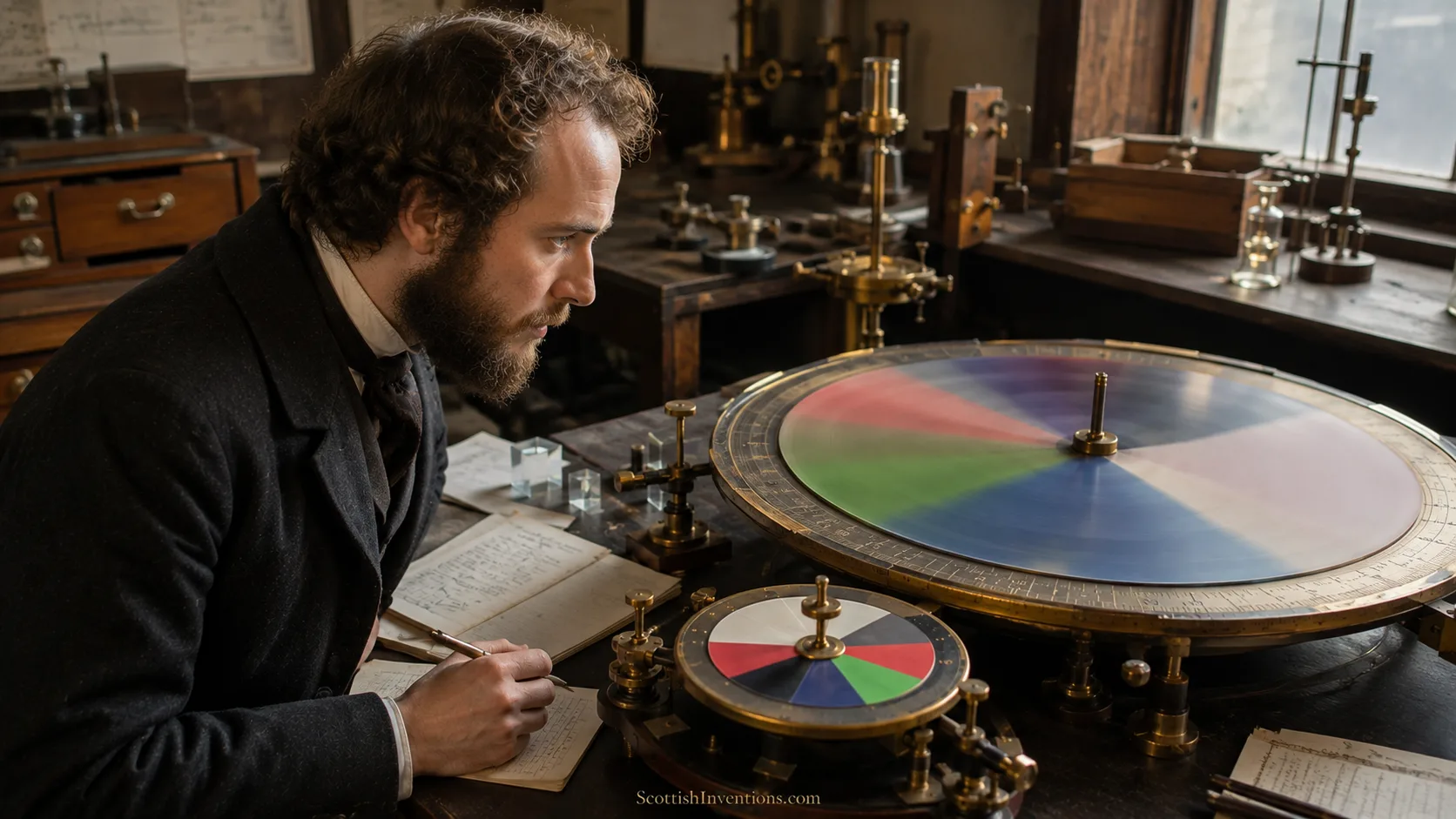
Maxwell's first instrument was charming in its simplicity. The colour top was a spinning top fitted with discs of coloured paper, each disc cut along a radius so that several could be slotted together and overlapped like a pie chart, exposing an adjustable sector of each colour. Spun rapidly — faster than the eye can follow — the separate colours blur into a single uniform mixed colour through persistence of vision. By adding a second, smaller set of discs in an inner circle, Maxwell could spin two mixtures at once and adjust the sectors until inner and outer rings matched exactly.
The genius was in the measurement. Maxwell had a disc made with a percentage scale, 0 to 100, marked around its rim, so he could read off precisely what proportion of each colour produced a given match. Choosing vermilion (red), emerald green and ultramarine (blue) as his primaries, plus snow-white and ivory-black discs to control lightness, he could write down a colour equation for any sample: so much red, so much green, so much blue, equalling a given grey. Colour, for the first time, had become arithmetic.
He owed the instrument to his Edinburgh professor James David Forbes, who gave the young Maxwell the run of his laboratory. Maxwell witnessed Forbes's colour experiments in 1849, including the key finding that red, yellow and blue could not produce a neutral grey — they yielded “a pinkish tint” — whereas red, green and blue could. Maxwell was about eighteen.
The 1855 Royal Society of Edinburgh Paper
This work culminated in Maxwell's first major paper, “Experiments on Colour, as perceived by the Eye, with Remarks on Colour-Blindness”, read to the Royal Society of Edinburgh on 19 March 1855 and published in the Transactions, vol. 21(2): 275–298, in 1857. In it Maxwell stated his aim precisely: to describe a method “by which every variety of visible colour may be exhibited to the eye in such a form as to admit of accurate comparison”, to register the results numerically, and “to deduce from these numerical results certain laws of vision”.
His matches proved consistent across observers, with small individual variation; they changed with the light source; and — crucially — they required exactly three primaries. Maxwell's first published account of the colour-blindness work had in fact appeared slightly earlier, as a letter dated 4 January 1855, “On the Theory of Colours in Relation to Colour-Blindness”, printed in the Edinburgh chemist George Wilson's 1855 book Researches on Colour-Blindness (Edinburgh: Sutherland & Knox) — the first book devoted to the subject.
Contemporary verdict
The Colour Box — Measuring With Pure Spectral Light
Maxwell recognised a weakness in the top: coloured papers are impure and hard to reproduce exactly. So, beginning at Aberdeen in the late 1850s and refining the design at King's College London, he built a far more precise instrument — the Maxwell colour box.
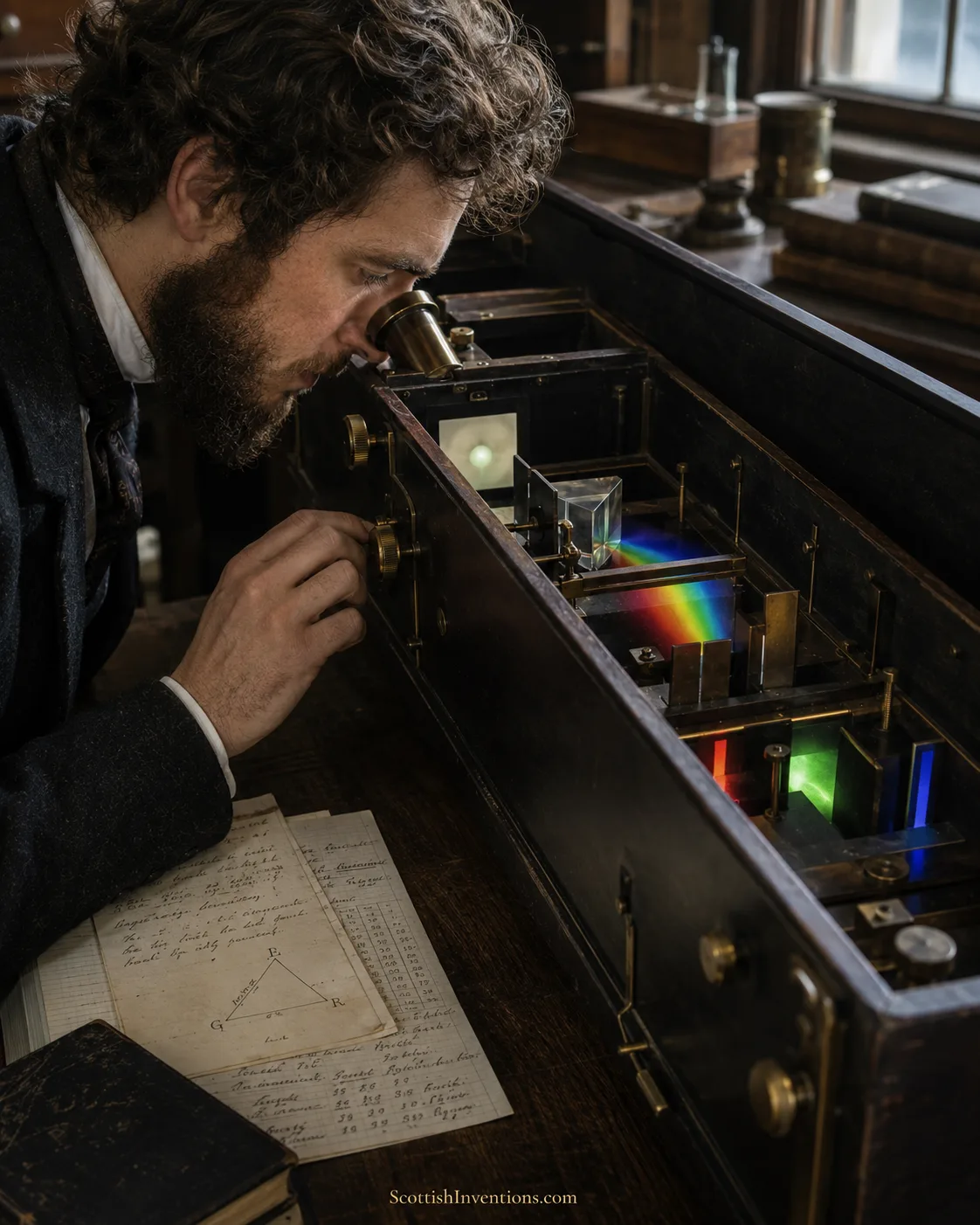
The colour box used the spectrum itself rather than pigments. Sunlight entered through slits and was dispersed by prisms into a pure spectrum inside a long, light-tight box. By positioning adjustable slits, Maxwell could select three pure spectral colours — a red, a green and a blue — and control the intensity of each by varying the slit widths. The instrument worked like a reversed spectroscope: through an eyepiece the observer saw a split field, with a mixture of the three chosen spectral primaries in one half and a standard white in the other, and adjusted the slits until the two halves matched.
With it, Maxwell produced the first precise trichromatic colour-matching functions — measurements of exactly how much of each primary is needed to match every colour across the spectrum. Published in his 1860 paper, these functions are the direct ancestor of the CIE colour-matching functions used throughout colour science and industry today, and Maxwell's measurements are in substantial agreement with the modern standard. He acknowledged one limitation honestly: adjusting a colour's intensity by slit width also slightly altered its spectral composition. By choosing his standard colours astutely, he obtained functions that nevertheless agree closely with the modern CIE curves.
The results appeared as “On the Theory of Compound Colours, and the Relations of the Colours of the Spectrum” in the Philosophical Transactions of the Royal Society of London, vol. 150 (1860), pp. 57–84. The paper was received on 5 January 1860, read on 22 March 1860, and won Maxwell the Royal Society's Rumford Medal that year.
What Maxwell Actually Proved
Maxwell converted a vague physiological hunch into an exact mathematical science. Specifically, he established five things.
Colour is three-dimensional
Any colour the human eye can perceive can be specified by just three numbers: the amounts of three primaries needed to match it. Colours therefore form a three-dimensional mathematical space.
The eye has three receptor types
Three numbers suffice precisely because the eye has three kinds of colour receptor — what we now call cones — each with its own spectral sensitivity. Maxwell saw the conceptual point clearly: each nerve “acts, not as some have thought, by conveying to the mind the knowledge of the length of an undulation of light, or of its periodic time, but simply by being more or less affected by the rays which fall on it.” Colour, in other words, is a fact of physiology rather than a property of light itself — what Maxwell called “that theory of three primary elements in the sensation of colour, which treats the investigation of the laws of visible colour as a branch of human physiology, incapable of being deduced from the laws of light itself.”
Light mixes additively
Mixing coloured lights adds their effects: red and green light make yellow; red, green and blue together make white. This additive behaviour is exactly what the three-receptor model predicts, and it is mathematically distinct from the subtractive mixing of pigments.
The Maxwell colour triangle
Maxwell represented colour space graphically as a triangle, with the three primaries at the corners. A pure primary sits at a corner; a mixture of two lies along the edge between them; a mixture of all three lies inside, its position fixed by the proportions. White sits near the centre. This elegant diagram is the direct ancestor of the modern chromaticity diagram.
The colour equations
Maxwell expressed every colour match as a linear equation — a colour equals a weighted sum of three primaries — drawing on the brand-new linear algebra of Hermann Grassmann, whose laws of colour mixing Maxwell verified experimentally. This was the first genuinely mathematical treatment of colour perception, and it is the reason colour can be computed at all.
Colour Blindness as a Missing Dimension
Maxwell's sixth result was arguably his most humane. He explained colour blindness as the absence or anomaly of one of the three receptor types, leaving the sufferer with a two-dimensional colour world: “All colours appear to the colour-blind as if composed of blue and yellow.” Using himself, his wife Katherine and colour-blind volunteers as test subjects, he showed that colour-blind observers matched all colours using only two primaries instead of three. He defined this dichromatic vision as a reduced form of normal vision — the defect being “that colour, the absence of the sensation of which constitutes the defect of the dichromic eye” — and found that the common form corresponds to the absence of the “red” sensation.
It was a theory that made a testable prediction about individual people, and it held. It also quietly solved the puzzle that had led Helmholtz to doubt trichromacy: variation between observers is not evidence against three receptors, but a consequence of how those three receptors differ from eye to eye.
1861: A Theory Made Visible
To demonstrate the power of the theory, in 1861 Maxwell had the photographer Thomas Sutton photograph a tartan ribbon three times — through red, green and blue filters — then projected the three resulting images through corresponding coloured filters using three magic lanterns, superimposing them to recreate a full-colour picture. It was the world's first colour photograph and a direct application of trichromatic theory. The full story, including what the wet-collodion plates of 1861 could and could not record, is told in the First Colour Photograph article in the Inventions series (Card 14).
Two Maxwell cards, one Maxwell
Young, Helmholtz, Maxwell: Giving Credit Fairly
The trichromatic theory is a relay race, and the honest version is more impressive than the simplified one.
- Thomas Young (1802) had the original three-receptor hypothesis — but little proof.
- Hermann von Helmholtz (1850s) clarified additive versus subtractive mixing and later developed the physiological theory in detail in his Handbook of Physiological Optics.
- James Clerk Maxwell (1850s–60s) supplied what the others lacked: the first rigorous experimental demonstration, the mathematical framework of colour equations and the colour triangle, the first precise colour-matching functions, a rigorous account of colour blindness, and a dramatic technological proof in 1861.
In physiology textbooks the theory is usually called the Young–Helmholtz theory, and that is a fair acknowledgement of who had the idea first. Many colour scientists nonetheless regard Maxwell as the most important figure in turning the idea into a working science: the editorial introduction to the 1993 republication of Maxwell's 1860 paper in Color Research & Application states that “even though the theory of trichromacy is sometimes referred to as the Young-Helmholtz theory, arguably the most important person in its development was James Clerk Maxwell.” Helmholtz himself acknowledged that “Young's theory of the color sensations… remained unnoticed until Maxwell directed attention to it.”
A hypothesis is not experimental proof, and a historical precursor is not the same as the person who made an idea usable. Maxwell took a physiological guess and made it exact, measurable and computable — and it is that version, with its equations, triangles and matching functions, that cinematography, broadcasting and your phone screen still use.
From a Spinning Top to Every Screen on Earth
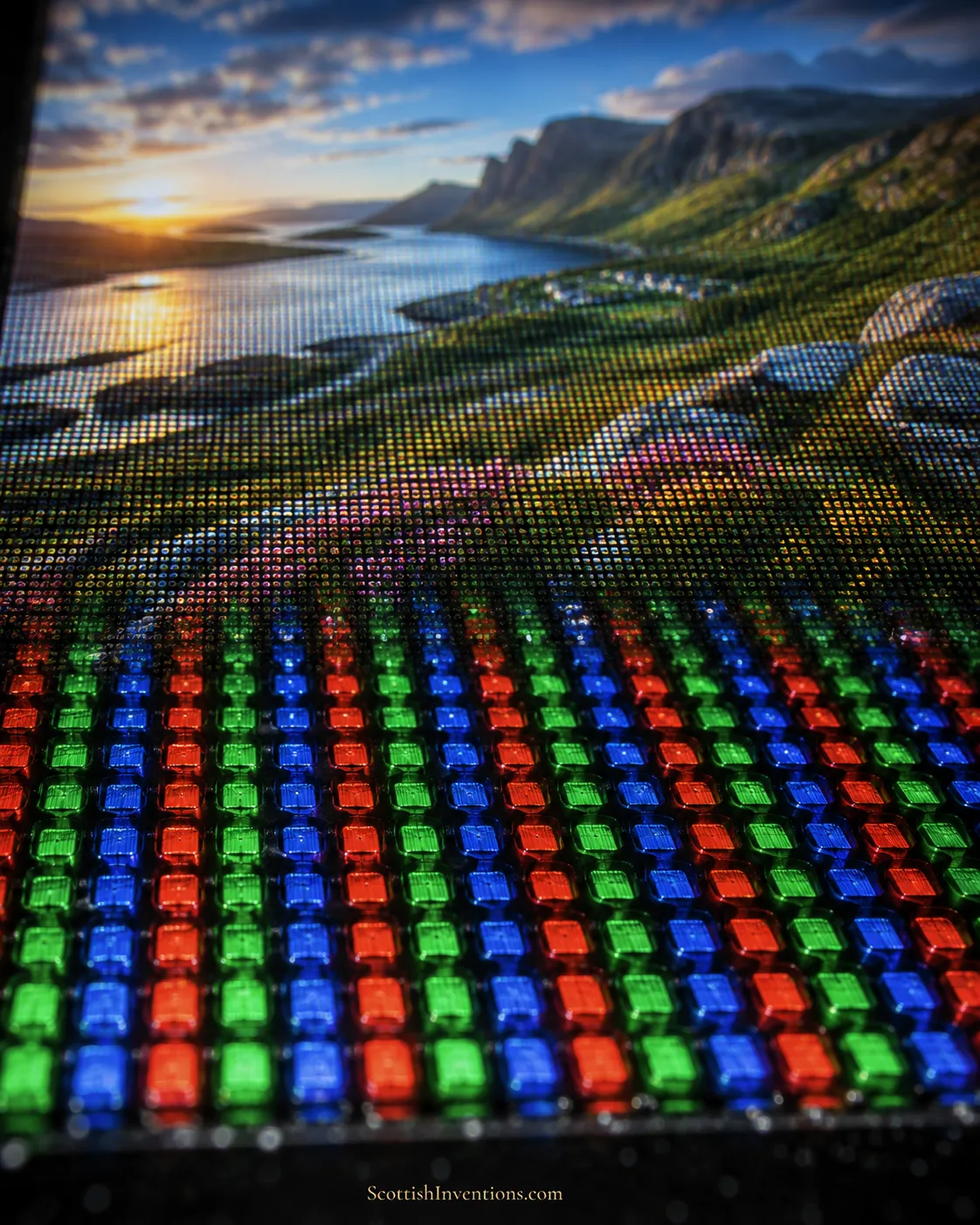
Maxwell's discovery is not a museum piece. It is running on the device in your hand.
RGB screens. Every television, monitor, tablet and smartphone builds every colour from red, green and blue sub-pixels mixed additively — Maxwell's additive mixing made physical.
Digital cameras. Almost every digital camera sensor sits beneath a Bayer filter, invented by Eastman Kodak's Bryce Bayer: a mosaic of red, green and blue filters, half green, a quarter red and a quarter blue, laid over the photosites. It deliberately mimics the eye's three cone types, with extra green because the human retina, through its combined L- and M-cones, is most sensitive to green light.
Colour printing. Printing uses CMYK — cyan, magenta, yellow and black — which works by subtractive mixing. But subtractive mixing is simply the complement of Maxwell's additive model, and both rest on the same three-channel understanding of human vision.
Colour television. From the 1953 NTSC standard, adopted in the United States on 25 June 1953, through PAL and SECAM to modern HD and 4K, colour television encodes pictures trichromatically in red, green and blue, built explicitly on additive colour theory. Scotland's own contribution to the medium is covered in the Colour Television article.
CIE colour science. The international colour standard — the CIE 1931 colour-matching functions used by every display, lighting and paint manufacturer in the world — is the direct descendant of Maxwell's colour-matching experiments and his colour triangle. The 1931 chromaticity diagram derives from the very method Maxwell pioneered, refined through the 1920s colour-matching experiments of W. David Wright and John Guild.
And why three? Maxwell's work is the reason we use three colour channels rather than two or four. Three is not arbitrary, and it is not a technological convenience. It reflects the biology of the human eye's three cone types — biology that Maxwell's theory both explained and exploited.
The arc is worth stating plainly: a teenage student in Edinburgh; discs of coloured paper spun on a top; percentages read off a rim; equations; a triangle; matching functions; a standard; and finally the pixel grid glowing a few centimetres from your eyes, mixing three lights into everything you can see.
Did You Know?
- Maxwell began proving the trichromatic theory with nothing more than a spinning disc of coloured paper, while still a teenage student at Edinburgh University — he was about 18 when he started.
- The RGB colour system in every TV, computer screen and phone camera is a direct legacy of Maxwell's 1855 Royal Society of Edinburgh paper.
- Maxwell showed colour blindness is caused by the loss or anomaly of one of the three receptor types, leaving a two-colour world: “All colours appear to the colour-blind as if composed of blue and yellow.”
- The CIE 1931 colour standard, still used by every display manufacturer on Earth, descends directly from Maxwell's colour equations and colour-matching experiments.
- Maxwell made the world's first colour photograph in 1861 as a direct demonstration of his colour theory.
- The mysterious “K” observer in Maxwell's colour experiments was his wife, Katherine, who collaborated with him both before and after their marriage.
Timeline
1666
Newton separates white light into the spectrum with a prism
The physics of light — but not an account of how humans see colour
1704
Newton publishes Opticks, arranging spectral colours in a circle
The first colour wheel
1802
Thomas Young's Bakerian Lecture proposes a small number of receptor types
Originally red, yellow and blue; soon revised to red, green and violet
13 June 1831
James Clerk Maxwell born at 14 India Street, Edinburgh
Childhood at Glenlair, Dumfries and Galloway
1849
As an 18-year-old Edinburgh undergraduate, Maxwell sees J. D. Forbes's colour-top experiments
Forbes finds red, yellow and blue cannot make a neutral grey; red, green and blue can
1852
Helmholtz publishes on compound colours in Annalen der Physik
Establishes that mixing lights obeys different rules from mixing pigments
4 January 1855
Maxwell's letter “On the Theory of Colours in Relation to Colour-Blindness”
Printed in George Wilson's Researches on Colour-Blindness (Edinburgh, 1855)
19 March 1855
“Experiments on Colour…” read to the Royal Society of Edinburgh
Published in the Transactions, vol. 21(2): 275–298, in 1857
7 November 1857
G. G. Stokes writes to Maxwell about the three-primary theory
“which you, and you alone, as far as I know, have established on an exact numerical basis”
Late 1850s
Maxwell builds the colour box at Aberdeen, refining it in London
Pure spectral primaries replace impure coloured papers
5 January 1860
“On the Theory of Compound Colours” received by the Royal Society of London
Read on 22 March 1860; wins the Rumford Medal that year
1861
The tartan-ribbon colour photograph, taken with Thomas Sutton
A public demonstration of the theory — told in full in the Inventions series
1871
Maxwell becomes the first Cavendish Professor of Physics at Cambridge
He dies of cancer in 1879, aged 48
1931
The CIE colour-matching functions are standardised
Direct descendants of Maxwell's method, refined by Wright and Guild in the 1920s
Notes on the Evidence
“Three primaries” wording varies by source. Young proposed red, green and violet; modern physiology describes the cones as long- (red), medium- (green) and short- (blue/violet) wavelength sensitive. This article uses “blue” in the modern RGB sense and notes Young's “violet” where it is his own term.
Helmholtz's credit is genuinely contested. Some historians argue Helmholtz reached the three-receptor theory independently around the same time as Maxwell; others note that he under-credited Maxwell in his influential Handbuch. This article follows the mainstream scholarly view that Maxwell's experimental and mathematical contribution was decisive.
One quotation comes from a third paper. The line that colour is “a branch of human physiology, incapable of being deduced from the laws of light itself” is from Maxwell's short 1856 British Association paper “On the Theory of Compound Colours with reference to Mixtures of Blue and Yellow Light”, not the 1855 or 1860 papers.
Keep the dates straight. The 1855 Royal Society of Edinburgh paper was read on 19 March 1855 and published in 1857; the major London paper was received on 5 January 1860 and read on 22 March 1860. They are frequently conflated elsewhere.
Frequently Asked Questions
What did James Clerk Maxwell discover about colour?
James Clerk Maxwell produced the first rigorous experimental proof and the first mathematical treatment of trichromatic colour vision: the finding that every colour a human can see can be matched by a mixture of just three primaries, because the eye contains three types of colour receptor. He measured colour matches numerically, wrote them as colour equations, drew the colour triangle, produced the first precise colour-matching functions, and explained colour blindness as the loss of one receptor type.
How did Maxwell's colour top work?
The colour top was a spinning top fitted with discs of coloured paper, each slit along a radius so several discs could be overlapped like a pie chart with adjustable sectors. Spun faster than the eye can follow, the separate sectors blur into one uniform colour. Maxwell added an inner ring of smaller discs so two mixtures could be compared at once, and a rim marked with a 0–100 percentage scale so he could read off exactly what proportions produced a match.
What was Maxwell's colour box?
The colour box was Maxwell's precision instrument, built at Aberdeen in the late 1850s and refined at King's College London. Sunlight entered through slits and was dispersed by prisms into a pure spectrum inside a long light-tight box. Adjustable slits selected a spectral red, green and blue and controlled the intensity of each. Looking through an eyepiece, the observer saw a split field — the three-primary mixture against a standard white — and adjusted the slits until the halves matched.
Did Maxwell invent RGB?
No. Thomas Young proposed the three-receptor hypothesis in 1802 and Hermann von Helmholtz developed the physiology in the 1850s. Maxwell's contribution was decisive but different: he proved trichromacy experimentally, expressed it mathematically, and produced the numerical colour-matching data on which all later colour engineering rests. Modern RGB systems descend from that quantitative science rather than from a single act of invention.
What is the Maxwell colour triangle?
The Maxwell colour triangle is a diagram of colour space with the three primaries at the corners. A pure primary sits at a corner, a mixture of two lies along the edge between them, and a mixture of all three lies inside, its position fixed by the proportions; white sits near the centre. It is the direct ancestor of the modern chromaticity diagram used in colour science today.
How did Maxwell explain colour blindness?
Maxwell explained colour blindness as the absence or anomaly of one of the three receptor types, leaving a two-dimensional rather than three-dimensional colour world. Testing himself, his wife Katherine and colour-blind volunteers, he showed that colour-blind observers matched every colour using only two primaries instead of three, and that the common form corresponds to the absence of the “red” sensation. He wrote that “All colours appear to the colour-blind as if composed of blue and yellow.”
How is Maxwell connected to modern screens?
Every television, monitor, tablet and phone builds its picture from red, green and blue sub-pixels mixed additively — the behaviour Maxwell measured and formalised. Digital camera sensors sit beneath a Bayer filter of red, green and blue elements designed to mimic the eye's three receptor types, and the CIE 1931 colour-matching functions used by display, lighting and paint manufacturers descend directly from Maxwell's colour-matching experiments and colour triangle.
Was the 1861 tartan-ribbon photograph the discovery itself?
No — and this is the most common misconception about Maxwell and colour. The 1861 photograph, taken with Thomas Sutton by photographing a tartan ribbon three times through red, green and blue filters and projecting the three results back through matching filters, was a demonstration of the theory, not the discovery. The discovery was the years of measurement and mathematics that came before it: the colour top, the colour box, the colour equations, the colour triangle and the colour-matching functions. The photograph is the dramatic public proof; the science sits in the numbers behind it.
Sources & Further Reading
- Maxwell, J. C. — “Experiments on Colour, as perceived by the Eye, with Remarks on Colour-Blindness,” read to the Royal Society of Edinburgh 19 March 1855; Transactions of the Royal Society of Edinburgh, vol. 21(2), pp. 275–298 (1857).
- Maxwell, J. C. — “On the Theory of Compound Colours, and the Relations of the Colours of the Spectrum,” Philosophical Transactions of the Royal Society of London, vol. 150 (1860), pp. 57–84.
- Maxwell, J. C. — “On the Theory of Colours in Relation to Colour-Blindness,” letter dated 4 January 1855, in George Wilson, Researches on Colour-Blindness (Edinburgh: Sutherland & Knox, 1855).
- Maxwell, J. C. — “On the Theory of Compound Colours with reference to Mixtures of Blue and Yellow Light,” British Association paper, 1856.
- Young, T. — “On the Theory of Light and Colours,” Bakerian Lecture, Royal Society, 1802.
- Helmholtz, H. von — “Über die Theorie der zusammengesetzten Farben,” Annalen der Physik, 1852; and Handbook of Physiological Optics.
- Newton, I. — Opticks, 1704.
- Editorial introduction to the republication of Maxwell's 1860 paper, Color Research & Application, 1993.
- Letter from G. G. Stokes to James Clerk Maxwell, 7 November 1857.
- Commission Internationale de l'Éclairage — CIE 1931 colour-matching functions; Wright and Guild colour-matching experiments of the 1920s.
Discoveries · No. 8 of 50
Colour Vision Theory joins the Discoveries series
Collector card artwork for this discovery is in production. In the meantime, explore the rest of the collection.