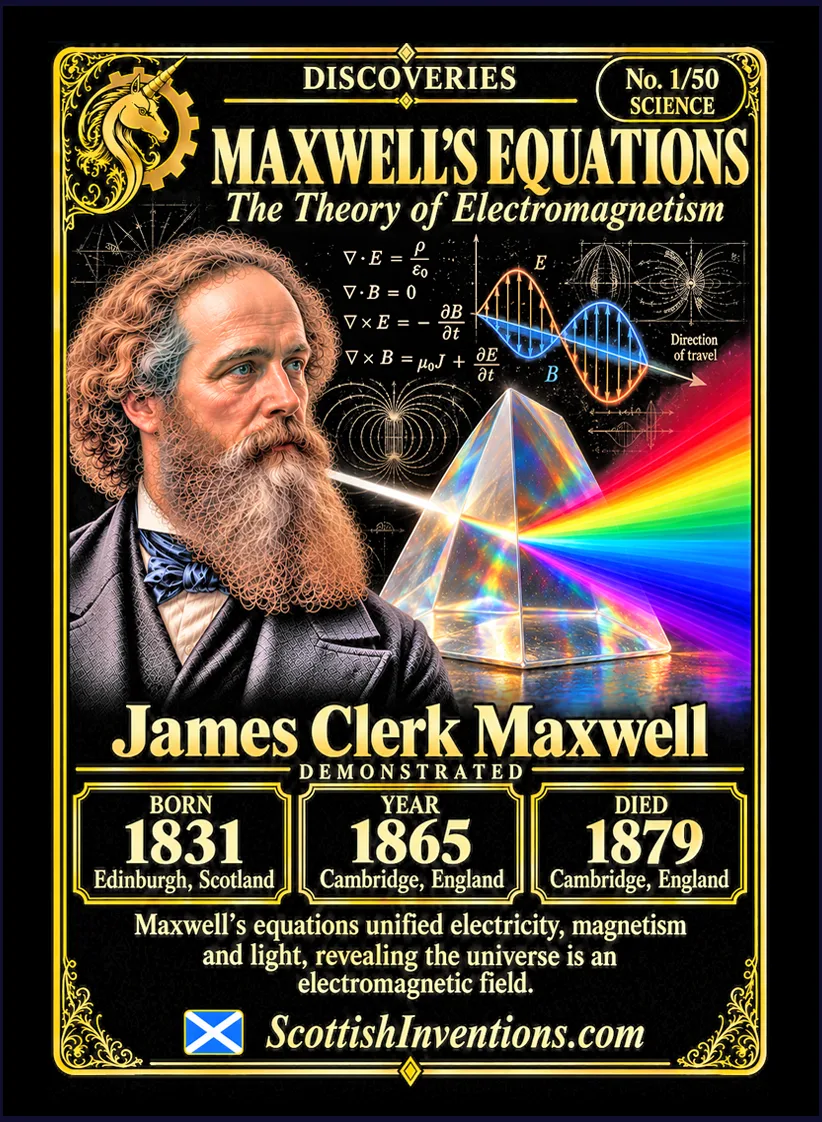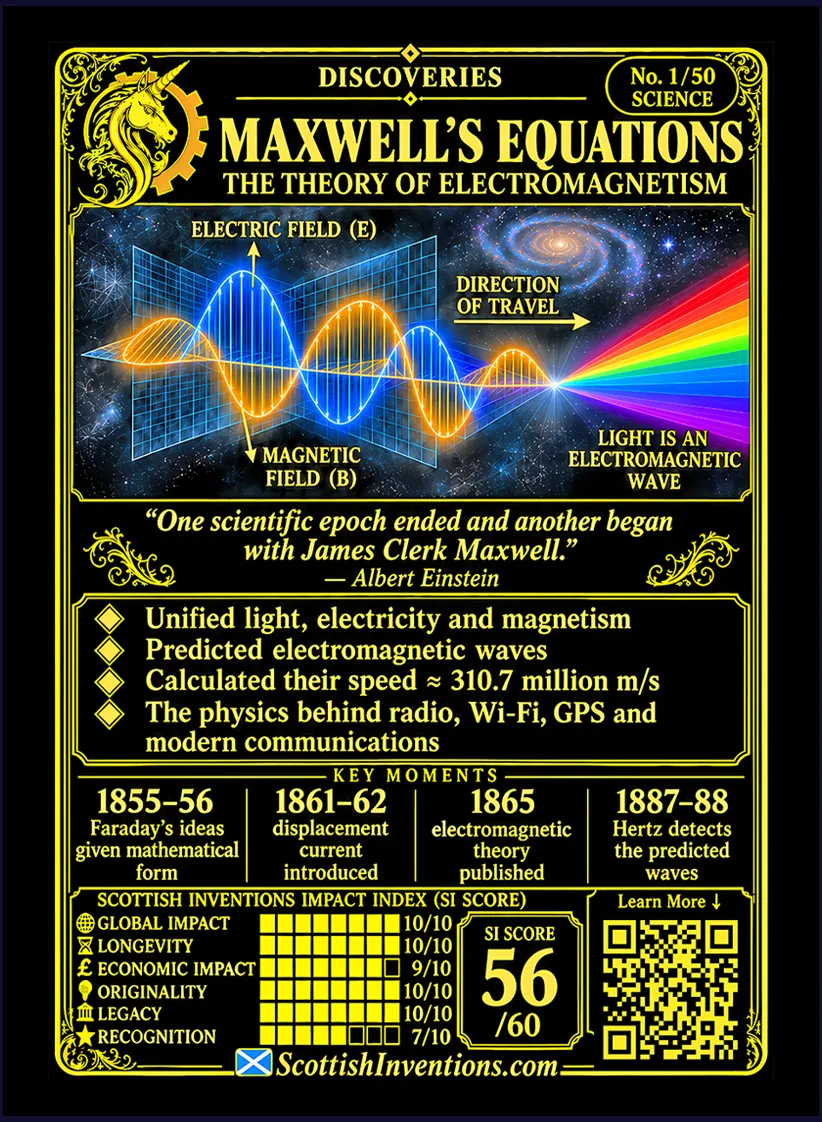
Discoveries · No. 1 of 50 · Science
James Clerk MaxwellThe quiet genius who unified electricity, magnetism and light
Discovery · Physics1831–1879Reading time · 14 min~2,600 words
TL;DR
- James Clerk Maxwell (1831–1879), born in Edinburgh and raised in Galloway, unified electricity, magnetism and light into four equations — work physicists rank alongside Newton and Einstein, and which underpins every wireless device on Earth.
- Before that triumph he produced the world's first colour photograph, proved Saturn's rings are countless particles, co-founded the statistical theory of gases, and dreamed up "Maxwell's Demon" — an astonishing range for one short life.
- He died of abdominal cancer at just 48, the same disease that took his mother; his prediction of electromagnetic waves was confirmed by Hertz within a decade, and Einstein later kept his portrait on his study wall.
Key Findings
- Maxwell's central breakthrough was adding the "displacement current" to Ampère's law — a term demanded by mathematical consistency, not by any experiment — which revealed that changing electric fields create magnetic fields, and that the two together travel as waves at the speed of light.
- His calculated wave speed — about 310,740,000 m/s — was so close to the measured speed of light that he concluded light itself is an electromagnetic disturbance.
- Several popular "facts" about Maxwell need correction: the famous "dp/dt" story is a mathematical in-joke about his initials, not an anecdote about a Scots accent; and the widely repeated claim that he appeared on a Clydesdale Bank £100 note appears to be false — that note carried Lord Kelvin.
Claim status · Mixed — established for the core equations, shared for statistical mechanics
- Maxwell's Equations (1861–65) — established. The unification of electricity, magnetism and light into one coherent field theory is Maxwell's own synthesis; no rival claimant.
- Maxwell–Boltzmann distribution (1860 / 1872) — shared. Maxwell derived the 1860 distribution of molecular speeds; Ludwig Boltzmann generalised and rigorously derived it in 1872. Properly credited jointly as the Maxwell–Boltzmann distribution.
Key Facts
- Born
- 13 June 1831, 14 India Street, Edinburgh
- Died
- 5 November 1879, Cambridge, England (aged 48)
- Raised
- Glenlair, Kirkcudbrightshire, Galloway
- Education
- Edinburgh Academy · University of Edinburgh · Trinity College, Cambridge
- Fields
- Mathematical physics, electromagnetism, thermodynamics, optics
- Main discoveries
- Maxwell's equations · displacement current · first colour photograph · Maxwell–Boltzmann distribution · nature of Saturn's rings
- Known for
- Unifying electricity, magnetism and light into a single electromagnetic theory
- Legacy
- Radio · television · radar · mobile phones · Wi-Fi · GPS · fibre optics · MRI · special relativity
- Influenced
- Einstein, Boltzmann, Hertz, Marconi, Feynman, Planck
- Claim status
- Mixed — see claim-status box below. Electromagnetism established; Maxwell-Boltzmann distribution shared (Boltzmann co-credited).
The Curious Boy Who Asked "What's the Go o' That?"

James Clerk Maxwell was born on 13 June 1831 at 14 India Street in Edinburgh — a New Town house his parents had built in the 1820s, and which today is home to the James Clerk Maxwell Foundation. He came of two old Scottish landed families, the Clerks of Penicuik near Edinburgh and the Maxwells of Middlebie in Dumfriesshire, a lineage that had produced several remarkable and occasionally eccentric characters. Soon after his birth the family moved to Glenlair, their country home in Kirkcudbrightshire in Galloway, about 20 km from Dumfries. It was here, roaming fields, ponds and drains, that the boy's restless curiosity first showed itself.
That curiosity is beautifully documented. In a letter of 25 April 1834, when "the Boy" was not yet three, a relative wrote that "he has great work with doors, locks, keys etc., and Show me how it doos is never out of his mouth," adding that he "investigates the hidden course of streams and bell-wires." The phrase most associated with him — pestering adults with "What's the go o' that?", and when fobbed off, "But what's the particular go o' that?" — captures a mind that simply had to know how everything worked. (The often-repeated claim that his very first word was "Look!" is charming, but harder to source firmly, and we flag it as such.)
His childhood was not without sorrow. When James was eight, his mother, Frances Cay, died of abdominal cancer — the same disease that would one day claim him, at a strikingly similar age. The plan to educate him at home until he was thirteen collapsed, and a teenaged tutor, remembered as harsh and prone to beating the boy, was eventually dismissed. James was sent instead to Edinburgh Academy in 1841, aged ten. Arriving with a strong Galloway accent and home-made clothes, he was teased and saddled with the nickname "Dafty" — until, partway through his school career, he astonished his classmates by sweeping up prizes in mathematics, scholarship and English verse. There he formed a lifelong friendship with the future physicist Peter Guthrie Tait.
He was just 14 when he wrote his first scientific paper, "On the description of oval curves, and those having a plurality of foci," generalising the geometry of the ellipse. The construction was not wholly original — Descartes had studied such multifocal curves in the 17th century — but it was a remarkable achievement for a boy of fourteen. It was read to the Royal Society of Edinburgh on 6 April 1846 — and here a popular story needs correcting: it was not read by his father. Maxwell was deemed too young to present it himself, so it was read on his behalf by Professor James Forbes of Edinburgh University.
Maxwell then studied at the University of Edinburgh (1847–1850), under Forbes and the philosopher Sir William Hamilton, before going up to Cambridge — briefly to Peterhouse, then transferring to Trinity College, where he believed a fellowship would be easier to win. He graduated in 1854 as Second Wrangler in the Mathematical Tripos, behind Edward Routh, and shared the more demanding Smith's Prize with Routh. He was elected a Fellow of Trinity in 1855.
Throughout, his character shone: playful, deeply and quietly devout, omnivorously curious, a lover of poetry and word-games who wrote his own comic and serious verse, and whose conversation — said one contemporary — "started so many hares" that listeners struggled to keep up.
"Show me how it doos" is never out of his mouth.Family letter, 1834 · James aged two
A Breadth of Genius — Before Electromagnetism
What makes Maxwell extraordinary is that the work for which he is most famous — electromagnetism — was only one peak in a whole mountain range. One of those other peaks, statistical mechanics, deserves a full account of its own, and gets one below.
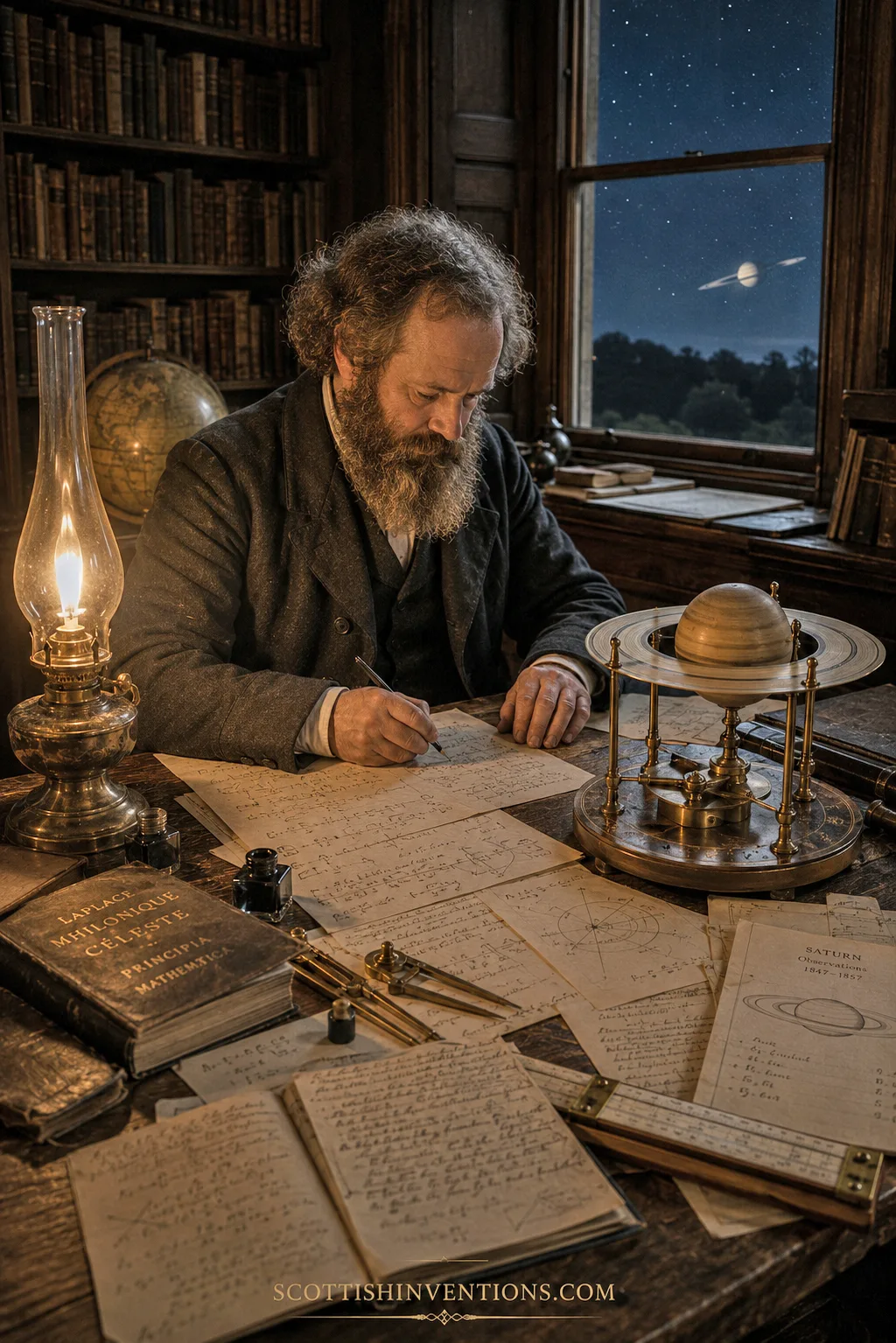
Saturn's Rings — a mathematical prophecy
The intellectual link between Saturn and gases is central to what came next: wrestling with the collective behaviour of countless independent orbiting particles primed Maxwell to think about the countless colliding molecules of a gas in exactly the same probabilistic spirit.
The World's First Colour Photograph
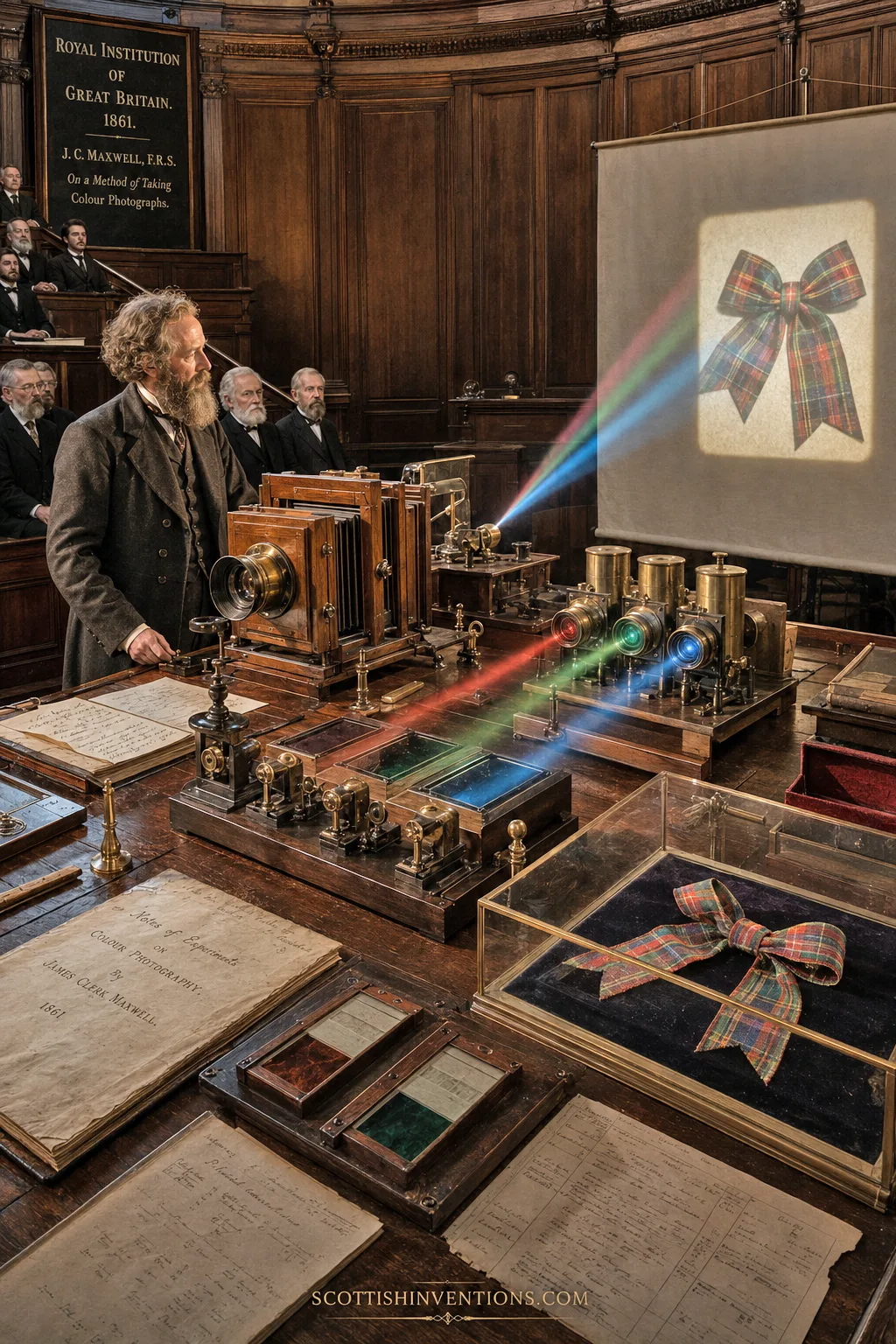
Maxwell worked out that any colour could be reproduced by mixing red, green and blue light — the principle of additive colour, and the foundation of every screen you own. To demonstrate it, at a Royal Institution lecture in London in 1861, he had the photographer Thomas Sutton photograph a tartan ribbon three times, through red, green and blue filters, then projected the three positives through matching filters to recombine them into one full-colour image.
There is a delicious accident in the story: Sutton's plates were essentially blind to red light, and the demonstration only worked because the red dye in the ribbon happened to reflect ultraviolet that leaked through the red filter — a fact not understood until Kodak researcher Ralph M. Evans reproduced the experiment and explained it in Scientific American in November 1961. See our full article on Maxwell's first colour photograph.
The Aberdeen Years — Where Statistical Mechanics Was Born
On the urging of his old professor Forbes, Maxwell applied for the vacant Chair of Natural Philosophy at Marischal College, Aberdeen. His father died at Glenlair in April 1856 before the result was known; Maxwell took up the professorship in November 1856, aged just 25 — a good fifteen years younger than any other professor at the college. In 1858 he married Katherine Mary Dewar, daughter of the Reverend Daniel Dewar, Principal of Marischal College; they wed at Old Machar on 2 June 1858. Katherine was no mere bystander to his science: she assisted in his colour-vision experiments and, as described below, made the painstaking measurements behind one of his most important results.
It was at Aberdeen, having read a paper by Rudolf Clausius on the diffusion of gases in 1859, that Maxwell turned to the kinetic theory of gases — presenting his results at the British Association meeting in Aberdeen in September 1859 and publishing them in the Philosophical Magazine in 1860 as "Illustrations of the Dynamical Theory of Gases." This work is entirely separate from his electromagnetic theory, but it is every bit as Scottish, right down to the city where it was done.
What problem was Maxwell solving?
The kinetic theory of gases holds that a gas is an immense swarm of tiny molecules flying about rapidly, colliding with one another and with the walls of their container; their impacts cause pressure, and their average kinetic energy sets the temperature. The idea had ancient roots in Epicurus and Lucretius, but became quantitative only in 1738, when Daniel Bernoulli, in his Hydrodynamica, first argued that gas pressure arises from molecular impacts and that pressure varies as the square of molecular velocity.
The theory was revived and sharpened in the mid-19th century. James Joule (1848) estimated molecular speeds; August Krönig (1856) built a simple model considering only translational motion; and Rudolf Clausius (1857), in "On the Nature of the Motion which we call Heat," developed a far more sophisticated version including rotation and vibration. In a follow-up in 1858 Clausius introduced the crucial concept of the mean free path — the average distance a molecule travels between collisions — to answer a devastating objection: if molecules really moved at hundreds of metres per second, gases ought to mix almost instantly, whereas the smell of an opened bottle spreads only slowly. Clausius's answer was that each molecule is constantly colliding, so its progress is a slow zig-zag.
But these earlier theories shared a fatal simplification: they assumed all molecules moved at the same average speed. Clausius himself had recognised that speeds must actually vary "within wide limits." The question Maxwell set out to answer was precise and new: in a gas at equilibrium, what is the distribution of molecular speeds?
The Maxwell distribution
Maxwell's genius was to stop tracking individual molecules and instead ask how many molecules have velocities in any given range. His argument rested on a beautifully simple set of assumptions: the three components of a molecule's velocity are statistically independent; each follows the same distribution; and the overall distribution depends only on total speed, not direction. Those constraints force each velocity component to follow a Gaussian — the bell curve of the normal distribution.
Crucially, this was the very same mathematical reasoning used to describe the distribution of random errors in observations — a link Maxwell made explicit, writing that the "velocities are distributed among the particles according to the same law as the errors are distributed in the theory of the 'method of least squares'." Drawing on the astronomer John Herschel's 1850 treatment of observational errors, Maxwell transplanted the theory of errors from the observatory into the physics of matter. This is why historians such as Clifford Truesdell regard Maxwell's 1860 Proposition IV as the first statistical law of physics — a result triumphantly confirmed by Otto Stern's molecular-ray measurements from 1920 onward.
The resulting Maxwell speed distribution is a bell-shaped but skewed curve: most molecules cluster around moderate speeds, a few crawl very slowly, and a long tail of rare molecules moves very fast. It has three characteristic speeds, in ascending order: the most probable speed (the peak), the mean speed, and the root-mean-square speed, higher still because squaring weights the fast molecules. In modern notation:
f(v) = 4π (m / 2πkT)3/2 v² exp(−mv² / 2kT)
Read plainly: m is the molecule's mass, T the absolute temperature, and k the Boltzmann constant, a fixed conversion factor between temperature and energy. The factor v² reflects that there are more ways to have a given speed as speed increases, pushing the peak away from zero; the exponential term suppresses very high speeds, since high kinetic energy becomes ever less probable. Heavier molecules and lower temperatures shift the curve toward lower speeds. Knowing this distribution, Maxwell could calculate measurable bulk properties of gases from first principles — pressure, temperature, diffusion, thermal conductivity and viscosity.
The viscosity prediction — and Katherine Maxwell's laboratory work
The Epistemological Revolution — Statistics Enters Physics
The deeper significance of Maxwell's work went beyond gases. Before Maxwell, physics was strictly deterministic: in principle, if you knew the position and velocity of every particle, Newton's laws let you predict everything forever. Maxwell showed this was both impossible in practice and unnecessary. For 10²³ molecules no one could ever track every motion — yet powerful, exact and real statistical laws emerge from the sheer numbers. As he put it in Theory of Heat (1871): "In dealing with masses of matter, while we do not perceive the individual molecules, we are compelled to adopt what I have described as the statistical method of calculation, and to abandon the strict dynamical method, in which we follow every motion by the calculus."
It was Maxwell's coinage of "statistical" in this mechanical sense that J. Willard Gibbs later credited when he coined the term statistical mechanics, in the title of his 1884 paper "On the Fundamental Formula of Statistical Mechanics, with Applications to Astronomy and Thermodynamics."
Maxwell was philosophically alert to what this meant. In a paper delivered at Cambridge in 1873 he asked whether the progress of physical science favours determinism over contingency, and argued that unstable "singular points" — where an infinitesimally small cause produces a finite effect — undermine strict determinism. Some modern scientists count these reflections among the earliest anticipations of chaos theory and sensitive dependence on initial conditions.
Maxwell's Demon
The most vivid expression of the statistical Second Law came in a letter to Tait of 11 December 1867, where Maxwell set out to "pick a hole" in the law. He imagined "a finite being who knows the paths and velocities of all the molecules by simple inspection but who can do no work except open and close a hole in the diaphragm by means of a slide without mass." By letting only fast molecules pass one way and slow ones the other, this "very observant and neat-fingered being" could make one chamber hotter and the other colder without doing work. Maxwell's point was profound: the Second Law is not an absolute mechanical truth but a statistical near-certainty, holding only because we deal with vast numbers of molecules we cannot manipulate individually.
The deeply religious Maxwell never used the word "demon." It was William Thomson (Lord Kelvin) who introduced the term, in "Kinetic Theory of the Dissipation of Energy," Nature 9 (9 April 1874), intending the Greek sense of a mediating spirit rather than an evil one. The thought experiment reached the public in Maxwell's Theory of Heat (1871).
Its resolution took over a century and transformed our understanding of information. Leó Szilárd (1929) argued that the demon must pay an entropy price to acquire information about each molecule. Rolf Landauer, in "Irreversibility and Heat Generation in the Computing Process" (IBM Journal of Research and Development, 1961), showed that it is specifically the erasure of information that must dissipate energy — at least kBT ln 2 of heat per erased bit, about 3 zeptojoules at room temperature, confirmed experimentally by Bérut and colleagues in Nature in 2012. Charles Bennett later showed the demon's memory-erasure exactly balances the books, saving the Second Law. That lineage links Maxwell's 1867 sorting demon directly to Claude Shannon's information entropy (1948) and today's thermodynamics of computation; physicists have since built real nanoscale "Maxwell's demons" in the laboratory.
Boltzmann's Extension — and the Modern Legacy
The Austrian physicist Ludwig Boltzmann (1844–1906), a younger contemporary and correspondent of Maxwell, generalised the work. Where Maxwell had treated the distribution of translational velocities, Boltzmann — in papers beginning in 1868 — extended it to systems with additional degrees of freedom (rotation, vibration and motion in external fields such as gravity), arriving at the general result now known as the Maxwell–Boltzmann distribution. Its key form shows that the probability of a molecule having energy E falls off as exp(−E/kT), the celebrated Boltzmann factor.
In his landmark 1872 paper Boltzmann introduced the Boltzmann equation and the H-theorem, attempting to derive the irreversibility of the Second Law from reversible mechanics. The proof was later shown to require extra statistical assumptions — Loschmidt's reversibility objection of 1876 — but the debate hugely sharpened the field's foundations. In fairness to the record, Maxwell's own 1860 derivation, and specifically its assumption that velocity components are independent, was also later recognised as not fully rigorous; Maxwell returned in 1867 to justify it through the dynamics of collisions, and Boltzmann supplied deeper derivations still. That is precisely why the joint name is the honest one.
Related to all this is the equipartition theorem: in thermal equilibrium, energy is shared equally among a system's degrees of freedom. Its failure to describe the specific heats of gases at low temperature, and its catastrophic prediction of infinite energy for black-body radiation — the "ultraviolet catastrophe," a phrase coined by Paul Ehrenfest in 1911 — were among the first cracks in classical physics, cracks that Planck and Einstein prised open to launch quantum mechanics.
Boltzmann's atomic worldview was fiercely resisted by influential positivists, above all Ernst Mach and the chemist Wilhelm Ostwald, who regarded atoms as at best convenient fictions. Worn down by that opposition and by ill health and depression, Boltzmann died by suicide on 5 September 1906 while on holiday at Duino, near Trieste. The irony is bitter: Einstein's 1905 paper on Brownian motion, which explained the jittering of suspended particles using exactly this kinetic-statistical theory, had already effectively proven atoms real a year before his death. Boltzmann's tombstone in Vienna is engraved with his entropy formula, S = k log W.
Statistical mechanics is now one of the pillars of physical science. Quantum statistics splits Maxwell–Boltzmann into Fermi–Dirac statistics for fermions and Bose–Einstein statistics for bosons, both reducing to Maxwell's law in the classical limit. In chemistry, the high-energy tail of the distribution sets the fraction of molecules energetic enough to react — the physical basis of the Arrhenius equation. In planetary science, that same fast tail lets molecules exceed escape velocity, which is why Earth kept its nitrogen and oxygen but lost most of its hydrogen and helium while massive Jupiter kept its hydrogen. And in astrophysics, it is the rare ultra-fast particles in the tail that overcome electrical repulsion to trigger nuclear fusion — so the Maxwell–Boltzmann tail quite literally makes the stars shine, while Doppler broadening of spectral lines lets astronomers read the temperatures of distant stars.
The Equations — The Heart of It All
By the mid-19th century, electricity and magnetism were a patchwork of separate laws. Michael Faraday had shown that a changing magnetic field produces electricity, and had the visionary but un-mathematical idea of "lines of force" filling space. André-Marie Ampère had quantified the magnetism produced by currents; Carl Friedrich Gauss had described how charges produce electric fields. What was missing was a single mathematical framework. Maxwell supplied it.
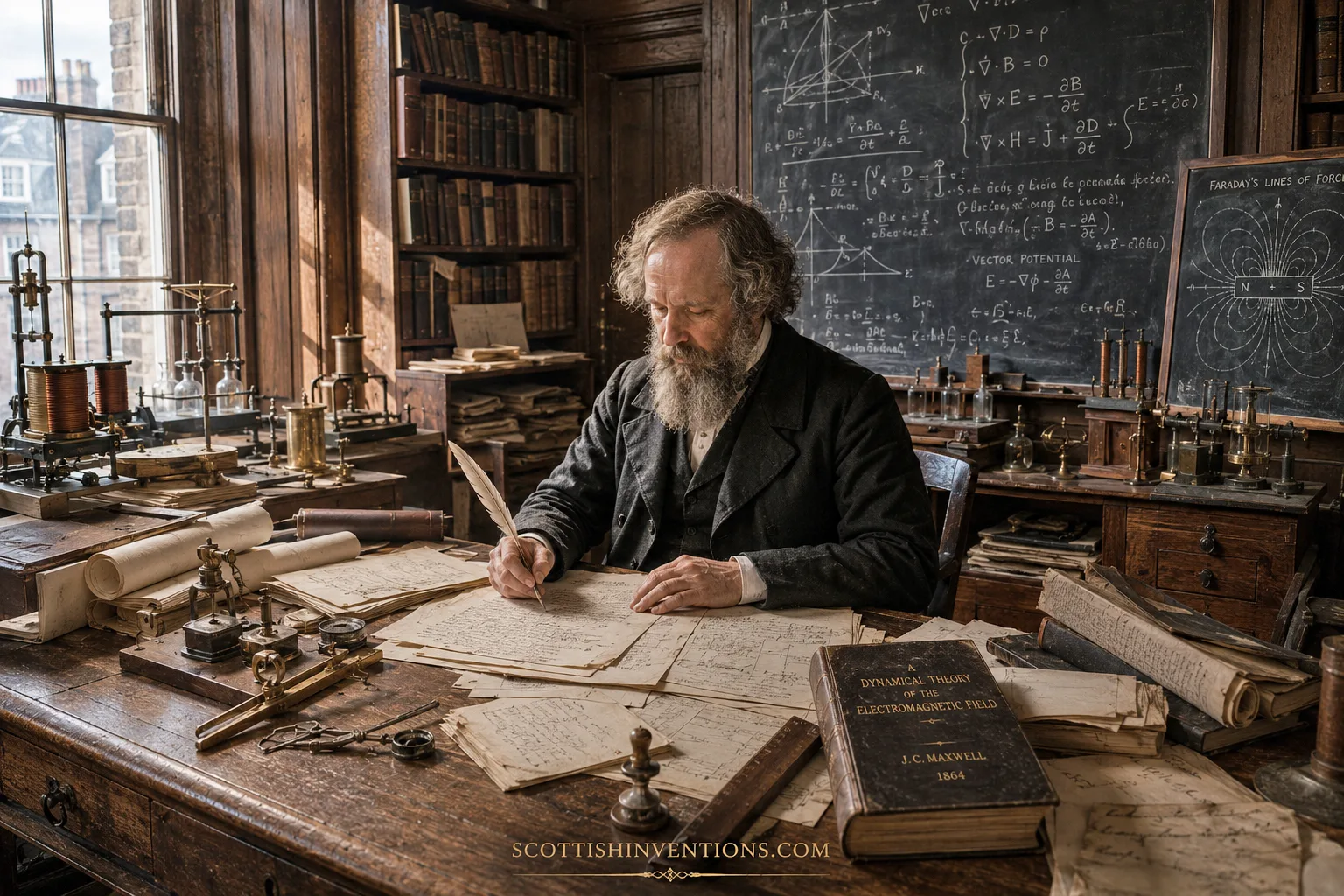
In three great works he built the theory: On Faraday's Lines of Force (1855–56); On Physical Lines of Force (1861–62), which introduced his decisive new idea; and A Dynamical Theory of the Electromagnetic Field (1865), which stripped away the mechanical scaffolding to present the field itself as the reality. He gathered it all into the monumental two-volume Treatise on Electricity and Magnetism in 1873.
The crucial stroke was the displacement current. Ampère's law, as it stood, was mathematically inconsistent for changing fields. Maxwell added a new term — with no experimental evidence behind it at the time — to make the mathematics whole. The consequence was breathtaking: a changing electric field must itself generate a magnetic field. Combine that with Faraday's induction, and electric and magnetic fields can take turns regenerating one another and propagate through empty space as a wave.
When Maxwell calculated the speed of that wave from purely electrical measurements, he obtained about 310,740,000 metres per second — startlingly close to the measured speed of light. He drew the inevitable conclusion: light itself is an electromagnetic disturbance.
The Four Equations, in Plain English
- Electric charges produce electric fields (Gauss's law).
- There are no magnetic monopoles — magnetic field lines always form closed loops (Gauss's law for magnetism).
- A changing magnetic field creates an electric field (Faraday's law).
- Electric currents and changing electric fields create magnetic fields (the Ampère–Maxwell law).
Maxwell did not live to see it proved. In 1887–88, eight to nine years after his death, the German physicist Heinrich Hertz generated and detected electromagnetic waves in his laboratory, measured their speed, and confirmed they behaved exactly as Maxwell's mathematics demanded.
What Maxwell Gave the World
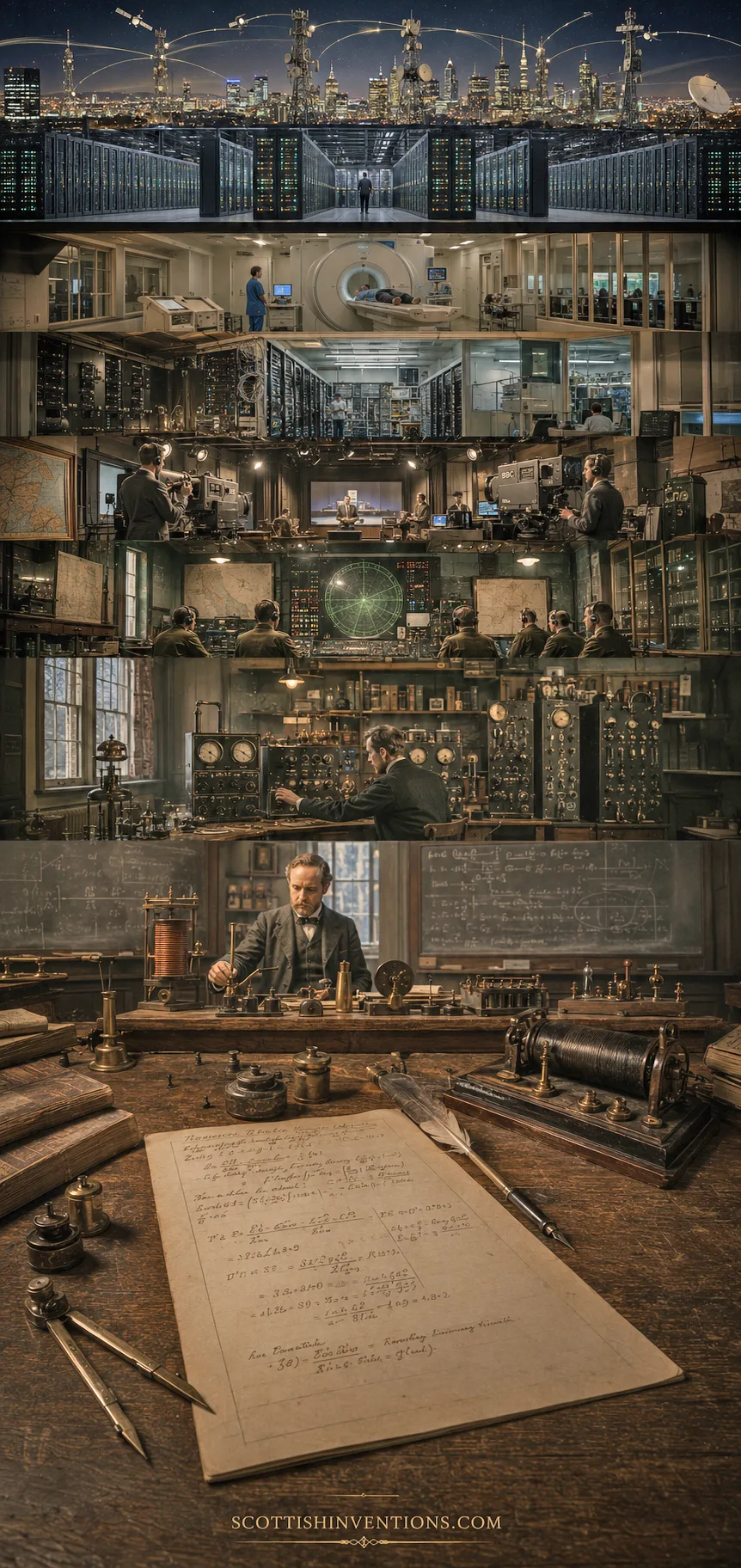
Almost every technology that defines modern life is a direct descendant of those four lines. Hertz's spark-gap experiments led, through Oliver Lodge, Nikola Tesla and Guglielmo Marconi, to radio and television — and then to radar. Today the same physics powers mobile phones, Wi-Fi, microwave ovens and GPS.
Because Maxwell showed that visible light is just one band of a vast electromagnetic spectrum, his work also underlies X-rays, fibre-optic communications, and the magnetic fields at the heart of MRI scanners.
Feynman on Maxwell
Maxwell's equations also lit the fuse of 20th-century physics. They implied that the speed of light is the same for every observer — a fact that clashed with everyday notions of relative motion. Albert Einstein resolved the paradox by making it the foundation of his special theory of relativity in 1905. Writing for the centenary of Maxwell's birth in 1931, Einstein described Maxwell's achievement as "the most profound and the most fruitful that physics has experienced since the time of Newton," and declared that "one scientific epoch ended and another began with James Clerk Maxwell." On the walls of his studies in Berlin and Princeton he hung the portraits of just three predecessors: Newton, Faraday and Maxwell.
The Man Behind the Mathematics
In 1858 Maxwell married Katherine Mary Dewar at Old Machar, Aberdeen. Katherine was no mere bystander to his science — she assisted in his colour-vision experiments and later made the painstaking temperature measurements for his work on the viscosity of gases. When Maxwell nearly died of smallpox, he credited her nursing with saving his life.
His career carried him across Britain: Professor of Natural Philosophy at Marischal College, Aberdeen (1856–1860); King's College London (1860–1865); five productive years back at Glenlair (1865–1871), where he wrote much of the Treatise; and finally, from 1871, the first Cavendish Professor of Physics at Cambridge, where he designed and oversaw the building of the Cavendish Laboratory — which opened in 1874 and went on to become one of the most famous laboratories in the world.
For all his seriousness of purpose, Maxwell was a famous wit who delighted in puns and parody. Tait suggested that Maxwell sign his letters "dp/dt", because in Tait's own thermodynamics textbook the equation dp/dt = JCM happened to spell out Maxwell's initials — and Maxwell duly adopted the joke. (It is a mathematical in-joke about his initials, not, as is sometimes claimed, a quip about a Scottish accent.) His faith was deep but unshowy, and threaded quietly through both his life and his letters.
Death and Legacy
Maxwell died on 5 November 1879, aged just 48, of abdominal cancer — the same disease, at a strikingly similar age, that had killed his mother. Most authoritative sources, including the MacTutor archive, record that he died in Cambridge; some popular accounts say Glenlair, where he was deeply rooted and near which, at Parton Kirk, he is buried. Hertz's confirmation of his waves came within a decade; special relativity was built on his equations a generation later.
His standing today is immense. In Physics World's 1999 millennium poll of 100 leading physicists, Maxwell was voted the third-greatest physicist of all time, behind only Einstein and Newton and ahead of Bohr, Heisenberg, Galileo and Feynman. A statue of him by Alexander Stoddart — seated with his dog Toby at his feet and a colour-top in his hands — was unveiled at the east end of George Street in Edinburgh on 25 November 2008. His birthplace at 14 India Street houses the James Clerk Maxwell Foundation.
Timeline
1831
Born in Edinburgh
Born 13 June at 14 India Street, Edinburgh — today the James Clerk Maxwell Foundation.
1846
First scientific paper — aged 14
'On the description of oval curves' read to the Royal Society of Edinburgh.
1854
Cambridge triumph
Graduates from Trinity College as Second Wrangler; shares the Smith's Prize.
1856
Wins the Adams Prize
Proves mathematically that Saturn's rings must consist of countless particles.
1860
Kinetic theory of gases
Publishes the Maxwell distribution — the first statistical physical law.
1861
World's first colour photograph
Projects a tartan ribbon in red, green and blue at the Royal Institution.
1865
A Dynamical Theory of the Electromagnetic Field
Publishes the paper that unifies electricity, magnetism and light.
1873
Treatise on Electricity and Magnetism
The monumental two-volume synthesis of his life's work in electromagnetism.
1879
Dies at 48 in Cambridge
Same disease, at almost the same age, as his mother. Buried at Parton Kirk, Galloway.
1888
Hertz confirms electromagnetic waves
Nine years after Maxwell's death, Heinrich Hertz proves the prediction experimentally.
1905
Einstein's special relativity
Built directly on the constancy of the speed of light Maxwell's equations require.
Today
The wireless world
Every radio, phone, Wi-Fi network, satellite and MRI scanner traces to Maxwell's four lines.
Did You Know?
- • Einstein hung portraits of only three scientists on his study wall — Newton, Faraday and Maxwell.
- • Feynman predicted Maxwell's discovery would 'pale' the American Civil War in the long view of history.
- • Maxwell made the world's first colour photograph — of a tartan ribbon — in 1861.
- • He died at 48 of the same disease, at almost the same age, as his mother.
- • His proof that Saturn's rings are countless particles was confirmed by Voyager and Cassini over a century later.
- • Einstein's special theory of relativity is built directly on Maxwell's equations.
- • He had a scientific paper read to the Royal Society of Edinburgh when he was just 14 — by Professor James Forbes, not by his father, because Maxwell was thought too young to present it himself.
- • His four equations underpin every wireless device on Earth.
- • A separate landmark, easily missed: Maxwell's 1860 paper on the speed distribution of gas molecules was the first time probability and statistics were applied to a fundamental problem in physics — it founded statistical mechanics, entirely apart from his work on electromagnetism.
- • His most counter-intuitive prediction in that other field — that the viscosity of a gas is independent of its pressure — was widely disbelieved. He verified it experimentally himself, with his wife Katherine helping to conduct the measurements.
- • Maxwell's Demon, proposed in an 1867 letter, was not called that until Lord Kelvin named it in 1874. Maxwell — a religious man — only ever called it a "finite being".
- • Ludwig Boltzmann, who extended Maxwell's statistical work, died by suicide in 1906, worn down partly by colleagues who refused to believe atoms were real — one year after Einstein's 1905 paper on Brownian motion had confirmed their reality.
Myths Corrected
Myth
Maxwell appeared on a Clydesdale Bank £100 note.
The Truth
That note featured Lord Kelvin, not Maxwell. He was shortlisted for other banknotes but did not appear on one.
Myth
'dp/dt' was a joke about Maxwell's Scottish accent.
The Truth
It's a mathematical in-joke: in Tait's thermodynamics textbook the equation dp/dt = JCM spelled his initials.
Myth
Maxwell discovered electricity.
The Truth
He didn't. He discovered the mathematical laws proving that electricity, magnetism and light are one phenomenon.
Myth
Maxwell invented radio.
The Truth
He predicted electromagnetic waves; Hertz confirmed them in 1888; Marconi and others engineered radio decades later.
Myth
Maxwell experimentally proved electromagnetic waves.
The Truth
He predicted them mathematically. Heinrich Hertz generated and detected them in the laboratory in 1887–88.
Myth
Maxwell's father read his boyhood oval-curves paper to the Royal Society of Edinburgh.
The Truth
He did not. The paper was read on 6 April 1846 by Professor James Forbes of Edinburgh University, because the 14-year-old was thought too young to present it himself.
Myth
Maxwell invented the kinetic theory of gases.
The Truth
He did not. Daniel Bernoulli laid the foundation in 1738; August Krönig (1856) and Rudolf Clausius (1857–58, including the mean free path) built the modern model. Maxwell's distinct step was the distribution of molecular speeds and the statistical method itself.
Caveats & Corrections
- Maxwell did not invent the kinetic theory of gases. Bernoulli (1738), Krönig (1856) and Clausius (1857–58, mean free path) came first. Maxwell's distinct contribution was the distribution of molecular speeds and the statistical method itself.
- The Maxwell–Boltzmann distribution is jointly credited. Maxwell derived the 1860 velocity distribution; Boltzmann generalised and more rigorously derived it from 1868 onwards. Maxwell's original derivation was later judged not fully rigorous.
- The 1846 oval-curves paper was read by Professor James Forbes, not by Maxwell's father, and the multifocal curves themselves had been studied earlier by Descartes.
- The Clydesdale Bank £100 note featured Lord Kelvin, not Maxwell. Maxwell was shortlisted for other notes but never appeared on a circulating banknote.
- "dp/dt" was a mathematical in-joke, not a joke about his accent — in Tait's thermodynamics textbook dp/dt = JCM, Maxwell's initials.
- Maxwell's Demon was named by Kelvin (Nature, 1874). Maxwell himself wrote only of a "finite being".
- Hedged claims. The story that Maxwell's first word was "Look!" is charming but poorly sourced. On place of death, the most authoritative sources (including MacTutor) favour Cambridge over Glenlair; we follow them while noting the disagreement.
Frequently Asked Questions
Who was James Clerk Maxwell?
James Clerk Maxwell (13 June 1831 – 5 November 1879) was a Scottish mathematical physicist born at 14 India Street, Edinburgh, and raised at Glenlair in Galloway. He unified electricity, magnetism and light into four equations, produced the world's first colour photograph, proved Saturn's rings are countless particles, and co-founded the statistical theory of gases — ranked alongside Newton and Einstein.
What did Maxwell discover?
Maxwell's central discovery was that electricity, magnetism and light are three aspects of one phenomenon — the electromagnetic field. By adding the 'displacement current' to Ampère's law he showed mathematically that changing electric and magnetic fields regenerate one another and travel through space as waves at the speed of light.
Why are Maxwell's equations important?
The four equations underpin every wireless technology on Earth — radio, television, radar, mobile phones, Wi-Fi, GPS, satellites, microwaves, fibre optics and MRI scanners. They also implied that the speed of light is constant for every observer, becoming the foundation on which Einstein built special relativity in 1905.
How did Maxwell invent colour photography?
Maxwell worked out that any colour can be reproduced by mixing red, green and blue light — the principle of additive colour. At a Royal Institution lecture in London in 1861 he had photographer Thomas Sutton photograph a tartan ribbon three times through red, green and blue filters, then projected the positives through matching filters to recombine them into one full-colour image — the world's first colour photograph.
Did Maxwell invent radio?
No. Maxwell predicted electromagnetic waves mathematically. Heinrich Hertz experimentally confirmed them in 1887–88, and Marconi, Lodge and Tesla later turned that physics into practical radio. Every wireless device descends from Maxwell's theoretical breakthrough.
Why is Maxwell considered one of history's greatest physicists?
In Physics World's 1999 millennium poll of 100 leading physicists, Maxwell was voted the third-greatest physicist of all time, behind only Einstein and Newton. Einstein kept portraits of only three predecessors on his study wall: Newton, Faraday and Maxwell.
What was Maxwell's Demon?
A thought experiment set out in an 1867 letter to Peter Guthrie Tait and in Maxwell's 1871 Theory of Heat. A 'finite being' controls a tiny door between two boxes of gas, letting fast molecules through one way and slow ones the other — seemingly cheating the second law of thermodynamics. Lord Kelvin later called it a 'demon'. It still drives debate linking thermodynamics and information theory today.
Did Maxwell appear on a Clydesdale Bank £100 note?
No — this is a myth. The Clydesdale Bank £100 note featured Lord Kelvin, not Maxwell. Maxwell was shortlisted for other notes (RBS £10 in 2017 and Bank of England £50) but did not appear on a circulating banknote.
Where did Maxwell die?
The most authoritative sources, including the MacTutor History of Mathematics archive, record that Maxwell died in Cambridge on 5 November 1879, aged 48, of abdominal cancer — the same disease that had killed his mother. He is buried at Parton Kirk, near his beloved family home of Glenlair in Galloway.
What did Einstein say about Maxwell?
Einstein described Maxwell's achievement as 'the most profound and the most fruitful that physics has experienced since the time of Newton', and wrote that 'one scientific epoch ended and another began with James Clerk Maxwell' (1931 commemorative volume for the centenary of Maxwell's birth).
Sources & Further Reading
Tier 1 · Primary
- Maxwell, J. C. — A Dynamical Theory of the Electromagnetic Field, Philosophical Transactions of the Royal Society, 1865.
- Maxwell, J. C. — A Treatise on Electricity and Magnetism, 2 vols., 1873.
- Einstein, A. — "Maxwell's Influence on the Development of the Conception of Physical Reality," in James Clerk Maxwell: A Commemorative Volume 1831–1931, Cambridge University Press.
Tier 2 · Scholarly and institutional
- Feynman, R. P. — The Feynman Lectures on Physics, Vol. II, Lecture 1 (1964).
- Physics World — Millennium Poll of the Greatest Physicists (1999).
- The James Clerk Maxwell Foundation, 14 India Street, Edinburgh.
Tier 3 · General reference
- Evans, R. M. — "Maxwell's Color Photograph," Scientific American, November 1961.
- MacTutor History of Mathematics Archive — Biography of James Clerk Maxwell.
Discoveries · No. 1 of 50
Collect the Scottish Discoveries Trading Card
Own this piece of Scottish scientific history. A collector-quality flip card celebrating the man Einstein ranked beside Newton and Faraday.