Discoveries · No. 4 of 50 · Physics
Absolute Zero & the Kelvin ScaleThe Glasgow genius who found the bottom of the thermometer
Lord Kelvin · 1848University of GlasgowReading time · 12 minUpdated 31 July 2026
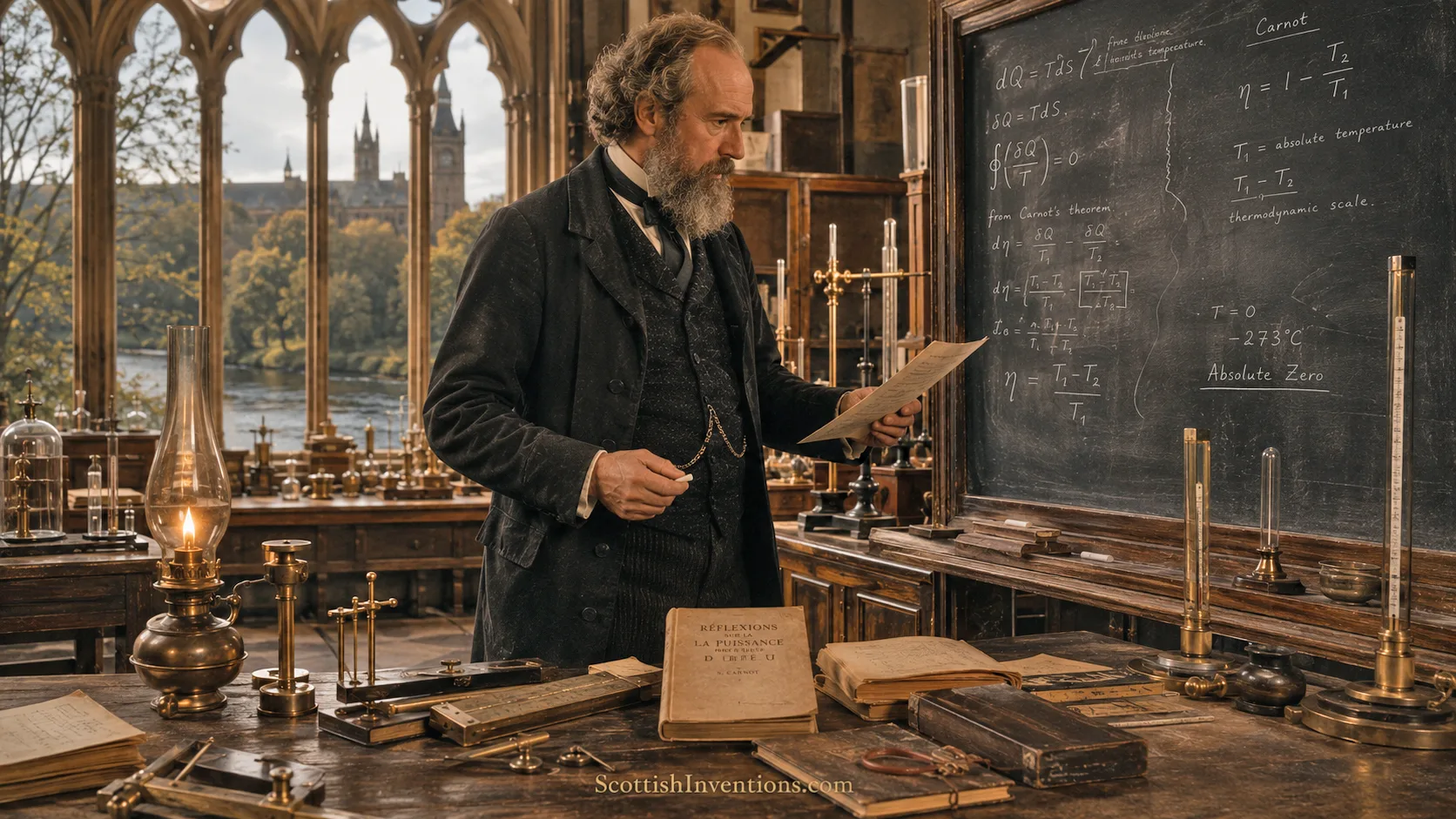
Above: William Thomson works through Carnot's theory of heat engines at the University of Glasgow, the reasoning that produced the absolute temperature scale. Illustration © ScottishInventions.com.
TL;DR
- In 1848 William Thomson — later Lord Kelvin — defined an absolute temperature scale from the laws of thermodynamics rather than from the freezing and boiling points of water.
- He calculated absolute zero at about −273°C. The modern value is −273.15°C, a remarkable agreement given his data.
- Born in Belfast in 1824, he was raised in Glasgow, matriculated at its University aged 10, and held its Chair of Natural Philosophy for 53 years.
- The kelvin (K) is now one of the seven SI base units, and since 2019 has been fixed by the Boltzmann constant — exactly the substance-independent definition Thomson wanted.
- His thermodynamics underpins refrigeration, cryogenics, superconductivity and quantum computing; the “5000K” on a lightbulb box is his name.
Scottish Impact Index (SI Score)
- Global Impact
- 10/10
- Longevity
- 10/10
- Economic / Material Impact
- 9/10
- Originality / Distinctiveness
- 10/10
- Legacy (Built Upon)
- 10/10
- Recognition
- 6/10
Quick Facts
- Discovery
- Absolute thermodynamic temperature scale; absolute zero fixed at about −273°C
- Year
- 1848 (paper: “On an Absolute Thermometric Scale”, Philosophical Magazine)
- Key figure
- William Thomson, Baron Kelvin of Largs (1824–1907)
- Place
- University of Glasgow, Scotland
- Field
- Physics · Thermodynamics
- Born / died
- 26 June 1824, Belfast · 17 December 1907, Largs, Ayrshire
- Career
- Professor of Natural Philosophy, Glasgow, 1846–1899 (53 years)
- Why it matters
- Temperature defined by physical law rather than by water or mercury
- Global impact
- Refrigeration, cryogenics, superconductivity, quantum physics, lighting
- Legacy
- The kelvin (K) — one of the seven SI base units, redefined in 2019 via the Boltzmann constant
- Claim status
- Established — Thomson's 1848 absolute scale is undisputed; earlier gas-law extrapolations (Amontons, c. 1700) estimated a limit but did not define a thermodynamic scale
The Man Who Gave Temperature a Floor
William Thomson (1824–1907), known to the world as Lord Kelvin, was Professor of Natural Philosophy at the University of Glasgow for 53 years. In 1848 he published a short paper that changed how science measures the physical world: “On an Absolute Thermometric Scale founded on Carnot's Theory of the Motive Power of Heat.”
Before it, thermometry was a patchwork of conveniences. Celsius and Fahrenheit were pegged to the freezing and boiling of water — useful, but with no deeper physical meaning. Worse, the size of a “degree” depended on what was inside the thermometer: mercury, alcohol and gas each expand slightly differently, so the very meaning of temperature wobbled with the instrument. Thomson proposed instead a scale defined by the relationship between heat and work in an ideal engine, and therefore, in his words, “quite independent of the physical properties of any specific substance.”
That definition implied something profound: a true zero, the coldest temperature possible, which he calculated at roughly −273°C. Today's accepted value is −273.15°C. Every measurement in modern physics, chemistry and engineering rests on the scale he built — and so does the “5000K daylight” printed on a box of lightbulbs.
He was born in Belfast, and this article says so plainly. The Scottish claim on Kelvin does not rest on birthplace. It rests on a Glasgow childhood, a Glasgow education begun at the age of ten, a 53-year Glasgow professorship, and a peerage title lifted from the river that runs past the University gates.
Belfast-Born, Glasgow-Made
Thomson was born on 26 June 1824 at College Square, Belfast, the fourth of seven children. His father, James Thomson (1786–1849), was a self-improved mathematician of real gifts — at the time of William's birth a teacher of mathematics and engineering at the Royal Belfast Academical Institution, and the author of school textbooks. William's mother, Margaret, died in 1830 when he was six, and his father took sole charge of the children's education, a task he pursued with an intensity that shaped both William and his elder brother James.
In 1832 James Thomson was appointed Professor of Mathematics at the University of Glasgow; the family's physical move to the city is usually dated to around October 1833. (Sources sometimes compress the two into a single year — the safe statement is appointed 1832, moved 1833.) It was a fateful relocation. The boy who would become Scotland's greatest physicist arrived in Glasgow as a child and never really left.
Historical context
In 1841 he went up to Peterhouse, Cambridge, graduating in 1845 as Second Wrangler and Smith's Prizeman — the second-highest place in the mathematics tripos, paired with the prize that was widely held to be the better measure of original ability — and was elected a Fellow. A spell followed in Paris, in the laboratory of the experimental physicist Henri Victor Regnault, where the theoretician learned to handle instruments and precision measurement, a training that marks everything he did afterwards.
When the Chair of Natural Philosophy at Glasgow fell vacant in 1846, the 22-year-old Thomson — helped by energetic campaigning from his father — was unanimously elected, and found himself lecturing to the very class he had sat in as a student a few years before. He held the post for 53 years, until his retirement in 1899 “to make way for younger men,” turning down repeated offers from Cambridge and other world-renowned universities along the way.
His character was a rare double act: a profound theoretical physicist who was simultaneously a hands-on engineer and a successful businessman. Over a lifetime he published over 600 scientific papers — the University of Glasgow's own tribute puts the figure at 661 — and filed around 70–75 patents, building a fortune and a manufacturing firm, eventually Kelvin & James White Ltd, on his inventions.
Is There a Bottom to Cold?
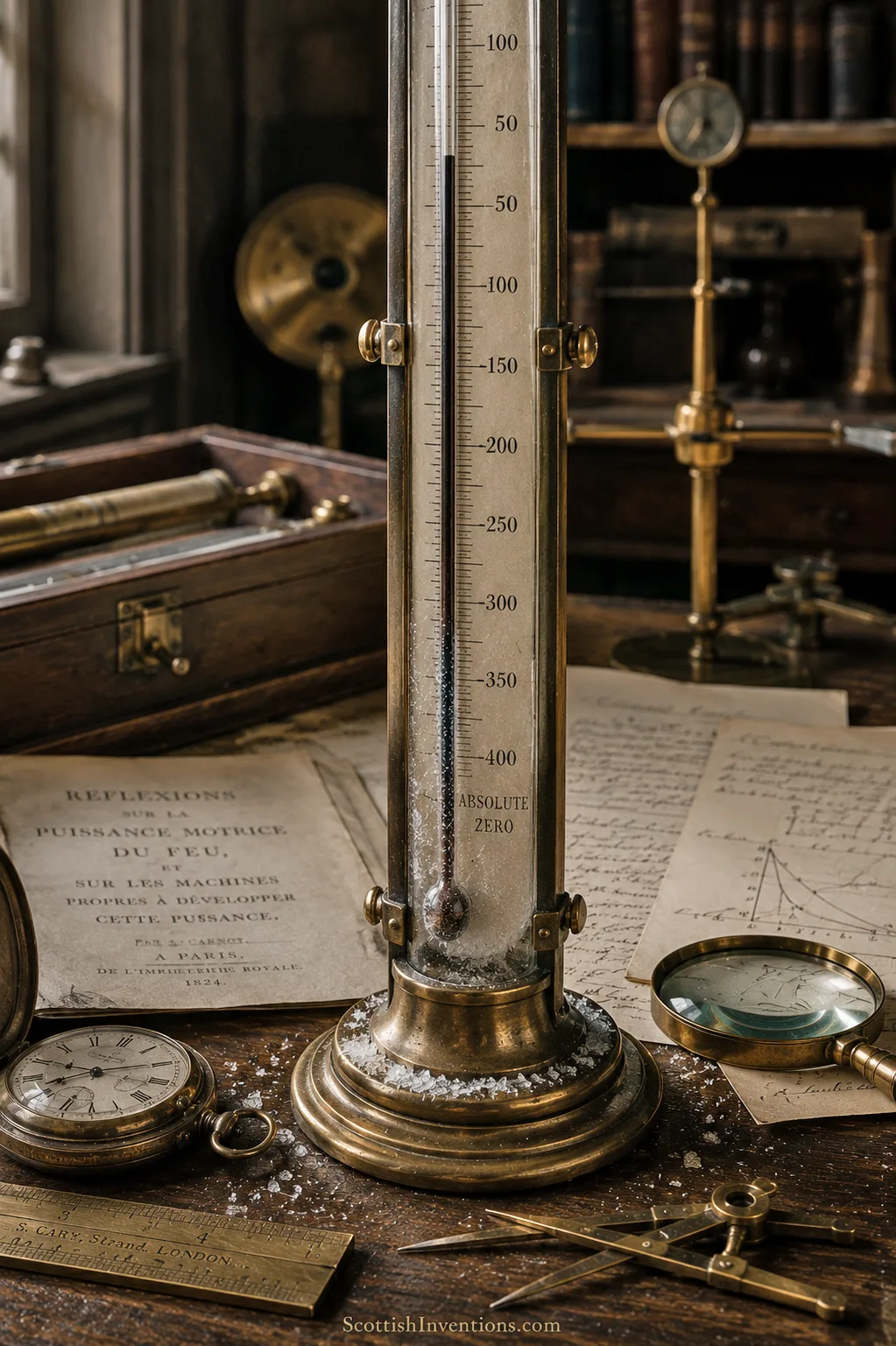
Two problems stood in the way of a scientific temperature. The first was arbitrariness: Celsius and Fahrenheit hung on convenient reference points chosen by people, not required by nature. The second was substance-dependence: since no two working fluids expand identically, two equally careful thermometers could disagree between their fixed points, and there was no principled way to say which was right.
Beneath both lurked a deeper question: is there a lower limit to cold? The first real clue came from the French physicist Guillaume Amontons (1663–1705). Around 1700–1703, experimenting with a constant-volume air thermometer, he noticed that the pressure of a gas fell steadily as it cooled, and reasoned that at some low enough temperature the pressure — and with it the volume — would vanish entirely. Extrapolating the line downwards, he arrived at roughly −240°C: remarkably close to the modern value, and the earliest serious glimpse of absolute zero.
A century later Jacques Charles and Joseph Louis Gay-Lussac refined the relationships between a gas's temperature, pressure and volume into the gas laws, sharpening the extrapolation without changing its status. It remained an inference drawn from the behaviour of one particular substance — air — rather than a consequence of physical law. What was still missing was a scale grounded not in the quirks of any material, but in fundamental physics.
This is the distinction that matters when crediting Kelvin. He was not the first person to suspect that cold has a floor; Amontons had that, and others such as Johann Lambert circled it too. Kelvin's achievement was to give absolute zero a rigorous physical meaning, and to build the thermodynamic scale on which it sits.
The Absolute Scale of 1848
In 1848, dissatisfied that even the best gas thermometers gave only an operational definition of temperature tied to a specific substance, Thomson published his paper in the Philosophical Magazine. He built it on Sadi Carnot's 1824 analysis of idealised heat engines, and proposed defining temperature by the relationship between heat and mechanical work in a perfect engine. On his scale, as he wrote, “a unit of heat descending from a body A at the temperature T° … to a body B at the temperature (T−1)°, would give out the same mechanical effect, whatever be the number T.”
Read slowly, that sentence is the whole idea. A degree is defined by how much work you can extract when a fixed quantity of heat drops through it — and that is the same at every point on the scale, whether you are near the boiling point of water or deep in the cold. Nothing about mercury, alcohol or air enters into it. The scale is therefore universal: valid in a Glasgow lecture theatre and in the atmosphere of a star.
“Quite independent of the physical properties of any specific substance.”William Thomson, 1848
And it implied a true zero — a coldest possible temperature at which no more heat can be extracted and, in modern terms, thermal molecular motion ceases. In a footnote to the paper, Thomson derived a value of about −273°C for it, calculated from the reciprocal of the measured thermal expansion coefficient of gas (0.00366 per °C). The modern accepted value is −273.15°C, equivalently −459.67°F. Given the imperfect data he had to work with, the agreement is stunning — and it is characteristic of the man that the most famous number of his career was buried in a footnote.
Scientific explanation
Common misconception
Energy, Engines and the Second Law
The absolute scale was one pillar of a much larger achievement: the creation of thermodynamics as a science. In the ferment of the 1840s and 1850s — and crucially after hearing James Prescott Joule argue at the 1847 British Association meeting that heat is a form of motion-energy rather than a weightless fluid — Thomson helped establish both the first and second laws, alongside Joule and the German physicist Rudolf Clausius.
The Kelvin statement of the second law — often combined with Max Planck's, as the Kelvin–Planck statement — can be put plainly: it is impossible to build a device that, working in a continuous cycle, takes heat from a single source and converts it entirely into useful work with no other effect. In everyday terms, there is no perfect engine. Some energy must always be “wasted” as heat flowing away to a colder body.
That is the deep reason a cup of tea cools rather than spontaneously heating itself by chilling the room, why heat flows from hot to cold and never the reverse of its own accord, and why every power station in the world throws away a large fraction of the energy it releases. It sets the ultimate limit on every engine, turbine and refrigerator ever built — a limit no engineering ingenuity can legislate away.
Thomson's friendship and working partnership with Joule produced another lasting result: the Joule–Thomson effect, from experiments begun around 1852. It describes how a real gas changes temperature when forced through a valve or porous plug while insulated from heat exchange. For most gases at ordinary temperatures the result is cooling — and that cooling is the physical heart of modern refrigeration, air conditioning, and the industrial liquefaction of gases, including the Linde process that produces liquid oxygen, nitrogen and argon.
Why it matters
The Working Engineer: Cable, Compass and Tides
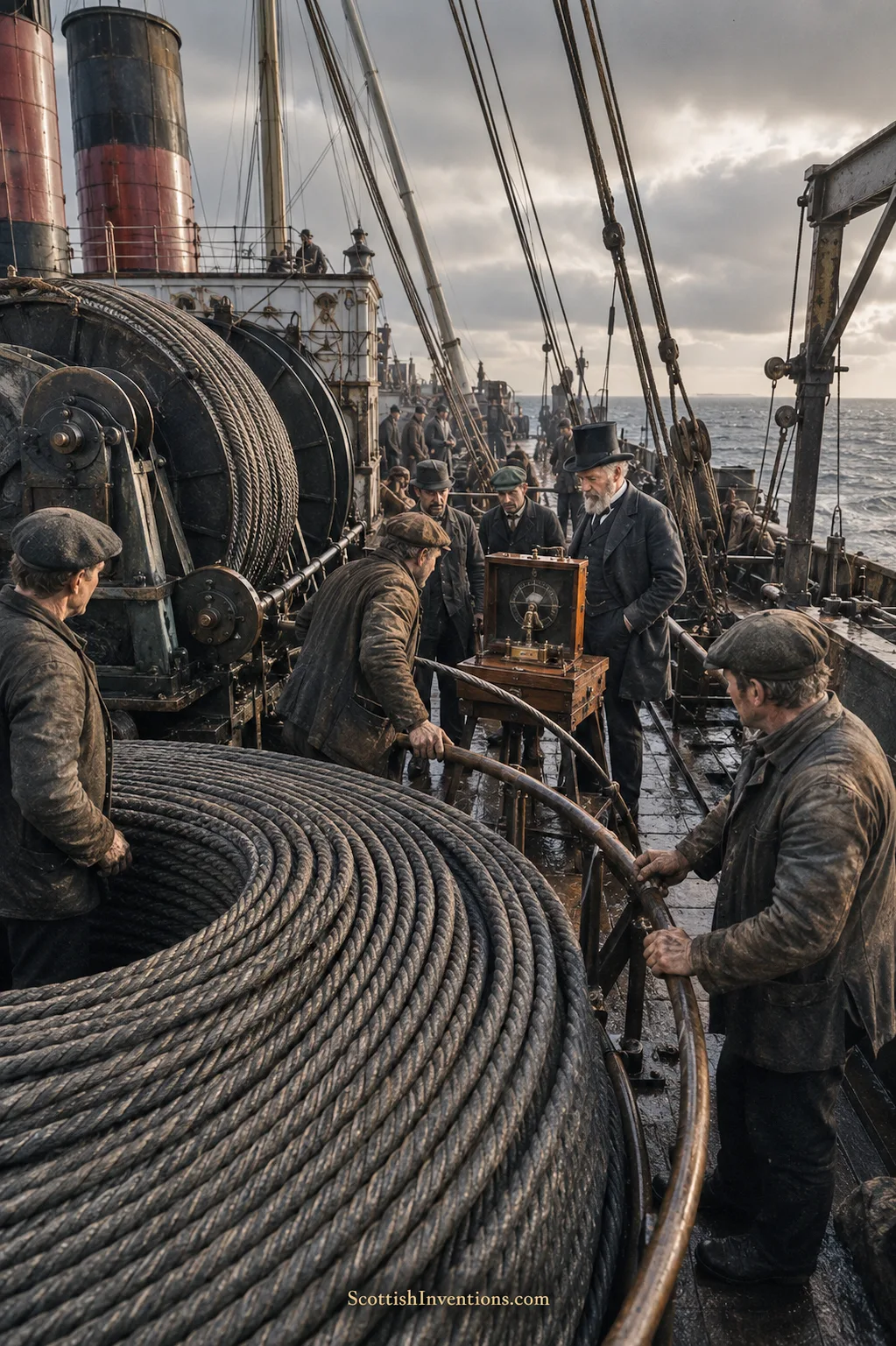
Absolute zero would secure his fame on its own, but it is only part of the story. Thomson was the leading scientific mind behind the audacious attempt to lay a telegraph cable across the Atlantic — the “Apollo project” of its age, and a commercial gamble on a scale that terrified its investors. The 1858 cable worked only briefly before failing; after redesign and a second campaign, a permanently successful cable was achieved in 1866.
The technical obstacle was that a signal sent into thousands of miles of undersea cable arrives at the far end faint and smeared out in time. Thomson's answer was the mirror galvanometer, patented in 1858: a tiny mirror on a suspended magnet threw a spot of light across a scale, so that a current far too weak to move a conventional needle became a visible, readable movement. Later the siphon recorder wrote the signal onto a moving paper tape.
Queen Victoria knighted him in 1866, and the cable patents made him wealthy. Nor did he stop there: he redesigned the mariner's compass into a far more reliable instrument, eventually adopted as the Admiralty standard, and built ingenious mechanical tide-predicting machines that computed the rise and fall of the sea by summing harmonic components on wheels and wires. His dynamical theory of heat papers, from 1851, ran in parallel with all of it. This is the pattern of the man: over 600 papers and around 70–75 patents, theory and hardware in the same hands.
The Great Mistake: The Age of the Earth
No honest account of Kelvin can skip his most famous error, and there is no reason to want to. In 1862 he published calculations that treated the Earth as a body cooling from an originally molten state, and derived an age of between 20 million and 400 million years. Over the following decades he narrowed the range rather than widening it; his final word, in 1897, was that the Earth was more than 20 and less than 40 million years old, and probably much nearer 20 than 40.
This put him in direct conflict with two disciplines at once. The geologists, working in the tradition of Hutton and Lyell, needed vast stretches of time to accumulate the strata they could see and measure. Darwin's natural selection needed even more. Kelvin's numbers, backed by the prestige of mathematical physics, squeezed both. It was one of the sharpest interdisciplinary quarrels of the Victorian century, and for a long time the physicist appeared to be winning it.
The Earth is about 4.54 billion years old — a hundred times his upper bound. But he was wrong for an honest reason. Thomson's mathematics was sound; his assumption was not. He assumed the Earth had no internal heat source, only a store of primordial heat leaking away. Radioactivity — the hidden furnace in the Earth's interior, which continuously replenishes that heat — had not yet been discovered. Once it was, the calculation collapsed, and it was Arthur Holmes and radiometric dating that eventually supplied the true answer.
Why we keep this in
Why This Is a Scottish Story
Should Scotland claim Lord Kelvin? Honestly and emphatically, yes — in the same spirit this collection embraces other adopted Scots, such as the French-born film pioneer William Kennedy Laurie Dickson. Kelvin was born in Belfast, but arrived in Glasgow as a young child, was educated almost entirely there, and spent his whole 53-year working life as Professor of Natural Philosophy at its University, teaching thousands of students from around the world and building Britain's first dedicated physics teaching laboratory.
He was, remarkably, both the youngest and the oldest matriculated member of the University — registering as a ten-year-old student and serving as its Chancellor until his death. He took his noble title from the city's river, the Kelvin, which flows past the campus: the name belongs to Glasgow first and to the physicist second.
And Glasgow has returned the embrace more thoroughly than perhaps any city has for any scientist. The University's Kelvin Building, Kelvingrove Park and the Kelvingrove Art Gallery, Kelvin Hall, and the districts of Kelvinside and Kelvinbridge — a whole quarter of the city carries the name. As the Glasgow Herald asked proudly at the height of his telegraph fame: “Is Professor Thomson… not a Glasgow man?” The answer the city has always given is unambiguous.
He died on 17 December 1907 at his home, Netherhall, near Largs in Ayrshire, and was buried in the nave of Westminster Abbey, near the grave of Sir Isaac Newton, in what is informally known as Scientists' Corner alongside Darwin, and later Rutherford and Hawking. His memorial statue, sculpted by Archibald Macfarlane Shannan and unveiled in 1913, stands in Kelvingrove Park, and the Hunterian Museum keeps a permanent exhibition of his instruments and papers — down to his smoking pipe.
Timeline
c. 1700–1703
Guillaume Amontons extrapolates gas pressure to zero
First hint that cold has a floor, estimated near −240°C
1824
Sadi Carnot publishes Réflexions sur la puissance motrice du feu
The idealised heat engine Thomson would build his scale upon
1834
Thomson matriculates at the University of Glasgow, aged 10
The youngest matriculated member in the University's history
1845
Graduates from Peterhouse, Cambridge
Second Wrangler and Smith's Prizeman; then Regnault's laboratory in Paris
1846
Elected Professor of Natural Philosophy at Glasgow, aged 22
He holds the chair for 53 years
1847
Hears James Prescott Joule argue heat is energy in motion
Turns Thomson toward the science of energy
1848
Publishes “On an Absolute Thermometric Scale”
Temperature defined by thermodynamics; absolute zero calculated at about −273°C
1851–1852
Dynamical theory of heat; Joule–Thomson effect
Foundations of the second law and of modern refrigeration
1862–1897
Calculates the age of the Earth at 20–400 million years
Wrong — radioactivity, the Earth's hidden furnace, was undiscovered
1866
Permanent transatlantic telegraph cable succeeds; knighted
Mirror galvanometer reads signals from thousands of miles of cable
1892
Created Baron Kelvin of Largs
The first scientist ever raised to the peerage
1907
Dies at Netherhall, near Largs; buried in Westminster Abbey
Laid to rest near Sir Isaac Newton
1967
CGPM Resolution 3 renames the unit “kelvin”
No more “degrees Kelvin” — the symbol is K
2019
The kelvin redefined via the Boltzmann constant
Temperature tied to a fundamental constant, as Thomson wished
Why It Matters Today
The kelvin is one of the seven base units of the International System of Units, sitting alongside the second, metre, kilogram, ampere, mole and candela as a fundamental building block of all scientific measurement. In 2019 it was redefined: rather than being pegged to the triple point of water, it is now fixed by assigning an exact value to the Boltzmann constant (1.380649 × 10⁻²³ joules per kelvin), tying temperature directly to a constant of nature — exactly the substance-independent definition Thomson wanted in 1848.
Absolute zero remains one of the most important reference points in physics. As matter is cooled towards it, exotic quantum phenomena emerge: superconductivity, superfluidity and the Bose–Einstein condensate. That “fifth state of matter,” predicted by Bose and Einstein in the 1920s, was first created in 1995 by Eric Cornell and Carl Wieman at JILA in Colorado, who cooled rubidium atoms to less than 170 billionths of a degree above absolute zero — work that won the 2001 Nobel Prize in Physics, shared with Wolfgang Ketterle.
Cryogenics, space science and quantum computing all live in this ultra-cold realm. Yet 0 K itself can never quite be reached: the third law of thermodynamics establishes that no finite sequence of cooling steps can bring anything all the way down. You can get fantastically close — as of the late 2010s, researchers in Bremen had reached 38 picokelvin, a record of the kind that is periodically broken — but never arrive.
Modern relevance
The Chain of Influence
- Amontons (c. 1700–03) — Air-thermometer extrapolation hints at a floor near −240°C↓
- Carnot (1824) — Idealised heat engines and the motive power of heat↓
- Joule (1847) — Heat is energy in motion, not a fluid↓
- Thomson (1848) — Absolute thermodynamic scale; absolute zero at about −273°C↓
- Clausius & Thomson (1850s) — The first and second laws of thermodynamics↓
- Joule–Thomson (c. 1852) — Gas cooling on expansion — refrigeration and liquefaction↓
- Nernst (1906) — Third law: absolute zero is unreachable↓
- Bose & Einstein → Cornell, Wieman, Ketterle (1995) — Bose–Einstein condensate, 170 nK above absolute zero↓
- 2019 — The kelvin redefined by the Boltzmann constant↓
- Today — Cryogenics, superconductors, quantum computing, SI kelvin
Did You Know?
- He started university at 10 — and was still a matriculated member at 75, making him both the youngest and the oldest in the University of Glasgow's history.
- Absolute zero is −273.15°C (−459.67°F): the coldest temperature theoretically possible, where a substance has no thermal energy left to give up.
- “Lord Kelvin” is named after a Glasgow river, not the other way around. His title, Baron Kelvin of Largs, comes from the River Kelvin that flows past the University.
- His mirror galvanometer, patented in 1858, made the 1866 transatlantic telegraph cable readable, connecting Europe and North America.
- The “K” on your lightbulb box is him — colour temperature uses the very scale he defined.
- Over 600 papers and around 70–75 patents: a one-man research-and-development powerhouse, and one of the wealthiest, most honoured scientists of the 19th century.
- He was the first scientist ever raised to the peerage, in 1892, and is buried in the nave of Westminster Abbey near Newton.
- He got the age of the Earth spectacularly wrong — tens of millions of years rather than 4.54 billion — because radioactivity had not yet been discovered.
Honest Caveats
He did not “discover” absolute zero, exactly. The idea of a coldest possible temperature predates him — Amontons around 1702, and others such as Johann Lambert. Kelvin's distinct achievement was determining its correct value and, more importantly, building the absolute thermodynamic scale on fundamental principle. He is the man who gave absolute zero its rigorous physical meaning, not the first to imagine that cold had a floor.
The family move date. Sources vary slightly. James Thomson was appointed to the Glasgow chair in 1832, but the family's physical move is usually dated to October 1833; some accounts compress this to “1832.” We use “appointed 1832, moved 1833.”
Papers and patents. The University of Glasgow's own tribute cites 661 scientific papers and 75 patents — patents applied for, not all of them issued; some sources round to “around 70” for those actually granted in his name. We use “over 600 papers” and “around 70–75 patents.”
Westminster Abbey. He lies in the nave near — to the south of — Newton's grave, in what is informally Scientists' Corner with Darwin, and later Rutherford and Hawking. “Near Newton” is accurate; “right next to Newton” is a romanticisation.
The Joule–Thomson date. The effect is dated to experiments begun around 1852; the collaboration itself grew out of the 1847 British Association meeting. We use “around 1852” for the effect.
Coldest-temperature records are time-stamped. The 38-picokelvin figure achieved in Bremen in 2018 is the kind of record that is periodically broken. Treat it, and any figure like it, as “as of the late 2010s” rather than permanent.
He was Belfast-born. We say so plainly. The Scottish claim rests on a Glasgow childhood, a Glasgow education and a 53-year Glasgow career — not on birthplace.
Frequently Asked Questions
Who discovered absolute zero?
The idea that cold has a lower limit goes back to Guillaume Amontons around 1700, who extrapolated falling gas pressure to a value near −240°C. The rigorous, thermodynamic definition came in 1848 from William Thomson (Lord Kelvin) at the University of Glasgow, who calculated absolute zero at about −273°C. The modern accepted value is −273.15°C.
What is the Kelvin scale?
The Kelvin scale is an absolute temperature scale that begins at absolute zero (0 K) and uses the same degree size as Celsius. Water freezes at 273.15 K and boils at 373.15 K. Because it is defined by thermodynamics rather than by the properties of any particular substance, it is the temperature scale used throughout science.
Is it “degrees Kelvin” or just “kelvin”?
Just kelvin, written in lower case with the symbol K — never “°K”. The unit was officially renamed from “degree Kelvin” to “kelvin” by the 13th General Conference on Weights and Measures in 1967, in Resolution 3.
Was Lord Kelvin Scottish?
He was born in Belfast on 26 June 1824 but moved to Glasgow as a child, matriculated at the University of Glasgow aged 10, and spent his entire 53-year career there as Professor of Natural Philosophy. He took his title from the River Kelvin, which flows past the campus. Belfast-born, Glasgow-made.
Why can absolute zero never be reached?
The third law of thermodynamics establishes that no finite sequence of cooling steps can bring a system all the way to 0 K. Laboratories get extraordinarily close — researchers in Bremen reached 38 picokelvin in 2018 — but the last step is unattainable.
What does the “K” on a lightbulb box mean?
It is colour temperature, measured in kelvin. A “2700K warm white” or “5000K daylight” bulb is described by the temperature at which a theoretical glowing object would emit light of that colour — the very scale Thomson defined in 1848.
Did Lord Kelvin get anything badly wrong?
Yes. From 1862 he calculated the age of the Earth from its rate of cooling, arriving at 20–400 million years and later narrowing that to nearer 20 million. The Earth is about 4.54 billion years old. His method was sound for what was known; radioactivity, which keeps the Earth's interior hot, had not yet been discovered.
What is the Joule–Thomson effect?
It describes how a real gas changes temperature when it is forced through a valve or porous plug while insulated from heat exchange. For most gases at ordinary temperatures the result is cooling. Thomson and James Prescott Joule established it in experiments begun around 1852, and it is the physical heart of refrigeration, air conditioning and the industrial liquefaction of gases.
What is the Kelvin statement of the second law of thermodynamics?
No device working in a continuous cycle can take heat from a single source and convert it entirely into useful work with no other effect. Often combined with Max Planck's version as the Kelvin–Planck statement, it means there is no perfect engine: some energy must always flow away as heat to a colder body.
How did Lord Kelvin help the transatlantic telegraph cable?
He was the leading scientific figure on the project. His mirror galvanometer, patented in 1858, threw a spot of light from a tiny mirror on a suspended magnet so that currents far too weak to move a normal needle became readable. The 1858 cable failed after a few weeks; a permanently successful cable followed in 1866, and Queen Victoria knighted him that year.
How many papers and patents did Lord Kelvin produce?
Over 600 scientific papers — the University of Glasgow's own tribute gives 661 — and around 70–75 patents. The higher patent figure counts applications rather than grants, which is why careful sources hedge between about 70 and 75.
Sources & Further Reading
Tier 1 · Primary
- Thomson, W. — “On an Absolute Thermometric Scale founded on Carnot's Theory of the Motive Power of Heat,” Philosophical Magazine, 1848.
- Carnot, S. — Réflexions sur la puissance motrice du feu, Paris, 1824.
Tier 2 · Scholarly and institutional
- University of Glasgow — Lord Kelvin, University Story and Hunterian Museum collections.
- BIPM — The International System of Units (SI), 9th edition, on the 2019 redefinition of the kelvin.
- 13th General Conference on Weights and Measures (CGPM), Resolution 3, 1967.
- Westminster Abbey — Burials and memorials: William Thomson, Lord Kelvin.
Tier 3 · General reference
- Encyclopaedia Britannica — William Thomson, Baron Kelvin.
- MacTutor History of Mathematics Archive — Biography of William Thomson.
Discoveries · No. 4 of 50
Absolute Zero joins the Discoveries series
Collector card artwork for this discovery is in production. In the meantime, explore the rest of the collection.