Discoveries · No. 12 of 50 · Biology
The Man Who Named the Control Centre of Life: Robert Brown and the Cell Nucleus
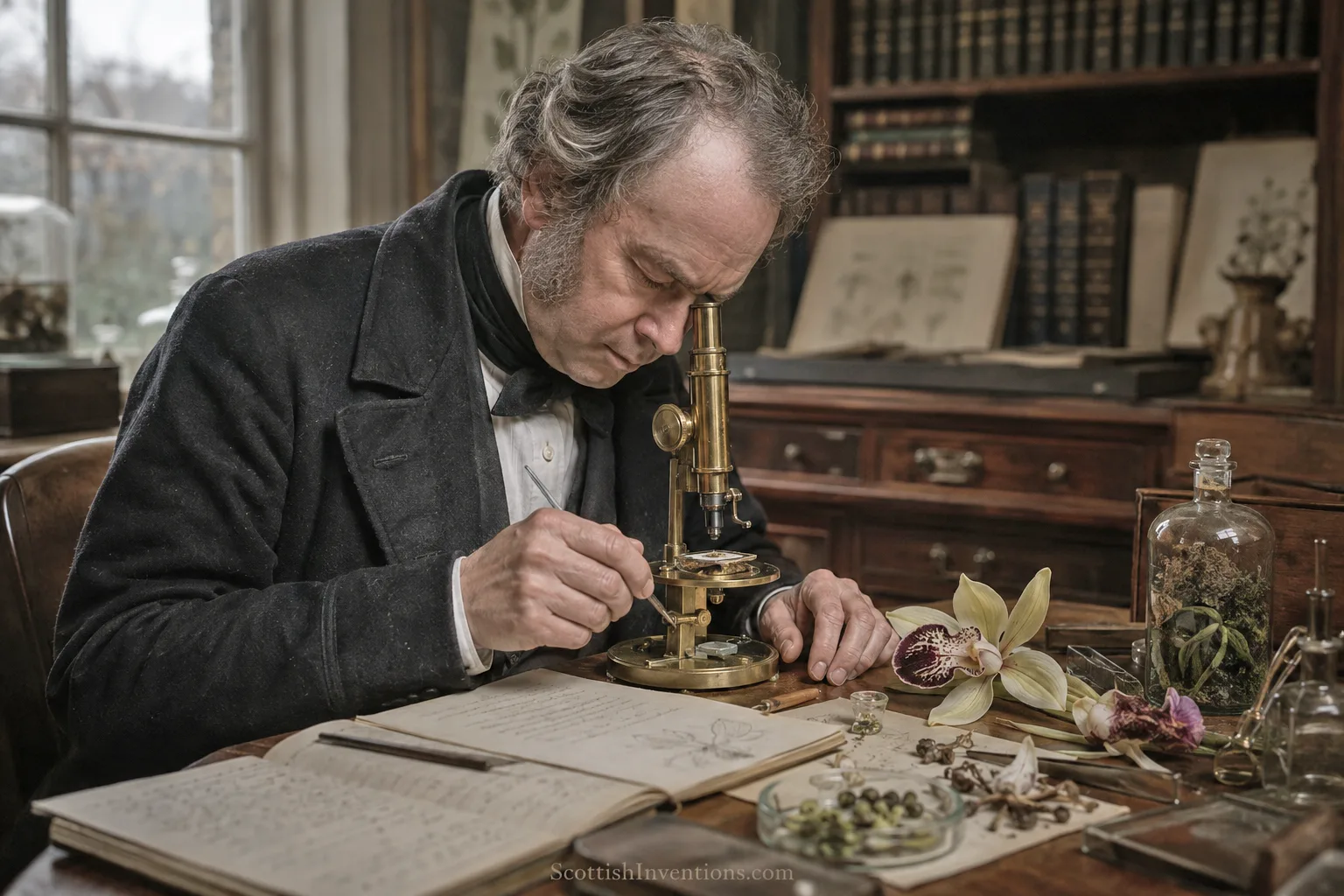
He was studying how orchids reproduce. Cell after cell, the same small opaque spot kept appearing. In November 1831 a botanist from Montrose told the Linnean Society what it was, and gave it a name that has been in every biology textbook since.
Robert Brown · 1773–1858Montrose · Edinburgh · LondonReading time · 15 minUpdated 2 August 2026
In Brief
Robert Brown, born in Montrose in 1773, was the first scientist to demonstrate systematically that a small opaque body is a regular feature of plant cells — and to name it the nucleus. He announced it in a paper read to the Linnean Society of London on 1 and 15 November 1831, published in the Society's Transactions in 1833. Brown was not the first person ever to glimpse such a structure: Leeuwenhoek described something like it in fish blood cells in 1682, and Kew's Franz Bauer had drawn it in orchids without understanding it. What Brown added was recognition, generalisation and a name — and on that foundation Schleiden and Schwann built cell theory within a decade.
Scottish Impact Index (SI Score)
- Global Impact
- 9/10
- Longevity
- 10/10
- Economic / Material Impact
- 5/10
- Originality / Distinctiveness
- 9/10
- Legacy (Built Upon)
- 9/10
- Recognition
- 4/10
Key Facts
- Discovery
- The first systematic demonstration that the nucleus is a regular feature of plant cells — and the naming of it
- Key figure
- Robert Brown (1773–1858), botanist
- Born
- 21 December 1773, Montrose, Angus
- Died
- 10 June 1858, 17 Dean Street, Soho Square, London, aged 84
- Read to the Linnean Society
- 1 and 15 November 1831
- Published
- Transactions of the Linnean Society of London, vol. 16 (1833), pp. 685–745
- Field
- Biology · Botany · Microscopy
- Instrument
- A simple single-lens microscope, not a compound one — now cared for by the Linnean Society of London
- Subject material
- Epidermis of orchid leaves (Orchidaceae), plus Liliaceae, Irideae, Commelineae; “uncommonly distinct” in Tradescantia virginica
- Word coined
- “Nucleus”, from the Latin for kernel or little nut
- Other discovery
- Brownian motion, 1827 — Card No. 9 in this collection
- Claim status
- Established — Brown named and characterised the nucleus; earlier sightings exist but were not recognised as such
Montrose to London
There is something wonderfully Scottish about Robert Brown's beginning: a manse childhood, a grammar-school grounding, and a restless, self-driven curiosity that carried a Montrose minister's son to the far side of the world and into the pages of every biology textbook ever printed.
He was born on 21 December 1773 on the Angus coast, in a house that stood where Montrose's Carnegie-funded public library stands today. His father, the Reverend James Brown, was an Episcopalian clergyman of such firm Jacobite conviction that in 1788 he defied his own church's decision to give allegiance to George III. His mother, Helen Taylor, was the daughter of a Presbyterian minister. Young Robert attended Montrose Grammar School — today's Montrose Academy — where he formed a lifelong friendship with the philosopher James Mill. At fourteen he went up to Marischal College in Aberdeen on a Ramsay bursary, and when the family moved to Edinburgh he enrolled to study medicine at the university. He never took his degree. Botany had already seized him: he tramped the Highlands collecting specimens, wrote meticulous descriptions, and discovered a new grass, Alopecurus alpinus.
In 1795 he was commissioned as surgeon's mate in the Fifeshire Regiment of Fencibles and posted to the north of Ireland, where light military duties left him ample time to botanise. By 1800 he was an established figure among Irish naturalists. The turning point had come in 1798, when a recruiting trip to London led, through Jonas Dryander, to an introduction to Sir Joseph Banks — the wealthy and immensely influential President of the Royal Society. Banks was impressed. When Matthew Flinders proposed a voyage to chart the coasts of New Holland, Banks wrote to Brown in December 1800 offering him the post of naturalist. Brown accepted at once.
HMS Investigator, 1801–1805
HMS Investigator sailed from Spithead on 18 July 1801, reaching the Western Australian coast that December. For the next several years Brown botanised with extraordinary energy, working up his specimens on the spot rather than merely hoarding them. It was punishing, sometimes tragic work — much of the material collected along the southern coast was lost when the Porpoise wrecked in 1803 — but the harvest was staggering. The Linnean Society of London records that the expedition collected over 4,000 botanical specimens, of which Brown classified 2,040; other reputable sources cite figures of around 3,400 to 3,900 plants, more than half of them new to science. However the specimens are counted, the achievement laid the foundations of Australian botany.
The fruit of the expedition was Prodromus Florae Novae Hollandiae et Insulae Van Diemen (1810), a landmark in systematic botany in which Brown championed the "natural system" of classification. On his return he became librarian to Banks, and after Banks's death in 1820 he inherited the great library and herbarium. When those collections passed to the British Museum in 1827, Brown negotiated the post of Keeper of the Banksian Botanical Collection; after the museum's natural-history department was reorganised in 1837 he became the first Keeper of the Botanical Department, a post he held until his death.
The other discovery
In the summer of 1827, examining pollen grains of Clarkia pulchella suspended in water, Brown noticed the tiny particles inside jiggling in a ceaseless, random dance — and proved the motion had nothing to do with life by finding it in dead matter, ground glass, rock, and even a fragment of the Sphinx. Einstein explained it in 1905, providing some of the first hard evidence that atoms are real. It is the subject of Card No. 9, Brownian Motion. Two of the most consequential microscopical observations in the history of science, four years apart, from the same quiet Scot.
Orchids and Milkweeds
Brown's discovery of the nucleus was, characteristically, almost a footnote. His subject was the reproductive machinery of orchids and milkweeds — the Orchidaceae and Asclepiadaceae — and how their pollen fertilises the ovary. This was a live and difficult question, and it was to answer it, not to catalogue the interior of cells, that he spent his evenings at the eyepiece.
His timing was fortunate. Joseph Jackson Lister's 1830 work on achromatic, colour-corrected lenses was reigniting serious interest in microscopy just as Brown was looking hardest. Brown, though, was not using the new compound instruments. He worked with a simple single-lens microscope — the sort a generation of scientists had begun to regard as obsolete. Modern re-creations using his surviving lenses, restored and studied by Professor Brian J. Ford, confirm the instrument was entirely capable of resolving what he claimed to see.
The 1831 Observation
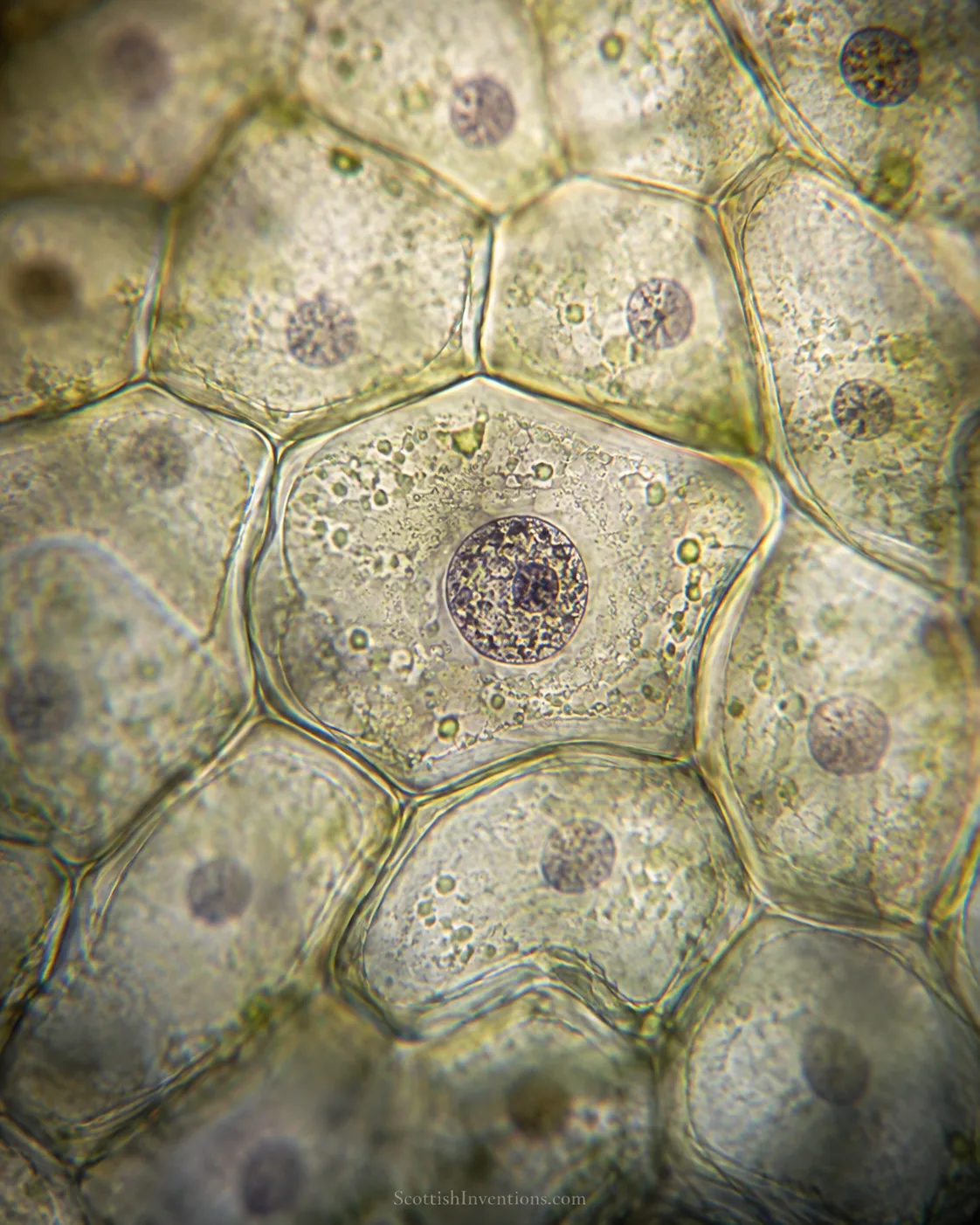
Peering at the epidermis of orchid leaves, Brown kept seeing the same small, opaque spot in cell after cell. His own words, from the 1831 paper, are precise and unforgettable:
"In each cell of the epidermis of a great part of this family, especially of those with membranous leaves, a single circular areola, generally somewhat more opaque than the membrane of the cell, is observable. This areola, which is more or less distinctly granular, is slightly convex, and although it seems to be on the surface is in reality covered by the outer lamina of the cell."
Note what that description does. It is not a claim of novelty; it is a careful account of shape, opacity, texture, convexity and position within the cell — including the observation that the structure only appears to sit on the surface. This is the "minuteness of observation, and perfect accuracy" Darwin would later praise.
Naming the Nucleus
Then came the sentence that named a piece of every living thing:
"This areola, or nucleus of the cell as perhaps it might be termed, is not confined to the epidermis…"
Nucleus — from the Latin for kernel, or little nut. Brown reported the structure in many other monocotyledons, among them Liliaceae, Irideae and Commelineae, and noted that it was "uncommonly distinct" in Tradescantia virginica. He had done the essential thing: he had shown the spot was neither an optical illusion nor a stray artefact but a genuine, regular component of the cell, and he had given it a word that other scientists could use.
The paper — "Observations on the Organs and Mode of Fecundation in Orchideæ and Asclepiadeæ" — was read to the Linnean Society of London on 1 and 15 November 1831, circulated as a privately printed pamphlet that same year, and published in the Transactions of the Linnean Society of London, volume 16 (1833), pp. 685–745. That two-year gap is the reason textbooks disagree about the date.
One caveat is worth stating plainly, because it is to Brown's credit rather than against him: he did not believe the nucleus was truly universal. He thought it largely confined to the monocotyledons. Even great discoverers see only part of the picture, and Brown was habitually more cautious about his own claims than posterity has been on his behalf.
Was Brown the First?
Accuracy demands honesty here, and the honest history is more interesting than the myth. Robert Brown did not discover the nucleus from nothing.
- Antonie van Leeuwenhoek, the Dutch microscopist, described a small round body within the oval blood cells of salmon and cod in a letter of 3 March 1682 to Robert Hooke and the Royal Society: "it seemed to me that some of them enclosed in a small space a little round body or globule, and at some distance from this body there was round the globule a clear ring." This was very probably one of the first sightings of a cell nucleus — but he had no framework in which to interpret it.
- Franz Andreas Bauer (1758–1840), the Austrian-born botanical illustrator at Kew, had drawn the structure in orchid cells. The often-repeated claim that Bauer "observed the nucleus in 1802" should be treated with care: his orchid drawings span the 1790s to the 1830s and were published only in 1830–1838, in Illustrations of Orchidaceous Plants with text by John Lindley, and the individual plates carry dates such as 1793 and 1801 — not 1802. Brown himself noted that Bauer had figured the areola in the stigma of Bletia and "seems to consider it as only visible after impregnation." Bauer, in other words, depicted the structure without recognising it as a general cell component.
- Brown also acknowledged that near-contemporaries such as Meyen, Purkinje and Brongniart had figured the structure, "but so little importance seems to be attached to it that the appearance is not always referred to."
So why does Brown get the credit? Because he was the first to demonstrate the nucleus as a regular, near-universal feature of plant cells; to describe its shape, position and optical properties systematically; to name it; and to publish in a way the scientific community could build upon. As the Dictionary of Scientific Biography records, Brown "recognized the nucleus as an essential part of the living cell."
A footnote for the careful reader: the two Bauer brothers are frequently confused in the literature. Franz Bauer is the Kew illustrator relevant to the nucleus; his younger brother Ferdinand Bauer was the artist who sailed with Brown on the Investigator. They are not interchangeable.
Cell Theory, 1838–39
The significance is hard to overstate. Cells had been known since Robert Hooke coined the word in 1665, but their inner workings were a mystery. By naming the nucleus and showing it to be a constant feature, Brown handed biologists both a vocabulary and a target.
The German botanist Matthias Schleiden seized on it. In his 1838 "Contributions to Phytogenesis" he took Brown's nucleus as his starting point — crediting Brown explicitly, though renaming the structure the "cytoblast" — and argued that all plants are aggregates of nucleated cells. A year later Theodor Schwann extended the idea to animals, and cell theory was born. Rudolf Virchow completed the picture in 1855 with omnis cellula e cellula: every cell from a cell.
From Nucleus to DNA
Then the nucleus gave up its deepest secret: heredity. In 1879 Walther Flemming discovered thread-like "chromatin" — later, chromosomes — inside the nucleus, and described mitosis. The trail led onward, to the recognition of DNA as the genetic material by Avery, MacLeod and McCarty in 1944, confirmed by Hershey and Chase in 1952, and to the double helix in 1953. Every one of those discoveries depended on knowing there was a nucleus to look inside.
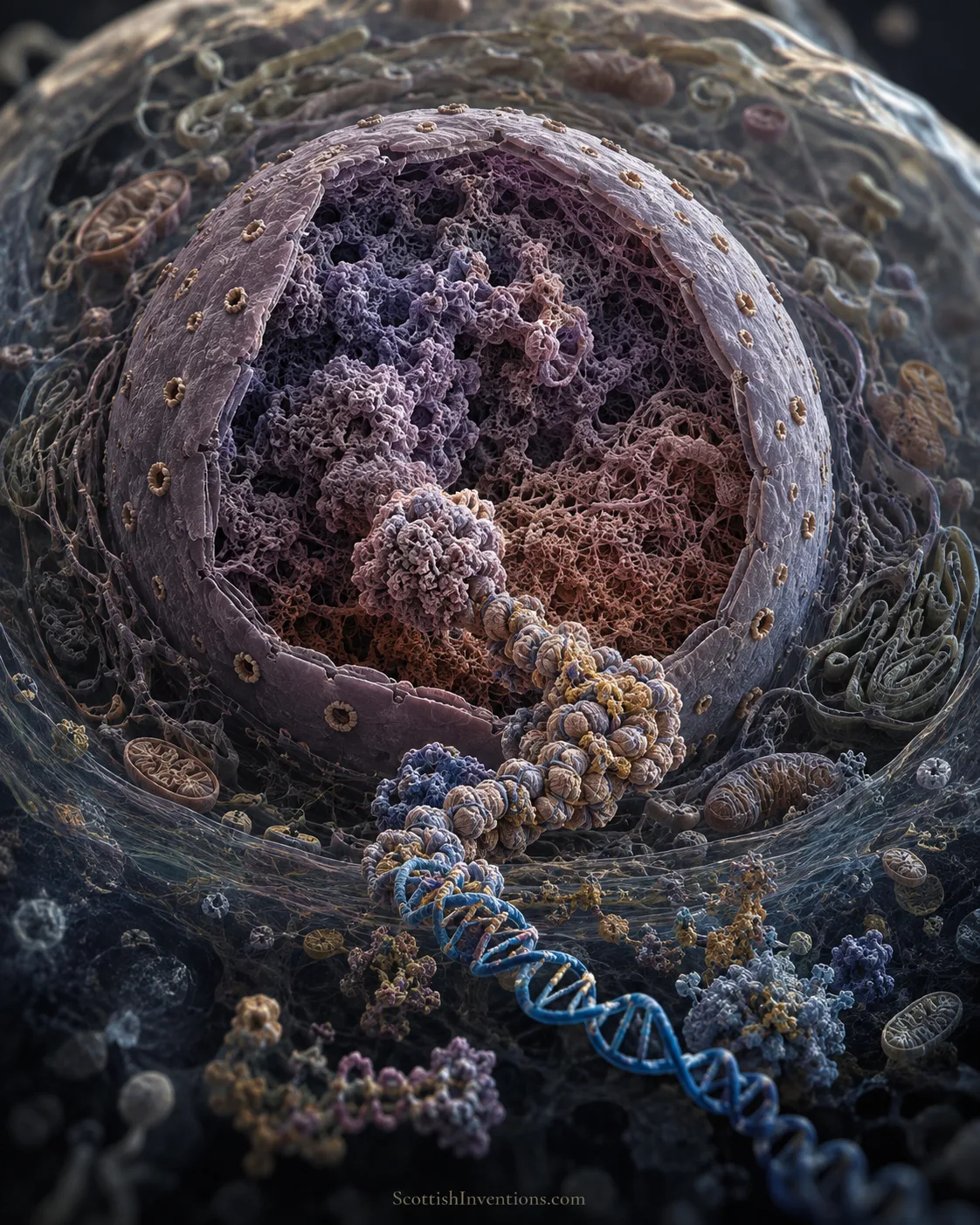
Today the nucleus is understood as the cell's control centre: it houses the chromosomes, directs protein synthesis and DNA replication, and governs cell division. It matters in medicine every day. Cancer is fundamentally a disease of uncontrolled nuclear division; genetic diseases involve nuclear DNA; gene therapy targets the DNA within the nucleus.
Brown's Legacy
Robert Brown was, by common consent, the greatest botanist of his age. Early in the nineteenth century Alexander von Humboldt referred to him as botanicorum facile princeps — the prince of botanists — "a designation both apt and just," as the Dictionary of Scientific Biography puts it. Charles Darwin, who called on him repeatedly, wrote in his autobiography: "I saw a good deal of Robert Brown, 'facile Princeps Botanicorum,' as he was called by Humboldt. He seemed to me to be chiefly remarkable for the minuteness of his observations, and their perfect accuracy. His knowledge was extraordinarily great, and much died with him, owing to his excessive fear of ever making a mistake." The popular tag therefore traces to Humboldt, not Darwin — a small but worthwhile correction.
He was elected a Fellow of the Royal Society in 1811 and awarded its highest honour, the Copley Medal, in 1839 — the citation reading "for his discoveries during a series of years, on the subject of vegetable impregnation." He served as President of the Linnean Society from 1849 to 1853. The Australian herb genus Brunonia — the blue pincushion — was named for him, along with species such as Banksia brownii and Eucalyptus brownii, and geographical features including Mount Brown and Point Brown in South Australia. His actual microscope survives in the care of the Linnean Society of London. In Montrose, a bust of Brown stands in the foyer of the public library built on the site of his birthplace. He worked almost to the end, dying at 17 Dean Street, Soho Square, on 10 June 1858, aged 84, and was buried in Kensal Green Cemetery.
Did You Know?
- Brown found the nucleus almost by accident — he was investigating how orchids reproduce when the same opaque spot kept appearing in cell after cell.
- The same Montrose man discovered Brownian motion in 1827 and named the cell nucleus in 1831 — four years apart, one microscope.
- Alexander von Humboldt, not Darwin, dubbed Brown “the prince of botanists”. Darwin praised the “perfect accuracy” of his observations.
- Brown used a simple single-lens microscope, an instrument many contemporaries considered outdated. It survives at the Linnean Society of London.
- Schleiden built cell theory on Brown's nucleus in 1838 — but renamed it the “cytoblast”, a word that did not survive.
- Brown never believed the nucleus was universal; he thought it largely confined to the monocotyledons.
Timeline
3 Mar 1682
Leeuwenhoek describes a “little round body” in fish blood cells
Very probably an early sighting of a nucleus, but with no framework to interpret it
21 Dec 1773
Robert Brown born in Montrose, Angus
Son of the Reverend James Brown of the Scottish Episcopal Church
1787
Enters Marischal College, Aberdeen, aged fourteen, as a Ramsay scholar
Later studies medicine at Edinburgh, but never graduates
1790s–1801
Franz Bauer draws orchid cell structures at Kew
Plates dated 1793 and 1801; published only in 1830–1838
1795
Commissioned surgeon's mate, Fifeshire Regiment of Fencibles
Posted to the north of Ireland; botanises in his ample spare time
1798
Introduced to Sir Joseph Banks in London
Through Jonas Dryander — the introduction that made his career
1801–1805
Naturalist aboard HMS Investigator under Matthew Flinders
The circumnavigation of Australia; much southern material lost in the 1803 Porpoise wreck
1810
Publishes Prodromus Florae Novae Hollandiae et Insulae Van Diemen
The foundation of Australian systematic botany
1820
Inherits Banks's library and herbarium on his death
Passed to the British Museum in 1827, with Brown as Keeper
1827
Observes what becomes known as Brownian motion
Published 1828 — see Card No. 9
1830
Joseph Jackson Lister's achromatic lenses transform microscopy
Colour-corrected optics reignite interest in the microscope
1–15 Nov 1831
Reads “Observations on the Organs and Mode of Fecundation in Orchideæ and Asclepiadeæ”
Names the nucleus; a private pamphlet circulates the same year
1833
Formal publication in the Transactions of the Linnean Society, vol. 16
The version most often cited
1838
Schleiden's “Contributions to Phytogenesis”
Takes Brown's nucleus as its starting point, renaming it the “cytoblast”
1839
Schwann extends the idea to animals; Brown awarded the Copley Medal
Cell theory is born; the medal citation is for vegetable impregnation
1855
Virchow: omnis cellula e cellula
Every cell from a cell — cell theory completed
1879
Flemming discovers chromatin and describes mitosis
The nucleus begins to give up its secret
1944–1953
Avery–MacLeod–McCarty, Hershey–Chase, then the double helix
DNA identified as the genetic material inside Brown's nucleus
Notes on the Evidence
1831 or 1833? Both, properly understood. Brown read the paper on 1 and 15 November 1831 and printed a private pamphlet that year; formal journal publication was 1833. Some sources cite 1832 for a shorter version. All three dates appear in the literature for good reasons.
Collection numbers vary. Over 4,000 specimens with 2,040 classified per the Linnean Society; around 3,900 in Britannica; about 3,400 elsewhere. The variation reflects the difference between specimens collected, species recognised and species published — compounded by the 1803 Porpoise wreck.
The Bauer priority question is genuinely nuanced. The "1802" date is not firmly documented in primary sources; it is largely repeated from secondary literature such as Henry Harris's The Birth of the Cell (1999). We credit Bauer's drawings and Brown's own acknowledgement of them, without asserting the date.
Brown's degree. Sources agree he studied medicine at Edinburgh but did not graduate. One source mentions a "diploma", which should not be confused with a completed medical degree.
Two Bauer brothers. Franz Bauer (Kew illustrator, relevant to the nucleus) and Ferdinand Bauer (the Investigator voyage artist) are frequently confused. They are kept distinct above.
"The most productive microscopist in history" is a rhetorical flourish rather than a measurable fact. It is fairer to say Brown ranks among the most important, given that both Brownian motion and the naming of the nucleus came from the same man.
Frequently Asked Questions
Who discovered the cell nucleus?
The Scottish botanist Robert Brown (1773–1858) is credited with the discovery, announced in a paper read to the Linnean Society of London on 1 and 15 November 1831 and published in 1833. Strictly, Brown was the first to demonstrate that the structure is a regular, near-universal feature of plant cells, to describe it systematically, and to name it — earlier observers had glimpsed nucleus-like bodies without recognising what they were.
When was the cell nucleus discovered — 1831 or 1833?
Both dates are defensible, which is why textbooks disagree. Brown read the paper to the Linnean Society on 1 and 15 November 1831 and circulated a privately printed pamphlet that year; formal journal publication came in the Transactions of the Linnean Society, vol. 16, in 1833. A shorter version is sometimes dated 1832. This site uses 1831 for the discovery and 1833 for the publication.
Why is Robert Brown credited when Leeuwenhoek saw it first?
Antonie van Leeuwenhoek described a small round body inside the oval blood cells of salmon and cod in a letter of 3 March 1682, and that was very probably a nucleus. But he had no conception of what he was seeing. Credit in science generally attaches to recognition rather than to the first accidental glimpse: Brown showed the structure was a constant, genuine component of cells rather than an artefact, named it, and published it in a form other scientists could build on.
What about Franz Bauer and the 1802 claim?
Franz Andreas Bauer (1758–1840), the Austrian-born botanical illustrator at Kew, had drawn nucleus-like structures in orchid cells, and Brown credited him. The widely repeated claim that Bauer “observed the nucleus in 1802” is not firmly documented in primary sources: his orchid plates carry dates such as 1793 and 1801, and were published only in 1830–1838. Brown himself noted that Bauer figured the areola in the stigma of Bletia and “seems to consider it as only visible after impregnation” — that is, Bauer depicted the structure without conceptualising it as a universal cell component.
What exactly did Brown write in 1831?
“In each cell of the epidermis of a great part of this family, especially of those with membranous leaves, a single circular areola, generally somewhat more opaque than the membrane of the cell, is observable.” He then added the sentence that named a piece of every living thing: “This areola, or nucleus of the cell as perhaps it might be termed, is not confined to the epidermis…”
What kind of microscope did Robert Brown use?
A simple single-lens microscope, not the compound instruments then coming into fashion. Modern re-creations using his surviving lenses — restored and studied by Professor Brian J. Ford, with the instrument cared for by the Linnean Society of London — confirm it was optically capable of resolving the nuclei he described.
Why does the cell nucleus matter?
The nucleus is the control centre of every eukaryotic cell. It houses the chromosomes, directs protein synthesis and DNA replication, and governs cell division. Naming it gave biologists a vocabulary and a target: Schleiden and Schwann built cell theory on it in 1838–39, Flemming found chromatin inside it in 1879, and the trail led to DNA and the double helix. Cancer is fundamentally a disease of uncontrolled nuclear division; genetic medicine targets nuclear DNA.
Did Robert Brown discover anything else?
Yes — and it is one of the most remarkable doubles in the history of science. In 1827 the same man, working with the same patience at the same kind of microscope, carried out the first systematic investigation of what is now called Brownian motion, the phenomenon Einstein explained in 1905 as evidence for the reality of atoms. Two foundational observations, four years apart, from one Montrose minister's son.
Sources & Further Reading
Tier 1 · Primary
- Brown, R. — "Observations on the Organs and Mode of Fecundation in Orchideæ and Asclepiadeæ," read to the Linnean Society of London 1 and 15 November 1831; Transactions of the Linnean Society of London, vol. 16 (1833), pp. 685–745.
- Brown, R. — Prodromus Florae Novae Hollandiae et Insulae Van Diemen, 1810.
- Brown, R. — "A Brief Account of Microscopical Observations… on the Particles Contained in the Pollen of Plants," 1828.
- Leeuwenhoek, A. van — letter to Robert Hooke and the Royal Society, 3 March 1682.
- Bauer, F. & Lindley, J. — Illustrations of Orchidaceous Plants, 1830–1838.
- Schleiden, M. J. — "Beiträge zur Phytogenesis" ("Contributions to Phytogenesis"), 1838.
- Schwann, T. — Mikroskopische Untersuchungen, 1839.
- Virchow, R. — Cellularpathologie, 1858 (omnis cellula e cellula, 1855).
- Flemming, W. — work on chromatin and mitosis, from 1879.
Tier 2 · Scholarly and institutional
- Harris, H. — The Birth of the Cell, Yale University Press, 1999.
- Ford, B. J. — studies and re-creations using Robert Brown's surviving microscope, Linnean Society of London.
- Dictionary of Scientific Biography — entry on Robert Brown.
- The Linnean Society of London — collections and biographical records for Robert Brown.