Discoveries · No. 6 of 50 · Chemistry
Joseph Black & Latent HeatThe hidden fire that built the Industrial Revolution
Joseph Black · c. 1761Glasgow & EdinburghReading time · 14 minUpdated 17 August 2026
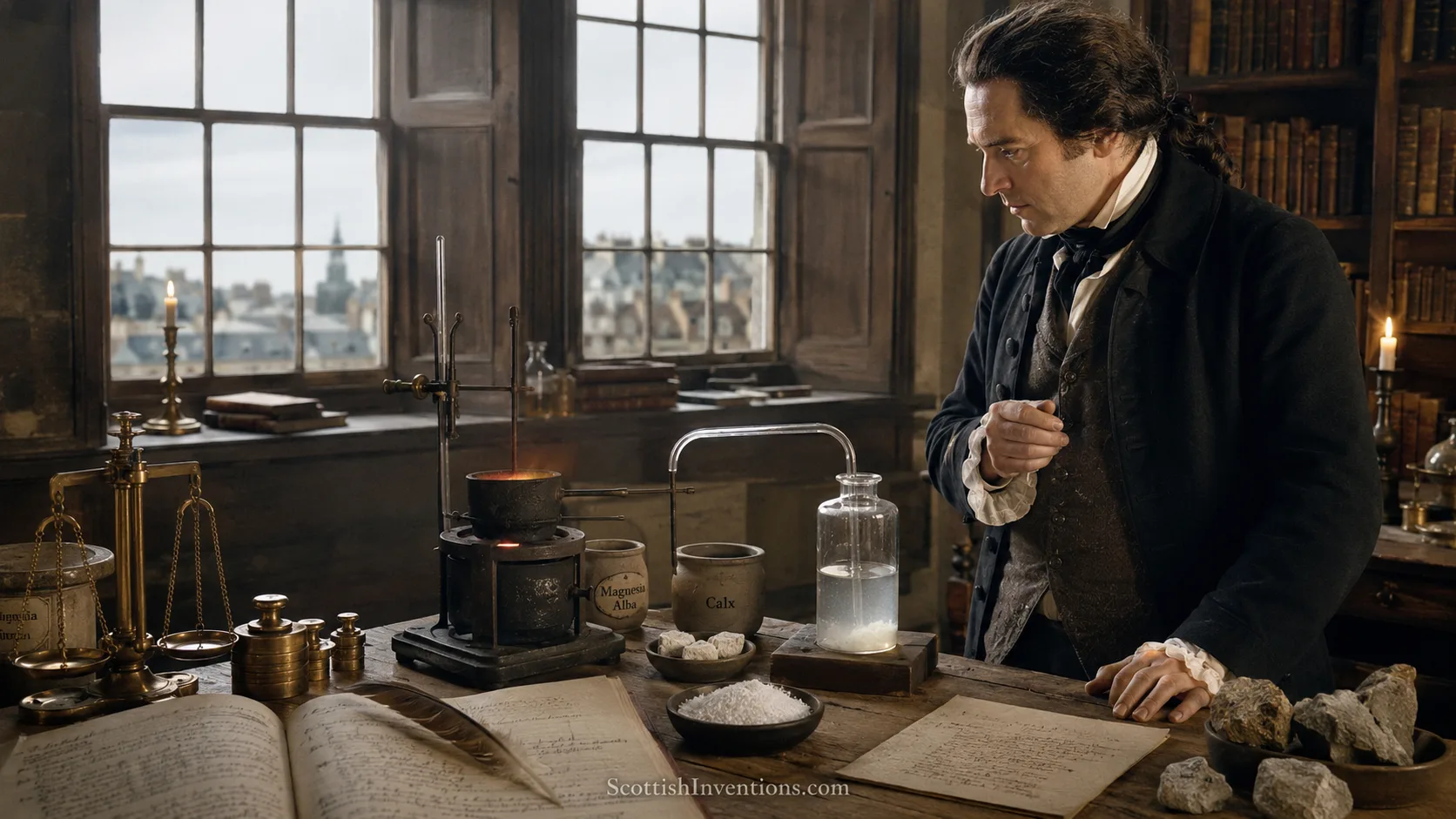
Above: Black's method in one image — a thermometer, a balance, and the patience to measure what nobody could see. Illustration © ScottishInventions.com.
TL;DR
- Around 1761–62 Joseph Black discovered latent heat — the hidden heat a substance absorbs or releases when it changes state, with no change of temperature at all. He coined the name from the Latin latere, “to lie hidden.”
- A year or so earlier, around 1760, he had separated heat from temperature altogether with his “capacity for heat” — what we now call specific heat capacity.
- He taught both discoveries rather than publishing them. Latent heat reached print only in 1803, posthumously, in Robison's edition of his Lectures; specific heat lost formal priority to Johan Carl Wilcke, who published independently in 1772.
- His measurements were extraordinary: latent heat of fusion of ice at roughly 79–80 cal/g against a modern value of 79.7 cal/g.
- His friendship with James Watt at Glasgow ran alongside the invention of the separate condenser — a connection historians still debate, and one Watt himself credited late in life.
- His 1754 thesis on “fixed air” — carbon dioxide — was a real and separate achievement: the first rigorous quantitative characterisation of the gas.
Claim status · Mixed — established for latent heat, shared for specific heat
- Latent heat (1761–62) — established. Black's discovery and the term itself are his alone; no competing claim in the record.
- Specific heat capacity (c. 1760) — shared. Black reached it first but never published; Johan Carl Wilcke discovered it independently and published in 1772, giving him formal priority in the printed literature.
Quick Facts
- Discovery
- Latent heat — the hidden heat absorbed or released when a substance changes state without any change of temperature
- Year
- Latent heat c. 1761–62; specific heat capacity c. 1760; “fixed air” thesis 1754
- Key figure
- Joseph Black (1728–1799)
- Field
- Physics · Chemistry · Thermodynamics
- Named from
- Latin latere, “to lie hidden” — Black coined the term himself
- Measured value
- Latent heat of fusion of ice ≈ 79–80 cal/g; modern value 79.7 cal/g (333.5 J/g)
- First published
- Posthumously, in Lectures on the Elements of Chemistry (1803), edited by John Robison
- Why it matters
- Underpins the steam engine, refrigeration, air conditioning, meteorology and thermodynamics
- Teacher
- William Cullen, University of Glasgow
- Claim status
- Mixed — see claim-status box below. Latent heat established (Black's alone); specific heat capacity shared (Wilcke published independently in 1772, ahead of Black's unpublished c.1760 discovery).
Where Does the Heat Go?
Drop a block of ice into a warm room and put a thermometer in the meltwater. The room is warm. Heat is plainly flowing into the ice. And the thermometer does not move. It sits at 0°C, hour after hour, until the last splinter of ice has gone — and only then does the water begin to warm.
Do the same at the other end. Bring a pan of water to the boil and keep the flame on. It boils at 100°C and stays at 100°C. You are pouring heat in; the thermometer refuses to acknowledge it. The water is vanishing into steam, and the temperature will not budge.
Every reader has watched both of these happen. Almost nobody stops to ask the obvious question. Where does the heat go?
In Glasgow in the early 1760s, Joseph Black (1728–1799) asked it, and then did something harder than asking: he measured the answer. The heat, he showed, is not destroyed and not idle. It is consumed by the change of state itself — hidden inside the substance, doing the work of turning solid into liquid or liquid into vapour, and released again when the change runs backwards. He called it latent heat, from the Latin latere, “to lie hidden.”
That answer is why your refrigerator works, why sweating cools you, why hurricanes have the energy they do, and why James Watt's steam engine stopped wasting most of its fuel. It is one of the most consequential questions ever asked about something everyone had already seen.
A Scot Born in Bordeaux
Black was born on 16 April 1728 in Bordeaux, where his father, John Black — a Belfast wine merchant of Scottish ancestry — had settled to trade. His mother, Margaret Gordon, came of a Scottish family and is said, on family tradition recorded in the biographies rather than on primary record, to have come from Aberdeenshire. Joseph was the sixth of thirteen children, and spent his early years between Bordeaux and Belfast before being sent to Glasgow for his education.
At the University of Glasgow from around 1746 he began in arts and switched to medicine — the decisive move, because it put him under William Cullen, who in 1747 had founded the first independent chemistry lectureship in the British Isles. Cullen became his teacher, mentor and lifelong friend, and it was in Cullen's laboratory that Black acquired the habit that defines him: weigh everything, measure everything, trust the numbers over the theory.
He followed Cullen to Edinburgh in 1752 and took his MD there in 1754 with a thesis that turned out to be a major scientific discovery in its own right. When Cullen returned to Edinburgh in 1756, Black succeeded him at Glasgow — formally as Professor of Anatomy and Botany, a title that says nothing about what he actually did there, which was teach chemistry and perform the greatest experimental work of his life. In 1766 he followed Cullen once more, to the Edinburgh chair of Medicine and Chemistry, which he held for the remaining thirty-three years of his life.
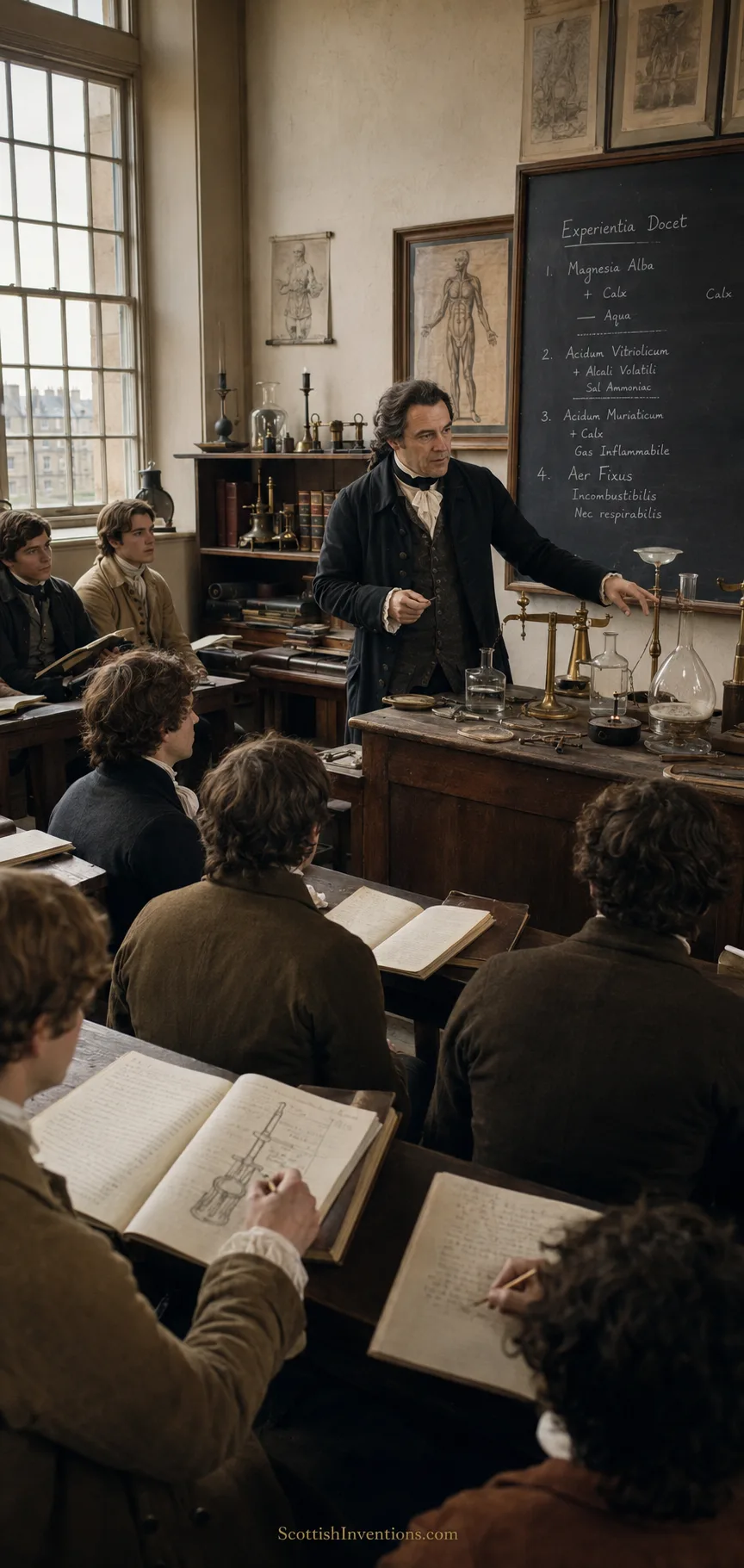
At Edinburgh he became one of the most celebrated lecturers in Europe: unhurried, exact, his classes built around beautifully designed demonstrations. Students came from Scotland, England, Ireland, America and the Continent to hear him. His circle included Adam Smith, David Hume, James Hutton and — crucially for this story — James Watt.
He died at his desk in Edinburgh on 10 December 1799. By the popular account, possibly improved in the telling, he had a cup of milk in his hand and did not spill a drop: an ending in keeping with a life of unbroken composure.
What Is Heat? The Eighteenth-Century Muddle
To see what Black did, you have to step into a science that was confused in ways that now look elementary and were then genuinely intractable.
The dominant theory held that heat was a material fluid — caloric — invisible, weightless, flowing from hot bodies to cold. For simple mixing problems it worked well enough. Mix equal weights of hot and cold water and you get a predictable average. The model survived on that kind of success.
It fell apart at changes of state. The naïve caloric picture predicted that adding heat always raises temperature. Melting ice and boiling water say flatly otherwise, and they say it in every kitchen and every winter. This was not a fringe anomaly awaiting a refinement; it was a hole in the middle of thermal science, sitting in plain view.
The two stubborn facts
Boiling. Water at 100°C stays at 100°C however hard you heat it. The heat converts liquid to steam and the thermometer never registers it.
First: Heat Is Not Temperature (c. 1760)
Black's first thermodynamic insight, around 1760, was the one everything else rests on: heat and temperature are different quantities.
The demonstration is almost embarrassingly simple. Take equal weights of water and mercury; heat them with identical flames for the same time. The mercury races up the scale; the water crawls. The same heat produces very different temperature changes. Mercury therefore needs less heat per degree per unit of mass — or, put the other way round, water has a far greater capacity for heat.
Black called it the “capacity for heat” of a substance. We call it specific heat capacity, and it is taught in every school physics course on Earth. Temperature measures how intensely a body is heated; heat capacity measures how much heat it stores per unit mass per degree. Once those two things are prised apart, the door to thermodynamics is open.
And here the article has to be honest, because this is the point at which Black's own habits cost him. He discovered the principle around 1760 and taught it in Glasgow and Edinburgh for years. He never published a formal paper on it. The Swedish scientist Johan Carl Wilcke arrived at the same discovery independently and published it in 1772, and publication is what the record recognises. Wilcke holds formal priority in print.
Black was, by all accounts, annoyed — reasonably so. His friends and students attested to his priority, and his lecture notes date the discovery well before Wilcke's paper. None of that outranks a printed publication. The convention that credit follows print was already entrenched in the eighteenth century, and it took from Black a discovery that was arguably his.
Great discoveries do not always go to the person who made them. They go to the person who wrote them down where others could read.
Then: The Hidden Heat (c. 1761–62)
The greater discovery came a year or two later, and it came from refusing to let the melting-ice problem go.
Black saw that the ice was absorbing heat from its surroundings without rising above 0°C, and that this was not a curiosity but a measurable quantity waiting to be pinned down. So he pinned it down. He prepared known quantities of ice at exactly 0°C, let them melt in a controlled environment, and tracked the heat exchange and the time with obsessive care.
The result was startling. The very same quantity of heat that would have raised that mass of water from 0°C through nearly eighty degrees was instead swallowed entirely by the melting — with the thermometer stationary throughout. An enormous store of heat had gone into the ice and left no thermal trace at all.
Black's interpretation is the discovery. The heat is not destroyed; it is hidden in the substance in a form that does not show itself as temperature, and it comes back out when the change of state reverses and the water refreezes. He named it latent heat — from latere, to lie hidden — a term he coined himself and which physics has never needed to replace.
He then measured the latent heat of vaporisation of water, the heat swallowed when liquid becomes steam, and found it larger still — roughly five to six times the latent heat of fusion of ice. That number, more than any other, is what makes the steam engine both possible and, in its early form, so wasteful.
How accurate was he?
As with specific heat, he communicated it by lecturing. He began teaching latent heat at Glasgow around 1762 and continued at Edinburgh for the rest of his career. It reached print only in 1803, four years after his death, in his collected Lectures on the Elements of Chemistry, edited and published by his student John Robison.
How He Did It — The Experiments
What raises Black above a clever theorist is the experimental craft. His apparatus was almost primitive; his quantification was not.
- The melting-ice experiment
Black filled a vessel with ice at exactly 0°C, confirmed by thermometer, and placed it in a room held at a known warmer temperature. He timed the melt. Alongside it he ran the control: how long the same mass of water at 0°C took to warm to a target temperature in the same thermal environment. The comparison was stark — the heat input that would have carried his water from 0°C to around 79°C instead melted the ice with no temperature change whatsoever.
- The boiling-water experiment
He repeated the logic at the other transition. A known quantity of water at 100°C was allowed to evaporate under controlled conditions with the temperature monitored throughout. It stayed at 100°C; all the added heat went into making vapour. From the heat supply and the rate of evaporation he calculated the latent heat of vaporisation — on the order of 530 cal/g.
- The calorimeter
He worked in a simple insulated vessel — a direct precursor of the modern calorimeter — to minimise heat leaking to the surroundings. By varying the weights of ice and warm water mixed in it and reading the final temperature, he could calculate the exchanges with real precision.
None of this needed complex equipment. It needed patience, precision, a clear head and the willingness to follow the evidence where it went — including straight through the received theory of heat.
The Watt Connection — Handled Honestly
This is where the story becomes one of the most consequential friendships in the history of technology, and where it needs the most care, because the popular version — Black explained latent heat, Watt built the engine — is tidier than the record.
What is documented. James Watt and Joseph Black met and became friends in Glasgow, where Watt was mathematical instrument maker to the University and Black, from 1756, was teaching chemistry. They belonged to the same fertile circle as Adam Smith and John Robison. The friendship was practical as well as intellectual: Black lent Watt money on at least one occasion to help finance his experiments — documented in correspondence, though the amount and terms are reported variously and no precise figure should be quoted.
The problem Watt faced. From around 1763–65 Watt worked on the inefficiency of the Newcomen atmospheric engine, a model of which the University had asked him to repair. Each stroke filled the main cylinder with steam, then cooled it with a jet of cold water to condense the steam and make the vacuum — then reheated the whole cylinder for the next stroke. The engine burned enormous quantities of fuel doing nothing but cycling its own cylinder between hot and cold.
The thermodynamics of that waste is pure latent heat. The injected cold water was not merely cooling steam; it was absorbing the vast latent heat of condensation given up as the steam returned to liquid — heat that then had to be driven out of the cylinder again on the next stroke. The cylinder was a thermal seesaw. Watt's separate condenser broke the cycle: condense the steam in a permanently cold chamber and keep the working cylinder permanently hot.
What is debated. Watt's own accounts of how he got there are tantalising and inconsistent, and they shifted over the decades. Sometimes he describes a flash of insight on a Sunday walk on Glasgow Green in 1765. Later he credits Black's doctrine of latent heat as the framework that let him see what was happening. In an 1814 letter he wrote plainly: “The attention which I had paid to the doctrine of latent heat… led me to the invention of the separate condenser.” But that was written nearly fifty years after the event, and the contemporaneous record is far less clear-cut.
Historians of science — Donald Cardwell, A. E. Musson, Eric Robinson among them — have argued the question both ways: did Black's theory produce the practical insight, or did it supply retrospective clarity to an insight that was largely empirical?
The honest position
Before the Heat: “Fixed Air” (1754)

Seven years before the latent-heat experiments, Black had already made a major discovery in a different field. His 1754 Edinburgh MD thesis, De humore acido a cibis orto et magnesia alba — “on the acid humour arising from food, and magnesia alba” — described a long series of experiments on magnesia alba (magnesium carbonate) and limestone (calcium carbonate).
Heating magnesia alba, he found, released a gas and left a lighter residue. He called the gas “fixed air”, because it had previously been chemically fixed inside the solid. It behaved nothing like common air: it extinguished flame, suffocated animals, was heavier than air, and produced a white precipitate when bubbled through lime-water. The same gas came from acids on chalk, from exhaled breath and from fermentation — and, decisively, the residue could reabsorb it and return to its original weight.
The achievement was to establish that fixed air was a chemically distinct substance, not simply air altered in quality as earlier thinkers had vaguely supposed. The Flemish chemist Jan Baptist van Helmont had earlier noted a gas from fermentation and combustion — his “gas sylvestre” — and even coined the word “gas”. That was an earlier, qualitative observation of a CO₂-like gas. Black's priority lies in the first rigorous quantitative characterisation: distinguishing carbon dioxide chemically and physically from ordinary air, and showing it to be a product of both combustion and animal respiration. Modern chemistry knows his fixed air as carbon dioxide.
That distinction matters and is worth stating plainly rather than blurring: Black was not the first person to encounter CO₂. He was the first to prove what it was.
The Man Who Would Not Publish
A pattern runs through Black's career and explains much about how his reputation sits today. He published almost nothing. His 1754 thesis and the expanded 1756 paper, “Experiments upon Magnesia Alba, Quick-Lime, and Some Other Alcaline Substances,” were effectively his only substantial chemical publications. Both of his great thermal discoveries — specific heat and latent heat — he simply taught.
The lectures were not obscure. For thirty-three years they drew students from across Europe and America, and his ideas circulated widely through the notes those students carried home and through secondary accounts, including Robison's own 1785 entry in the Encyclopædia Britannica. Black's thinking was not hidden; it simply was not his, in print, under his name, on a dated page.
The cost was precise. On latent heat it cost him nothing but delay: no one else claimed the discovery, and the 1803 Lectures secured it. On specific heat it cost him the credit outright, to Wilcke's 1772 publication. Same habit, two very different outcomes — which is exactly why this card's claim status treats the two discoveries separately rather than as one undifferentiated legacy.
Timeline
c. 1609–1640s
Jan Baptist van Helmont describes “gas sylvestre” and coins the word “gas”
An earlier, qualitative sighting of a CO₂-like gas
c. 1700
Georg Ernst Stahl names phlogiston
The theory that made heat and gases hard to see clearly
1746
Black enters the University of Glasgow and falls in with William Cullen
The teacher who made him a quantitative chemist
1754
Black takes his Edinburgh MD with a thesis on magnesia alba
First rigorous quantitative characterisation of “fixed air” (CO₂)
1756
Black succeeds Cullen at Glasgow as Professor of Anatomy and Botany
He teaches chemistry regardless — and meets James Watt
c. 1760
Black works out the “capacity for heat” of different substances
Specific heat capacity — taught, but never formally published
c. 1761–1762
Black quantifies the heat hidden in melting ice and boiling water
Latent heat: he coins the term from Latin latere
1763–1765
Watt wrestles with the Newcomen engine and conceives the separate condenser
Black lends him money; the two men's ideas run together
1766
Black moves to Edinburgh as Professor of Medicine and Chemistry
Thirty-three years of Europe's most celebrated chemistry lectures
1772
Johan Carl Wilcke publishes on specific heat in Sweden
Independent discovery — and formal priority in print
1799
Black dies at his desk in Edinburgh, 10 December
Still, by every account, entirely unhurried
1803
Robison edits and publishes Lectures on the Elements of Chemistry
Latent heat finally reaches print, four years after Black's death
Today
Latent heat underpins every fridge, weather forecast and power station
The hidden fire, still doing the work
Why It Matters Today
Latent heat is not a historical curiosity. It is running, right now, in the room you are sitting in.
Refrigeration and air conditioning. Every domestic fridge and air conditioner runs a vapour-compression cycle: a refrigerant evaporates, absorbing latent heat and cooling everything around it, then condenses elsewhere and dumps that latent heat outside. Black's discovery, executed billions of times a day worldwide.
Weather and climate. Water's enormous latent heat is one of the great engines of the atmosphere. Evaporation from the ocean absorbs latent heat and cools the surface; when moist air rises and the vapour condenses into cloud, that heat is released into the atmosphere, driving convection and feeding thunderstorms and hurricanes. Every forecast is built on it.
Why coastal climates are mild. The ocean's vast heat capacity — a consequence of water's exceptionally high specific heat, Black's other insight — buffers coastal temperatures against the swings that inland regions endure.
Why sweating cools you. Evaporating sweat takes its latent heat of vaporisation, roughly 580 cal/g, out of your skin. Your body is a heat engine running on Black's principle.
Power generation. Every steam turbine in every thermal and nuclear power station on Earth is managing latent heat of vaporisation and condensation — the same balance sheet Watt first learned to keep.
The Chain of Influence
- Cullen (1747–1756) — Founds independent chemistry teaching in Britain; trains Black↓
- Black (c. 1760) — Separates heat from temperature — “capacity for heat”↓
- Black (c. 1761–62) — Discovers and names latent heat; measures it to a fraction of a percent↓
- Watt (1765) — The separate condenser — the latent-heat problem solved in iron↓
- Wilcke (1772) — Publishes specific heat independently, taking formal priority↓
- Lavoisier & Laplace (1780s) — Calorimetry built directly on Black's framework↓
- Robison (1803) — Publishes Black's Lectures; latent heat reaches print at last↓
- Carnot, Joule, Kelvin, Clausius (19th c.) — Thermodynamics and its Second Law↓
- Today — Refrigeration, air conditioning, meteorology, power generation
Black also sat at the centre of the Edinburgh Enlightenment — Hume, Smith, Hutton, Watt, Adam Ferguson, Cullen — a circle that in one generation and one city helped found modern economics, geology, chemistry and engineering. His insistence on measurement was that spirit in its most productive form. Antoine Lavoisier, the father of modern chemistry, acknowledged Black's influence explicitly, and his calorimetric work with Laplace built on Black's foundation.
Did You Know?
- Black discovered latent heat by asking a question any curious child could ask: why does ice stay cold while it melts, even when you keep adding heat?
- He coined the word “latent” for it himself, from the Latin latere — “to lie hidden.”
- He never published his latent heat discovery in his lifetime; it appeared in print only in 1803, four years after his death.
- He lost formal credit for specific heat capacity to Johan Carl Wilcke, who published independently in 1772 — twelve years after Black had worked it out and taught it.
- His measured latent heat of fusion of ice, around 79–80 cal/g, is within a fraction of a percent of the modern value of 79.7 cal/g.
- He lent James Watt money to fund his early steam experiments, during the very years the separate condenser was conceived.
- The latent heat of vaporisation of water is roughly five to six times its latent heat of fusion — the number that explains why the Newcomen engine wasted so much fuel.
- He also discovered carbon dioxide in his 1754 doctoral thesis, making two of the most important breakthroughs of eighteenth-century science.
- He is said to have died at his desk holding a cup of milk, without spilling a drop.
Honest Caveats
Specific heat priority is genuinely contested. Black reached the discovery first, around 1760, and taught it for years; Wilcke discovered it independently and published in 1772. Formal priority in the printed literature is Wilcke's. Black's claim rests on lecture notes and testimony, which is why this card treats latent heat and specific heat differently rather than as a single uncontested achievement.
The Watt connection is debated, not settled. The friendship, the loan and Watt's 1814 letter are all documented. The causal path from Black's theory to Watt's invention is not, and historians disagree. Any account that says simply “Black told Watt and Watt built the engine” is tidying up the record.
The Watt loan has no reliable figure. That Black lent Watt money is documented in correspondence; the amount and terms are reported inconsistently and are not given here.
Family origins are partly traditional. The Bordeaux birth is firmly attested across Britannica, the Oxford DNB and Royal Society of Chemistry sources. His mother's Aberdeenshire origin rests on family tradition recorded in biographical accounts and cannot be fully verified from primary records — hence the hedging above.
The professorship titles vary. His 1756 Glasgow post is most consistently recorded as Professor of Anatomy and Botany, though some secondary sources write “Professor of Chemistry” retrospectively because that is what he taught. His Edinburgh chair appears as both Professor of Medicine and Chemistry and Professor of Chemistry and Medicine; both accurately describe the dual appointment.
Publication dates need care. Latent heat was first formally published in the posthumous Lectures on the Elements of Chemistry (1803), edited by Robison — but the ideas had circulated for decades through his lectures and through secondary accounts, including Robison's 1785 Encyclopædia Britannica entry.
Carbon dioxide “discovery” must be qualified. Van Helmont had earlier noted a gas with similar properties. Black's priority is specifically the rigorous quantitative chemical characterisation — a claim that stands firmly, and one this site states the same way everywhere it appears.
Frequently Asked Questions
What is latent heat?
Latent heat is the heat a substance absorbs or releases when it changes state — melting, boiling, freezing or condensing — without any change in its temperature. Joseph Black discovered and named it around 1761–62, from the Latin latere, “to lie hidden.” Melting ice sits stubbornly at 0°C while soaking up heat; that heat has not vanished, it is hidden in the transition from solid to liquid, and it comes back out when the water refreezes.
Who discovered latent heat, and when?
Joseph Black, working at the University of Glasgow, discovered latent heat experimentally around 1761–62 and began teaching it in his lectures from about 1762. He never published a formal paper on it; his findings reached print only in 1803, in his posthumous Lectures on the Elements of Chemistry, edited by his student John Robison. On latent heat itself there is no competing claim in the historical record.
What is the difference between latent heat and specific heat capacity?
Specific heat capacity is how much heat a substance needs to raise its temperature by one degree per unit mass — heat that shows on the thermometer. Latent heat is heat that changes a substance's state and does not show on the thermometer at all. Black discovered both: specific heat around 1760, latent heat about a year or two later.
Did Joseph Black lose credit for discovering specific heat?
In print, yes. Black established the “capacity for heat” of different substances around 1760 and taught it for years, but never published it. The Swedish scientist Johan Carl Wilcke reached the same result independently and published in 1772, which gave him formal priority in the printed literature. Black's lecture notes and his students' testimony show his discovery came first; the convention that credit follows publication cost him the credit anyway.
How accurate were Black's measurements?
Remarkably accurate. His value for the latent heat of fusion of ice was about 79–80 calories per gram; the accepted modern value is 79.7 cal/g (333.5 J/g) — within a fraction of a percent. For vaporisation he found roughly 530 cal/g against a modern value of 539 cal/g at 100°C. He achieved that with insulated vessels, a thermometer, a clock and patience.
Did latent heat lead to James Watt's steam engine?
The connection is real but genuinely debated. Black and Watt were close friends in Glasgow during exactly the years Watt conceived the separate condenser, and Black lent him money for his experiments. Watt wrote in 1814 that “the attention which I had paid to the doctrine of latent heat… led me to the invention of the separate condenser” — but that was written nearly 50 years later, and his earlier accounts are inconsistent. Historians such as Donald Cardwell, A. E. Musson and Eric Robinson differ over whether Black's theory drove the insight or explained it afterwards.
Why does the separate condenser matter?
The Newcomen engine filled its cylinder with steam, then sprayed in cold water to condense it — releasing an enormous quantity of latent heat that had to be driven out again on the next stroke. The cylinder was a thermal seesaw, wasting fuel cycling between hot and cold. Watt's separate condenser condensed the steam in a permanently cold chamber and kept the cylinder permanently hot, eliminating those latent-heat losses.
What was “fixed air”?
“Fixed air” was Black's name for carbon dioxide, described in his 1754 Edinburgh MD thesis on magnesia alba. He showed the gas had been chemically “fixed” inside solids such as chalk, and that heating or acid released it. It extinguished flame, was heavier than air, suffocated animals and turned lime-water milky. Van Helmont had earlier noted a similar “gas sylvestre”; Black's first was the rigorous quantitative characterisation.
Why is latent heat why sweating cools you?
Evaporating sweat absorbs its latent heat of vaporisation — roughly 580 cal/g at skin temperature — and that heat comes out of your body surface. Your skin is running Black's principle as a cooling engine. The same physics keeps a refrigerator cold and drives thunderstorms.
Was Joseph Black Scottish?
He was born in Bordeaux on 16 April 1728, to a Belfast-born wine merchant of Scottish ancestry, John Black, and Margaret Gordon, who is said in family tradition to have come from Aberdeenshire. He was schooled partly in Belfast, studied at Glasgow under William Cullen, took his MD at Edinburgh and spent his whole career in Scotland.
Did Black publish anything in his lifetime?
Very little. His 1754 thesis and the expanded 1756 paper “Experiments upon Magnesia Alba, Quick-Lime, and Some Other Alcaline Substances” were effectively his only major chemical publications. Both his thermal discoveries reached the wider world through his lectures — and, in Robison's 1785 Encyclopædia Britannica entry, through others writing them up.
How did Black influence Lavoisier?
Lavoisier, often called the father of modern chemistry, acknowledged Black's influence explicitly, and his calorimetric work with Pierre-Simon Laplace built directly on Black's framework of measured heat. Black's insistence on the balance and the thermometer — measure everything, close the loop — is the method Lavoisier used to demolish the phlogiston theory.
Sources & Further Reading
Primary
- Black, J. — Lectures on the Elements of Chemistry, ed. John Robison, Edinburgh, 1803.
- Black, J. — Dissertatio medica inauguralis, de humore acido a cibis orto, et magnesia alba, Edinburgh, 1754.
- Black, J. — “Experiments upon Magnesia Alba, Quick-Lime, and Some Other Alcaline Substances,” Essays and Observations, Physical and Literary, Edinburgh, 1756.
- Watt, J. — letter of 1814 on the doctrine of latent heat and the separate condenser.
- Wilcke, J. C. — papers on the capacity of bodies for heat, Royal Swedish Academy of Sciences, 1772.
Scholarly
- Cardwell, D. S. L. — From Watt to Clausius: The Rise of Thermodynamics in the Early Industrial Age.
- Musson, A. E. & Robinson, E. — Science and Technology in the Industrial Revolution.
- Guerlac, H. — studies on Joseph Black and the origins of pneumatic chemistry.
- Robison, J. — entry on heat, Encyclopædia Britannica, 1785.
Reference
- Encyclopaedia Britannica — entry on Joseph Black.
- Oxford Dictionary of National Biography — Joseph Black.
- Royal Society of Chemistry — historical resources on Joseph Black.
- University of Edinburgh & University of Glasgow — archival biographies of Joseph Black.
Discoveries · No. 6 of 50
Joseph Black joins the Discoveries series
Collector card artwork for this discovery is in production. In the meantime, explore the rest of the collection.