Discoveries · No. 10 of 50 · Biology
Dolly the Sheep: The First Mammal Cloned from an Adult Cell
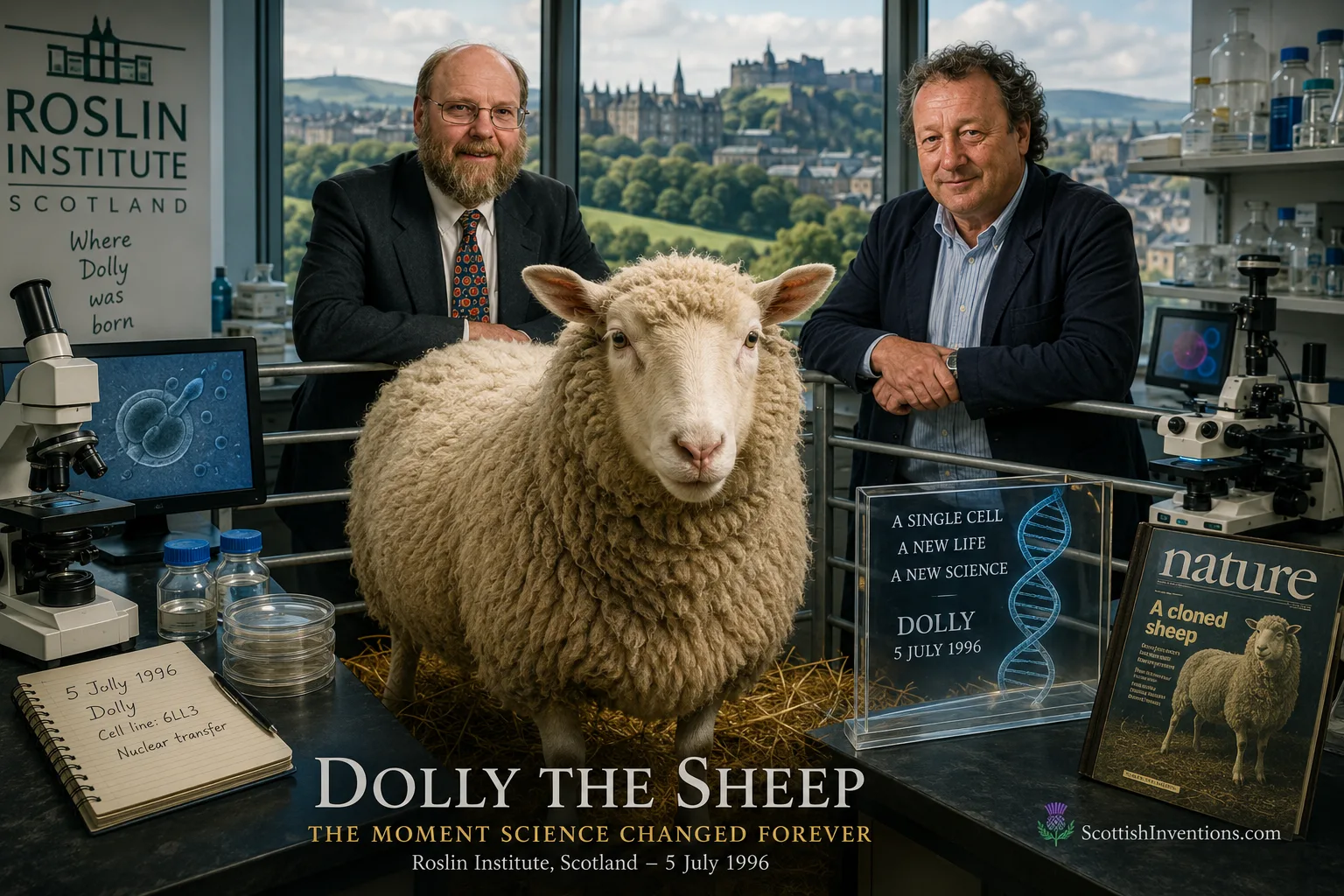
A single lamb, born quietly at the Roslin Institute outside Edinburgh on 5 July 1996, overturned a century of biological dogma and opened the door to modern regenerative medicine. Her creation is also a case study in how scientific credit is claimed, contested, and — eventually — corrected.
Ian Wilmut · 1944–2023Keith Campbell · 1954–2012Roslin Institute, MidlothianReading time · 18 min
In Brief
Dolly the Sheep was born on 5 July 1996 at the Roslin Institute near Edinburgh, the first mammal ever cloned from an adult (somatic) cell, using a technique called somatic cell nuclear transfer. The project was led by Sir Ian Wilmut, but the decisive technical breakthrough — forcing the donor cell into a dormant, quiescent state before nuclear transfer — was devised by cell biologist Keith Campbell. Wilmut himself later said, and testified under oath, that Campbell deserved the greater share of the credit. Bill Ritchie carried out the delicate micromanipulation, and the work was co-funded by the Scottish firm PPL Therapeutics. Dolly proved that an adult cell's genome retains the full instructions to build a whole new animal — a discovery that helped launch modern stem-cell science and regenerative medicine.
Scottish Impact Index (SI Score)
- Global Impact
- 10/10
- Longevity
- 8/10
- Economic / Material Impact
- 6/10
- Originality / Distinctiveness
- 10/10
- Legacy (Built Upon)
- 8/10
- Recognition
- 9/10
Key Facts
- Discovery
- First cloning of a mammal from an adult (somatic) cell
- Animal
- Dolly the Sheep, a Finn Dorset ewe, laboratory designation 6LL3
- Born
- 5 July 1996, Roslin Institute, Midlothian, Scotland
- Announced
- 22–27 February 1997, following an early leak to The Observer
- Institution
- Roslin Institute, near Edinburgh, with PPL Therapeutics
- Lead scientists
- Sir Ian Wilmut (1944–2023) and Keith Campbell (1954–2012)
- Decisive technical insight
- Keith Campbell's cell-cycle quiescence (G0) method for the donor cell
- Also credited
- Bill Ritchie (micromanipulation), Angelika Schnieke, Karen Mycock, PPL Therapeutics
- Method
- Somatic cell nuclear transfer (SCNT) from a mammary-gland cell
- Published
- Nature 385, 810–813 (27 February 1997), ‘Viable offspring derived from fetal and adult mammalian cells’
- Success rate
- 1 live lamb from 277 reconstructed embryos
- Died
- 14 February 2003, aged six and a half, of ovine pulmonary adenocarcinoma
- On display
- National Museum of Scotland, Edinburgh, since 2003
- Claim status
- Established as a Scottish institutional achievement (Roslin Institute); individual credit is genuinely shared and contested — see below
Introduction — The Lamb That Rewrote Biology
Of all the discoveries ever made on Scottish soil, few have rippled outward as far as the one that began with a single lamb in a quiet field outside Edinburgh. On 5 July 1996, at the Roslin Institute in Midlothian, a Finn Dorset ewe gave birth to a 6.6-kilogram lamb known in the laboratory only as 6LL3. The world would come to know her as Dolly — the first mammal ever cloned from an adult body cell.
Dolly was not merely an extraordinary animal; she was a living refutation of a century of biological dogma. Her existence proved that the DNA in a fully grown, specialised cell still held the complete blueprint to build a whole new creature. From that single Scottish lamb came the modern stem-cell revolution, the foundations of regenerative medicine, and a worldwide bioethics debate that continues to this day.
Her existence was kept quiet for seven months. She was born in July 1996 but the story only broke, ahead of schedule, in The Observer in February 1997, forcing the Roslin Institute to confirm her existence on 22 February, days before the formal scientific paper appeared in Nature on 27 February 1997. The announcement made Dolly, briefly, the most famous animal on Earth.
Two Englishmen, a Scottish Triumph
Like Joseph Lister — the Englishman whose revolutionary antiseptic surgery was developed in Glasgow and Edinburgh — the two scientists most closely associated with Dolly were born south of the border, but their world-changing work was carried out entirely in Scotland.
Sir Ian Wilmut (1944–2023) was born in Hampton Lucy, Warwickshire, and read agricultural science at Nottingham before completing a PhD on the deep-freezing of embryos at Darwin College, Cambridge. In 1973 he took a post at the Animal Breeding Research Organisation at Roslin, just south of Edinburgh, where he spent his career studying embryo development and, later, the genetic engineering of livestock.
Keith Campbell (1954–2012) was born in Birmingham to an English mother and a Scottish father, and began his schooling in Perth, Scotland. After a winding route through microbiology at Queen Elizabeth College, London, and a DPhil at the University of Sussex, he joined Roslin in 1991. Wilmut hired him specifically because Campbell's expertise in the cell cycle could solve the problem that had defeated everyone else. The work was funded in part by the Scottish biotechnology company PPL Therapeutics and carried out using an egg from a Scottish Blackface ewe and a Scottish Blackface surrogate. Dolly is, in every institutional sense that matters, a Scottish achievement — even though neither lead scientist was Scottish by birth.
The Dogma Dolly Broke
To understand the magnitude of Dolly, it helps to understand the dogma she destroyed. As an animal develops, a single fertilised egg divides and its descendant cells differentiate into specialised types — skin, muscle, nerve, liver, udder. The prevailing belief through much of the twentieth century, rooted in ideas associated with the nineteenth-century biologist August Weismann, was that this specialisation was essentially irreversible. Once a cell became an udder cell, the genetic information it no longer needed was thought to be switched off, lost, or permanently locked away.
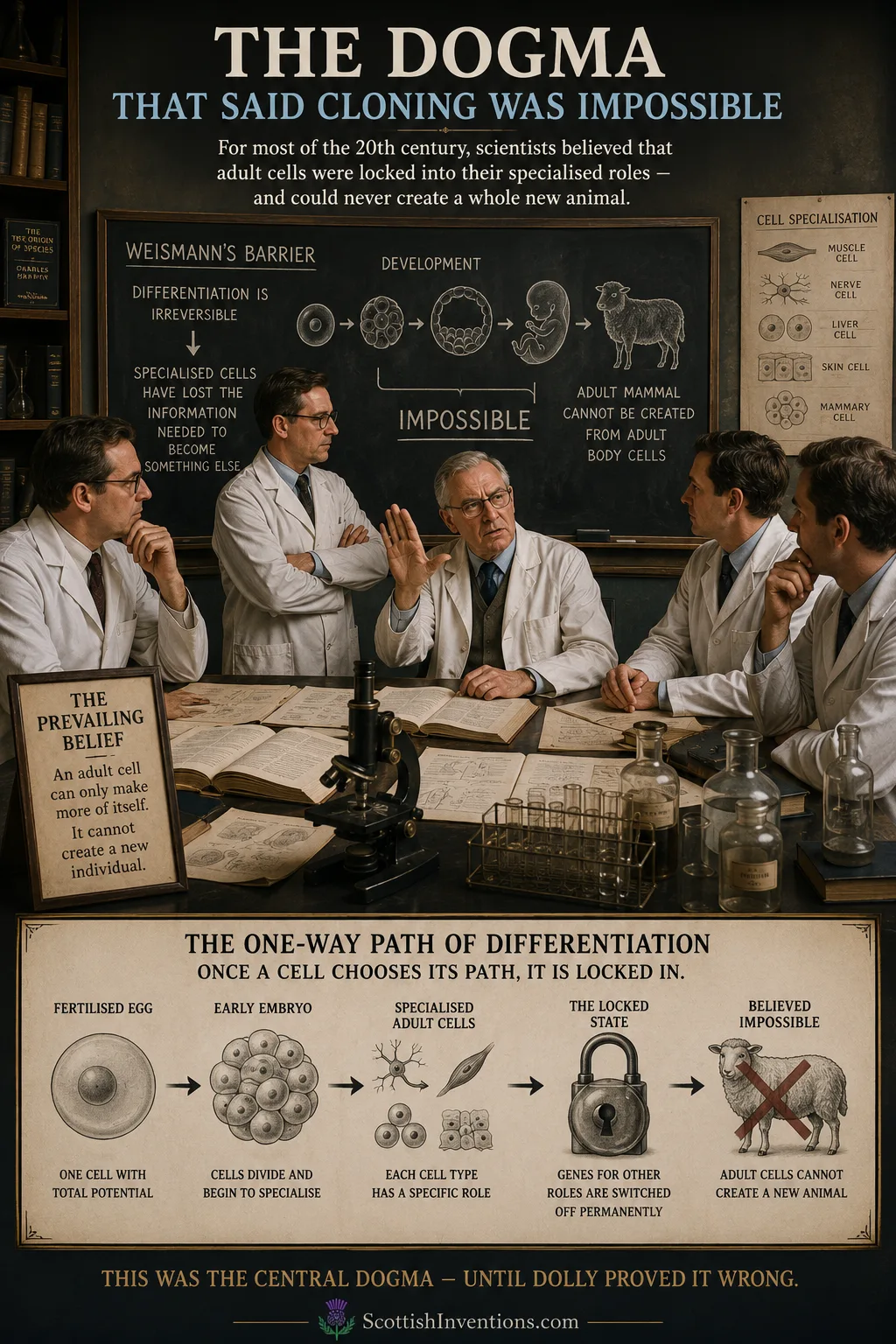
Through the 1970s and 1980s, most mammalian biologists held firm to the view that, whatever amphibians might allow, the mammalian case was fundamentally different — that the genome of an adult mammalian cell simply could not be persuaded to start over. Somatic cell nuclear transfer from an adult mammal was considered, by serious scientists, to be effectively impossible.
Precedents: Briggs, Gurdon, Megan and Morag
Fair credit requires acknowledging the ladder Dolly climbed. Cloning by nuclear transfer was neither a Scottish nor a 1996 invention. In 1952, the American embryologists Robert Briggs and Thomas King transferred nuclei from early frog embryo cells into enucleated frog eggs, producing the first cloned vertebrates — leopard frogs cloned from embryonic, not adult, cells.
A far more significant precedent came from Oxford. Between 1958 and 1962, John Gurdon transplanted nuclei from increasingly specialised Xenopus frog cells — ultimately from the intestinal cells of a fully mature, feeding tadpole — into enucleated frog eggs, and obtained swimming tadpoles and, later, adult frogs. This was the first solid evidence that a differentiated animal cell's genome retained the full instructions needed to build an entire organism. Gurdon shared the 2012 Nobel Prize in Physiology or Medicine with Shinya Yamanaka for this and related work. But frogs are not mammals, and their eggs and cell biology differ from those of sheep or mice in ways that mattered greatly to the practical difficulty of the problem.
Closer to home, the Roslin team itself had already taken the first mammalian step. In July 1995, Campbell and Bill Ritchie produced Megan and Morag, two lambs cloned from cells taken from a cultured, differentiating sheep embryo — not yet from a fully adult animal, but far more specialised than a single fertilised egg. Megan and Morag proved that cells grown and partly differentiated in culture could still yield live mammalian offspring, and gave the team the confidence, and much of the method, needed for the leap to an adult cell a year later.
Campbell's Breakthrough
The step from Megan and Morag to Dolly required solving a problem that had stumped cloning researchers for years: the cell cycles of the donor nucleus and the recipient egg had to be properly synchronised, or the resulting embryo would carry the wrong number of chromosomes and fail. This was Keith Campbell's area of deep expertise, and it was his insight, more than any other single factor, that made Dolly possible.
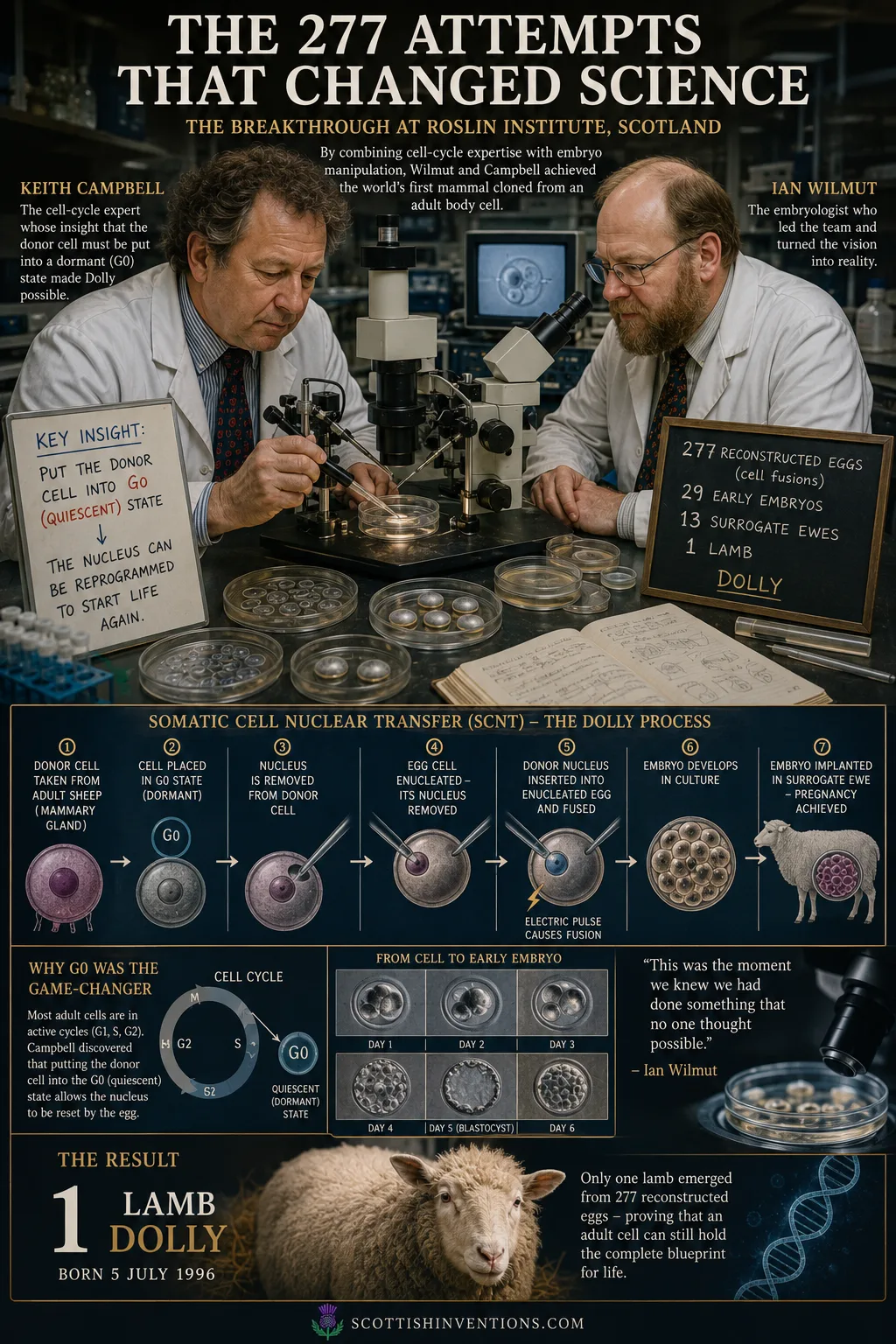
Campbell recognised that the donor cell should be pushed into a quiescent, non-dividing state known as G0 before its nucleus was transferred. By starving the donor cells of serum nutrients, the team could arrest them in this dormant phase, making the nucleus far more receptive to being reprogrammed by the recipient egg's own cytoplasm. It was a deceptively simple idea, drawn from Campbell's specialist knowledge of cell-cycle biology, and it succeeded where more elaborate approaches elsewhere had failed.
How Dolly Was Made
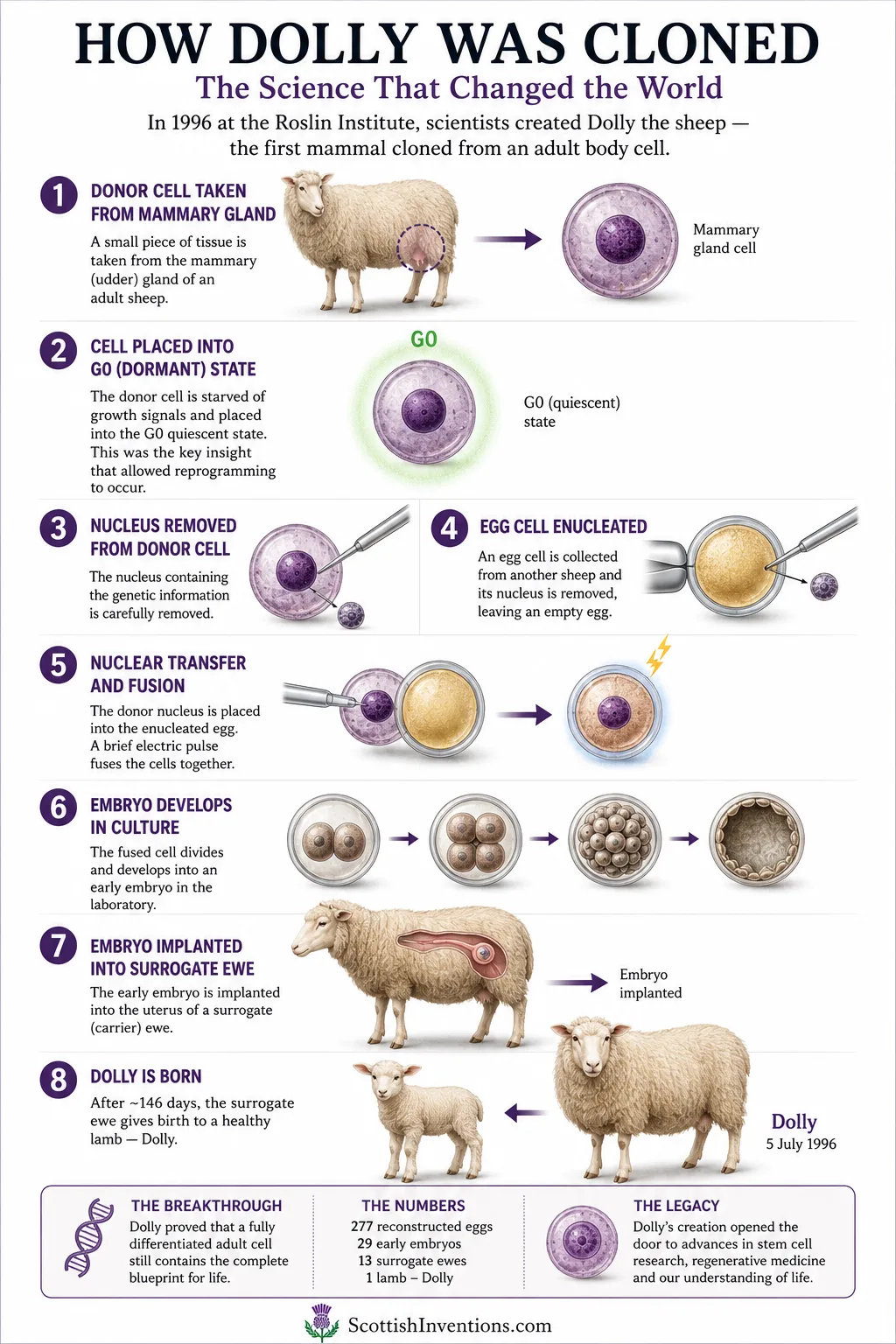
In practical terms: the team took a mammary-gland cell from a six-year-old Finn Dorset ewe; starved it of nutrients to induce the quiescent G0 state; removed the nucleus from an unfertilised egg taken from a Scottish Blackface ewe; fused the donor cell with the enucleated egg using a brief pulse of electricity, which both triggered fusion and mimicked the activation of fertilisation; cultured the resulting reconstructed embryo in the laboratory for around six days; and implanted the surviving embryo into the uterus of a surrogate Scottish Blackface ewe. Bill Ritchie carried out the exacting micromanipulation — the physical work of removing and inserting nuclei under the microscope — without which the idea could not have been executed.
Of 277 reconstructed eggs, only 29 developed into embryos judged suitable for implantation. Those were placed into thirteen surrogate ewes. Only one pregnancy went to term. After 148 days of gestation, that single surrogate gave birth to a healthy lamb — the first mammal ever cloned from an adult cell. The 1997 Nature paper credited Wilmut and Campbell as lead authors, with Angelika Schnieke, Jim McWhir, Bill Ritchie and Karen Mycock also named as authors for their respective contributions to the work.
Who Really Deserves the Credit?
Dolly's story is, among other things, a case study in how scientific credit gets distributed — and sometimes redistributed. In the years immediately after 1997, Ian Wilmut, as project leader and lead author, became the public face of the achievement: he was profiled, interviewed, and eventually knighted in 2008 for services to science.
Wilmut himself pushed back against this framing. In a 2006 interview he stated that Keith Campbell deserved the greater share of the credit for Dolly, at one point suggesting a split of roughly 66 per cent to Campbell and 34 per cent to himself. That same year, giving evidence to a UK patent tribunal considering rival claims over the underlying cloning technology, Wilmut testified under oath that his own role in the popular, headline account of Dolly's creation had been overstated — that Campbell's cell-cycle insight, not his own contribution, was the specific technical breakthrough that made the experiment succeed.
This candour deserves to be taken seriously rather than treated as false modesty. Campbell was the specialist in cell-cycle biology; the quiescence method was his idea, drawn from his own doctoral and postdoctoral research; and without it the earlier failed attempts at adult-cell cloning, at Roslin and elsewhere, would very likely have continued to fail. Bill Ritchie's practical skill at the micromanipulation bench was equally indispensable — a contribution too easily lost in accounts that reduce Dolly to a contest between two named scientists. Angelika Schnieke and Karen Mycock's laboratory work, and PPL Therapeutics' co-funding and commercial partnership, complete a picture of a genuinely collective achievement.
Yet history's rewards have not tracked this reassessment. Wilmut was knighted in 2008; Campbell, despite being — by Wilmut's own later account — the more technically decisive figure, was never knighted. He died in 2012, aged 58, having shared the 2008 Shaw Prize for Medicine and Life Sciences with Wilmut and Yamanaka, and having received the International Embryo Transfer Society's Pioneer Award only posthumously, in 2015. Any fair account of Dolly the Sheep must state plainly that the individual whose insight made her possible was, for most of the public record, also the individual least publicly credited for it.
Why Dolly Mattered
Dolly proved that the DNA in an adult, fully differentiated somatic cell retains the complete genetic blueprint of the whole organism, and that this genome can be reprogrammed to build an entirely new animal. The decades-old dogma of irreversible differentiation was overturned in a single Scottish lamb.
The implications cascaded outward. Dolly gave enormous momentum to research on therapeutic cloning, stem-cell biology, and cellular ageing and reprogramming. Most importantly, she set the conceptual stage for the next great leap in the field: in 2006 Shinya Yamanaka showed that introducing just four specific genes could reprogram an adult mouse cell back into a pluripotent, stem-cell-like state — the induced pluripotent stem (iPS) cell. The idea that reprogramming an adult mammalian cell was even possible had already been demonstrated, unambiguously, by Dolly.
The Ethical and Political Reaction
No scientific announcement of the 1990s provoked a faster political response. Within weeks of the February 1997 paper, governments, religious authorities and international bodies were drafting positions on a technology that had existed, in mammals, for a matter of months.
Ian Wilmut himself was among the first to argue against extending the method to people. Testifying before a United States Senate subcommittee on 12 March 1997, he called the prospect of human cloning “unethical” and “quite inhumane”, pointing to the losses and abnormalities seen in the animal work as reason enough not to attempt it in humans (reported by the Washington Post, 13 March 1997). The team that had done the thing everyone feared was, in public, the party urging restraint.
In the United States the response moved quickly from words to policy. In March 1997 President Bill Clinton imposed a moratorium on the use of federal funds for human cloning research and asked the National Bioethics Advisory Commission to report. Acting on the Commission’s recommendation, in June 1997 he proposed legislation to prohibit human cloning — a bill that, like several successors, did not pass into federal law, leaving the funding restriction rather than a statutory ban as the operative measure.
Religious authorities responded just as promptly. In late February 1997 the Vatican newspaper L’Osservatore Romano published an editorial condemning the prospect of applying the technique to human beings and calling for the right of every person to be conceived and born naturally to be respected. The Pontifical Academy for Life followed later in 1997 with a fuller statement, “Reflections on Cloning”, setting out the theological and ethical objections in detail while distinguishing human reproductive cloning from animal work.
The international settlement, when it came, was weaker than either camp wanted. In 2005 the United Nations General Assembly adopted the Declaration on Human Cloning, calling on member states to prohibit all forms of human cloning incompatible with human dignity. It was non-binding, adopted by a divided vote, and its ambiguity over therapeutic cloning meant that national law — not the Declaration — continued to determine what was actually permitted. Nearly three decades on, that patchwork remains the reality.
Dolly's Life, Death and the Ageing Question
Dolly lived her entire life at the Roslin Institute, where she became the most photographed sheep in history — friendly, curious, and thoroughly indulged by visitors. She bred naturally with a Welsh Mountain ram named David, producing six lambs between 1998 and 2000 and demonstrating that a cloned animal could reproduce normally.
In February 2003 a CT scan revealed tumours in her chest — ovine pulmonary adenocarcinoma, a lung disease caused by a retrovirus common among sheep kept indoors. She was euthanised on 14 February 2003, aged six and a half. Her body was preserved by taxidermy and donated to National Museums Scotland; she has been on display at the National Museum of Scotland in Edinburgh ever since.
A 1999 study found Dolly's telomeres were shorter than expected for a sheep her age, raising fears she had been “born old”. But a 2016 University of Nottingham study of thirteen aged cloned sheep — four of them genetic copies of Dolly — found that somatic cell nuclear transfer “has no obvious detrimental long-term health effects”. The consensus today is that premature ageing is not an inevitable consequence of cloning, though Dolly's own arthritis and relatively early death continue to be discussed as a possible, if unproven, exception.
Legacy
Sir Ian Wilmut spent his later career championing regenerative medicine, becoming founding director of the MRC Centre for Regenerative Medicine at the University of Edinburgh in 2006. He was appointed OBE in 1999 and knighted in 2008 for services to science. He died in 2023, aged 79.
Keith Campbell — and this point matters — was not knighted, despite frequent claims to the contrary that circulate online. He shared the 2008 Shaw Prize for Medicine and Life Sciences with Wilmut and Yamanaka, and received the International Embryo Transfer Society's Pioneer Award posthumously in 2015. He died at his home in Nottinghamshire in 2012, aged 58.
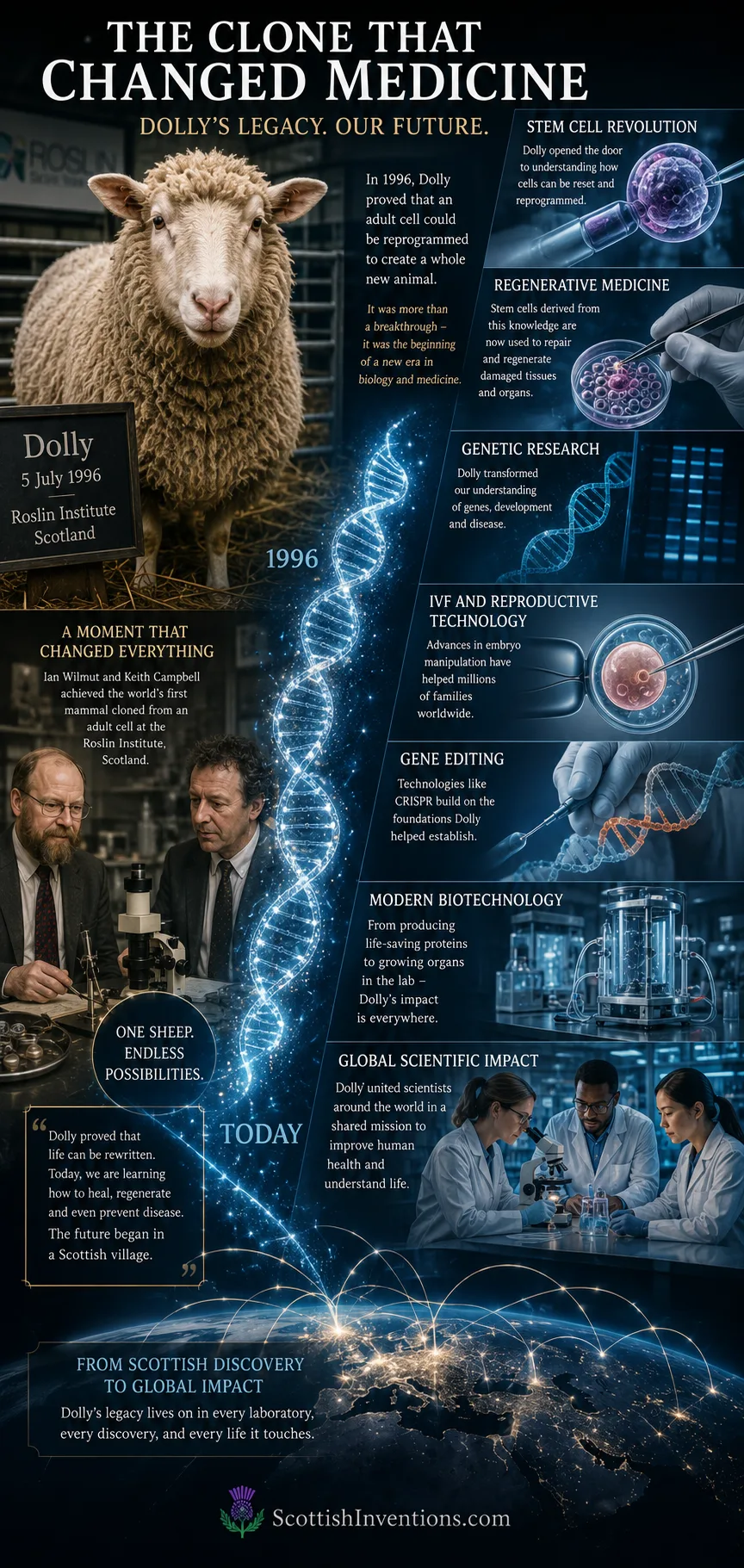
Dolly opened the floodgates. Cats, dogs, cattle, pigs, horses, deer, mice and rats have all since been cloned using the same fundamental technique. Cloning has even been applied to endangered species — a Pyrenean ibex was briefly, if only very briefly, brought back from extinction in 2009. The Roslin Institute, now part of the University of Edinburgh, continues to build on the Dolly legacy in genetics and regenerative medicine. The broadest legacy, though, is conceptual: Dolly changed our understanding of what a cell can do, proving that the developmental clock can be turned back — and that a decisive chapter of the future of medicine began in a Scottish research institute.
Did You Know?
- Dolly was named after Dolly Parton because she was cloned from a mammary-gland (udder) cell.
- Dolly was the only live lamb produced from 277 reconstructed eggs made with adult cells.
- She bred naturally with a Welsh Mountain ram named David and had six lambs of her own.
- Dolly was born in July 1996, but her existence was not announced until February 1997, after a leak to The Observer.
- Her taxidermied body has been on display at the National Museum of Scotland in Edinburgh since 2003.
- The decisive scientific insight was Keith Campbell's idea of putting the donor cell into a quiescent G0 state.
- In 2006 Ian Wilmut said publicly that Campbell deserved '66 per cent' of the credit for Dolly — and testified to the same effect under oath.
- Megan and Morag, cloned from embryonic cells in 1995, were Dolly's direct forerunners at the same Roslin laboratory.
Timeline
1952
Briggs and King clone leopard frogs from embryonic cell nuclei
The first successful nuclear transfer in a vertebrate, using early blastula cells
1958–62
John Gurdon clones Xenopus frogs from tadpole and adult intestinal cell nuclei
Proof that a differentiated animal cell's genome retains full developmental potential — work later shared in the 2012 Nobel Prize
1991
Keith Campbell joins the Roslin Institute
Brought expertise in cell-cycle biology that Ian Wilmut lacked
1995
Megan and Morag are born — lambs cloned from cultured embryonic cells
Wilmut, Campbell and Bill Ritchie prove cultured, differentiating cells can still yield live offspring
5 Jul 1996
Dolly is born, a Finn Dorset lamb cloned from an adult mammary-gland cell
The 277th and only successful reconstruction to produce a live birth
22 Feb 1997
Roslin Institute confirms Dolly's existence
After The Observer breaks the story ahead of schedule
27 Feb 1997
The paper is published in Nature, 385: 810–813
Dolly becomes a global sensation and a bioethical flashpoint
1998–2000
Dolly breeds naturally with a Welsh Mountain ram named David
Produces six lambs, showing a clone can reproduce normally
14 Feb 2003
Dolly is euthanised after a CT scan reveals lung tumours
Ovine pulmonary adenocarcinoma, a disease common in sheep kept indoors, unrelated to cloning by most evidence
2006
Ian Wilmut states publicly that Keith Campbell deserved the greater share of the credit
He proposed a 66/34 split in Campbell's favour
2006
Wilmut also gives evidence to a UK patent tribunal
Testifying that his own contribution to the practical breakthrough had been overstated in the popular account
2012
Keith Campbell dies, aged 58
He was never knighted, despite the achievement he was central to
2023
Sir Ian Wilmut dies, aged 79
He had been knighted in 2008 and led Edinburgh's MRC Centre for Regenerative Medicine from 2006
Notes on the Evidence
Credit division. Wilmut's 2006 remarks about a “66/34” split, and his patent tribunal testimony that year, are widely reported in the science press and are treated here as authoritative statements by the person best placed to know — the project leader himself. This article follows Wilmut's own later account in giving Campbell's technical contribution primary billing for the scientific breakthrough, while noting that Wilmut's leadership, funding and public advocacy were also essential to the project's completion and impact.
Campbell was never knighted. This is stated explicitly because the error — that Campbell shared a knighthood with Wilmut — circulates persistently online and is not correct.
Nationality. Neither Ian Wilmut nor Keith Campbell was Scottish by birth. Campbell's father was Scottish and Campbell was partly schooled in Perth; Wilmut had no Scottish family connection. The claim made on this page is institutional and geographic — that the discovery was made in Scotland, at a Scottish research institute, using Scottish sheep — not that its lead scientists were Scots.
Ageing controversy. The 1999 telomere finding and the 2016 Nottingham reassurance study are both genuine and are presented together, since the scientific record on this question remains somewhat unsettled rather than fully closed.
Precedent studies. Briggs and King (1952) and Gurdon (1958–62) are described accurately as cloning from embryonic and, in Gurdon's later work, fully differentiated tadpole cells — achievements in amphibians that pre-date Dolly by decades. Dolly's distinct claim to fame is specifically the first cloning of a mammal from a fully adult, differentiated cell.
Frequently Asked Questions
Who actually cloned Dolly the Sheep?
Dolly was produced by a team at the Roslin Institute near Edinburgh, led jointly by Sir Ian Wilmut and Keith Campbell. Wilmut led the project and secured funding; Campbell supplied the decisive technical insight — that the donor cell had to be starved into a quiescent, non-dividing (G0) state before its nucleus was transferred. Bill Ritchie carried out the delicate micromanipulation; Angelika Schnieke and Karen Mycock were also named authors on the 1997 Nature paper; and the work was co-funded by the Scottish biotech company PPL Therapeutics.
Was Ian Wilmut or Keith Campbell more responsible for Dolly?
This is genuinely contested, and Wilmut himself settled much of the ambiguity. In 2006 he stated publicly that Campbell deserved the greater share of the credit, at one point proposing a 66/34 split in Campbell's favour, and in testimony to a UK patent tribunal that year he conceded that his own role in the popular, headline account of Dolly's creation had been overstated. The cell-cycle synchronisation method that made nuclear transfer from an adult cell work at all was Campbell's contribution. Wilmut remained the project leader and public face of the work, and was knighted in 2008; Campbell, despite being the more technically decisive figure, was never knighted and died in 2012.
Was Dolly really the first cloned mammal?
Dolly was the first mammal cloned from an adult, fully differentiated somatic cell — a cell taken from a grown animal's mammary gland rather than from an embryo. She was not the first cloned mammal in any sense: in 1995 the same Roslin team, using cells from a cultured embryo rather than an adult, had already produced two lambs, Megan and Morag. What made Dolly historic was cloning from adult tissue, which overturned the assumption that once a cell had specialised, its genome could no longer be reset to build a whole new animal.
Did anyone clone an animal before Dolly?
Yes, and this history matters. Robert Briggs and Thomas King cloned leopard frogs from embryonic nuclei in 1952. From 1958 to 1962, John Gurdon in Oxford produced cloned Xenopus frogs from tadpole and, eventually, adult intestinal cell nuclei — work recognised in the 2012 Nobel Prize in Physiology or Medicine, shared with Shinya Yamanaka. These experiments proved the principle in amphibians decades earlier. What remained unresolved until 1996 was whether the same was true of mammals, whose cell biology was then believed to make adult-cell cloning impossible.
Why was Dolly named after Dolly Parton?
Dolly was cloned from a cell taken from a ewe's mammary gland, and one of the technicians on the team suggested naming her after the singer Dolly Parton, on the grounds that no udder was more famous. The name stuck and became, almost accidentally, one of the most recognisable in the history of science.
Did Dolly age prematurely because she was a clone?
A 1999 study found Dolly's telomeres — the protective caps on chromosomes that shorten with age — were shorter than expected for her age, prompting fears she had been ‘born old’. Dolly did develop arthritis relatively young and died at six and a half of a lung disease common in sheep housed indoors. However, a 2016 University of Nottingham study of thirteen aged cloned sheep, including four genetic copies of Dolly, found no evidence of long-term detrimental health effects from cloning. The scientific consensus today is that premature ageing is not an inevitable consequence of somatic cell nuclear transfer, though Dolly's own case remains debated.
Where is Dolly the Sheep now?
After her death in February 2003, Dolly's body was preserved by taxidermy and donated to National Museums Scotland. She has been on permanent public display at the National Museum of Scotland in Edinburgh since 2003.
What did Dolly lead to?
Dolly proved that an adult mammalian cell's genome could be reprogrammed to build a whole new organism, giving enormous momentum to stem-cell research and regenerative medicine. Cats, dogs, cattle, pigs, horses and other species have since been cloned using the same basic technique. Conceptually, Dolly's proof that cellular differentiation was reversible helped set the stage for Shinya Yamanaka's 2006 discovery that four genes could reprogram an adult cell into an induced pluripotent stem cell — for which Yamanaka shared the 2012 Nobel Prize with Gurdon.
Is Dolly the Sheep a Scottish discovery?
The work was carried out entirely in Scotland, at the Roslin Institute near Edinburgh, using a Scottish Blackface egg donor and surrogate and co-funded by the Scottish company PPL Therapeutics. Both lead scientists, however, were born in England: Ian Wilmut in Warwickshire and Keith Campbell in Birmingham (Campbell was raised partly in Perth, Scotland, and his father was Scottish). The achievement belongs to Scottish science and to the Roslin Institute as an institution, even though its principal architects were not Scots by birth — a pattern also seen with Joseph Lister's antiseptic surgery, developed in Glasgow and Edinburgh by an Englishman.
Sources
Tier 1 · Primary
- Reports of Ian Wilmut's 2006 public remarks and UK patent tribunal testimony on the division of credit for Dolly, as covered in the contemporary science press.
Tier 2 · Scholarly and institutional
- Wilmut, I., Schnieke, A. E., McWhir, J., Kind, A. J., & Campbell, K. H. S. (1997). “Viable offspring derived from fetal and adult mammalian cells.” Nature, 385, 810–813.
- Gurdon, J. B. (1962). “The developmental capacity of nuclei taken from intestinal epithelium cells of feeding tadpoles.” Journal of Embryology and Experimental Morphology, 10, 622–640.
- Briggs, R., & King, T. J. (1952). “Transplantation of Living Nuclei From Blastula Cells into Enucleated Frogs' Eggs.” Proceedings of the National Academy of Sciences, 38(5), 455–463.
- Sinclair, K. D., et al. (2016). “Healthy ageing of cloned sheep.” Nature Communications, 7, 12359.
- Shiels, P. G., et al. (1999). “Analysis of telomere lengths in cloned sheep.” Nature, 399, 316–317.
- Roslin Institute, University of Edinburgh — institutional history and archive materials on Dolly the Sheep.
- National Museums Scotland — Dolly the Sheep collection record and exhibition materials.
- The Nobel Prize in Physiology or Medicine 2012 — award documentation for Sir John B. Gurdon and Shinya Yamanaka.