Discoveries · No. 5 of 50 · Physics
The Man Who Was Right for 48 Years: Peter Higgs and the Particle He Predicted from Edinburgh
In 1964, a lecturer at the University of Edinburgh predicted a particle nobody could yet build a machine to find. CERN found it on 4 July 2012.
Peter Higgs · 1929–2024University of EdinburghReading time · 14 minUpdated 1 August 2026
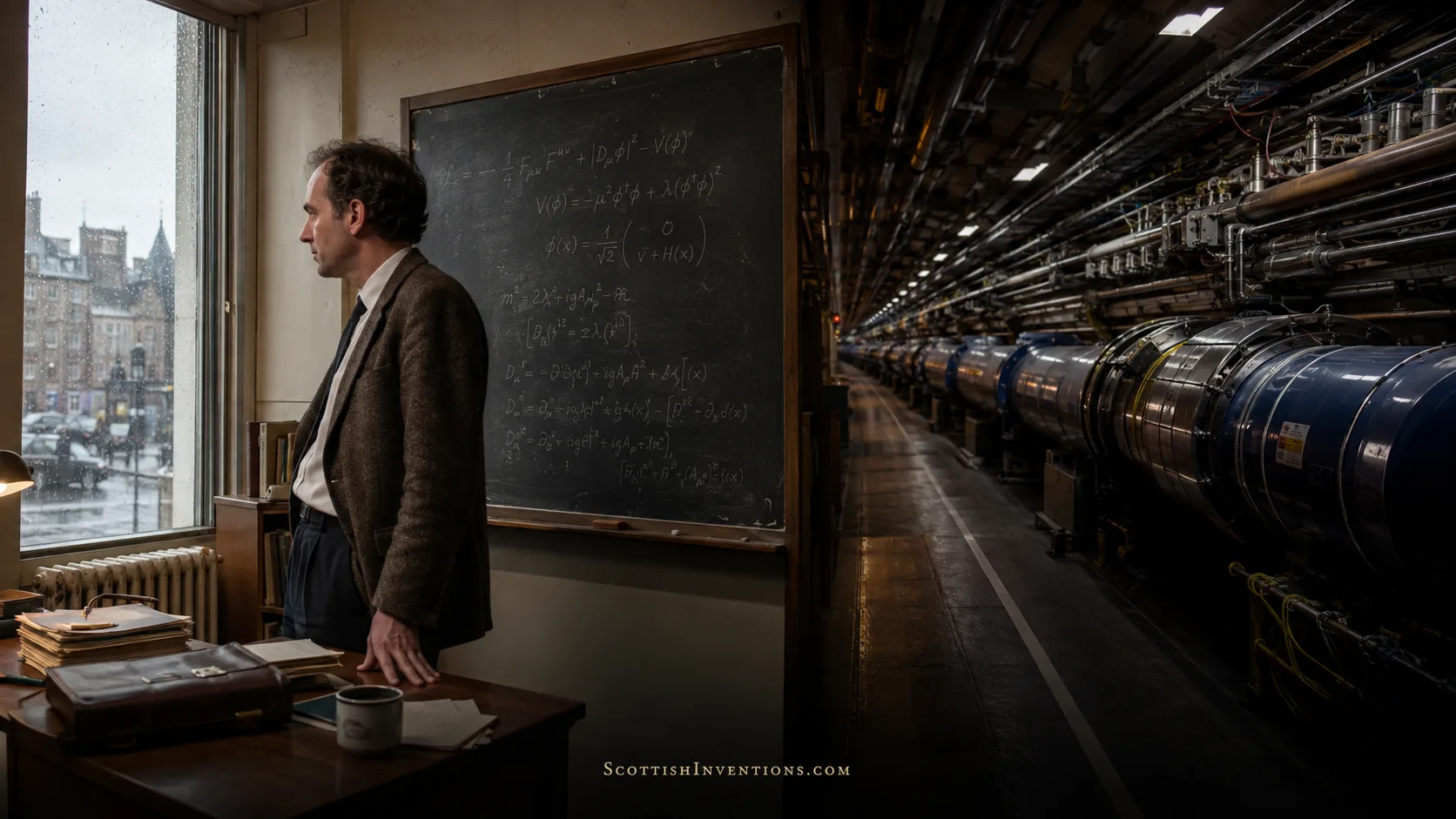
TL;DR
- In 1964, working as a lecturer at the University of Edinburgh, Peter Higgs predicted that an invisible field filling all of space — and its associated particle, the Higgs boson — must exist to explain why fundamental particles have mass. The particle was finally found at CERN on 4 July 2012, an astonishing 48 years later, and Higgs shared the 2013 Nobel Prize in Physics with François Englert.
- Born in Newcastle upon Tyne in 1929, Higgs was English by birth but Scottish by life and career: he spent over five decades at Edinburgh, made the city his adopted home, and died there in 2024. The institution and the city are inseparable from his scientific identity.
- His prediction is one of the longest-range successful forecasts in the history of science, and this article carefully separates the verified facts from the popular myths — including the misleading “God particle” nickname and the widespread misconception that the Higgs gives everyday objects their mass.
Scottish Impact Index (SI Score)
- Global Impact
- 10/10
- Longevity
- 9/10
- Economic / Material Impact
- 3/10
- Originality / Distinctiveness
- 10/10
- Legacy (Built Upon)
- 9/10
- Recognition
- 8/10
Key Findings
- Verified prediction and confirmation. Higgs's decisive paper, “Broken Symmetries and the Masses of Gauge Bosons”, was received by Physical Review Letters on 31 August 1964 and published on 19 October 1964. It was the paper that explicitly predicted a new massive scalar boson. CERN announced the discovery of a matching particle on 4 July 2012.
- A shared idea, fairly credited. Higgs was one of three independent teams in 1964. CERN and the University of Edinburgh both call the underlying idea the Brout–Englert–Higgs mechanism.
- The Scottish connection is real and deep. Higgs took up a lectureship at Edinburgh's Tait Institute of Mathematical Physics in October 1960 and remained at the University for the rest of his career, becoming Professor of Theoretical Physics in 1980.
- The myths matter. The Higgs mechanism accounts for only about 1% of the mass of a proton; the “God particle” nickname came from a publisher, not from physics, and Higgs disliked it.
Quick Facts
- Discovery
- Prediction of the Higgs field, the mass-giving mechanism and a new massive scalar boson
- Year
- 1964 (Physics Letters, 15 September; Physical Review Letters, 19 October)
- Key figure
- Peter Ware Higgs (1929–2024)
- Place
- Tait Institute of Mathematical Physics, University of Edinburgh
- Field
- Physics · Theoretical particle physics
- Born / died
- 29 May 1929, Elswick, Newcastle upon Tyne · 8 April 2024, Edinburgh
- Shared credit
- Brout–Englert–Higgs mechanism (Brout, Englert; Guralnik, Hagen, Kibble)
- Claim status
- Shared attribution — three independent groups published the mechanism in 1964
- Confirmed
- 4 July 2012 by ATLAS and CMS at CERN's Large Hadron Collider, near 125 GeV
- Nobel Prize
- Physics 2013, shared with François Englert
- Measured mass
- 125.25 ± 0.17 GeV (Particle Data Group global average)
Who Was Peter Higgs?
Peter Ware Higgs (1929–2024) was a theoretical physicist at the University of Edinburgh. In 1964, working at the Tait Institute of Mathematical Physics on Roxburgh Street, he published two short papers showing how fundamental particles could acquire mass — and, in the second, explicitly predicting a new massive scalar particle. Forty-eight years later, on 4 July 2012, the ATLAS and CMS experiments at CERN's Large Hadron Collider announced a new particle matching that prediction near 125 GeV. In 2013 Higgs shared the Nobel Prize in Physics with the Belgian theorist François Englert.
He was born in England, to an English father and a Scottish mother, and he never claimed otherwise. But his science belongs to Edinburgh: he worked there from October 1960 until his retirement in 1996, called the city “my adopted home”, and died there on 8 April 2024, aged 94.
Early Life and Edinburgh
Peter Ware Higgs was born on 29 May 1929 in the Elswick district of Newcastle upon Tyne, England — a date and place confirmed by the Nobel Foundation, Encyclopaedia Britannica and the University of Edinburgh. His father, Thomas Ware Higgs, was a sound engineer for the BBC; his mother, Gertrude Maude (née Coghill), was Scottish — a detail the Nobel Foundation records explicitly. Childhood asthma and the disruption of his father's job and the Second World War meant Higgs missed some early schooling and was partly taught at home, largely in Bristol. He attended Cotham Grammar School in Bristol, where he was inspired by the work of a former pupil, the great quantum physicist Paul Dirac.
In 1947, aged 17, Higgs went to King's College London to study physics, graduating with first-class honours in 1950, taking his MSc in 1951 and his PhD in 1954 for a thesis on molecular vibrations. After his doctorate he moved to the University of Edinburgh as a senior research fellow, spent the late 1950s back in London at University College and Imperial College, and then returned to Edinburgh in October 1960 to take up a lectureship at the Tait Institute of Mathematical Physics. He was promoted to Reader in 1970 and to a personal chair as Professor of Theoretical Physics in 1980, retiring in 1996 as Professor Emeritus.
Is he Scottish?
His character was famously self-effacing. Colleagues and the world's press reached for the same words: “modest”, “shy”, “uncomfortable as a celebrity”. He had no mobile phone, no television and little internet contact for most of his life. His biographer Frank Close titled his 2022 book Elusive because, as Close put it, Higgs the man was every bit as elusive as his boson. The Scotsman's obituary captured it well: “For decades, Professor Peter Higgs was as unknown to most of the world as the particle that bears his name.” He died peacefully at home in Edinburgh on 8 April 2024, aged 94.
Why Do Particles Have Mass?
To understand why Higgs's idea was so important, you need to understand the crisis it solved. By the early 1960s, physicists were building what became the Standard Model — a quantum theory describing nature's fundamental particles and forces. Forces in this picture are carried by particles called gauge bosons. Electromagnetism is carried by the photon, which is massless, and that masslessness is why light and the electromagnetic force reach across the universe.
But there was a deep problem with the weak nuclear force — the force responsible for certain kinds of radioactive decay. The weak force is extremely short-range, and a short-range force requires heavy carrier particles. Yet the elegant mathematics of gauge theory, which worked beautifully for the massless photon, insisted that the weak force's carriers (later called the W and Z bosons) must also be massless. Putting a mass in “by hand” wrecked the theory's consistency.
So physicists faced a simple-sounding but profound question: why do some particles weigh something and others weigh nothing? What gives matter its mass? This was not an academic nicety. Without some mechanism to give particles mass, atoms could not form, chemistry could not happen, and stars, planets and people could not exist. The universe as we know it depended on solving this puzzle.
The Higgs Mechanism — the 1964 Prediction
The breakthrough came in 1964 — and it came from several people at once. Three independent papers, all now recognised as milestones, were published that year in Physical Review Letters: one by the Belgian theorists Robert Brout and François Englert; one by Peter Higgs; and one by Gerald Guralnik, Carl Hagen and Tom Kibble. Brout and Englert published first, their paper appearing on 31 August 1964. Because all three groups reached compatible conclusions, the idea is properly called the Brout–Englert–Higgs mechanism — a name CERN and Edinburgh both use, and a fair acknowledgement that this was not a lone-genius story.
Higgs actually wrote two short papers in 1964. The first, showing how a loophole in a theorem by Jeffrey Goldstone allowed massive particles to emerge, appeared in Physics Letters on 15 September 1964. His second paper described the model itself — but it was rejected by Physics Letters, whose editors judged it “of no obvious relevance to physics”. Higgs revised it, adding a crucial extra paragraph, and resubmitted it to Physical Review Letters, where it was published on 19 October 1964. That extra material was decisive: it explicitly predicted the existence of a new massive scalar boson — what the world now calls the Higgs boson. This makes Higgs's contribution distinctive: of the 1964 papers, his most clearly pointed to a specific, findable particle.
The physics, in plain terms: imagine the entire universe is filled with an invisible field — the Higgs field — present at every point in space. Particles that interact strongly with this field acquire a lot of mass; particles that interact weakly acquire little; and particles that ignore it altogether, like the photon, stay massless.

The Higgs boson is the particle-like “ripple” or excitation of that field, just as the photon is the particle of the electromagnetic field. The most popular analogy is a celebrity moving through a crowded party: a famous guest is mobbed and slowed (gaining “mass”), while an unknown walks straight across the room unimpeded (staying massless). Higgs developed these ideas in Edinburgh; he reportedly had the key insight after returning to his New Town flat from a washed-out weekend camping trip in the Highlands, though he always insisted there was no single “eureka moment”. He wrote the two 1964 papers in an office at the Tait Institute of Mathematical Physics on Roxburgh Street.
The Long Wait — 1964 to 2012
Then came one of the longest waits in the history of physics: 48 years between prediction and confirmation. Why so long? Because creating a Higgs boson, even for a fleeting instant, requires concentrating an enormous amount of energy in a tiny space — far beyond anything available in 1964. Confirming the idea meant building machines of almost unimaginable power.
For decades, physicists hunted. CERN's Large Electron–Positron Collider and Fermilab's Tevatron in the United States narrowed the search but could not clinch it. The decisive instrument was CERN's Large Hadron Collider (LHC) near Geneva on the Swiss–French border — the world's largest and most powerful particle accelerator. Its tunnel, sitting about 100 metres underground, has a circumference of 26,659 metres (commonly rounded to 27 km) and houses some 9,300 magnets. It was designed so that two proton beams, each reaching a maximum energy of 7 TeV, collide head-on at a combined energy of 14 teraelectronvolts. Finding the Higgs was one of its central goals.
4 July 2012 at CERN
On 4 July 2012, before a packed auditorium at CERN, the spokespeople for two separate, independent detector experiments — ATLAS and CMS — announced that each had observed a new particle with properties matching the long-predicted Higgs boson, near a mass of 125 GeV. The figure has since been pinned down with remarkable precision: the Particle Data Group global average is 125.25 ± 0.17 GeV, and ATLAS's 2023 combined result of 125.11 ± 0.11 GeV is the most precise single measurement to date. At around 10:40 a.m., as applause thundered through the hall, CERN's Director-General Rolf Heuer declared, “As a layman, I would say: now we have it!”
Peter Higgs, then 83, was in the audience — and was filmed wiping away tears.
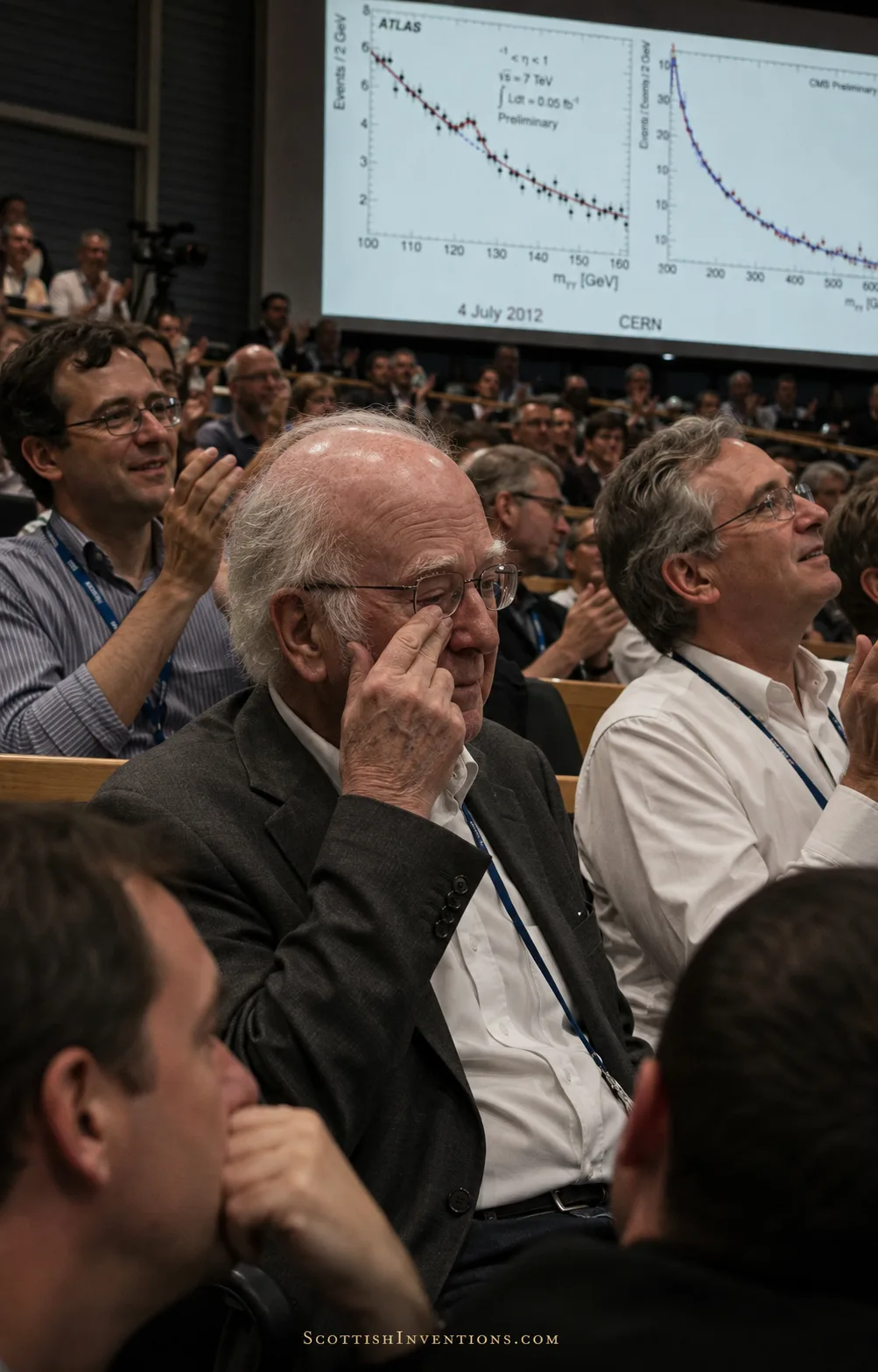
He later explained the emotion simply: “During the talks I was still distancing myself from it all, but when the seminar ended, it was like being at a football match when the home team wins.” He also said it was remarkable the discovery had been made in his lifetime, having earlier reflected, “I certainly had no idea that this would happen in my lifetime,” when he first put the idea on paper.
How the particle was found
The Nobel Prize — 2013
On 8 October 2013, the Royal Swedish Academy of Sciences announced that Peter Higgs and François Englert would share the Nobel Prize in Physics “for the theoretical discovery of a mechanism that contributes to our understanding of the origin of mass of subatomic particles, and which recently was confirmed through the discovery of the predicted fundamental particle, by the ATLAS and CMS experiments at CERN's Large Hadron Collider”.
Why only Higgs and Englert? The Nobel can be shared by at most three living people and is not awarded posthumously. Robert Brout, Englert's co-author, had died in 2011 — one year before the discovery and two before the prize. Higgs himself generously made the point at his press conference: “Unfortunately Robert Brout died a few years ago so is no longer able to be awarded the prize, but he would certainly have been one of the winners if he had still been alive.”
Higgs's reaction to the Nobel is the stuff of legend — and it is well documented. He had deliberately gone out to avoid the media circus, enjoying a leisurely lunch at a seafood bar in Leith. Having no mobile phone, he learned he had won only when a former neighbour — “a lady in her 60s or 70s”, the widow of a judge — got out of her car in the street near his home to congratulate him. “I said, ‘What news?'” Higgs recalled. “And so she told me that her daughter had phoned from London to alert her to the fact that I had got this prize.”
Edinburgh embraced him. Even before the Nobel, the city had named him the recipient of the 2011 Edinburgh Award; on 24 February 2012 the Lord Provost presented him with an engraved loving cup and his handprints were set in Caithness stone in the City Chambers quadrangle. In 2014 he received the Freedom of the City of Edinburgh.
Field, Mechanism, Boson — Keeping Them Straight
- Higgs field
- An invisible field present at every point in space. It is the thing that exists everywhere, all the time.
- Higgs mechanism (Brout–Englert–Higgs mechanism)
- The process by which interaction with that field gives fundamental particles — including the W and Z bosons — their mass without breaking the mathematics of gauge theory.
- Higgs boson
- The particle-like excitation of the field: a ripple that can be created in a collider and detected through its decay products. Finding it is how the field's existence was confirmed.
Timeline
1929
Peter Ware Higgs born in Elswick, Newcastle upon Tyne, 29 May
English father, Scottish mother; partly home-schooled through the war
1947–1954
King's College London: BSc, MSc, then PhD on molecular vibrations
Inspired at school by the work of Paul Dirac
1949
Hitchhikes north to the Edinburgh Festival as a student
“I thought, ‘This is a place I'd like to be.'”
October 1960
Takes up a lectureship at the Tait Institute of Mathematical Physics, Edinburgh
The University where he would spend the rest of his career
31 Aug 1964
Brout and Englert's paper appears in Physical Review Letters
The first of the three 1964 papers to be published
15 Sep 1964
Higgs's first 1964 paper appears in Physics Letters
Shows how a loophole in Goldstone's theorem allows massive particles
19 Oct 1964
Higgs's second paper published in Physical Review Letters
Rejected elsewhere as “of no obvious relevance to physics”; the revision explicitly predicts a new massive scalar boson
1964 (also)
Guralnik, Hagen and Kibble publish independently
Three groups, compatible conclusions — the Brout–Englert–Higgs mechanism
1970 / 1980
Promoted to Reader, then to Professor of Theoretical Physics
Retires in 1996 as Professor Emeritus
1980s–2000s
LEP at CERN and the Tevatron at Fermilab narrow the search
Neither machine can reach the energy needed to settle it
24 Feb 2012
Receives the 2011 Edinburgh Award; handprints set in Caithness stone
The city honours him months before the discovery
4 July 2012
ATLAS and CMS announce a new particle near 125 GeV
“As a layman, I would say: now we have it!” — Rolf Heuer
8 Oct 2013
Nobel Prize in Physics awarded to Higgs and Englert
He hears the news in the street, from a neighbour
2023
ATLAS combined measurement: 125.11 ± 0.11 GeV
The most precise single measurement of the mass to date
8 April 2024
Peter Higgs dies at home in Edinburgh, aged 94
Sixty-four years after arriving at the Tait Institute
Did You Know?
- The paper that predicted the boson was first rejected as “of no obvious relevance to physics”. The revision that added the prediction was published on 19 October 1964.
- Higgs had no mobile phone and learned he had won the Nobel Prize from a former neighbour who stopped her car in the street.
- The Higgs mechanism accounts for only about 1% of a proton's mass — most of it comes from the energy binding quarks together.
- The LHC tunnel is 26,659 metres around, about 100 metres underground, and houses roughly 9,300 magnets.
- Two independent experiments, ATLAS and CMS, announced the result on the same morning — independence is what made the claim credible.
- Higgs disliked the nickname “God particle”: it came from a publisher, not from physics.
Honest Caveats
He was not Scottish by birth. Higgs was born in Newcastle upon Tyne. His mother was Scottish, Edinburgh was his adopted home, and his landmark work was done at the University of Edinburgh — that is the basis of the Scottish claim, and we state it plainly.
It was not a lone-genius story. Brout and Englert published first, in August 1964; Guralnik, Hagen and Kibble published independently the same year. The correct name for the idea is the Brout–Englert–Higgs mechanism. Higgs's distinctive contribution was to spell out the consequence: a new massive scalar boson.
The Higgs does not give ordinary objects their mass. It accounts for roughly 1% of a proton's mass; the rest comes from the energy of the strong interaction.
“God particle” is not a scientific term. It is a publisher's coinage, disliked by Higgs and by most physicists.
Nothing was seen directly. CERN inferred the particle from a statistical excess in decay products across two independent detectors, not by observing a persistent object.
Frequently Asked Questions
Who was Peter Higgs?
Peter Ware Higgs (1929–2024) was a theoretical physicist at the University of Edinburgh who, in 1964, predicted that an invisible field filling all of space — and its associated particle — must exist to explain why fundamental particles have mass. He was born in Newcastle upon Tyne, joined the Tait Institute of Mathematical Physics in Edinburgh in October 1960, became Professor of Theoretical Physics in 1980, and shared the 2013 Nobel Prize in Physics with François Englert.
What did Peter Higgs predict in 1964?
He showed how gauge bosons could acquire mass without wrecking the mathematics of the theory, and — crucially, in a paragraph added to his second paper after it was initially rejected — he explicitly predicted the existence of a new massive scalar boson. Of the three 1964 papers on the mechanism, his most clearly pointed to a specific, findable particle.
What is the Higgs field?
The Higgs field is an invisible field present at every point in space. Fundamental particles that interact strongly with it acquire a lot of mass; particles that interact weakly acquire little; particles that ignore it altogether, such as the photon, remain massless. The Higgs mechanism is the process by which that interaction produces mass.
What is the Higgs boson, and how is it different from the Higgs field?
The Higgs boson is the particle-like excitation, or ripple, of the Higgs field — just as the photon is the particle of the electromagnetic field. The field is what gives particles mass; the boson is the observable disturbance in that field, and detecting it is how physicists confirmed the field exists.
Why did confirmation take 48 years?
Creating a Higgs boson, even briefly, requires concentrating an enormous amount of energy in a tiny space — far beyond anything available in 1964. CERN's Large Electron–Positron Collider and Fermilab's Tevatron narrowed the search but could not settle it. Only the Large Hadron Collider, with proton beams of up to 7 TeV each colliding at a combined 14 TeV, had the reach.
What happened on 4 July 2012?
Before a packed auditorium at CERN, the spokespeople for two separate and independent detector experiments, ATLAS and CMS, each announced the observation of a new particle with properties matching the predicted Higgs boson, near a mass of 125 GeV. CERN's Director-General Rolf Heuer told the hall, “As a layman, I would say: now we have it!” Higgs, then 83, was in the audience and was filmed wiping away tears.
Did the Higgs boson give ordinary objects their mass?
No — this is the most common misconception. The Higgs mechanism accounts for only about 1% of the mass of a proton. The overwhelming majority of the mass of everyday matter comes from the energy of the strong interaction binding quarks together inside protons and neutrons.
Why is it called the “God particle”?
That is a popular nickname originating with a publisher, not a scientific term, and Higgs disliked it. Physicists call it the Higgs boson, and the underlying idea the Brout–Englert–Higgs mechanism.
Was Peter Higgs Scottish?
He was born in Newcastle upon Tyne to an English father and a Scottish mother, so not by birth. But his scientific identity is inseparable from Edinburgh: he first fell for the city as a student in 1949, worked at the University of Edinburgh from October 1960 for the rest of his career, did his Nobel-winning work there, called it “my adopted home”, and died there in 2024.
Sources & Further Reading
Tier 1 · Primary
- Higgs, P. W. — “Broken Symmetries and the Masses of Gauge Bosons,” Physical Review Letters, 19 October 1964.
- Higgs, P. W. — “Broken Symmetries, Massless Particles and Gauge Fields,” Physics Letters, 15 September 1964.
- Englert, F. & Brout, R. — “Broken Symmetry and the Mass of Gauge Vector Mesons,” Physical Review Letters, 31 August 1964.
- Guralnik, G., Hagen, C. R. & Kibble, T. W. B. — “Global Conservation Laws and Massless Particles,” Physical Review Letters, 1964.
Tier 2 · Scholarly and institutional
- CERN — Higgs boson discovery announcement and LHC technical documentation.
- The Nobel Foundation — Nobel Prize in Physics 2013: Peter W. Higgs and François Englert.
- University of Edinburgh — Peter Higgs and the Higgs Centre for Theoretical Physics.
- Particle Data Group — Review of Particle Physics, Higgs boson mass average.
Tier 3 · General reference
- Close, F. — Elusive: How Peter Higgs Solved the Mystery of Mass, 2022.
Discoveries · No. 5 of 50
The Higgs Boson joins the Discoveries series
Collector card artwork for this discovery is in production. In the meantime, explore the rest of the collection.