Discoveries · Forensic Science
Henry Faulds & Fingerprint Identification: The Ayrshire Doctor Who Started It — and the Men Who Finished It
A shard of ancient Japanese pottery, a sooty handprint on a Tokyo wall, and a short letter to Nature in October 1880 together launched the science that now unlocks a billion phones a day. But the man who published first was not the man whose method the police actually adopted — and the argument over who deserves the credit has never fully died down.
Henry Faulds · 1843–1930Beith · Tokyo · StaffordshireReading time · 20 minUpdated 10 August 2026
In Brief
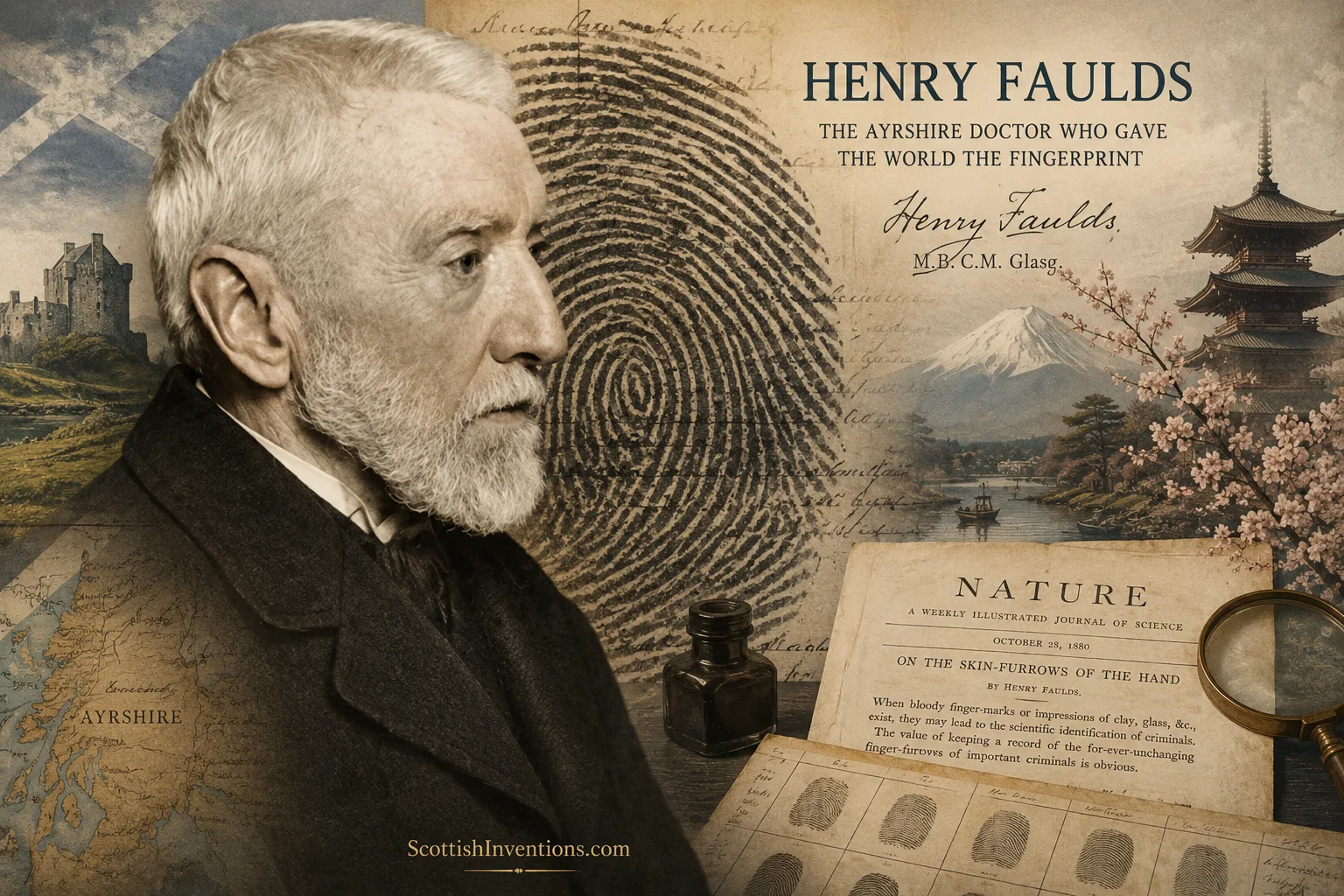
Henry Faulds, a doctor from Beith in Ayrshire working as a medical missionary in Tokyo, published the first proposal that fingerprints are unique, permanent, and capable of identifying criminals from marks left at a crime scene, in a letter to Nature on 28 October 1880. He was not, however, the only claimant. A month later William Herschel, a British civil servant in Bengal, said he had used handprints and fingerprints administratively in India since the late 1850s — decades before Faulds, though unpublished until after him. And the classification system British and Indian police forces actually adopted from 1901 was built not by Faulds but by Francis Galton and Edward Henry. This is a genuine, unresolved three-way priority dispute, and the fairest account gives each man his due rather than crowning one.
Scottish Impact Index (SI Score)
- Global Impact
- 9/10
- Longevity
- 9/10
- Economic / Material Impact
- 6/10
- Originality / Distinctiveness
- 8/10
- Legacy (Built Upon)
- 9/10
- Recognition
- 5/10
Key Facts
- Claim
- First published proposal that fingerprints are unique, permanent, and usable for forensic identification
- Key figure
- Dr Henry Faulds (1843–1930), physician and medical missionary
- Born
- 1 June 1843, Beith, North Ayrshire, Scotland
- Died
- 24 March 1930, Wolstanton, Staffordshire, England, aged 86
- Publication
- "On the Skin-Furrows of the Hand", Nature, vol. 22, 28 October 1880, pp. 605–605
- Location of discovery
- Tsukiji Hospital, Tokyo, Japan, where Faulds served as a medical missionary
- Field
- Forensic science · biometrics · criminology
- Rival claimants
- Sir William James Herschel (prior administrative use in India, claimed from 1858); Sir Francis Galton and Sir Edward Henry (the classification system actually adopted by Scotland Yard, 1901)
- First adopted forensically
- Scotland Yard, 1901, using the Galton–Henry classification system — not Faulds's method
- Landmark conviction
- R v Stratton, 1905 — the first British murder conviction secured chiefly on fingerprint evidence
- Modern legacy
- Automated Fingerprint Identification Systems (AFIS), national biometric databases, smartphone and banking authentication
- Claim status
- Disputed — a genuine three-way priority dispute. Faulds published first and demonstrated forensic use in practice; Herschel claimed two decades of prior administrative use, unpublished until after Faulds; Galton and Henry built the classification system actually adopted by policing
Beith to Tsukiji
Henry Faulds was born on 1 June 1843 in Beith, a small weaving town in North Ayrshire. His family had modest means, and he left school at thirteen to work as a clerk in Glasgow. But he was restless for education, and eventually returned to attend classes at the Faculty of Arts at the University of Glasgow, before training in medicine at Anderson's College — now part of the University of Strathclyde — and qualifying as a physician and surgeon.
A committed Presbyterian, Faulds combined his medical training with a sense of missionary vocation. After a spell of medical mission work in India with the Church of Scotland, he sailed for Japan in 1873, part of a wave of Western missionaries and advisers arriving during the Meiji Restoration's rapid opening to foreign expertise. In Tokyo he founded Tsukiji Hospital, one of the first Western-style teaching hospitals in the country, where he taught surgery to Japanese students, fought outbreaks of cholera and rabies, and helped build the infrastructure of modern medicine in Japan. It was ordinary, demanding work — and it was in the middle of it that an archaeological curiosity changed the course of his career.
The Jōmon Pottery
In the late 1870s Faulds joined the American zoologist Edward Sylvester Morse, then excavating the famous Ōmori shell mound near Tokyo, in examining fragments of ancient Jōmon-period pottery — some of it several thousand years old. Turning a shard in his hand, Faulds noticed the unmistakable ridge pattern of a human fingertip, pressed into the clay by a potter long before Japan had a written history.
The observation seized him. If a fingerprint could survive intact on fired clay for millennia, and if he could find no two prints exactly alike among his hospital colleagues, students and patients, then the pattern on a human fingertip might be both permanent and individually unique. He tested the idea with a missionary doctor's patience: collecting prints systematically, comparing them across many subjects, even shaving the ridges from his own fingers to confirm — as they did — that they grew back in an identical pattern. He extended his comparisons to the fingers of monkeys at a Tokyo zoo, to see whether the human pattern was distinctive among primates generally.

The Tokyo Thief Cases
Faulds did not keep the idea in the abstract. According to his own later accounts — the principal source for these episodes, and not independently corroborated by surviving Japanese police records — he had the chance to test it twice before he ever wrote a scientific paper. In one case a servant was wrongly suspected of a burglary; comparing a sooty handprint left at the scene with the accused man's own prints, Faulds concluded he was innocent, and the print instead matched another man who subsequently confessed. In a second, related account, a drunken intruder who had scaled a garden wall left a print on a whitewashed surface that Faulds was again able to use to clear one suspect and implicate the actual culprit.
These episodes matter because they mean Faulds arrived at his 1880 letter having already field-tested the idea, not merely speculated about it. They should be read, however, with appropriate caution: because they survive chiefly through Faulds's own retelling, written up years afterwards as he sought recognition, historians treat them as broadly credible but not forensically verified in the way a modern case file would be.
The Nature Letter, 1880
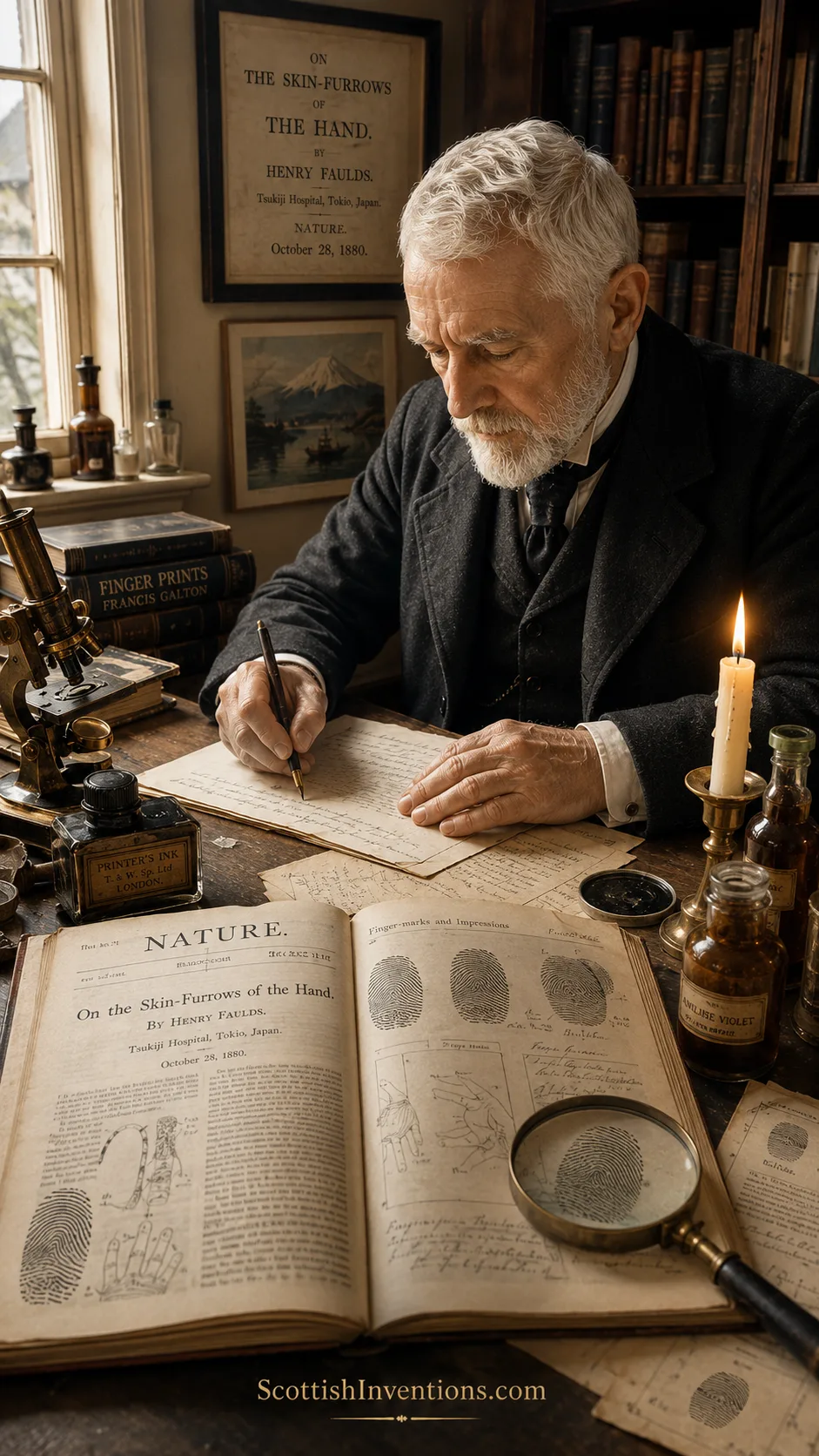
On 28 October 1880 the journal Nature published a short letter under the heading "On the Skin-Furrows of the Hand", signed Henry Faulds, Tsukiji Hospital, Tokio, Japan. In barely a page of close, careful prose he set out the argument that would eventually remake criminal investigation:
"When bloody finger-marks or impressions of clay, glass, &c., exist, they may lead to the scientific identification of criminals."
The letter argued three things in combination: that the ridge patterns on human fingertips are individually distinctive; that they persist unchanged, even after injury, throughout a person's life; and — the genuinely novel step — that this permanence and individuality could be exploited forensically, by comparing a print left at a crime scene against the prints of known or suspected individuals. No earlier publication anywhere had put these three propositions together in print as a proposal for criminal identification.
Darwin, Herschel and Galton
Before writing to Nature, Faulds had already tried to interest a more famous scientific figure. In February 1880 he wrote to Charles Darwin, by then elderly and in poor health, asking for advice on how to develop and publish his fingerprint work. Darwin declined to pursue it himself but did not ignore the letter: he passed it on to his younger cousin, Francis Galton, a keen student of heredity and statistics who was well placed, both scientifically and socially, to take the idea further.
Galton did not act on the material immediately, and it was over a decade before he returned to fingerprints in earnest. But the chain matters: Darwin's forwarding of Faulds's letter is one of the threads that later connected Faulds's original observation to the classification system Galton would eventually build largely on someone else's records — William Herschel's.
A Three-Way Priority Dispute
Recognition for Faulds was slow, and the historical picture is genuinely contested rather than simply a case of a forgotten Scot being denied his due. Three separate claims deserve to be weighed on their own terms.
- Henry Faulds published first, in a scientific journal, the proposal that fingerprints are unique, permanent and forensically usable — and had already tested the idea on real Tokyo cases. His claim rests on priority of publication and of practical demonstration.
- William James Herschel, a British magistrate and civil servant in Bengal, wrote to Nature on 25 November 1880, a month after Faulds, asserting that he had required Indian contractors and pensioners to place inked palm- and fingerprints on official documents since around 1858 — originally as a safeguard against impersonation and repudiated contracts, not as a criminal identification method. If his account is accurate, his practical use long predates Faulds's. But it was an internal administrative device, never published or scientifically framed as a general theory of identification until after Faulds had already done exactly that in print. Priority of use and priority of publication point in different directions.
- Francis Galton and Edward Henry built the actual working system. Galton's 1892 book Finger Prints established, with rigorous statistical argument, that ridge patterns are individually distinctive and essentially permanent, and proposed the first practical classification scheme — drawing heavily on Herschel's Indian specimens and records, and mentioning Faulds only briefly. Edward Henry, working in the Bengal Police, then refined Galton's classification into a system capable of filing and retrieving tens of thousands of prints efficiently — the Galton–Henry system that British India adopted in 1897 and Scotland Yard adopted in 1901.
Put plainly: Faulds asked the right question first and put it in print; Herschel may have been using a related practice for longer, but kept it to himself for two decades; Galton and Henry built the tool the world's police forces actually picked up and used. None of the three claims cancels out the others, and a fair account credits each on its own merits rather than declaring a single winner.
Galton, Henry and Scotland Yard
Galton's contribution was to give fingerprint identification a scientific and statistical foundation: he calculated the astronomical odds against two fingerprints being identical, distinguished several broad pattern types, and showed that the patterns did not change with age. What he lacked was an efficient filing method — a way to sort millions of prints so that a new one could be checked against the archive in a reasonable time, rather than compared one by one.
That problem was solved by Sir Edward Henry, an Inspector-General of the Bengal Police, who developed a numerical classification system based on the pattern types in each of a person's ten fingers, allowing prints to be filed and retrieved systematically at scale. British India adopted the Henry system from 1897, and in 1901 Scotland Yard established its own Fingerprint Branch built directly on Galton and Henry's work. Faulds, still in general practice in Britain and without institutional standing in policing, played no part in this development and was not consulted.
The Stratton Brothers, 1905
The new system's courtroom credibility was established in 1905, in the trial of Alfred and Albert Stratton at the Old Bailey for the murder of an elderly shopkeeper and his wife in Deptford, south-east London. A bloody thumbprint left on the till used in the robbery was matched, using the Galton–Henry classification system then employed by Scotland Yard, to Alfred Stratton. It was the first murder conviction in Britain secured chiefly on fingerprint evidence, and it did more than any single case to convince British juries and judges that the technique was reliable enough to hang a man on.
The irony is exact: the case that made fingerprint evidence a fixture of British criminal justice was won using the system built by Galton and Henry, a quarter of a century after Faulds had first proposed the underlying idea in print — and Faulds himself had no part in it.
How Fingerprint Identification Works
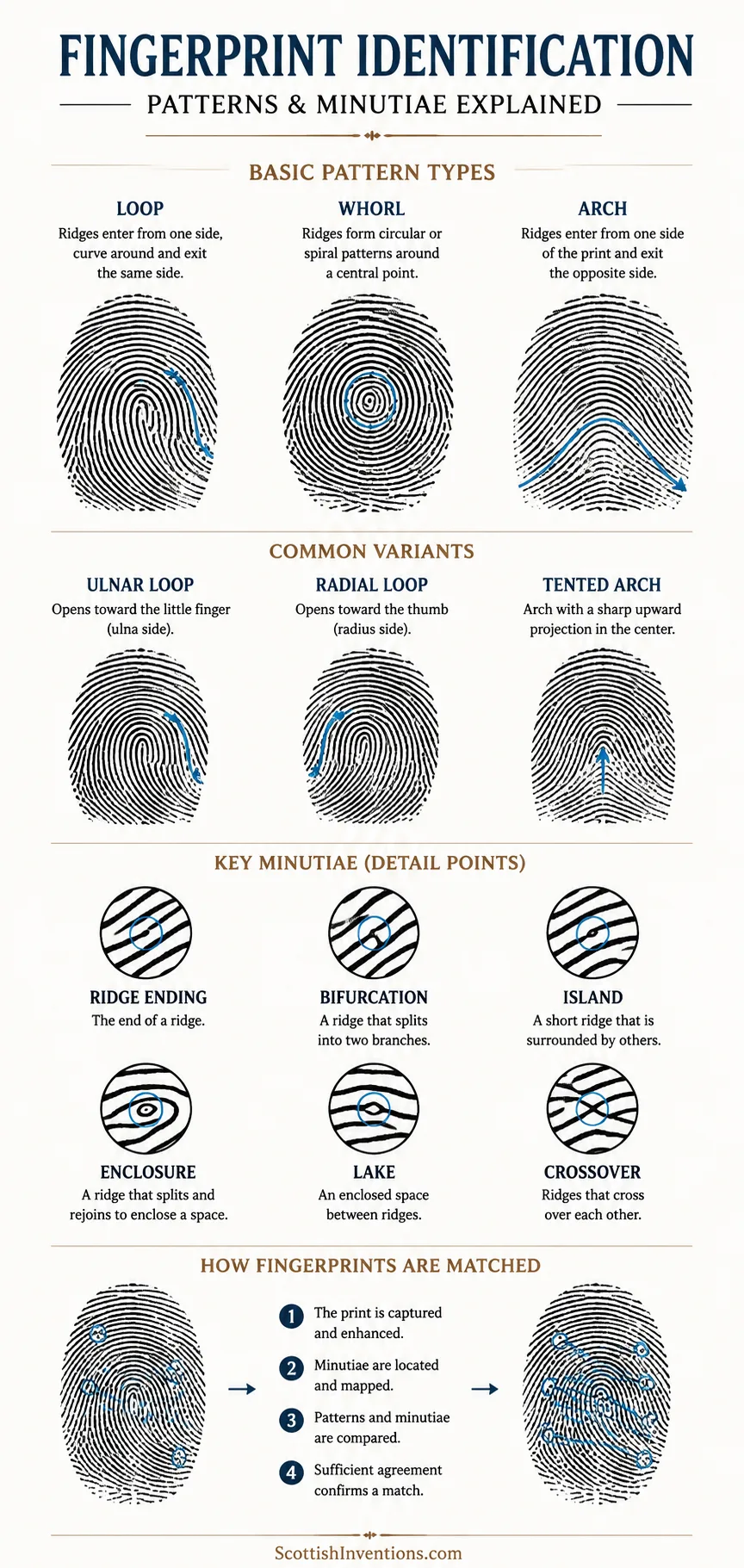
A fingerprint records the pattern of friction ridges on the fingertip, formed before birth and essentially unchanged for life — even regrowing in the same pattern after a shallow cut or burn, as Faulds demonstrated on his own hand. Identification proceeds on two levels: the broad pattern type, and the fine detail within it.
The three primary pattern types are the loop, where ridges enter and exit on the same side of the print; the whorl, a roughly circular or spiral pattern around a central core; and the arch, where ridges enter on one side and exit on the other without looping back. Within these broad categories, examiners compare "minutiae": ridge endings, bifurcations where one ridge splits into two, short isolated ridge segments, enclosures and crossovers. A confident identification generally requires a sufficient number of minutiae to align in matching relative positions across both prints.
AFIS and Modern Biometrics
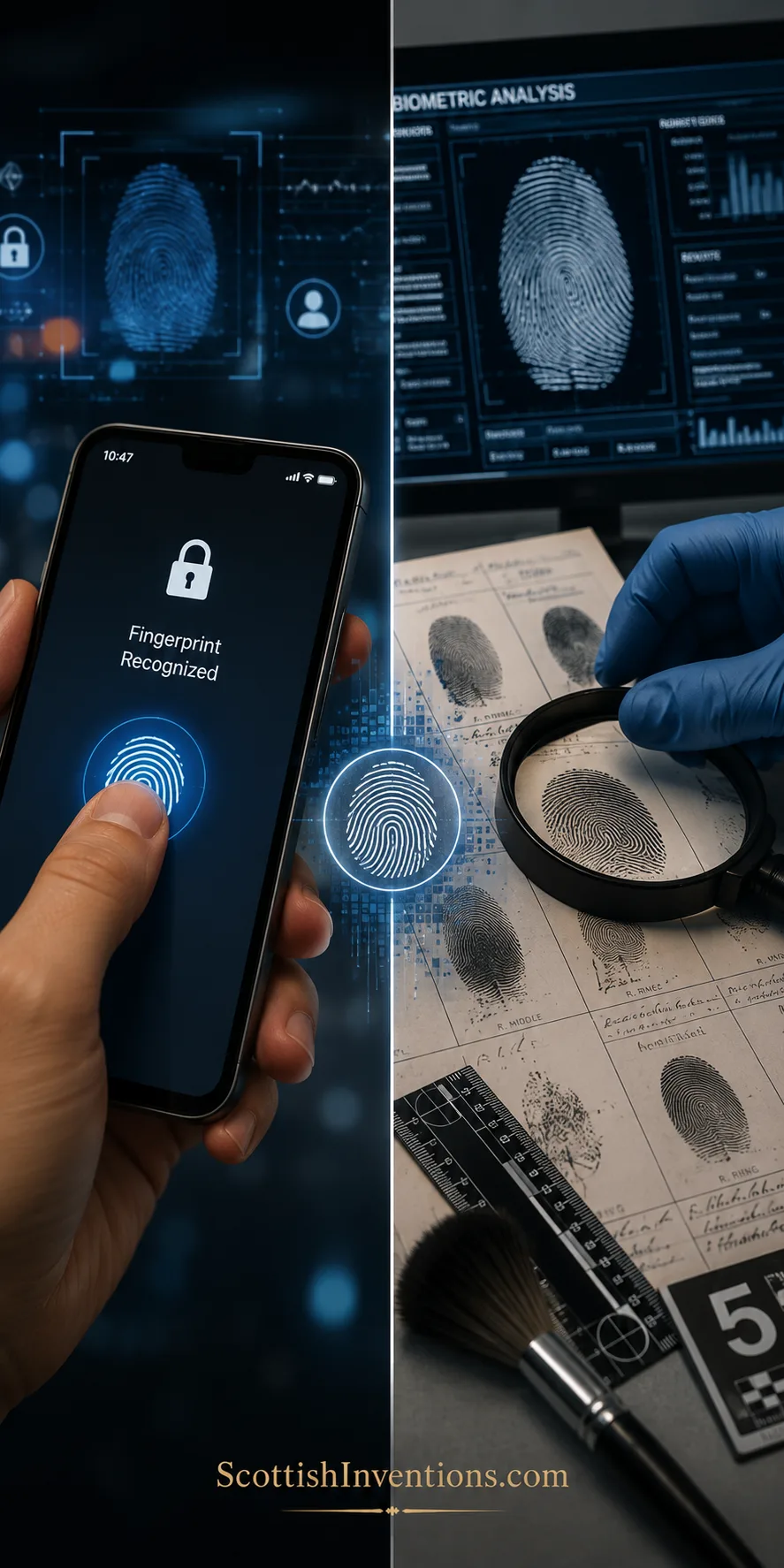
The principle first set out in Faulds's 1880 letter has long since escaped the police evidence room. Automated Fingerprint Identification Systems (AFIS) now digitise a print, extract its minutiae algorithmically, and search that pattern against databases holding tens of millions of records in seconds — work that would once have taken a human examiner years. National biometric identity schemes such as India's Aadhaar programme hold fingerprint records for well over a billion people.
The same principle now unlocks smartphones, authorises banking transactions and controls access to secure facilities, all resting on the claim Faulds made from a Tokyo hospital desk: that the ridges on a human fingertip are individually distinctive, essentially permanent, and machine-readable.
The Reliability Question
Accuracy over patriotism requires an honest look at the limits of the technique this article celebrates. Fingerprint identification is a highly reliable investigative tool, but it is a human comparative judgement, not an infallible mathematical proof, and it has produced serious documented errors.
The most notorious is the 2004 case of Brandon Mayfield, an American lawyer wrongly linked by the FBI to the Madrid train bombings on the strength of a fingerprint later shown to belong to an Algerian national. A subsequent US Department of Justice inquiry found that examiners had been influenced by contextual bias once a preliminary match seemed likely — a phenomenon now well documented in the forensic-science literature. Broader studies of examiner error rates, including work commissioned by the US National Academy of Sciences (2009) and the President's Council of Advisors on Science and Technology (2016), have concluded that fingerprint comparison, while a valuable forensic tool, should not be presented in court as a source of absolute certainty, and that proficiency testing, blind verification and clearer statements of uncertainty are needed. Modern forensic practice has moved, gradually, in that direction.
Myth vs Evidence
Myth
Henry Faulds invented fingerprinting and deserves sole credit.
Evidence
Faulds was the first to publish the proposal, in Nature in October 1880, and the first to demonstrate forensic use in a real case. But he did not invent the observation that fingerprints are individual — travellers, physicians and colonial administrators had noticed this for decades — and the classification system that police forces actually adopted was built by Galton and Henry, not Faulds.
Myth
William Herschel proved he used fingerprints first.
Evidence
Herschel's claim of use in India from around 1858 is plausible and widely accepted as sincere, but it rests on his own later recollection and surviving administrative documents rather than a contemporaneous published scientific proposal. He did not publish the idea that fingerprints could identify unknown criminals from a crime-scene mark until after Faulds had already done so in print.
Myth
Scotland Yard adopted Faulds's method.
Evidence
It did not. The Fingerprint Branch established at Scotland Yard in 1901 used the classification system devised by Francis Galton and refined for large-scale filing by Edward Henry — a system built independently of, and largely without reference to, Faulds's original proposal.
Myth
Fingerprint matching is mathematically infallible.
Evidence
It is a highly reliable but fundamentally human judgement, not an infallible mathematical proof. Documented misidentifications, most notoriously the FBI's 2004 Madrid bombing error, have led forensic scientists and courts to treat fingerprint evidence with more caution than was once customary.
Did You Know?
- Faulds shaved the ridges from his own fingertips to test whether the pattern would regrow identically — it did.
- He extended his comparisons to monkeys at a Tokyo zoo, checking whether unique, individual fingerprints were a purely human trait.
- Darwin, too unwell to pursue the idea himself, forwarded Faulds's 1880 letter to his cousin Francis Galton, who eventually built the classification system that mattered most to policing.
- The Galton–Henry system, not Faulds's original proposal, secured the first British murder conviction founded chiefly on a fingerprint, at the 1905 Stratton brothers trial.
- Faulds died in 1930 in Wolstanton, Staffordshire, having spent decades campaigning, largely without success, for recognition of his priority.
- The FBI's wrongful 2004 fingerprint match in the Brandon Mayfield case remains one of the most studied errors in modern forensic science.
Timeline
1 Jun 1843
Henry Faulds born in Beith, North Ayrshire
Leaves school at thirteen to work as a clerk in Glasgow before returning to study
1871
Qualifies M.D. after study at the University of Glasgow and Anderson's College
Trains in medicine and divinity, intending missionary service
1873
Sails for Japan as a medical missionary
Founds Tsukiji Hospital in Tokyo, one of the first Western-style teaching hospitals in Meiji Japan
c.1874–1879
Handles ancient Jōmon-period pottery with Edward S. Morse near Tokyo
Notices fired-clay fingerprints thousands of years old and begins systematic study of skin-furrows
1879–1880
Investigates two Tokyo/Yokohama theft cases using fingerprints
Clears one innocent suspect and identifies the true culprit using a sooty print left at a scene
16 Feb 1880
Faulds writes to Charles Darwin for advice on publishing and pursuing the idea
Darwin, in poor health, declines to take it up himself and forwards the letter to his cousin Francis Galton
28 Oct 1880
"On the Skin-Furrows of the Hand" published in Nature
The first printed proposal that fingerprints are unique, permanent and usable to identify criminals
25 Nov 1880
William Herschel's reply published in Nature
Herschel claims prior use of handprints and fingerprints on Indian contracts and documents since the late 1850s
1880s–1890s
Faulds returns to Britain, then works in Fife (Dundee) before settling in Staffordshire
Continues corresponding, largely unsuccessfully, with the Home Office and Scotland Yard
1892
Francis Galton publishes Finger Prints
Establishes the scientific classification of ridge patterns; draws heavily on Herschel's Indian records, barely mentions Faulds
1897
Herschel–Henry classification adopted in British India
Edward Henry, Inspector-General of the Bengal Police, refines Galton's system for large-scale filing
1901
Scotland Yard establishes a Fingerprint Branch using the Galton–Henry system
The system actually adopted by British policing; Faulds is not consulted
1905
R v Alfred and Albert Stratton, Old Bailey
First British murder conviction secured chiefly on fingerprint evidence, using the Galton–Henry method
1905–1930
Faulds campaigns for recognition through pamphlets, letters and Guide to Finger-Print Identification (1905)
Dies in 1930 in Wolstanton, largely unacknowledged in his lifetime
1980s–2000s
Historians of forensic science re-examine the record
Faulds increasingly credited as the first to publish the forensic proposal, though the dispute over overall priority remains live
21st century
AFIS and biometric fingerprint systems become near-universal
Billions of daily authentications, plus renewed scientific scrutiny of examiner error rates
Notes on the Evidence
The Tokyo thief cases are not independently documented. They come principally from Faulds's own later accounts, written up as part of his campaign for recognition. This does not mean they are false — the level of circumstantial detail is consistent — but they should be read as credible personal testimony rather than verified case records.
Herschel's dates rely on his own recollection. His claim of use from around 1858 was first made publicly in his November 1880 letter to Nature, over two decades after the practice supposedly began, and elaborated later in his own pamphlet. Contemporary documentary corroboration exists for his general practice of requiring handprints on Indian contracts, but the precise starting date and his early awareness of individual uniqueness (as opposed to using the mark simply as a signature-equivalent) are less firmly documented than the bare claim suggests.
Galton's acknowledgement of Faulds was minimal. Finger Prints (1892) leans heavily on Herschel's specimens and records and gives Faulds only brief mention, which is part of why Faulds felt so aggrieved for the rest of his life.
Faulds's medical qualification. Some sources give the initial degree as M.B., C.M. (Bachelor of Medicine, Master of Surgery) from Glasgow rather than a full M.D.; usage varies across biographical sources and is not treated here as materially significant to his forensic claim.
Scope of the "first" claim. This article credits Faulds specifically with the first published proposal of forensic fingerprint identification, not with inventing the observation that fingerprints differ between people (which had been noted informally for decades before 1880) nor with devising the classification system that made mass fingerprint filing practical (which was Galton and Henry's achievement).
Frequently Asked Questions
Who discovered fingerprint identification?
There is no single, uncontested discoverer. Henry Faulds, a Scottish doctor working in Tokyo, was the first to publish the proposal that fingerprints are unique, permanent and could identify criminals from marks left at a crime scene — in Nature on 28 October 1880. William Herschel, a British civil servant in India, claimed to have used handprints and fingerprints administratively since the late 1850s, though he did not publish this claim until a month after Faulds. Francis Galton and Edward Henry then built the classification system that police forces actually adopted from 1901. Each man has a genuine claim to part of the story.
Was Henry Faulds Scottish?
Yes. Faulds was born on 1 June 1843 in Beith, North Ayrshire, and studied at the University of Glasgow and Anderson's College (now part of the University of Strathclyde) before qualifying in medicine and training for missionary service.
What did Faulds actually publish in 1880?
A short letter in Nature titled "On the Skin-Furrows of the Hand" (28 October 1880), arguing that the ridge patterns on human fingertips are individually distinctive, that they persist unchanged through life, and that "when bloody finger-marks or impressions of clay, glass, &c., exist, they may lead to the scientific identification of criminals." It is the first printed statement of forensic fingerprint identification as a proposal, illustrated with his own case experience in Tokyo.
Did Faulds solve a real case before publishing?
According to his own later accounts, yes. In Tokyo he was consulted after a burglary and a case of drunken trespass; in one instance a sooty handprint on a wall helped clear a wrongly suspected servant and, by comparison, pointed towards the actual culprit. These pre-1880 cases are recorded chiefly in Faulds's own retrospective writing rather than in independent contemporary police records, so historians treat them as credible but not fully independently verified.
What was William Herschel's claim?
Herschel, a magistrate in Bengal, said he had required Indian contractors to place an inked handprint or fingerprint on contracts and pension documents from around 1858, originally to prevent impersonation and repudiation of agreements rather than to solve crimes. He wrote to Nature in November 1880, a month after Faulds's letter, describing this practice and asserting priority. His account is generally accepted as truthful, but it describes an internal administrative safeguard developed and unpublished for over twenty years, not a published proposal for forensic criminal identification.
What did Francis Galton contribute?
Galton, a cousin of Charles Darwin, took up fingerprint research in the 1880s after Darwin forwarded him Faulds's earlier private correspondence, and drew extensively on Herschel's Indian records and specimens. His 1892 book Finger Prints established a rigorous statistical case for the uniqueness and permanence of ridge patterns and set out the first workable classification scheme for filing large numbers of prints — the scientific foundation on which policing systems were later built. Galton's book gives Faulds only passing acknowledgement.
Why did Scotland Yard use Galton and Henry's system rather than Faulds's?
Edward Henry, working as a police official in British India, refined Galton's classification into a practical filing method capable of handling tens of thousands of prints. This Galton–Henry system was adopted by British India from 1897 and by Scotland Yard's new Fingerprint Branch in 1901. Faulds's original proposal was never developed into a comparable classification system, and he had no institutional standing within British or Indian policing to press his method into service.
What happened to Henry Faulds?
Faulds returned to Britain, worked for a time in Fife and then settled in general practice in Staffordshire. He spent much of the rest of his life — including a 1905 book, Guide to Finger-Print Identification — campaigning, often bitterly, for recognition of his priority, largely without success in his lifetime. He died in Wolstanton, Staffordshire, on 24 March 1930, aged 86.
What was the Stratton brothers case?
In 1905, Alfred and Albert Stratton were tried at the Old Bailey for the murder of a shopkeeper couple in Deptford, London. A thumbprint left in blood on a cash box was matched to Alfred Stratton using the Galton–Henry classification system then in use at Scotland Yard. It was the first murder conviction in Britain secured chiefly on fingerprint evidence, and it established the courtroom credibility of the technique built on Galton and Henry's work rather than on Faulds's original proposal.
Is fingerprint evidence completely reliable?
It is very reliable but not infallible, and courts and forensic scientists now say so explicitly. The most cited failure is the 2004 case of Brandon Mayfield, an American lawyer wrongly linked by the FBI to the Madrid train bombings on the basis of a fingerprint later shown to belong to someone else. Studies of examiner error rates and cognitive bias since the early 2000s have led agencies to adopt stricter verification protocols, and fingerprint identification is now presented in court as a strong probabilistic judgement rather than an absolute certainty.
How does modern fingerprint technology work?
Modern Automated Fingerprint Identification Systems (AFIS) digitise a print, extract its minutiae — ridge endings, bifurcations, islands and similar features — and compare that minutiae map algorithmically against millions of records to shortlist likely matches, which are then usually confirmed by a human examiner. The underlying principle is exactly the one Faulds proposed in 1880: individual, permanent ridge patterns that can identify a person.
Sources & Further Reading
Tier 1 · Primary
- Faulds, H. — "On the Skin-Furrows of the Hand," Nature, vol. 22 (28 October 1880), p. 605.
- Herschel, W. J. — letter, Nature, vol. 23 (25 November 1880), p. 76.
- Faulds, H. — Guide to Finger-Print Identification, Wakefield: Milner & Co., 1905.
- Galton, F. — Finger Prints, Macmillan, 1892.
- Herschel, W. J. — The Origin of Finger-Printing, Oxford University Press, 1916.
- Central Criminal Court (Old Bailey) trial records — R v Alfred Stratton and Albert Ernest Stratton, 1905.
Tier 2 · Scholarly and institutional
- Beavan, C. — Fingerprints: The Origins of Crime Detection and the Murder Case that Launched Forensic Science, Hyperion, 2001.
- Cole, S. A. — Suspect Identities: A History of Fingerprinting and Criminal Identification, Harvard University Press, 2001.
- National Research Council (US) — Strengthening Forensic Science in the United States: A Path Forward, National Academies Press, 2009.
- President's Council of Advisors on Science and Technology — Forensic Science in Criminal Courts: Ensuring Scientific Validity of Feature-Comparison Methods, 2016.
- US Department of Justice, Office of the Inspector General — A Review of the FBI's Handling of the Brandon Mayfield Case, 2006.