Discoveries · No. 33 of 50 · Astronomy
Dame Jocelyn Bell Burnell and the Discovery of Pulsars
A Glasgow-trained 24-year-old PhD student spotted "a bit of scruff" on a chart recording and found one of the strangest objects in the universe. Her supervisor won the Nobel Prize for it. She did not — and how she responded to that has become as remarkable as the discovery itself.
Jocelyn Bell Burnell · b. 1943Discovery · 1967Reading time · 20 minUpdated 16 August 2026
TL;DR
- Dame Jocelyn Bell Burnell — a Glasgow-trained physicist — discovered the first pulsar in 1967 as a 24-year-old PhD student, one of the great astronomical discoveries of the 20th century; her supervisor and his colleague won the 1974 Nobel Prize for it while she was excluded, one of the most controversial omissions in Nobel history.
- Her Scottish credentials are real and substantial: a BSc in physics from the University of Glasgow (1965), nearly a decade at the Royal Observatory Edinburgh, the first woman President of the Royal Society of Edinburgh, and Chancellor of the University of Dundee.
- She was born in Northern Ireland, not Scotland — this article says so plainly — but her formative scientific education was Scottish, making her a legitimate and inspiring entry in this collection.
Scottish Impact Index (SI Score)
- Global Impact
- 9/10
- Longevity
- 8/10
- Economic / Material Impact
- 3/10
- Originality / Distinctiveness
- 9/10
- Legacy (Built Upon)
- 8/10
- Recognition
- 7/10
Key Findings
- The discovery: in 1967, analysing paper chart recordings from a radio telescope she had helped build at Cambridge, Bell Burnell noticed "a bit of scruff" that turned out to be regular radio pulses every 1.337 seconds — the first known pulsar, PSR B1919+21.
- The Scottish education: she graduated with a BSc in Natural Philosophy (physics) from the University of Glasgow in 1965 — reportedly the only woman in her honours physics class.
- The Nobel controversy: the 1974 Nobel Prize in Physics went to Antony Hewish and Martin Ryle; Bell Burnell, the discoverer, was left out. Sir Fred Hoyle publicly protested her exclusion.
- The donation: in 2018 she won the $3 million Special Breakthrough Prize in Fundamental Physics and gave away every penny to fund PhD scholarships for people underrepresented in physics.
- A note on birthplace: contrary to several older encyclopedias that say "Belfast," the best sources place her birth and upbringing at "Solitude," the family home in Lurgan, County Armagh.
Quick Facts
- Discovery
- The first pulsar, PSR B1919+21 — a rapidly rotating neutron star emitting regular radio pulses
- Year
- 1967 — signal first noticed August 1967, confirmed as regular pulses 28 November 1967
- Key figure
- Dame Jocelyn Bell Burnell (b. 1943), then a 24-year-old PhD student at Cambridge
- Scottish credential
- BSc in Natural Philosophy (physics), University of Glasgow, 1965
- Where the discovery happened
- Mullard Radio Astronomy Observatory, Cambridge, England — not Scotland
- Method
- Manual analysis of ~30 metres of daily paper chart recordings from a purpose-built radio telescope
- Famous phrase
- 'A bit of scruff' — her description of the anomalous signal
- Announcement
- Nature, 24 February 1968, 'Observation of a Rapidly Pulsating Radio Source', 5 authors, Hewish first, Bell second
- Nobel Prize
- 1974 Physics Nobel awarded to Antony Hewish and Martin Ryle; Bell Burnell was not included
- Later Scottish career
- Royal Observatory Edinburgh (1982–91); President, Royal Society of Edinburgh (2014–2018); Chancellor, University of Dundee (2018–2023)
- 2018 honour
- Special Breakthrough Prize in Fundamental Physics, $3 million, donated entirely to fund PhD scholarships
- Claim status
- Disputed — the discovery itself is undisputed and attributed to her; the fairness of the 1974 Nobel omission remains genuinely contested
Early Life
Susan Jocelyn Bell was born on 15 July 1943 in Northern Ireland, into a Quaker family. Casual sources — including Encyclopædia Britannica and NASA's StarChild site — commonly say she was born in Belfast, but the weight of authoritative and recent evidence points to Lurgan, County Armagh, where the family home, a large and rather isolated house named "Solitude," stood. Her father's own professional record in the Dictionary of Irish Architects confirms that he lived his entire life at Solitude, Lurgan, and local Northern Irish outlets such as the Belfast Telegraph describe her as "Lurgan-born." The "Belfast" claim most likely arose because her father ran his architectural practice from offices in Belfast. This article treats Lurgan as her home and flags the discrepancy honestly rather than repeating the more common but weaker claim.
Her father, G. Philip Bell, was an architect — and, as it happens, the designer of the Armagh Planetarium, which opened on 1 May 1968. Many popular biographies loosely say he was "architect for the Armagh Observatory," which is a conflation worth correcting: the historic Armagh Observatory building dates from 1789–90 and was designed by Francis Johnston. Bell designed the modern Planetarium, whose first director was the famous broadcaster Sir Patrick Moore. Through her father's library of astronomy books and family visits to the nearby Armagh Observatory, where the staff encouraged her, the young Jocelyn caught the astronomy bug early.
Her path into science was not smooth. She failed the eleven-plus examination as a child. Her parents, who strongly believed in educating their daughters, sent her to The Mount School, a Quaker girls' boarding school in York, England, where she completed her secondary education in 1961. There an inspiring physics teacher, Mr Tillott, showed her, in her own words, "how easy physics was" once you learned a few key principles — an experience she has credited repeatedly as decisive for her career.
Glasgow and Natural Philosophy
She then went to the University of Glasgow, graduating in 1965 with a Bachelor of Science degree in Natural Philosophy — the traditional Scottish name for physics. This is the cornerstone of her Scottish connection. Glasgow in the early 1960s was not a welcoming place for a woman physicist: she was reportedly the only woman in her honours physics class, and she has recalled the "tradition" that when a woman entered the lecture theatre the male students would whistle, stamp, bang the desks and catcall. She persevered because she knew she needed a physics degree to do what she wanted to do.
It is worth pausing on how significant that Glasgow degree was for everything that followed. It was not an incidental credential; it was the entire technical foundation on which her subsequent PhD project, her instrument-building work, and her eventual discovery all rested. Without a rigorous physics education, none of the careful, sceptical reasoning she brought to bear on an anomalous chart signal a few years later would have been possible. Later in 1965 she began her PhD at the University of Cambridge (New Hall, now Murray Edwards College), under the supervision of radio astronomer Antony Hewish.
Building the Telescope
Bell Burnell's PhD project was tied to a new instrument: the Interplanetary Scintillation Array at the Mullard Radio Astronomy Observatory outside Cambridge. Hewish had designed the array to study interplanetary scintillation — the "twinkling" of compact radio sources such as quasars caused by the solar wind — which could be used to measure the tiny angular sizes of those sources.
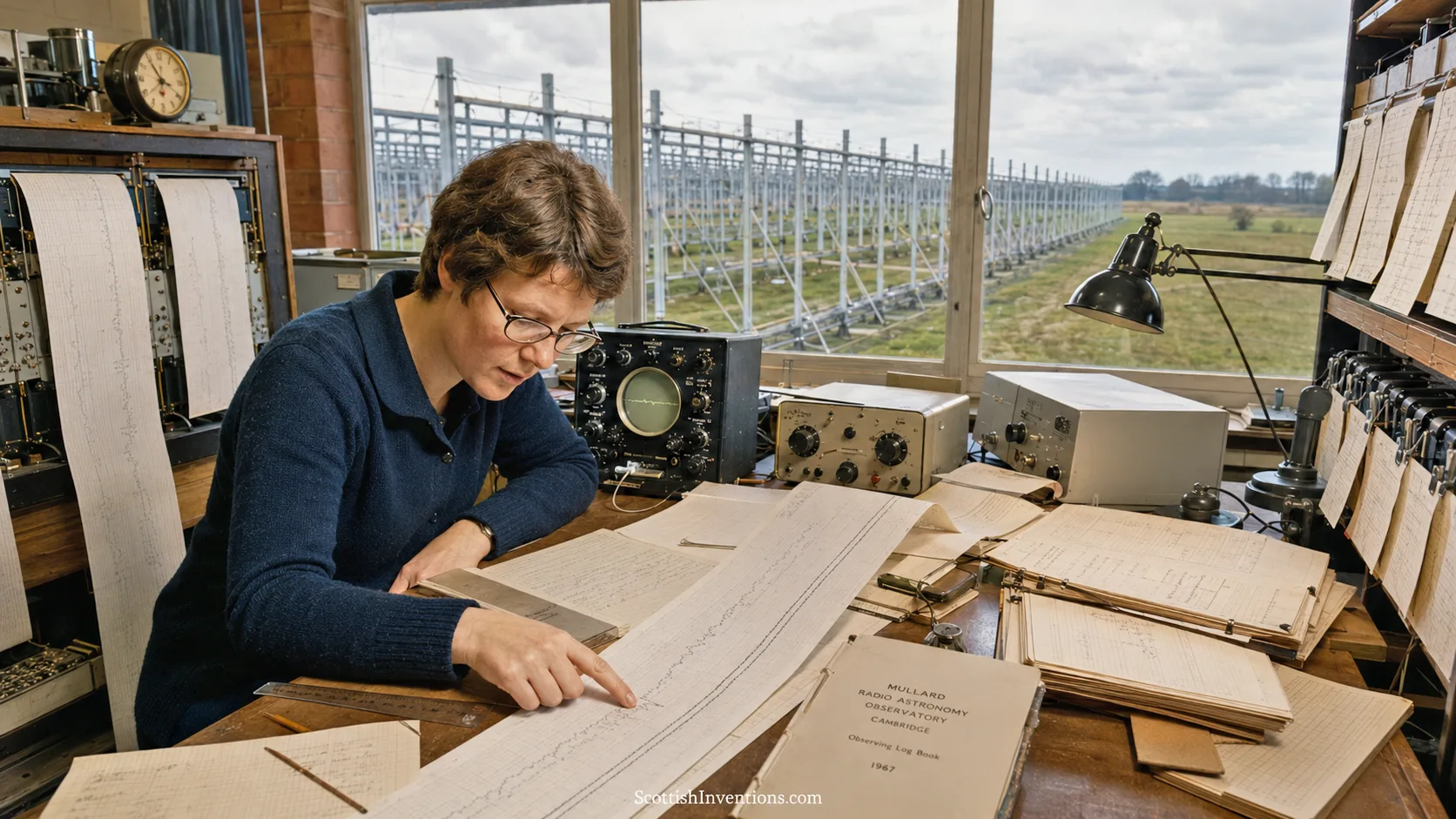
The telescope was a vast field of wire. It consisted of 2,048 dipole antennas arranged in rows, spread across about 4.5 acres, operating at a radio frequency of 81.5 MHz (a wavelength of 3.7 metres). Bell Burnell was not a passive observer of its construction: she spent roughly two years helping to build it — swinging sledgehammers to drive posts into the ground and taking responsibility for the network of cables connecting the dipoles. The array was completed and tested by July 1967, when it began surveying the sky.
Crucially, the telescope had unusually high time resolution — it could register rapid fluctuations that most radio telescopes of the day would have smoothed away. Once operating, it poured out data as ink traces on paper chart recorders, and it fell to Bell Burnell to analyse it all by hand. The chart recorder produced about 30 metres (roughly 96 feet) of paper every day, and she scrutinised it meticulously — a task that demanded exactly the kind of sustained, disciplined attention that would prove decisive within months.
The Discovery — 1967
The story of the discovery is one of the great examples of a careful, sceptical mind refusing to dismiss an anomaly. In early August 1967 Bell Burnell noticed a small patch of unusual signal on the chart paper — "a bit of scruff," in her famous phrase — that looked like neither quasar scintillation nor ordinary man-made interference. The signal occupied only a few millimetres out of hundreds of metres of chart.
What made it astronomical rather than terrestrial was its timing: it reappeared at the same sidereal time, rising about four minutes earlier each day, exactly as a fixed star would. When Bell Burnell reconfigured the recording for higher time resolution — famously having to switch to a faster chart just before the source came into the beam — the "scruff" resolved, on 28 November 1967, into a train of astonishingly regular pulses, one every 1.337 seconds. The signal had actually been present in data taken in August, but the manual analysis took months to catch up, a reminder of just how labour-intensive and unglamorous the underlying work of discovery could be.
The regularity was uncanny — as steady as a laboratory clock — and for a short while the team took seriously, if half-jokingly, the possibility that it was an artificial beacon from another civilisation. They nicknamed the source "LGM-1," for "Little Green Men 1." Bell Burnell herself was unconvinced it was aliens: as she put it, she "knew it wasn't artificial" because she had been tracking the source for months and it behaved like a natural object fixed among the stars.
The decisive breakthrough came when, shortly before Christmas 1967, she found a second pulsating source in a completely different part of the sky. Two independent "little green men" civilisations both beaming at Cambridge on the same frequency was absurd — this had to be a new natural phenomenon. She rapidly found further examples; three additional pulsating sources were identified, retiring the LGM idea for good.
The discovery was announced in a paper in the journal Nature on 24 February 1968, titled "Observation of a Rapidly Pulsating Radio Source." It had five authors: Antony Hewish was listed first and S. J. Bell second, followed by J. D. H. Pilkington, P. F. Scott and R. A. Collins. Her second-author position on the paper would loom large in the Nobel debate to come. The word "pulsar" (a contraction of "pulsating star") was coined shortly afterwards by the British science correspondent Anthony R. Michaelis, in an interview with Hewish published in The Daily Telegraph on 5 March 1968.
The Science of Pulsars
So what had she found? A pulsar is a rapidly rotating neutron star — the ultra-dense collapsed core left behind when a massive star ends its life in a supernova explosion.
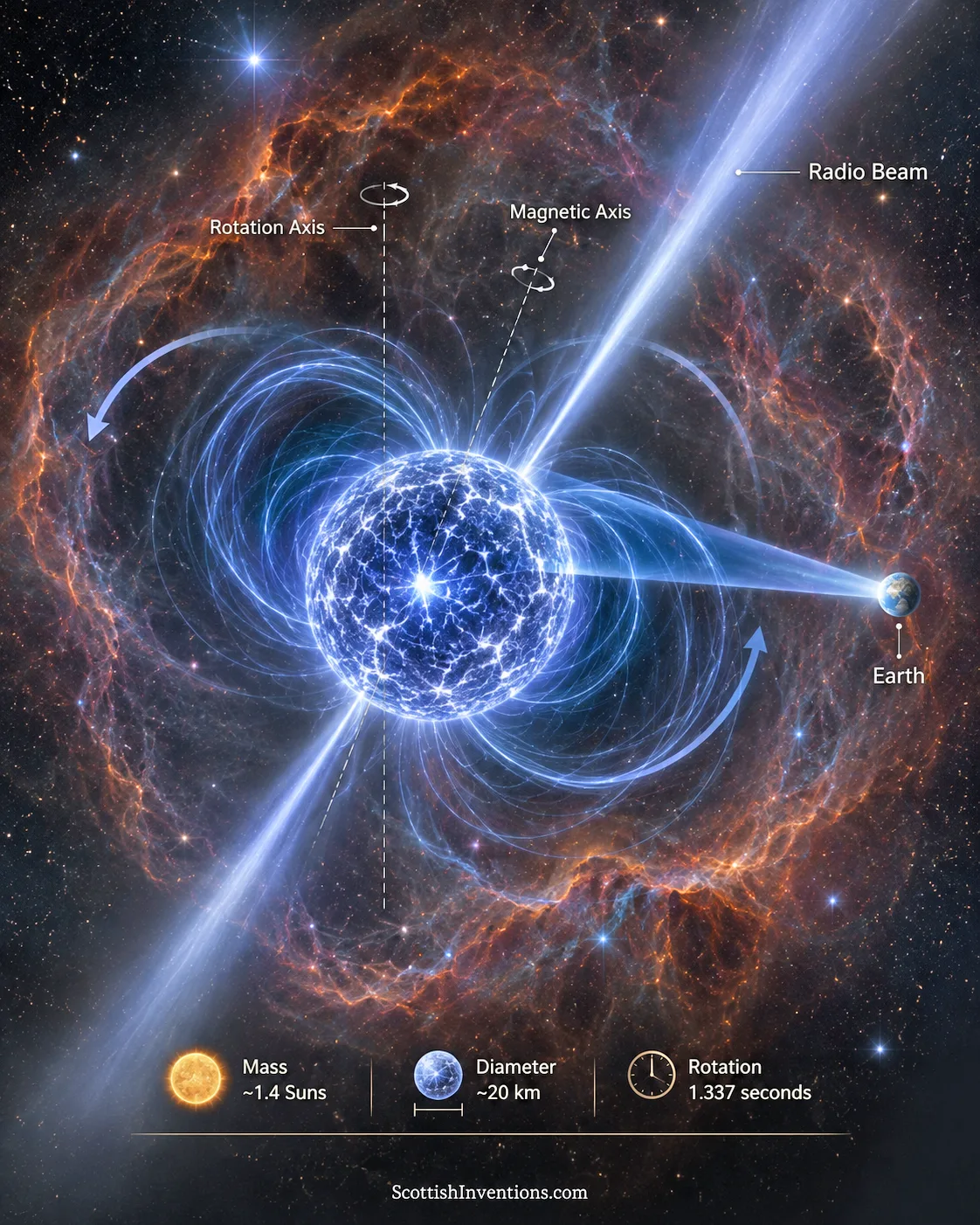
Neutron stars are among the densest objects in the universe. A typical neutron star packs about 1.4 times the mass of our Sun into a sphere only about 20 kilometres across — a single teaspoonful of the material would weigh on the order of a billion tonnes on Earth. When the core of a dying massive star collapses, protons and electrons are crushed together into neutrons, and the collapse halts only when neutron degeneracy pressure resists further compression.
Why they spin so fast: as the core collapses from something the size of a star to a city-sized ball, conservation of angular momentum dramatically speeds up its rotation — the same effect that makes a figure skater spin faster when she pulls in her arms. The original star's magnetic field is likewise concentrated to enormous strength.
Why they pulse — the lighthouse analogy: a pulsar's intense magnetic field channels radiation into two narrow beams that stream out from its magnetic poles. Because the magnetic axis is generally misaligned with the rotation axis (just as Earth's magnetic north differs from true north), those beams sweep around the sky as the star rotates. Each time a beam sweeps across the Earth, our telescopes register a pulse — exactly like the rotating beam of a lighthouse.
The range: known pulsar spin periods range from a few milliseconds to several seconds. Bell Burnell's first pulsar, PSR B1919+21, has a period of about 1.337 seconds — very precisely, 1.3372795 seconds.
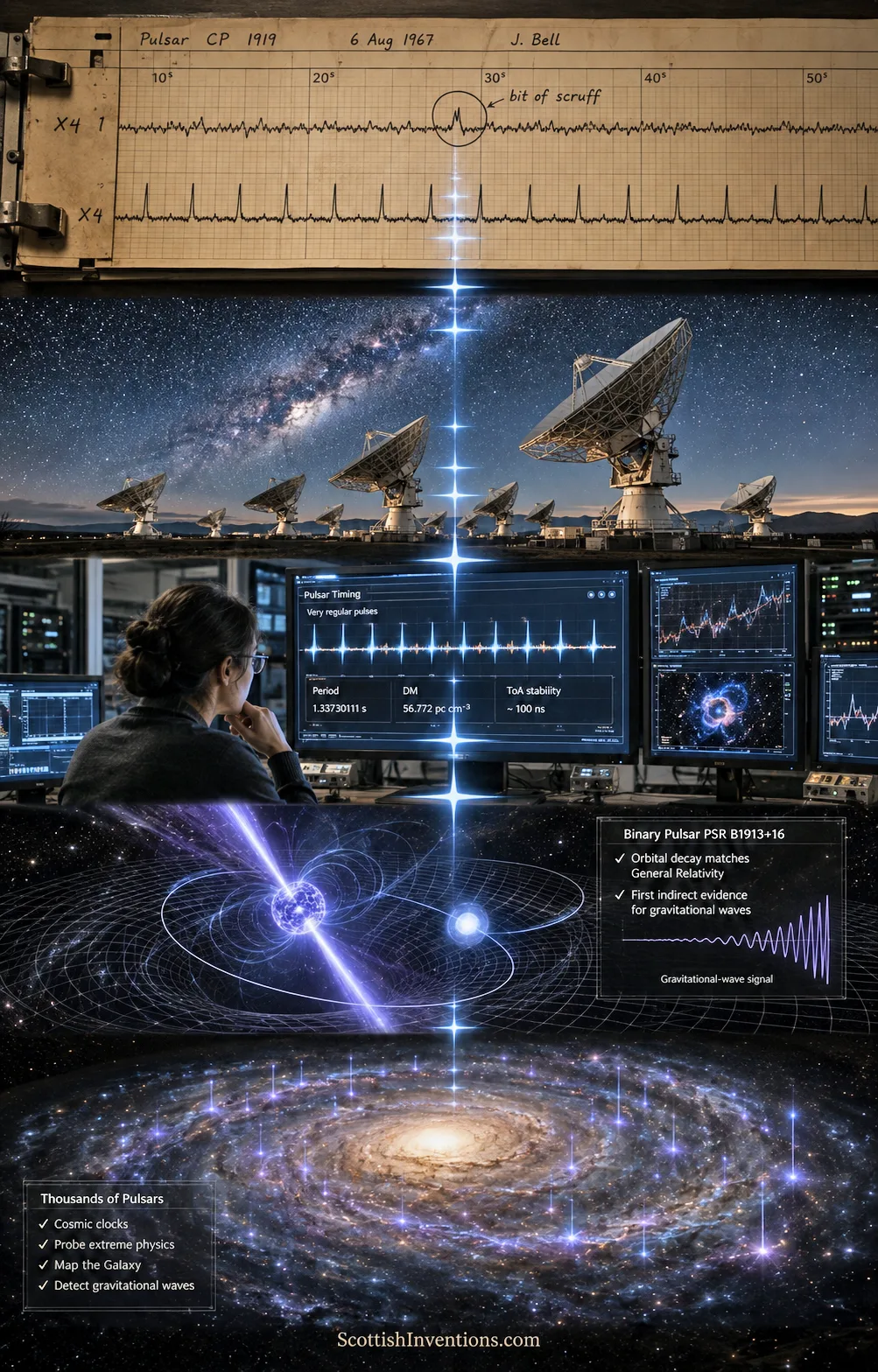
Why they matter: pulsars became some of the most valuable tools in modern physics. The fastest, "millisecond" pulsars are so regular they rival atomic clocks. In 1974 Russell Hulse and Joseph Taylor discovered the first binary pulsar (PSR B1913+16) — a separate discovery from Bell Burnell's, made seven years later, of a different object; by timing its decaying orbit they produced the first strong evidence for gravitational waves, in beautiful agreement with Einstein's general relativity, and won the 1993 Nobel Prize in Physics for it. Astronomers now use arrays of pulsars — pulsar timing arrays — as galaxy-sized gravitational wave detectors. There are now more than 3,000 known pulsars catalogued — every one a descendant of that first "bit of scruff."
The Nobel Prize Controversy
In 1974 the Nobel Prize in Physics was awarded to Antony Hewish — cited for his "decisive role in the discovery of pulsars" — and to Martin Ryle, for his pioneering work in radio astronomy including the aperture-synthesis technique. It was the first Nobel Prize awarded for observational astronomy. Bell Burnell, who had built much of the telescope, spotted the signal, and fought to have it taken seriously, was not included.
The Nobel committee gave no explicit reason for excluding her; the prevailing convention was that prizes generally were not given to research students. The omission provoked one of the most enduring controversies in the history of the prize. The most prominent critic was the astronomer Sir Fred Hoyle, who told a reporter in Montreal: "Yes, Jocelyn Bell was the actual discoverer, not Hewish, who was her supervisor, so she should have been included." Hoyle himself was later, controversially, passed over for the 1983 Nobel despite his foundational work on stellar nucleosynthesis, so he knew the territory well.
The gender dimension has been debated ever since. Many commentators argue Bell Burnell was overlooked partly because she was a woman as well as a student. She has reflected that "the fact that I was a graduate student and a woman, together, lowered my standing in terms of receiving a Nobel prize."
What is most striking is Bell Burnell's own graciousness. In 1977 she said she believed "it would demean Nobel Prizes if they were awarded to research students, except in very exceptional cases, and I do not believe this is one of them," reasoning that a supervisor carries final responsibility for a project's success or failure. She has consistently credited Hewish's role in conceiving and building the research programme while quietly maintaining her own contribution. Her dignity in the face of the snub has arguably enhanced her stature more than the prize itself would have. This article records Hoyle's public criticism, the gender-bias argument raised by many later commentators, and Bell Burnell's own more measured position, without declaring any one of them the final word — because none of them has settled the historical debate.
Career After Cambridge
Far from being defined by the omission, Bell Burnell built one of the most wide-ranging careers in British astronomy, often working part-time while raising her son and moving around the country to follow her husband's job. After completing her PhD she worked at the University of Southampton (1968–73) on gamma-ray astronomy; at University College London and its Mullard Space Science Laboratory (1974–82) on X-ray astronomy; and — importantly for her Scottish story — at the Royal Observatory Edinburgh (1982–91) on infrared and millimetre-wave astronomy. While in Edinburgh she managed the international James Clerk Maxwell Telescope project. She was a long-serving tutor and later Professor of Physics at the Open University (professor 1991–2001), a visiting professor at Princeton, Dean of Science at the University of Bath (2001–04), and Visiting Professor of Astrophysics at the University of Oxford, with a fellowship at Mansfield College.
She has been a scientific leader as much as a researcher. She was President of the Royal Astronomical Society (2002–04); the first woman President of the Institute of Physics (2008–10, returning briefly as interim president in 2011); and the first woman President of the Royal Society of Edinburgh (2014–2018), returning as interim president for six months in 2021. She was Chancellor of the University of Dundee (2018–2023) and, more recently, became Rector of Brunel University in London. She was appointed CBE in 1999, DBE (Dame) in 2007, received the Royal Society's Copley Medal in 2021 (only the second woman ever to do so, after Dorothy Hodgkin), and was appointed to the Order of the Companions of Honour in 2025. She helped found the Athena SWAN scheme to advance women in science, and is widely admired as a science communicator.
The Breakthrough Prize
In September 2018 Bell Burnell was awarded the Special Breakthrough Prize in Fundamental Physics — a $3 million award (about £2.3 million) — "for fundamental contributions to the discovery of pulsars, and a lifetime of inspiring leadership in the scientific community." The Breakthrough Prizes, popularly dubbed the "Oscars of Science," were founded by a group of technology philanthropists including Sergey Brin, Priscilla Chan and Mark Zuckerberg, Yuri and Julia Milner, and Anne Wojcicki. At $3 million, the award is far larger in cash terms than the Nobel. The Special Breakthrough Prize is awarded only occasionally; previous recipients included Stephen Hawking, the CERN team behind the Higgs boson, and the LIGO gravitational-wave collaboration.
Then came the act that captured the world's admiration. Bell Burnell donated the entire prize to the Institute of Physics to establish scholarships for PhD students from groups underrepresented in physics — women, ethnic minorities and refugees. "I don't want or need the money myself," she told the BBC, "and it seemed to me that this was perhaps the best use I could put it to." She explicitly linked the gift to her own experience as an outsider: "I found pulsars because I was a minority person and feeling a bit overawed at Cambridge. I was both female but also from the northwest of the country and I think everybody else around me was southern English… minority folk bring a fresh angle on things."
The result is the Bell Burnell Graduate Scholarship Fund, launched in 2019 and administered by the Institute of Physics. According to the Institute of Physics, by 2025 — its sixth year — the fund had given out more than £1 million and supported 47 physics PhD students from underrepresented backgrounds, with 10 new awardees named in 2025 alone. It is a living, growing legacy that arguably does more good than the Nobel medal she never received.
The Scottish Connection
For the Scottish Discoveries Collection, honesty about the Scottish connection is essential. Here is the verified picture:
- Undergraduate degree, University of Glasgow (1965) — a BSc in Natural Philosophy (physics). This is the strongest connection: her entire formal physics education, the foundation of everything that followed, was Scottish.
- Royal Observatory Edinburgh (1982–91) — nearly a decade of her research career, including managing the James Clerk Maxwell Telescope project, was based in Scotland.
- President of the Royal Society of Edinburgh (2014–2018) — the first woman to lead Scotland's national academy.
- Chancellor of the University of Dundee (2018–2023) — the ceremonial head of a Scottish university.
- Honorary degrees from Scottish institutions, including an honorary doctorate from Heriot-Watt University.
Assessment: this is a strong and multi-stranded Scottish connection — stronger than a purely honorary link. Unlike figures whose Scottish tie is a single job, Bell Burnell was educated as a physicist in Scotland, did a substantial part of her research career in Scotland, and later led Scotland's premier learned society and a Scottish university. The one caveat worth weighing is that the discovery itself was made in Cambridge, England, not Scotland — the Scottish contribution is the education and training that made the discoverer, plus a distinguished later Scottish career. This is directly comparable to other figures in the collection, such as Peter Higgs, Newcastle-born with an Edinburgh career. She belongs here — provided the article, as this one does, is transparent that she was born in Northern Ireland and made the discovery in England.
Timeline
1943
Susan Jocelyn Bell born, 15 July, at 'Solitude', Lurgan, Co. Armagh, Northern Ireland
Best-supported birthplace; many encyclopedias incorrectly say Belfast
1961
Completes secondary education at The Mount School, York
A Quaker girls' boarding school; an inspiring physics teacher shaped her path
1965
Graduates BSc in Natural Philosophy (physics), University of Glasgow
Reportedly the only woman in her honours physics class
1965
Begins PhD at Cambridge under Antony Hewish
Joins the project to build the Interplanetary Scintillation Array
1965–67
Helps build the radio telescope array by hand
2,048 dipole antennas across 4.5 acres; she managed cabling and drove posts with a sledgehammer
July 1967
Array completed and begins surveying the sky
Produces roughly 30 metres of chart paper per day for manual analysis
August 1967
Bell Burnell first notices 'a bit of scruff' in the chart data
A few millimetres of anomalous signal amid hundreds of metres of paper
28 November 1967
Higher-resolution recording resolves the scruff into pulses every 1.337 seconds
The first confirmed detection of a pulsar, later designated PSR B1919+21
Late 1967
Signal jokingly nicknamed 'LGM-1' (Little Green Men 1)
Bell Burnell herself doubted the artificial-signal explanation
Shortly before Christmas 1967
A second pulsating source found in a different part of the sky
Rules out the alien-beacon idea; retires 'LGM' for good
24 February 1968
Discovery published in Nature
Five authors; Hewish listed first, Bell second
5 March 1968
The word 'pulsar' coined
Science correspondent Anthony R. Michaelis, in an interview with Hewish for The Daily Telegraph
1974
Nobel Prize in Physics awarded to Antony Hewish and Martin Ryle
The first Nobel for observational astronomy; Bell Burnell excluded
1974
Hulse and Taylor discover the first binary pulsar, PSR B1913+16
A distinct, later discovery — not to be confused with Bell Burnell's 1967 find
1977
Bell Burnell publicly states her own view on the Nobel omission
Argues prizes should not generally go to research students
1982–91
Works at the Royal Observatory Edinburgh
Manages the James Clerk Maxwell Telescope project; a substantial Scottish research chapter
1993
Hulse and Taylor awarded the Nobel Prize in Physics
For the binary pulsar's evidence of gravitational waves — again, a separate discovery from 1967
2014–2018
President of the Royal Society of Edinburgh
First woman to hold the post
2018–2023
Chancellor of the University of Dundee
Ceremonial head of a Scottish university
September 2018
Awarded the $3 million Special Breakthrough Prize in Fundamental Physics
Donates the entire sum to fund PhD scholarships for underrepresented groups
2019 onward
Bell Burnell Graduate Scholarship Fund launched
By 2025, more than £1 million distributed to 47 PhD students
2021
Awarded the Royal Society's Copley Medal
Only the second woman ever to receive it, after Dorothy Hodgkin
2025
Appointed to the Order of the Companions of Honour
Continuing recognition well into her eighties
Myths & Facts
Myth: Jocelyn Bell Burnell won the Nobel Prize for discovering pulsars.
Fact: She did not. The 1974 Nobel Prize in Physics for the discovery of pulsars was awarded to her PhD supervisor Antony Hewish (with Martin Ryle recognised separately for radio astronomy techniques). Bell Burnell, who made the actual discovery, was not included — a decision that remains genuinely debated.
Myth: The 1993 Nobel Prize to Hulse and Taylor was for the same pulsar Bell Burnell discovered.
Fact: No. Bell Burnell discovered the first pulsar ever found, PSR B1919+21, in 1967. Hulse and Taylor discovered a different object, the first binary pulsar PSR B1913+16, in 1974, and won the 1993 Nobel Prize for using it to provide evidence of gravitational waves. These are two separate discoveries, seven years apart, by different scientists.
Myth: Jocelyn Bell Burnell was born in Belfast.
Fact: The claim appears in several older reference works, including Britannica and NASA's StarChild site, but the better-supported evidence points to Lurgan, County Armagh, where her family home 'Solitude' stood. The Belfast confusion likely arose because her architect father's practice was based there.
Myth: Her father designed the historic Armagh Observatory.
Fact: He did not. The historic Armagh Observatory building dates from 1789–90 and was designed by Francis Johnston. G. Philip Bell designed the separate, modern Armagh Planetarium, which opened in 1968.
Myth: She discovered pulsars in Scotland.
Fact: The discovery was made at the Mullard Radio Astronomy Observatory near Cambridge, England, where Bell Burnell was a PhD student. Her Scottish connection is her physics education at the University of Glasgow and her later research and leadership career in Scotland, not the location of the discovery itself.
Myth: She was bitter about being excluded from the Nobel Prize.
Fact: The historical record shows the opposite. Bell Burnell has repeatedly and publicly stated a considered, non-bitter position — that she does not believe her case was one of the 'very exceptional' ones that would justify a prize going to a research student — while others, including Sir Fred Hoyle, have argued forcefully on her behalf. Her own tone has been measured rather than aggrieved.
Did You Know?
- Dame Jocelyn Bell Burnell studied physics at the University of Glasgow — the Scottish education that helped produce one of the greatest astronomical discoveries of the 20th century.
- She first noticed just 'a bit of scruff' on a chart recording — a scrap of anomalous signal a few millimetres long that turned out to be the first pulsar ever detected.
- The team briefly nicknamed the signal 'LGM-1' — Little Green Men 1 — because its pulses were so regular they wondered, half-seriously, if it might be an alien beacon.
- She was excluded from the 1974 Nobel Prize that was awarded for her discovery — one of the most controversial decisions in Nobel history.
- When she won the $3 million (£2.3m) Breakthrough Prize in 2018, she donated every penny to fund PhD scholarships for under-represented groups in physics — a fund that has since supported 47 students.
- There are now more than 3,000 known pulsars — every one a consequence of the discovery she made as a 24-year-old PhD student.
- She was reportedly the only woman in her honours physics class at Glasgow, where male students had a 'tradition' of catcalling women who entered the lecture theatre.
Honest Caveats
Birthplace: older tertiary sources (Britannica, NASA StarChild) say Belfast; the better-sourced answer is Lurgan, Co. Armagh. No source pinpoints a delivery hospital, so absolute certainty on the exact town of birth is not available — but Lurgan is where she was raised and is the better-supported claim.
Father's project: the Armagh Planetarium attribution rests on the institution's own website and architectural databases; the Dictionary of Irish Architects does not list it (its coverage window largely predates 1968), though it confirms he was her father and a Lurgan architect.
Discovery date: sources variously cite August 1967 (first noticing the "scruff," often given as 6 August) and 28 November 1967 (confirming the regular pulses). Both are correct for different stages; this article distinguishes them.
Telescope specifications: the array is described as 2,048 dipoles over ~4.5 acres at its 1967 discovery configuration; it was later enlarged (to about 9 acres, 4,096 dipoles), so some sources quoting larger figures refer to the upgraded instrument.
Dundee chancellorship dates: most sources give 2018–2023; some give 2019–2024. The appointment was announced in February 2018 and she took office shortly after. This article uses 2018–2023.
Pulsar count: "more than 3,000" reflects the widely cited figure from the ATNF Pulsar Catalogue and recent literature; the exact current total rises continually as surveys (notably China's FAST telescope) add new detections, with some 2024–2025 catalogue versions listing over 3,600 entries including X-ray and gamma-ray pulsars.
The Nobel omission is a matter of ongoing debate, not settled fact. This article presents Sir Fred Hoyle's public criticism, the gender-bias arguments made by many later commentators, and Bell Burnell's own more measured stated position side by side. It does not resolve the debate on her behalf, because the historical record itself does not resolve it.
PSR B1919+21 and PSR B1913+16 are different objects, discovered by different people seven years apart, and this article keeps them clearly distinguished throughout: Bell Burnell found the first, in 1967; Hulse and Taylor found the second, a binary pulsar, in 1974, winning a separate Nobel Prize in 1993 for the gravitational-wave evidence it provided.
Frequently Asked Questions
Did Jocelyn Bell Burnell discover pulsars?
Yes. In 1967, as a 24-year-old PhD student at Cambridge, she noticed an anomalous signal — 'a bit of scruff' — in chart recordings from a radio telescope she had helped build, and through months of careful, sceptical analysis established it as a new astronomical phenomenon: a rapidly rotating neutron star emitting regular radio pulses, the first known pulsar. This is not seriously disputed; the discovery itself is credited to her.
Why didn't she win the Nobel Prize?
In 1974 the Nobel Prize in Physics for the discovery of pulsars went to her supervisor Antony Hewish (and to Martin Ryle, for separate work on radio astronomy techniques). The Nobel committee gave no explicit public reason for excluding Bell Burnell; the prevailing convention at the time was that prizes were generally not given to research students. This is one of the most debated omissions in the prize's history, and this article presents both sides rather than settling the matter.
Was the Nobel decision unfair?
Opinions genuinely differ, and honest treatment requires stating both. The astronomer Sir Fred Hoyle publicly protested, telling a reporter, 'Yes, Jocelyn Bell was the actual discoverer, not Hewish, who was her supervisor, so she should have been included.' Many commentators since have argued gender bias played a role, and Bell Burnell herself has reflected that being 'a graduate student and a woman, together, lowered my standing in terms of receiving a Nobel prize.' Yet Bell Burnell has also stated her own, more measured position: in 1977 she said it 'would demean Nobel Prizes if they were awarded to research students, except in very exceptional cases,' and she does not consider her case one of those exceptions, reasoning that a supervisor bears final responsibility for a project's success or failure. This article states Hoyle's criticism, the gender-bias argument, and Bell Burnell's own more forgiving position side by side, without picking a winner.
What exactly did she do that Hewish did not?
Hewish designed and led the research programme and the telescope that made the discovery possible. Bell Burnell spent roughly two years physically helping build that telescope — driving posts with a sledgehammer and managing its cabling — and then, crucially, she was the person who manually scrutinised the daily chart recordings, noticed the anomalous 'scruff,' refused to dismiss it as interference, reconfigured the recording to resolve it into pulses, and went on to find further pulsating sources that ruled out an artificial or extraterrestrial explanation. The Nature paper credits five authors, with Hewish first and Bell (as S. J. Bell) second.
Is the 1993 Nobel Prize to Hulse and Taylor the same discovery?
No, and this article is careful not to conflate the two. Bell Burnell's 1967 discovery was the first pulsar ever found, PSR B1919+21. In 1974, Russell Hulse and Joseph Taylor discovered a completely different object, the first binary pulsar, PSR B1913+16, and used its decaying orbit to provide the first strong evidence for gravitational waves. Hulse and Taylor won the 1993 Nobel Prize in Physics for that separate achievement. The two Nobel-adjacent stories both involve pulsars, but they are distinct discoveries by different people at different times.
Was Jocelyn Bell Burnell born in Scotland?
No. She was born on 15 July 1943 in Northern Ireland, most likely at 'Solitude,' the family home in Lurgan, County Armagh, though several older reference sources incorrectly state Belfast. This article states her Northern Irish birth plainly. Her connection to Scotland is educational and professional, not one of birth.
So why is she in a collection of Scottish discoveries?
Because her formal training as a physicist was entirely Scottish, and a substantial part of her later career was too. She earned her BSc in Natural Philosophy (physics) — the traditional Scottish name for the subject — at the University of Glasgow in 1965, the foundation for everything that followed. She later spent nearly a decade (1982–91) at the Royal Observatory Edinburgh, managing the James Clerk Maxwell Telescope project, served as the first woman President of the Royal Society of Edinburgh (2014–2018), and was Chancellor of the University of Dundee (2018–2023). The discovery itself happened at Cambridge, in England — this article does not claim otherwise — but the education and much of the career that produced the discoverer were Scottish.
What was Bell Burnell's experience like as a physics student at Glasgow?
Difficult in ways specific to being a lone woman in the field. She was reportedly the only woman in her honours physics class, and she has recalled a demeaning 'tradition' whereby male students would whistle, stamp their feet, bang desks and catcall whenever a woman entered the lecture theatre. She persevered because she needed the physics degree to pursue the astronomy career she wanted.
What is a pulsar, in plain terms?
A pulsar is a rapidly spinning neutron star — the extraordinarily dense collapsed core left behind after a massive star explodes as a supernova. A typical neutron star packs about 1.4 times the Sun's mass into a sphere only around 20 kilometres across. Its intense magnetic field channels radiation into two narrow beams that sweep around like a lighthouse as the star rotates; each time a beam crosses Earth, telescopes detect a pulse. Bell Burnell's first pulsar pulses once every 1.3372795 seconds.
What did the team initially think the signal might be?
For a short while, half-jokingly, the possibility of an artificial signal from an alien civilisation was floated, and the source was nicknamed 'LGM-1' for 'Little Green Men 1.' Bell Burnell herself was sceptical of this explanation; she has said she 'knew it wasn't artificial' because she had tracked the source for months and it behaved exactly like a natural object fixed among the stars. The discovery of a second, unrelated pulsating source shortly before Christmas 1967 settled the matter — two independent alien civilisations transmitting on the same frequency to Cambridge was far less plausible than a new natural phenomenon.
What did she do with the $3 million Breakthrough Prize?
In September 2018 Bell Burnell was awarded the Special Breakthrough Prize in Fundamental Physics, worth about $3 million (roughly £2.3 million), 'for fundamental contributions to the discovery of pulsars, and a lifetime of inspiring leadership in the scientific community.' She donated the entire sum to the Institute of Physics to fund PhD scholarships for people underrepresented in physics — women, ethnic minorities and refugees. The resulting Bell Burnell Graduate Scholarship Fund had, by 2025, distributed more than £1 million and supported 47 PhD students.
How has Bell Burnell herself framed her own story?
With notable graciousness that has become part of her public reputation. Rather than dwelling on grievance over the Nobel omission, she has consistently credited Hewish's role in conceiving and leading the research programme, while explaining her own position calmly and without bitterness. She has also connected her outsider status directly to her achievement, saying: 'I found pulsars because I was a minority person and feeling a bit overawed at Cambridge... minority folk bring a fresh angle on things.' Many observers consider her dignified handling of the episode, and her subsequent donation of the Breakthrough Prize money, to have enhanced her public stature at least as much as the Nobel medal would have.
Sources & Further Reading
Tier 1 · Primary
- Hewish, A., Bell, S. J., Pilkington, J. D. H., Scott, P. F., Collins, R. A. — "Observation of a Rapidly Pulsating Radio Source," Nature, 24 February 1968.
- The Nobel Prize in Physics 1974 — official citation, Antony Hewish and Martin Ryle.
- The Nobel Prize in Physics 1993 — official citation, Russell Hulse and Joseph Taylor.
Tier 2 · Scholarly and institutional
- Royal Society of Edinburgh — biographical record of Dame Jocelyn Bell Burnell's presidency, 2014–2018.
- Institute of Physics — Bell Burnell Graduate Scholarship Fund, fund history and awardee figures.
- Breakthrough Prize Foundation — 2018 Special Breakthrough Prize in Fundamental Physics citation.
- Dictionary of Irish Architects — entry for G. Philip Bell.
Tier 3 · Site source document
docs/sources/discoveries/discovery-of-pulsars.md— the commissioned source document underlying this article.