Discoveries · No. 45 of 50 · Physics
Soliton (Wave of Translation)
A Scottish engineer on horseback, a wave that refused to obey the physics of its day, and a discovery that took 131 years to earn its modern name — and now carries the world's data through glass fibre at the speed of light.
John Scott Russell · 1808–1882Discovered · August 1834Reading time · 32 minUpdated 16 August 2026

TL;DR
- In August 1834, on the Union Canal near Edinburgh, the Glasgow-born engineer John Scott Russell watched a "large solitary elevation" of water peel away from a stopped canal boat and roll on unchanged for one to two miles — a phenomenon he chased on horseback and named the "Wave of Translation." It is now called the soliton.
- Russell's observation was dismissed by two of Britain's greatest mathematical physicists, George Biddell Airy and George Gabriel Stokes, who argued such a wave could not exist. He was vindicated — by Boussinesq (1871–72), Rayleigh (1876), and definitively the Korteweg–de Vries equation (1895)— then rediscovered computationally in 1965 by Zabusky and Kruskal, who coined the word "soliton."
- Solitons now underpin fibre-optic telecommunications, plasma and fusion physics, and Bose–Einstein condensates — an entire branch of modern science that traces back to one man, one horse, and one Scottish canal.
Scottish Impact Index (SI Score)
- Global Impact
- 7/10
- Longevity
- 8/10
- Economic / Material Impact
- 4/10
- Originality / Distinctiveness
- 9/10
- Legacy (Built Upon)
- 7/10
- Recognition
- 3/10
Key Findings
- John Scott Russell (1808–1882), a Glasgow-born engineer working on the Union Canal near Edinburgh, observed in August 1834 a self-sustaining solitary water wave that kept its shape and speed over a distance of one to two miles.
- His account, the famous horseback-chase passage, is genuine primary source — Russell's own words, published in his 1844 "Report on Waves," not a later embellishment.
- Russell was not the first to notice a solitary wave (Giorgio Bidone reported one in Turin in 1826), but he was the first to recognise its scientific significance and study it systematically, building a wave tank and deriving an empirically correct speed formula.
- His claim was disputed by George Biddell Airy and George Gabriel Stokes, whose linear wave theories implied that no wave could travel without dispersing.
- The mathematics vindicating Russell came from Joseph Boussinesq (1871–72), Lord Rayleigh (1876), and definitively Korteweg and de Vries (1895).
- The word "soliton" was coined in 1965 by Norman Zabusky and Martin Kruskal, after they discovered computationally that solitary waves collide and separate like particles.
- Solitons are now foundational to fibre-optic telecommunications, plasma physics, and Bose–Einstein condensate research.
Quick Facts
- Discovery
- A self-sustaining 'Wave of Translation' — a solitary wave that keeps its shape and speed without dispersing — now called the soliton
- Year
- August 1834, on the Union Canal near Hermiston, west of Edinburgh
- Key figure
- John Scott Russell (1808–1882)
- Role
- Engineer, commissioned to study steam haulage on the Union Canal
- Method
- Direct field observation, a horseback pursuit, and later a purpose-built garden wave tank
- Russell's own term
- 'The Wave of Translation' — 'soliton' was coined much later
- Predecessor
- Giorgio Bidone (Turin, 1826) reported solitary waves earlier but did not pursue their significance
- Russell's real contribution
- Systematic experimental characterisation and an empirically correct speed formula, v = √(g(h+k))
- Contemporary dispute
- George Biddell Airy and George Gabriel Stokes both doubted a permanent-form solitary wave could exist
- Mathematics supplied later
- Joseph Boussinesq (1871–72), Lord Rayleigh (1876), and definitively Korteweg & de Vries (1895)
- Term coined
- 'Soliton' — Norman Zabusky and Martin Kruskal, 1965, from computational study of the KdV equation
- Claim status
- Established as the founding experimental discovery of the soliton phenomenon; the theory that vindicated Russell was developed by others over the following six decades, and the modern name is later still
- Modern descendants
- Optical solitons in fibre-optic telecommunications, plasma physics, Bose–Einstein condensates
- Commemoration
- Scott Russell Aqueduct, Union Canal, named 1995; plaque at Bridge 11 from the 1982 centenary conference
A Glasgow Prodigy
John Scott Russell was born in Parkhead, near Glasgow, in May 1808. Even the exact day of his birth carries a small, honest ambiguity that this account will not paper over: the Oxford Dictionary of National Biography gives 8 May, while MacTutor and other sources give 9 May. He was the son of the Reverend David Russell, a Church of Scotland clergyman and a Glasgow graduate, and Agnes Clark Scott, from whom he took the middle name that would later attach itself, almost inseparably, to a single wave on a single canal.
He was, by any measure, a prodigy. He entered the University of St Andrews at around twelve or thirteen years of age, an extraordinarily young start even by the more flexible standards of Scottish university admission in the period, and then transferred to the University of Glasgow, from which he graduated with an MA around 1825. He was not yet twenty. After graduation he moved to Edinburgh, where he taught mathematics and natural philosophy and, for a period, filled in for the professor of natural philosophy following the death of Sir John Leslie — a considerable responsibility for a man still in his twenties. By the time he reached his late twenties, Russell had already established himself as one of the more versatile scientific minds working in Edinburgh: part mathematician, part practising engineer, and part unusually attentive observer of the physical world around him.
It was this last quality — attentiveness, the habit of actually watching a phenomenon rather than assuming it away — that would prove decisive. In 1834, Russell was engaged on a commission for the Union Canal Company to investigate whether steam power might usefully replace horses for hauling barges along the canal. This was practical, unglamorous engineering work: assessing haulage speeds, resistance, efficiency, the mundane economics of canal transport in the early industrial age. It was in this capacity — as a working engineer, standing on a towpath, watching how boats actually moved through water — that he made the observation that would eventually reshape a branch of mathematical physics.
Wave Theory Before Russell
By the 1830s, the mathematics of periodic water waves was reasonably well developed by the standards of the day. Siméon Denis Poisson and Augustin-Louis Cauchy had each worked on the linear theory of waves produced by a disturbance at the water's surface. The conventional expectation, built directly into that mathematics, was that any localised heap of water must disperse: a sharp, compact disturbance is mathematically equivalent to a superposition of many different wavelength components, and because those components travel at slightly different speeds under linear theory, the disturbance inevitably spreads out and flattens as it travels. A wave that held its shape indefinitely, without spreading, without diminishing, simply had no comfortable place in the accepted framework.
This is not to say the underlying phenomenon had never been glimpsed. Giorgio Bidone, working in Turin, had already described solitary waves in 1826, and a short note on the subject had appeared that same year in the Edinburgh Journal of Science — a detail worth stating plainly, because it means Russell was not sailing into entirely uncharted waters, so to speak. But Bidone's observation went essentially unnoticed by the wider scientific community and unexplained by any theory; it sat as an isolated, slightly puzzling fact rather than the seed of a new field. What Russell brought to bear, eight years later and several hundred miles away, was the mind of a trained engineer, professionally used to watching precisely how boats moved through water, standing in exactly the right place at exactly the right moment to see something extraordinary — and, crucially, to take it seriously rather than dismiss it as an anomaly.
The Discovery — August 1834
Russell had been commissioned by the Union Canal Company to study whether steam haulage could replace horse-drawn barges. His fieldwork took him to the Union Canal near the village of Hermiston, west of Edinburgh, close to what is now the Riccarton campus of Heriot-Watt University — a stretch of quiet, flat water that, on one particular afternoon in August 1834, produced one of the more consequential observations in the history of physics.
Russell's own account, published a decade later in his 1844 "Report on Waves," is among the most quoted passages in the entire literature of physical science, and it deserves to be read in full rather than paraphrased:
"I was observing the motion of a boat which was rapidly drawn along a narrow channel by a pair of horses, when the boat suddenly stopped — not so the mass of water in the channel which it had put in motion; it accumulated round the prow of the vessel in a state of violent agitation, then suddenly leaving it behind, rolled forward with great velocity, assuming the form of a large solitary elevation, a rounded, smooth and well-defined heap of water, which continued its course along the channel apparently without change of form or diminution of speed. I followed it on horseback, and overtook it still rolling on at a rate of some eight or nine miles an hour, preserving its original figure some thirty feet long and a foot to a foot and a half in height. Its height gradually diminished, and after a chase of one or two miles I lost it in the windings of the channel. Such, in the month of August 1834, was my first chance interview with that singular and beautiful phenomenon which I have called the Wave of Translation."
It is worth being explicit about what this passage is, and is not. It is not folklore that accumulated around Russell's name after his death, embroidered by admiring biographers. It is Russell's own testimony, written in his own hand and published under his own name, in an official report to the British Association for the Advancement of Science. The horseback chase, the pair of horses, the sudden stop, the "rounded, smooth and well-defined heap of water," the pursuit of "one or two miles" — every memorable detail traces directly back to this primary source.
The properties Russell recorded were precise and, as it later turned out, physically exact. The wave was a single, isolated elevation of water, not part of a periodic train of successive crests and troughs. It kept its shape without visibly changing as it travelled. It moved at a roughly constant speed of eight or nine miles an hour. It measured about thirty feet in length and one to one-and-a-half feet in height. Each of these details would later matter enormously to the mathematicians who eventually worked out why such a wave was possible at all.
What marks Russell out as a genuinely first-class experimenter, rather than merely a lucky witness, is what he did next. He did not simply publish an anecdote and move on. He built a wave tank in his own garden — a long, shallow wooden channel roughly thirty feet in length — and set about generating solitary waves under controlled conditions, typically by releasing a weight at one end of the tank and observing the resulting disturbance. Through sustained, patient experimentation he established the central quantitative relationship of the whole phenomenon: the speed of a solitary wave depends on both the depth of the water and the height of the wave itself, with taller waves consistently travelling faster. From this he deduced the speed formula v = √(g(h + k)), where h is the undisturbed depth of the water, k is the height of the wave, and g is the acceleration due to gravity — a formula that later, more rigorous mathematical treatments confirmed as substantially correct. He also noted, with characteristic care, that a sufficiently large initial disturbance would split apart into several separate solitary waves, ordered by height, and that two solitary waves could pass directly through one another without being destroyed or merged in the process — an observation whose full significance would not be appreciated for well over a century.
The Mathematics
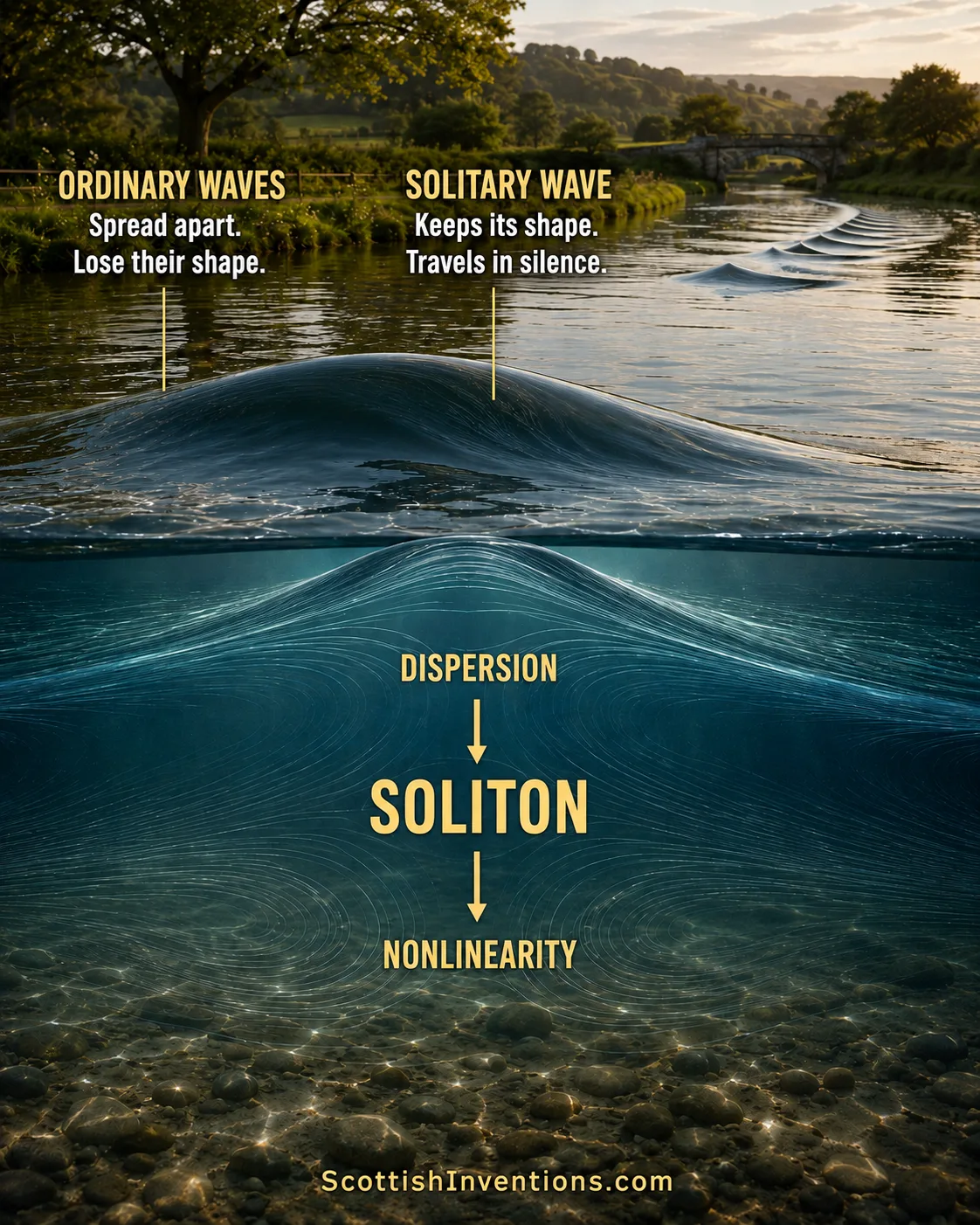
To understand why Russell's wave was so startling to the physicists of his day, it helps to understand what ordinary waves do, and why the Wave of Translation refused to do it. In most water waves, the individual wavelength components that make up any real, localised disturbance travel at slightly different speeds from one another. A sharp, compact heap of water is, mathematically speaking, really a combination of many such components superimposed on top of each other. Because those components separate out over time — the longer wavelengths typically outrunning the shorter ones, or vice versa depending on the medium — the disturbance as a whole spreads out and flattens into a broad, low train of ripples. This spreading is called dispersion, and under the linear wave theory available in the 1830s, dispersion was treated as essentially unavoidable for any localised disturbance in water.
Russell's wave did not disperse. And the reason it did not disperse turns out to hinge on the interplay of two effects that pull in genuinely opposite directions rather than operating one after the other in sequence. Dispersion, as already described, tries continuously to spread the wave out and flatten it. Working directly against dispersion is a second, entirely separate effect called nonlinearity: in a water wave of appreciable height, the taller part of the wave — sitting in deeper effective water — tends to travel faster than the shallower part around it, and this difference in speed tends to make the wave steepen and pile up on itself rather than spread out. Dispersion spreads; nonlinearity steepens. These are not sequential stages that a wave passes through one after the other — they are two forces acting on the water simultaneously, continuously, and in direct opposition to each other. A soliton exists precisely at the point where these two opposing tendencies are in exact, sustained balance: the spreading push of dispersion is exactly cancelled, moment by moment, by the steepening push of nonlinearity. Neither effect wins. The wave settles into a single, stable, self-reinforcing shape and simply travels onward unchanged, for as long as that balance holds. That is precisely what Russell watched roll away from the stopped canal boat and precisely what he chased on horseback for two miles without ever seeing it break apart.
The equation that finally captured this balance mathematically arrived six decades after Russell's discovery. In 1895 the Dutch mathematician Diederik Korteweg and his doctoral student Gustav de Vries published a partial differential equation governing the behaviour of long waves in shallow water. Their equation possesses an exact analytical solution — a curve with the mathematical shape known as a sech² profile — that corresponds precisely to Russell's solitary wave. This was the crucial theoretical step: it demonstrated, with full mathematical rigour, that a permanent-form solitary wave was not merely a curiosity that happened to occur once on a Scottish canal, but an inevitable and stable solution of the underlying physics of shallow-water waves, arising naturally out of the balance between dispersion and nonlinearity described above. It is worth noting, in the interests of strict historical accuracy, that the French mathematician Joseph Boussinesq had already derived essentially the same governing equation and its solitary-wave solution back in 1872 — so the Korteweg–de Vries equation is arguably somewhat misnamed in terms of strict priority. Nonetheless, the 1895 paper became the field's definitive milestone reference, the version subsequent generations of mathematicians and physicists actually built upon.
For roughly seventy years after Korteweg and de Vries, the solitary wave remained, in scientific terms, a largely self-contained curiosity — mathematically sound, but without any wider theoretical or practical resonance. That changed dramatically in 1965, when Norman Zabusky, working at Bell Labs, and Martin Kruskal, at Princeton, studied the Korteweg–de Vries equation numerically using early digital computers. What they found was genuinely astonishing to physicists at the time: when two solitary waves, travelling at different speeds, were made to collide with one another within the model, they did not merge, cancel, or destroy each other as ordinary overlapping waves generally do. Instead, they passed cleanly through one another and emerged afterward with their original individual shapes and speeds fully intact — behaving, in other words, remarkably like discrete particles rather than like conventional overlapping waves. To capture this unmistakably particle-like quality, Zabusky and Kruskal coined the term "soliton," with the "-on" ending deliberately echoing the names of known particles such as the electron and the proton. Their paper, "Interaction of 'Solitons' in a Collisionless Plasma and the Recurrence of Initial States," appeared in Physical Review Letters, volume 15, pages 240 to 243, in 1965. Two years later, in 1967, Clifford Gardner, John Greene, Martin Kruskal and Robert Miura developed the inverse scattering transform, an exact analytical method for solving the Korteweg–de Vries equation directly, completing the mathematical picture that Russell's original observation had opened up, in outline, 133 years earlier.
Airy, Stokes and Vindication
Russell's claim did not simply sit quietly in the scientific literature awaiting confirmation; it collided head-on with the authority of two of the most respected mathematical physicists of the age. George Biddell Airy (1801–1892), the Astronomer Royal and one of the most influential figures in British science of the period, argued on the basis of his own linear "long wave" theory that no wave could propagate through shallow water without progressively changing its form as it travelled. George Gabriel Stokes (1819–1903), whose work on fluid dynamics remains foundational to the field to this day, likewise expressed serious doubt that a solitary wave could travel any real distance without changing shape or gradually dying away.
The disagreement was not a matter of politeness or minor emphasis; it was fundamental and, for a working engineer without the mathematical authority of an Astronomer Royal behind him, genuinely difficult to resolve in his favour. Russell, the empirical observer who had watched the phenomenon repeatedly with his own eyes and reproduced it deliberately in his garden wave tank, insisted the wave was real, stable and essentially permanent in form. Airy and Stokes, reasoning from equations that had proved reliable for every other wave phenomenon they had previously examined, maintained that their mathematics simply forbade what Russell was describing. This impasse persisted from the 1840s onward, effectively for the remainder of Russell's active scientific life, without a clear resolution either way.
The eventual resolution came not from Britain but from the Continent, and not until long after the original dispute had begun. Joseph Boussinesq, working in 1871 and 1872, assumed for the sake of argument that such a wave did exist, and, crucially, incorporated a term for vertical acceleration in the water that Airy's original linear theory had neglected entirely. With that correction in place, Boussinesq derived an equation whose solution faithfully reproduced the essential features of Russell's wave. Lord Rayleigh, working independently in 1876, arrived at a closely related confirmation of his own. Finally, Korteweg and de Vries, in 1895, supplied the fully definitive mathematical treatment described above.
The irony embedded in this sequence of events is close to complete, and worth stating without embellishment: a practical Scottish engineer, watching moving water with unusual patience and care, had been essentially correct from the outset; and two of the greatest mathematical physicists of his era, reasoning with perfect internal consistency from equations that were simply incomplete for this particular case, had been wrong. Russell did not live to see the full extent of his own vindication — Korteweg and de Vries published their definitive equation thirteen years after his death — but the historical record on the substance of the dispute is now entirely clear.
Modern Applications
Fibre-optic communications. An ordinary pulse of light travelling down an optical fibre tends to spread out over distance because of chromatic dispersion, the same fundamental tendency towards spreading that afflicts ordinary water waves. But if the light pulse is deliberately shaped as an optical soliton, the fibre's own nonlinear response — specifically the Kerr effect — works against that dispersion and balances it out, exactly as nonlinearity balances dispersion in Russell's water wave. The result is a pulse of light that can travel enormous distances through the fibre without spreading or degrading. Akira Hasegawa and Fred Tappert, working at AT&T Bell Labs, first proposed this application in 1973, and soliton-based pulse transmission subsequently became a genuine foundation of long-haul fibre-optic telecommunications infrastructure.
Plasma physics and fusion research. Solitons also appear naturally in ionised gases, in the form of ion-acoustic waves, and they have been studied extensively within the broader context of nuclear fusion research, where understanding wave behaviour in confined plasmas is of direct practical importance to the design of fusion reactors.
Bose–Einstein condensates. In the exotic, ultra-cold quantum gases known as Bose–Einstein condensates, both "bright" solitons and "dark" solitons have been created and directly observed in laboratory experiments — notably by Denschlag and colleagues, published in Science in 2000, and by Strecker and colleagues, published in Nature in 2002 — extending the reach of Russell's original phenomenon into the realm of quantum physics, a field that did not exist in any form in Russell's own lifetime.
The Union Canal today. The canal on which Russell made his discovery survives, restored and now used chiefly for leisure. The site of the discovery is commemorated by a plaque at Bridge 11, installed for a 1982 centenary conference held at Heriot-Watt University, and the aqueduct that carries the canal over the Edinburgh City Bypass was formally named the Scott Russell Aqueduct on 12 July 1995. On that same day, an international gathering of scientists — organised by the Heriot-Watt mathematician Chris Eilbeck, with Martin Kruskal himself present — re-created Russell's original solitary wave on the canal, a fitting piece of scientific theatre. It is a detail with a certain quiet symmetry that a fibre-optic cable, carrying data as trains of optical solitons, now runs beneath the very towpath from which Russell first watched his own wave roll away.

Russell's Later Career
It is worth remembering that Russell's fame during his own lifetime rested overwhelmingly on shipbuilding rather than on the solitary wave, which for decades remained a relatively niche scientific dispute rather than a matter of wide public recognition. Building directly on his understanding of wave motion, Russell developed what became known as the "wave-line" theory of hull design — the principle of shaping a ship's bow according to the geometry of a wave curve in order to minimise resistance as the hull moved through water.
His most celebrated project by far was the SS Great Eastern, the colossal steamship designed in partnership with Isambard Kingdom Brunel. At its launch in 1858 it was the largest ship in the world, measuring 692 feet in length and displacing 32,160 tons. Russell served as the ship's builder and contractor, and the vessel's hull embodied his own wave-line design principles. His working relationship with Brunel, warm at the outset, deteriorated badly over the course of the project amid disputes over money and engineering responsibility — a difficult professional episode that sits alongside, rather than diminishes, Russell's genuine technical achievement.
Russell went on to publish his three-volume work "The Modern System of Naval Architecture" in 1865, founded the Institution of Naval Architects in 1860, and was elected a Fellow of the Royal Society in June 1849 in recognition of his broader scientific and engineering contributions. He died on 8 June 1882 at Ventnor, on the Isle of Wight. His primary scientific account of the solitary wave remains his "Report on Waves," published in the Report of the Fourteenth Meeting of the British Association for the Advancement of Science, held in York in September 1844 (London: John Murray, 1845), pages 311 to 390 — the source from which the famous horseback-chase passage quoted earlier in this article is drawn.
Russell and Scotland
Russell's formative years were entirely Scottish, and the discovery for which he is chiefly remembered today happened within a few miles of Edinburgh. He was born in Glasgow, educated at St Andrews and then Glasgow, worked as a lecturer in Edinburgh, engineered on the River Clyde, and — most significantly of all — made his defining scientific observation on the Union Canal on the western outskirts of Edinburgh. He belongs squarely within a recognisable Scottish tradition of practical, hands-on genius: the lineage that includes James Watt's meticulous attention to the physical behaviour of steam and Thomas Telford's close engineering study of how materials and structures actually perform under real conditions. Like those figures, Russell's great insight did not come from abstract theorising in isolation from the physical world, but from watching that world with unusual patience — in this case, watching a stretch of perfectly ordinary Scottish canal water do something that theory of the day said it should not be able to do.
Timeline
17th century
Poisson and Cauchy begin developing the linear mathematics of water waves
Establishes the conventional expectation that any localised disturbance in water must disperse over time
1808
John Scott Russell born in Parkhead, near Glasgow (8 or 9 May, sources differ)
Son of a Church of Scotland minister; educated at St Andrews from age twelve or thirteen, then Glasgow
1826
Giorgio Bidone reports solitary waves in Turin; a note appears in the Edinburgh Journal of Science
Goes largely unnoticed and unexplained — the phenomenon exists in the literature but nobody yet grasps its significance
c. 1825
Russell graduates MA from Glasgow and moves to Edinburgh
Teaches mathematics and natural philosophy, briefly filling in for the chair left vacant by the death of Sir John Leslie
August 1834
Russell observes and chases the Wave of Translation on the Union Canal near Hermiston
The founding observation of what would later be called the soliton
1834 onward
Russell builds a wave tank in his garden and experiments systematically
Derives the speed formula v = √(g(h+k)) and observes waves passing through one another unchanged
1840s
George Biddell Airy and George Gabriel Stokes dispute Russell's claim
Both argue, from linear wave theory, that a permanent-form solitary wave cannot exist
1844
Russell publishes his 'Report on Waves' to the British Association
Records his observations, his speed formula, and the horseback-chase account in his own words
1858
Russell builds Brunel's SS Great Eastern
His wave-line theory of hull design, derived from his wave studies, shapes the largest ship of its era
1865
Russell publishes The Modern System of Naval Architecture
Consolidates his engineering reputation, distinct from his wave research
1871–72
Joseph Boussinesq derives an equation whose solution reproduces Russell's wave
The first proper mathematical vindication, assuming the wave's existence and correcting Airy's neglect of vertical acceleration
1876
Lord Rayleigh independently confirms the solitary-wave solution
Reinforces Boussinesq's result from a different direction
1882
John Scott Russell dies at Ventnor, Isle of Wight
Does not live to see the definitive mathematics or the word 'soliton'
1895
Korteweg and de Vries publish their equation for long shallow-water waves
Gives an exact sech² solution matching Russell's wave and proves such a wave is not just possible but inevitable
1965
Norman Zabusky and Martin Kruskal coin 'soliton'
Numerical study of the KdV equation reveals that colliding solitary waves behave like particles, passing through each other unchanged
1967
Gardner, Greene, Kruskal and Miura develop the inverse scattering transform
Provides an exact analytical method for solving the KdV equation
1973
Hasegawa and Tappert propose optical solitons for fibre-optic transmission
Founding idea behind soliton-based long-haul telecommunications
1995
The Scott Russell Aqueduct is named and Russell's wave is re-created on the Union Canal
International gathering of scientists, including Martin Kruskal, marks the discovery's bicentenary context
Myths & Facts
Myth
Russell was the first person ever to see a solitary wave.
Fact
He was not. Giorgio Bidone had already reported solitary waves in Turin in 1826, and a note on the phenomenon appeared that same year in the Edinburgh Journal of Science. Russell's real contribution was recognising the wave's significance, chasing and describing it in detail, and then studying it systematically with a purpose-built wave tank.
Myth
Russell's mathematics fully explained the wave he observed.
Fact
It did not. Russell derived an empirically correct speed formula from his own experiments, but he did not have the mathematical tools to prove that a permanent-form solitary wave was theoretically possible. That proof came from Joseph Boussinesq (1871–72), Lord Rayleigh (1876), and definitively from Korteweg and de Vries (1895) — decades after Russell's discovery and well after his death in 1882.
Myth
The scientific community accepted Russell's claim straight away.
Fact
The opposite is true. George Biddell Airy and George Gabriel Stokes, two of the most eminent mathematical physicists in Britain, argued that Russell's wave could not exist as he described it, since their linear wave theories implied that any such disturbance must disperse. The dispute persisted for decades before later mathematics vindicated Russell.
Myth
The word 'soliton' comes from Russell's own time.
Fact
It does not. Russell called his discovery the 'Wave of Translation'. The word 'soliton' was coined in 1965 — 131 years after Russell's observation — by Norman Zabusky and Martin Kruskal, after they discovered computationally that solitary waves collide like particles.
Myth
A tsunami is simply a giant soliton.
Fact
This is a popular but contested comparison among fluid dynamicists, and this article deliberately avoids treating it as settled. Real ocean tsunamis do not necessarily travel far enough, or under the right conditions, for true soliton dynamics to fully develop, even though both are shallow-water long waves governed by related mathematics.
Myth
The Korteweg–de Vries equation was the first correct mathematical treatment of the soliton.
Fact
Joseph Boussinesq derived essentially the same governing equation and its solitary-wave solution in 1871–72, more than two decades before Korteweg and de Vries published their 1895 paper. The equation's usual name reflects the paper that became the field's definitive reference, not strict historical priority.
Did You Know?
- Russell chased a wave on horseback along the Union Canal for nearly two miles in 1834 — and that same wave phenomenon eventually helped explain how the modern internet works, because the light pulses in fibre-optic cables travel as optical solitons.
- His discovery was dismissed by the greatest mathematical physicists of his age — George Airy and George Stokes both argued his wave could not exist. On the substance of the dispute, Russell was right and they were wrong.
- The word "soliton" was not coined until 1965 — 131 years after Russell's discovery — by two physicists, Norman Zabusky and Martin Kruskal, who rediscovered the phenomenon's most striking property using a digital computer.
- Russell's understanding of wave motion led directly to his "wave-line" theory of hull design and, ultimately, to his role building the SS Great Eastern, the largest ship in the world at its 1858 launch.
- The Union Canal where Russell made his discovery is still there today, running between Edinburgh and Falkirk — and it is possible to walk the very towpath along which he once rode his horse.
- A fibre-optic data cable now runs beneath the towpath at the site of Russell's original observation, carrying information as trains of optical solitons — the same physical phenomenon he first watched roll away from a stopped canal boat.
Honest Caveats
- Russell's birth date is genuinely disputed — 8 May 1808 per the Oxford Dictionary of National Biography, 9 May 1808 per MacTutor and other sources. This article states both rather than picking one arbitrarily.
- "First observation" is a simplification. Giorgio Bidone described solitary waves in Turin in 1826, eight years before Russell's canal-side observation, and Poisson and Cauchy had already worked on related linear wave problems earlier still. Russell's priority properly belongs to the systematic experimental characterisation and recognition of the phenomenon's significance, not to literal first sighting.
- The Korteweg–de Vries equation was arguably first derived by Boussinesq in 1872, not by Korteweg and de Vries in 1895. The equation's standard name reflects the paper's historical influence and definitive status, not strict mathematical priority.
- Real water-surface solitary waves are only approximate solitons. Exact soliton behaviour, in the strict mathematical sense, holds precisely only for the idealised Korteweg–de Vries equation and closely related models.
- This article deliberately avoids the tsunami–soliton comparison. It is a genuinely contested analogy among fluid dynamicists, and treating it as settled would risk overstating the connection.
FAQ
Did John Scott Russell discover the soliton?
He gave the first systematic experimental description of the phenomenon, in August 1834, when he observed and chased a self-sustaining solitary wave on the Union Canal near Edinburgh and named it the 'Wave of Translation'. He was not literally the first person to record a solitary wave — Giorgio Bidone had reported one in Turin in 1826 — but Russell was the first to recognise its significance, chase it, and study it systematically with a purpose-built wave tank. The modern word 'soliton' was coined much later, in 1965, by Norman Zabusky and Martin Kruskal.
What exactly did Russell observe in 1834?
Watching a canal boat come to a sudden stop, Russell saw the mass of water it had pushed ahead of it detach and roll on as a single, smooth, rounded heap roughly thirty feet long and a foot to a foot and a half high, travelling at about eight or nine miles an hour without changing shape. He followed it on horseback for one to two miles before losing it in the windings of the channel. This account survives in his own words, in his 1844 'Report on Waves'.
Was Russell really the first to see a solitary wave?
No, and this article does not claim that he was. Giorgio Bidone had reported solitary waves in Turin in 1826, and a note on the subject had already appeared in the Edinburgh Journal of Science that year. What Russell contributed was not the initial sighting but the systematic experimental study: he built a wave tank, generated solitary waves under controlled conditions, and derived an empirically correct formula for their speed. That combination of recognition and rigorous characterisation is the basis of his claim to the discovery.
Did other scientists accept Russell's claim at the time?
No — and this is an important part of the story, not a footnote. George Biddell Airy, the Astronomer Royal, and George Gabriel Stokes, both leading mathematical physicists of the period, argued on the basis of the linear wave theory then available that a wave of permanent form travelling without dispersing could not exist. The dispute ran from the 1840s and was not resolved in Russell's favour until mathematicians developed better theory decades later.
Who actually supplied the mathematics that proved Russell was right?
Nobody in Russell's own generation. Joseph Boussinesq, working in 1871–72, was the first to derive an equation — by assuming such a wave existed and correcting for vertical acceleration that Airy's theory had neglected — whose solution reproduced Russell's wave. Lord Rayleigh independently confirmed this in 1876. The definitive treatment came from the Dutch mathematician Diederik Korteweg and his student Gustav de Vries in 1895, whose equation has an exact solution matching Russell's solitary wave. Because Boussinesq's derivation came first, the equation's usual name is arguably a slight historical mismatch, though the Korteweg–de Vries paper became the field's defining reference.
Where does the word 'soliton' come from, and who coined it?
The word was coined in 1965 by Norman Zabusky, at Bell Labs, and Martin Kruskal, at Princeton, more than 130 years after Russell's original observation. Studying the Korteweg–de Vries equation numerically, they found that two solitary waves, on colliding, pass through each other and emerge with their original shapes and speeds intact — behaving like particles rather than ordinary waves. The '-on' ending, echoing 'electron' and 'proton', was chosen to capture that particle-like quality.
Is the soliton a purely Scottish discovery?
The founding observation is squarely Scottish: Russell was born near Glasgow, educated at St Andrews and Glasgow, worked in Edinburgh, and made his discovery on a canal a few miles from that city. But the theory that explained why his wave behaved as it did, and the name by which we now know it, came from French, English, Dutch and American scientists working across the following 130 years. This article treats the Scottish contribution honestly, as the founding empirical discovery within a much longer international chain of work — not as the whole story.
What practical uses do solitons have today?
Optical solitons, proposed for fibre-optic transmission by Hasegawa and Tappert in 1973, allow light pulses to travel enormous distances through fibre-optic cables without spreading, because the fibre's nonlinearity balances chromatic dispersion. Solitons also appear as ion-acoustic waves in plasma physics, relevant to nuclear fusion research, and as 'bright' and 'dark' solitons observed experimentally in ultra-cold Bose–Einstein condensates. The mathematics that began on an Edinburgh canal now underlies a meaningful share of the world's data infrastructure.
Why did Airy and Stokes get it wrong?
Their linear theories of wave motion, which had served physics well for ordinary waves, implicitly assumed that different wave components disperse — that is, spread at different speeds and flatten out over time. That assumption is a good approximation for many real waves, but it breaks down for the special case where a balancing nonlinear effect prevents dispersion. Airy and Stokes were reasoning correctly from an incomplete theory; Russell was reporting correctly from direct observation. Reconciling the two required mathematics that did not yet exist in their lifetimes.
Is a tsunami a soliton?
This article deliberately does not pursue that comparison. It is a contested and frequently oversimplified analogy among fluid dynamicists, and drawing it risks implying a settled equivalence that does not exist. The soliton's genuine, well-established legacy lies in fibre optics, plasma physics and cold-atom physics, and this account focuses on that verified territory.
What should readers take away from Russell's story?
That a careful, patient observer — in this case an engineer watching water on a Scottish canal rather than a professional mathematician — can be right well before the theoretical tools needed to prove it exist. Russell's empirical claim stood for decades against the doubts of two of the era's most eminent mathematical physicists, and was vindicated only once Boussinesq, Rayleigh, and finally Korteweg and de Vries built the necessary mathematics. The credit for the soliton is properly shared across more than a century of work, with Russell's 1834 observation as its genuine starting point.
Sources
Tier 1 · Primary
- John Scott Russell, "Report on Waves," Report of the Fourteenth Meeting of the British Association for the Advancement of Science, York, September 1844 (London: John Murray, 1845), pp. 311–390.
- Joseph Boussinesq, "Théorie des ondes et des remous qui se propagent...," Journal de Mathématiques Pures et Appliquées, 1871–72.
- Lord Rayleigh, "On Waves," Philosophical Magazine, 1876.
- D. J. Korteweg and G. de Vries, "On the Change of Form of Long Waves Advancing in a Rectangular Canal, and on a New Type of Long Stationary Waves," Philosophical Magazine, Series 5, vol. 39, 1895, pp. 422–443.
Tier 2 · Scholarly and institutional
- N. J. Zabusky and M. D. Kruskal, "Interaction of 'Solitons' in a Collisionless Plasma and the Recurrence of Initial States," Physical Review Letters, vol. 15, 1965, pp. 240–243.
- C. S. Gardner, J. M. Greene, M. D. Kruskal and R. M. Miura, "Method for Solving the Korteweg–de Vries Equation," Physical Review Letters, vol. 19, 1967, pp. 1095–1097.
- A. Hasegawa and F. Tappert, "Transmission of Stationary Nonlinear Optical Pulses in Dispersive Dielectric Fibers," Applied Physics Letters, vol. 23, 1973.
- J. Denschlag et al., "Generating Solitons by Phase Engineering of a Bose–Einstein Condensate," Science, vol. 287, 2000.
- K. E. Strecker et al., "Formation and Propagation of Matter-Wave Soliton Trains," Nature, vol. 417, 2002.
- Oxford Dictionary of National Biography, entry on John Scott Russell.
- Heriot-Watt University, records of the 1995 re-creation of the Wave of Translation and the naming of the Scott Russell Aqueduct.
Tier 3 · General reference
- MacTutor History of Mathematics Archive, University of St Andrews, biography of John Scott Russell.