Discoveries · Card No. 23 · Standards
Universal Standard Time: Sandford Fleming's Global Campaign
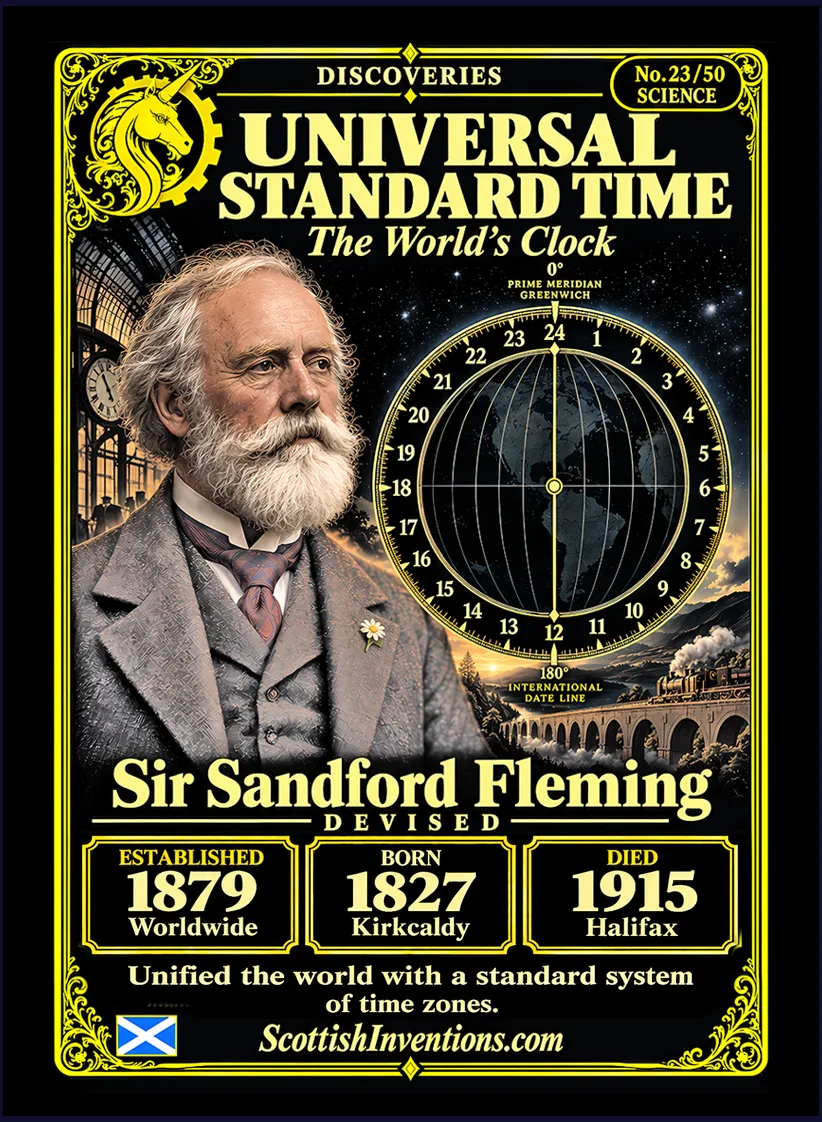
From 1879, the Kirkcaldy-born engineer Sandford Fleming campaigned tirelessly for a single worldwide system of standard time and 24 time zones. He was one of the most important people behind the clocks we all now trust without thinking — but he was not the only one, and he did not act alone.
Sir Sandford Fleming · 1827–1915Standards · TimekeepingScotland / CanadaReading time · 21 minUpdated 10 August 2026
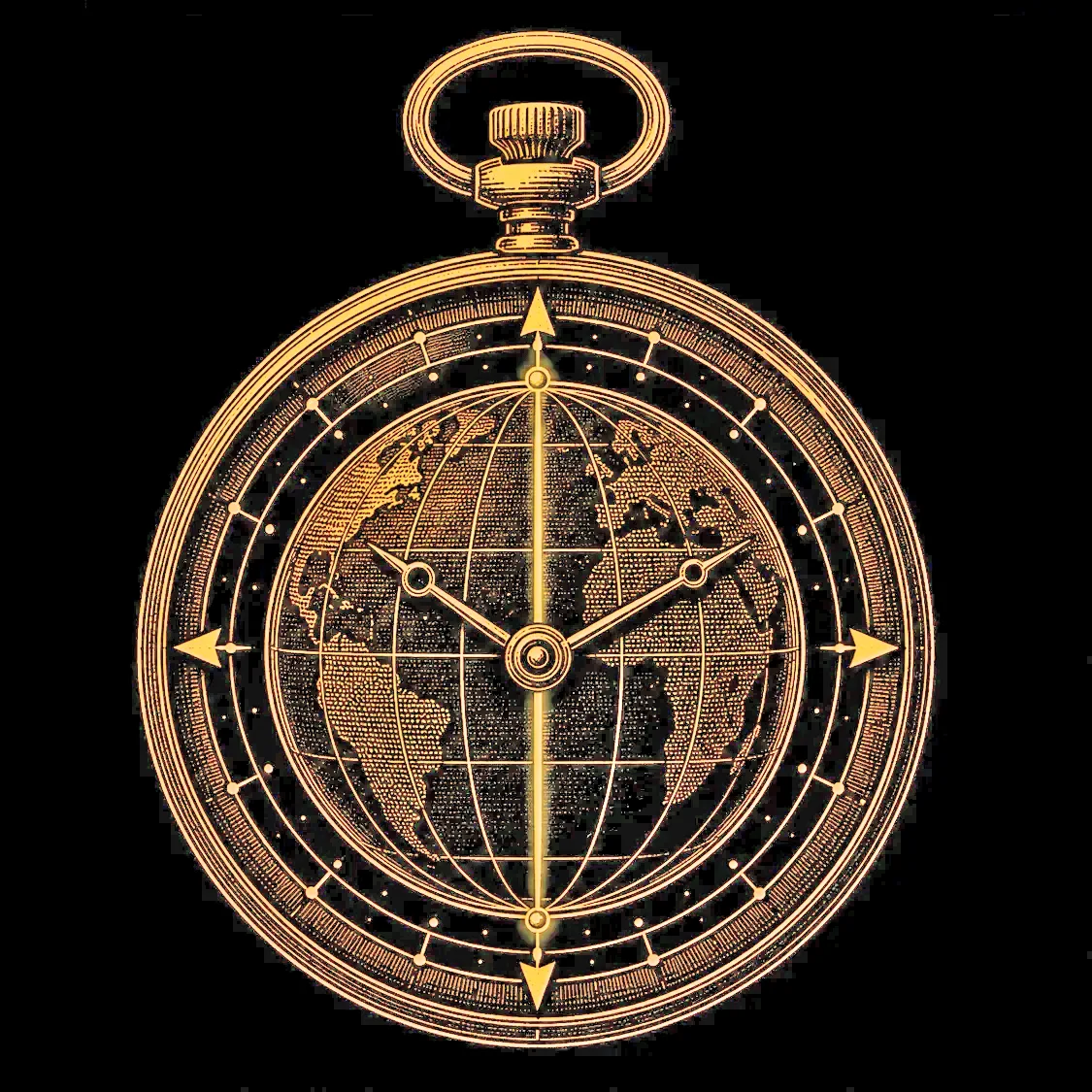
Sandford Fleming and universal standard time — in brief
Sir Sandford Fleming (1827–1915), born in Kirkcaldy, Fife, and later a leading Canadian railway engineer, became from 1879 the most persistent and internationally influential campaigner for a single worldwide system of standard time: a global 24-hour clock he called "Cosmic Time," paired with a practical scheme of 24 standard time zones. He was not the first to propose such an idea — the Italian Quirico Filopanti had floated 24 hourly zones in 1858, and the American Charles F. Dowd had proposed US railway time zones in 1869–1870 — and North American railway companies adopted standard time on their own initiative in November 1883, a year before the International Meridian Conference met in Washington in October 1884 and fixed Greenwich as the world's prime meridian. Fleming's real achievement was advocacy: turning a patchwork of local and national conveniences into an internationally coordinated, and eventually near-universal, system.
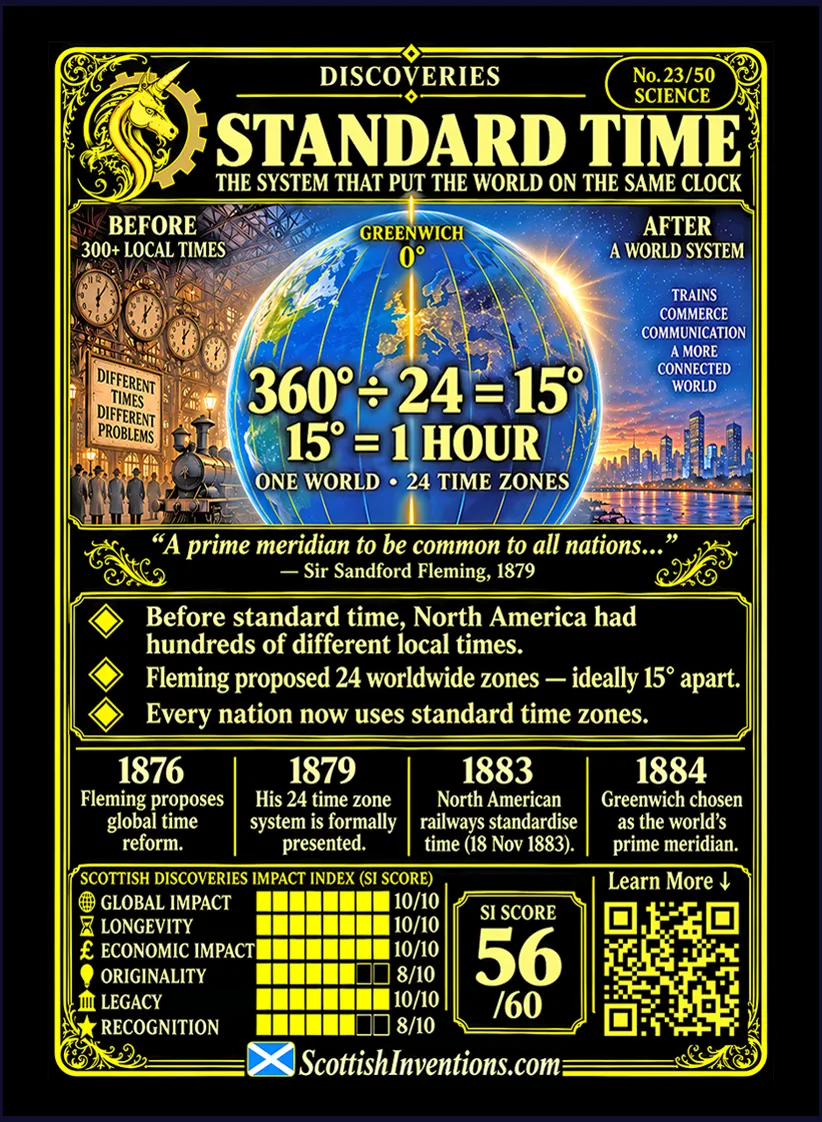
Scottish Impact Index (SI Score)
- Global Impact
- 10/10
- Longevity
- 10/10
- Economic / Material Impact
- 9/10
- Originality / Distinctiveness
- 7/10
- Legacy (Built Upon)
- 9/10
- Recognition
- 5/10
Sandford Fleming — Key Facts
- Discovery
- A single, worldwide system of standard time and 24 time zones, campaigned for from 1879
- Campaigner
- Sir Sandford Fleming (1827–1915)
- Born
- 7 January 1827, Kirkcaldy, Fife, Scotland
- Emigrated
- To Canada in 1845, aged 18
- Day job
- Chief engineer of the Intercolonial Railway and surveyor for the Canadian Pacific Railway
- Key proposal
- 'Terrestrial Time' / 'Cosmic Time' — a single 24-hour global clock plus 24 standard time zones, set out in papers from 1879
- Rival/parallel claims
- Charles F. Dowd (USA, proposed US time zones 1869–1870); Quirico Filopanti (Italy, proposed 24 hourly zones in an 1858 book); William Lambert (USA, proposed a prime meridian and world time scheme, 1809–1811)
- First real-world adoption
- North American railway companies adopted standard time zones on their own initiative on 18 November 1883, before any government had acted
- Key event
- International Meridian Conference, Washington, D.C., October 1884
- What the 1884 conference actually did
- Adopted Greenwich as the world's prime meridian and fixed a universal day; it did not mandate national time zones, which individual countries adopted gradually over the following decades
- Other achievements
- Chief engineer of Canada's Intercolonial Railway and a surveyor for the Canadian Pacific Railway; designer of Canada's first postage stamp, the Three-Penny Beaver (1851)
- Claim status
- ESTABLISHED that Fleming was a leading and highly effective campaigner for worldwide standard time from 1879 onward — NOT established, and not claimed here, that he invented time zones alone or first
Kirkcaldy to Canada
Sandford Fleming was born on 7 January 1827 in Kirkcaldy, Fife, a Scottish coastal town already known for linoleum manufacturing and, a century earlier, as the birthplace of the economist Adam Smith. Fleming trained as a land surveyor in Scotland before emigrating to Canada in 1845 at the age of eighteen, settling first in what is now Ontario and building, over the following decades, one of the most consequential engineering careers in Canadian history.
It is worth being plain from the outset about what kind of figure Fleming was. He was not a scientist working in a laboratory, nor an astronomer specialising in timekeeping. He was a practical civil engineer and railway surveyor whose encounter with the problem of standard time grew directly out of the day-to-day chaos of running trains across a continent that, before the 1880s, had no agreed way of telling the time from one town to the next.
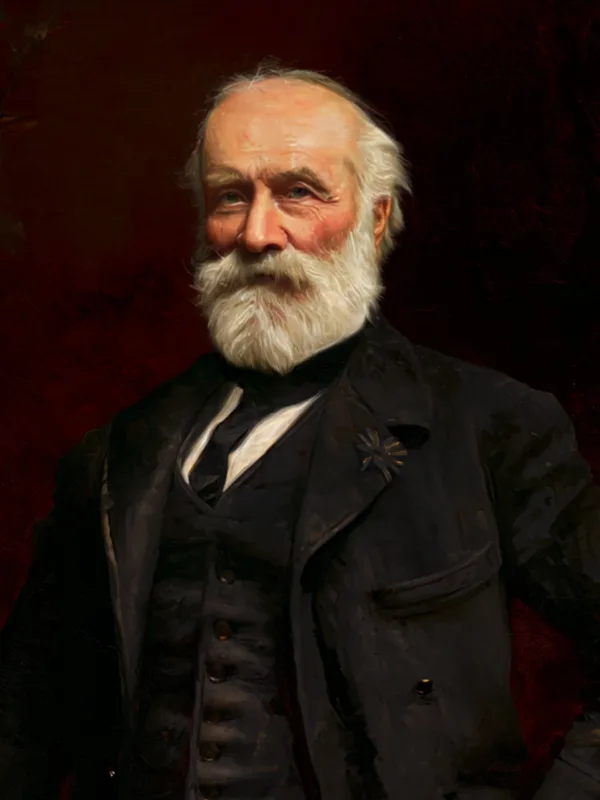
A Career Built on Railways
Long before he turned his attention to global timekeeping, Fleming had already built a formidable reputation as an engineer. He served as chief engineer of Canada's Intercolonial Railway, connecting the Maritime provinces to central Canada, and later worked as a chief surveyor for the Canadian Pacific Railway, the transcontinental line that would bind the young Canadian confederation together from Atlantic to Pacific.
Running trains across such distances exposed, better than almost any other occupation of the period, exactly how badly local time-telling scaled. In the mid-nineteenth century, most towns set their clocks by local solar noon, which meant that towns even a short distance apart, east or west, kept clocks that differed by minutes. Railway timetables printed in one town's local time became a source of genuine danger and confusion once used to schedule trains passing through dozens of other towns, each with its own version of "noon." Fleming's later campaign for standard time was, in this sense, less a flash of inspiration than the natural conclusion of a career spent staring at exactly this problem on paper timetables and physical rail lines alike.
The Bandoran Story
The anecdote most often used to explain Fleming's conversion to time reform concerns a missed train in Ireland in 1876. As Fleming told it in later years, he arrived at a railway station — often located near Bandoran, County Donegal, in tellings of the story — to find that a printed timetable, using twelve-hour numbering without a clear a.m./p.m. distinction, had led him to turn up twelve hours too late, having read a p.m. departure as a.m. He is said to have missed his connection and spent an uncomfortable night waiting, brooding on just how easily an ambiguous clock notation could derail a traveller's plans.
This story deserves an honest caveat. It is well attested in the sense that Fleming himself told it, and it appears consistently across biographical accounts of his life; there is no serious reason to doubt that some frustrating timetable mishap of this general kind occurred. But the precise location, date and circumstances vary between different retellings, and no independent contemporary document — a diary entry, a letter written at the time — has been produced to pin the story down exactly. It should be read, honestly, as a traditional anecdote Fleming used to illustrate and dramatise his motivation, rather than a precisely documented historical event corroborated by outside sources.
Whatever its precise details, the frustration it describes was real and widely shared. Ambiguous local time and inconsistent timetable notation were a genuine, well-documented nuisance across the railway networks of the 1870s, and Fleming was far from the only traveller of his generation to be caught out by them.
1879: Cosmic Time and World Zones
In 1879, Fleming began presenting papers — chiefly to the Royal Canadian Institute in Toronto — proposing a radical simplification of world timekeeping. His original scheme called for a single, universal 24-hour clock, which he termed "Cosmic Time" or "Terrestrial Time," to be used everywhere on Earth regardless of local sunrise and sunset. Alongside this, he proposed dividing the globe into 24 standard time zones, each one hour apart, keyed to a chosen prime meridian, so that local civil clocks could remain convenient for daily life while still bearing a fixed, predictable relationship to the single global standard.
Fleming circulated these ideas energetically over the following years, presenting them to scientific societies, geographical congresses and government committees in Canada, the United States and Europe. He revised the scheme repeatedly in response to criticism — in particular, the single-clock "Cosmic Time" element proved harder to sell than the more modest, more practical proposal for standard hourly zones, and it was the zone system, not the single global clock, that ultimately caught on internationally.
Dowd, Filopanti, Lambert, and the Railways
An accurate account of standard time cannot credit Fleming alone, because he was not alone. The Italian mathematician Quirico Filopanti had proposed a scheme of 24 hourly time zones as early as 1858, in a book titled Miranda!; it attracted little attention at the time and appears to have been essentially unknown to Fleming, Dowd or the delegates of the 1884 conference, but it establishes Filopanti's clear priority for the core zoning concept.
Closer to Fleming's own context, the American schoolteacher and railway timetable author Charles F. Dowd proposed, in 1869–1870, a scheme of four standard time zones specifically for United States railways — a proposal that predates Fleming's global scheme by roughly a decade and directly influenced the specific zone boundaries American railways would later adopt. Even earlier, the American surveyor William Lambert had proposed a prime meridian running through Washington, D.C., and a related scheme for reckoning time globally, in papers presented to Congress between 1809 and 1811 — a proposal so early that it predates not just Fleming but the whole nineteenth-century railway problem that eventually made standard time urgent.
None of this diminishes what Fleming did. His distinctive contribution was not originality of concept — others had that first — but relentless, well-connected advocacy: taking a scattered set of national and theoretical proposals and turning them, through sustained lobbying of scientific bodies and governments across two continents, into an internationally coordinated system that actually got adopted.
1883: The Railways Move First
The first large-scale, practical adoption of standard time in North America came not from any government but from the railway industry itself. On 18 November 1883 — remembered popularly as "The Day of Two Noons," because many towns effectively reset their clocks partway through the day — Canadian and American railway companies, coordinated through the General Time Convention, adopted a system of standard time zones across the continent, closely following the zone boundaries Dowd and Fleming had each separately proposed.
This is an important and often overlooked sequence of events: the railways acted commercially, on their own authority, a full year before the international diplomatic conference that is popularly remembered as the moment standard time was decided, and decades before the United States Congress gave standard time zones the force of federal law in the Standard Time Act of 1918.
The 1884 International Meridian Conference
In October 1884, delegates from twenty-five nations convened in Washington, D.C., at the invitation of the United States government, for the International Meridian Conference. Fleming attended as one of two Canadian delegates and was, by this point, one of the scheme's best-known international advocates — but it is worth being precise that the conference itself was convened by the United States, not organised or chaired by Fleming personally.
The conference's actual resolutions were narrower than popular memory often suggests. Delegates voted to adopt the meridian passing through the Royal Observatory at Greenwich, England, as the world's single prime meridian for measuring longitude, and to define a universal day beginning at Greenwich mean midnight, for use in astronomy, navigation and international communication. The conference did not mandate that individual nations adopt standard civil time zones for domestic use; that remained a matter for each country to decide, and adopt, in its own time.
France, notably, abstained from the vote on the Greenwich meridian and continued using Paris Mean Time for civil purposes for years afterward, adopting Greenwich-based time only in 1911 — and even then, for legal reasons, describing it for decades as "Paris Mean Time, retarded by 9 minutes 21 seconds" rather than naming Greenwich directly, a legal fiction not formally dropped until 1978.
Greenwich, Railway Time, and What Came Before
Fleming's worldwide proposal did not emerge from nothing. Britain had already worked through a smaller- scale version of the same problem decades earlier. British railway companies began adopting "railway time" — clocks synchronised to Greenwich Mean Time rather than local solar time — from the 1840s, as their networks expanded and local time discrepancies between stations began causing timetabling chaos. By 1852, Greenwich time was being transmitted by telegraph to stations across the country, and by 1880 it had been formally adopted as Britain's single legal standard time.
This British precedent mattered for two reasons. First, it demonstrated on a national scale that abandoning local solar time in favour of a single external standard was practical and survivable — an important proof of concept for anyone later proposing to do the same thing globally. Second, it meant that when the 1884 conference came to choose a prime meridian, Greenwich already had by far the largest base of existing shipping charts, navigational tables and railway timetables built around it, a practical advantage that weighed heavily against rival candidates such as Paris.
The Three-Penny Beaver
Fleming's career included at least one entirely different claim to a small piece of history. In 1851, working for the Province of Canada's postal service, he designed Canada's first postage stamp: the Three-Penny Beaver, which depicted a beaver rather than a royal portrait, an unusual and distinctly Canadian choice for the period. It is a minor footnote next to the standard-time campaign, but it fits the pattern of Fleming's whole working life — a practically minded engineer who kept finding himself solving infrastructure and coordination problems that nobody else had quite got round to solving yet.
Myth vs Evidence
Myth
Sandford Fleming invented time zones.
Evidence
He did not invent the underlying idea alone, and this site does not claim he did. The Italian mathematician Quirico Filopanti had proposed 24 hourly zones in a book as early as 1858; the American Charles F. Dowd proposed a four-zone scheme for US railways in 1869–1870; and William Lambert had floated a global time-reckoning scheme in Washington as early as 1809. Fleming's distinctive contribution was persistence, international lobbying and a workable practical scheme from 1879 onward, not sole priority for the concept.
Myth
The 1884 International Meridian Conference created worldwide time zones.
Evidence
It did not. The conference fixed Greenwich as the prime meridian and defined a single universal day for scientific and navigational purposes. It did not oblige any country to adopt standard civil time zones; that happened piecemeal, country by country, over the following four decades, driven mainly by railway and telegraph companies rather than by the conference's resolutions.
Myth
Railways adopted standard time because governments told them to.
Evidence
The opposite is closer to the truth in North America. Railway companies across Canada and the United States adopted standard time zones on their own initiative on 18 November 1883 — a full year before the Washington conference and decades before the US Congress made time zones a matter of federal law, in the Standard Time Act of 1918.
Myth
The Bandoran missed-train story is a precisely documented historical fact.
Evidence
It is a genuine and frequently repeated anecdote that Fleming himself told in later life, about a missed train in Ireland caused by an a.m./p.m. mix-up on a printed timetable. It is well attested as a story Fleming told about himself, but the fine detail — the exact place and date — varies between retellings and should be read as a traditional, personally sourced anecdote rather than an independently verified event.
Myth
France simply accepted Greenwich Mean Time in 1884.
Evidence
It did not. France abstained from the vote adopting Greenwich as the prime meridian and continued to use Paris Mean Time, offset from Greenwich by a fixed interval, well into the twentieth century, adopting Greenwich-based time for civil purposes only in 1911 and using 'Paris Mean Time, retarded by 9 minutes 21 seconds' as a face-saving formula for legal purposes until 1978.
Timeline
| Date | Event | Detail |
|---|---|---|
| 1827 | Sandford Fleming is born in Kirkcaldy, Fife, Scotland | Son of a merchant; trained as a land surveyor before emigrating |
| 1845 | Fleming emigrates to Canada at age 18 | He builds a career as a surveyor and civil engineer in the young colony |
| 1851 | Fleming designs Canada's first postage stamp, the Three-Penny Beaver | A rare instance of a railway engineer also shaping a nation's earliest official iconography |
| 1809–1811 | William Lambert (USA) proposes a prime meridian through Washington and a global time-reckoning scheme | An early, largely forgotten American precursor to worldwide standard time, decades before Fleming's papers |
| 1840s | British railway companies adopt 'railway time' based on Greenwich Mean Time | A practical, national-scale precursor to worldwide zones, driven by the need for timetables that made sense across a rail network |
| 1852 | Greenwich time is transmitted by telegraph across Britain, cementing GMT as the national standard | The infrastructure and habit of a single reference time already existed in Britain decades before Fleming's global proposal |
| 1858 | Quirico Filopanti, an Italian mathematician, proposes 24 hourly time zones in his book Miranda! | Published but little-read at the time; largely unknown to Fleming and Dowd, and rediscovered by historians only much later |
| 1869–1870 | Charles F. Dowd (USA) proposes a system of four standard time zones for American railways | An independent American proposal focused specifically on US railway scheduling, predating Fleming's global scheme by about a decade |
| 1876 | Fleming misses a train in Ireland owing to a printed timetable ambiguity between a.m. and p.m. | A frequently retold anecdote, sourced to Fleming's own later accounts; the exact village and details vary between tellings and should be treated as tradition rather than a precisely documented event |
| 1879 | Fleming presents papers proposing 'Cosmic Time' — a single 24-hour global clock — and a system of standard time zones | Delivered to the Royal Canadian Institute and circulated internationally; Fleming becomes the proposal's most persistent and best-connected international advocate |
| 1880–1883 | Fleming lobbies scientific bodies, governments and railway associations across North America and Europe | He revises his scheme repeatedly in response to criticism, in particular narrowing 'Cosmic Time' into the more practical standard-zone system |
| 18 November 1883 | North American and Canadian railway companies adopt standard time zones on their own authority | Known as 'The Day of Two Noons'; railways acted before any national government had legislated on the matter |
| October 1884 | The International Meridian Conference convenes in Washington, D.C. | Twenty-five nations attend; Fleming is present as a Canadian delegate and prominent advocate, though the conference is convened by the United States, not by Fleming |
| 1884 | The conference adopts Greenwich as the prime meridian and defines a universal day | It does not mandate time zones for individual countries; France abstains on the meridian vote and continues using Paris Mean Time for years afterward |
| 1885–1929 | Countries adopt standard time zones individually, at their own pace | Japan (1888), most of Europe (1890s–1900s) and finally France (1911, fully in 1978 for legal purposes) adopt zones over a period of decades, not overnight |
| 1897 | Fleming is knighted for his services to Canada, including his railway and standard-time work | By this point Fleming is an elder statesman of Canadian engineering as much as a time-reform campaigner |
| 1915 | Sandford Fleming dies at Halifax, Nova Scotia, aged 88 | He lived to see standard time widely, though not universally, adopted across the industrialised world |
Did You Know?
Fleming designed Canada's first postage stamp, the Three-Penny Beaver, nearly three decades before he began his standard-time campaign.
North American railways adopted standard time on 18 November 1883, a full year before the Washington conference — "The Day of Two Noons."
France did not officially adopt Greenwich-based civil time until 1911, and kept a face-saving legal formula avoiding the word "Greenwich" until 1978.
Quirico Filopanti's 1858 proposal for 24 hourly time zones predates Fleming's papers by two decades but went almost entirely unnoticed at the time.
Fleming's true legacy is not the invention of an idea that already existed in scattered form elsewhere, but the patient, cross-border advocacy that turned that idea into the coordinated global infrastructure of standard time we now take entirely for granted. It is a distinctly unglamorous kind of achievement — committee papers, lobbying, revised proposals — but it changed how the entire industrialised world tells the time, and it did so through decades of collective, international effort rather than a single inventor's flash of insight.
Frequently Asked Questions
Did Sandford Fleming invent time zones?
No, not by himself, and this site does not claim otherwise. Fleming was the most persistent, best-organised and most internationally influential campaigner for a single worldwide system of standard time from 1879 onward, and his practical scheme closely resembles the time-zone system in use today. But the underlying idea of dividing the world into standard hourly zones had already been proposed independently by others: the Italian Quirico Filopanti in an 1858 book, and the American Charles F. Dowd, whose 1869–1870 proposal for US railway time zones predates Fleming's global scheme by roughly a decade. William Lambert had even floated an early global time-reckoning idea in Washington as far back as 1809. Fleming's importance lies in advocacy, lobbying and practical refinement, not sole invention.
Who was Sandford Fleming and where was he born?
Sir Sandford Fleming (1827–1915) was born in Kirkcaldy, Fife, Scotland, and emigrated to Canada in 1845 at the age of 18. He built his career as a land surveyor and civil engineer, eventually becoming chief engineer of Canada's Intercolonial Railway and a leading surveyor for the transcontinental Canadian Pacific Railway, before turning his engineering skills toward the problem of standardising time for railway scheduling.
What did Fleming actually propose in 1879?
In papers presented from 1879 onward, chiefly to the Royal Canadian Institute, Fleming proposed a single 24-hour global clock he called 'Cosmic Time' (also referred to as 'Terrestrial Time'), alongside a practical system of 24 standard time zones keyed to hourly intervals from a chosen prime meridian. Over the following years, in response to criticism from scientists and diplomats, Fleming refined the scheme, with the more workable standard-zone element eventually proving far more influential internationally than his original single-clock proposal.
What is the Bandoran / missed-train story, and is it true?
Fleming himself, in later life, told a story about missing a train while travelling in Ireland — sometimes located near Bandoran, County Donegal — because of confusion over a.m. and p.m. on a printed timetable that used only twelve-hour numbering. It is a well-attested anecdote in the sense that Fleming told it about himself and it circulates widely in accounts of his life, and it plausibly reflects the kind of everyday scheduling confusion that motivated reformers of the period. However, the precise place, date and details vary between retellings, so it should be treated as a personally sourced, traditional anecdote illustrating Fleming's motivation, rather than a precisely documented historical event with primary-source corroboration.
What did the 1884 International Meridian Conference actually decide?
Meeting in Washington, D.C. in October 1884, delegates from twenty-five nations adopted the meridian through Greenwich, England, as the world's prime meridian for longitude, and defined a single universal day beginning at Greenwich mean midnight. The conference did not create or mandate national civil time zones; those were adopted separately by individual countries over the following decades. Fleming attended as a Canadian delegate and one of the scheme's most prominent advocates, but the conference itself was convened by the United States government, and its resolutions were narrower than the full system of standard time zones that later became universal.
Did railways or governments adopt standard time first?
In North America, railways moved first. On 18 November 1883 — a date popularly remembered as 'The Day of Two Noons' — Canadian and American railway companies adopted a coordinated system of standard time zones on their own commercial initiative, a full year before the Washington conference and decades before national governments made the system a matter of law. In the United States, standard time zones were not given federal legal force until the Standard Time Act of 1918.
Did every country adopt Greenwich-based standard time immediately after 1884?
No. Adoption was slow and uneven. Britain and its railways had effectively used Greenwich Mean Time since the 1840s–1850s, well before the conference. Other countries took far longer: Japan adopted standard time in 1888, most of continental Europe followed across the 1890s and 1900s, and France — which had abstained from the 1884 meridian vote — did not adopt Greenwich-based civil time until 1911, and only fully removed a face-saving legal fiction referencing Paris time in 1978.
What was Fleming's connection to Canada's first postage stamp?
In 1851, before his standard-time campaign, Fleming designed Canada's first postage stamp, the Three-Penny Beaver, which depicted a beaver rather than a monarch's portrait — an unusual choice for the period. It reflects the same practical, infrastructure-minded career — spanning railways, surveying, postal design and international time reform — that runs through Fleming's whole working life.
Should Fleming be credited as 'the inventor of time zones'?
It depends on the precision of the claim. Crediting Fleming as the leading international campaigner who turned standard time from a scattered set of national and railway conveniences into a coordinated worldwide proposal, and who did more than any other single individual to carry that idea to governments and scientific bodies from 1879 to 1884 and beyond, is accurate and well supported. Crediting him as the sole or first inventor of the underlying concept is not, given Filopanti's 1858 proposal, Dowd's 1869–1870 American railway scheme, and Lambert's much earlier 1809 proposal. This site credits Fleming for what the historical record actually supports: outstanding, persistent advocacy, not solitary invention.
Collect the Card
Sources & Further Reading
Tier 1 · Primary
- Fleming, Sandford — "Time-Reckoning for the Twentieth Century," Smithsonian Institution Annual Report, and earlier papers to the Royal Canadian Institute, from 1879.
- Protocols of the International Meridian Conference, Washington, D.C., October 1884.
- Dowd, Charles F. — "A System of National Time for Railroads," 1870.
- Filopanti, Quirico — Miranda!, 1858 (proposal for 24 hourly time zones).
- Lambert, William — reports to the United States Congress on a national prime meridian and time-reckoning, 1809–1811.
- United States Standard Time Act, 1918, and related legislative history.
- Bureau International de l'Heure and Paris Observatory historical records on French adoption of Greenwich-based time, 1911 and 1978.
- General Time Convention (railway associations) records on the 18 November 1883 adoption of standard time zones in North America.
- Library and Archives Canada — biographical records on Sir Sandford Fleming, including his design of the Three-Penny Beaver postage stamp (1851).
Tier 2 · Scholarly and institutional
- Blaise, Clark — Time Lord: Sir Sandford Fleming and the Creation of Standard Time, 2000.