Discoveries · No. 50 of 50 · Physics
Particle Tracks in Supersaturated Vapour: The Cloud Chamber
In 1911, the Scottish physicist C.T.R. Wilson perfected an instrument that grew out of a mountaintop weather obsession and ended up making the invisible world of subatomic particles visible for the first time. What he built earned him a Nobel Prize; what others later did with it built modern particle physics.
Charles Thomson Rees Wilson · 1869–1959Physics · Scientific InstrumentsScotland / EnglandReading time · 20 minUpdated 10 August 2026
C.T.R. Wilson and the cloud chamber — in brief
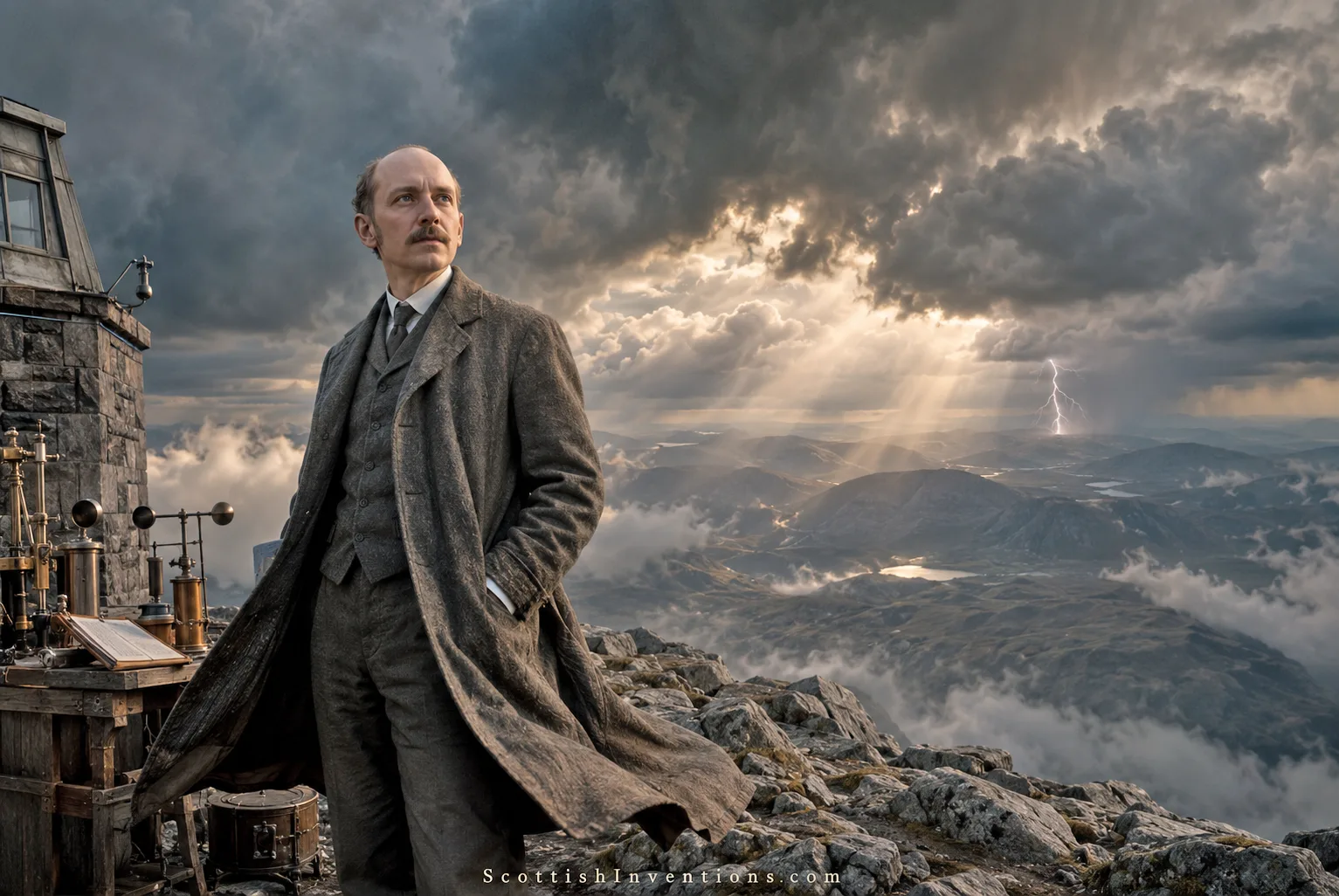
Charles Thomson Rees Wilson (1869–1959), a Scottish physicist working at the Cavendish Laboratory in Cambridge, perfected the cloud chamber in 1911: a sealed vessel in which a sudden expansion creates supersaturated water vapour, so that any electrically charged particle passing through leaves behind a visible trail of condensed droplets. The idea began as pure meteorology — an attempt, inspired by weeks spent at the Ben Nevis Observatory in 1894, to recreate natural cloud formation in the laboratory — and built directly on the earlier condensation-nuclei work of the Scottish physicist John Aitken. Wilson shared the 1927 Nobel Prize in Physics with the American physicist Arthur Compton, each cited for a separate achievement. The chamber's greatest scientific triumphs, however, came from other hands: Patrick Blackett's automated triggering, Carl Anderson's 1932 discovery of the positron, and Cecil Powell's cosmic-ray work, before the instrument was gradually superseded by Donald Glaser's bubble chamber from 1952 onward.
Scottish Impact Index (SI Score)
- Global Impact
- 9/10
- Longevity
- 9/10
- Economic / Material Impact
- 5/10
- Originality / Distinctiveness
- 9/10
- Legacy (Built Upon)
- 9/10
- Recognition
- 4/10
C.T.R. Wilson — Key Facts
- Discovery
- The cloud chamber (1911) — the first instrument able to make the paths of individual subatomic particles visible and photographable
- Inventor
- Charles Thomson Rees Wilson (1869–1959)
- Born
- 14 February 1869, Glencorse, Midlothian, Scotland
- Institution
- Cavendish Laboratory, University of Cambridge
- Direct predecessor
- John Aitken (Scotland), condensation-nuclei research on dust and water vapour, 1880s
- Inspiration
- Meteorological cloud-formation observations at the Ben Nevis Observatory, September 1894
- Chamber perfected
- 1911 — first photographs of individual alpha- and beta-particle tracks
- Nobel Prize
- Physics, 1927 — shared jointly with Arthur Compton (United States), for an unrelated discovery (the Compton effect)
- Key later users
- Patrick Blackett (automated chamber, 1932); Carl Anderson (positron, 1932); Cecil Powell (pion, 1947)
- Superseded by
- The bubble chamber, invented by Donald Glaser (United States), 1952
- Claim status
- ESTABLISHED priority for the instrument itself, but the chamber's scientific payoff came almost entirely from other physicists who used it after Wilson
Aitken's Dust-Free Air
Any honest account of the cloud chamber has to start not with Wilson but with a less celebrated Scottish physicist: John Aitken, working largely alone in Falkirk during the 1880s. Aitken was investigating why fog and cloud form at all, and established a principle that seems obvious only after someone has proved it: water vapour does not simply condense out of thin air by itself. It needs something to condense onto — a nucleus. In ordinary air, that nucleus is almost always a speck of dust. Remove the dust, and even heavily supersaturated air can remain clear, refusing to form droplets.
Aitken built an instrument, his dust counter, to measure the number of these nuclei in a sample of air, and used it to study fog formation, ventilation and atmospheric pollution with a rigour well ahead of his time (his work is treated at length in Discoveries card No. 29 on this site). It was this body of work — published, debated and generally accepted in the physics community of the day — that gave the young Wilson the conceptual toolkit he needed: a laboratory-tested understanding that condensation requires nuclei, and that removing dust from air removes the ordinary route to cloud formation. Wilson's subsequent insight, that ions could substitute for dust as nucleation sites, would have made little sense to his contemporaries without Aitken's foundation already in place.
A Winter on Ben Nevis
Charles Thomson Rees Wilson was born on 14 February 1869 at Crosshouse Farm near Glencorse, Midlothian, the son of a sheep farmer. After his father's death the family moved to Manchester, where Wilson attended Owens College before winning a scholarship to Sidney Sussex College, Cambridge, and settling into a career in physics at the Cavendish Laboratory under J.J. Thomson, the discoverer of the electron.
Wilson's route to the cloud chamber began not in a laboratory but on a mountain. In September 1894 he spent several weeks working at the meteorological observatory on the summit of Ben Nevis, one of the most scientifically ambitious weather stations in the world at the time, staffed year-round through brutal Highland winters to record barometric pressure, temperature and cloud behaviour above the Scottish glens. Wilson later wrote that the effects of coloured rings and glories he saw playing on clouds from the summit — optical phenomena caused by sunlight interacting with water droplets — left him "greatly fascinated," and determined to reproduce cloud formation artificially once he returned to Cambridge.
This origin matters for an accurate account of the invention. Wilson was not chasing atomic particles in 1894; nobody was, since the electron itself would not be identified for another three years and radioactivity had not yet been discovered. He was a meteorologist-minded physicist trying to understand clouds. The device that would eventually reveal the subatomic world was, at its conception, a piece of weather-science apparatus.
The Long Road at the Cavendish
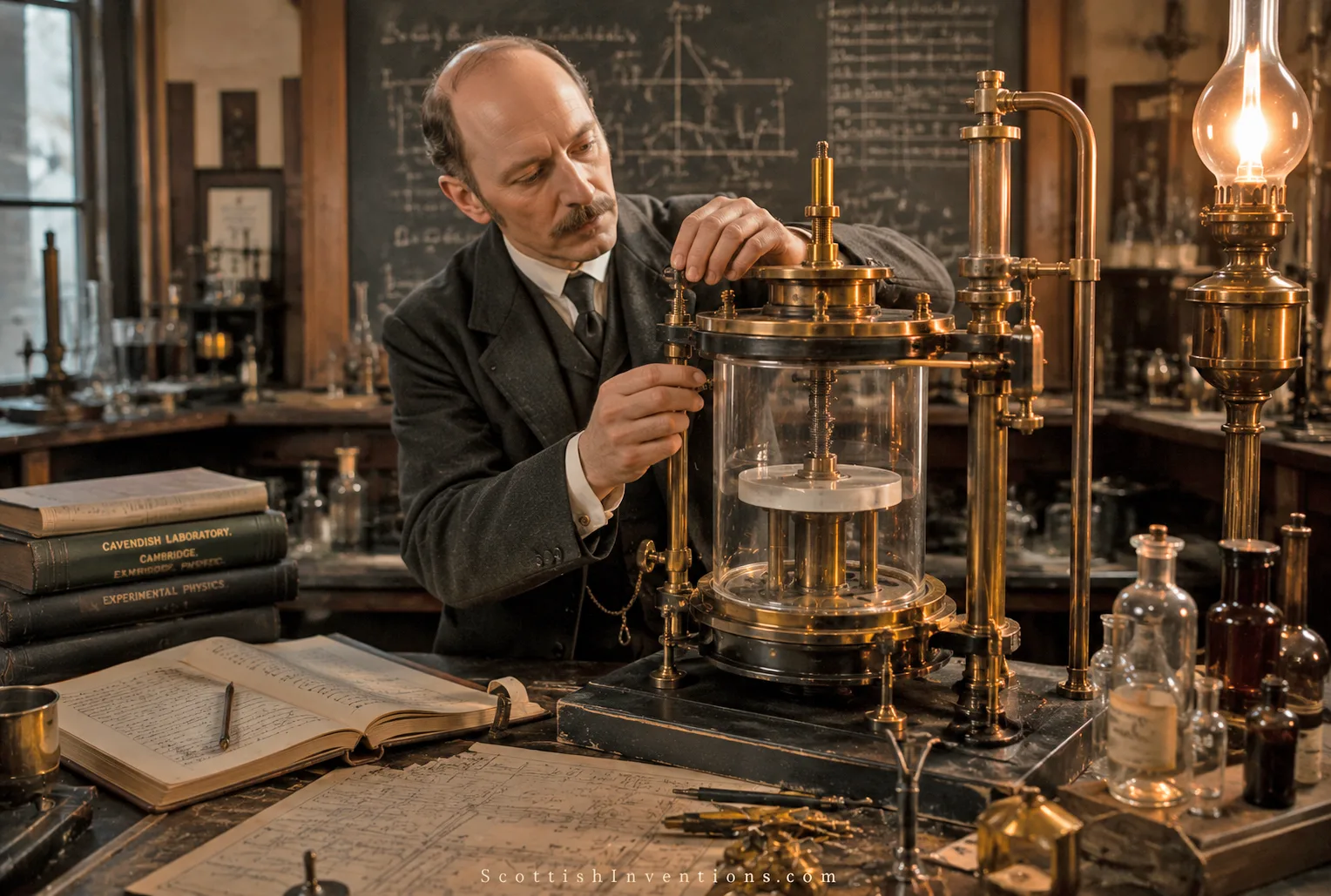
Back in Cambridge, Wilson built his first expansion chamber in 1895: a glass vessel in which a sudden drop in pressure caused the air inside to expand and cool rapidly, pushing water vapour past its saturation point. Following Aitken, he confirmed that dust particles seeded droplet formation in ordinary air, and that scrupulously dust-free air could be pushed to remarkable degrees of supersaturation without clouding at all.
The turn toward what would become particle physics came almost by accident, in the wake of two enormous discoveries elsewhere: Wilhelm Röntgen's X-rays in November 1895 and Henri Becquerel's radioactivity in 1896. Wilson found that ionising radiation — X-rays, or the radiation from radioactive substances — dramatically increased condensation in his dust-free chamber, even though no dust was present. His conclusion was that the radiation was creating ions in the air, and that these ions, like Aitken's dust motes, could themselves serve as condensation nuclei.
Progress from that insight to a usable instrument was slow. Wilson held a demanding Cambridge teaching post throughout, worked for long stretches essentially alone, and was hampered at points by poor health. More than fifteen years separate his first crude expansion chamber from the device that would make him famous — a reminder that this was patient, incremental instrument-building rather than a single flash of insight.
1911: The Tracks Appear
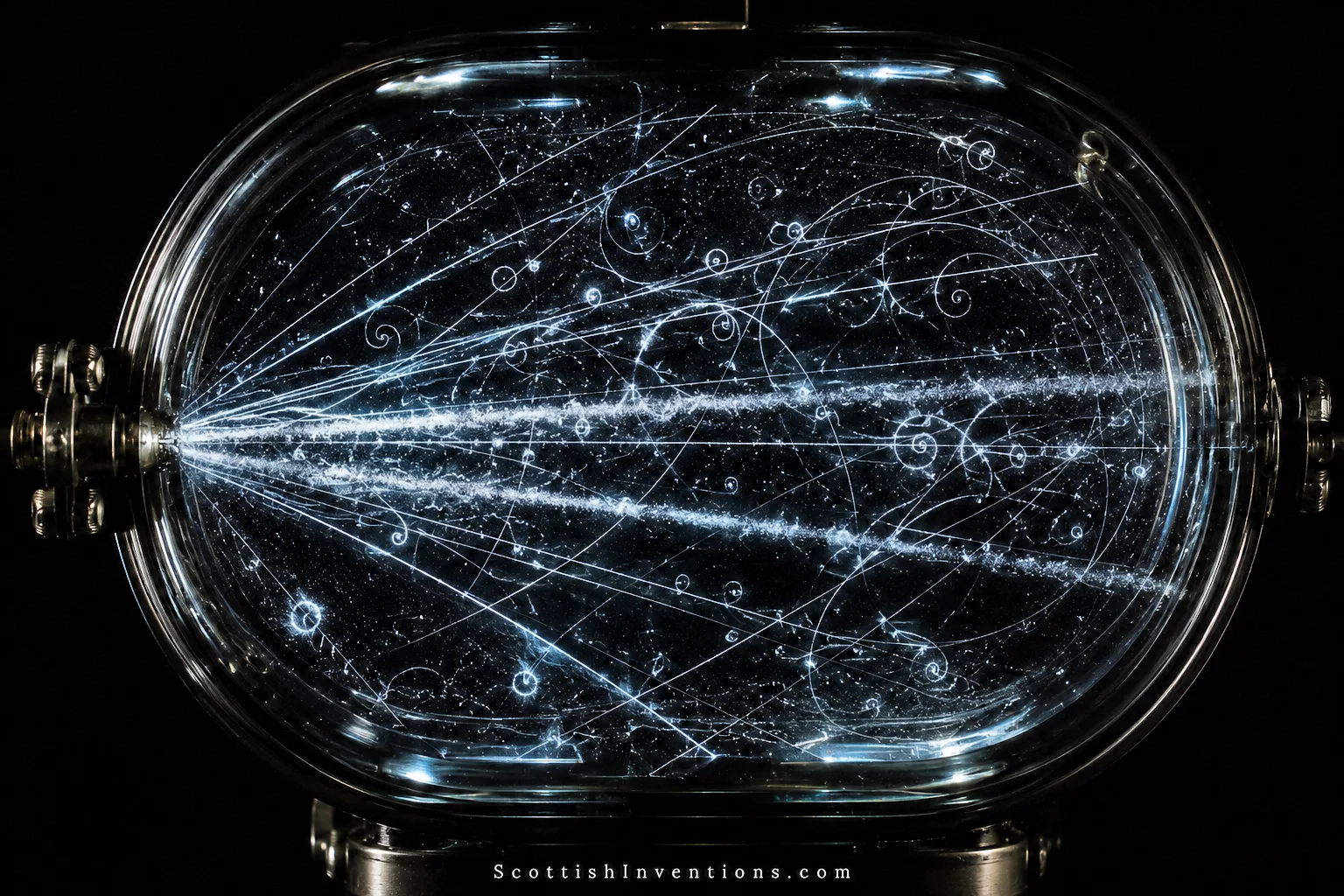
By 1911 Wilson had refined his apparatus to the point where he could do something genuinely new: not merely detect that ionising radiation was present, by counting droplets in a fog, but photograph the actual path taken by a single ionising particle as it crossed the chamber. An alpha or beta particle speeding through the supersaturated vapour leaves a trail of ions in its wake; each of those ions instantly nucleates a tiny water droplet; and the resulting string of droplets, illuminated and photographed at the right instant, appears as a fine, glowing line — a visible fossil record of a single subatomic event.
Wilson published these results, with photographs, in the Proceedings of the Royal Society the following year. For a physics community that had spent fifteen years inferring the existence and behaviour of atomic particles indirectly — through counters, scintillation screens and mathematical argument — the ability to simply look at, and photograph, the track of one particle was a genuine sensation within specialist circles, even if wider public fame came only later, reinforced by his 1927 Nobel award.
The 1927 Nobel Prize
In 1923 Wilson used his chamber to photograph the recoil tracks of electrons scattered by X-rays, providing striking visual confirmation of a discovery the American physicist Arthur Compton had made that same year: the Compton effect, in which X-ray photons behave as particles that transfer momentum to electrons on collision. It is worth being precise about what happened four years later, because the record is easy to garble. The 1927 Nobel Prize in Physics was shared between Wilson and Compton, but not for a joint achievement. Wilson was cited "for his method of making the paths of electrically charged particles visible by condensation of vapour"; Compton was cited separately, in the same citation document, "for his discovery of the effect named after him." Two independent contributions to the same field of physics, recognised together in a single year — a standard, unremarkable Nobel practice, not evidence that the two men worked together or shared a single discovery.
Blackett's Automated Chamber
Wilson's original chamber had a serious practical limitation: it produced tracks only in the brief instant after the expansion, and an operator triggering the expansion by hand had no way of knowing in advance whether an interesting particle was about to pass through. Most photographs, therefore, showed nothing at all.
The solution came from the British physicist Patrick Blackett, working with the Italian physicist Giuseppe Occhialini at the Cavendish Laboratory in 1932. They connected the chamber's expansion mechanism to a set of Geiger counters arranged so that the chamber fired automatically, and the camera took a photograph, only when a cosmic-ray particle had actually just passed through the relevant volume of the apparatus. This counter-controlled cloud chamber transformed the instrument from an occasionally lucky curiosity into a systematic research tool, and was central to the body of work for which Blackett himself received the 1948 Nobel Prize in Physics.
Anderson and the Positron
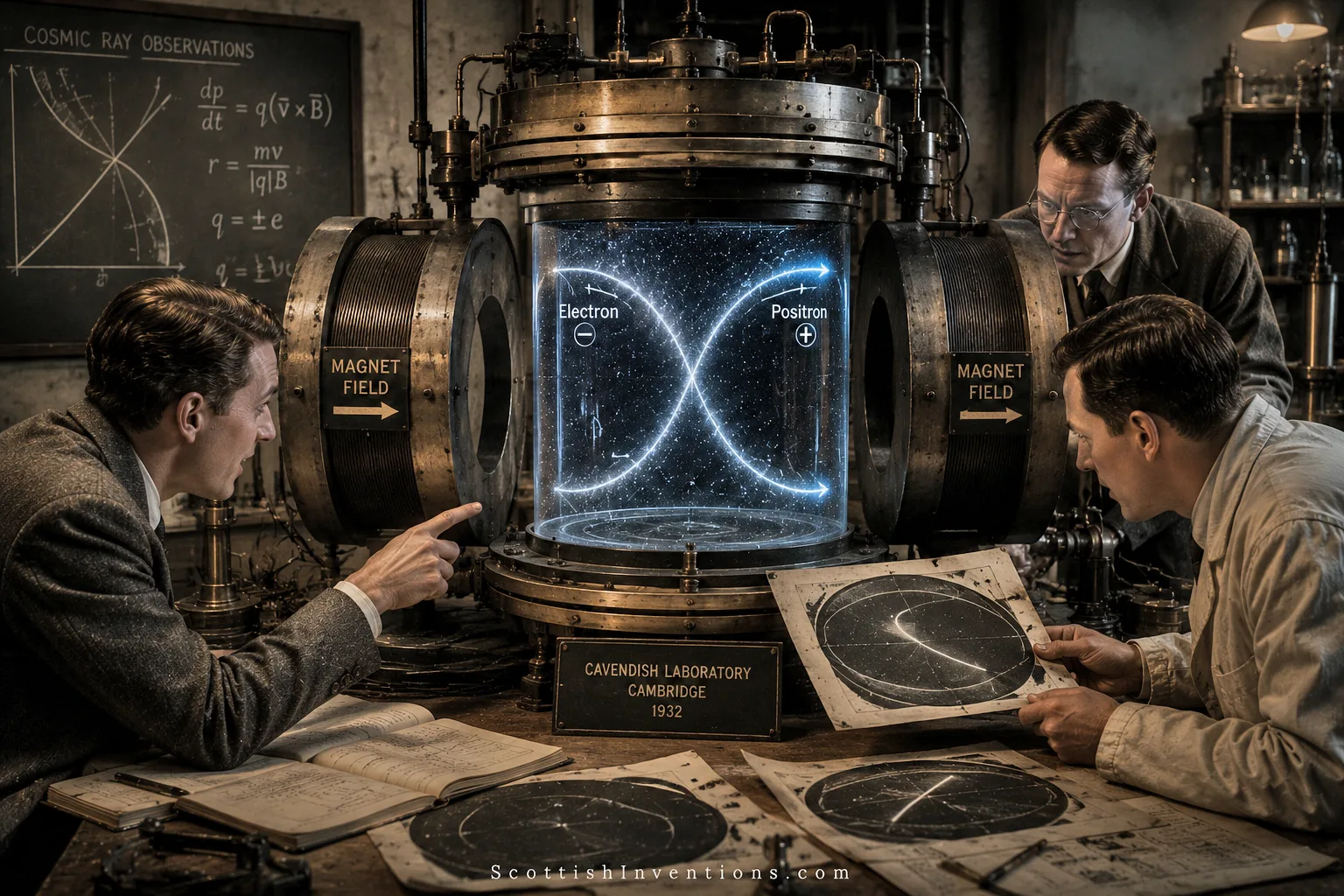
The cloud chamber's single most famous scientific triumph belongs to an American physicist working an ocean away from Cambridge, more than two decades after Wilson began his research. In 1932, Carl Anderson at the California Institute of Technology placed a cloud chamber inside a powerful magnetic field to study cosmic rays. A charged particle moving through a magnetic field curves, and the direction and tightness of the curve reveal both its charge and its momentum. Among his photographs, Anderson found a track that curved exactly like an electron's — except in the wrong direction, revealing a positive charge on a particle with an electron's mass.
This was the positron: the first particle of antimatter ever observed, confirming a prediction the British theoretical physicist Paul Dirac had made from his relativistic quantum equation in 1928. Anderson received the 1936 Nobel Prize in Physics for the discovery. It is worth stating plainly that Wilson had no part in this work. He had built the instrument; he did not make, and was not present for, the discovery it is now most famous for enabling.
Powell, Pions, and the Bubble Chamber's Arrival
Through the 1930s and 1940s, cloud chambers exposed to cosmic rays at mountain observatories and on high-altitude balloon flights continued to turn up new particles, including the muon, identified by Anderson and Seth Neddermeyer in 1936. In 1947, the British physicist Cecil Powell and his Bristol group identified the pion using a different technique — photographic nuclear emulsion plates rather than a cloud chamber — for which Powell received the 1950 Nobel Prize in Physics; cloud-chamber observations of cosmic-ray showers around the same period provided related, corroborating evidence for the wider zoo of particles being uncovered by several competing techniques at once.
The cloud chamber's dominance did not last, however. In 1952 the American physicist Donald Glaser invented the bubble chamber, which used a superheated liquid rather than a supersaturated vapour. Because liquids are far denser than gases, bubble chambers could stop and track much higher-energy particles produced by the new generation of particle accelerators being built in the 1950s and 1960s. Bubble chambers, and eventually electronic wire and spark chambers, progressively took over the frontier work that cloud chambers had made possible, and Glaser received the 1960 Nobel Prize in Physics for his invention.
Legacy: From Fog to the LHC
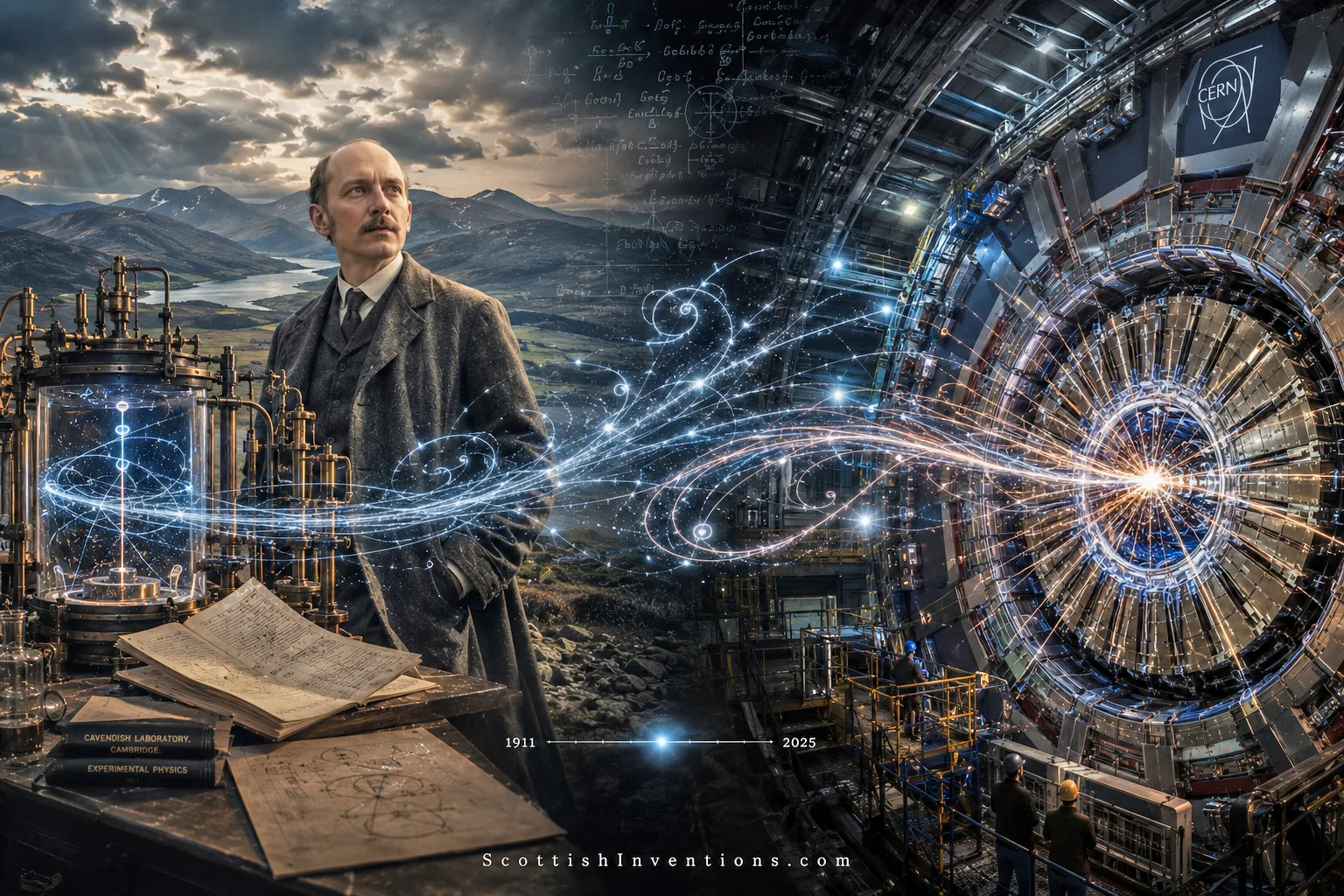
It would be a mistake to read the bubble chamber's later dominance as erasing Wilson's importance. The cloud chamber established, for the first time, the basic proposition on which all subsequent particle detection depends: that the passage of an invisible subatomic particle can be converted into a visible, measurable, photographable signal. Every later detector technology — bubble chambers, spark chambers, wire chambers, and the silicon trackers and calorimeters inside CERN's ATLAS and CMS experiments at the Large Hadron Collider — descends conceptually from that basic proof of principle, even though none of them physically resembles Wilson's glass vessel of condensing vapour.
Simple cloud chambers, meanwhile, never disappeared from ordinary life. Cheap to build from dry ice and alcohol vapour, they remain a staple of school and university physics demonstrations and science museum exhibits worldwide, where visitors can watch natural background radiation and cosmic-ray muons streak through a tank of fog in real time — very possibly the single most direct, unmediated encounter most people will ever have with the subatomic world.
Myth vs Evidence
Myth
C.T.R. Wilson invented particle physics.
Evidence
He did not. Wilson built an instrument. The scientific discoveries that made the cloud chamber famous — the positron, the muon, and much of the systematic cataloguing of cosmic-ray particles — were made by other physicists, working independently of Wilson, in the two decades after he perfected the device.
Myth
Wilson set out to study subatomic particles.
Evidence
He did not. Wilson's chamber began life purely as a meteorological instrument, built to recreate and understand natural cloud formation in the laboratory. Its usefulness for tracking ionising radiation was a discovery made along the way, not the original goal.
Myth
The 1927 Nobel Prize recognised a joint discovery by Wilson and Compton.
Evidence
It did not. Wilson and Compton shared the prize for two separate, unconnected achievements in the same field of physics — Wilson for the cloud-chamber method, Compton for his discovery of the Compton effect — a common Nobel practice when two independent contributions in one area are recognised in the same year.
Myth
The cloud chamber is still the standard tool of particle physics.
Evidence
It is not, and has not been for decades. Denser bubble chambers, invented by the American physicist Donald Glaser in 1952, and later wire chambers and fully electronic detectors superseded the cloud chamber for frontier research. Simple cloud chambers survive mainly as teaching demonstrations, in schools, universities and science museums.
Myth
John Aitken's work was unrelated background context.
Evidence
It was not. Aitken, working in Falkirk in the 1880s, established that dust particles act as nuclei around which water vapour condenses into droplets — the same nucleation principle Wilson later exploited, substituting ions for dust. Wilson's own papers acknowledge this debt, and Aitken's condensation-nuclei research (Discoveries card No. 29) is a direct scientific predecessor to the cloud chamber, not a coincidence of geography.
Timeline
| Date | Event | Detail |
|---|---|---|
| 1869 | C.T.R. Wilson is born at Crosshouse Farm, Glencorse, Midlothian | The son of a sheep farmer; the family later moves to Manchester after his father's death |
| 1880s | John Aitken, at Falkirk, shows that dust particles act as nuclei for water-droplet condensation | Aitken's dust counter and his papers on the role of condensation nuclei directly precede and inform Wilson's work |
| September 1894 | Wilson spends several weeks at the Ben Nevis Observatory | He is captivated by coronas, glories and cloud effects seen from Britain's highest weather station and resolves to reproduce cloud formation in the laboratory |
| 1895 | Wilson builds his first expansion chamber at the Cavendish Laboratory, Cambridge | Intended purely as a meteorological research tool to study cloud and rain formation, not to study atomic physics |
| 1896–1899 | Wilson discovers that ions, not just dust, can act as condensation nuclei | Following the discovery of X-rays (1895) and radioactivity (1896), he finds that ionising radiation dramatically increases droplet formation in dust-free, supersaturated air |
| 1900–1910 | Wilson refines the apparatus while holding a full teaching post | Progress is slow; Wilson works largely alone, fitting the research around Cambridge teaching duties and a bout of ill health |
| 1911 | Wilson photographs the first individual tracks of alpha and beta particles | For the first time, the passage of a single subatomic particle leaves a visible, photographable trail of condensed droplets |
| 1912 | Wilson publishes detailed photographs of particle tracks in the Proceedings of the Royal Society | The images are immediately recognised within physics as significant, though wider fame comes later |
| 1923 | Wilson photographs the recoil tracks confirming the Compton effect | Independent visual confirmation of Arthur Compton's X-ray scattering results |
| 1927 | Wilson shares the Nobel Prize in Physics with Arthur Compton | Wilson is cited 'for his method of making the paths of electrically charged particles visible by condensation of vapour'; Compton is cited separately for his discovery of the Compton effect |
| 1932 | Patrick Blackett and Giuseppe Occhialini build a counter-triggered automatic cloud chamber | Coincidence counters fire the chamber only when a cosmic ray has actually passed, making systematic particle-physics research practical for the first time |
| 1932 | Carl Anderson identifies the positron using a cloud chamber in a strong magnetic field | The first experimental evidence for antimatter, at Caltech in Pasadena, California — a discovery made entirely independently of Wilson |
| 1936 | Anderson and Seth Neddermeyer find the muon in cosmic-ray cloud chamber tracks | A second unexpected particle, again identified using chamber photographs rather than by Wilson himself |
| 1947 | Cecil Powell's Bristol group identifies the pion | Using nuclear emulsion plates rather than a cloud chamber, though cloud-chamber work at the same period corroborates related cosmic-ray findings |
| 1952 | Donald Glaser invents the bubble chamber | A denser, faster medium that could track higher-energy particles and would supersede the cloud chamber in frontier accelerator physics through the following decades |
| 1959 | C.T.R. Wilson dies at Carlops, Peeblesshire, Scotland, aged 90 | He remains, at the time of his death, the oldest living Nobel laureate in Physics |
What Wilson Actually Gave Us
C.T.R. Wilson's importance lies not in a claim that he founded particle physics, but in a more modest and entirely defensible one: a Scottish physicist, working alone through fifteen patient years, converted a boyhood fascination with Highland cloud effects into the first instrument that let anyone actually see a subatomic particle. What other physicists then did with that instrument — Blackett's triggers, Anderson's positron, the whole subsequent architecture of particle detection through to the Large Hadron Collider — belongs to them, not to Wilson. Crediting Wilson accurately, for exactly what he built, is a stronger and more durable claim than the folklore that quietly hands him credit for everything that followed.
It is also, in its way, a very Scottish shape of achievement: not a single dramatic breakthrough claimed in isolation, but one careful contribution — building directly on John Aitken's condensation-nuclei work — that other scientists in other countries then carried forward for the better part of a century.
Frequently Asked Questions
Who invented the cloud chamber?
The cloud chamber was invented by the Scottish physicist Charles Thomson Rees Wilson (C.T.R. Wilson), who built early prototypes from the mid-1890s and perfected the instrument in 1911 at the Cavendish Laboratory, University of Cambridge, producing the first photographs of individual subatomic particle tracks.
Did C.T.R. Wilson invent particle physics?
No, and this site does not claim that. Wilson built an instrument that made particle tracks visible. He did not discover the positron, the muon or the pion, and he was not the physicist whose research programme defined the emerging field of particle physics. Those discoveries were made by later scientists — chiefly Carl Anderson, Patrick Blackett and Cecil Powell — using tools descended from Wilson's chamber. Crediting Wilson for the instrument is accurate; crediting him for the discoveries made with it is not.
What inspired the cloud chamber?
Wilson's inspiration came from several weeks spent at the meteorological observatory on the summit of Ben Nevis in September 1894, where he observed dramatic cloud effects, coronas and glories. He returned to Cambridge determined to reproduce cloud formation artificially in the laboratory — a meteorological ambition, not a search for subatomic particles, which only emerged as a byproduct of the research years later.
Was Wilson the first to study condensation nuclei?
No. The Scottish physicist John Aitken, working independently in Falkirk during the 1880s, had already shown that airborne dust particles act as nuclei for water-droplet condensation, and invented an instrument — Aitken's dust counter — to measure them. Wilson's key innovation was to show that ions produced by radiation could serve the same nucleating role in dust-free air; without Aitken's prior work on condensation nuclei, Wilson's approach would have lacked its conceptual foundation.
Why did C.T.R. Wilson win the Nobel Prize, and did he share it fairly?
Wilson was awarded (jointly with the American physicist Arthur Compton) the 1927 Nobel Prize in Physics. The two men did not share credit for a single joint discovery: Wilson was recognised specifically 'for his method of making the paths of electrically charged particles visible by condensation of vapour', while Compton was separately recognised for his discovery of the Compton effect. Awarding two independent achievements in the same broad field within a single year's ceremony was, and remains, a standard Nobel practice.
How did the cloud chamber lead to the discovery of the positron?
In 1932 the American physicist Carl Anderson, at the California Institute of Technology, placed a cloud chamber inside a strong magnetic field and photographed a track left by a particle with the mass of an electron but a positive electric charge — the positron, the first observed particle of antimatter. Anderson's discovery used Wilson's instrument but was made entirely independently of Wilson, more than two decades after the chamber was perfected and on a different continent.
What did Patrick Blackett contribute?
The British physicist Patrick Blackett, working with the Italian physicist Giuseppe Occhialini at the Cavendish Laboratory in 1932, paired Wilson's chamber with Geiger-counter triggers so that it photographed automatically only when a cosmic-ray particle had actually passed through it. This coincidence-counting method converted a slow, largely manual instrument into a practical tool for systematic research, and was central to Blackett's own 1948 Nobel Prize.
Is the cloud chamber still used in research today?
Not in frontier particle physics. Denser bubble chambers, invented by Donald Glaser in 1952, and later wire chambers, spark chambers and fully electronic silicon and calorimeter detectors superseded cloud chambers for high-energy accelerator work from the 1950s onward. Simple cloud chambers remain in wide use as teaching and demonstration devices in schools, universities and science museums, where they still vividly show tracks from natural background radiation and cosmic rays.
Where was C.T.R. Wilson born and where did he die?
Wilson was born on 14 February 1869 at Crosshouse Farm near Glencorse, Midlothian, close to Edinburgh, the son of a sheep farmer. He died on 15 November 1959 at Carlops, Peeblesshire, in the Scottish Borders, aged 90, having remained the oldest living Nobel laureate in physics at the time of his death.
Sources & Further Reading
Tier 1 · Primary
- Wilson, C.T.R. — Nobel Lecture, "On the Cloud Method of Making Visible Ions and the Tracks of Ionizing Particles," 1927; Nobel Prize in Physics 1927 award records, The Nobel Foundation.
- Wilson, C.T.R. — "On a Method of Making Visible the Paths of Ionising Particles through a Gas," Proceedings of the Royal Society A, 1911–1912.
- Aitken, J. — "On the Number of Dust Particles in the Atmosphere," Transactions of the Royal Society of Edinburgh, 1888, and related papers on condensation nuclei.
- Blackett, P.M.S. & Occhialini, G.P.S. — "Some Photographs of the Tracks of Penetrating Radiation," Proceedings of the Royal Society A, 1933.
- Compton, A.H. — Nobel Prize in Physics 1927 award records, The Nobel Foundation.
Tier 2 · Scholarly and institutional
- Anderson, C.D. — "The Positive Electron," Physical Review, 1933; Nobel Prize in Physics 1936 award records.
- Powell, C.F., Fowler, P.H. & Perkins, D.H. — "The Study of Elementary Particles by the Photographic Method," 1959; Nobel Prize in Physics 1950 award records.
- Glaser, D.A. — Nobel Lecture, "Elementary Particles and Bubble Chambers," 1960.
- CERN — historical materials on the evolution of particle detectors, from cloud chambers to the Large Hadron Collider experiments.
- Cambridge Cavendish Laboratory — departmental archives and biographical records on C.T.R. Wilson.