
Charles Rennie Mackintosh: He Built with His Eye on the Stars
Contents
TL;DR
Charles Rennie Mackintosh (1868–1928) was a Glasgow architect, designer and artist. He took the tall, plain walls of the Scottish castle and tower house, the restraint of Japanese design and the flowing lines of Art Nouveau, and made from them a style entirely his own. His masterpiece was the Glasgow School of Art, designed in 1896 and built in two phases (1897–99 and 1907–09) on a shoestring budget. It became one of the most admired buildings of its age before being gutted by fires in 2014 and 2018.
With his wife, the artist Margaret Macdonald, he designed the Willow Tea Rooms, the Hill House and some of the most famous chairs ever made. He was celebrated in Vienna, Munich and Turin, and largely forgotten in Britain by the time of his death. Rediscovered from the 1930s, he is now one of Scotland's best-loved designers. The School of Art's own former Director, Douglas Percy Bliss, warned Scots that it was "only too easy for us to exaggerate his originality". The verdict of the outsiders who studied him is the more telling: Nikolaus Pevsner ranked his spatial imagination "second to none".
Key Findings
- He was a policeman's son. Mackintosh was born in Glasgow on 7 June 1868, the son of a police superintendent and one of a family of eleven. He was a delicate boy, sent out to sketch in the country for his health.
- He trained by night. He was apprenticed to the architect John Hutchison in 1884 and took evening classes at the Glasgow School of Art. He won the "Greek" Thomson travelling scholarship, which took him to France and Italy, and in 1889 he joined the firm of Honeyman and Keppie.
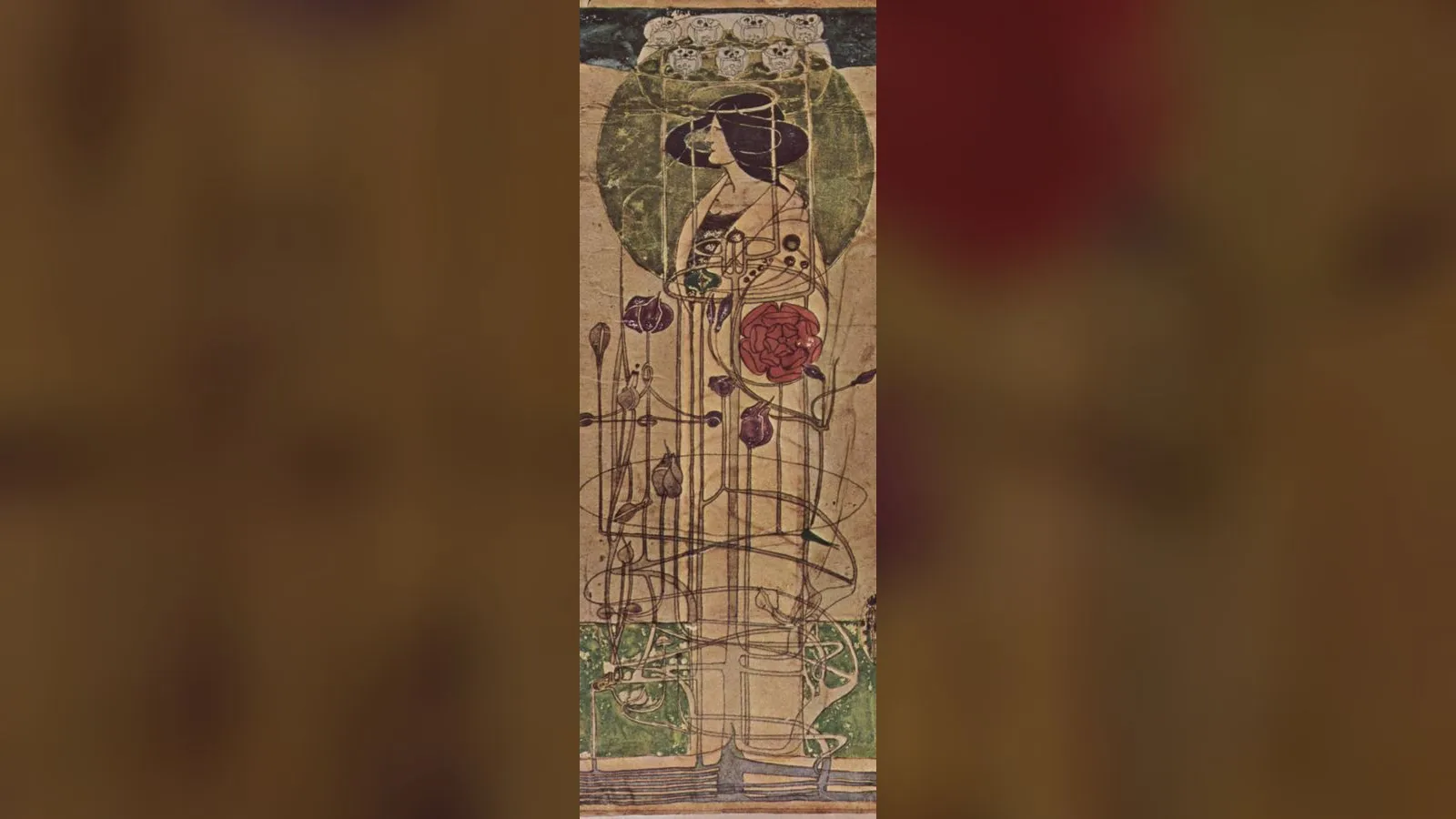
- He was one of "the Four". With Margaret and Frances Macdonald and Herbert MacNair he formed a group that exhibited in London in 1896 and caught the eye of The Studio magazine. Critics nicknamed them the "Spook School".
- He won the School of Art competition on a tight budget. The 1896 competition offered about £21,000 in all, and entrants had to show what could be built for £14,000. Bliss believed the lack of money for decoration was a blessing: it forced a plain, modern building with vast north-light studio windows.
- He was a European star. His work caused a stir at exhibitions in Munich (1898), Vienna (1900) and Turin (1902).
- His great houses and tea rooms followed. They include Windyhill (1901), the Hill House for the publisher Walter Blackie (1902–04), Kate Cranston's tea rooms including the Willow (1903), and Scotland Street School (1903–06).
- His career collapsed. He left Glasgow and his firm in 1913. After that he built almost nothing except a small house interior at Northampton and painted watercolours in England and France. He died in London of cancer in 1928.
Key Facts
- Born
- 7 June 1868, Glasgow
- Died
- 10 December 1928, London
- Father
- A Glasgow police superintendent
- Education
- Allan Glen's School; evening classes, Glasgow School of Art
- Training
- Apprentice to John Hutchison (1884); draughtsman, Honeyman and Keppie (1889); partner (1904)
- Wife
- Margaret Macdonald (1864–1933), artist and collaborator; married 1900
- Masterpiece
- Glasgow School of Art, Renfrew Street (designed 1896; built 1897–99 and 1907–09)
- Other works
- Windyhill, Kilmacolm; the Hill House, Helensburgh; the Willow Tea Rooms; Scotland Street School; 78 Derngate, Northampton
- Exhibitions
- Munich (1898), Vienna Secession (1900), Turin (1902)
- Late work
- Watercolour landscapes and flower studies, about forty in his last decade
- Fires
- Glasgow School of Art, May 2014 and June 2018
Scottish Impact Index (SI Score)
- Global Influence
- 8/10
- Enduring Relevance
- 9/10
- Material Contribution
- 6/10
- Exceptional Achievement
- 9/10
- Lasting Legacy
- 8/10
- Recognition
- 8/10
48/60
Ranked #19 of 200 in Great Scots
Claim Status
established
- his life, works, dates and patrons;
- the School of Art competition and its two building phases;
- his European exhibitions;
- his move to London in 1915 and to France in the 1920s;
- the fires.
shared
- the division of credit between Mackintosh and Margaret Macdonald. Bliss, writing in 1961, dismissed her decorative work as "the stock-in-trade of 'Art Nouveau'". Recent scholarship gives her a much larger role in the interiors and decorative schemes. Mackintosh himself reportedly said that she had genius while he had only talent.
disputed
- why he left Glasgow. Bliss called it "a mystery", and suggested ill-health, frustration with office routine and obstruction by the School's governors. He added that "probably he was drinking excessively". That last claim is speculation and is contested by later biographers.
traditional
- that he was "ignored" in Scotland. He had loyal Glasgow patrons, including Kate Cranston, Walter Blackie, William Davidson and Fra Newbery. Bliss himself wrote that "except in his own Glasgow, Mackintosh was forgotten before his death".
A Delicate Boy
Mackintosh was born in Glasgow on 7 June 1868, the son of a police superintendent. He was, as the School of Art's handbook puts it, "a delicate boy, one of a family of eleven". At Allan Glen's School his interests were "rambling and sketching", and he always intended to be an architect. In 1884, at sixteen, he was apprenticed to the architect John Hutchison and started evening classes at the Glasgow School of Art.
He was a brilliant student. He won prizes, two silver medals and the "Greek" Thomson travelling scholarship, named after the Glasgow architect Alexander Thomson, which took him to France and Italy. In 1889 he joined the busy firm of Honeyman and Keppie as a draughtsman. In 1892 he won a National Silver Medal and a National Gold Medal at South Kensington.
Bliss saw the sketching boy in the finished building. Looking at the castle-like east wall of the School of Art, he wrote: "one seems aware of the young Mackintosh, the delicate boy ordered by the doctor to live as much as possible in the country, and spending his time sketching castle walls."
The Four and the "Spook School"
At the School of Art Mackintosh met Herbert MacNair and two sisters, Margaret and Frances Macdonald. The four, "very intense and poetic", experimented with posters, metalwork, embroidery, furniture and graphic design. They exhibited together in London in 1896 and attracted the attention of The Studio, the most influential art magazine of the day. Their elongated, ghostly figures earned them the nickname the "Spook School". Mackintosh married Margaret Macdonald in 1900, and MacNair married Frances.
The art school's headmaster, Fra Newbery, encouraged the new style. Bliss describes it as "the original, exciting, short-lived movement in which Glasgow played a part", owing much to the Pre-Raphaelites, William Morris's Arts and Crafts movement, Japanese design and Whistler, and appealing at once to "clever young people" as "a protest against the stuffiness of Victorian design".
The Glasgow School of Art
In 1896 the School's governors held a limited competition for a new building on a steep site in Renfrew Street. The money was painfully short: about £21,000 in all, and competitors had to show how much could be built for just £14,000. Newbery, meanwhile, had grand ideas. Honeyman and Keppie submitted a design "from the hand of Mackintosh", and, as Bliss drily put it, "this design alone seemed acceptable to the far from impartial Newbery".
Building began in 1897, and the east half was finished in December 1899. The west half followed in 1907–09, by which time Mackintosh's style had changed. He had moved from the curves of Art Nouveau to a "new angular style... with its passion for straight lines".
Shortage of money turned out to be the building's making. "The Age believed that Architecture without decoration was hardly possible," Bliss wrote, "but there was not money enough... to have decoration. We can now see how fortunate this was for posterity." While the School went up "in all its simplicity", Kelvingrove Art Gallery was rising nearby "in its clumsy and costly bedizenment". Newbery wanted huge north-lit studio windows, and he got them: the Renfrew Street front is a vast, plain wall of glass, astonishing for the 1890s.
The handbook picks out the details that made the building famous:
- The east front rises sheer for 80 feet in small-scale rubble, like a medieval wall.
- The west front, regarded as his finest work, is lit by three 25-foot library windows set in stone oriels that climb from the pavement to a height of 65 feet. Stone blocks in the window mouldings were meant for sculptures. A note on a contract drawing suggests the subjects included Cellini, Palladio and St Francis, but they were never carved.
- A conservatory juts out from a top-floor studio some 80 feet above the ground. It was drawn on the 1896 plans and is believed to have been a complete innovation at the time.
- The "Hen Run", a glass corridor added along the roof, linked the two wings past the Director's studio.
- The Library, "a major masterpiece of spatial composition", had a gallery set back from its timber posts, with balusters carved and enamelled in bright colours.
- The clocks. The building's square wall clocks were driven from a master clock in the entrance hall, and are reputed to have been the first electrically driven clocks installed in a European building.
Mackintosh designed everything inside it: furniture, ironwork, lettering, light fittings and clocks. "All are the product of one fertile brain," Bliss wrote. "All are part of one great scheme."
The architect Sir Frank Mears heard a deeper Scottish note in the great west front:
There is in this building, rising austerely in a clifflike mass above the froth of Sauchiehall Street, a real affinity with the north of Linlithgow Palace, or the Castles of Hermitage, Borthwick or Huntly... Mackintosh was not content to erect a functional frame for certain numbers of studios and students. He built with his eye on the stars.
Bliss agreed that Mackintosh drew on the old Scottish buildings he had studied, but noted that, unlike Robert Lorimer and other revivalists, "he did not imitate their features. He was no historicist... he was a pioneer of modernism."
Miss Cranston's Tea Rooms
In Kate Cranston, Mackintosh found "another loyal client... This lady, who had money, vision, and business acumen, dreamt of revolutionising the dingy restaurants of the city." From 1898 the Mackintoshes worked on her tea rooms in Buchanan Street and Argyle Street, then Ingram Street (1900). In 1903 he built her the Willow Tea Rooms on Sauchiehall Street, "the loveliest of her tea-shops". Its Room de Luxe was inspired by Rossetti's sonnet sequence "Willowwood". "Never before," Bliss wrote, "had Scotland seen Art and Mysticism wedded to Commerce." The Mackintoshes designed the rooms down to the furniture, light fittings and cutlery. In 1911 he added the Cloister and Chinese rooms at Ingram Street.
Houses and a School
At the turn of the century, Bliss wrote, "life must have seemed good to him". He was in practice with designs on his board for a church, a school and several houses, and he was "the darling of the advanced magazines of Art". His salary from Honeyman and Keppie was £16 a month. In 1901 he completed Windyhill at Kilmacolm for his friend William Davidson, "in a style that owed nothing to 'the styles', yet wonderfully suggested a traditional laird's house of the seventeenth century".
In the 1901 German competition for a "House for an Art Lover" he was placed second, but his drawings, published by Alexander Koch of Darmstadt, became famous across Europe. The house itself was finally built in Glasgow's Bellahouston Park in the 1990s. In 1902–04 he built the Hill House at Helensburgh for the publisher Walter Blackie, his most complete domestic work. In 1904 he became a partner in the firm, now Honeyman, Keppie and Mackintosh, and designed Scotland Street School, with its two glazed stair towers.
In 1906 the Mackintoshes moved to 78 Southpark Avenue, a plain Glasgow terraced house, and transformed its interior into an exquisite home. Bliss observed that Mackintosh "was frequently obliged to play the hermit-crab by inhabiting other people's shells", but his genius for dividing space let him rise above it. The house was later demolished for university buildings, but its interiors were saved and reinstated at the University of Glasgow's Hunterian Art Gallery.
Exile
Then, at the height of his success, Mackintosh resigned from his firm and in 1913 left Glasgow for good. The reasons are still debated: ill-health, frustration with office routine, quarrels over Scotland Street School, and the School governors' obstruction of his plans. Bliss suggested drink as well, but that was speculation. In 1914 he was at Walberswick in Suffolk, where the Newberys had a house, and in 1915 he settled in Chelsea. The First World War had stopped building, he had few contacts in London, and he got no worthwhile commissions.
His only significant architectural work in his last decade was the remodelling of 78 Derngate, Northampton, for the model-engineering manufacturer W. J. Bassett-Lowke, a small house with startling geometric interiors. He turned to painting and produced about forty watercolours of landscapes and flowers in England and the south of France, now greatly admired. In 1927 he returned to London, and he died there of cancer of the throat on 10 December 1928.
Rediscovery
"Except in his own Glasgow," Bliss wrote, "Mackintosh was forgotten before his death." Art Nouveau had gone out of fashion within a decade, and critics such as H. S. Goodhart-Rendel dismissed him as a decorator, deploring the "curious humps and wriggles" of the Glasgow style. Bliss replied that such critics had clearly never visited the School of Art, whose later work "banishes curves, is firm and tense and rectilinear".
From the 1930s historians began to see Art Nouveau as a serious historical style, and Mackintosh was rediscovered. The decisive voice was not Scottish. Nikolaus Pevsner, in an Italian monograph, claimed for him a spatial imagination "second to none". He argued that Mackintosh's abstract murals anticipated Kandinsky and Picasso, and that his abstract sculpture contained the idea of the mobile "before Alexander Calder was out of his pram". Bliss added that as early as 1898 Mackintosh had designed a saucer-domed concert hall that anticipated the Royal Festival Hall of 1951. His conclusion was that Mackintosh's ideas were "every whit as fertile as those of Le Corbusier or Frank Lloyd Wright. What, then, might he not have achieved had his opportunities been greater and his career longer?"
Fire
The Glasgow School of Art remained in use as a working art school for more than a century, a place of pilgrimage for architects from around the world. In May 2014 a fire, started by a student's projector, destroyed the celebrated library. A painstaking restoration was nearly complete when, on the night of 15 June 2018, a second, far larger fire gutted the building, leaving only its stone walls. Its reconstruction is planned but remains a long-term undertaking.
Elsewhere his work survives. The Hill House is cared for by the National Trust for Scotland, and since 2019 it has been sheltered inside a vast steel-mesh "box" to let its rain-soaked walls dry out. The Willow Tea Rooms building on Sauchiehall Street was restored and reopened in 2018. The Mackintosh House at the Hunterian, Scotland Street School and the Mackintosh Church at Queen's Cross are all open to visitors.
Timeline
Born in Glasgow — Son of a police superintendent
Apprenticed to John Hutchison; evening classes at the School of Art —
Joins Honeyman and Keppie —
"Greek" Thomson travelling scholarship — France and Italy
National Silver and Gold Medals, South Kensington —
"The Four" exhibit in London; wins School of Art competition —
School of Art, east wing —
Cranston tea rooms; Munich exhibition —
Marries Margaret Macdonald; Vienna Secession; Ingram Street tea room —
Windyhill; "House for an Art Lover" competition —
Turin exhibition —
The Hill House, Helensburgh —
Willow Tea Rooms —
Partner in the firm; Scotland Street School designed —
Moves to 78 Southpark Avenue —
School of Art, west wing and library —
Cloister and Chinese rooms, Ingram Street —
Leaves the firm and Glasgow —
Settles in Chelsea —
78 Derngate, Northampton —
Watercolours in the south of France —
Dies in London —
House for an Art Lover built in Bellahouston Park —
First School of Art fire — Library destroyed
Second School of Art fire — Building gutted
Did You Know?
- The School of Art's plainness was partly forced by the budget. The governors had about £14,000 for the first phase.
- Its library windows were designed with stone blocks for statues of Cellini, Palladio and St Francis that were never carved.
- The School's wall clocks are reputed to have been the first electrically driven clocks in a European building.
- Students nicknamed the glass corridor on the School's roof the "Hen Run".
- Mackintosh's father, like the bothy-song collector John Ord, was a Glasgow police superintendent.
Honest Caveats
- Bliss's text dates from 1961. Some of its judgements, especially on Margaret Macdonald and on Mackintosh's drinking, reflect the attitudes and evidence of its time.
- Margaret Macdonald's role. Her contribution to their joint work is now more fully recognised than it was when the handbook was written.
- Unverified "firsts". Claims such as the first electric clocks in a European building and the innovative cantilevered conservatory are the handbook's, given as "reputed" and "believed".
- The fires. The 2014 and 2018 fires, and the later fate of the buildings, are summarised from general sources, not from the handbook.
FAQ
1What is Mackintosh famous for?
The Glasgow School of Art, the Hill House, the Willow Tea Rooms and his high-backed chairs and complete interiors.
2What style was he?
He began in the Glasgow version of Art Nouveau and moved to a severe, geometric style. He also drew on Scottish castles and tower houses without copying them.
3Who was Margaret Macdonald?
His wife and collaborator, one of "the Four", and a major artist of the Glasgow Style.
4Why did he leave Glasgow?
The reasons are debated: ill-health, frustration with his firm and the School's governors, and a lack of commissions have all been suggested.
5What happened to the Glasgow School of Art?
Fire destroyed its library in May 2014, and a second fire gutted the building in June 2018.
6Where can I see his work today?
At the Hill House, the Willow Tea Rooms, the Mackintosh House at the Hunterian, Scotland Street School, the Mackintosh Church at Queen's Cross and the House for an Art Lover.
Related
- Margaret Macdonald Mackintosh
- The Glasgow School of Art
- Scottish Tea Rooms
- The Glasgow Boys
- Alexander "Greek" Thomson
Sources
Primary/Institutional
- The Glasgow School of Art, "The Mackintosh Building". https://www.gsa.ac.uk/
- National Trust for Scotland, "The Hill House". https://www.nts.org.uk/
General
- Charles Rennie Mackintosh Society. https://www.crmsociety.com/
Further reading
- Douglas Percy Bliss (text) and H. Jefferson Barnes (ed. and notes), Charles Rennie Mackintosh and the Glasgow School of Art (Glasgow School of Art; first published 1961, revised reprint). Design by Gordon Huntly.
- Nikolaus Pevsner, Charles R. Mackintosh (Milan, 1950).
- Thomas Howarth, Charles Rennie Mackintosh and the Modern Movement (1952).
Card 107 · Great Scots