Discoveries · No. 38 of 50 · Medicine
Sir Edward Sharpey-Schafer, Adrenaline and the Hormone Concept
An English-born physiologist, an Edinburgh chair held for 34 years, a dog's blood pressure spiking off the chart in 1894, and a word — "insuline" — coined for a hormone nobody had yet found. The full, carefully qualified story of the man who helped found endocrinology without ever isolating its most famous molecules.
Edward Sharpey-Schafer · 1850–1935Discovery demonstrated · 1894Reading time · 20 minUpdated 16 August 2026
TL;DR
- Working in 1894 with the Harrogate GP George Oliver, the physiologist Edward Schafer (then still plain "Schafer") proved that an extract of the adrenal medulla sends blood pressure soaring — the demonstration that launched the science of hormones, though the pure chemical, adrenaline, was not isolated until 1901 by Jokichi Takamine and Thomas Aldrich.
- He was English-born (Hornsey, Middlesex, 1850), but belongs to Scottish science by career: 34 years as Professor of Physiology at the University of Edinburgh (1899–1933). He took the name "Sharpey-Schafer" in 1918 to honour his Scottish mentor William Sharpey of Arbroath, and he died in North Berwick in 1935.
- He did not coin "hormone" — Ernest Starling did, in 1905. But he did coin "endocrine" and named "insuline" in 1916, five years before Banting, Best and Macleod isolated the actual substance in Toronto — though the Belgian Jean de Meyer had used the same name first, in 1909.
Scottish Impact Index (SI Score)
- Global Impact
- 9/10
- Longevity
- 9/10
- Economic / Material Impact
- 7/10
- Originality / Distinctiveness
- 9/10
- Legacy (Built Upon)
- 9/10
- Recognition
- 4/10
Key Findings
- The 1894 discovery was of a physiological effect, not a pure substance. Oliver and Schafer proved that adrenal-medulla extract dramatically raised blood pressure. They never isolated the active chemical; that came later, in 1901.
- The Scottish connection is by career, not birth. Like Joseph Lister (English-born, Glasgow), Sharpey-Schafer belongs to Scottish science through Edinburgh, where he spent his longest and most productive years, 1899–1933.
- Sharpey-Schafer did NOT coin "hormone" — Ernest Starling did, in 1905. But Sharpey-Schafer did coin "endocrine" and "insulin" (as "insuline"), and championed the whole concept of internal, chemical regulation.
- The insulin prediction is remarkable and verified, though he was not first: the Belgian Jean de Meyer used "insuline" in 1909. Sharpey-Schafer, apparently unaware, proposed it independently in his 1913 Lane Lectures, published in 1916.
- The Schafer method (1903) was a genuine, widely adopted life-saving technique, standard first aid worldwide until the late 1950s.
Quick Facts
- Discovery
- An extract of the adrenal (suprarenal) gland medulla dramatically raises blood pressure — the founding demonstration of adrenaline's action
- Year
- 1894 (Physiological Society demonstration, 10 March), full paper published 1895
- Key figures
- George Oliver (1841–1915), Harrogate GP, and Edward Schafer (1850–1935), UCL physiologist
- Key figure's later name
- Sir Edward Albert Sharpey-Schafer, from 1918
- Birthplace
- Hornsey, Middlesex, England, 1850 — English by birth
- Scottish connection
- Professor of Physiology, University of Edinburgh, 1899–1933 (34 years) — claimed by career, not birth, exactly as with Joseph Lister
- Death
- North Berwick, East Lothian, 29 March 1935
- What was NOT achieved in 1894
- The pure chemical was not isolated — only its physiological effect was demonstrated
- Pure substance isolated
- 1901, independently by Jokichi Takamine (as 'Adrenalin') and Thomas Aldrich, at Parke, Davis & Co.
- Who coined 'hormone'
- Ernest Starling, 1905 — NOT Sharpey-Schafer
- What Sharpey-Schafer did coin
- 'Endocrine' (for ductless-gland secretions) and 'insuline' (1916), plus 'autacoid' and 'chalone'
- Insulin naming priority
- Belgian physician Jean de Meyer used 'insuline' first, in 1909; Sharpey-Schafer proposed it independently in 1913/1916
- Other major achievement
- The 'Schafer method' of prone-pressure artificial respiration (1903), standard first aid worldwide until the late 1950s
- Knighthood
- Knight Bachelor, 1913 Birthday Honours — not a KBE, which did not exist until the Order of the British Empire was created in 1917
- Claim status
- Shared — the physiological effect (1894) is Oliver and Schafer's; the pure hormone (1901) belongs to Takamine and Aldrich; the word 'hormone' belongs to Starling
An Englishman Made Scottish
Sir Edward Albert Sharpey-Schafer was born Edward Albert Schäfer on 2 June 1850 in Hornsey, then in Middlesex, on the northern edge of London. He was the third son of James William Henry Schäfer, a merchant born in Hamburg who had come to England as a young man and become a naturalised British citizen, and an English mother, Jessie Brown. There is nothing Scottish about his origins: he was educated at Clewer House School in England and entered University College London (UCL) in 1868, an entirely English childhood and education.
The connection to Scotland begins, fittingly, with a Scottish teacher. At UCL, Schäfer came under the lasting influence of William Sharpey (1802–1880), widely called "the father of British physiology." Sharpey was born in Arbroath, Angus (then Forfarshire), on 1 April 1802, the posthumous youngest child of an English shipowner father from Folkestone and a Scottish mother, Mary Balfour. He studied medicine at the University of Edinburgh from 1818 before becoming Professor of Anatomy and Physiology at UCL. Schäfer became the first holder of the Sharpey Scholarship in 1871 and qualified in medicine in 1874.
His rise from there was rapid, and entirely English in its geography. He was appointed Assistant Professor of Practical Physiology at UCL in 1874, elected a Fellow of the Royal Society in 1878 at just 28, and became Jodrell Professor of Physiology at UCL in 1883. The pivot to Scotland came only in 1899, when, aged 49, he took the Chair of Physiology at the University of Edinburgh, succeeding the late William Rutherford. He held that chair until his retirement in 1933 — 34 years, by far the longest and most productive stretch of his career, and the period in which the achievements this article describes were consolidated, extended and made permanent through his textbooks, his journal editorship and his public honours.
This is precisely the pattern by which this collection claims Joseph Lister, another English-born figure whose defining scientific career unfolded in Scotland, at Glasgow. Sharpey-Schafer is not presented here as a Scot by birth or upbringing; he is presented, accurately, as a scientist whose most important working life — the years of the adrenaline discovery's consolidation, the endocrine vocabulary, the insulin prediction and the Schafer method — belongs to Edinburgh.
The name change that fixed this Scottish association permanently came in 1918, and its origin is personal rather than professional. Following the death of his elder son, Commander John Sharpey Schäfer of the Royal Navy — killed when his ship struck a mine in the North Sea on 22 March 1918 — Edward hyphenated "Sharpey" (already given to his children as a middle name) to his own surname. He explained in his diary that it was "partly on Jack's account… partly because it was the name of my old teacher and master in physiology — the best friend I ever had." His younger son, Second Lieutenant Thomas Sydney Schäfer of the 13th Northumberland Fusiliers, had already been killed in action at Loos in France on 26 September 1915, aged 24. The change also served, incidentally, to de-Germanise his name amid wartime anti-German sentiment — a practical consideration layered on top of the personal and commemorative ones.
He was knighted by King George V in 1913, as part of the Birthday Honours that year, and the London Gazette records him under his pre-1918 name: "Edward Albert Schafer, FRS, Professor of Physiology, University of Edinburgh." It is worth stating precisely what kind of honour this was, because popular accounts sometimes get it wrong: he was made a Knight Bachelor, a plain knighthood carrying the title "Sir" but attached to no order of chivalry and no post-nominal letters of its own. He was never a KBE — the Order of the British Empire, of which KBE is a grade, was not created until 1917, four years after his knighthood. His genuine post-nominals were FRS, FRSE and FRCP(Ed).
He died at his home, Marly Knowe, in North Berwick, East Lothian, on 29 March 1935, aged 84 — a Scottish death to match a Scottish career, and, given his mentor's Arbroath origins and burial in Arbroath Abbey, a name that had, by a strange and moving turn of family history, become unexpectedly and permanently Scottish.
The Hunt for Internal Secretions
The intellectual foundation for everything that follows was laid by the French physiologist Claude Bernard (1813–1878), who in the 1850s developed the concept of "internal secretion" — the idea that organs could release substances directly into the bloodstream rather than through a duct. Bernard demonstrated the glycogenic function of the liver, showing it released glucose into the blood, and coined the notion of the "milieu intérieur," the internal environment the body works to keep stable. His term "internal secretion" did not yet carry its precise modern meaning, but it reframed physiology around the idea that the blood itself could be a channel of chemical communication between organs.
Several further strands converged in the second half of the nineteenth century to focus attention specifically on the adrenal glands. Thomas Addison, in 1855, described the fatal wasting disease now named after him, caused by destruction of the adrenal (suprarenal) glands, proving that these small, paired organs were essential to life — though nobody yet knew why, or what substance they might make. Charles-Édouard Brown-Séquard, having shown in 1856 that surgically removing the adrenals killed animals, caused a public sensation in June 1889 when, aged 72, he told the Société de Biologie in Paris that self-injection of extracts prepared from animal testicles had rejuvenated him. His claims were never substantiated, and modern re-creation of his extract has found testosterone concentrations four orders of magnitude below any plausible biological threshold — the effect, insofar as there was one, is now understood as a placebo response. But the announcement launched a public and scientific craze for "organotherapy," the treatment of disease with extracts of animal organs, and it sharply raised scientific interest in exactly what such extracts might contain and do.
By 1893–1894, then, the state of knowledge was tantalisingly incomplete: it was firmly established that the adrenal glands were essential to life, and there was a fashionable, if scientifically undisciplined, enthusiasm for organ extracts of every kind. But nobody had yet shown, with rigorous experimental method, what the adrenal gland actually did, nor had anyone yet distinguished clearly between its outer cortex and inner medulla, structures with entirely different embryological origins and functions. The question of what the adrenal gland secreted, and what that secretion did to the body, hung open, waiting for a decisive experiment.
The 1894 Discovery
George Oliver (1841–1915) was a physician in the Yorkshire spa town of Harrogate. Born at Middleton-in-Teesdale, County Durham, the son of a surgeon, he trained at UCL — where he too had come under William Sharpey's influence — and ran a busy general practice from 1876. The seasonal nature of a spa-town practice gave him unusually long winter leisure, and he devoted it, year after year, to physiological experiment, building his own precise instruments for measuring blood pressure and circulation. He later endowed the Oliver-Sharpey Lectureship in honour of his old master, a fitting gesture from an amateur scientist whose greatest work grew directly out of that mentorship.
The story of how Oliver and Schäfer came together is one of the most vivid in the history of medicine, told repeatedly by Sir Henry Dale, who witnessed its aftermath as a young student. Oliver, experimenting at home, prepared a glycerine extract of adrenal gland obtained from the local butcher, injected it into his own young son, and used an instrument of his own devising to measure the effect on the boy's radial artery, observing contraction. Dale later remarked, half in jest, that the boy "deserved a memorial." It is worth flagging, in the interest of accuracy, that this anecdote rests substantially on Dale's retelling years afterward, and some modern historians treat its more colourful details — the precise method, the boy's exact reaction — with mild caution, even while accepting the broad outline as well-attested.
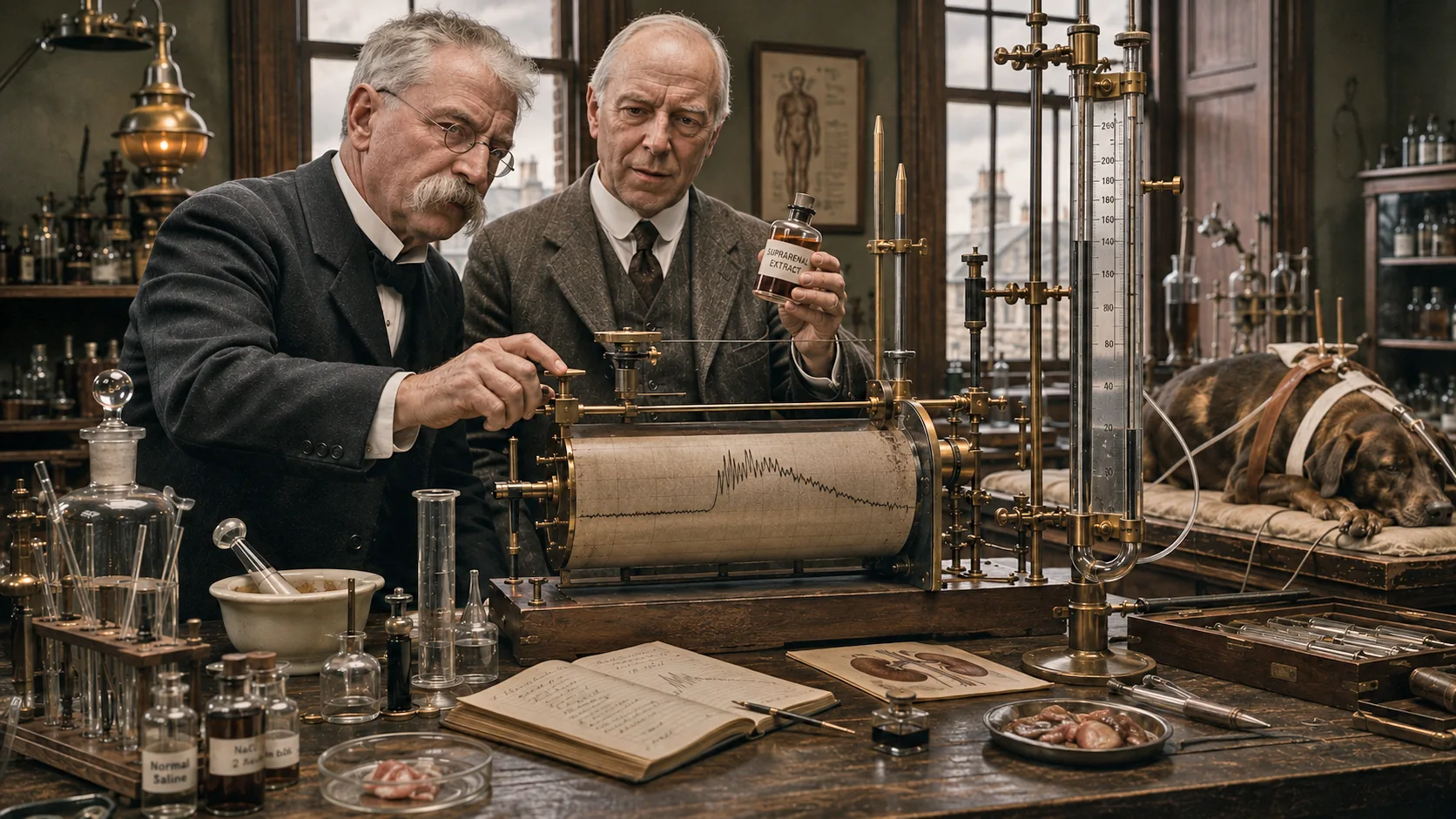
Convinced he was onto something important, Oliver travelled to London to see Schäfer at UCL — the two men shared a bond as former pupils of Sharpey. Schäfer's own later account records the encounter: "In the autumn of 1893 there called upon me in my laboratory at University College a gentleman who was personally unknown to me, but with whom I had a common bond of interest — seeing that we had both been pupils of Sharpey." Schäfer, according to the traditional telling, was in the middle of an unrelated experiment, recording a dog's blood pressure, and was reportedly sceptical and somewhat impatient with his unannounced visitor. Oliver waited, then produced his adrenal extract from his pocket and asked Schäfer simply to inject it and watch. Schäfer did — and saw the mercury column of his arterial manometer shoot upward until the recording float very nearly lifted clear out of its tube.
The extract had caused massive vasoconstriction — a sudden, powerful squeezing of the small arteries. As the historian T. Yamashima records in his 2017 account "Adrenaline/Epinephrine Hunters," the injection "caused an enormous rise (from 2 to 4 times above normal) of blood pressure, although it entirely passed off after a few seconds." Schäfer immediately agreed to collaborate, and through the winter of 1893–1894 the two men systematically studied the effect: they tested the extract against known circulatory agents such as ergot and digitalis, and subjected it to heat, acids, alkalis and digestion to characterise its chemical nature. Crucially, they localised the active principle to the medulla — the inner part of the gland — rather than the outer cortex, a distinction that later proved fundamental to endocrinology.
They presented their findings to the Physiological Society on Saturday 10 March 1894. Among those present, as Yamashima notes, were an 18-year-old student named Henry Dale and a 37-year-old physiologist named Charles Scott Sherrington, both, by the historical record, greatly impressed by the demonstration. The full paper, "The Physiological Effects of Extracts of the Suprarenal Capsules," appeared in the Journal of Physiology in 1895 (volume 18, issue 3, pages 230–276), following a preliminary note published in volume 16 in 1894 — a discrepancy in dating that different sources resolve differently, some citing 1894 for the discovery and others 1895 for its formal publication. It is fair, and necessary for precision, to give both dates. The paper's conclusion was carefully stated: "the suprarenal capsules are to be regarded, although ductless, as strictly secreting glands." What Oliver and Schäfer did not do, and never claimed to do, was isolate or chemically identify the specific active substance responsible for the effect. That remained, for seven more years, a mystery.
From Extract to Pure Substance
The chain from Oliver and Schäfer's crude extract to a pure, identifiable chemical ran through several further hands, and it is important to state clearly who did what, because popular retellings often compress this into a single moment that never actually happened.
John Jacob Abel, at Johns Hopkins, purified an active constituent from adrenal extract and in 1899 named it "epinephrin." But, as the endocrinologist J. D. Wilson notes in a 2005 historical account in Clinical Endocrinology, "In 1897 Abel and Crawford at the Johns Hopkins Hospital used the Oliver/Schäfer bioassay to purify the active principle as a monobenzoyl derivative of epinephrine that was not very active physiologically" — in other words, a chemically modified compound, not the pure, fully active hormone itself. Abel's claim to priority in isolating adrenaline does not, on close examination, hold up.
The pure, stable, crystalline substance was isolated in 1901, and by two people working independently. Jokichi Takamine, a Japanese chemist working in New York with his associate Keizo Uenaka and backed by the pharmaceutical firm Parke, Davis & Co., isolated the pure substance and named it "Adrenalin" — a name he trademarked in the United States. Thomas Bell Aldrich, a chemist also at Parke, Davis & Co. who had earlier worked in Abel's own laboratory, independently isolated the same substance around the same time and, comparing his product against Takamine's, determined the correct empirical chemical formula, C9H13NO3, in 1901.
This dual, near-simultaneous isolation, together with Takamine's American trademark on "Adrenalin," produced the transatlantic naming split that persists to this day: "adrenaline" (the standard British and European usage, from the Latin ad, "near," and renes, "kidneys") versus "epinephrine" (American usage and the official United States Pharmacopoeia name, from the Greek epi, "upon," and nephros, "kidney") — both names describing, in different classical languages, the same anatomical fact of origin near or upon the kidney. The pharmacologist Henry Dale championed "adrenaline" for British and European usage, cementing the split.
Adrenaline was soon synthesised chemically as well as extracted biologically: Friedrich Stolz in Germany produced a related ketone form, adrenalone, in 1904, and adrenaline became the first hormone ever to be chemically synthesised. It moved into clinical use quickly thereafter — first used in asthma in 1903 — and became valued as a vasoconstrictor for controlling surgical bleeding and prolonging the action of local anaesthetics.
Naming the Endocrine Revolution
Oliver and Schäfer's 1894 demonstration was the essential experimental precursor to the birth of endocrinology as a discipline — but the word that came to define that discipline was not Schäfer's. The word "hormone" belongs, without ambiguity, to Ernest Henry Starling. In 1902, Starling and his brother-in-law William Bayliss discovered secretin, a substance released by the duodenum that travels through the blood to stimulate the pancreas — itself a landmark demonstration of chemical, as opposed to purely nervous, control within the body. In his Croonian Lectures to the Royal College of Physicians in 1905, titled "On the Chemical Correlation of the Functions of the Body," Starling introduced the term "hormone," from the Greek for "I arouse to activity," a word suggested to him by the Cambridge scientist W. B. Hardy. This is a point worth stating with complete plainness, because popular accounts of Schäfer sometimes credit him with the word: he did not coin it, and this article will not repeat that error.
Sharpey-Schafer's own contributions to the vocabulary and the conceptual apparatus of the new science were nonetheless real and foundational in their own right. He coined the term "endocrine" for the secretions of the ductless glands — a word that has since given its name to the entire discipline of endocrinology — and he also introduced "autacoid" and "chalone." He argued that the term "hormone" should properly be reserved for stimulatory chemical messengers, proposing "autacoid" as a broader category for substances that could either stimulate or inhibit; this particular terminological campaign did not ultimately prevail in general usage, but it reflects how actively he was thinking about the underlying concepts, not merely describing isolated facts. He proclaimed what he called a "New Physiology" of chemical regulation succeeding the "Old Physiology" of purely nervous control, writing that "the Old Physiology was based… on nervous regulation; the New Physiology is based on chemical regulation" — a genuinely important reframing of how the body's internal communication was understood, even if the specific word "hormone" for that chemical communication belongs to someone else.
The Insulin Prediction
Sharpey-Schafer's most prophetic single contribution concerns insulin, and it deserves to be told with its genuine complexity intact rather than smoothed into a simple story of solitary foresight.
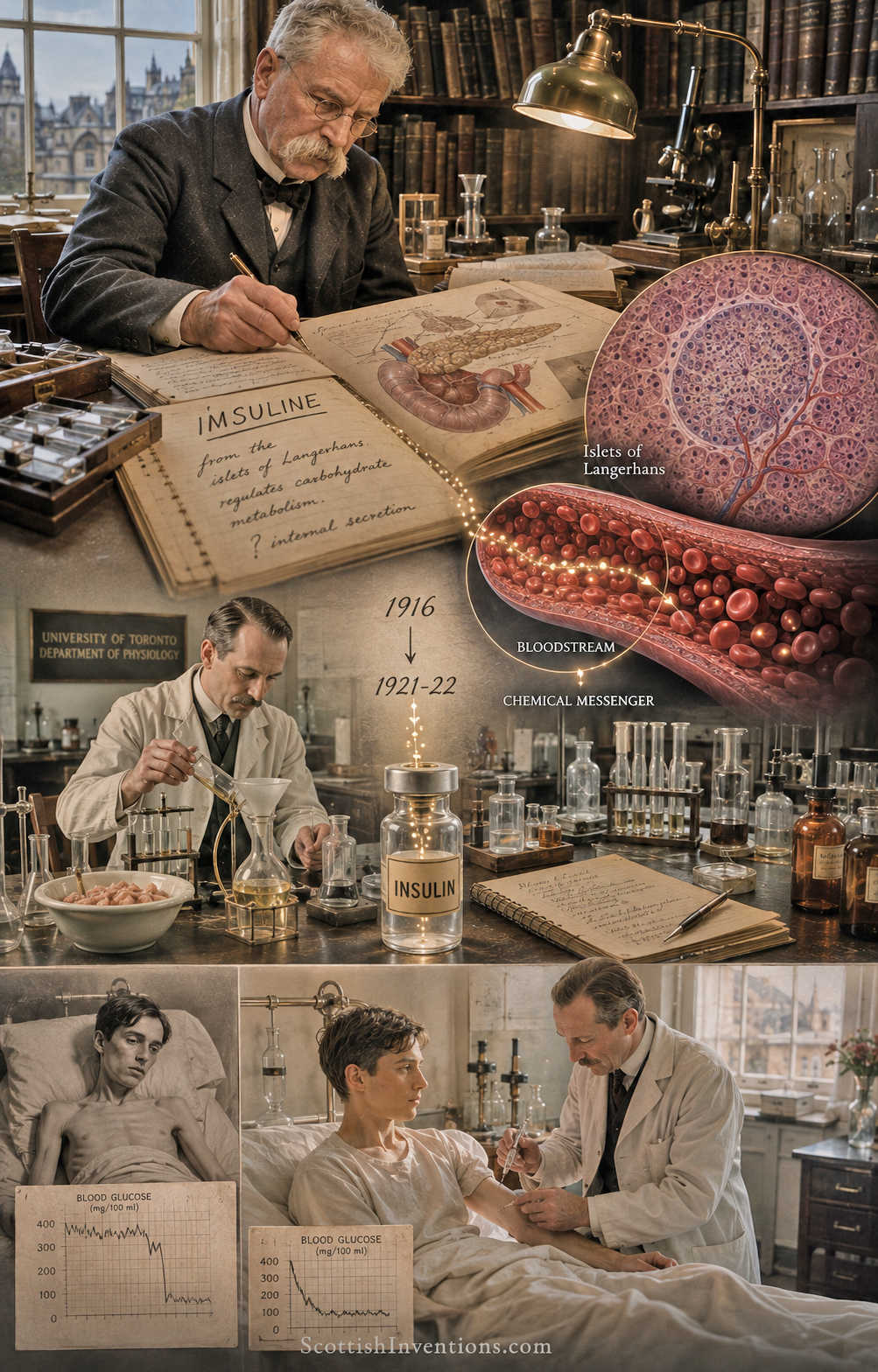
As early as 1894, Schäfer had suggested, on morphological grounds, that the islets of Langerhans — small clusters of cells scattered through the pancreas, structurally distinct from the pancreas's main digestive tissue — might act as an organ of internal secretion controlling blood sugar. In his Lane Medical Lectures at Stanford University in 1913, published as "The Endocrine Organs: An Introduction to the Study of Internal Secretion" (Longmans, Green and Co., London, 1916), he proposed the name "insuline" — from the Latin insula, "island" — for the still entirely hypothetical pancreatic substance. He went further than simply naming it: he predicted, in terms that later proved remarkably close to correct, how such a substance would work, and he even suggested that it might exist first as an inactive precursor, which he called "pro-insuline" — anticipating, by roughly half a century, the actual discovery of proinsulin.
He was not, however, the first to use the name. The Belgian physician Jean de Meyer had already used "insuline" in 1909, apparently entirely unknown to Schäfer, writing in a paper titled "Action de la sécrétion interne du pancréas" (Archives de Physiologie, 1909) that the internal secretion of the pancreas, "if derived, as we believe, from the islets of Langerhans, could be called insulin." This article states that priority fact clearly and without hedging: Sharpey-Schafer's proposal was independent of de Meyer's, and it was influential and prophetic, but it was not primary.
The name nonetheless stuck, and it stuck to the actual, isolated substance rather than remaining a historical footnote. When Frederick Banting, Charles Best, James Collip and J. J. R. Macleod finally isolated the real hormone in Toronto in 1921–1922, they adopted the name "insulin." In his Nobel Lecture, Macleod acknowledged the debt directly: "This name had previously been suggested by Sir E. Sharpey Schafer (1916), who had been one of the first to support the hypothesis of the insular derivation of the antidiabetic hormone."
That acknowledgment creates a genuinely remarkable link within Scottish science, and it is one this article is glad to make explicit rather than merely gesture at: Sharpey-Schafer, Edinburgh's professor of physiology, named insulin years before anyone had isolated it, and the Scottish-born J. J. R. Macleod — who shared the 1923 Nobel Prize in Physiology or Medicine for the Toronto team's work — oversaw the very research programme that finally isolated the substance Sharpey-Schafer had named.
The Schafer Method
In 1903, by then Professor of Physiology at Edinburgh and chairman of the fourth committee of the Royal Medical and Chirurgical Society examining methods of resuscitation, Sharpey-Schafer described his "prone pressure method" of artificial respiration. The patient is laid face down; the operator kneels astride or beside the body, places both hands on the lower ribs, and rhythmically swings his weight forward to compress the chest for about three seconds, then releases for about two — roughly twelve times a minute — mechanically forcing air out of, and then allowing it back into, the lungs.
He published the technique as "Description of a Simple and Efficient Method of Performing Artificial Respiration in the Human Subject" (Medico-Chirurgical Transactions, 1904), having first reported it to the Royal Society of Edinburgh in 1903. Before this, there was no simple, standardised, effective manual method for reviving people who had drowned or been asphyxiated. According to A. H. Sykes's historical account "Edward Schafer (1850–1935) and artificial respiration," Schafer "described his own prone-pressure method which, on the basis of recorded respiratory minute-volumes, was superior to other methods and subsequently was employed worldwide for nearly 50 years." J. P. Marsh and colleagues, writing in Resuscitation in 2004, confirm that "Schäfer's eponymous method, first described in 1903, was recommended in successive editions of the American Red Cross First Aid Textbook until 1959, when the whispers of its detractors rose to a clamour for its abandonment and replacement by mouth-to-mouth respiration." It was ultimately superseded when mouth-to-mouth resuscitation, championed by Peter Safar in the late 1950s, was shown in controlled studies to move a greater volume of air more reliably.
The Schafer method is easy to overlook in an account focused on hormones, but it is worth dwelling on for a moment, because it is the one achievement here that is entirely and uncomplicatedly his: no rival claim, no priority dispute, no earlier partial version by someone else. For roughly half a century it was, quite simply, how the drowned and the asphyxiated were saved.
Edinburgh Career and Legacy
For 34 years — 1899 to 1933 — Sharpey-Schafer was Professor of Physiology at the University of Edinburgh, by his own reckoning and by any external measure the longest and most productive stretch of his life. He was one of the nineteen founder members of the Physiological Society in 1876, and founded and edited the Quarterly Journal of Experimental Physiology from 1908 to 1933. His textbooks reached an extraordinary readership: his "Essentials of Histology" ran to 16 editions between 1885 and 1954; he edited a major multi-author "Text-Book of Physiology" (1898–1900); he wrote "The Endocrine Organs" (1916), the book in which "insuline" reached print; and he composed a "History of the Physiological Society During Its First Fifty Years, 1876–1926" (1927).
His honours, accumulated substantially during his Edinburgh years, were extensive. He was President of the British Association for the Advancement of Science and President of the British Medical Association, both in 1912. He was elected a Fellow of the Royal Society of Edinburgh in 1900, served as its Vice-President from 1913 to 1917 and its President from 1929 to 1934, and won its Neill Prize. He received a Royal Medal from the Royal Society in 1902 and the Copley Medal, the Society's oldest and most prestigious award, in 1924, along with the Cameron Prize for Therapeutics from the University of Edinburgh. He was knighted, as already noted, as a Knight Bachelor in 1913. In 1902 he commissioned the distinguished Scottish architect Sir Robert Lorimer to design his Arts and Crafts villa, Marly Knowe, in North Berwick — a physical, domestic commitment to a Scottish life that outlasted his active career and became, in the end, the place where he died.
His mentor William Sharpey — born in Arbroath and buried in Arbroath Abbey — was thoroughly Scottish, so the 1918 name change made this English-born scientist's name unexpectedly and permanently Scottish, a small but telling detail that captures the whole shape of his relationship to Scotland: not a matter of origin, but a matter of loyalty, mentorship and the place where a career's real substance was built.
Modern Significance
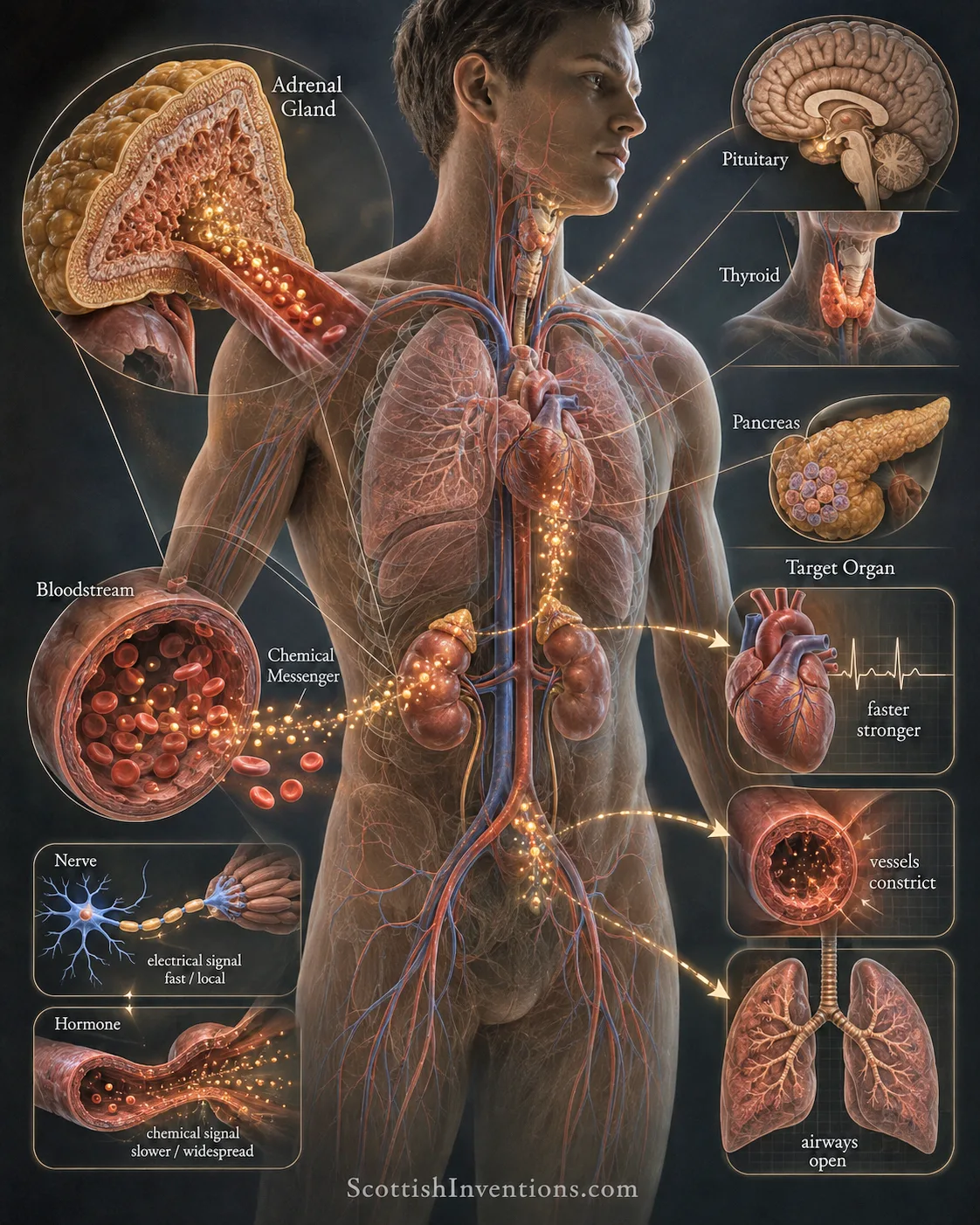
Adrenaline is today one of the most important emergency drugs in the world. It is the first-line treatment for anaphylaxis, delivered through EpiPens and similar autoinjectors, in which it constricts blood vessels, raises blood pressure and opens the airways. It is a core drug in cardiac-arrest resuscitation, where its alpha-adrenergic effects help restore circulation. It is added to local anaesthetics to prolong their action and reduce bleeding at the injection site, and it remains a treatment for asthma and severe allergic reactions.
The understanding of how adrenaline actually works — through distinct alpha and beta adrenergic receptors, distinguished by the pharmacologist Raymond Ahlquist in 1948 — led directly to one of Scottish medicine's greatest later achievements: Sir James Black's development of beta-blockers at ICI in the early 1960s, drugs that selectively block adrenaline's effect on the heart to treat angina, hypertension and heart disease, work for which Black won the 1988 Nobel Prize in Physiology or Medicine. The scientific line runs, without a serious break, from Oliver and Schäfer's dog on a London laboratory bench in 1894 to the beta-blockers found in millions of medicine cabinets today.
Endocrinology — the discipline Sharpey-Schafer helped found and, in significant part, helped name — now encompasses diabetes, thyroid disease, reproductive medicine, adrenal disorders and a great deal more of modern medicine. And every EpiPen ever manufactured is filled with the very substance whose dramatic physiological effect Oliver and Schäfer first demonstrated in that London laboratory in 1894, more than a century before either device or drug reached its present, life-saving form.
Timeline
William Sharpey born in Arbroath, Angus
Later 'the father of British physiology' and Schafer's lifelong mentor at UCL
Edward Albert Schäfer born in Hornsey, Middlesex
English by birth, to a Hamburg-born naturalised father and an English mother
Thomas Addison describes Addison's disease
Proves the adrenal glands are essential to life, without explaining why
Schäfer enters University College London
Comes under the influence of William Sharpey
Schäfer qualifies in medicine and joins the UCL staff
Begins a rapid academic rise in physiology
Elected a Fellow of the Royal Society, aged 28
Recognition of early distinction in physiological research
Brown-Séquard announces his 'rejuvenation' claims in Paris
Unsubstantiated, but ignites intense public and scientific interest in gland extracts ('organotherapy')
George Oliver visits Schäfer's UCL laboratory
Brings a homemade adrenal extract and a device for measuring its effect on his own son's artery
Oliver and Schafer present their findings to the Physiological Society
Demonstrate that suprarenal extract causes a dramatic, transient rise in blood pressure — the founding demonstration
Full paper published in the Journal of Physiology
'The Physiological Effects of Extracts of the Suprarenal Capsules' localises the effect to the adrenal medulla
John Jacob Abel at Johns Hopkins names 'epinephrin'
An impure, chemically modified derivative, not the pure active hormone
Schafer becomes Professor of Physiology at Edinburgh
Begins the 34-year Scottish chapter of his career
Jokichi Takamine and Thomas Aldrich independently isolate the pure substance
Takamine names it 'Adrenalin'; Aldrich determines its formula, C9H13NO3
Starling and Bayliss discover secretin
The experimental basis for Starling's later coinage of 'hormone'
Schafer devises the prone-pressure 'Schafer method' of artificial respiration
Becomes the world standard resuscitation technique for nearly 50 years
Friedrich Stolz synthesises adrenalone in Germany
Adrenaline becomes the first hormone to be chemically synthesised
Ernest Starling coins 'hormone' in his Croonian Lectures
Establishes the term Sharpey-Schafer is often wrongly credited with
Jean de Meyer proposes 'insuline' in Belgium
The first use of the name, ahead of Sharpey-Schafer
Schafer delivers his Lane Medical Lectures at Stanford
Independently proposes the name 'insuline' for the still-hypothetical pancreatic secretion
Schafer is knighted as a Knight Bachelor
Birthday Honours; a plain knighthood, not a KBE
Schafer's lectures published as 'The Endocrine Organs'
The book form in which 'insuline' reaches print
Schäfer becomes 'Sharpey-Schafer'
Honours his late son and his mentor William Sharpey of Arbroath amid wartime anti-German sentiment
Banting, Best, Collip and Macleod isolate insulin in Toronto
Adopt the name Sharpey-Schafer had proposed years earlier; the Scot Macleod shares the 1923 Nobel Prize
Sharpey-Schafer retires from the Edinburgh chair
Ends 34 years as Professor of Physiology
Sir Edward Sharpey-Schafer dies at Marly Knowe, North Berwick
A Scottish death closing a career reshaped around a Scottish name and a Scottish institution
Raymond Ahlquist distinguishes alpha and beta adrenergic receptors
Lays the groundwork for beta-blockers
Sir James Black develops beta-blockers
Drugs that block adrenaline's effect on the heart, a direct scientific descendant of the 1894 discovery
Myths & Facts
Myth: Oliver and Schafer discovered adrenaline in 1894.
Fact: They discovered its physiological effect — that adrenal-medulla extract dramatically raises blood pressure. The pure chemical substance now called adrenaline was not isolated until 1901, independently by Jokichi Takamine and Thomas Aldrich.
Myth: Sharpey-Schafer was a Scottish scientist.
Fact: He was born in Hornsey, Middlesex, in 1850, to a Hamburg-born father and an English mother, and trained entirely in England before the age of 49. His claim to Scottish science rests on 34 years as Professor of Physiology at Edinburgh (1899–1933), not on birth or upbringing — the same basis on which the collection claims the English-born Joseph Lister.
Myth: Sharpey-Schafer coined the word 'hormone'.
Fact: He did not. Ernest Starling coined 'hormone' in his 1905 Croonian Lectures. Sharpey-Schafer coined 'endocrine', 'autacoid' and 'chalone', and separately proposed the name 'insuline' in 1913/1916 for a substance not yet isolated.
Myth: Sharpey-Schafer was the first person to propose the name 'insulin'.
Fact: The Belgian physician Jean de Meyer used 'insuline' in a 1909 paper, apparently unknown to Sharpey-Schafer, who proposed the same name independently in his 1913 Lane Lectures (published 1916). Sharpey-Schafer's proposal was influential and prophetic, but not the first use of the term.
Myth: Sharpey-Schafer helped isolate insulin.
Fact: He did not participate in the isolation. Insulin was isolated in 1921–1922 in Toronto by Frederick Banting, Charles Best, James Collip and J. J. R. Macleod, who adopted the name Sharpey-Schafer (and de Meyer) had proposed years earlier. Macleod credited Sharpey-Schafer's naming explicitly in his Nobel Lecture.
Myth: He was knighted as a KBE.
Fact: He was made a Knight Bachelor in 1913 — a plain knighthood with no order of chivalry attached. The Order of the British Empire, which includes the KBE grade, was not created until 1917, four years after his knighthood.
Did You Know?
- Sharpey-Schafer predicted the existence of insulin and even named it in 1916 — five years before Banting, Best and Macleod actually isolated it at Toronto.
- The adrenaline story begins with a Harrogate GP experimenting on his own son using a homemade instrument to measure the artery's response.
- Sharpey-Schafer changed his name in 1918 to honour his Scottish mentor William Sharpey of Arbroath — making a very English scientist's name unexpectedly Scottish.
- Every EpiPen ever made contains the substance Oliver and Schafer first demonstrated in 1894.
- The "Schafer method" of artificial respiration he devised in 1903 was the standard first-aid technique for rescuing the drowned for nearly 50 years.
- Sharpey-Schafer served 34 years as Edinburgh's Professor of Physiology — his longest and most productive phase was entirely Scottish.
Honest Caveats
- "Discovered adrenaline" is imprecise. Many popular sources say Oliver and Schafer "discovered adrenaline" in 1894; strictly, they discovered the physiological effect of adrenal extract. The pure hormone was isolated in 1901.
- The homemade-instrument story rests substantially on Henry Dale's retelling. Systemic effects of orally given adrenaline are highly unlikely, so some historians treat details of the canonical account as possibly embellished legend; the broad outline is well attested, but the colourful specifics were recounted years after the fact.
- Date discrepancies exist across sources. The Oliver-Schafer work is variously dated to 1893 (experiments began), 1894 (Physiological Society presentation) and 1895 (full Journal of Physiology paper). The insulin naming is dated 1909 (de Meyer), 1913 (Schäfer's Lane Lectures) or 1916 (published book) depending on the source; a few loosely say "1910." This article gives the fuller set of dates rather than picking one.
- He was not first with "insuline." Jean de Meyer used the word in 1909. Sharpey-Schafer's 1913/1916 proposal was independent but not primary.
- "Hormone" was Starling's word, not Sharpey-Schafer's — a point some casual sources get wrong, and one this article corrects directly.
- Knighthood type. He was a Knight Bachelor (1913), not a member of an order of chivalry; he held no "KBE," since the Order of the British Empire did not exist until 1917. His genuine post-nominals were FRS, FRSE and FRCP(Ed).
FAQ
Did Edward Schafer discover adrenaline in 1894?
Not quite, and this article is deliberately precise about the distinction. In 1894, working with the Harrogate GP George Oliver, Schafer demonstrated that an extract of the adrenal gland's medulla caused a dramatic, transient rise in blood pressure when injected into an animal. That was a genuine and hugely important discovery — the first proof that the adrenal gland produced a powerful chemical messenger. But it was a discovery of a physiological effect, not of a pure substance. The pure, crystalline chemical we call adrenaline was not isolated until 1901, independently by Jokichi Takamine and Thomas Aldrich.
Was Sharpey-Schafer Scottish?
No, not by birth. He was born Edward Albert Schäfer in Hornsey, Middlesex, in 1850, to a Hamburg-born father and an English mother — entirely an English upbringing and early career at University College London. His claim to Scottish science rests on his career: he was Professor of Physiology at the University of Edinburgh for 34 years, from 1899 to 1933, the longest and most productive stretch of his working life, and he died at his home in North Berwick in 1935. This is exactly the same basis on which the site claims Joseph Lister — another English-born figure whose defining scientific career was made in Scotland (at Glasgow, in Lister's case) — and the article states that plainly rather than implying Scottish birth.
Why did his name change to Sharpey-Schafer?
In 1918, following the death of his elder son Commander John Sharpey Schäfer, killed when his Royal Navy ship struck a mine in the North Sea, Edward hyphenated 'Sharpey' onto his surname. He explained in his diary that it was partly in memory of his son and partly to honour William Sharpey of Arbroath, his old teacher and, in his words, 'the best friend I ever had.' His younger son had already been killed in action at Loos in 1915. The change also had the effect of de-Germanising an English scientist's German-derived surname during the First World War. Because Sharpey himself was thoroughly Scottish — born in Arbroath and buried in Arbroath Abbey — the change made an English-born scientist's name unexpectedly and permanently Scottish.
Did Sharpey-Schafer coin the word 'hormone'?
No, and this is one of the most common errors in popular accounts of his career, which this article corrects directly. The word 'hormone' was coined by Ernest Starling in his 1905 Croonian Lectures to the Royal College of Physicians, describing work he had done with William Bayliss on secretin. Sharpey-Schafer's own major coinages were different: he introduced the term 'endocrine' for the secretions of ductless glands, along with 'autacoid' and 'chalone', and he argued (unsuccessfully, in the end) that 'hormone' should be reserved specifically for stimulatory messengers.
Did Sharpey-Schafer name insulin first?
He named it, but not first. In his 1913 Lane Medical Lectures at Stanford, published in 1916 as 'The Endocrine Organs,' Sharpey-Schafer proposed the name 'insuline' for the still-undiscovered pancreatic substance he believed was produced by the islets of Langerhans. However, the Belgian physician Jean de Meyer had already used the term 'insuline' in 1909, apparently without Sharpey-Schafer's knowledge, in a paper on the internal secretion of the pancreas. Sharpey-Schafer's proposal was independent, not primary. What is remarkable is that his prediction of the substance's existence and behaviour, made years before anyone had isolated it, proved essentially correct, and when Banting, Best, Collip and Macleod isolated the actual hormone in Toronto in 1921–1922, they adopted the name he (and de Meyer) had proposed. Macleod acknowledged this directly in his Nobel Lecture.
What exactly happened in the 1894 demonstration?
George Oliver, a Harrogate GP who experimented in his winter leisure, had prepared a glycerine extract of adrenal gland and tested it, by his own account, on his young son, observing an effect on the boy's radial artery. He then brought the extract to Edward Schafer's laboratory at University College London. Schafer, in the middle of an unrelated blood-pressure experiment on a dog, injected the extract more or less to humour his visitor — and watched the animal's blood pressure shoot up dramatically within seconds. The two then spent the winter of 1893–94 systematically studying the effect, comparing it against known agents and testing its resistance to heat and digestion, and localised the active principle to the medulla, the inner part of the adrenal gland. They presented the results to the Physiological Society on 10 March 1894, with the full paper following in the Journal of Physiology in 1895.
Who actually isolated pure adrenaline?
Two men, working independently and almost simultaneously, in 1901: Jokichi Takamine, a Japanese chemist working in New York and backed by the pharmaceutical firm Parke, Davis & Co., isolated the pure, stable, crystalline substance and named it 'Adrenalin' (a trademarked name in the United States); and Thomas Aldrich, a chemist also working for Parke, Davis, isolated it independently and determined its correct chemical formula, C9H13NO3. An intermediate, impure derivative had been produced earlier, in 1899, by John Jacob Abel at Johns Hopkins, who called it 'epinephrin' — but this compound, as later analysis showed, was not very physiologically active, and Abel's claim to the discovery of the pure hormone does not hold up.
Why are there two names, adrenaline and epinephrine?
The split reflects the split priority claims and a transatlantic disagreement over terminology. 'Adrenaline', from the Latin ad ('near') and renes ('kidneys'), became the standard British and European term, championed by the pharmacologist Henry Dale. 'Epinephrine', from the Greek epi ('upon') and nephros ('kidney') — essentially the same anatomical idea rendered in Greek rather than Latin — became, partly for trademark reasons connected to Takamine's 'Adrenalin' brand name, the official term in United States pharmacopoeia and clinical usage. Both names refer to the same molecule and describe the same anatomical origin.
What was the Schafer method?
In 1903, as Professor of Physiology at Edinburgh, Sharpey-Schafer devised a manual technique for reviving people who had stopped breathing — the 'prone pressure method'. The patient is laid face down; the rescuer kneels astride or beside the body and rhythmically presses down on the lower ribs for about three seconds and releases for two, roughly twelve times a minute, mechanically forcing air out of and back into the lungs. Reported to the Royal Society of Edinburgh in 1903 and published in 1904, it was adopted worldwide and, according to the medical historical record, was recommended in the American Red Cross First Aid Textbook until 1959, when it was superseded by mouth-to-mouth resuscitation, shown by Peter Safar and colleagues to be more effective.
What was Sharpey-Schafer's knighthood?
He was made a Knight Bachelor in the 1913 Birthday Honours, listed in the London Gazette under his pre-1918 name as 'Edward Albert Schafer, FRS, Professor of Physiology, University of Edinburgh.' A Knight Bachelor is a plain knighthood carrying the title 'Sir' but no order of chivalry and no post-nominal letters of its own. He was never a KBE (Knight Commander of the Order of the British Empire) — that order did not exist until it was created in 1917, four years after his knighthood. His genuine post-nominals were FRS, FRSE and FRCP(Ed).
How does this connect to Sir James Black and beta-blockers?
Directly, through nearly seventy years of pharmacology. Adrenaline works on the body through receptors that the physiologist Raymond Ahlquist classified in 1948 into two types, alpha and beta. That classification made it possible for Sir James Black, working at ICI in the early 1960s, to design drugs — beta-blockers — that selectively block adrenaline's action on the heart, transforming the treatment of angina, hypertension and heart disease and earning Black the 1988 Nobel Prize. The scientific line runs, without a serious break, from Oliver and Schafer's dog on a laboratory bench in 1894 to the beta-blockers taken by millions of patients today.
Why does the site call this a 'shared' discovery rather than crediting Sharpey-Schafer alone?
Because the honest history distributes credit across several people and moments, and this collection would rather state that plainly than inflate a single figure's role. Oliver and Schafer jointly demonstrated the physiological effect in 1894; Takamine and Aldrich isolated the pure chemical in 1901; Starling coined the defining word 'hormone' in 1905; de Meyer used the name 'insuline' before Sharpey-Schafer did; and Macleod's Toronto team, not Sharpey-Schafer, actually isolated insulin. Sharpey-Schafer's own, undiluted achievements — the 1894 demonstration, the coinage of 'endocrine', the prophetic naming of insulin, and the life-saving Schafer method — are substantial enough that they do not need borrowed credit to stand up.
Sources
Primary and near-primary sources
- Oliver, G. and Schäfer, E. A., "The Physiological Effects of Extracts of the Suprarenal Capsules," Journal of Physiology, vol. 18, issue 3 (1895), pp. 230–276.
- Schäfer, E. A., "The Endocrine Organs: An Introduction to the Study of Internal Secretion" (Longmans, Green and Co., London, 1916), based on the 1913 Lane Medical Lectures, Stanford University.
- Schäfer, E. A., "Description of a Simple and Efficient Method of Performing Artificial Respiration in the Human Subject," Medico-Chirurgical Transactions (1904).
- de Meyer, J., "Action de la sécrétion interne du pancréas," Archives de Physiologie (1909).
- Macleod, J. J. R., Nobel Lecture, 1923, Nobel Foundation.
- Starling, E. H., Croonian Lectures, "On the Chemical Correlation of the Functions of the Body," Lancet (1905).
- London Gazette, 1913 Birthday Honours list.
Secondary historical scholarship
- Yamashima, T., "Adrenaline/Epinephrine Hunters," Emergency Medicine Investigations (2017).
- Wilson, J. D., "History of the discovery of hormones," Clinical Endocrinology (2005).
- Sykes, A. H., "Edward Schafer (1850–1935) and artificial respiration," PubMed-indexed historical review.
- Marsh, J. P. et al., historical review of resuscitation methods, Resuscitation (2004).
- Wikipedia, "Catecholamine" and related historical articles on the discovery of adrenaline (consulted for cross-referencing dates and the Oliver anecdote's provenance).
Biographical and institutional records
- Royal Society, Copley Medal and Royal Medal citation records.
- Royal Society of Edinburgh, Fellowship and Presidency records.
- University of Edinburgh, Chair of Physiology institutional history.