Discoveries · No. 29 of 50 · Atmospheric Science
John Aitken and the Discovery of Atmospheric Condensation Nuclei
A privately funded Falkirk physicist with no university post proved that clouds, fog and rain cannot form without dust — and then built a brass-and-glass instrument to count the invisible particles responsible, founding the modern sciences of cloud physics and aerosol study.
John Aitken · 1839–1919Discovery published · 1880Reading time · 18 minUpdated 16 August 2026
TL;DR
- John Aitken (1839–1919), a privately funded Scottish physicist working from his own home laboratory in Falkirk, discovered that water vapour in the atmosphere does not condense into cloud, fog or rain on its own but needs tiny airborne particles — "condensation nuclei" — to form on. These particles are named "Aitken nuclei" in his honour.
- He built the world's first instrument for counting invisible airborne particles, the Aitken Dust Counter, the direct ancestor of the condensation particle counters used today in atmospheric science and semiconductor clean rooms, and used it to show city air holds thousands of times more nuclei than clean mountain or ocean air.
- Aitken was entirely Scottish by birth and career — never a university professor, but a "gentleman scientist" whose meticulous, home-built experiments founded the sciences of cloud physics and aerosol study, work now central to cloud seeding, climate modelling and air-quality research.
Scottish Impact Index (SI Score)
- Global Impact
- 7/10
- Longevity
- 8/10
- Economic / Material Impact
- 4/10
- Originality / Distinctiveness
- 9/10
- Legacy (Built Upon)
- 7/10
- Recognition
- 2/10
Key Findings
- John Aitken (1839–1919), born and working entirely in Scotland from a home laboratory in Falkirk, discovered that atmospheric water vapour condenses onto microscopic solid and liquid particles — dust, smoke, sea salt — and that without such nuclei clouds, fogs and rain as we know them could not form at natural levels of supersaturation.
- Ill health prevented Aitken from ever holding an official academic position; as the Encyclopædia Britannica records, "Ill health prevented Aitken from holding any official position; he worked instead in the laboratory in his home in Falkirk."
- From 1888 to 1890 he designed and built the Aitken Dust Counter, the first apparatus able to count individual airborne particles, using rapid expansion of moist air to force condensation onto nuclei so the resulting droplets could be counted.
- The Frenchman Paul-Jean Coulier had performed similar laboratory experiments in 1875, and John Tyndall had studied floating dust in air; Aitken's distinct contribution was quantitative counting and demonstrating that nuclei govern real-world atmospheric cloud and fog formation.
- He was elected a Fellow of the Royal Society of Edinburgh (1875) and of the Royal Society of London (1889), and was awarded the Royal Society's Royal Medal in 1917 — he did not receive the Rumford Medal, a claim that should not be repeated.
- The smallest, most numerous atmospheric particles (roughly 10–100 nanometres) are now called the "Aitken mode"; his counter's electronic descendant, the condensation particle counter, remains standard equipment; and his principle underpins cloud seeding and proposed climate interventions such as marine cloud brightening.
Quick Facts
- Discovery
- Water vapour in the atmosphere does not condense into cloud, fog or rain by itself — it needs microscopic airborne particles, or 'condensation nuclei', to form on
- Year
- 1880 — 'On Dust, Fogs, and Clouds', read to the Royal Society of Edinburgh, December 1880
- Key figure
- John Aitken (1839–1919)
- Role
- Independently wealthy 'gentleman scientist' working from his own home laboratory in Falkirk
- Instrument
- The Aitken Dust Counter — the world's first instrument for counting invisible airborne particles
- Method
- Rapid expansion of a moist air sample to force condensation onto nuclei, so the resulting droplets could be counted on a ruled plate
- Prior work
- Paul-Jean Coulier (Paris, 1875) showed filtered dust-free air resisted condensation; John Tyndall studied floating dust in air
- Aitken's real contribution
- Quantitative counting of nuclei, plus proof that they govern real-world cloud and fog formation, not just laboratory demonstration
- Named after him
- 'Aitken nuclei' and the 'Aitken mode' — the smallest, most numerous atmospheric particles (roughly 10–100 nanometres)
- Recognition
- FRSE (1875), FRS (1889), Keith Prize, Gunning Victoria Jubilee Prize, honorary LLD (Glasgow, 1902), Royal Medal of the Royal Society (1917)
- Not received
- The Rumford Medal — a claim sometimes repeated in error and not used in this article
- Claim status
- Established as the founding demonstration and quantification of condensation nuclei; Coulier preceded him in the laboratory and should be credited
- Living legacy
- Cloud seeding, marine cloud brightening, aerosol–cloud climate science, and modern condensation particle counters (CPCs) all rest on Aitken's principle
The Falkirk Gentleman Scientist
John Aitken was born on 18 September 1839 in Falkirk, Stirlingshire, the fourth son of Margaret Russel and Henry Aitken, a businessman and head of the Falkirk legal firm Russel & Aitken. Despite persistent ill health as a boy, he was educated at Falkirk Grammar School and then, following his father and brothers, at the University of Glasgow, where from 1855 he studied logic, chemistry and mathematics. He graduated at the top of William Rankine's class in civil engineering and mechanics, and also topped William Thomson's — later Lord Kelvin's — natural philosophy class, striking up a lifelong friendship with the professor that would later see Kelvin propose him for Fellowship of the Royal Society of Edinburgh.
Aitken trained as a marine engineer, serving an apprenticeship in Dundee before working for around five years with the celebrated Clyde shipbuilders Robert Napier & Sons in Glasgow. Surviving drawings of marine steam engines, screw propellers and paddle wheels show he was a highly capable draughtsman. But a breakdown in his health forced him to abandon engineering as a career. After the death of both his parents around 1860 he became financially secure on inherited wealth, and by 1867 had retired to Falkirk, where he lived unmarried alongside his brothers. This inheritance was the practical foundation of everything that followed: it let him pursue science as an independent "gentleman philosopher," entirely free of any academic salary or institutional appointment.
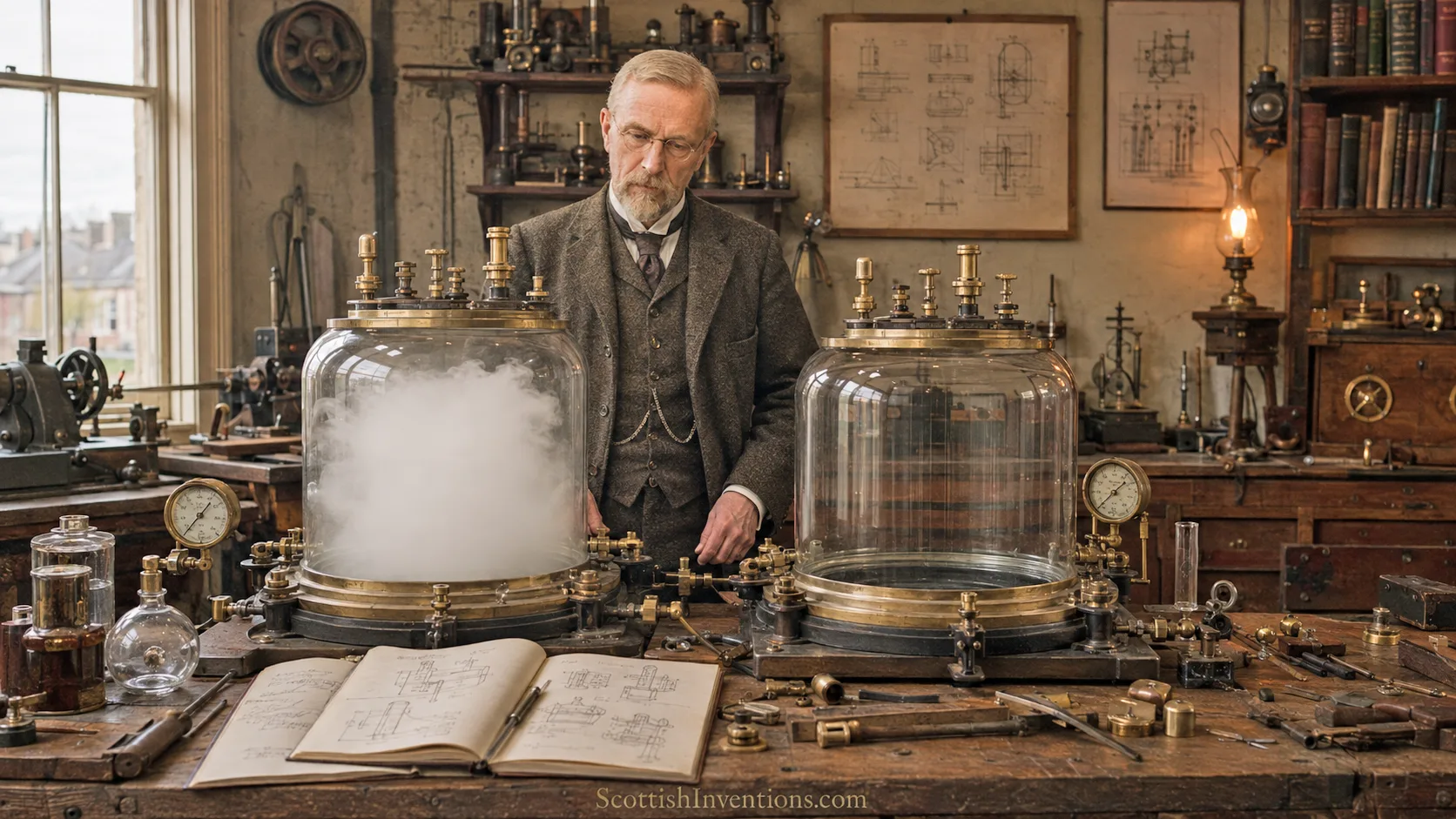
Back home, he converted the drawing room of the family home of Darroch into a laboratory and workshop, and from 1897 built a purpose-designed house, Ardenlea, complete with a workshop equipped with a turning lathe, a carpenter's bench, glassware and instruments he made himself. His early engineering training proved invaluable here: rather than relying on commercial apparatus, he designed and built almost all of his own equipment, giving him a level of control over his experiments that few contemporaries could match. His delicate health meant he was often able to work only a few hours a day, yet across nearly half a century he sustained a research programme of extraordinary care and consistency — a career built entirely on private means, private premises, and private determination, without ever holding a university chair.
What Was Known Before Aitken
By the mid-nineteenth century, meteorologists understood in general terms that clouds and rain form when moist air cools below its dew point. But precisely why droplets began to form at that point — what physically triggered the condensation — remained unexplained. In sufficiently clean and undisturbed conditions, water vapour can in fact be cooled well past the point of saturation and become greatly "supersaturated" without condensing into droplets at all. Something more than cooling alone was evidently required, and nobody had identified what that something was.
Two strands of earlier work set the stage for Aitken's breakthrough. John Tyndall's investigations of light scattering by floating dust in air — the phenomenon now known as the "Tyndall effect" — had shown in the 1870s that even carefully cleaned air contained enormous quantities of suspended particles, establishing that the atmosphere was never truly free of solid matter. More decisively, in 1875 the French physician and chemist Paul-Jean Coulier, working in Paris, performed the crucial laboratory experiment: air that had been filtered of its dust proved far harder to turn into a fog by expansion than ordinary, unfiltered air, strongly suggesting that particles were serving as necessary "seeds" for droplet formation.
Aitken did not read Coulier's paper until 1881, a year after publishing his own landmark findings, having begun his research independently in 1875. When he did encounter it, he was scrupulous about giving credit where it was due, writing plainly that "Monsieur Coulier was the first to show the important part played by dust in the cloudy condensation of the vapour in air." This is an important and sometimes overlooked fact in Aitken's own story: he did not claim priority for the laboratory demonstration of the principle, and this article follows his own lead in crediting Coulier for that first step.
Dust, Fogs and Clouds
Aitken began his research on condensation in 1875 and started publishing his findings from 1880. His reasoning was elegant and characteristically direct: if dust-free air resists condensation under controlled laboratory conditions, then in the real, open atmosphere, water vapour must likewise be condensing on the dust particles that are always present there — and the sheer number of those particles must be what governs how, and how readily, clouds and fogs actually form.
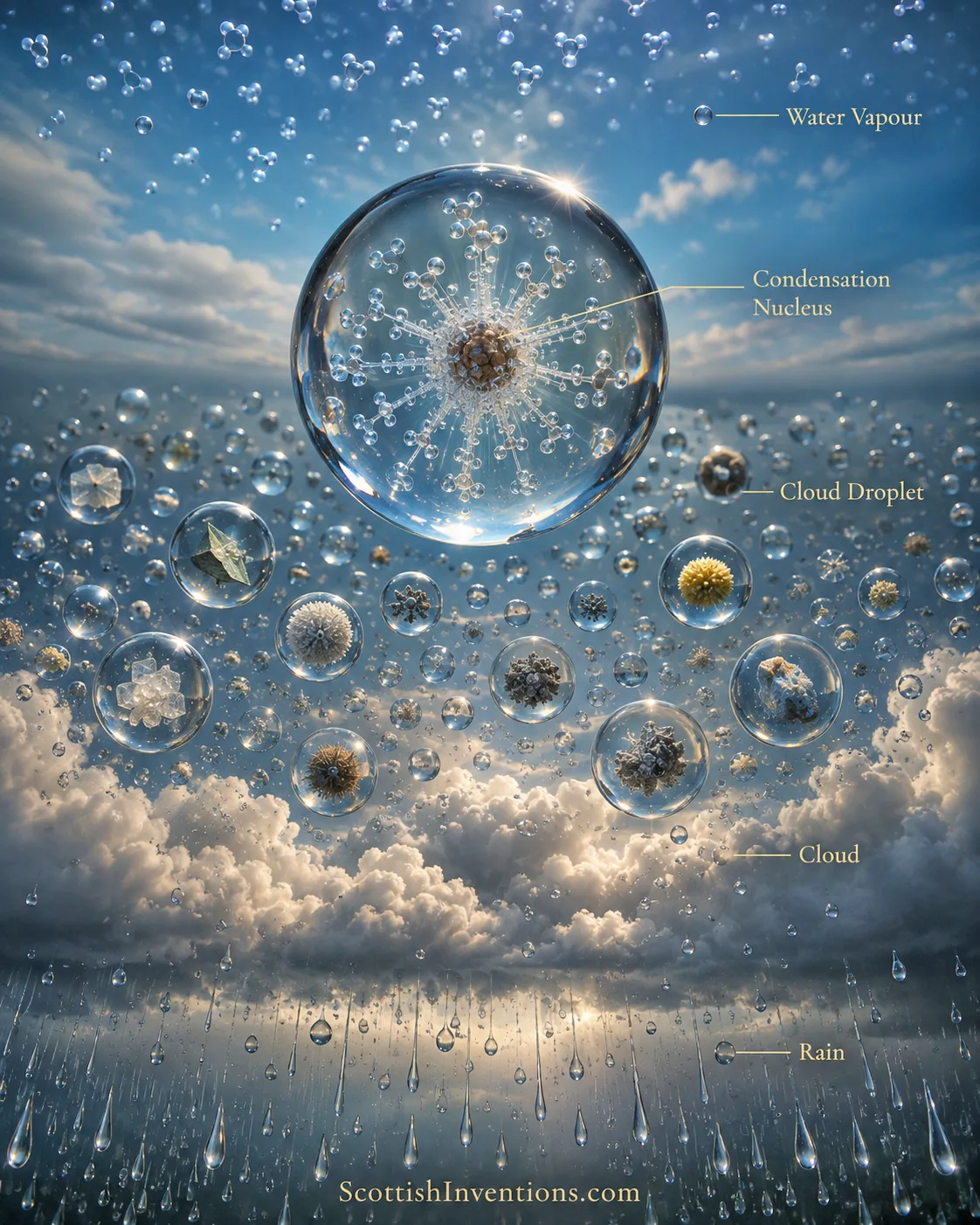
His experiments used what is best described as a "cloud in a bottle" method. He took a sealed chamber of moist air and rapidly expanded it, which cooled the air through adiabatic expansion, driving it into a state of supersaturation. In dusty air, a dense cloud of tiny droplets formed almost instantly. In filtered, dust-free air, no cloud appeared at all until the expansion — and hence the supersaturation — was pushed to genuinely extreme levels. He summarised his conclusions with characteristic bluntness: "(1) when water vapour condenses in the atmosphere, it always does so on some solid nucleus; (2) the dust particles in the air form the nuclei on which it condenses; (3) if there was no dust in the air there would be no fogs, no clouds, no mists, and probably no rain."
He also demonstrated that the number of nuclei present controls the physical character of the resulting cloud: many nuclei produce many small droplets, while few nuclei produce fewer but larger drops — a relationship that remains central to modern cloud physics and to understanding how pollution changes cloud behaviour. His landmark paper, "On Dust, Fogs, and Clouds," was read to the Royal Society of Edinburgh in December 1880 and published in its Transactions (volume 30, 1880–1881). The work won rapid acclaim and the endorsement of Lord Rayleigh, and — together with his 1884 follow-up paper "On the Formation of Small Clear Spaces in Dusty Air" — earned him the Keith Prize of the Royal Society of Edinburgh for 1883–1885.
The Aitken Dust Counter
Aitken's greatest practical achievement was solving a problem that had previously seemed impossible: how to count particles far too small to see. His solution was as ingenious as it was simple — it turned the invisible nuclei themselves into the mechanism of their own detection. A measured volume of air was saturated with moisture inside a closed chamber and then suddenly expanded. The resulting cooling produced strong supersaturation, and a visible water droplet condensed on every single nucleus present. Those droplets then fell onto a ruled, silvered plate, where they could be individually counted under a microscope, yielding a precise figure for the number of particles per cubic centimetre of air. This instrument became known as the Aitken Dust Counter.
He first described the apparatus around 1888, produced a heavy "first-class laboratory" version by 1889, and a simple pocket-sized version by 1890–1891, published as "On a Simple Pocket Dust-Counter" in the Proceedings of the Royal Society of Edinburgh. He also devised a companion instrument, the koniscope, in 1892 — an optical "dust detective" that gauged particle concentration by the colour of the condensation cloud rather than by direct droplet counting. It is worth stating plainly that the koniscope is Aitken's own instrument and is distinct from the unrelated "konimeter," a different dust-sampling device from a separate tradition of industrial hygiene; the two names should never be treated as interchangeable. The portable Aitken Dust Counter, small enough to fit "the size of a well-filled cigar case," allowed him to take measurements up mountains, at the seaside, and abroad.
The Aitken Dust Counter was quickly adopted internationally. It was carried on global scientific voyages — E. D. Fridlander took Aitken counters around the world in the mid-1890s, charting ocean dust — and was stationed in the Sahara and installed at the Ben Nevis Observatory in Scotland. Its scientific descendants remain in daily use today: modern electronic condensation particle counters (CPCs), also known as condensation nucleus counters, still work on exactly Aitken's original principle of growing invisible particles into countable droplets through controlled supersaturation.
Mapping the Dustiness of the Air
Aitken used his portable Dust Counters to map the "dustiness" of the air across Britain and continental Europe, ultimately collecting more than 1,500 individual measurements and showing how high-pressure weather systems tend to concentrate particles near the ground. In his own summary of this extensive survey, he reported that "it is very rare to find air with less than 100 particles per c.c., whilst in most country places the numbers rise to thousands, and in cities such as London and Paris the number may be as high as 100,000 to 150,000 per c.c."
His measurements of genuinely clean environments produced strikingly low figures by comparison. In Atlantic ocean air arriving on Scotland's west coast, the cleanest samples averaged around 72 particles per cubic centimetre; clean Highland air ran to a few hundred, with a mean of about 141 for the lowest readings recorded; and Alpine air atop the Rigi Kulm in Switzerland ranged from a few hundred up to around 900. Yet these same clean sites became dramatically dirtier when the wind direction shifted: on the Rigi Kulm the count sometimes exceeded 10,000 particles per cubic centimetre when air rose from inhabited valleys below, and even on Scotland's remote west coast the count climbed above 5,000 when the wind blew off the populated Lowlands, more than sixty miles away.
This geography of dust had real, practical meaning. Air rich in nuclei condenses readily and forms dense fogs; genuinely clean air resists condensation far more strongly. Aitken connected the enormous particle counts he found in city air — especially the sulphurous smoke thrown up by coal fires — to London's notorious winter "pea-souper" fogs, whose extreme density owed much to the vast number of industrial condensation nuclei suspended in the city's air. Two of Aitken's Dust Counters — one automatic, one portable — ran continuously alongside the other instruments at the summit Ben Nevis Observatory from 1890 onward, where observers there confirmed his findings of clear daily and seasonal cycles in the dust count, driven closely by wind direction.
Aitken's Broader Science
Aitken's curiosity ranged well beyond condensation nuclei. He settled a centuries-old controversy about the origin of dew, concluding from painstaking experiments in 1885 that dew condensing on cold surfaces comes mainly from moisture rising out of the ground below, rather than falling from the air above — a surprising and counterintuitive finding at the time. He studied the vivid colours of sunsets, including those that followed the catastrophic 1883 eruption of Krakatoa, attributing them to fine dust suspended high in the upper atmosphere, and he explored the related colours of the sky and the ocean. He devised small-scale laboratory "mimicry" experiments intended to reproduce cyclones and anticyclones in miniature, publishing this work from 1900 onward.
He also spent decades on the precise physics of thermometry, demonstrating that thermometers housed in the standard Stevenson screen — the standard meteorological instrument shelter of the period — read systematically too high on sunny days. The paper describing this finding was finished only days before he died and was published posthumously in 1921. Throughout all of this work, his method remained consistent: that of the meticulous, self-reliant experimenter who distrusted premature mathematical theorising and prized close observation, patient measurement, and instruments built with his own hands over abstract speculation.
From Brass Counter to Climate Science
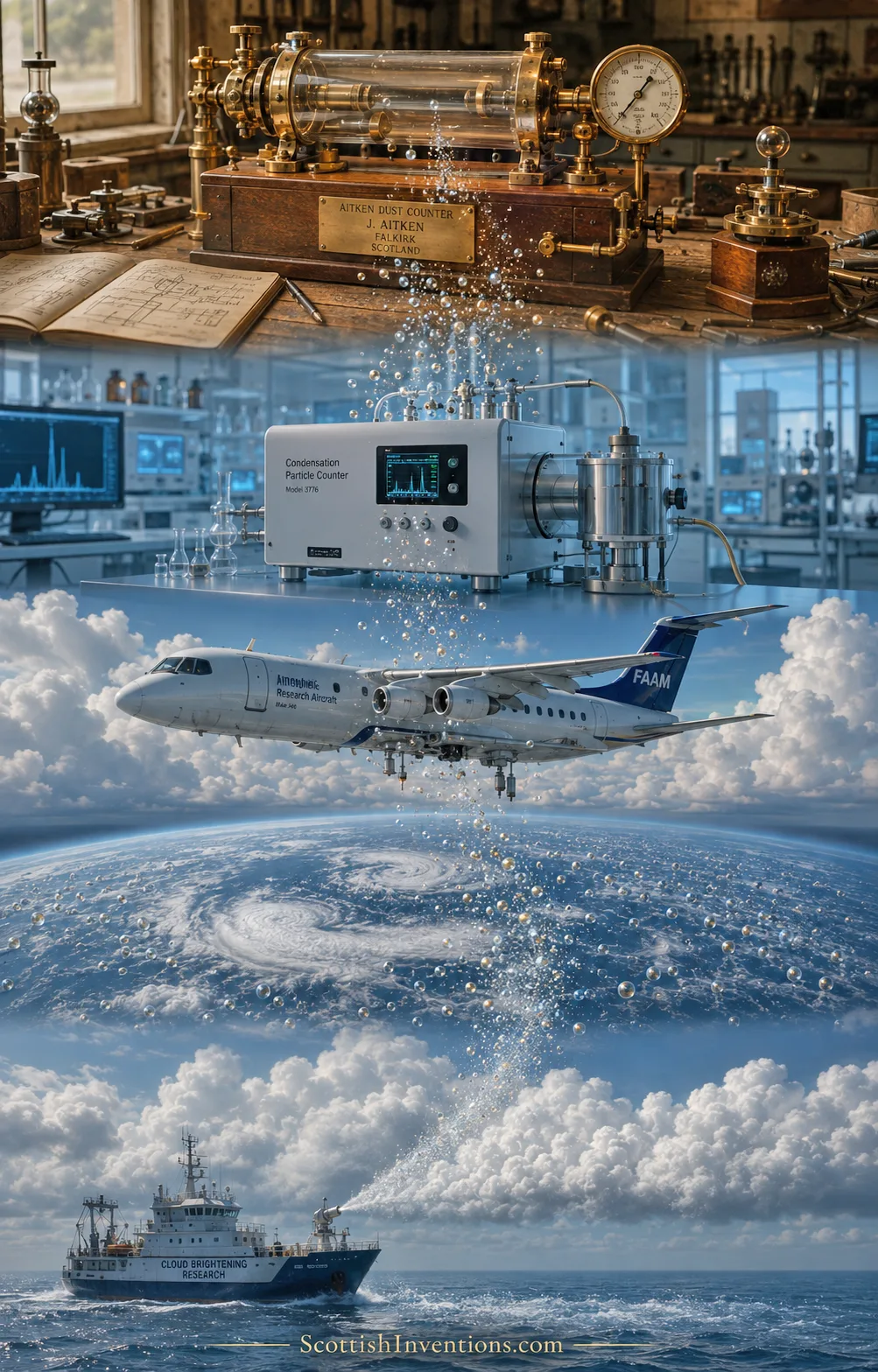
Aitken's principle — that condensation needs nuclei — underlies a wide swathe of modern science. Cloud seeding is one direct application: on 13 November 1946, at General Electric, Vincent Schaefer made the first aerial cloud-seeding flight, dropping six pounds of dry-ice pellets into a cloud at 14,000 feet over Mount Greylock, Massachusetts, after a sixty-mile chase from Schenectady County Airport. His mentor Irving Langmuir reported that "within two minutes a radical modification of the cloud took place and streamers of snow began to pour out of the base of the cloud." Bernard Vonnegut soon found silver iodide even more effective than dry ice for this purpose. This deliberate addition of nuclei to promote precipitation is a direct, practical application of Aitken's core insight that nuclei initiate condensation, though it is worth noting the 1946 experiments primarily concerned ice nuclei in supercooled clouds — a related but distinct mechanism from the liquid-water condensation nuclei Aitken himself studied.
In climate science, tiny airborne particles — aerosols — act as cloud condensation nuclei, and adding more of them produces clouds made up of more, smaller droplets that reflect more sunlight back into space. This is the "Twomey effect," named for Sean Twomey, who set it out in "Pollution and the Planetary Albedo" (1974), observing that "addition of cloud nuclei by pollution can lead to an increase in the solar radiation reflected by clouds," and who formalised the relationship mathematically in the Journal of the Atmospheric Sciences in 1977. The broader influence of aerosols on clouds — termed "aerosol–cloud interactions" — is identified by the Intergovernmental Panel on Climate Change as one of the largest sources of uncertainty in current estimates of humanity's radiative forcing of the climate: in the IPCC's Sixth Assessment Report, the effective radiative forcing attributed to aerosol–cloud interactions carries a 5–95% range of roughly −1.43 to −0.29 watts per square metre (within a total aerosol forcing range of about −2.0 to −0.6 watts per square metre), and it remains the single most uncertain component of the overall human forcing of the climate system. This is, quite precisely, Aitken's territory, more than a century on.
In modern aerosol science, the population of the smallest, freshest atmospheric particles — roughly 10 to 100 nanometres in diameter, and often the largest contributor to the total number concentration of particles in ambient air — is named the "Aitken mode" in his honour. Today's electronic condensation particle counters, essential equipment in both atmospheric research and semiconductor clean-room monitoring, are the direct lineal descendants of Aitken's original brass-and-glass counter. And a proposed climate intervention known as marine cloud brightening would spray fine sea-salt particles into marine air specifically to add condensation nuclei, brightening low-lying ocean clouds so they reflect more sunlight — working on exactly the principle Aitken established in 1880.
Aitken's Dust Counter also inspired one of the truly great instruments of twentieth-century physics. The young C. T. R. Wilson, after a summer working at the Ben Nevis Observatory in 1894 where Aitken's counters were already installed, extended the expansion-chamber idea further still, and found that in dust-free air, at sufficiently extreme expansions, droplets condensed instead on electrically charged ions. This became the Wilson cloud chamber, for which Wilson won the 1927 Nobel Prize in Physics — an instrument that made subatomic particle tracks visible for the first time and helped transform the whole of experimental physics, tracing its ancestry directly back to a Falkirk gentleman's home-built apparatus.
Timeline
1839
John Aitken born in Falkirk, Stirlingshire, on 18 September
Fourth son of Henry Aitken, head of the Falkirk legal firm Russel & Aitken
1855 onward
Aitken studies at the University of Glasgow
Tops William Rankine's civil engineering class and William Thomson's (Lord Kelvin's) natural philosophy class, beginning a lifelong friendship with Kelvin
c. 1860
Trains and works as a marine engineer, including with Robert Napier & Sons on the Clyde
Ill health forces him to abandon engineering as a career
c. 1860–67
Inherits family wealth after the deaths of both parents
Becomes financially independent and, by 1867, retires to Falkirk to pursue science without an academic salary
1875
Elected a Fellow of the Royal Society of Edinburgh
Proposed by Lord Kelvin among others
1875
Paul-Jean Coulier publishes laboratory experiments in Paris
Shows that dust-filtered air is far harder to turn into fog by expansion than ordinary air — the first clear laboratory evidence for condensation nuclei
1875
Aitken begins his own research on condensation
Working independently, without yet having read Coulier's paper
1880
Aitken publishes 'On Dust, Fogs, and Clouds' in the Transactions of the Royal Society of Edinburgh
Establishes experimentally that atmospheric water vapour condenses on dust particles, and that without such nuclei there would be no fogs, clouds or mists
1881
Aitken reads Coulier's 1875 paper and credits him
Writes that 'Monsieur Coulier was the first to show the important part played by dust in the cloudy condensation of the vapour in air'
1883
Krakatoa erupts; Aitken studies the resulting vivid sunsets
Attributes the colours to volcanic dust high in the atmosphere
1883–1885
Aitken awarded the Keith Prize of the Royal Society of Edinburgh
Recognises 'On Dust, Fogs, and Clouds' and his 1884 follow-up paper
1885
Aitken settles a long-standing controversy about dew
Shows experimentally that dew comes mainly from moisture rising out of the ground, not falling from the air
1888–1890
Aitken designs and builds the first apparatus for counting airborne particles
The Aitken Dust Counter, working by rapid expansion of a moist air sample to force condensation onto nuclei
1889
Elected a Fellow of the Royal Society of London
International recognition of his condensation and nucleation research
1890
The first Aitken Dust Counter installed at the Ben Nevis Observatory
Confirms daily and seasonal cycles in dust count driven by wind direction
1890–1891
Aitken publishes 'On a Simple Pocket Dust-Counter'
A portable version, small enough to fit 'the size of a well-filled cigar case', allowing measurements up mountains, at the seaside and abroad
1892
Aitken devises the koniscope
An optical instrument that gauges particle concentration by the colour of the condensation cloud — not to be confused with the unrelated South African 'konimeter'
1894
C. T. R. Wilson spends a summer at the Ben Nevis Observatory
Extends Aitken's expansion-chamber idea and, in dust-free air at extreme expansions, finds condensation on electrically charged ions instead of dust
1895
Wilson shows condensation can occur on ions in dust-free air at high supersaturation
A genuine qualification to Aitken's picture, though in the natural atmosphere dust and other nuclei are effectively always present
1897
Aitken awarded the Gunning Victoria Jubilee Prize (for 1893–1896)
For his continuing programme of atmospheric research
1902
University of Glasgow awards Aitken an honorary LLD
Recognition from his alma mater
1917
Royal Society of London awards Aitken its Royal Medal
For his lifelong researches on the nuclei of cloudy condensations — not, as sometimes wrongly stated, the Rumford Medal
1919
John Aitken dies at his home, Ardenlea, in Falkirk, on 13–14 November, aged 80
Buried in Falkirk Cemetery; leaves roughly half his estate to the poor of Falkirk
1923
Aitken's collected scientific papers published
Edited by Cargill Gilston Knott, published by Cambridge University Press for the Royal Society of Edinburgh
1927
C. T. R. Wilson wins the Nobel Prize in Physics
For the cloud chamber, an instrument descended from Aitken's expansion-chamber technique
1946
Vincent Schaefer performs the first aerial cloud-seeding flight
Drops dry ice into a cloud over Mount Greylock, Massachusetts, applying Aitken's principle of adding nuclei to promote condensation and precipitation
1974–1977
Sean Twomey formalises the 'Twomey effect'
Describes how added cloud condensation nuclei change cloud reflectivity, a direct descendant of Aitken's aerosol–cloud science
Present
The 'Aitken mode', condensation particle counters and marine cloud brightening proposals all trace to Aitken's 1880 discovery
His principle remains central to atmospheric science and climate research
Myths & Facts
Myth: John Aitken was the first scientist to show that dust is needed for condensation.
Fact: He was not first in the laboratory. The French physician and chemist Paul-Jean Coulier demonstrated in Paris in 1875 that dust-filtered air resisted fog formation far more than ordinary air. Aitken began his own, independent research the same year but did not read Coulier's paper until 1881, after which he explicitly credited Coulier as first. Aitken's distinct achievement was quantitative counting of nuclei and demonstrating their role in real atmospheric conditions, not the initial laboratory observation.
Myth: Aitken received the Rumford Medal for his work.
Fact: He did not. This claim appears in some secondary sources but is not supported by the record and should not be repeated. Aitken's major Royal Society honour was the Royal Medal of the Royal Society of London, awarded in 1917 for his lifelong research on the nuclei of cloudy condensations.
Myth: The Aitken Dust Counter is the same instrument as a 'konimeter'.
Fact: No. The Aitken Dust Counter (and its optical companion, the koniscope, from 1892) is Aitken's own invention, working by rapid expansion and condensation of moist air onto nuclei. A 'konimeter' is a separate, unrelated dust-sampling instrument from a different tradition of industrial and mining hygiene. The two terms should never be used interchangeably, and this article uses 'Aitken Dust Counter' consistently for Aitken's instrument.
Myth: Without dust, there would be no rain at all, under any conditions.
Fact: This was Aitken's own stated conclusion in 1880 — that without dust there would be 'no fogs, no clouds, no mists, and probably no rain' — but it required later qualification. C. T. R. Wilson showed in 1895 that at sufficiently high supersaturation, condensation can occur on electrically charged ions even in dust-free air. In the natural atmosphere, however, dust and other nuclei are effectively always present in sufficient quantity, so Aitken's basic picture holds for real-world conditions even though his absolute statement was an oversimplification.
Myth: Aitken was an Edinburgh or Glasgow university professor.
Fact: He was not. Ill health prevented Aitken from ever holding an official academic position. He worked his entire career from a private home laboratory in Falkirk, funded by inherited family wealth, as an independent 'gentleman scientist' — though he studied at the University of Glasgow as a young man and later received an honorary LLD from Glasgow in 1902.
Myth: Modern particle counts, quoted at up to three million particles per cubic centimetre, are Aitken's own figures.
Fact: They are not. Aitken's own published nuclei-count figures — roughly 100 per cubic centimetre as a rare minimum, thousands in the countryside, and up to 100,000–150,000 in cities such as London and Paris — are the ones used in this article as the most defensible historical record. Some modern secondary summaries quote much higher figures, sometimes citing counts in the millions; such figures are not directly traceable to Aitken's own measurements and should be treated with caution.
Did You Know?
- Aitken discovered the role of dust in cloud formation from his own private laboratory in Falkirk — one of the great scientific discoveries of the nineteenth century, made without a university post or an institutional salary.
- Before Aitken, nobody knew why raindrops formed where and when they did; his work gave the first coherent scientific explanation of what actually triggers condensation in the atmosphere.
- The 'Aitken nuclei' and 'Aitken mode' — the smallest, most numerous particles in the air — are named after him, more than 130 years after his original discovery.
- City air can contain a thousand times more condensation nuclei than clean ocean air — Aitken's Dust Counters were the first instruments to quantify this difference, roughly 72 particles per cubic centimetre in clean Atlantic air off western Scotland, versus up to 150,000 in London and Paris.
- The cloud-seeding technology used to coax rain from clouds in drought-hit regions works on exactly the principle Aitken discovered: adding nuclei to air where they are naturally scarce.
- His nucleus counter — a simple brass-and-glass instrument he built by hand in his Falkirk workshop — was the direct ancestor of the electronic particle counters used today in semiconductor clean rooms and atmospheric-science laboratories.
- A young C. T. R. Wilson spent a summer working alongside Aitken's dust counters at the Ben Nevis Observatory in 1894, an experience that led him to invent the Wilson cloud chamber and win the 1927 Nobel Prize in Physics.
Honest Caveats
Aitken was not first to demonstrate the effect in a laboratory. Paul-Jean Coulier performed the crucial laboratory experiment in Paris in 1875, five years before Aitken's landmark 1880 paper. Aitken began his own research independently that same year but did not read Coulier's work until 1881, after which he credited Coulier explicitly. This article names Coulier as the first laboratory demonstrator and credits Aitken specifically for quantitative counting of nuclei and for proving their role in real atmospheric conditions, not for the original laboratory observation.
The name of the device requires care. Sources use "Aitken dust counter," "Aitken nucleus counter," "pocket dust counter" and "koniscope" somewhat interchangeably; the koniscope (1892) is specifically the optical version of his instruments. This article uses "Aitken Dust Counter" consistently for Aitken's expansion-based particle-counting instrument, and does not use the term "konimeter" for it — a konimeter is a distinct, unrelated dust-sampling instrument and the two should never be conflated.
Aitken did not receive the Rumford Medal. This claim circulates in some secondary sources but is not supported by the record. His major Royal Society of London honour was the Royal Medal, awarded in 1917 for his lifelong researches on the nuclei of cloudy condensations.
His death date varies slightly by source. Most modern biographical sources give 14 November 1919, while the Complete Dictionary of Scientific Biography and some others give 13 November 1919. Both dates appear in reputable sources; the discrepancy is minor and is noted here rather than silently resolved.
"No rain without dust" was an oversimplification, later qualified. Aitken's own third conclusion in 1880 — that without dust there would be "probably no rain" — does not hold in every possible condition. C. T. R. Wilson showed in 1895 that at sufficiently high supersaturation, condensation can occur on electrically charged ions even in dust-free air. In the natural atmosphere, however, nuclei of one kind or another are effectively always present, so Aitken's basic picture holds true for real-world conditions.
Nuclei-count figures vary by source and instrument. Aitken's own published figures, used throughout this article, are the most defensible historical record. Some modern secondary summaries quote much wider ranges — occasionally up to three million particles per cubic centimetre — that are not directly traceable to Aitken's own measurements and should be treated with caution.
The cloud-seeding link involves a related but distinct mechanism. The 1946 dry-ice cloud-seeding experiments primarily concerned ice nuclei acting within supercooled clouds, which is related to but not identical with the liquid-water condensation nuclei that Aitken himself studied. The shared underlying principle — that seeding the air with additional nuclei changes how it condenses or precipitates — is the valid and defensible link between the two.
Frequently Asked Questions
What exactly did John Aitken discover?
Aitken demonstrated experimentally, in a paper read to the Royal Society of Edinburgh in December 1880, that water vapour in ordinary air does not spontaneously condense into cloud droplets, fog or rain on its own. Instead it condenses onto microscopic airborne particles — dust, smoke, sea salt and similar material — which he called 'condensation nuclei'. In carefully dust-filtered air, condensation could be suppressed almost entirely, even when the air was pushed to extreme supersaturation. This proved that nuclei, not water vapour alone, govern cloud and fog formation in the real atmosphere.
Was Aitken the first person to show this in a laboratory?
No, and this article does not claim that he was. The French physician and chemist Paul-Jean Coulier performed the crucial laboratory demonstration first, in Paris in 1875, showing that dust-filtered air resisted fog formation far more than ordinary air. Aitken began his own research in 1875 as well, but independently, and did not read Coulier's paper until 1881 — after which he generously credited Coulier as first to show 'the important part played by dust in the cloudy condensation of the vapour in air'. Aitken's distinct and lasting contribution was to go beyond the laboratory demonstration: he quantified nuclei by inventing a way to count them, and he showed that the same mechanism governs real-world atmospheric cloud and fog formation, not just condensation in a sealed flask.
What was the Aitken Dust Counter and how did it work?
The Aitken Dust Counter, designed and built between 1888 and 1890, was the world's first instrument capable of counting invisible airborne particles. It worked by saturating a measured volume of air with moisture inside a closed chamber, then suddenly expanding it. The rapid expansion cooled the air and drove it into strong supersaturation, so that a water droplet condensed on every nucleus present. Those droplets fell onto a ruled, silvered plate, where they could be counted under a microscope, giving a precise count of particles per cubic centimetre of air. Aitken built a heavy 'first-class laboratory' version by 1889 and a simple pocket-sized version by 1890–1891.
Is the Aitken Dust Counter the same thing as a 'konimeter'?
No, and the two should never be conflated. The Aitken Dust Counter — along with its optical companion instrument, the koniscope, which Aitken devised in 1892 — is Aitken's own family of instruments, working by expansion and condensation onto nuclei. A 'konimeter' is a distinct instrument, associated with dust sampling in a different tradition of industrial and mining hygiene, and it is not one of Aitken's inventions. This article uses 'Aitken Dust Counter' throughout for Aitken's expansion-based particle counter and does not use the term 'konimeter' for his device.
Did John Aitken hold a university post?
No. Ill health prevented Aitken from holding any official academic position throughout his life. He worked instead from a home laboratory in Falkirk — first in the family home of Darroch, and from 1897 in a purpose-built house, Ardenlea, complete with a workshop containing a turning lathe, a carpenter's bench and instruments he made himself. He was financially independent on inherited wealth after the deaths of his parents around 1860, which allowed him to work as an unaffiliated 'gentleman scientist' for nearly half a century, despite often being able to work only a few hours a day because of his health.
What is the 'Aitken mode' in modern atmospheric science?
In modern aerosol science, the population of the smallest and freshest atmospheric particles — roughly 10 to 100 nanometres in diameter, which can represent the largest number concentration of particles in ambient air even though they carry very little total mass — is named the 'Aitken mode' in his honour, more than a century after his original discovery. It sits alongside other named particle-size classes (such as the accumulation mode and coarse mode) used to describe the full population of atmospheric aerosol.
Did Aitken receive the Rumford Medal?
No. This is a claim that circulates in some secondary sources but is not supported by the record and should not be repeated. Aitken's major honour from the Royal Society of London was its Royal Medal, awarded in 1917 'in recognition of his lifelong researches on the nuclei of cloudy condensations', as the Complete Dictionary of Scientific Biography records. He was also elected a Fellow of the Royal Society of Edinburgh in 1875 and a Fellow of the Royal Society of London in 1889, and received the Keith Prize and the Gunning Victoria Jubilee Prize from the Royal Society of Edinburgh, and an honorary LLD from the University of Glasgow in 1902.
How much dustier is city air than clean ocean air, according to Aitken's own measurements?
Using his portable counters, Aitken collected more than 1,500 measurements across Britain and the Continent. His cleanest recorded air, off Scotland's Atlantic west coast, averaged around 72 particles per cubic centimetre; clean Highland air ran to a few hundred; and Alpine air atop the Rigi Kulm in Switzerland ran from a few hundred to around 900. By contrast, he reported that cities such as London and Paris could reach 100,000 to 150,000 particles per cubic centimetre — over a thousand times the cleanest ocean-air readings. Even normally clean sites could spike sharply: the Rigi Kulm exceeded 10,000 per cubic centimetre when air rose from inhabited valleys, and west-coast Scottish air climbed above 5,000 when the wind blew off the populated Lowlands more than sixty miles away.
Did Aitken's work explain London's famous 'pea-souper' fogs?
Yes, at least in outline. Aitken connected the extraordinarily high particle counts he measured in city air — much of it sulphurous smoke from coal fires — to the density of London's notorious winter fogs. Because more nuclei mean more, smaller cloud or fog droplets forming more readily, the huge quantity of industrial condensation nuclei in London's air helped explain why its fogs were so thick and persistent. This was one of the earliest scientific links drawn between air pollution and fog formation.
How does Aitken's discovery connect to modern cloud seeding?
Directly, in principle, though the mechanisms are related rather than identical. On 13 November 1946, Vincent Schaefer of General Electric made the first aerial cloud-seeding flight, dropping dry-ice pellets into a supercooled cloud over Mount Greylock, Massachusetts; his mentor Irving Langmuir reported that 'within two minutes a radical modification of the cloud took place and streamers of snow began to pour out of the base of the cloud.' Bernard Vonnegut soon found silver iodide even more effective. These experiments mainly concern ice nuclei in supercooled clouds, a related but distinct mechanism from the liquid-water condensation nuclei Aitken studied. The shared underlying principle — that adding nuclei to air changes whether and how it condenses or precipitates — is the valid and direct link back to Aitken's 1880 discovery.
Is Aitken's principle relevant to climate change science today?
Yes, substantially. Airborne particles act as cloud condensation nuclei, and adding more of them produces clouds with more, smaller droplets that reflect more sunlight back to space — an effect named the 'Twomey effect' after the physicist Sean Twomey, who set it out in a 1974 paper and formalised it in 1977. The influence of aerosols on clouds, known as 'aerosol–cloud interactions', is identified by the Intergovernmental Panel on Climate Change as one of the largest sources of uncertainty in estimating humanity's overall effect on the climate; the IPCC's Sixth Assessment Report gives a 5–95% range of roughly −1.43 to −0.29 watts per square metre for this effect. This is precisely Aitken's territory, more than a century after his original experiments.
Did Aitken's work lead to any other major scientific instruments?
Yes, indirectly but significantly. The young physicist C. T. R. Wilson spent a summer at the Ben Nevis Observatory in 1894, where Aitken's dust counters were already installed, and went on to extend Aitken's expansion-chamber technique. Wilson discovered that in dust-free air, at sufficiently extreme expansions, water droplets condensed instead on electrically charged ions. This finding became the basis of the Wilson cloud chamber, an instrument that made the tracks of subatomic particles visible for the first time and for which Wilson won the 1927 Nobel Prize in Physics — an important qualification to Aitken's original claim that dust alone governs condensation, and also one of the more surprising downstream consequences of his research programme.
Sources & Further Reading
Tier 1 · Primary
- Aitken, J. — "On Dust, Fogs, and Clouds," Transactions of the Royal Society of Edinburgh, vol. 30, 1880–1881.
- Aitken, J. — "On the Formation of Small Clear Spaces in Dusty Air," 1884.
- Aitken, J. — "On a Simple Pocket Dust-Counter," Proceedings of the Royal Society of Edinburgh, 1890–1891.
- Aitken, J. — Collected Scientific Papers, ed. Cargill Gilston Knott, Cambridge University Press for the Royal Society of Edinburgh, 1923.
Tier 2 · Scholarly and institutional
- Complete Dictionary of Scientific Biography, entry on John Aitken.
- Encyclopædia Britannica, entry on John Aitken.
- Royal Society of Edinburgh and Royal Society of London records of Fellowship, prizes and the 1917 Royal Medal citation.
- Twomey, S. — "Pollution and the Planetary Albedo," Atmospheric Environment, 1974; and Journal of the Atmospheric Sciences, 1977.
- Intergovernmental Panel on Climate Change, Sixth Assessment Report, aerosol–cloud interactions radiative forcing estimates.
Tier 3 · Site source document
docs/sources/discoveries/atmospheric-condensation-nuclei.md— the commissioned source document underlying this article.