Discoveries · No. 13 of 50 · Neuroscience
The Edinburgh Anatomist Who Split the Nervous System in Two
For fifteen centuries the nerves were imagined as one undifferentiated web. In a pamphlet printed in a hundred copies and posted to friends who never replied, a minister's son from Edinburgh began to prise it apart — and started one of the fiercest priority disputes in the history of medicine.
Sir Charles Bell · 1774–1842Edinburgh · London · BrusselsReading time · 15 minUpdated 3 August 2026
In Brief
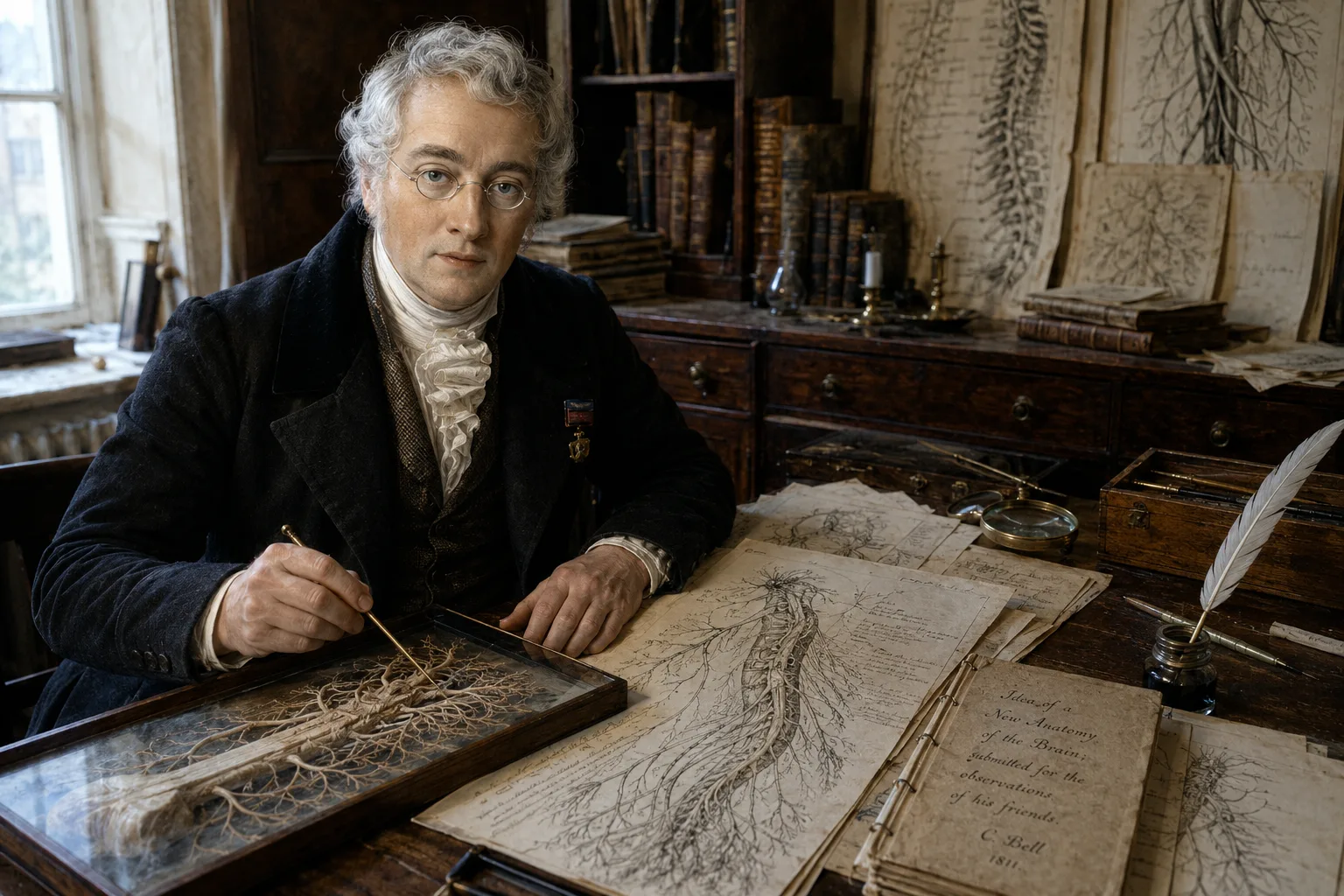
Sir Charles Bell, born in Edinburgh in 1774 and trained there under his formidable brother John, was the first person to experiment on the roots of the spinal nerves and to show that the anterior roots are connected with movement. He set out his ideas in a privately printed pamphlet of 1811. He did not, however, state that the posterior roots are sensory — his animals were stunned or dead, so he could not test sensation. That proof came in 1822 from the French physiologist François Magendie. Bell then reissued his earlier texts with quiet amendments to strengthen his claim. Both men's names are on the law, and both deserve to be there.
Scottish Impact Index (SI Score)
- Global Impact
- 7/10
- Longevity
- 8/10
- Economic / Material Impact
- 4/10
- Originality / Distinctiveness
- 8/10
- Legacy (Built Upon)
- 7/10
- Recognition
- 3/10
Key Facts
- Discovery
- That the spinal nerve roots are functionally distinct — anterior (ventral) roots motor, posterior (dorsal) roots sensory
- Key figures
- Sir Charles Bell (1774–1842) and François Magendie (1783–1855)
- Born
- 12 November 1774, Edinburgh — often given as the Fountainbridge district
- Died
- 28 April 1842, Hallow Park, near Worcester, aged 67
- Trained by
- His elder brother John Bell (1763–1820), the Edinburgh surgeon-anatomist
- Graduated
- University of Edinburgh, 1798; FRCS Edinburgh, 1799
- The pamphlet
- “Idea of a New Anatomy of the Brain”, privately printed, c. late August 1811 — 100 copies
- Decisive proof
- Magendie's 1822 experiments on living puppies, sectioning the roots separately
- Named the law
- Charles Sherrington, around 1900
- Where the work happened
- London, not Scotland — Bell was Edinburgh-born and Edinburgh-trained, and returned as Professor of Surgery in 1836
- Second monument
- Bell's palsy — from his 1821 Royal Society paper “On the Nerves”
- Claim status
- Disputed / shared — the law carries both names for good reason
Edinburgh Beginnings
Charles Bell was born in Edinburgh on 12 November 1774, the youngest of the sons of the Reverend William Bell, a clergyman of the Scottish Episcopal Church, and his second wife Margaret Morice. Several accounts place the birth in the Fountainbridge district. His father died in 1779, when Charles was five, and it was his mother who taught him to read and write and — decisively for everything that followed — arranged drawing lessons with the Scottish painter David Allan.
The Bell brothers were a formidable set. Robert was a Writer to the Signet; George Joseph became professor of Scots law at Edinburgh; and John, ten years Charles's senior, was among the foremost surgeons in Scotland, remembered as a father of surgical anatomy. It was John who taught Charles. From about 1792 Charles was assisting in his brother's private anatomy school while attending the university, and in 1798, the year he graduated, he published his own illustrated A System of Dissections. In 1799 he became a Fellow of the Royal College of Surgeons of Edinburgh, taught anatomy and operated at the Royal Infirmary, and wrote and illustrated volumes three and four of his brother's Anatomy of the Human Body.
Then the family's talent for making enemies caught up with them. John Bell's public war with the powerful Professor James Gregory cost both brothers their prospects at the Royal Infirmary. Charles, seeing no future in the city that had made him, left for London in November 1804 at the age of thirty. He set up an anatomy school near Leicester Square, and in 1812 bought into the Great Windmill Street School of Anatomy — the institution founded by William Hunter. He joined the Middlesex Hospital in 1814, became the first Professor of Anatomy and Surgery at the Royal College of Surgeons of England in 1824, and helped found the medical school of the new University of London.
Nerves Before Bell
To measure what Bell did, you have to know how little anyone knew. For roughly fifteen hundred years, Western medicine followed Galen: nerves were hollow tubes down which invisible "animal spirits" flowed to produce movement and sensation. Descartes still invoked them in the seventeenth century.
Microscopy eventually showed that nerves are solid fibres, not pipes, and in the 1780s and 1790s Galvani's frog experiments suggested that nerve signals are electrical — something measurable at last. Yet the prevailing assumption survived intact: that all nerves are essentially alike, undifferentiated conductors carrying impressions in and commands out along the same paths.
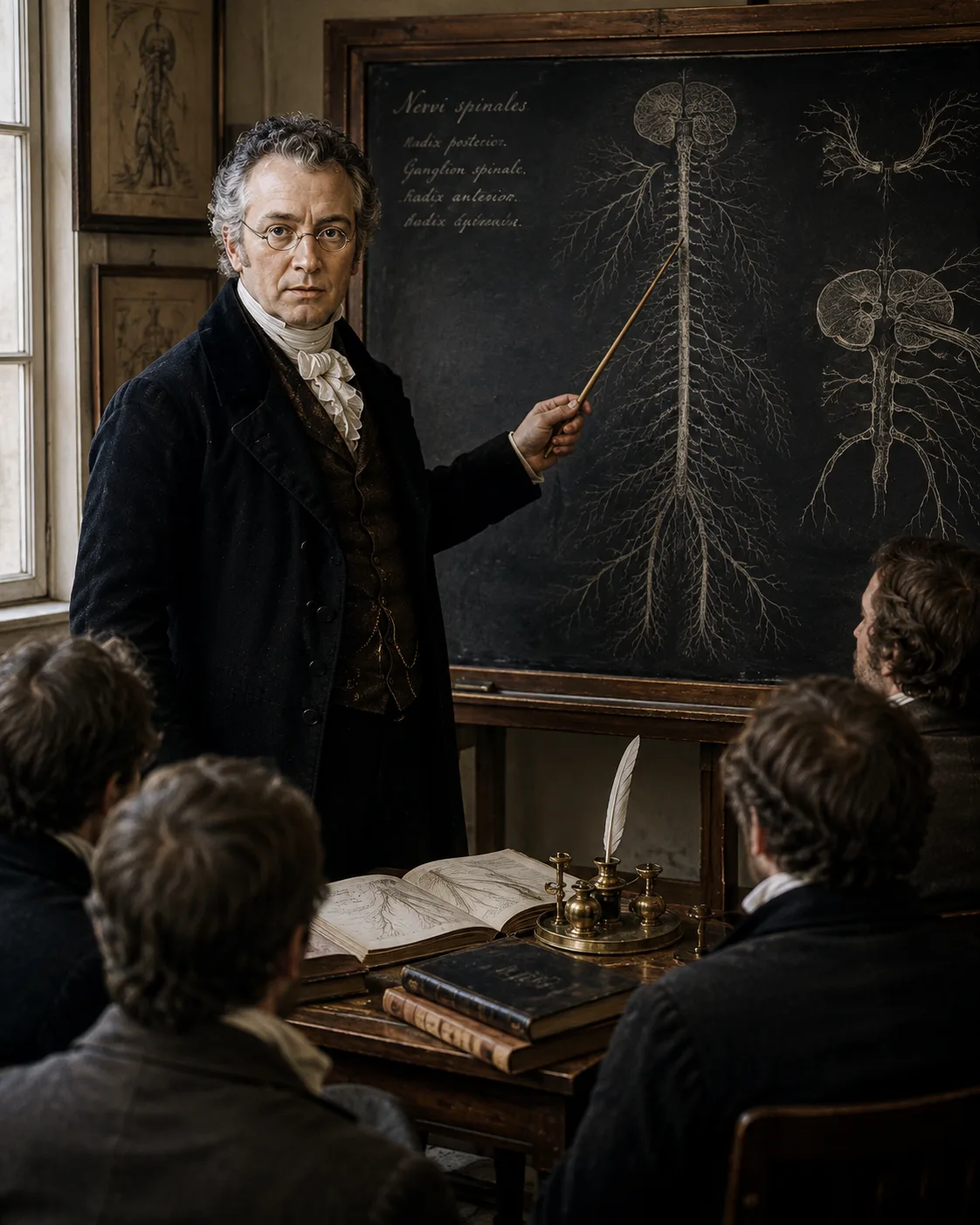
The specific puzzle sat at the spinal cord. At every segment, each spinal nerve attaches by two roots — a posterior (dorsal) root at the back, an anterior (ventral) root at the front. What did each do? Before Bell and Magendie, nobody knew.
The 1811 Pamphlet
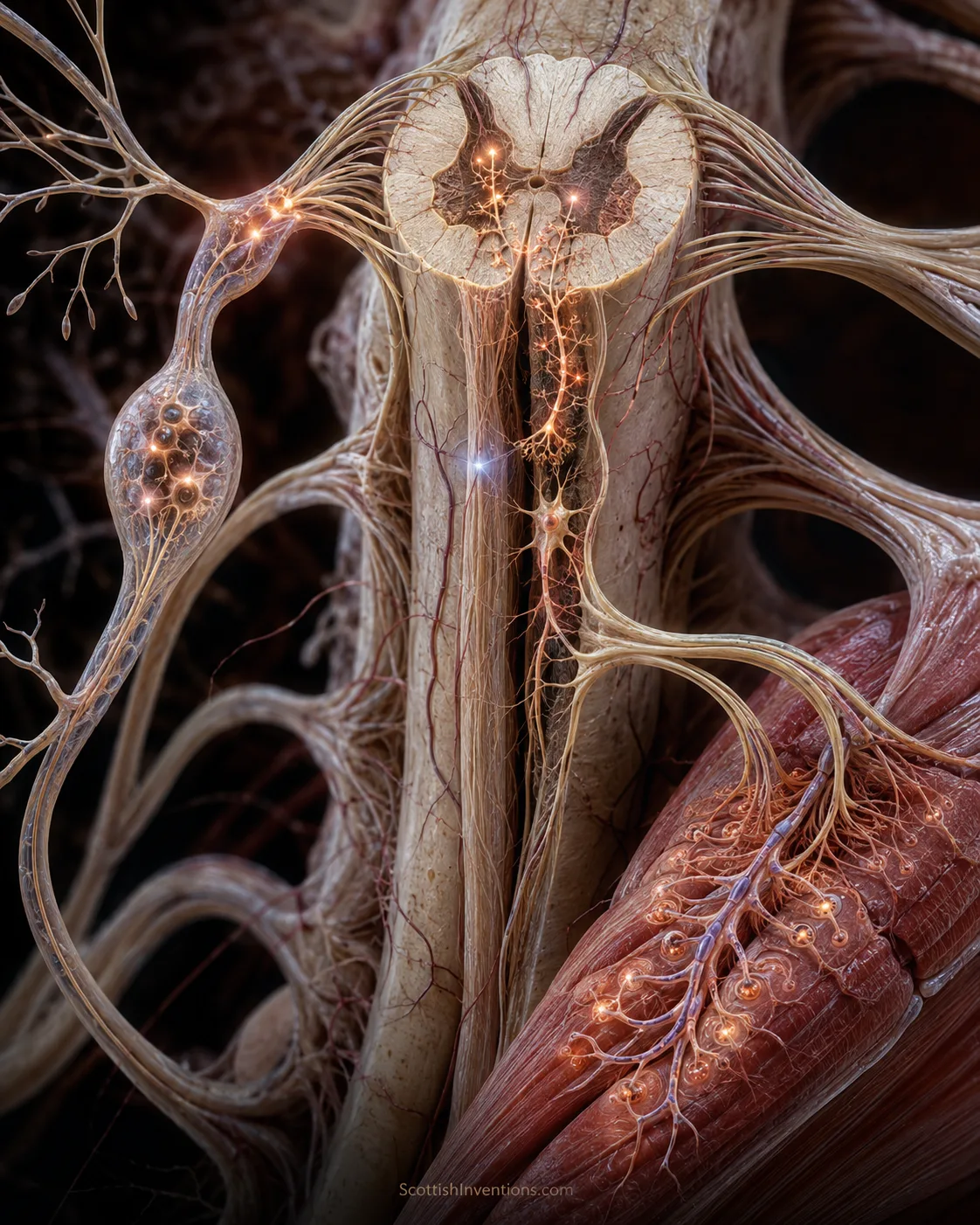
In the summer of 1811 Bell wrote a thirty-six-page essay: Idea of a New Anatomy of the Brain; submitted for the observations of his friends. It carried no date, but the researcher Ortwin Bock established from the printers Strahan and Preston that around a hundred copies were printed towards the end of August 1811. Bell did not publish it in any ordinary sense. He circulated it privately, asked for comment, and — by his own account — received none. Its rarity became legendary: the physiologist Brown-Séquard, writing in 1860, said he had never even seen a copy.
It is sometimes called the "Magna Carta of neurology". Here accuracy matters, because the pamphlet's reputation has run a long way ahead of its contents. Bell's actual preoccupation was not the spinal roots but the idea that the cerebrum and the cerebellum have different functions. He reasoned that the anterior columns of the cord connect to the cerebrum and the posterior columns to the cerebellum, and designed experiments to test it. He describes pricking the posterior filaments of the spinal nerves without producing convulsions, then touching the anterior division and seeing the muscles convulse — and correctly infers that the anterior roots are connected with motion.
What the pamphlet did not say
Nowhere in 1811 does Bell clearly state that the posterior roots are sensory and the anterior roots motor. His animals were stunned or dead, so sensation could not be tested at all. One passage even suggests he believed a single nerve carried the attributes of both parts of the brain. He had half the answer, and framed it in the wrong terms — cerebrum versus cerebellum rather than sensory versus motor.
Why keep it private? Because British medicine of the day was wary of vivisection and of experimental physiology generally, and still prized anatomical demonstration and teaching over journal publication. Circulating a pamphlet among trusted friends was a normal way to think aloud. It was not, in 1811, an attempt to plant a flag.
Magendie's Proof, 1822
Across the Channel, François Magendie — born in Bordeaux on 6 October 1783 — had become the leading experimental physiologist of his generation. His work with Alire Raffeneau-Delille on plant alkaloids in 1809 is often described as the beginning of modern pharmacology.
In 1822 he did the experiment that settled the question. Working on living puppies — young enough that the vertebral column could be opened to expose the roots — he cut the posterior roots on one side and found that sensation was abolished while movement remained. He then cut the anterior roots and found movement abolished while sensation remained. Clean, repeatable, unambiguous.
Magendie was scrupulous about Bell. Having read a copy of Idea, he wrote that Bell "was very close to discovering the functions of the spinal roots," but that "the fact that the anterior roots are motor while the posterior are specifically sensory seems to have escaped him" — and accordingly limited his own claim to having established that fact positively.
Who Deserves the Credit?
This is one of the most famous priority disputes in the history of science, and it deserves an honest telling. After Magendie's papers appeared, Bell — who had done no further work on the roots since 1811 — joined with his brothers-in-law John and Alexander Shaw to defend his priority. He republished Idea with amendments in 1824 and revised his 1821 Royal Society communication, in each case introducing new material while keeping the original dates, so that he appeared to have known all along.
Contemporaries noticed. A Royal College of Surgeons report of 1839 — written by the maverick anatomist Alexander Walker, who had a claim of his own — charged that Bell's "surreptitious additions… by giving a false appearance of anticipation, unjustly tend to deprive Messrs. Magendie and Mayo of their unquestionable priority." The American physiologist Austin Flint Jr. compared the texts in 1868 and concluded that "from the experiments of Magendie dates all of our positive knowledge of the physiological properties of the two roots of the spinal nerves." In 1911 Augustus Waller went further still, calling Bell's claim "a carefully fabricated claim".
"It is now widely accepted that although Bell made the first experimental observations on spinal root properties, his claims for full priority cannot be allowed."Edwin Clarke & L. S. Jacyna, Nineteenth-Century Origins of Neuroscientific Concepts, 1987
Paul F. Cranefield's 686-page study of 1974, The Way In and the Way Out: François Magendie, Charles Bell, and the Roots of the Spinal Nerves, reproduces facsimiles of nearly all the primary sources — including Bell's own annotated copy of Idea — and comes down decisively for Magendie, its author openly acknowledging his "prejudice against Bell". Bell's leading modern biographer, Michael Aminoff, is kinder: Bell "deserves credit for the concepts and initial experimental approach", while "Magendie and Mayo deserve credit for obtaining and correctly interpreting the definitive experimental findings" — and Bell, he suggests, persuaded himself rather than lied.
The fairest summary is this. Bell had the earlier insight and, above all, focused scientific attention on the roots. Magendie provided the rigorous, reproducible proof. That is why the law carries both names. German confirmation followed quickly: Johannes Müller's frog experiment of 1831 divided the posterior roots on one side and the anterior on the other, leaving one limb without sensation and the other without motion. Sherrington gave the principle its enduring name around 1900. And a third Scot deserves a footnote: Alexander Walker had proposed on purely theoretical grounds in 1808–09 that the roots differ in function — but guessed it the wrong way round.
Bell's Palsy
Bell's other permanent monument in medicine has nothing to do with the spinal roots. On 12 July 1821 his paper "On the Nerves; giving an account of some experiments on their structure and functions" was read to the Royal Society. In it he described the course and function of the seventh cranial nerve, establishing that it controls the muscles of facial expression. The clinical stakes were real: before Bell, surgeons treating facial pain sometimes cut that nerve and unknowingly paralysed the face.
Bell's palsy is the most common cause of facial paralysis in the world. The annual incidence is around 15 to 40 per 100,000 people, the lifetime risk about 1 in 60, and the recurrence rate 8–12%. Officially the cause remains idiopathic, but the evidence strongly implicates reactivation of latent herpes viruses — chiefly herpes simplex type 1, sometimes varicella-zoster — in the geniculate ganglion. Most patients recover within weeks; treatment today usually combines corticosteroids with antivirals when started early. In fairness, earlier descriptions of facial palsy exist — Nicolaus Anton Friedreich in 1798, Richard Powell in 1813 — but it was Bell's anatomy that identified the nerve responsible.
Bell at Waterloo
In 1809 Bell volunteered to treat soldiers evacuated from the Corunna campaign, painting a series of oil studies of their wounds. Then came Waterloo. Hearing the news, he turned to his brother-in-law John Shaw: "Johnnie! How can we let this pass? Here is such an occasion of seeing gun-shot wounds come to our very door. Let us go!" Within days of 18 June 1815 he was in Brussels, operating on the wounded of both sides.
The surgery was grim. Of his twelve amputation cases at Brussels, one man survived — a mortality that reflects how late and desperate these secondary operations were rather than any singular incompetence. But Bell recorded what he saw in pencil sketches and later watercolours that are among the most extraordinary documents in the history of military surgery: unflinching, humane portraits of shattered men, many annotated with the patient's name, regiment and fate. They survive in the Wellcome Collection and the Royal College of Surgeons of Edinburgh.
Why It Matters
Before the law, the nervous system was an undifferentiated web. After it, the nervous system became an information-processing system with distinct input and output channels running along separate anatomical routes. Sherrington's phrase captures it exactly: the way in and the way out.
- It made the reflex arc intelligible. Sensory input enters by the dorsal root, is integrated in the cord, and produces motor output by the ventral root — a circuit that simply could not be described before.
- It established localisation of function. If different routes carry different traffic, different regions may do different jobs — the idea that would eventually map the brain itself.
- It fed directly into Johannes Müller's law of specific nerve energies (1835), extending the insight from routes to the senses themselves.
- It remains a daily clinical tool. Paralysis with intact sensation points to the ventral root or anterior horn; sensory loss with preserved movement points to the dorsal root. Spinal injuries, radiculopathies and nerve compressions are localised on this basis every day.
Modern neuroscience has refined the rule — a few unusual fibres are known to violate it strictly — but the architecture stands.
Legacy
Bell was a prolific and beautifully illustrated author: A System of Dissections (1798–99), The Anatomy of the Brain, explained in a series of engravings (1802), Essays on the Anatomy of Expression in Painting (1806, which influenced Darwin's later work on emotional expression), On the Nerves (1821) and The Nervous System of the Human Body (1830). In 1833 he wrote the fourth Bridgewater Treatise, The Hand: Its Mechanism and Vital Endowments as Evincing Design. His last Edinburgh books were Institutes of Surgery (1838) and Practical Essays (1841).
He was elected FRSE in 1807 and FRS of London in 1826, receiving one of the Society's first Royal Medals, and was knighted in 1831 by William IV as a Knight of the Royal Guelphic Order of Hanover. Some 3,000 specimens from the anatomical collection he amassed at Great Windmill Street were sold to the Royal College of Surgeons of Edinburgh for £3,000 in 1825; they formed the heart of the Playfair Museum collection when the Playfair building opened in 1832, and much of it — including his Corunna oil paintings — remains on display at Surgeons' Hall. Charles Bell House at University College London bears his name. But his most everyday legacy is a phrase spoken in clinics all over the world: Bell's palsy.
He died on 28 April 1842 at Hallow Park near Worcester, while travelling from Edinburgh to London, and is buried in Hallow churchyard.
Did You Know?
- Bell set out one of medicine's most fundamental ideas in a private pamphlet of 100 copies — and reportedly not one friend replied.
- He was an accomplished artist. On hearing of Waterloo he rushed to Brussels to treat and paint the wounded.
- Bell's palsy affects roughly 1 in 60 people over a lifetime, and is named for his 1821 work on the facial nerve.
- His drawing teacher was the Scottish painter David Allan, arranged by his widowed mother.
- A third Scot, Alexander Walker, guessed in 1808–09 that the roots differed — but got it exactly the wrong way round.
- Bell returned to Edinburgh as Professor of Surgery in 1836, six years before his death.
Timeline
c. 129–216 AD
Galen teaches that nerves are hollow tubes carrying “animal spirits”
The doctrine holds for roughly 1,500 years
1780s–90s
Galvani's frog experiments suggest nerve signals are electrical
Animal spirits displaced; nerves become measurable
12 Nov 1774
Charles Bell born in Edinburgh
Youngest son of the Rev. William Bell; father dies when Charles is five
1798
Graduates from the University of Edinburgh; publishes A System of Dissections
Trained largely by his brother John
1804
Leaves for London aged thirty
Barred from advancement after John Bell's feud with the Edinburgh establishment
1808–09
Alexander Walker proposes on theoretical grounds that the roots differ
But guesses the wrong way round — motor to the posterior roots
Aug 1811
“Idea of a New Anatomy of the Brain” privately printed
100 copies, circulated to friends; reportedly none replied
1812
Buys into the Great Windmill Street School of Anatomy
William Hunter's old school
18 Jun 1815
Waterloo; Bell travels to Brussels to operate on the wounded
Produces the celebrated surgical watercolours
12 Jul 1821
“On the Nerves” read to the Royal Society
Describes the facial nerve — the origin of “Bell's palsy”
1822
Magendie sections the roots of living puppies
The first unambiguous proof: posterior sensory, anterior motor
1824
Bell reissues “Idea” with amendments, keeping the original dates
The act that damaged his reputation with later historians
1826
Elected FRS of London; receives one of its first Royal Medals
FRSE had followed in 1807
1831
Knighted; Johannes Müller's frog experiment confirms the law in Germany
Independent confirmation settles the physiology
1833
Publishes the Bridgewater Treatise The Hand
Natural theology, and a bestseller
1836
Returns to Edinburgh as Professor of Surgery
His life comes full circle
1839
A Royal College of Surgeons report attacks Bell's “surreptitious additions”
Authored by Alexander Walker, himself a claimant
c. 1900
Sherrington names the Bell–Magendie Law
“The way in and the way out”
Notes on the Evidence
Where the discovery happened. London, not Scotland. We describe Bell as Edinburgh-born and Edinburgh-trained, London-based for the key work, and returned to Edinburgh at the end. We do not claim the discovery for Scottish soil.
The "Magna Carta of neurology". A real nickname for the 1811 pamphlet, but a misleading one. Its actual argument concerned the cerebrum and cerebellum, and it does not state the sensory–motor distinction.
The date of the pamphlet. It is undated. The late-August 1811 dating and the print run of 100 copies come from Ortwin Bock's enquiry to the printers Strahan and Preston.
Bell's motives. The scholarly range runs from Waller's "carefully fabricated claim" (1911) and Cranefield's decisive verdict for Magendie (1974) to Aminoff's more sympathetic reading. We report the charge and the range rather than adjudicating Bell's inner life.
Priority of the facial-palsy description. Friedreich (1798) and Powell (1813) described facial palsy before Bell. Bell's contribution was to identify the nerve responsible.
Frequently Asked Questions
What is the Bell–Magendie Law?
It is the principle that the two roots by which each spinal nerve attaches to the spinal cord carry different kinds of traffic: the anterior (ventral) roots carry motor commands outwards to the muscles, and the posterior (dorsal) roots carry sensory information inwards to the cord and brain. Charles Sherrington summarised it as “the way in and the way out”. It is the founding architectural principle of modern neuroscience.
Who discovered it — Bell or Magendie?
Both, which is why the law carries both names. Charles Bell made the first experimental observations on the roots in 1811 and correctly linked the anterior roots to movement. François Magendie, in 1822, provided the first rigorous, reproducible proof by sectioning the roots of living puppies and showing that cutting the posterior roots abolished sensation while cutting the anterior roots abolished movement. Bell had the earlier insight and focused scientific attention on the roots; Magendie established the fact.
Did Bell's 1811 pamphlet actually state the law?
No — and this matters. “Idea of a New Anatomy of the Brain” was principally about the cerebrum and cerebellum having distinct functions. Bell described pricking the posterior filaments without producing convulsions and the anterior division with convulsions, correctly inferring that the anterior roots relate to motion. But he nowhere clearly states that the posterior roots are sensory. His animals were stunned or dead, so he could not test sensation at all. He got half the answer.
Was Charles Bell dishonest about his priority?
Contemporaries and many later historians thought so. After Magendie published, Bell reissued “Idea” in 1824 with amendments and revised his 1821 Royal Society communication, in each case adding material while retaining the original dates. A Royal College of Surgeons report of 1839 called these “surreptitious additions”, and Clarke and Jacyna concluded in 1987 that he “deceitfully emended his earlier publications before reprinting them”. His modern biographer Michael Aminoff is gentler, suggesting Bell persuaded himself of his own version rather than lying outright.
Was the discovery made in Scotland?
No. Bell was born in Edinburgh in 1774, trained there under his brother John, graduated from the University of Edinburgh in 1798 and became FRCS Edinburgh in 1799 — but the 1811 work was done in London, where he had moved in 1804. He returned to Edinburgh as Professor of Surgery in 1836. The Scottish claim is on the man and his formation, not the location of the experiment.
What is Bell's palsy, and is it the same discovery?
No — it is a separate achievement. In his paper “On the Nerves”, read to the Royal Society on 12 July 1821, Bell established that the seventh cranial nerve controls the muscles of facial expression. Idiopathic paralysis of that nerve has been called Bell's palsy ever since. It is the most common cause of facial paralysis worldwide: incidence is roughly 15 to 40 per 100,000 per year, with a lifetime risk of about 1 in 60 and a recurrence rate of 8–12%.
Why does the law still matter in clinical medicine?
It is a daily diagnostic tool. Paralysis with intact sensation points to the ventral root or anterior horn; sensory loss with preserved movement points to the dorsal root. That single distinction lets clinicians localise spinal injuries, radiculopathies and nerve compressions with precision. It also made the reflex arc intelligible and opened the way to the whole idea of localisation of function in the nervous system.
What did Charles Bell do at Waterloo?
On hearing of the battle he said to his brother-in-law John Shaw, “Johnnie! How can we let this pass?… Let us go!”, and travelled to Brussels in the days after 18 June 1815 to operate on wounded men of both sides. Of his twelve amputation cases there, only one survived — a reflection of how late and desperate the secondary surgery was. He recorded what he saw in sketches and watercolours now held by the Wellcome Collection and the Royal College of Surgeons of Edinburgh.
Sources & Further Reading
Tier 1 · Primary
- Bell, C. — Idea of a New Anatomy of the Brain; submitted for the observations of his friends, privately printed, London, c. August 1811.
- Bell, C. — "On the Nerves; giving an account of some experiments on their structure and functions," read to the Royal Society, 12 July 1821.
- Magendie, F. — papers on the functions of the anterior and posterior roots of the spinal nerves, 1822.
- Müller, J. — confirmatory frog experiments on the spinal roots, 1831; law of specific nerve energies, 1835.
- Bock, O. — research on the printing and dating of Bell's 1811 pamphlet.
- Flint, A. Jr. — comparison of Bell's original and reworked texts, 1868; Waller, A. — commentary, 1911.
Tier 2 · Scholarly and institutional
- Cranefield, P. F. — The Way In and the Way Out: François Magendie, Charles Bell, and the Roots of the Spinal Nerves, Futura Publishing, Mount Kisco NY, 1974.
- Clarke, E. & Jacyna, L. S. — Nineteenth-Century Origins of Neuroscientific Concepts, University of California Press, 1987.
- Aminoff, M. J. — biographical studies of Sir Charles Bell.
- Surgeons' Hall Museums, Royal College of Surgeons of Edinburgh — records of the Bell collection and Corunna paintings.
- NCBI StatPearls — epidemiology of Bell's palsy.