Discoveries · No. 2 of 50 · Earth Science
Uniformitarian Geology: Hutton, Lyell and the Discovery of Deep Time
The Edinburgh farmer, chemist and naturalist who read the Scottish coastline and concluded that the Earth is almost unimaginably old — and the Angus-born lawyer-turned-geologist, Charles Lyell, whose Principles of Geology made that idea the working method of a whole science.
James Hutton · 1726–1797Charles Lyell · 1797–1875Siccar Point, 1788Reading time · 17 minUpdated 10 August 2026
TL;DR
- James Hutton (1726–1797), an Edinburgh-born farmer, chemist and naturalist, made one of the most profound discoveries in the history of science: that the Earth is shaped by slow, continuous geological processes acting over almost unimaginably vast spans of time — a concept now called deep time. His insight is the foundation of modern geology, and it earned him the title “Father of Modern Geology”.
- His evidence came from the Scottish landscape itself — above all the dramatic angular unconformity at Siccar Point in Berwickshire, reached by boat in 1788, where he concluded the Earth showed “no vestige of a beginning, no prospect of an end”.
- Hutton's deep time was the essential foundation for Charles Lyell and, through Lyell, for Charles Darwin: evolution by natural selection needs immense timescales to work. Without Hutton's discovery, the whole edifice of modern Earth and life sciences would have been unthinkable.
Key Findings
- Hutton established uniformitarianism: the processes we see operating today — erosion, sedimentation, volcanic activity, uplift — are the same ones that have always operated, at the same gradual rates, over vast time. The term itself was coined later, in 1832, by William Whewell — not by Hutton.
- He overturned the prevailing belief, anchored in Archbishop James Ussher's 1650 chronology, that the Earth was created in 4004 BC and was only about 6,000 years old.
- His field evidence — Siccar Point's unconformity, and granite veins at Glen Tilt proving granite had once been molten — supported his Plutonist theory of an internally hot, dynamic Earth, against Abraham Werner's Neptunist theory that all rock precipitated from a primordial ocean.
- Hutton's own prose was famously impenetrable; it was his friend John Playfair's 1802 book that made his ideas accessible and secured his reputation.
- Modern science has vindicated him: the Earth is now known to be 4.54 ± 0.05 billion years old — far older than even Hutton imagined, but his core insight was exactly right.
Scottish Impact Index (SI Score)
- Global Impact
- 10/10
- Longevity
- 10/10
- Economic / Material Impact
- 5/10
- Originality / Distinctiveness
- 10/10
- Legacy (Built Upon)
- 10/10
- Recognition
- 6/10
Quick Facts
- Discovery
- Deep time — the Earth shaped by ordinary processes over immense spans of time
- Year
- Read to the Royal Society of Edinburgh 1785; published 1788; Siccar Point visited spring 1788
- Key figure
- James Hutton (1726–1797)
- Second key figure
- Charles Lyell (1797–1875), Principles of Geology (1830–33)
- Places
- Edinburgh · Siccar Point, Berwickshire · Glen Tilt, Perthshire
- Field
- Earth Science · Geology
- Born / died
- 3 June 1726 (Old Style), Edinburgh · 26 March 1797, Edinburgh
- Opposed
- Ussher's 4004 BC chronology; Werner's Neptunism; catastrophism
- Championed by
- John Playfair, Illustrations of the Huttonian Theory of the Earth (1802)
- Legacy
- Foundation of modern geology; enabled Lyell, and through Lyell, Darwin
- Modern figure
- Earth's age: 4.54 ± 0.05 billion years — a number Hutton never attempted
Who Was James Hutton?
James Hutton was an Edinburgh-born farmer, chemical manufacturer and naturalist who, in 1785, told the newly founded Royal Society of Edinburgh that the ground beneath their feet was the product of processes still running today, operating over spans of time no human chronology could contain. He published the theory in 1788 and found its clearest proof that same year at Siccar Point on the Berwickshire coast. The idea is now called deep time, and it is the foundation on which modern geology, palaeontology and evolutionary biology all rest.
He was not a professional scientist in any modern sense. He trained as a physician and never practised, farmed in Berwickshire for some fourteen years, and made his money manufacturing sal ammoniac from coal soot. What he had was three decades of patient fieldwork and the nerve to follow the rocks where they led.
Early Life & Background
James Hutton was born in Edinburgh on 3 June 1726 (Old Style), one of five children of Sarah Balfour and William Hutton, a merchant who served as Edinburgh's City Treasurer. His father died in 1729, when James was about three, leaving Sarah to raise James and his sisters; the family nonetheless lived comfortably and owned the Berwickshire farms of Slighhouses and Nether Monynut. Educated at Edinburgh's High School, Hutton entered the University of Edinburgh aged fourteen as a “student of humanity”, studying the classics, mathematics (under Colin Maclaurin) and logic. Apprenticed briefly to a lawyer, he was found to be more interested in chemical experiments than legal copying, and turned instead to medicine. He studied at Edinburgh, then in Paris, and finally took his MD at the University of Leiden in September 1749. He never practised medicine.
Instead, Hutton became a farmer. In the early 1750s he settled at Slighhouses in Berwickshire, travelling to Norfolk and Flanders to learn improved methods, and spent roughly fourteen years working the land. It was here, watching soil wash from the hills and rock weather under wind and rain, that his fascination with the formation and destruction of land began. He also had a head for business and chemistry: with his close friend James Davie, he developed a profitable method of manufacturing sal ammoniac — a crystalline salt used in dyeing, metalworking and as smelling salts — from coal soot, building a successful chemical works. The income from this business, together with rented Edinburgh property, gave Hutton the financial independence to pursue science full-time. Around 1767–68 he moved back to Edinburgh.
There Hutton became a central figure of the Scottish Enlightenment. With the chemist Joseph Black and the economist Adam Smith he founded the Oyster Club, a weekly dining and discussion society that met in rooms off Niddry Street and drew Edinburgh's brightest minds — John Playfair, Adam Ferguson, David Hume, Sir James Hall — and visiting luminaries including James Watt and Benjamin Franklin. A visitor described his study as “so full of fossils and chemical apparatus that there is hardly room to sit down”. A patient, meticulous observer and a tireless fieldworker, Hutton was sociable and quick in conversation but a notoriously dense and difficult writer. He never married. He died in Edinburgh on 26 March 1797 and was buried in Greyfriars Kirkyard.
The View Before Hutton
To grasp Hutton's audacity, you must picture the world he challenged. The dominant framework was a young Earth. Archbishop James Ussher's chronology, published in 1650 in his Annales Veteris Testamenti, had calculated from Biblical genealogies that creation began on the night before 23 October 4004 BC — a date so authoritative it was printed in the margins of English Bibles. Most naturalists accordingly believed the Earth was only about 6,000 years old.
Within this framework, the prevailing geological theory was catastrophism: the idea that the Earth's features — mountains, valleys, strata — were carved by sudden, violent events, above all Noah's Flood. The leading scientific version was the Neptunism of the German mineralogist Abraham Gottlob Werner of the Freiberg Mining Academy, who held that all rocks, even granite and basalt, had precipitated and crystallised from a universal primordial ocean that gradually receded. The trouble was that a great deal of evidence — thick rock strata, fossils high in mountains, deep erosion — simply could not be squeezed into a few thousand years. To suggest otherwise required real intellectual courage, because it carried theological as well as scientific risk: Hutton would be accused of atheism.
Deep Time and the Rock Cycle
Hutton's central idea, built up through decades of observation, was deceptively simple and revolutionary. The geological processes we can watch operating today — rivers eroding rock, sediment settling on the sea floor, volcanoes erupting, land slowly rising — are the very same processes that have always operated, at the same unhurried rates, throughout the Earth's past. Given that, the Earth's history could not possibly be measured in thousands of years. It demanded almost incomprehensibly vast stretches of time: what we now call deep time.
Hutton envisaged a continuous, self-renewing rock cycle: existing rock is weathered and eroded; the debris is carried to the sea and deposited as sediment; the sediment is compressed and consolidated into new rock; that rock is then uplifted by the Earth's internal heat to form new land — which is, in turn, eroded again. It was a cyclical, self-sustaining “world machine”. Crucially, Hutton argued that the engine of this cycle was the Earth's internal heat, which melted material and forced it upward to create new rock such as granite. This was the Plutonist theory, in direct opposition to Werner's Neptunism. Hutton presented his theory to the Royal Society of Edinburgh in 1785, and famously concluded the published version with the line below.
“We find no vestige of a beginning, no prospect of an end.”James Hutton, Theory of the Earth, 1788
Terminology
Siccar Point, 1788
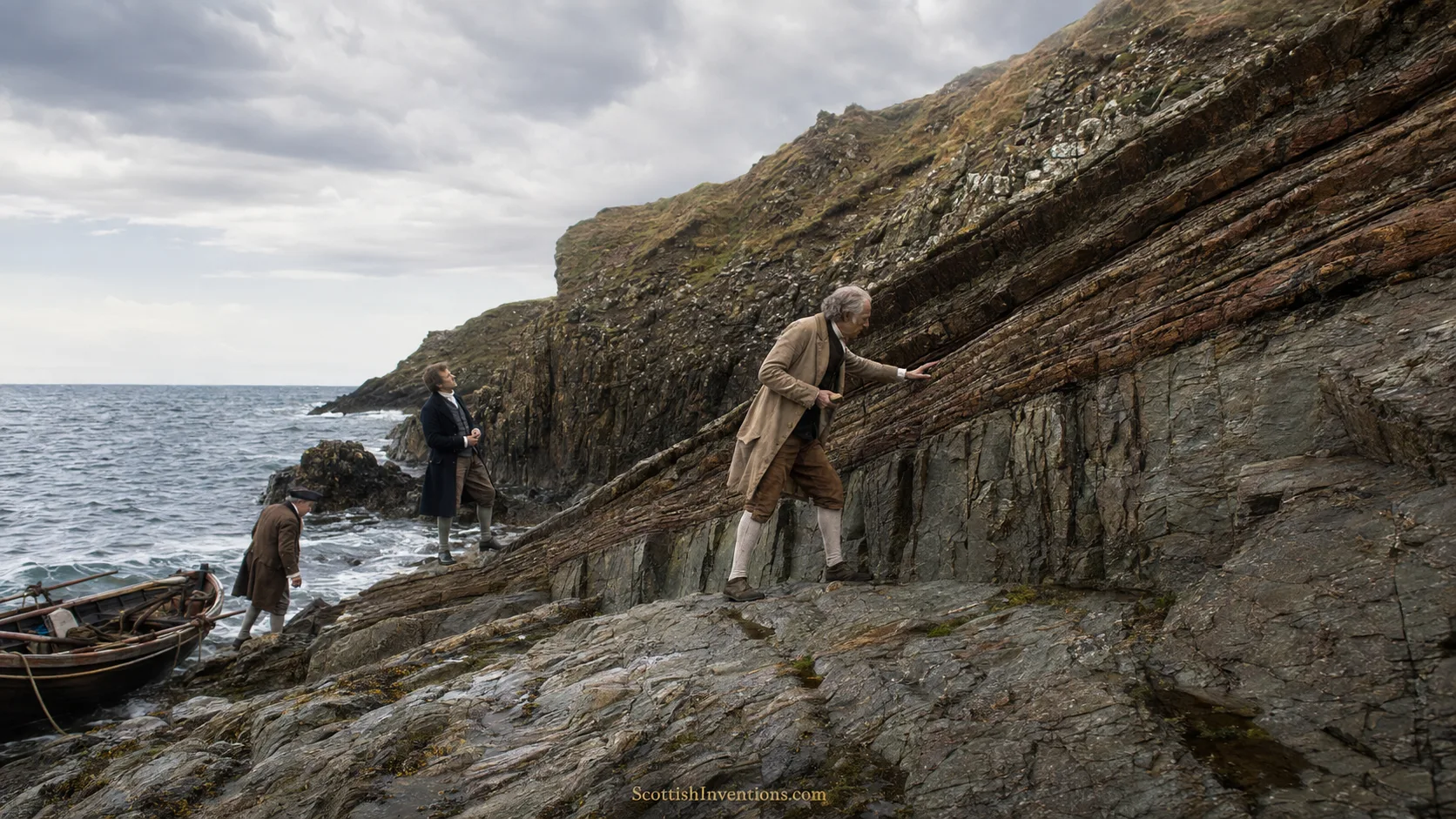
What makes Hutton a great scientist, not merely a great theorist, is that he went and found the evidence in the rocks of Scotland. In the spring of 1788, Hutton set out by boat along the Berwickshire coast with John Playfair and the geologist Sir James Hall of Dunglass, deliberately hunting for a clear exposure to prove his theory. At Siccar Point, a rocky promontory southeast of Cockburnspath, they found it. In Hutton's own words:
“Having taken boat at Dunglass burn, we set out to explore the coast; at Siccar Point, we found a beautiful picture of this junction washed bare by the sea. The sand-stone strata are partly washed away, and partly remaining upon the ends of the vertical schistus.”
Siccar Point is a textbook angular unconformity: steeply tilted, near-vertical layers of older grey greywacke — Silurian rock laid down on the floor of the ancient Iapetus Ocean about 435 million years ago — are overlain by gently sloping, almost horizontal layers of younger Upper Devonian Old Red Sandstone, formed in desert conditions roughly 370 million years ago. The only way such a junction could form was through an enormous sequence of events spanning immense time: the older rocks had to be deposited on the sea floor, hardened, folded and tilted to the vertical, uplifted, and eroded flat — before the younger sandstones were laid down on top and the whole thing raised again. The Edinburgh Geological Society's Siccar Point leaflet puts the missing interval starkly: the two sets of rock are “separated by a gap of 65 million years during which time the older rocks were changed and eroded”.
It was Playfair who left the immortal description of the day, writing in 1802 that “the mind seemed to grow giddy by looking so far into the abyss of time”.
Honest note
Glen Tilt and the Granite
Three years earlier, in the autumn of 1785, Hutton had visited Glen Tilt in the Highlands, on the Duke of Atholl's estate, accompanied by the artist John Clerk of Eldin. At the Dail-an-eas Bridge he found red granite veins penetrating and breaking through the older grey schists — proof that the granite had been molten and injected, under pressure, into cracks in pre-existing rock.
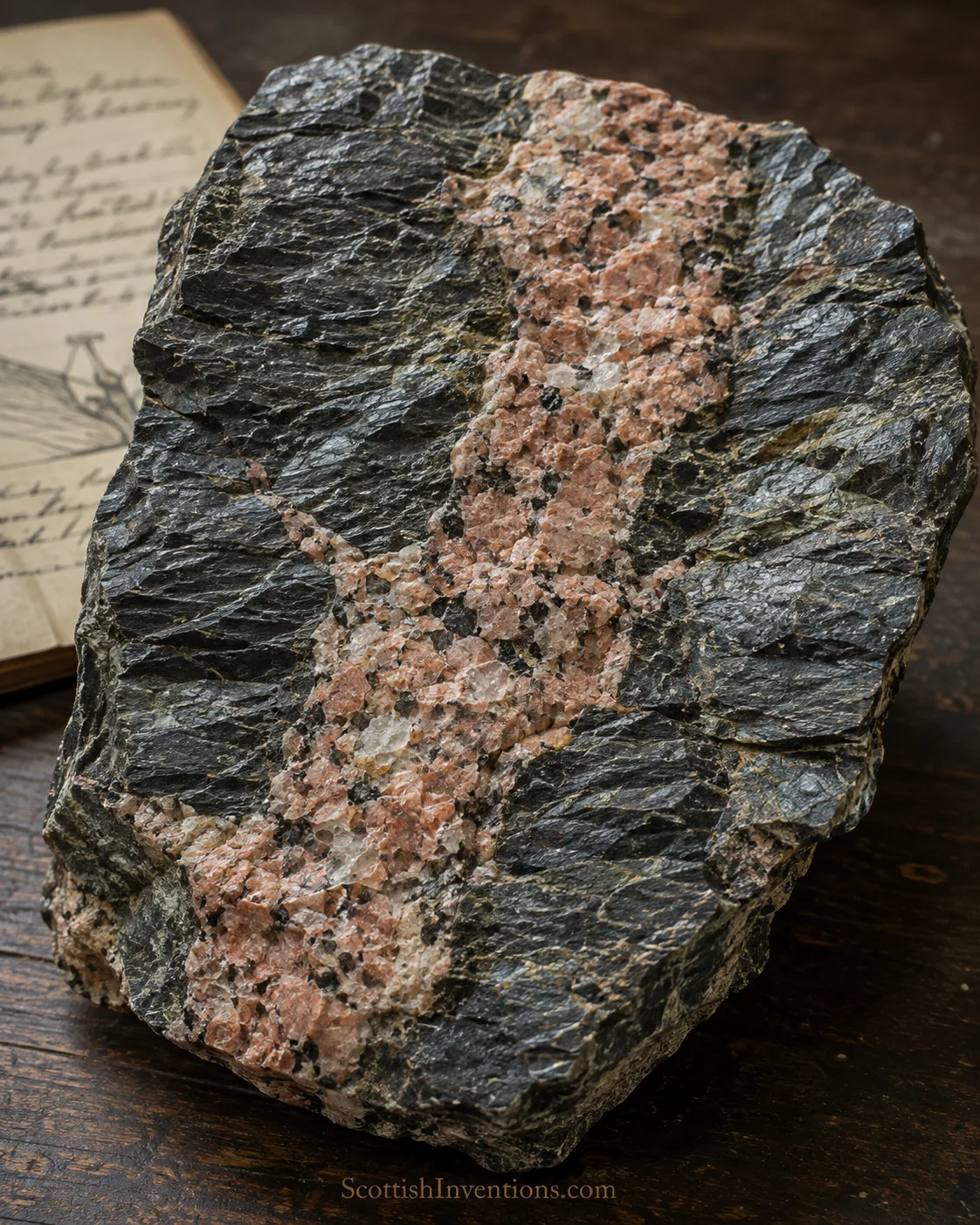
This directly contradicted the Neptunist claim that granite was the oldest, primeval rock precipitated from the sea. Hutton found further confirmation at Salisbury Crags in Edinburgh — now known as “Hutton's Section” — on the Isle of Arran (1787), and in Galloway (1786). He also identified earlier unconformities: at Lochranza on Arran, and a celebrated one at Inchbonny, Jedburgh, in 1787, of which he wrote that he “rejoiced at my good fortune in stumbling upon an object so interesting”. His method — patient, meticulous fieldwork married to bold theoretical synthesis — was itself a novelty.
Publication and Reception
Hutton's theory was first read to the Royal Society of Edinburgh in two parts: the first by his friend Joseph Black on 7 March 1785 (Hutton being unwell), and the second by Hutton himself on 4 April 1785. It was published in 1788 in the Society's Transactions under the full title “Theory of the Earth; or an Investigation of the Laws observable in the Composition, Dissolution, and Restoration of Land upon the Globe.” Following criticism — notably from Richard Kirwan, who branded Hutton's ideas atheistic — Hutton expanded the work into a two-volume book, Theory of the Earth, with Proofs and Illustrations (1795). A third volume remained unfinished at his death and was not published until 1899, when Sir Archibald Geikie edited it for the Geological Society of London from the surviving manuscript.
The reception was muted, and the reason was largely Hutton's prose. His writing was dense, repetitive and notoriously hard to read; even Playfair conceded that “the great size of the book, and the obscurity which may justly be objected to many parts of it, have probably prevented it from being received as it deserves”. The rescue came from John Playfair, a mathematician and gifted writer, who in 1802 — five years after Hutton's death — published Illustrations of the Huttonian Theory of the Earth. Clear, elegant and persuasive, it laid out the theory, the evidence and the counter-arguments in a way readers could actually follow. Playfair's book did far more to spread Huttonian ideas than anything Hutton himself wrote, and it is the chief reason Hutton's reputation survived.
Charles Lyell and the Principles of Geology
Hutton established deep time. Charles Lyell (1797–1875) is why the rest of science accepted it. Born at Kinnordy House in Angus in the year Hutton died, Lyell read law at Oxford, was called to the bar, and abandoned the profession as his eyesight and his interests both pushed him towards geology. He had absorbed Hutton at second hand — through John Playfair's Illustrations of 1802 rather than Hutton's own near-unreadable volumes — and he set out to do for the theory what Playfair had done for the prose, on a far larger scale.
The result was Principles of Geology, published in three volumes between 1830 and 1833 and subtitled “an attempt to explain the former changes of the Earth's surface by reference to causes now in operation”. That subtitle is the whole argument. Lyell's rule was methodological: a geologist may appeal only to processes that can be observed acting today, at intensities that can be observed today, and must then allow however much time the evidence demands. Volcanoes, earthquakes, erosion, deposition, slow uplift and subsidence — given long enough, these suffice. Nothing supernatural, nothing unrepeatable, no deluge.
What made the Principles overwhelming was not the philosophy but the fieldwork behind it. Lyell had walked the ground: the Auvergne volcanoes of central France, the Italian Apennines, Etna, and above all the Roman “Temple of Serapis” at Pozzuoli, whose marble columns are bored by marine molluscs several metres above their bases. Those borings proved the ground had sunk beneath the sea and risen again within historical time, without catastrophe. He put an engraving of the columns on the title page of every edition — the single most effective piece of scientific illustration of the century.
He also gave geology a working clock. By counting what proportion of fossil molluscan species in a Tertiary deposit were still living, Lyell produced a relative dating scheme and, with William Whewell's help on the Greek, the epoch names still in use: Eocene, Miocene and Pliocene, with Pleistocene added in 1839. Elements of Geology (1838) turned all of it into the first genuinely modern textbook, and the Principles itself ran to twelve editions in his lifetime, each revised.
Two honest qualifications belong here. First, the word: “uniformitarianism” is Whewell's, not Lyell's — coined in 1832 in an anonymous review of the Principles, and coined partly as criticism. Second, the doctrine: Lyell's insistence that rates of change have always been roughly constant went further than the evidence, and modern geology has walked it back. Asteroid impact, flood basalt eruption and catastrophic glacial outburst floods are now accepted as real and rapid. The current position is neither Lyell's strict gradualism nor the old catastrophism, but actualism: the same physical laws throughout, at whatever rate the evidence requires. Lyell also came late to evolution, conceding it only in The Antiquity of Man (1863), four years after the Origin of Species — a caution his friend Darwin found frustrating.
None of that diminishes the achievement. Hutton saw further than anyone had; Lyell built the road that let everyone else follow.
Claim status — Lyell section
Shared attribution / extension, not discovery
Lyell did not discover deep time or originate uniformitarian reasoning; Hutton did, and Playfair transmitted it. Lyell's distinct contributions are the evidential case, the Tertiary epoch nomenclature, and the popularisation that made gradualism standard practice. The term “uniformitarianism” was coined by William Whewell, an Englishman, in 1832.
Hutton, Lyell and Darwin
The chain of influence runs directly from Edinburgh to the foundations of modern biology. The Scottish geologist Charles Lyell built on and systematised Hutton's uniformitarian principles in his hugely influential Principles of Geology (1830–33), the most important geological work of the 19th century. The young Charles Darwin carried the first volume of Lyell's Principles with him when he sailed on HMS Beagle in December 1831, and received the later volumes during the voyage (1831–1836). Lyell taught Darwin to see the Earth as ancient and slowly changing — and Darwin's theory of evolution by natural selection absolutely required that vastness of time. Gradual change, accumulating tiny advantage upon tiny advantage, only works if there are millions upon millions of years to work in. Without Hutton's deep time — transmitted through Lyell — Darwin could not have conceived evolution as he did. It is one of the great indirect legacies in the history of thought: Hutton enabled Lyell, who enabled Darwin.

Deep Time and Modern Geology
Hutton is rightly remembered as the “Father of Modern Geology”. The concept of deep time he pioneered now underpins not just geology but palaeontology, evolutionary biology, astronomy and cosmology. Modern science has both validated and quantified his intuition. The breakthrough came through radiometric dating: in his classic 1956 paper, “Age of Meteorites and the Earth” (Geochimica et Cosmochimica Acta, vol. 10), the geochemist Clair Patterson reported that “the most accurate method (Pb207/Pb206) gives an age of 4.55 ± 0.07 × 10⁹ yr”, using the Canyon Diablo iron meteorite, and concluded that “the age for the earth is the same as for meteorites”. This was a colossal leap: before Patterson, leading estimates had put the Earth at around 3.3 billion years old.
Today the accepted figure stands at 4.54 ± 0.05 billion years. That is vastly older than even Hutton dared to imagine; he declined to put any number on it at all. But his fundamental insight — gradual processes, immense timescales, no supernatural catastrophe required — was exactly correct. The rock cycle he first described remains a core part of how geology is taught today.
Honours, Memorials and Recognition
Siccar Point is now a place of scientific pilgrimage, visited by geologists and students from around the world; it was designated a Site of Special Scientific Interest in 1961. The Edinburgh-based geologist Angus Miller of Geowalks describes it as “world-famous as the most important unconformity described by James Hutton (1726–1797) in support of his world-changing ideas on the origin and age of the Earth”. It sits on private farmland on the Berwickshire coast, reached on foot, with a steep and slippery descent to the rocks themselves; check current NatureScot and landowner guidance before visiting.
In Edinburgh, Hutton's grave in Greyfriars Kirkyard — in the Balfour family vault in the Covenanters' Prison section — remained unmarked until 1947, when, on the 150th anniversary of his death, a memorial plaque was unveiled. A James Hutton Memorial Garden, on the site of his former home at St John's Hill, contains boulders showing the granite veins of Glen Tilt and rocks illustrating the rock cycle. The modern James Hutton Institute, formed in 2011 from the merger of the Macaulay Land Use Research Institute and the Scottish Crop Research Institute, carries his name as a research centre for land, crops, water and the environment, recognising both his geology and his pioneering agricultural improvement.
Why, then, is Hutton less famous than Darwin or Newton, despite a contribution of comparable magnitude? In his biography The Man Who Found Time (2003), Jack Repcheck argues that Hutton lacked Darwin's genius for self-promotion, announced his greatest ideas while the English-speaking world's attention was fixed on the American Revolution, and — plainly put — “was not a gifted communicator”. His magnum opus was a jumble of formulas and learned quotation, hard to slog through and printed in a tiny edition. And because Lyell's later, far more readable synthesis came to be associated with uniformitarianism in the public mind, the science was popularised under other names. But the discovery was Hutton's.
Timeline
1650
Ussher's Annales Veteris Testamenti dates creation to 4004 BC
The young-Earth chronology Hutton's evidence would overturn
1726
James Hutton born in Edinburgh, 3 June (Old Style)
Son of a merchant and City Treasurer
1749
Takes his MD at the University of Leiden
He never practises medicine
1750s
Farms Slighhouses in Berwickshire for about fourteen years
Watching soil erode begins his interest in how land is made and destroyed
c. 1767–68
Returns to Edinburgh, financially independent from the sal ammoniac works
Free to pursue science full-time; founds the Oyster Club with Black and Smith
1785
Theory of the Earth read to the Royal Society of Edinburgh
Part one read by Joseph Black on 7 March; part two by Hutton on 4 April
Autumn 1785
Glen Tilt: granite veins cutting older schist
Evidence that granite had been molten and injected — against Neptunism
1786–1787
Further confirmation in Galloway, Arran and at Jedburgh
Unconformities at Lochranza and Inchbonny
1788
Theory of the Earth published in the Society's Transactions
“We find no vestige of a beginning, no prospect of an end”
Spring 1788
Siccar Point, by boat with Playfair and Sir James Hall
The angular unconformity that made deep time visible
1795
Theory of the Earth, with Proofs and Illustrations, two volumes
Expanded after Richard Kirwan's charge of atheism
1797
Hutton dies in Edinburgh, 26 March; buried in Greyfriars Kirkyard
His grave stays unmarked until 1947
1802
Playfair publishes Illustrations of the Huttonian Theory of the Earth
“The mind seemed to grow giddy by looking so far into the abyss of time”
1830–33
Charles Lyell's Principles of Geology
Systematises Huttonian gradualism for the 19th century
1831
Lyell appointed Professor of Geology at King's College London
The Principles, not the chair, carries his influence
1832
Volume two of the Principles published
Contains the sustained critique of Lamarck that Darwin read at sea
1833
Volume three completes the Principles; the Pleistocene and other epoch names introduced
Lyell's statistical dating of Tertiary strata by molluscan species
1832
William Whewell coins the word “uniformitarianism”
The label is Whewell's, not Hutton's
1838
Lyell's Elements of Geology, the first modern geological textbook
Gradualism becomes the default teaching position
1863
Lyell's Antiquity of Man
He accepts evolution late and cautiously, decades after championing deep time
1956
Clair Patterson dates the Earth from meteorites
4.55 ± 0.07 × 10⁹ years — Hutton's intuition quantified
Did You Know?
- Hutton's concept of deep time was essential for Darwin's theory of evolution to work — gradual change needs millions of years.
- Siccar Point's spectacular unconformity can still be visited today on the Berwickshire coast.
- Hutton's own writing was so difficult that his friend John Playfair had to effectively translate it for the public in 1802, after Hutton's death.
- “We find no vestige of a beginning, no prospect of an end” — one of the most famous lines in the history of science.
- Before turning to geology full-time, Hutton co-ran a successful chemical-manufacturing business making sal ammoniac from coal soot.
- The Earth is now known to be 4.54 billion years old — far older than anyone before Hutton dared imagine, yet his core insight was right.
Honest Caveats
“The present is the key to the past.” This maxim is routinely attributed to Hutton (and sometimes to Lyell), but the exact phrase appears to have been coined a century later by Sir Archibald Geikie, who used it in The Founders of Geology (1897) to describe Hutton's philosophy: “The dominant idea in his philosophy is that the present is the key to the past.” Hutton never wrote those words himself.
He did not coin “uniformitarianism”. William Whewell did, in 1832, thirty-five years after Hutton's death.
Old Style dating. Hutton's birth date, 3 June 1726, is recorded in the Old Style (Julian) calendar then in use in Scotland.
The 65-million-year gap at Siccar Point is a modern figure derived from absolute dating (Silurian greywacke c. 435 million years; Upper Devonian sandstone c. 370 million years) that Hutton could not have calculated. He understood only that the interval was immense, and he never proposed an age for the Earth.
Precedents. Hutton was not the first to notice unconformities or to speculate about an old Earth — Steno, de Saussure, Buffon and others contributed. It was Hutton who synthesised the observations into a coherent, evidence-based theory of a cyclic, self-renewing Earth, which is why he above all is credited as the founder of modern geology.
Frequently Asked Questions
Who was James Hutton?
James Hutton (1726–1797) was an Edinburgh-born farmer, chemical manufacturer, physician by training and naturalist who established that the Earth is shaped by slow, continuous processes over immense spans of time. He is known as the Father of Modern Geology. He presented his Theory of the Earth to the Royal Society of Edinburgh in 1785 and published it in 1788.
What is deep time?
Deep time is the concept that Earth's history spans almost unimaginably vast periods — far beyond human or historical timescales. Hutton argued that because the processes we can watch today (erosion, sedimentation, volcanic activity, uplift) work slowly, the rock record they produced must represent enormous stretches of time. He put no number on it; modern radiometric dating gives the Earth an age of 4.54 ± 0.05 billion years.
What is an angular unconformity?
An unconformity is a gap in the rock record. An angular unconformity is one where older layers were tilted or folded and then eroded flat before younger, near-horizontal layers were deposited on top of them. The angle between the two sets of beds records an entire lost sequence of deposition, hardening, tilting, uplift and erosion.
Why is Siccar Point important?
At Siccar Point on the Berwickshire coast, visited by boat with John Playfair and Sir James Hall in the spring of 1788, near-vertical Silurian greywacke (about 435 million years old) is overlain by gently dipping Upper Devonian Old Red Sandstone (about 370 million years old). The junction can only be explained by an immense sequence of events, which is why Hutton took it as decisive field proof of deep time.
What did Glen Tilt prove?
In autumn 1785 at the Dail-an-eas Bridge in Glen Tilt, Hutton found red granite veins penetrating older grey schist. That relationship showed the granite had been molten and injected under pressure into pre-existing rock, contradicting the Neptunist claim that granite was the oldest rock, precipitated from a primordial ocean. It supported his Plutonist theory of an internally hot, dynamic Earth.
Did James Hutton invent the word “uniformitarianism”?
No. The term was coined in 1832 by the Cambridge polymath William Whewell, in an anonymous review of Charles Lyell's Principles of Geology, to name the gradualist view and contrast it with catastrophism. Hutton established the idea; Whewell supplied the label, thirty-five years after Hutton's death.
Did Hutton say “the present is the key to the past”?
There is no evidence that he did. The phrase is routinely attributed to him, but it appears to originate with Sir Archibald Geikie, who used it in The Founders of Geology (1897) to describe Hutton's philosophy: “The dominant idea in his philosophy is that the present is the key to the past.” It is a fair summary of Hutton's thinking, but it is not a Hutton quotation.
How did Hutton influence Charles Darwin?
Indirectly, through Charles Lyell. Lyell built on and systematised Hutton's gradualism in Principles of Geology (1830–33). Darwin carried the first volume aboard HMS Beagle in December 1831 and received the later volumes during the 1831–1836 voyage. Evolution by natural selection needs immense timescales to work, so Hutton's deep time — transmitted through Lyell — was a precondition for Darwin's theory.
What did Charles Lyell actually add to Hutton's theory?
Lyell (1797–1875), born at Kinnordy in Angus, did not discover deep time — Hutton had established it forty years earlier. What Lyell supplied was evidence, method and reach: three volumes of Principles of Geology (1830–33) marshalling field observation from Italy, Sicily and France; a statistical method for dating Tertiary strata by the proportion of still-living molluscan species, which gave geology the epoch names Eocene, Miocene and Pliocene; and prose readable enough to make gradualism the working assumption of an entire discipline. Hutton had the insight; Lyell made it the profession's operating system.
Did Lyell coin “the present is the key to the past”?
No. Neither Hutton nor Lyell wrote that sentence. The formulation appears to originate with Sir Archibald Geikie in The Founders of Geology (1897). It does fairly summarise Lyell's method — he insisted that geologists explain the past only by causes “now in operation” — but it is a later paraphrase, not a quotation from either man.
Was Lyell right about everything?
No, and the article says so. Lyell's strict uniformitarianism denied any role for genuinely catastrophic events, a position modern geology has abandoned: the Chicxulub impact, mega-floods and flood basalts are now accepted as real, rapid agents of change. He also resisted evolution for decades, only conceding it publicly in The Antiquity of Man (1863), four years after Darwin's Origin. His gradualism was a corrective that overcorrected.
Sources & Further Reading
Tier 1 · Primary
- Hutton, J. — “Theory of the Earth,” Transactions of the Royal Society of Edinburgh, vol. I, 1788.
- Hutton, J. — Theory of the Earth, with Proofs and Illustrations, 2 vols., Edinburgh, 1795.
- Playfair, J. — Illustrations of the Huttonian Theory of the Earth, Edinburgh, 1802.
- Lyell, C. — Principles of Geology, 3 vols., London, 1830–33.
- Geikie, A. — The Founders of Geology, London, 1897.
Tier 2 · Scholarly and institutional
- Patterson, C. — “Age of Meteorites and the Earth,” Geochimica et Cosmochimica Acta, vol. 10, 1956.
- Repcheck, J. — The Man Who Found Time: James Hutton and the Discovery of the Earth's Antiquity, 2003.
- Edinburgh Geological Society — Siccar Point site leaflet.
- NatureScot — Siccar Point Site of Special Scientific Interest (designated 1961).
- The James Hutton Institute — institutional history and naming.
Discoveries · No. 2 of 50
Deep Time joins the Discoveries series
Collector card artwork for this discovery is in production. In the meantime, explore the rest of the collection.