Discoveries · No. 36 of 50 · Medicine
James Braid and the Science of Hypnosis
A Kinross-born Manchester surgeon, a travelling Swiss mesmerist, and the eyelids that would not open — the strange evening in 1841 that turned theatrical mesmerism into the beginnings of a genuine science of the nervous system.
James Braid · 1795–1860Neurypnology published · 1843Reading time · 19 minUpdated 16 August 2026
TL;DR
- James Braid (1795–1860), a surgeon born at Ryelaw in the parish of Portmoak, Kinross-shire, transformed the theatrical spectacle of "mesmerism" into a genuine science between 1841 and 1843 — proving the trance was a real physiological state of the subject's own nervous system, not a magnetic "fluid" flowing from the operator.
- His genuine achievement was explanation and method, not discovery of the trance itself: mesmerists had induced trances for sixty years, but Braid gave the phenomenon a reproducible technique (eye-fixation) and a neurological rationale, publishing the founding text Neurypnology in 1843. Crucially — and contrary to a widespread myth — Braid coined "hypnotism" and "neuro-hypnotism," but never actually used the word "hypnosis," which is a later derivative.
- Braid was Scottish by birth and Manchester by career; his intellectual line runs through Charcot, Bernheim and the French schools to Freud, and modern clinical hypnotherapy — recognised by the BMA in 1955 and by NICE for irritable bowel syndrome — descends directly from his work.
Scottish Impact Index (SI Score)
- Global Impact
- 7/10
- Longevity
- 4/10
- Economic / Material Impact
- 4/10
- Originality / Distinctiveness
- 8/10
- Legacy (Built Upon)
- 7/10
- Recognition
- 4/10
Key Findings
- Born 19 June 1795 at Ryelaw House, parish of Portmoak, Kinross-shire; trained by apprenticeship to Leith surgeons and at Edinburgh University (1812–1814); licensed LRCS Edinburgh in 1815.
- Established in Manchester by 1828, at 67 Piccadilly, as a highly regarded surgeon specialising in orthopaedic deformities (clubfoot, squint) and eye conditions.
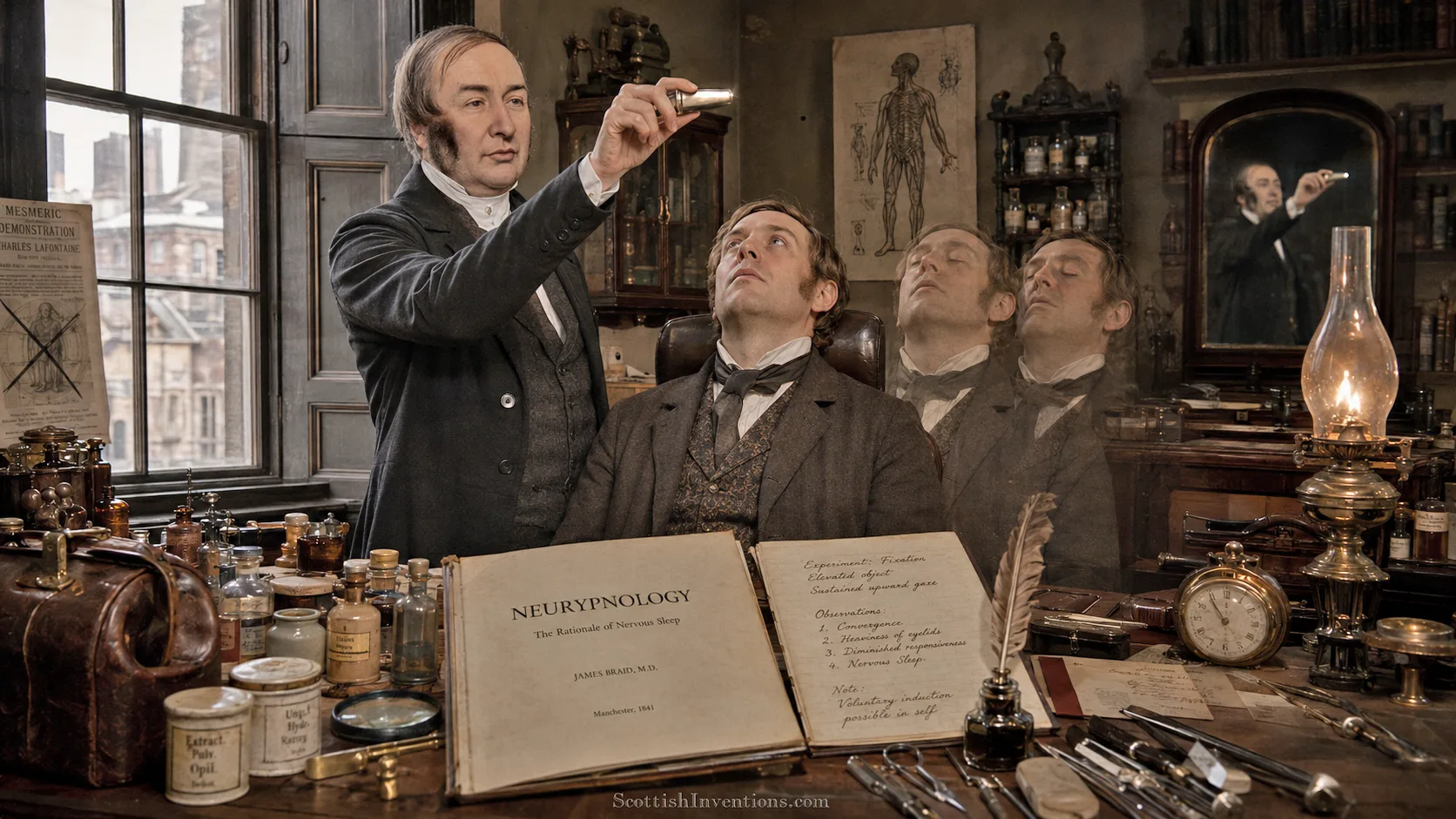
- The conversion: he attended Swiss mesmerist Charles Lafontaine's demonstration at the Manchester Athenaeum on 13 November 1841 as a sceptic; the fact that arrested him was a subject's genuine inability to open his eyelids.
- The method: fixed visual concentration on a bright object (his lancet case) held above eye level until the eyes fatigued — reproducible, teachable, and independent of any "operator."
- The book: Neurypnology; or, the Rationale of Nervous Sleep, Considered in Relation with Animal Magnetism (John Churchill, London, 1843).
- Fellow Scot James Esdaile (born Montrose, 1808) performed hundreds of operations under mesmeric trance in Bengal with dramatically reduced mortality.
- The lineage Braid → Charcot → Bernheim/Nancy → Freud is genuine; modern neuroscience confirms hypnosis produces distinct, measurable brain states.
Quick Facts
- Discovery
- That the hypnotic trance is a real physiological state generated within the subject's own nervous system, not a magnetic 'fluid' transmitted by an operator
- Year
- 1841–1843 — conversion in November 1841, founding book published 1843
- Key figure
- James Braid (1795–1860)
- Birthplace
- Ryelaw House, parish of Portmoak, Kinross-shire
- Career base
- Manchester, England, from 1828 — a respected surgeon at 67 Piccadilly
- Method
- Eye-fixation: prolonged fixed stare at a bright object (his lancet case) held above eye level until the eyes fatigued
- The book
- Neurypnology; or, the Rationale of Nervous Sleep, Considered in Relation with Animal Magnetism, published in London by John Churchill in 1843
- Terms coined by Braid
- 'Hypnotism', 'hypnotise' and 'hypnotist' — abbreviations of his 'neuro-hypnotism' and 'neurypnology'
- Term Braid did NOT coin
- 'Hypnosis' — a later derivative in wide use only from the 1880s in France, decades after Braid's death
- Conversion trigger
- Charles Lafontaine's mesmerism demonstration at the Manchester Athenaeum, 13 November 1841
- Later refinement
- 'Monoideism' — Braid's own attempted (unsuccessful) rename, recognising the state was not really sleep
- Fellow Scottish pioneer
- James Esdaile (born Montrose, 1808), who used mesmeric trance as surgical anaesthesia in Bengal
- Intellectual lineage
- Braid → Jean-Martin Charcot → Bernheim/Nancy School → Sigmund Freud
- Modern recognition
- British Medical Association, 1955; American Medical Association, 1958; NICE guidance on gut-directed hypnotherapy for IBS
- Claim status
- Established: Braid did not discover trance phenomena but gave them their first genuine scientific method and physiological explanation
A Kinross Surgeon
James Braid was born on 19 June 1795 at Ryelaw House, in the parish of Portmoak, Kinross-shire — the third son and youngest of seven children of James Braid, a landowner and farmer, and his wife Anne Suttie. A small but genuinely confusing geographical wrinkle attaches to his birthplace: because the River Leven boundary between Kinross and Fife was straightened and re-routed in the decades after his birth, the Ryelaw area was later transferred administratively to Fife, which is why some modern sources mistakenly describe him as a native of "Fifeshire." For the purposes of the historical record, Kinross- shire is correct for his 1795 birth.
He learned his trade the Scottish way: apprenticed to the Leith surgeons Thomas and Charles Anderson, and attending classes at the University of Edinburgh from 1812 to 1814. In 1815 he qualified as a Licentiate of the Royal College of Surgeons of Edinburgh. He married Margaret Mason at St Cuthbert's Church, Edinburgh, in November 1813. He then served as surgeon to Lord Hopetoun's lead mines at Leadhills, Lanarkshire, from 1816, later set up private practice, spent time at Dumfries, and by 1828 had settled in Manchester at 67 Piccadilly.
In Manchester he built a thriving surgical practice, particularly noted for correcting deformities — clubfoot, spinal curvature, knock-knees, bandy legs and squint — as well as eye conditions, drawing patients from across the kingdom. This detail matters for how this article frames him: Braid is Scottish by birth and by early training, but Manchester by career, and it is in Manchester, not Scotland, that the events that made him significant to the history of medicine actually took place. He died in Manchester on 25 March 1860, of a heart attack, aged 65.
Mesmerism Before Braid
To understand what Braid did, it helps to understand what came before him, in some detail. Franz Anton Mesmer (1734–1815) had promoted "animal magnetism" from the 1770s: the theory that an invisible universal fluid flowed through all living things, and that illness resulted from blockages in its flow, which a "magnetiser" could correct. His Paris sessions were pure theatre: patients sat around a baquet — a covered wooden tub filled with "magnetised" water, iron filings and protruding bent iron rods — linking hands, while Mesmer, in silk robes, made dramatic passes over their bodies.
In 1784, King Louis XVI appointed a Royal Commission to investigate. Its members included the American diplomat Benjamin Franklin, the chemist Antoine Lavoisier, the astronomer Jean Sylvain Bailly, and the physician Joseph-Ignace Guillotin. Using what were essentially the first blinded, sham-controlled experiments — testing "magnetised" trees and water against inert controls — they reached a devastating verdict: the effects were real, but their cause was imagination and expectation, not any magnetic fluid. This finding is now often celebrated as a founding moment of the controlled clinical trial and the study of the placebo effect. Yet mesmerism did not die — it thrived in Britain in the 1830s and 1840s as popular entertainment, touring theatres and public halls much as Charles Lafontaine's act would in Manchester in 1841.
Two precursors matter here, for honesty's sake, because they show that Braid's later insight had partial antecedents even though he was likely unaware of some of them at the time. The Marquis de Puységur, a disciple of Mesmer, discovered "artificial somnambulism" in 1784 — a lucid, sleep-like trance distinct from natural sleep. And Abbé Faria (José Custódio de Faria, 1756–1819), a Goan Catholic priest, argued in Paris in the 1810s that the trance arose from within the subject's own mind — through concentration and expectancy — not from any external fluid. Faria anticipated the direction Braid would later take, though he emphasised the subject's powers of concentration over suggestion and had little contemporary influence, in France or in Britain.
The 1841 Conversion
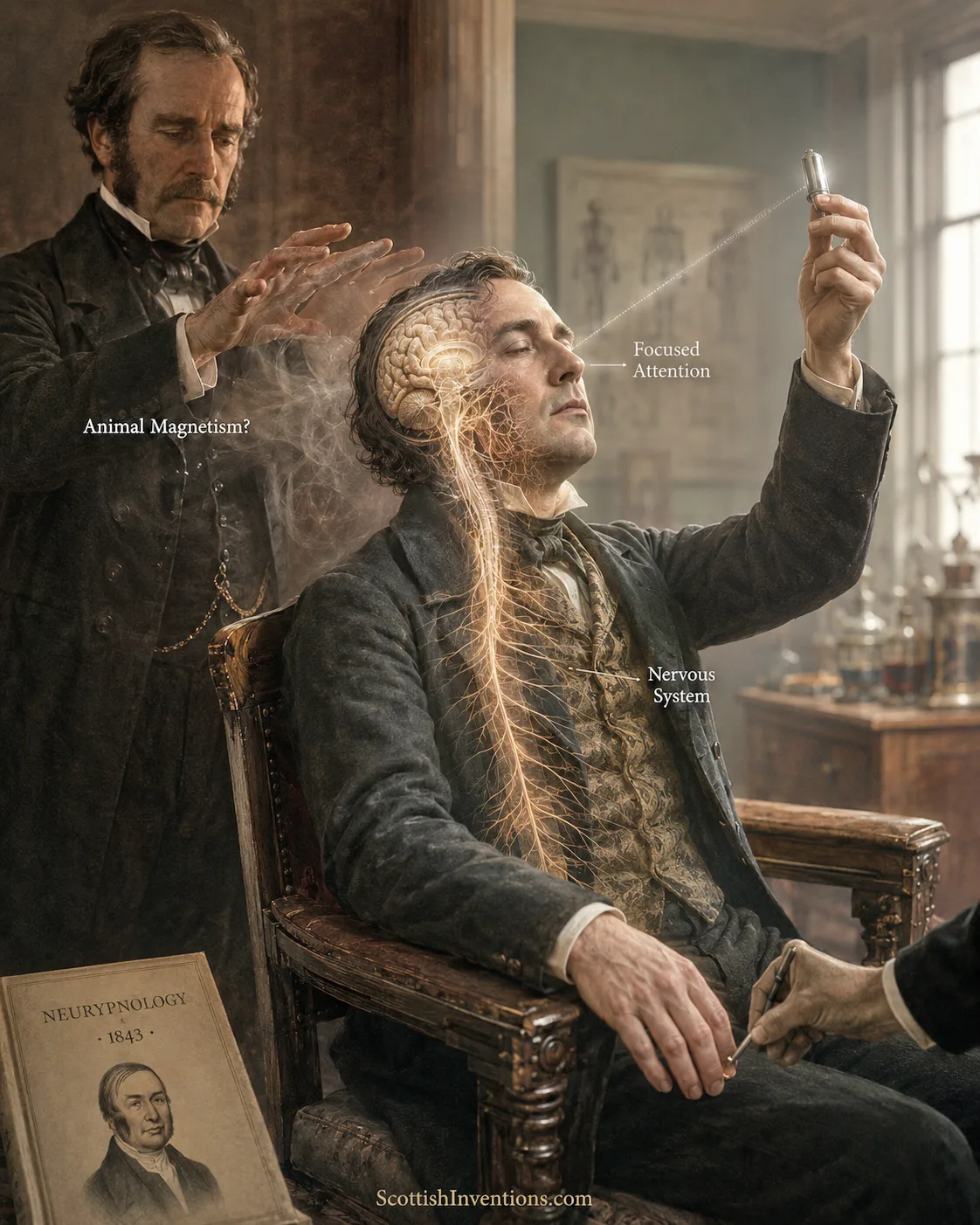
On the evening of Saturday 13 November 1841, Braid attended a demonstration of mesmerism at the Manchester Athenaeum given by the travelling Swiss mesmerist Charles Lafontaine (1803–1892), a bearded showman whose act involved rendering subjects apparently impervious to pain — shocking them with a battery or burning them with candles, seemingly without effect. Braid went as a hardened sceptic; he had already been persuaded by a four-part anonymous investigation of animal magnetism in The London Medical Gazette in 1838 that there was no evidence for any magnetic agency. Of that first night he wrote: "I saw nothing to diminish, but rather to confirm, my previous prejudices."
But he went back. At a later demonstration — six nights afterwards, by his own account — one thing arrested his attention: a mesmerised subject was genuinely unable to open his eyelids. Braid recognised this as a real physiological phenomenon and, as he put it, "was anxious to discover the physiological cause of it." That was the turning point. He immediately began experimenting — on himself, on family members and friends, and on consenting patients. Within a week he was already lecturing publicly on his own preliminary findings, a remarkably fast turnaround from sceptical audience member to independent investigator.
Braid's Key Experiments
Within days Braid had his answer, and it had nothing to do with magnetism. His method — the "eye-fixation" technique — is best given in his own words from Neurypnology:
"Take any bright object (I generally use my lancet case) between the thumb and fore and middle fingers of the left hand; hold it from about eight to fifteen inches from the eyes, at such position above the forehead as may be necessary to produce the greatest possible strain upon the eyes and eyelids, and enable the patient to maintain a steady fixed stare at the object."
The prolonged upward stare fatigued the eyes and the nervous system; the eyelids drooped; and a trance-like state followed. In his subjects Braid observed altered sensitivity to pain, changed muscle tone (catalepsy), and heightened responsiveness to suggestion. His explanation was physiological: a "nervous sleep" caused by the exhausting fixation of gaze and attention — not animal magnetism, and not the will of the operator.
The decisive point was that Braid could hypnotise himself. Since there was no operator channelling any fluid into him, the phenomenon had to originate within the subject. This was his experimentum crucis: by reversing the operator–subject relationship and treating the process as subject-internal, he demolished Lafontaine's magnetic claims with a form of Occam's razor. Just a week after the demonstration he was lecturing publicly on his own findings; within nine weeks, by his Liverpool lecture of 22 January 1842, he was reporting on the possibility of pain-free surgery. He presented his work around the British Association for the Advancement of Science's Manchester meeting in June 1842.
Braid's later theoretical refinement was monoideism: the recognition that the essential mechanism was the concentration of the mind upon a single dominant idea. By the late 1840s he had accepted that "hypnotism" was not really sleep at all, and tried to rename the state "monoideism" — but the earlier terminology had already stuck fast, and it is his original vocabulary, not his corrected later term, that survives in ordinary and clinical usage today.
Braid did investigate hypnotism as a surgical anaesthetic, and used it for pain-free procedures as early as January 1842 — more than three years before Esdaile's Indian experiments became widely known. But he was cautious; his primary interest was in hypnotism's broader therapeutic applications, and once effective chemical anaesthesia arrived he became an early advocate of ether as well.
Neurypnology (1843)
Braid's ideas were gathered in Neurypnology; or, the Rationale of Nervous Sleep, Considered in Relation with Animal Magnetism, published in London by John Churchill in 1843. It is regarded as the first book-length treatment of hypnotism. It argued that mesmeric trances were not caused by an occult fluid but were a psycho-physiological state produced by manipulating the subject's own nervous system, and it illustrated the claims with numerous case studies. The book sold well: according to Braid himself (and later his biographer John Milne Bramwell), 800 copies had gone by November 1843, and the first edition was exhausted by 1846.
Here the accuracy-conscious reader must tread carefully, and this is the single most important correction this article makes. Braid coined the English terms "hypnotism," "hypnotise" and "hypnotist" — as abbreviations of his "neuro-hypnotism" and "neurypnology," from the Greek hypnos (sleep). But he did not coin the noun "hypnosis." That word is a later derivative that came into wide use through French usage in the 1880s, roughly two decades after Braid's death; the Oxford English Dictionary in fact records an isolated earlier English use (1876), and some etymologists date a first appearance earlier still — so it is safest to say simply that "hypnosis" is a later back-formation that Braid himself never once wrote.
It is also worth noting that the French magnetist Étienne Félix d'Hénin de Cuvillers had used the cognate French terms hypnotisme and hypnotique as early as 1819–1820, before Braid. But Braid used the terminology independently and, decisively, in a new physiological sense rather than an occult one. Fittingly, Braid was scrupulous about this himself: he said he had "adopted" the term, not invented it, writing to The Lancet in 1845 that "I adopted the term 'hypnotism' … to get rid of the erroneous theory about a magnetic fluid."
What Braid Actually Established
Braid's importance is not that he discovered the trance — mesmerists had induced it for sixty years — but that he studied it scientifically rather than mystically; gave it a reproducible, teachable method that did not depend on the charisma of a "magnetiser"; replaced supernatural claims with a physiological explanation; and anticipated psychosomatic medicine — the recognition that the mind can produce real, measurable changes in the body.
After Braid's death, interest in Britain waned and the centre of research shifted to France. Shortly before he died, Braid sent a manuscript to the French surgeon Étienne Eugène Azam, who introduced his ideas in France; his terms were even translated into French as braidisme. Braid's work fed directly into the great French revival of the 1880s. Jean-Martin Charcot, at the Salpêtrière in Paris, treated hypnosis as a neurological phenomenon linked to hysteria; the rival Nancy School, led by Ambroise-Auguste Liébeault and Hippolyte Bernheim, argued it was a normal phenomenon of suggestion. The two schools clashed bitterly over the mechanism. Bernheim generously acknowledged the debt to earlier pioneers, observing that "suggestion was proposed by Abbé Faria, and was applied by James Braid." A young Sigmund Freud observed Charcot's demonstrations in 1885 and studied with Bernheim and Liébeault at Nancy in 1889; he used hypnosis in his early practice before abandoning it in favour of free association and developing psychoanalysis. So a Kinross-born surgeon sits genuinely near the headwaters of depth psychology — though it would be an overstatement to say Braid "caused" psychoanalysis.
James Esdaile in Bengal
The story has a second Scottish hero. James Esdaile (1808–1859), born in Montrose, Angus, on 6 February 1808, the eldest son of a Church of Scotland minister, trained in medicine at Edinburgh (graduating around 1829–1830) and served the East India Company in Bengal. There, in the 1840s, he used "mesmeric" trance as a surgical anaesthetic. As the historian of hypnotism Alan Gauld summarised it, "Esdaile conducted hundreds of surgeries and reported a 5 percent mortality rate (other techniques had a 50 percent or higher mortality rate)" — a staggering claim in an era before antiseptics. His feats included the removal of enormous scrotal tumours, and his work drew on indigenous Indian trance-induction practitioners; his Hooghly hospital earned the nickname of the "jadoo" (magic) hospital, and the colonial government granted him an experimental mesmeric hospital in Calcutta.
Esdaile and Braid were contemporaries who differed sharply in theory. Braid respected Esdaile's results but rejected his mesmerist framework, stating flatly: "In theory I entirely differ from Dr. Esdaile. He is a Mesmerist – that is, he believes in the transmission of some peculiar occult influence from the operator to the patient." Esdaile's window was brief. Chloroform, demonstrated by yet another Scot — James Young Simpson of Edinburgh — in November 1847, offered reliable, cheap chemical anaesthesia, and mesmeric surgery quickly faded from favour. Esdaile retired to Scotland and then Sydenham, where he died in January 1859. As with Braid's own figures, Esdaile's operation counts vary across sources — 260, 261, "at least 291," or simply "hundreds" — and the honest phrasing preferred here is "hundreds," with mortality falling from roughly 50% to roughly 5%; even contemporary observers and modern historians urge that his self-reported statistics be taken "with a pinch of salt."
Modern Applications
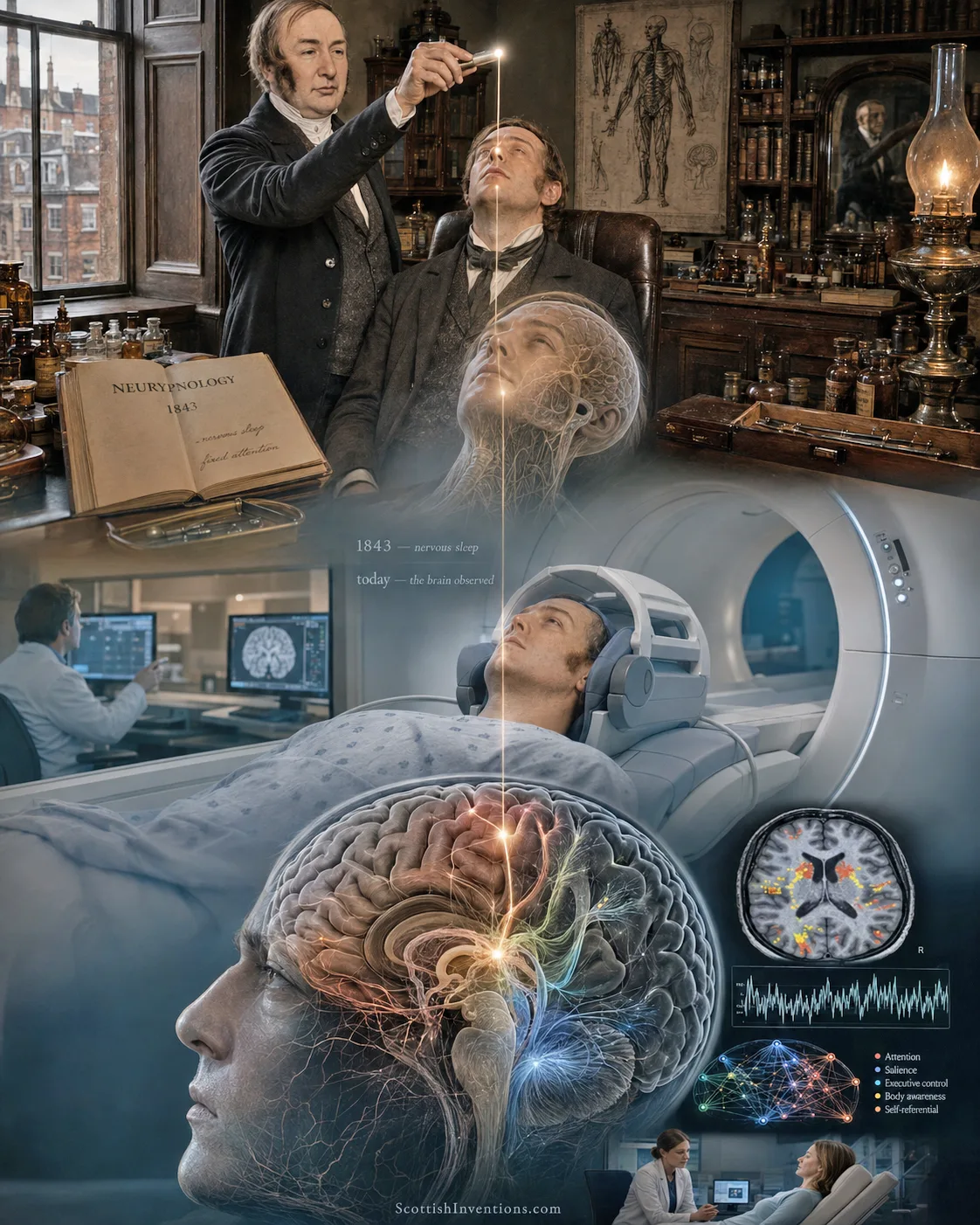
Braid's science is alive in the clinic. Modern clinical hypnotherapy has an evidence base for pain management, anxiety, phobias, smoking cessation and — most robustly — irritable bowel syndrome (IBS). In the UK, gut-directed hypnotherapy is recommended by NICE for refractory IBS. The pioneering evidence came from Professor Peter Whorwell's Manchester group — fittingly, Braid's own city: his landmark 1984 controlled trial in The Lancet found that 76% of patients with severe, refractory IBS improved with hypnotherapy, versus 35% of controls, and his later "Manchester Protocol" work reports response rates of 70–80%. Hypnosis is also used for pain relief in childbirth.
Institutional recognition has followed. The British Medical Association first examined hypnosis in 1892, and in 1955 a BMA subcommittee formally endorsed it as a legitimate therapeutic tool for psychosomatic disorders and pain, noting that "for the past hundred years there has been an abundance of evidence that psychological and physiological changes could be produced by hypnotism." The American Medical Association followed with its own endorsement in 1958, and the American Psychological Association maintains Division 30, the Society of Psychological Hypnosis. Modern neuroscience has vindicated Braid's core insight that this is a real, distinct state. The fMRI study by Heidi Jiang, David Spiegel and colleagues at Stanford (published in Cerebral Cortex in 2016), scanning 57 subjects, found that hypnosis produces characteristic changes in the brain: reduced activity in the dorsal anterior cingulate (part of the brain's "salience network"), increased connectivity between the dorsolateral prefrontal cortex and the insula, and reduced connectivity between the prefrontal cortex and the default-mode network. In other words, a Kinross surgeon's "nervous sleep" turns out to have a visible neural signature after all.
Timeline
1770s onward
Franz Anton Mesmer popularises 'animal magnetism' in Paris
Theatrical sessions around the baquet, claiming an invisible universal fluid explained illness and its cure
1784
Marquis de Puységur discovers 'artificial somnambulism'
A lucid, sleep-like trance distinct from natural sleep, deepening the mesmerist tradition
1784
Royal Commission under Louis XVI, including Franklin, Lavoisier and Guillotin, investigates Mesmer
Finds the effects real but the cause imagination, not magnetic fluid — an early landmark in controlled, blinded experiment
1810s
Abbé Faria argues in Paris that trance arises from the subject's own mind
Anticipates Braid's direction by emphasising concentration and expectancy over any external fluid, though with little contemporary influence
19 June 1795
James Braid born at Ryelaw House, parish of Portmoak, Kinross-shire
Third son and youngest of seven children of a landowner and farmer
1812–1814
Braid apprenticed to Leith surgeons and attends University of Edinburgh classes
The standard Scottish medical training route of the period
1815
Braid licensed LRCS Edinburgh
Qualifies as a surgeon
1816 onward
Braid serves as surgeon to Lord Hopetoun's lead mines at Leadhills, then private practice
Builds his early professional reputation before relocating
By 1828
Braid establishes his practice in Manchester at 67 Piccadilly
Becomes a respected surgeon specialising in orthopaedic deformities and eye conditions
13 November 1841
Braid attends Charles Lafontaine's mesmerism demonstration at the Manchester Athenaeum as a sceptic
Initially unconvinced, but returns for a later demonstration
Six nights later, November 1841
Braid observes a subject genuinely unable to open his eyelids
The single observation that converts him from sceptic to investigator
Late November–December 1841
Braid develops the eye-fixation technique and experiments on himself, family and patients
Establishes that the trance can be self-induced, disproving any operator-transmitted fluid
22 January 1842
Braid lectures in Liverpool, reporting on pain-free surgery under his technique
Just over nine weeks after his conversion
June 1842
Braid presents his findings around the British Association for the Advancement of Science's Manchester meeting
Brings his work before the wider scientific community
1843
Braid publishes Neurypnology; or, the Rationale of Nervous Sleep in London, John Churchill
The first book-length scientific treatment of hypnotism
By November 1843
800 copies of Neurypnology sold, according to Braid and his biographer John Milne Bramwell
First edition exhausted by 1846
1840s
James Esdaile performs hundreds of operations under mesmeric trance in Bengal
Reports dramatically reduced mortality compared with conventional surgery of the era
1845
Braid writes to The Lancet explaining he 'adopted' the term hypnotism
Clarifies his own scrupulous account of the terminology's purpose
November 1847
James Young Simpson of Edinburgh demonstrates chloroform anaesthesia
Chemical anaesthesia rapidly displaces mesmeric and hypnotic surgical anaesthesia
25 March 1860
James Braid dies in Manchester of a heart attack, aged 65
Shortly before his death he sends a manuscript to Étienne Eugène Azam in France
1880s
Charcot and the Nancy School (Bernheim, Liébeault) revive hypnosis research in France
Braid's ideas, translated as 'braidisme', feed directly into this French revival
1885 and 1889
A young Sigmund Freud observes Charcot's Salpêtrière demonstrations and studies at Nancy
Freud uses hypnosis early in his practice before developing free association and psychoanalysis
1892
The British Medical Association first formally examines hypnosis
Early institutional engagement, well before formal endorsement
1955
A BMA subcommittee formally endorses hypnosis as a legitimate therapeutic tool
Cites 'an abundance of evidence' for genuine psychological and physiological effects
1958
The American Medical Association issues its own endorsement
Follows the BMA's institutional recognition
1984
Peter Whorwell's Manchester group publishes a controlled trial of gut-directed hypnotherapy for IBS in The Lancet
Finds 76% of patients improved versus 35% of controls — fittingly, in Braid's own city
2016
Heidi Jiang, David Spiegel and colleagues publish an fMRI study of hypnosis in Cerebral Cortex
Finds measurable, distinct brain-network changes during hypnosis, vindicating Braid's core insight
Myths & Facts
Myth: James Braid coined the word 'hypnosis'.
Fact: He did not. Braid coined 'hypnotism', 'hypnotise' and 'hypnotist' as abbreviations of his own 'neuro-hypnotism' and 'neurypnology'. The noun 'hypnosis' is a later derivative that only came into wide use in the 1880s, through French usage, roughly two decades after Braid's death, though isolated earlier English usage is recorded. Braid never wrote the word 'hypnosis' himself.
Myth: Braid discovered the hypnotic trance.
Fact: Mesmerists had been inducing trance-like states for around sixty years before Braid took an interest in 1841. His genuine contribution was to explain the phenomenon scientifically — as a real state of the subject's own nervous system rather than a magnetic fluid — and to give it a reproducible, teachable method, not to discover the trance itself.
Myth: Braid's discovery happened in Scotland.
Fact: It did not. Braid was born in Kinross-shire and trained in Edinburgh, but by 1828 he had settled permanently in Manchester, England, and it was there, at the Manchester Athenaeum in 1841, that his conversion and all his subsequent experiments took place. He is best described as Scottish by birth, Manchester by career — and this article states that plainly rather than implying a Scottish setting for the discovery itself.
Myth: Neurypnology was published in Manchester in 1841.
Fact: It was published in London, by the publisher John Churchill, in 1843. The year 1841 refers instead to Charles Lafontaine's mesmerism demonstration that converted Braid from sceptic to investigator — a distinct and earlier date that is often mistakenly merged with the book's publication.
Myth: Braid believed in animal magnetism, just with a different name.
Fact: The opposite is true. Braid's entire scientific project was to demolish the animal-magnetism theory of an occult fluid transmitted from operator to subject, and to replace it with a physiological explanation located entirely within the subject's own nervous system. He demonstrated this decisively by hypnotising himself, with no operator present at all.
Myth: Esdaile's mortality statistics from Bengal are a solid, verified scientific record.
Fact: They should be treated with some caution. Esdaile's figures for reduced mortality under mesmeric surgical anaesthesia were self-reported in a colonial context without modern trial standards, and modern historians of medicine advise taking such statistics 'with a pinch of salt', even while acknowledging that his broader claim of dramatically improved surgical survival is very likely to have some real basis.
Did You Know?
- Braid attended his first mesmerism demonstration intending to expose fraud — and left convinced something real was happening, but for entirely different reasons than the mesmerists claimed.
- He coined 'hypnotism' from the Greek for sleep — then realised it wasn't really sleep, and tried (unsuccessfully) to rename it 'monoideism.' Despite the myth, he never used the word 'hypnosis' itself; that came later from France.
- The 1784 Franklin–Lavoisier commission debunked Mesmer's theory but proved the effects were real — Braid was the first to explain what those real effects actually were.
- Fellow Scot James Esdaile, born in Montrose, performed hundreds of operations in India under mesmeric trance, reporting mortality of about 5% against the 50%-plus of conventional surgery of the era.
- The chain from Braid → Charcot → Bernheim → Freud means a Kinross-born surgeon played a genuine role in the intellectual origins of psychoanalysis.
- Hypnosis is now recognised by the British Medical Association, the American Medical Association and the American Psychological Association as a legitimate clinical tool.
- Braid's own decisive proof against animal magnetism was simple: he could hypnotise himself, with no operator present at all.
Honest Caveats
Braid did not discover the trance. Mesmer, Puységur and Abbé Faria all preceded him by decades; his contribution was scientific explanation and reproducible method, not the initial phenomenon.
Braid coined "hypnotism," not "hypnosis." This is the most important correction in this article. The noun "hypnosis" is a later derivative that entered wide use through French usage in the 1880s, roughly two decades after Braid's death; he never wrote the word himself. It is safest to describe it as a later back-formation rather than crediting a single coiner, since sources disagree on the exact first date (the OED cites 1876; others suggest the 1850s or the 1880s in France).
Neurypnology was published in London by John Churchill in 1843 — not Manchester, not 1841. 1841 is the year of the Lafontaine demonstration that converted Braid; the book itself followed some two years later.
"Fife" versus "Kinross": both appear in sources because of a nineteenth-century boundary change; Kinross-shire is correct for Braid's birth in 1795.
Esdaile's operation counts vary across sources (260, 261, "at least 291," or simply "hundreds"); the honest phrasing used here is "hundreds," with mortality falling from roughly 50% to roughly 5% — and even contemporary observers and modern historians urge that his self-reported statistics be taken "with a pinch of salt."
Freud's use of hypnosis was early and later abandoned; the lineage from Braid through Charcot and Bernheim to Freud is real, but should not be overstated as Braid single-handedly originating psychoanalysis.
Beware overstated web claims: many commercial hypnotherapy sites exaggerate NHS and BMA endorsement. The reliable anchors used in this article are the 1955 BMA report, the 1958 AMA report, and NICE's inclusion of gut-directed hypnotherapy in its IBS guidance.
Frequently Asked Questions
Did James Braid discover hypnosis?
He did not discover the trance phenomenon itself — mesmerists had been inducing trance-like states for roughly sixty years before Braid took an interest in 1841. What Braid genuinely established was that the trance was a real physiological state generated within the subject's own nervous system rather than a magnetic 'fluid' transmitted by an operator, and he gave it a reproducible, teachable technique (eye-fixation) and the first scientific book-length treatment. His achievement is explanation and method, not the discovery of the underlying phenomenon.
Did Braid coin the word 'hypnosis'?
No, and this is one of the most persistent myths about him. Braid coined the English terms 'hypnotism', 'hypnotise' and 'hypnotist', as abbreviations of his own 'neuro-hypnotism' and 'neurypnology'. He never used the noun 'hypnosis' in his own writing. That word is a later derivative that came into wide use through French usage in the 1880s, roughly two decades after Braid's death, though isolated earlier English usage is recorded (the Oxford English Dictionary cites 1876). It is safest to describe 'hypnosis' as a later back-formation Braid himself never wrote, rather than crediting a single coiner.
Was Braid the very first person to use terms like 'hypnotic'?
Not quite, in one narrow respect worth flagging for accuracy. The French magnetist Étienne Félix d'Hénin de Cuvillers had already used the cognate French terms hypnotisme and hypnotique as early as 1819–1820, before Braid. But Braid arrived at his English terminology independently, and crucially used it in a new physiological sense — describing a real nervous-system state — rather than d'Hénin de Cuvillers's occult framing. Braid himself was scrupulous about this, writing to The Lancet in 1845 that he had 'adopted' the term hypnotism 'to get rid of the erroneous theory about a magnetic fluid', rather than claiming to have invented the underlying idea from nothing.
What actually happened at the 1841 demonstration that changed Braid's mind?
On 13 November 1841, Braid — already a convinced sceptic of animal magnetism after reading a critical four-part investigation in The London Medical Gazette in 1838 — attended a mesmerism demonstration at the Manchester Athenaeum given by the travelling Swiss mesmerist Charles Lafontaine. His first night left him unmoved: he wrote that he 'saw nothing to diminish, but rather to confirm' his prejudices. But he returned roughly six nights later, and on that occasion observed a mesmerised subject who was genuinely unable to open his eyelids. Braid recognised this as a real physiological effect worth explaining and began experimenting immediately.
What was Braid's eye-fixation method?
In his own words from Neurypnology, the subject was to 'take any bright object... hold it from about eight to fifteen inches from the eyes, at such position above the forehead as may be necessary to produce the greatest possible strain upon the eyes and eyelids, and enable the patient to maintain a steady fixed stare at the object.' Braid himself generally used his lancet case. The prolonged, strained upward stare fatigued the eyes and the nervous system, the eyelids drooped, and a trance-like 'nervous sleep' followed — a method that required no charismatic 'operator' and could even be self-induced.
How do we know the trance wasn't caused by a magnetic fluid transmitted from an operator?
Braid's decisive piece of evidence was that he could hypnotise himself. If a magnetic fluid had to be channelled into a subject by an external operator, self-induction should have been impossible. Because Braid achieved the state without any operator at all, the phenomenon had to originate within the subject's own nervous system. He treated this as his experimentum crucis, using it to dismantle Lafontaine's magnetic-fluid claims on grounds of simple logical economy.
What is Neurypnology and why does the exact citation matter?
Neurypnology; or, the Rationale of Nervous Sleep, Considered in Relation with Animal Magnetism is Braid's founding text, published in London by the publisher John Churchill in 1843 — not in Manchester, and not in 1841. The year 1841 is frequently and mistakenly attached to the book, but 1841 is actually the date of the Lafontaine demonstration that converted Braid; the book itself followed roughly two years later, once Braid had refined his technique and theory. Getting the place and date right matters because both errors circulate widely online, and precision here is part of this collection's basic commitment to accuracy.
Did Braid use hypnotism for surgery before Esdaile?
Yes, in a limited sense. Braid reported on the possibility of pain-free surgery under his technique as early as his Liverpool lecture of 22 January 1842, more than three years before James Esdaile's large-scale Indian operations became well known. However, Braid was cautious and his primary interest lay in hypnotism's broader therapeutic applications rather than surgical anaesthesia specifically, and once effective chemical anaesthesia (ether, then chloroform) arrived, he became an early advocate of those methods instead.
Who was James Esdaile, and how does he relate to Braid?
James Esdaile (1808–1859), born in Montrose, Angus, trained in medicine at Edinburgh and worked for the East India Company in Bengal, where in the 1840s he used mesmeric trance as surgical anaesthesia in hundreds of operations, reporting mortality of roughly 5% against 50% or higher for conventional surgery of the era — figures modern historians urge should be treated with some caution given they are self-reported. Braid and Esdaile were contemporaries who differed sharply on theory: Braid respected Esdaile's surgical results but explicitly rejected his mesmerist framework, writing, 'In theory I entirely differ from Dr. Esdaile. He is a Mesmerist — that is, he believes in the transmission of some peculiar occult influence from the operator to the patient.'
Is Braid really connected to Freud and psychoanalysis?
There is a genuine documented chain, though it should not be overstated. After Braid's death, interest in hypnosis in Britain waned while the centre of research shifted to France; Braid's ideas, sent shortly before his death to the French surgeon Étienne Eugène Azam, were translated into French as 'braidisme' and fed into the 1880s revival led by Jean-Martin Charcot at the Salpêtrière and by Ambroise-Auguste Liébeault and Hippolyte Bernheim at Nancy. A young Sigmund Freud observed Charcot's demonstrations in 1885 and studied with Bernheim and Liébeault at Nancy in 1889, using hypnosis early in his practice before abandoning it for free association. So a Kinross-born surgeon sits genuinely near the headwaters of depth psychology — but it would be an overstatement to say Braid single-handedly caused psychoanalysis.
Is hypnosis recognised by mainstream medicine today?
Yes, with defined and fairly narrow evidence-based applications. The British Medical Association formally endorsed hypnosis as a legitimate therapeutic tool for psychosomatic disorders and pain in 1955, and the American Medical Association followed in 1958. In the UK today, NICE recommends gut-directed hypnotherapy for refractory irritable bowel syndrome, an application with a particularly strong evidence base going back to Peter Whorwell's 1984 Manchester trial. Hypnosis is also used in pain management, anxiety, phobia treatment, smoking cessation and pain relief in childbirth, though the strength of evidence varies across these applications.
Does modern neuroscience confirm that hypnosis is a real, distinct state?
Yes, in the sense that matters most for Braid's legacy. A 2016 fMRI study by Heidi Jiang, David Spiegel and colleagues, published in Cerebral Cortex and scanning 57 subjects, found that hypnosis produces characteristic, measurable brain changes: reduced activity in the dorsal anterior cingulate cortex (part of the brain's salience network), increased connectivity between the dorsolateral prefrontal cortex and the insula, and reduced connectivity between the prefrontal cortex and the default-mode network. This does not validate every specific claim ever made about hypnosis, but it does vindicate Braid's central 1841–43 insight: that the state he called 'nervous sleep' is a genuine, distinct physiological phenomenon rather than fraud, imagination alone, or a magnetic fluid.
Sources & Further Reading
Tier 1 · Primary
- Braid, J. — Neurypnology; or, the Rationale of Nervous Sleep, Considered in Relation with Animal Magnetism, John Churchill, London, 1843.
- Braid, J. — letter to The Lancet, 1845, on the adoption of the term "hypnotism."
- Esdaile, J. — records of mesmeric surgical anaesthesia performed in Bengal, 1840s.
Tier 2 · Scholarly and institutional
- Bramwell, J. M. — biographical and bibliographic work on James Braid.
- Gauld, A. — historical scholarship on the development of hypnotism, including Esdaile's Bengal surgeries.
- Oxford English Dictionary — etymology of "hypnosis," "hypnotism," and related terms.
- British Medical Association — 1955 subcommittee report on hypnosis as a therapeutic tool.
- Whorwell, P. et al. — controlled trial of gut-directed hypnotherapy for irritable bowel syndrome, The Lancet, 1984.
- Jiang, H., Spiegel, D. et al. — fMRI study of hypnosis, Cerebral Cortex, 2016.
- NICE — clinical guidance referencing gut-directed hypnotherapy for refractory IBS.
Tier 3 · Site source document
docs/sources/discoveries/hypnosis-neurohypnology.md— the commissioned source document underlying this article.