Discoveries · No. 27 · Medicine
The Leith Doctor Who Invented the IV Drip: Thomas Latta and Intravenous Saline Therapy
She was cold, pulseless, sunken-eyed, and by every visible sign already dead. In May 1832, in a cholera hospital in Leith, a young Scottish physician inserted a tube into her arm and injected six pints of warm salt water directly into her blood. It was the first time anyone had ever done such a thing to save a human life — and it is the direct ancestor of every IV drip running in every hospital on Earth today.
Thomas Latta · c.1796–1833Leith · EdinburghReading time · 20 minUpdated 2 August 2026

In Brief
In May 1832, during the cholera pandemic then raging through Britain, the Leith physician Dr Thomas Aitchison Latta injected a warm solution of common salt and carbonate of soda directly into the vein of a dying elderly woman — the first recorded therapeutic intravenous saline infusion in a human being. He was acting on chemistry published a few months earlier by the Irish physician William Brooke O'Shaughnessy, who had shown that cholera victims' blood had lost its water and salts but who had never treated a patient this way himself. Latta's technique saved some lives and lost others, was published in The Lancet, and then, following his own death in 1833, was almost entirely abandoned for around sixty years for want of germ theory, electrolyte chemistry and sterile technique. It was revived from the 1880s by physicians including Sydney Ringer and Rudolph Matas, and today underlies the intravenous drip and oral rehydration therapy — interventions that between them have saved several hundred million lives.
Scottish Impact Index (SI Score)
- Global Impact
- 9/10
- Longevity
- 9/10
- Economic / Material Impact
- 7/10
- Originality / Distinctiveness
- 9/10
- Legacy (Built Upon)
- 9/10
- Recognition
- 3/10
Key Facts
- Discovery
- The first therapeutic intravenous saline infusion given to a human being
- Key figure
- Dr Thomas Aitchison Latta (c.1796–1833), physician, Leith
- Born
- c. 1796, Jessfield House, near Newhaven, Edinburgh
- Died
- 19 October 1833, Leith, of tuberculosis, aged about 37
- Trained
- MD, University of Edinburgh, 1819 (thesis on scurvy)
- Precursor work
- William Brooke O'Shaughnessy (1809–1889), Irish physician-chemist — blood-chemistry analysis and proposal, The Lancet, 10 December 1831
- First infusion
- An elderly woman in the collapse stage of cholera, Leith, May 1832
- Published
- Letters to The Lancet, May–June 1832
- Reported cases
- Around 25 patients treated intravenously by Latta and colleagues in the Leith and Edinburgh series
- Aftermath
- Technique largely abandoned for roughly sixty years; revived from the 1880s by Sydney Ringer, Rudolph Matas and others
- Legacy
- The intravenous drip and oral rehydration therapy — among the most widely used interventions in world medicine
- Claim status
- Established for the first therapeutic IV saline infusion in a human patient — built on O'Shaughnessy's prior chemistry, with earlier non-therapeutic IV injection experiments by Wren and Lower predating both
The 1831–32 Pandemic
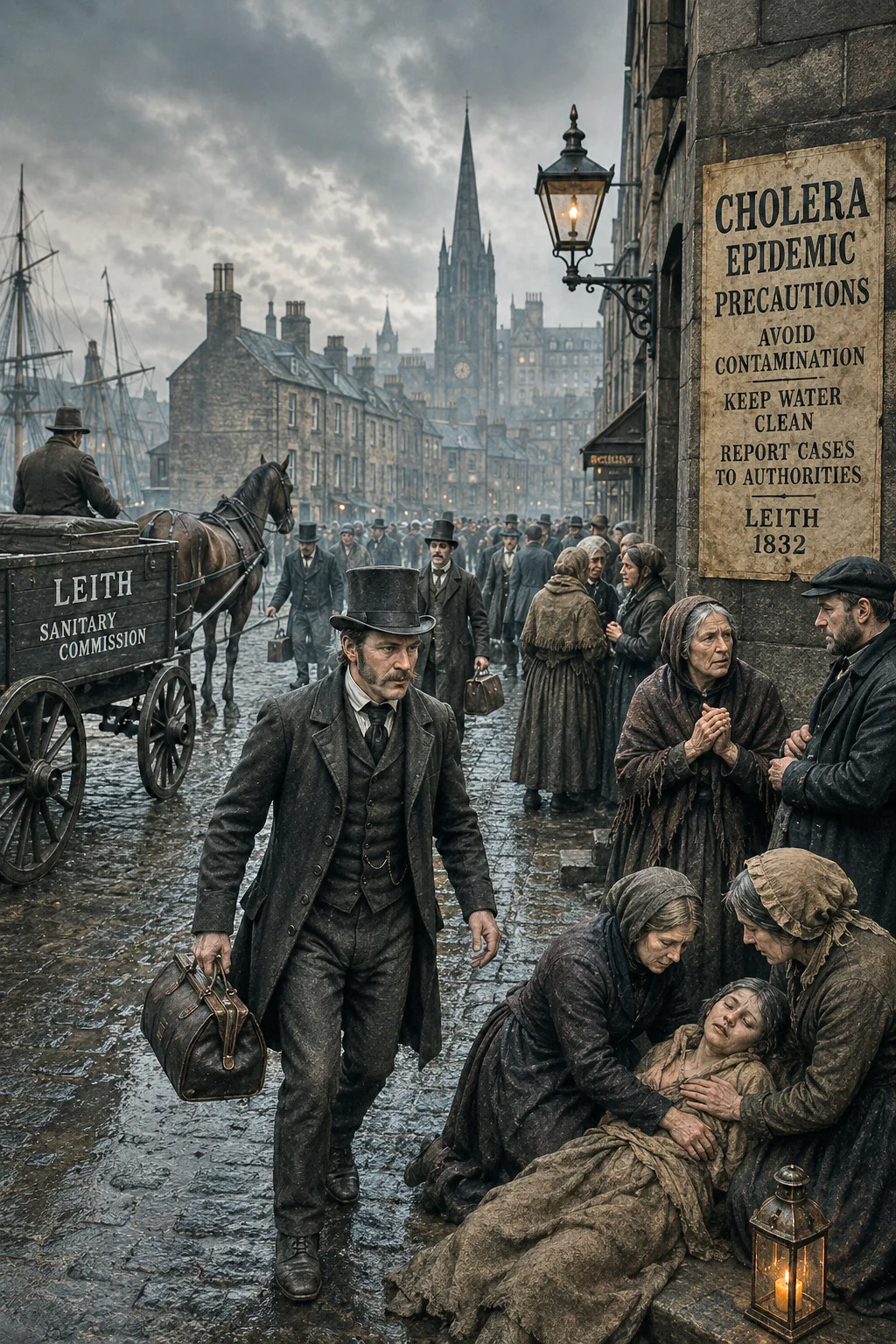
Asiatic cholera reached Britain for the first time at the port of Sunderland in October 1831, part of the second great cholera pandemic that had begun in Bengal and swept west across Asia and Europe. From Sunderland it spread north, reaching the Edinburgh and Leith area by early 1832. As a teeming North Sea port with constant shipping traffic, Leith was badly exposed.
Cholera terrifies because of the speed with which it kills. It causes torrential watery diarrhoea and vomiting; a victim can lose litres of fluid within hours, and death comes not from the infection directly but from catastrophic dehydration and the loss of the body's salts. Sufferers turned cold, shrivelled and bluish — hence the period's names for it, "blue cholera" and "the blue stage". In 1832, case-fatality among those seriously affected commonly ran to around half, and higher still in some local outbreaks.
Medicine in 1832 had no idea what caused the disease. Germ theory lay decades in the future: Pasteur's foundational work came in the 1850s and 1860s, and the cholera bacterium, Vibrio cholerae, was not isolated until Robert Koch's work in 1883. The standard treatments of the day — bleeding, opium, calomel (mercury chloride) and brandy — did nothing for the underlying fluid loss, and bleeding actively made matters worse. But one vital clue had already been noticed: the blood of cholera victims was abnormally thick and dark, as though it had lost its watery part.
O'Shaughnessy's Chemistry — Credit Where It Is Due
The man who first chased that clue systematically was William Brooke O'Shaughnessy (1809–1889), a brilliant young physician and chemist born in Limerick, Ireland, and trained in medicine at Edinburgh (MD c.1829–30). Responding to the Sunderland outbreak, O'Shaughnessy chemically analysed the blood of cholera victims and demonstrated that they had lost large quantities of water and of the blood's normal saline salts. He set out his findings and a proposed remedy in The Lancet, in a paper titled "Proposal of a New Method of Treating the Blue Epidemic Cholera by the Injection of Highly-Oxygenised Salts into the Venous System", published on 10 December 1831. His argument was that the way to rescue these patients was to restore the blood to something like its natural composition by injecting water and its usual salts directly into the veins.
This is the point at which the record needs to be stated with complete honesty, because the popular version of this story often shortchanges O'Shaughnessy. He did the essential scientific groundwork — the blood chemistry, the diagnosis of the underlying physiological problem, and the reasoned proposal for a remedy — and without it Latta would have had no theory to test. But O'Shaughnessy carried out animal experiments and made the theoretical case; he did not treat a single cholera patient intravenously himself. He soon left medicine's front line for India, where he had an entirely separate and remarkable second career as the pioneer of the electric telegraph on the subcontinent, building an experimental line near Calcutta in 1839 and later the vast trans-India telegraph network, for which he was knighted in 1856. That later achievement is real and impressive, but it should not obscure — nor be conflated with — his earlier, foundational contribution to intravenous therapy.
It was Thomas Latta, reading O'Shaughnessy's published paper in Leith, who had the nerve and the clinical judgement to put the idea into a living, dying human being. That is the precise and narrow distinction on which this whole story turns: O'Shaughnessy diagnosed the problem and proposed the cure; Latta administered it.
The First Infusion — Leith, May 1832
Latta first tried the more cautious route: giving salt solution by mouth and by enema into the bowel. For his most severely affected patients this produced, in his own words, "no permanent benefit". So, as he wrote afterwards, "I at length resolved to throw the fluid immediately into the circulation. In this, having no precedent to direct me, I proceeded with much caution."
His first subject was an elderly woman in the terminal "collapse" stage of cholera. Latta's own account, published in The Lancet, remains one of the most vivid passages in the history of medicine:
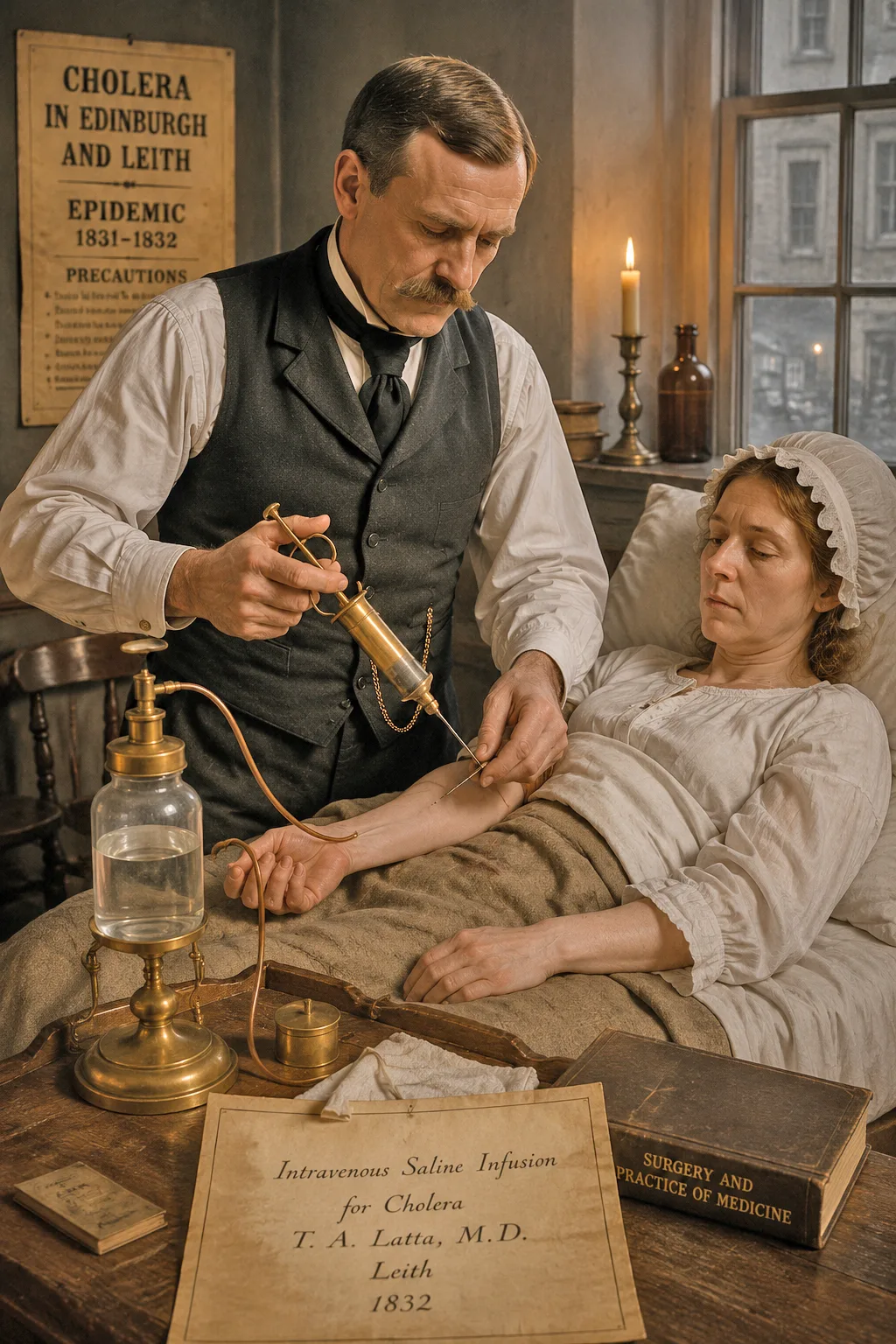
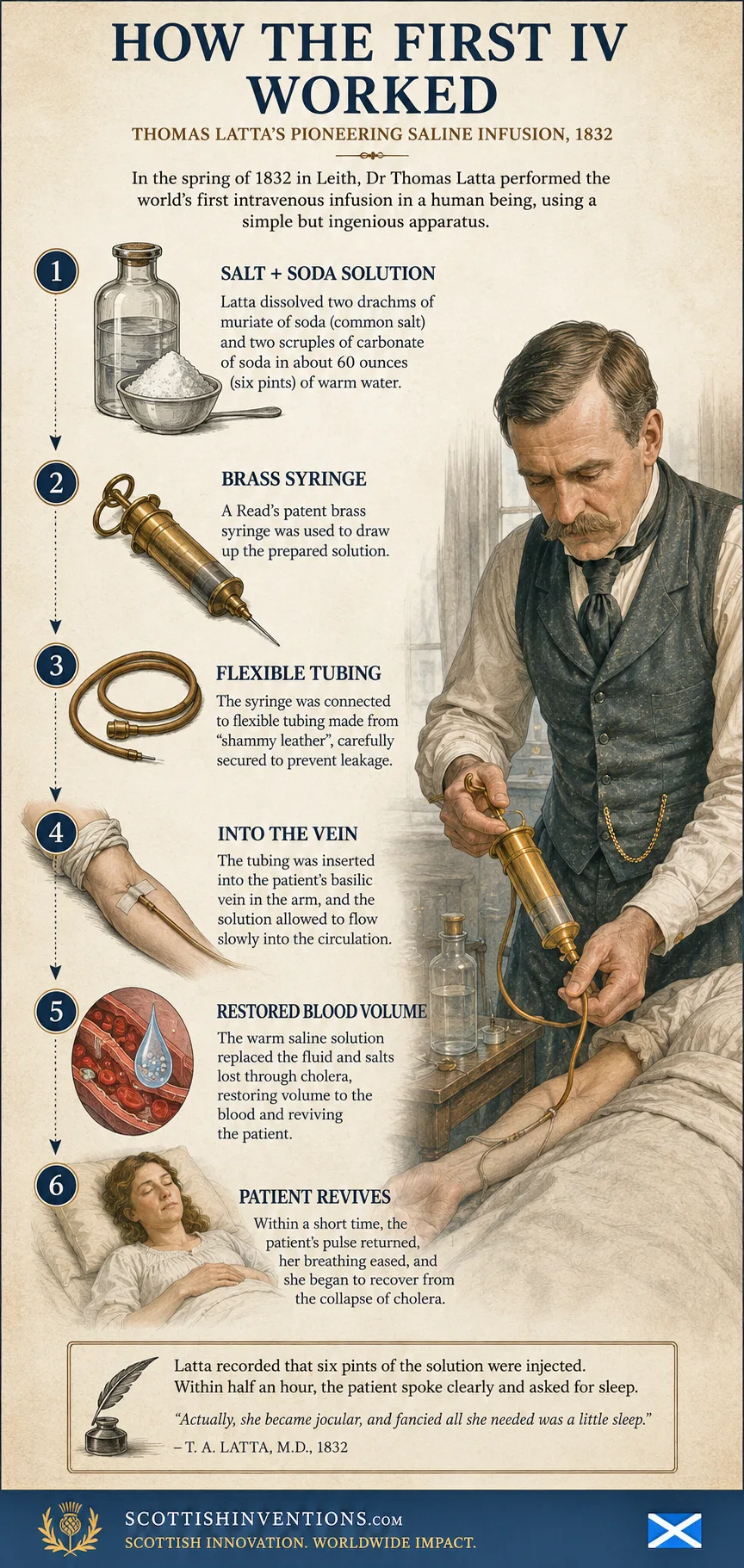
"She had apparently reached the last moments of her earthly existence… so entirely was she reduced, that I feared I should be unable to get my apparatus ready ere she expired. Having inserted a tube into the basilic vein, cautiously — anxiously, I watched the effects; ounce after ounce was injected, but no visible change was produced. Still persevering, I thought she began to breathe less laboriously; soon the sharpened features, and sunken eye, and fallen jaw, pale and cold, bearing the manifest impress of death's signet, began to glow with returning animation; the pulse, which had long ceased, returned to the wrist… and in the short space of half an hour, when six pints had been injected, she expressed in a firm voice that she was free from all uneasiness, actually became jocular, and fancied all she needed was a little sleep."
The apparatus was improvised from whatever came to hand: a Read's patent brass syringe, normally used for enemas or for pumping poisons from the stomach, connected by flexible chamois-leather ("shammy leather") tubing to a cannula inserted into the basilic vein of the arm. The solution was strained through chamois leather and given warm. The recorded composition — about two drachms of muriate of soda, or common salt, and two scruples of carbonate of soda, dissolved in around sixty ounces, or six pints, of water — is strikingly close to, though not identical with, the isotonic saline used in hospitals today.
An Honest Reckoning — Mixed Results
It matters to be candid about what happened next, because many popular retellings quietly omit it. That celebrated first patient revived dramatically — and then relapsed and died a few hours later, after Latta, exhausted, had left her in the care of the hospital surgeon. Latta himself remained convinced the underlying principle was sound, and subsequent patients in his care did recover fully.
The wider results across the Leith and Edinburgh series were genuinely mixed, and the surviving figures do not entirely agree with one another. The physician Robert Lewins reported that three of six patients treated by Latta himself recovered; he separately told the Central Board of Health that twelve of fifteen intravenously treated patients had died across the broader effort; and a tally from Edinburgh's Drummond Street cholera hospital, recorded by Mackintosh in 1836, gave 156 patients injected with 25 recovering — about sixteen per cent. That low recovery rate reflects the fact that physicians were deliberately selecting patients already at the point of death, for whom every other treatment had failed, rather than any general judgement on the treatment's effectiveness in less extreme cases. Even so, some patients who would certainly have died were saved — and the principle, not the raw statistics of a single desperate season, is what history has vindicated.
Rejection and Disappearance
Latta did not live to see his idea triumph. He died of tuberculosis on 19 October 1833 in Leith, aged about 37, the year after his breakthrough. With his death, and with the passing of the epidemic that had made the technique urgent, intravenous saline therapy fell out of use almost entirely for roughly the next sixty years.
The reasons were as much scientific as institutional. There was no germ theory, so contamination of solutions and equipment was inevitable, and infections following infusion were common and sometimes fatal. There was no understanding of electrolyte balance or osmotic pressure, so the composition of "saline" solutions varied unpredictably between practitioners, and some were dangerous. There were no sterile needles, no calibrated glass bottles, no rubber tubing of the kind used today. And the medical establishment of the 1830s, steeped in bleeding, opium and calomel, was reluctant to accept that the answer to a terrifying epidemic disease might be six pints of warm salt water injected into a vein by a brass enema syringe. The technique was, in effect, ahead of the science needed to make it safe and repeatable.
Ringer, Matas and the Slow Revival
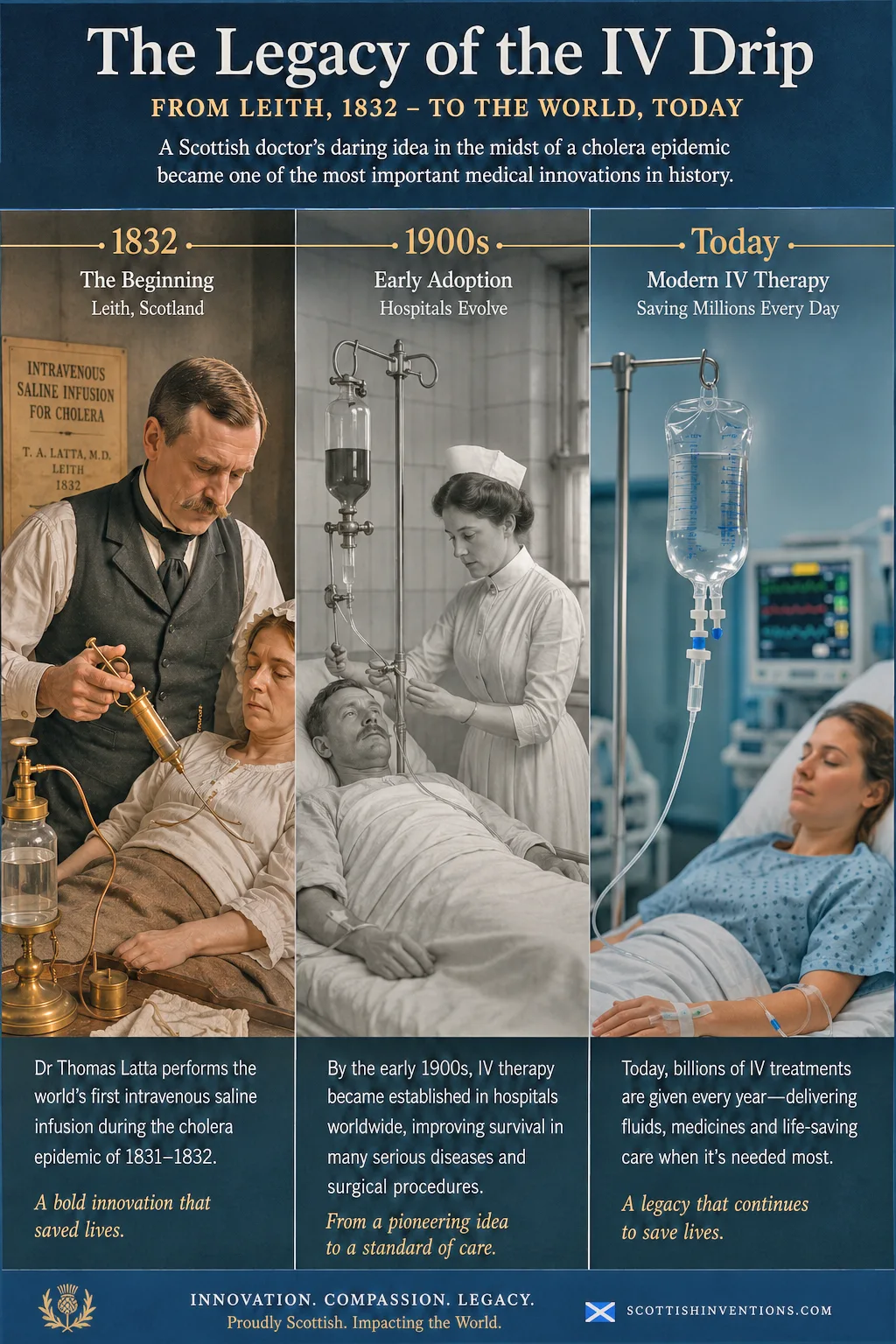
It was only from the 1880s, as germ theory took hold and as the chemistry of blood and cell fluid began to be properly understood, that intravenous therapy started to be rediscovered and rebuilt on firmer foundations. The physiologist Sydney Ringer, working at University College London, developed physiologically balanced salt solutions — the ancestor of what is still called Ringer's solution — that replaced the crude, variable salt-and-water mixes of Latta's day with chemically considered fluids matched more closely to the composition of blood plasma.
In the United States, the New Orleans surgeon Rudolph Matas is widely credited with reintroducing continuous, controlled intravenous saline infusion into mainstream surgical and medical practice from the 1890s onward, developing much of the apparatus and technique that made sustained IV therapy practical and safe on a routine basis. Neither Ringer nor Matas knew of Latta's earlier work in any direct sense; they were rebuilding the same idea independently, on ground that modern chemistry and bacteriology had finally made stable enough to build on.
The Modern Legacy
Latta has almost no memorial. There is no known portrait of him and no grave monument; even his birth year is an informed estimate, because his Presbyterian dissenting congregation did not enter births in the established Church's registers. A modest street, Latta Place, was named for him in Edinburgh only in 2014 — nearly two centuries after his breakthrough.
Yet his contribution is monumental in scale, even if his personal recognition has been modest. Every one of the countless intravenous drips running in hospitals, ambulances and operating theatres around the world today is a descendant, however many generations removed, of what Thomas Latta did with a brass enema syringe and a tube of warm salt water in Leith in 1832. The United States alone now uses well over 200 million litres of saline solution a year. Oral rehydration therapy — the low-technology cousin of Latta's intravenous method, using a simple solution of salts and sugar taken by mouth — is credited by international health bodies with helping to save tens of millions of lives, chiefly among children with diarrhoeal disease in the developing world, since it was refined and popularised in the 1960s and 1970s. Between the intravenous drip and oral rehydration, the principle Latta first proved in a Leith sickroom now touches several hundred million patients every year.
It belongs in the company of the other great Scottish contributions to medicine — James Young Simpson's chloroform anaesthesia, Joseph Lister's antiseptic surgery, the insulin work of Banting, Best, Macleod and Collip in which a Scot, John Macleod, played a leading part — and it deserves to be remembered alongside them, with its credit shared as honestly as theirs.
Myth vs Evidence
Myth: "Latta invented intravenous saline therapy from nothing."
Evidence: The essential blood chemistry and the proposal to inject salts into the veins were published a few months earlier by William Brooke O'Shaughnessy. Latta's distinct and genuine achievement was to be the first to apply that idea therapeutically to a living human patient.
Myth: "Latta's first patient recovered and lived."
Evidence: She revived dramatically within half an hour but relapsed and died some hours later, after Latta had left her in another's care. Subsequent patients he treated did recover, which is what convinced him — and history — that the principle was correct.
Myth: "No one had ever injected anything into a vein before 1832."
Evidence: Christopher Wren and Richard Lower had injected substances into the veins of dogs in Oxford as early as the 1650s. These were anatomical experiments with no therapeutic aim and no clinical descendants; Latta's claim is specifically to the first therapeutic use of intravenous saline in a human being.
Myth: "The IV drip was accepted immediately and used continuously from 1832 onward."
Evidence: It was almost entirely abandoned for roughly sixty years, for lack of germ theory, electrolyte chemistry and sterile technique, and was only rebuilt from the 1880s by physicians including Sydney Ringer and Rudolph Matas.
Did You Know?
- Latta's improvised syringe was normally used for giving enemas or pumping poisons from the stomach — not for anything remotely resembling modern medical apparatus.
- His salt-and-soda solution, worked out with no precedent to guide him, is strikingly close in composition to modern intravenous saline.
- Latta's own birth year is uncertain because his dissenting Presbyterian congregation did not register births with the established Church.
- A street in Edinburgh, Latta Place, was named after him only in 2014 — 182 years after his breakthrough.
- William Brooke O'Shaughnessy, whose chemistry made Latta's work possible, went on to build the electric telegraph network across British India and was knighted for it in 1856.
- The technique Latta pioneered vanished almost completely for around sixty years before Sydney Ringer and Rudolph Matas helped bring it back.
Timeline
1656–57
Christopher Wren experiments with injecting substances (wine, opium, ale) into the veins of dogs at Oxford using a quill and bladder
No therapeutic intent and no human application; an anatomical curiosity, not a treatment
1667
Richard Lower performs early experimental blood transfusion between animals
Part of the same seventeenth-century wave of venous experimentation; again, not saline and not therapeutic in the modern sense
c. 1796
Thomas Aitchison Latta born at Jessfield House, near Newhaven, Edinburgh
Baptismal records are uncertain; his dissenting congregation did not register births with the established Church
1819
Latta graduates MD from the University of Edinburgh with a thesis on scurvy
Establishes his interest in disorders of bodily fluids and nutrition
1822
Latta begins practice in Leith, attached to the Leith Dispensary and Humane Society
Ten years before his breakthrough
October 1831
Asiatic cholera reaches Britain at Sunderland
Part of the second cholera pandemic, spreading from Bengal across Asia and Europe
10 December 1831
William Brooke O'Shaughnessy publishes his blood-chemistry findings and proposal in The Lancet
Shows cholera victims' blood has lost water and salts; proposes injecting salts into the veins — but does not treat a single patient this way
Early 1832
Cholera reaches Edinburgh and Leith
Latta, already trying oral and rectal saline with little effect, turns to O'Shaughnessy's proposal
May 1832
Latta performs the first intravenous saline infusion on a dying elderly woman in Leith
She revives dramatically within half an hour, then relapses and dies some hours later after Latta has left her in another's care
May–June 1832
Latta's letters describing his cases are published in The Lancet
Brings the technique to national and international medical attention
1832–33
Roughly 25 patients treated intravenously across the Leith and Edinburgh series
Results are genuinely mixed; reporting from Lewins and Mackintosh varies in detail
19 October 1833
Latta dies of tuberculosis in Leith, aged about 37
The year after his breakthrough; he does not live to see the technique's ultimate vindication
1832–c.1880s
Intravenous therapy falls into near-total disuse
No germ theory, no understanding of electrolytes, no sterile technique — early enthusiasm curdles into professional scepticism
1880s
Sydney Ringer develops physiological salt solutions (later Ringer's solution) at University College London
Chemically informed IV fluids begin to replace crude salt-and-water mixes
1890s–1900s
Rudolph Matas in New Orleans pioneers continuous, controlled intravenous saline infusion
Often credited as reintroducing IV saline into mainstream surgical practice
20th century
Oral rehydration therapy (ORS) and modern IV fluid therapy become global public-health staples
ORS alone is credited with saving tens of millions of lives, chiefly in childhood diarrhoeal disease
Today
Billions of IV infusions given annually worldwide
The United States alone uses well over 200 million litres of saline a year
Notes on the Evidence
O'Shaughnessy's credit. His blood-chemistry analysis and December 1831 Lancet proposal are the essential scientific precursor to Latta's clinical work, and this article credits him prominently and explicitly rather than in a footnote. He is Irish, trained in Edinburgh, and did not himself treat a cholera patient by intravenous infusion; both facts are stated plainly above.
Latta's exact dates and birthplace. Sources give his birth year as "circa 1796" and his birthplace as Jessfield House near Newhaven; precision is limited because his family were Presbyterian dissenters whose births were not recorded in the established Church registers used by most genealogical sources of the period.
Case numbers and outcomes vary between contemporary sources. Lewins's figures (three of six recovering under Latta himself; twelve of fifteen dying in the wider effort) and Mackintosh's 1836 Drummond Street tally (25 of 156 recovering) are not fully reconcilable, and this article presents them side by side rather than collapsing them into a single misleadingly precise statistic.
Wren and Lower. Their 1650s–60s venous experiments on dogs are real and are acknowledged here, but they had no therapeutic purpose, used no saline solution of the kind at issue, and left no direct line of clinical descent to Latta's work. They are included for completeness and fairness, not to dilute Latta's specific claim.
The revival chronology. Sydney Ringer's and Rudolph Matas's contributions from the 1880s and 1890s onward are generally credited as reviving and modernising intravenous fluid therapy; neither claimed, nor is credited with, awareness of Latta's specific 1832 work at the time.
Frequently Asked Questions
Who invented the IV drip?
The first therapeutic intravenous saline infusion in a human being was performed by the Scottish physician Dr Thomas Aitchison Latta in Leith, the port of Edinburgh, in May 1832, during the second cholera pandemic. The underlying chemistry and the proposal to inject salts into the veins had been published a few months earlier by the Irish physician-chemist William Brooke O'Shaughnessy in The Lancet, but it was Latta who first put the idea into a living, dying patient and reported the results in print.
Was Thomas Latta Scottish?
Yes. Latta was born around 1796, probably at Jessfield House near the fishing village of Newhaven on the Forth shore of Edinburgh, trained at the University of Edinburgh (MD 1819), and practised medicine in Leith from 1822 until his death there in 1833.
Who was William Brooke O'Shaughnessy, and why does he matter to this story?
O'Shaughnessy (1809–1889) was an Irish-born physician and chemist, trained in Edinburgh, who in late 1831 chemically analysed the blood of cholera victims and showed it had lost large quantities of water and salts. He published this analysis and a proposal to restore the blood by injecting salts into the veins in The Lancet on 10 December 1831. His work was the essential scientific foundation for what followed — but O'Shaughnessy carried out animal experiments and theoretical argument, not treatment of cholera patients by intravenous infusion. He should be credited prominently and accurately as the originator of the chemical rationale; Latta should be credited as the clinician who first applied it to save a human life.
Did anyone inject fluids into veins before 1832?
Yes, but not therapeutically. In the 1650s the architect and polymath Christopher Wren, working with Robert Boyle and others at Oxford, injected substances such as wine, ale and opium into the veins of dogs using a quill and an animal bladder as a rudimentary syringe, and the anatomist Richard Lower experimented with early blood transfusion between animals in the 1660s. These were important anatomical and physiological experiments, but they were not attempts to treat human disease with saline, and they had no direct clinical descendants in the way Latta's work did. Latta's priority concerns the first *therapeutic* intravenous saline infusion in a human patient, not the first venous injection of any kind in any species.
What exactly did Latta inject, and how?
He dissolved about two drachms of muriate of soda (common salt) and two scruples of carbonate of soda in roughly sixty ounces — about six pints — of warm water, a solution strikingly close to, though not identical with, a modern intravenous saline drip. He drew it up with a Read's patent brass syringe, an instrument normally used for enemas or for pumping poisons from the stomach, and delivered it through flexible chamois-leather ("shammy leather") tubing into a cannula inserted in the basilic vein of the arm.
Did Latta's first patient survive?
Not in the end, and it is important to be honest about this rather than repeat the tidier popular version. His first patient, an elderly woman in the terminal collapse stage of cholera, revived dramatically within about half an hour of the infusion — she became, in Latta's own words, "jocular" — but relapsed some hours later, after an exhausted Latta had left her in the care of the hospital surgeon, and she died. Later patients in his and colleagues' series did recover fully, which convinced Latta the underlying principle was sound even though his single most famous case did not end in survival.
How successful was intravenous saline therapy overall in 1832?
Genuinely mixed, and the record should not be prettified. Reports vary: the physician Robert Lewins reported that three of six patients treated by Latta himself recovered, but separately told the Central Board of Health that twelve of fifteen intravenously treated patients across the wider effort had died; a tally from Edinburgh's Drummond Street cholera hospital recorded by Mackintosh in 1836 gave 156 patients injected with 25 recovering — about sixteen per cent. That low figure reflects that physicians were deliberately using the technique on patients already at the point of death, whom other treatments had failed, rather than that the treatment itself was ineffective. Even so, some patients who would certainly have died were saved.
Why was intravenous saline abandoned for so long?
Because 1832 medicine lacked almost everything needed to make the technique safe and reproducible. There was no germ theory, so contamination and resulting infections were inevitable and often fatal in themselves. There was no understanding of electrolyte balance or osmotic pressure, so the composition of solutions varied unpredictably. There was no sterile equipment, no controlled drip apparatus, and no professional consensus in favour of a startling new intervention that ran against the era's faith in bleeding, opium and calomel. With Latta's death in 1833 and the passing of the epidemic, the technique fell into near-total disuse for roughly sixty years, until physicians such as Sydney Ringer and Rudolph Matas revived and refined it from the 1880s onward.
Why does intravenous saline therapy matter today?
Because it is one of the true foundation stones of modern medicine. Every IV drip running in every hospital, ambulance and operating theatre in the world today — used in resuscitation, surgery, intensive care, chemotherapy, dialysis and the everyday treatment of dehydration — descends from the principle Latta first proved in a human being: that a failing circulation can be restored from outside the body by direct infusion of fluid and salts. Its close relative, oral rehydration therapy, is credited with saving tens of millions of lives, chiefly among children with diarrhoeal disease, in the century since.
Sources & Further Reading
Tier 1 · Primary
- O'Shaughnessy, W. B. — "Proposal of a New Method of Treating the Blue Epidemic Cholera by the Injection of Highly-Oxygenised Salts into the Venous System," The Lancet, 10 December 1831.
- Latta, T. — letters on the treatment of cholera by intravenous saline infusion, The Lancet, May–June 1832.
- Lewins, R. — reports to the Central Board of Health on cases treated by Dr Latta, 1832.
- Mackintosh, J. — tally of cases treated at the Drummond Street cholera hospital, Edinburgh, 1836.
- Cosnett, J. E. — "The Origins of Intravenous Fluid Therapy," The Lancet, 1989.
Tier 2 · Scholarly and institutional
- Foster, W. D. — A History of Medical Bacteriology and Immunology, on the germ-theory context that delayed the technique's revival.
- Baskett, T. F. — "William O'Shaughnessy, Thomas Latta and the Origins of Intravenous Saline," Resuscitation, 2002.
- Records relating to Christopher Wren's and Richard Lower's 1650s–60s venous injection experiments, Royal Society archives.
- Ringer, S. — publications on physiological salt solutions, University College London, 1880s.
- Matas, R. — publications on continuous intravenous saline infusion technique, New Orleans, 1890s–1900s.
- World Health Organization / UNICEF — historical assessments of oral rehydration therapy's global public-health impact.