Discoveries · No. 37 of 50 · Chemistry
Dialysis and Colloid Chemistry: Thomas Graham's Two Laws
The Glasgow chemist who first measured how gases diffuse, then spent his later years dividing the dissolved world into colloids and crystalloids — and, along the way, invented the word and the method later generations would call dialysis.
Thomas Graham · 1805–1869Glasgow & London, 1829–1861Reading time · 20 minUpdated 1 August 2026
TL;DR
- Thomas Graham (1805–1869), born and trained in Glasgow, made two separate foundational discoveries in physical chemistry roughly a generation apart. Between 1829 and 1833 he established Graham's Law: the rate at which a gas diffuses is inversely proportional to the square root of its molar mass.
- From 1850 to 1861 he turned to liquids, showing that dissolved substances fall into two very different classes — fast-diffusing, crystallisable crystalloids and slow-diffusing, non-crystallising colloids — and built a parchment-membrane apparatus he named dialysis. He coined the words colloid, crystalloid, sol, gel and dialysis, all still in daily scientific use.
- Graham's Law would later underpin industrial isotope separation, including the Manhattan Project's uranium enrichment plants, and his dialysis principle would later underpin the artificial kidney — but Graham did neither of those things himself. Both applications were built by other people, decades to a century after his laboratory work. This card is honest about that gap.
Key Findings
- Graham's Law (1833): the diffusion or effusion rate of a gas is inversely proportional to the square root of its density or molar mass. Derived from careful measurements in Glasgow using plaster plugs and fine tubes, published as "On the Law of the Diffusion of Gases".
- Liquid diffusion (1850): Graham showed that substances dissolved in water diffuse at widely differing rates — the first hint of the colloid/crystalloid divide he would formalise four years later.
- Colloids and crystalloids (1854): Graham classified dissolved matter into two families based on diffusion rate and crystallisability, coining both terms and adding "sol" and "gel" to describe colloidal states.
- Dialysis (1861): a parchment-paper membrane apparatus that separated crystalloids from colloids by selective diffusion — the technique and the name Graham gave it, "dialysis", from the Greek for "separating through".
- Institution-building: first president of the Chemical Society of London (1841) and Master of the Royal Mint from 1855 until his death — a career that combined pure research with public administration.
Quick Facts
- Discoveries
- Graham's Law of gas diffusion/effusion (1829–33); dialysis and the colloid/crystalloid distinction (1854–61)
- Key figure
- Thomas Graham (1805–1869)
- Born / died
- 21 December 1805, Glasgow · 16 September 1869, London
- Field
- Physical Chemistry
- Institutions
- University of Glasgow · Anderson's University · University College London · Royal Mint
- Key papers
- “On the Law of the Diffusion of Gases” (1833); “Liquid Diffusion Applied to Analysis” (1861)
- Coined terms
- Dialysis, colloid, crystalloid, sol, gel, osmosis (osmose)
- Later application
- Gaseous diffusion for uranium isotope separation, Manhattan Project, 1940s — not Graham's own work
- Modern therapy link
- Haemodialysis as treatment: Abel/Rowntree/Turner (1913, animal); Haas (1924, human); Kolff (1943–45, artificial kidney)
- Other roles
- Master of the Mint (1855–1869); first president of the Chemical Society of London (1841)
Scottish Impact Index (SI Score)
- Global Impact
- 9/10
- Longevity
- 9/10
- Economic / Material Impact
- 7/10
- Originality / Distinctiveness
- 9/10
- Legacy (Built Upon)
- 9/10
- Recognition
- 4/10
Who Was Thomas Graham?
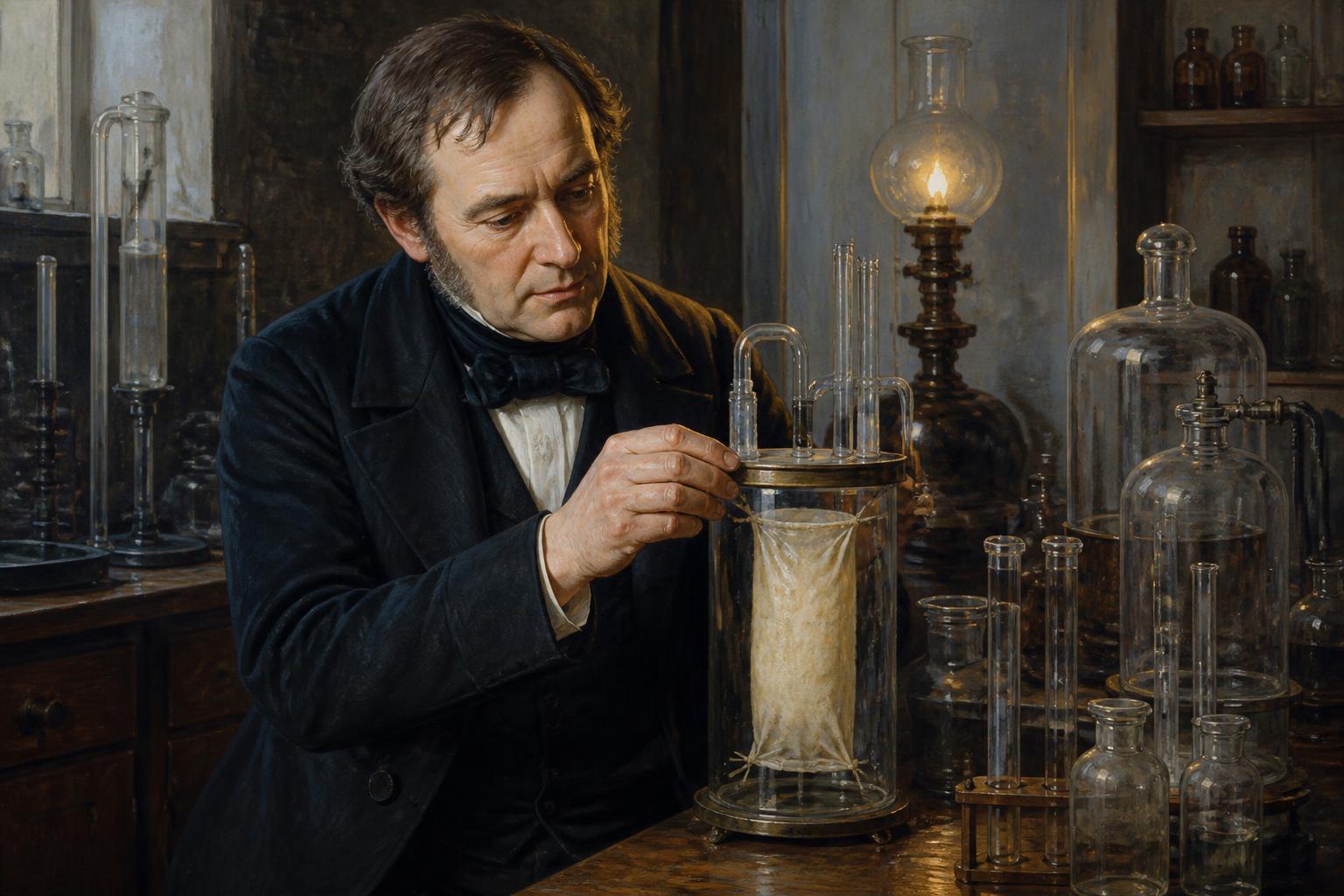
Thomas Graham was born in Glasgow on 21 December 1805 and became, by general scholarly agreement, the founder of physical chemistry as a distinct discipline in Britain. He is remembered for two achievements that, on the surface, look unrelated but share a single underlying idea: that the rate at which matter moves through space — a gas through a hole, a dissolved substance through a membrane — is not arbitrary, but obeys precise, measurable laws tied to the size and nature of the particles involved.
In the 1830s, working in Glasgow, he established Graham's Law of gas diffusion. In the 1850s and 1860s, working in London, he turned the same instinct for careful measurement onto liquids and founded colloid chemistry, inventing along the way the laboratory technique and the word dialysis. He was also a public servant of some standing, serving as Master of the Royal Mint for the last fourteen years of his life, and a professional leader, as the first president of the Chemical Society of London.
Early Life & Background
Graham was the son of a prosperous Glasgow manufacturer who wanted him to enter the ministry of the Church of Scotland. Thomas had other ideas. He enrolled at the University of Glasgow in 1819, aged just thirteen — not unusual for the period — and became fascinated with chemistry under the influence of Thomas Thomson, one of the leading chemists of the day. His father disapproved strongly enough that the two were estranged for years over Thomas's refusal to abandon science for divinity. Graham went on to study further in Edinburgh before returning to teach chemistry, first informally and then as a lecturer, at the Andersonian University (Anderson's Institution) in Glasgow from 1830.
It was in this Glasgow period, still in his twenties, that Graham began the careful, patient series of gas-diffusion experiments that would make his name. In 1837 he was appointed professor of chemistry at University College London, a post he held until 1854, and it was in London that his second great body of work — on liquid diffusion, colloids and dialysis — was carried out. He never married, was famously modest and unassuming for a scientist of his stature, and devoted his final years to both continued chemical research and his administrative duties as Master of the Mint. He died in London on 16 September 1869 and was buried in the churchyard of Glasgow Cathedral.
Graham's Law of Diffusion (1829–1833)
Graham's first major discovery concerned a deceptively simple question: when two gases are allowed to mix, or when a gas is allowed to escape through a tiny opening into a vacuum, why do some gases move faster than others? Beginning in 1829 in Glasgow, Graham devised careful experiments using narrow tubes plugged with plaster of Paris, or fitted with a tiny pinhole, to measure precisely how quickly different gases diffused through the plug or effused through the hole into open air or a vacuum.
He found a remarkably clean mathematical relationship. The rate of diffusion (or effusion) of a gas is inversely proportional to the square root of its density (and, since density under comparable conditions tracks molar mass, inversely proportional to the square root of its molar mass). Light gases such as hydrogen diffuse far faster than heavy gases such as carbon dioxide, and the ratio of their speeds is exactly the inverse ratio of the square roots of their densities. He presented preliminary results to the British Association in 1831 and published the finished law in his 1833 paper "On the Law of the Diffusion of Gases".
The elegance of the law lay in its simplicity and its close fit with the emerging kinetic picture of gases, in which temperature is a measure of the average kinetic energy of molecules in constant motion: if two gases at the same temperature have the same average kinetic energy, the lighter molecules must, on average, move faster, in exactly the inverse-square-root ratio Graham had measured. Graham's Law became a standard tool of nineteenth-century chemistry for estimating unknown molar masses and remains a staple of introductory chemistry teaching to this day.
From Gases to Isotopes
Graham's Law would go on to have consequences its author could not have foreseen. More than a century after his 1833 paper, physicists working on nuclear fission recognised that the tiny mass difference between the isotopes uranium-235 and uranium-238 — converted into gaseous uranium hexafluoride — could be exploited using exactly the principle Graham had described: the slightly lighter uranium-235 molecules diffuse fractionally faster than the heavier uranium-238 molecules through a porous barrier.
Repeated many thousands of times in cascade, that tiny difference in diffusion rate was enough to enrich uranium to weapons- or reactor-grade purity. This became the basis of the huge gaseous diffusion plants built at Oak Ridge, Tennessee, as part of the Manhattan Project in the 1940s, and of similar plants built by other nuclear powers in the decades that followed.
Honest note
It is worth stating plainly: Graham had no involvement whatsoever in nuclear physics, uranium enrichment or the Manhattan Project, all of which lay more than a century in his future and rested on twentieth-century discoveries — isotopes, nuclear fission — unknown in his lifetime. What Graham supplied was a law of physical chemistry. The American, British and other scientists and engineers of the 1940s supplied the immense feat of engineering that turned that law into a working industrial process. Crediting Graham with the Manhattan Project's technology would be exactly the kind of inflation this site tries to avoid; the honest statement is that his law made the physics of the separation possible, nothing more and nothing less.
Diffusion in Liquids (1850)
Having spent his younger years on gases, Graham turned in mid-career to a related but far less understood problem: how substances dissolved in a liquid diffuse through that liquid. In his 1850 paper "On the Diffusion of Liquids", read to the Royal Society, he measured how various dissolved salts, acids and other substances spread through water over time, using simple jars and careful sampling at intervals.
The results were striking. Some substances — common salts, most acids, sugar — diffused through water comparatively quickly. Others — starch, gum arabic, gelatin, albumin (egg white protein) — diffused extremely slowly, sometimes barely moving at all over the course of days. This was Graham's first hint of a fundamental division in the chemical world, one he would spend the next decade formalising.
Colloids, Crystalloids and Dialysis (1854–1861)
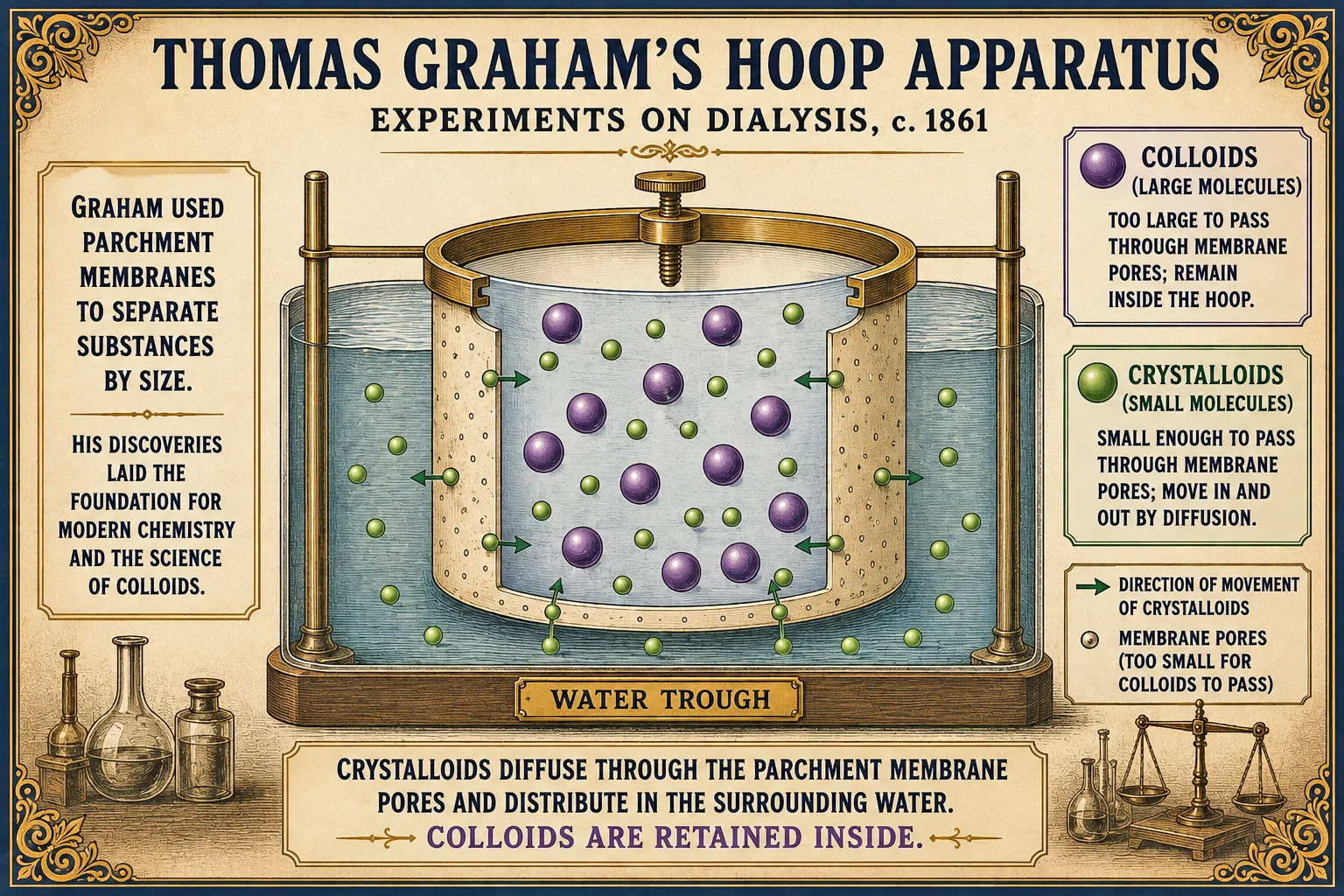
In his 1854 paper "On Osmotic Force" and, decisively, in his 1861 paper "Liquid Diffusion Applied to Analysis", Graham built his 1850 observations into a complete classification of dissolved matter. He divided substances into two great families.
Crystalloids — common salts, sugars, most simple acids and bases — diffuse quickly through a liquid and, true to their name, readily form regular crystals when the solvent is removed. Colloids — starch, gum, gelatin, albumin and many other complex, large-molecule substances — diffuse very slowly, if at all, and instead of crystallising they form the jelly-like or glue-like states Graham named a sol (a colloid dispersed in a liquid) and a gel (a colloid that has set into a semi-solid network). The word "colloid" itself derives from the Greek kolla, meaning glue — a nod to gelatin and gum arabic, the archetypal examples.
To demonstrate and exploit this distinction, Graham built a simple but ingenious piece of apparatus: a hoop, typically of gutta-percha, with a sheet of ordinary vegetable parchment paper stretched across the bottom like a drumhead, floated so that the parchment sat just below the surface of a trough of pure water. A mixture of crystalloids and colloids was poured into the hoop. Over hours, the small, fast-moving crystalloid molecules passed through the parchment's fine pores into the surrounding water, while the much larger colloid molecules were largely held back inside the hoop. Repeating the process with fresh water in the outer trough allowed the crystalloids to be washed out almost entirely, leaving the colloid behind in a much purer state. Graham named the technique, and the apparatus, from the Greek dia (through) and lysis (loosening or separation): dialysis.
Graham's motive was analytical chemistry, not medicine. He wanted a reliable way to separate and purify mixtures of dissolved substances for study — to isolate a colloid protein from the salts it was dissolved with, for instance, or to determine how much crystalloid contaminant a colloid sample contained. Dialysis, in his hands, was a bench technique, performed with simple laboratory glassware and a sheet of parchment, operating on small volumes over hours, with no therapeutic application in mind at all.
The Words Graham Invented
Few nineteenth-century chemists left as lasting a mark on scientific vocabulary as Graham. In the course of this work he coined or gave scientific currency to a cluster of terms still in universal use: colloid, crystalloid, sol, gel, and dialysis. He also adopted and helped popularise the term osmose (osmosis) for the passage of a solvent through a semi-permeable membrane, building on earlier work by the French physiologist Henri Dutrochet, and used it to help explain why colloids and crystalloids behave so differently across a membrane. Between them, these words became the working vocabulary of an entire branch of chemistry — colloid science — that underlies fields from soil science and food technology to biochemistry and pharmaceutical formulation.
Master of the Mint & the Chemical Society
Graham's career was not confined to the laboratory bench. In 1841 he was a founding figure of the Chemical Society of London — the first scientific society in the world devoted specifically to chemistry — and became its first president, a role that placed him at the centre of British chemistry's professional life for years afterward. The society survives today, after mergers, as part of the Royal Society of Chemistry.
In 1855 Graham was appointed Master of the Royal Mint, succeeding the astronomer Sir John Herschel in a post with a distinguished scientific pedigree — Isaac Newton himself had held it a century and a half earlier. Graham held the Mastership until his death in 1869, combining the administration of Britain's coinage with continued chemical research; his dialysis and colloid papers of 1854–1861 were written while he held this public office, a reminder that his most original scientific work came not from a young academic but from a chemist in his fifties balancing research with a demanding administrative career.
From Dialyser to Dialysis Machine
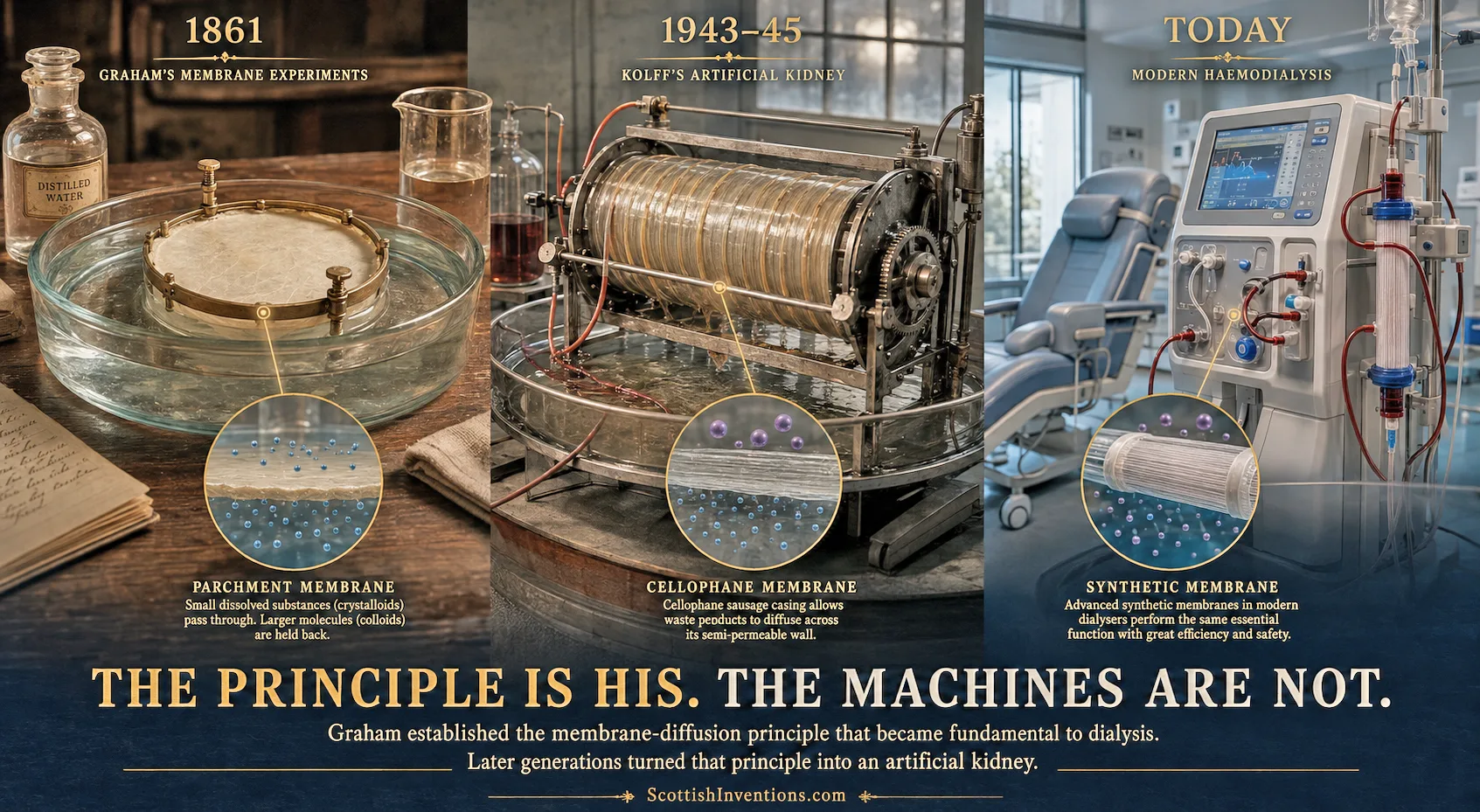
The single most important honesty check for this discovery concerns the word "dialysis" itself, which today is inseparable in most people's minds from haemodialysis, the life-saving treatment for kidney failure. Graham's word and his underlying membrane-separation principle are exactly what makes haemodialysis possible. But Graham did not build a dialysis machine, did not treat a patient, and by all accounts had no interest in medical application at all. The gap between his 1861 laboratory apparatus and a working artificial kidney spans more than eighty years and several distinct scientific and medical breakthroughs, achieved by other researchers entirely.
The first attempt to apply dialysis to a living body came in 1913, when the American researchers John Abel, Leonard Rowntree and Charles Turner, working at Johns Hopkins University, built an apparatus they called "vividiffusion" and used it to remove substances from the blood of anaesthetised animals — the first working proof that dialysis could be performed on circulating blood, though it was never used on a human patient.
The first dialysis of a human patient was performed in 1924 by the German physician Georg Haas in Giessen, who treated patients suffering from kidney failure with a rudimentary dialysis apparatus, though survival rates remained poor and the technique was far from a reliable therapy.
The breakthrough that turned dialysis into a genuinely life-saving medical treatment came from the Dutch physician Willem Kolff, who built the first practical rotating-drum artificial kidney during the German occupation of the Netherlands, between 1943 and 1945, using materials as improvised as sausage skins, orange-juice cans and a washing-machine drum. Kolff's device was the first to reliably keep patients with acute kidney failure alive long enough to recover kidney function, and it is Kolff, not Graham, who is generally credited as the father of the artificial kidney and modern dialysis therapy.
Honest note
The correct, defensible claim is that Thomas Graham discovered the scientific principle of dialysis and gave the technique and the field of colloid chemistry their names. The correct claim is not that a Scottish chemist invented the artificial kidney, or haemodialysis as a treatment — those achievements belong to Abel, Rowntree and Turner, to Georg Haas, and above all to Willem Kolff, working many decades later and independently of any intention to build on Graham's specific apparatus. This site states that distinction clearly rather than blur it.
Timeline
1805
Thomas Graham born in Glasgow, 21 December
Son of a manufacturer who wanted him in the ministry, not chemistry
1819–1826
Studies at the University of Glasgow, then Edinburgh
Defies his father to pursue chemistry
1829
First diffusion experiments in Glasgow
Measures how gases pass through a plaster plug or fine tube
1831
Presents early diffusion results to the British Association
The pattern of rates against gas density starts to emerge
1833
“On the Law of the Diffusion of Gases” published
States that diffusion rate is inversely proportional to the square root of density — Graham's Law
1837
Appointed professor of chemistry at University College London
Leaves Glasgow's Andersonian for the capital
1841
Co-founds and becomes first president of the Chemical Society of London
The forerunner of the Royal Society of Chemistry
1846
First edition of Elements of Chemistry
A standard textbook for a generation of students
1850
“On the Diffusion of Liquids” published
Shows some dissolved substances diffuse through water far more slowly than others
1854
“On Osmotic Force” introduces the colloid/crystalloid distinction
Substances like starch and gum diffuse and crystallise differently from salts and sugars
1855
Appointed Master of the Mint
Succeeds John Herschel; holds the post until his death
1861
“Liquid Diffusion Applied to Analysis” coins “dialysis”
The parchment-paper dialyser separates colloids from crystalloids
1869
Thomas Graham dies in London, 16 September
Buried in Glasgow Cathedral churchyard
1913
Abel, Rowntree and Turner build a “vividiffusion” apparatus
First working dialysis device tested on animals, decades after Graham
1924
Georg Haas performs the first human dialysis
A Giessen physician, treating patients with kidney failure
1943–1945
Willem Kolff builds the rotating-drum artificial kidney
The first machine to keep human patients alive through dialysis
1945
Manhattan Project gaseous diffusion plants separate uranium-235
Applies Graham's Law at industrial scale, a century after his experiments
Did You Know?
- Graham's original dialyser used ordinary vegetable parchment paper stretched over a hoop — a far cry from the synthetic membranes used in hospitals today.
- The word “colloid” comes from the Greek word for glue, kolla — a nod to gelatin and gum arabic, two of Graham's key examples.
- Graham's Law is still taught in introductory chemistry courses today, almost two centuries after his Glasgow experiments.
- Willem Kolff built his first artificial kidney partly from sausage skins and a washing-machine drum, under wartime shortages in the occupied Netherlands.
- Before Kolff's 1943–45 machine, dialysis had only ever been tried in animals (1913) and in a small number of human patients with poor outcomes (from 1924).
- Graham became the first president of the Chemical Society of London in 1841 and, from 1855, ran the Royal Mint at the same time as publishing his colloid research.
Honest Caveats
Graham did not invent haemodialysis as a therapy. He built a laboratory apparatus for chemical analysis and had no medical application in mind. The treatment familiar from modern kidney care was developed by Abel, Rowntree and Turner (1913, animal experiments), Georg Haas (1924, first human dialysis) and Willem Kolff (1943–45, first reliably successful artificial kidney) — all working independently, decades to nearly a century after Graham's 1861 paper.
Graham had no role in the Manhattan Project or isotope separation. Graham's Law made gaseous diffusion separation of isotopes physically possible, but the engineering of industrial-scale uranium enrichment plants in the 1940s was the work of other scientists and engineers, more than a century after his own research and unconnected to it in any personal sense.
Graham's motives were analytical, not medical or military. Both his 1833 diffusion law and his 1854–61 colloid and dialysis work were pursued as pure chemistry — understanding how matter behaves — not as steps toward any specific future technology. Reading later applications back into his intentions would misrepresent his actual research programme.
Precedents exist for individual pieces of the picture. Thomas Thomson and others had studied gas behaviour before Graham refined the diffusion law; Henri Dutrochet had earlier described osmotic phenomena in a physiological context that Graham drew on and extended into general chemistry. Graham's distinctive contribution was the precise, quantitative law of gas diffusion and the complete, named classification of colloids and crystalloids with a working separation technique — not the bare observation that gases and dissolved substances move at different rates, which others had glimpsed before him.
Frequently Asked Questions
What is Graham's Law?
Graham's Law states that the rate at which a gas diffuses or effuses (escapes through a tiny hole) is inversely proportional to the square root of its molar mass (or density). Lighter gases move faster. Thomas Graham derived this from careful Glasgow experiments between 1829 and 1833 and published it in his 1833 paper 'On the Law of the Diffusion of Gases'.
Did Thomas Graham invent the artificial kidney or haemodialysis?
No. Graham established the underlying science — the colloid/crystalloid distinction and the principle that a semi-permeable membrane can separate small dissolved molecules from large ones — and coined the word 'dialysis' in 1861. But he built a laboratory demonstration, not a medical device, and he had no interest in treating disease. The first working dialysis apparatus tested on animals was built by John Abel, Leonard Rowntree and Charles Turner in Baltimore in 1913. The first dialysis of a human patient was performed by Georg Haas in Germany in 1924. The first machine that reliably kept patients alive was Willem Kolff's rotating-drum artificial kidney, built in the Netherlands during 1943–1945. The Scottish claim is to the principle and the vocabulary, not the therapy.
Did Graham invent uranium enrichment or the Manhattan Project's diffusion plants?
No. Graham's Law describes the physics that makes gaseous diffusion separation possible, but the industrial gaseous-diffusion plants built at Oak Ridge, Tennessee in the 1940s to separate uranium-235 from uranium-238 were engineered by American and British scientists working on the Manhattan Project, more than a century after Graham's experiments and without his involvement. Graham supplied a law of physics; others built the technology on top of it.
What is a colloid, and why does the distinction matter?
Graham divided dissolved substances into two classes based on how fast they diffuse and whether they crystallise. 'Crystalloids' — salts, sugars, most simple acids — diffuse quickly and readily form crystals. 'Colloids' — starch, gum, gelatin, albumin, many biological molecules — diffuse very slowly, do not crystallise, and instead form what he called a 'gel' from a 'sol'. This distinction underlies colloid chemistry, a field essential to biochemistry, materials science, food science and medicine.
What did Graham's dialyser actually look like?
It was a simple laboratory device: a hoop of gutta-percha or similar material stretched with a sheet of vegetable parchment (parchment paper) across the bottom, like a drumhead, floated in a trough of water. The mixture to be separated was poured into the parchment-covered hoop. Crystalloids passed through the parchment membrane into the surrounding water; colloids, being much larger, were largely retained. It was slow, small-scale and intended for chemical analysis, not for treating patients.
Was Thomas Graham Scottish?
Yes, without qualification. He was born in Glasgow in 1805, educated at the University of Glasgow and in Edinburgh, and began his key diffusion experiments in Glasgow before moving to London in 1837 for his university chair and, later, the Mastership of the Mint. Both the gas-diffusion law and the dialysis/colloid work were his own original research, carried out under his own name, with no serious rival claimant — a rare case among nineteenth-century priority disputes.
What other roles did Graham hold?
Graham was the first president of the Chemical Society of London (founded 1841), the direct ancestor of today's Royal Society of Chemistry, and he served as Master of the Royal Mint from 1855 until his death in 1869, succeeding the astronomer John Herschel. He never married and devoted his later years to chemistry and Mint administration in roughly equal measure.
Is Graham's work still relevant today?
Yes, on both halves of it. Graham's Law of gaseous diffusion is still taught in introductory chemistry courses almost two centuries after his Glasgow experiments, and it describes the physics that later made industrial gaseous-diffusion separation possible. His membrane work matters even more widely: the colloid/crystalloid distinction founded colloid chemistry, a field essential to biochemistry, materials science, food science and medicine, and the principle he demonstrated with vegetable parchment stretched over a hoop is the same principle at work in the synthetic membranes used in hospital haemodialysis today.
Sources & Further Reading
Tier 1 · Primary
- Graham, T. — "On the Law of the Diffusion of Gases," Philosophical Magazine, 1833.
- Graham, T. — "On the Diffusion of Liquids," Philosophical Transactions of the Royal Society, 1850.
- Graham, T. — "On Osmotic Force," Philosophical Transactions of the Royal Society, 1854.
- Graham, T. — "Liquid Diffusion Applied to Analysis," Philosophical Transactions of the Royal Society, 1861.
- Abel, J. J., Rowntree, L. G. & Turner, B. B. — "On the Removal of Diffusible Substances from the Circulating Blood by Means of Dialysis," Journal of Pharmacology and Experimental Therapeutics, 1913–14.
- Haas, G. — reports on early human haemodialysis, Giessen, 1924–1928.
Tier 2 · Scholarly and institutional
- Kolff, W. J. — New Ways of Treating Uraemia, 1947, describing the 1943–45 rotating-drum artificial kidney.
- Royal Society of Chemistry — biographical and historical material on Thomas Graham and the Chemical Society of London.
- Royal Mint — historical list of Masters of the Mint.
- Manhattan Project / Oak Ridge historical records — gaseous diffusion enrichment process.
Discoveries · No. 37 of 50
Dialysis & Colloid Chemistry joins the Discoveries series
Collector card artwork for this discovery is in production. In the meantime, explore the rest of the collection.