Discoveries · No. 18 of 50 · Chemistry
Daniel Rutherford and the Isolation of Nitrogen
The Edinburgh doctor who caught the air we breathe — and who wins priority chiefly because he published first, not because he worked alone.
Daniel Rutherford · 1749–1819Thesis published 12 September 1772Reading time · 16 minUpdated 11 August 2026
TL;DR
- In 1772 the Scottish physician Daniel Rutherford — a student of Joseph Black at the University of Edinburgh — became the first person to publish a clear identification of nitrogen as a distinct gas, which he called "noxious", "malignant" or "phlogisticated" air, in his MD thesis De aere fixo dicto aut mephitico.
- Rutherford shares the credit honestly: Henry Cavendish, Carl Wilhelm Scheele and Joseph Priestley were all investigating the same gas at almost exactly the same time. Rutherford "wins" priority chiefly because he published first, not because he worked alone or understood the gas as a modern element.
- The gas Rutherford caught makes up 78.08% of dry air — every breath you take — and the science he helped launch led, more than a century later, to the Haber–Bosch process that fed an estimated 48% of the world's population as of 2008.
Scottish Impact Index (SI Score)
- Global Impact
- 8/10
- Longevity
- 9/10
- Economic / Material Impact
- 6/10
- Originality / Distinctiveness
- 9/10
- Legacy (Built Upon)
- 8/10
- Recognition
- 4/10
Key Findings
- Rutherford was born in Edinburgh on 3 November 1749 and died there on 15 November 1819; he was a maternal uncle of the novelist Sir Walter Scott.
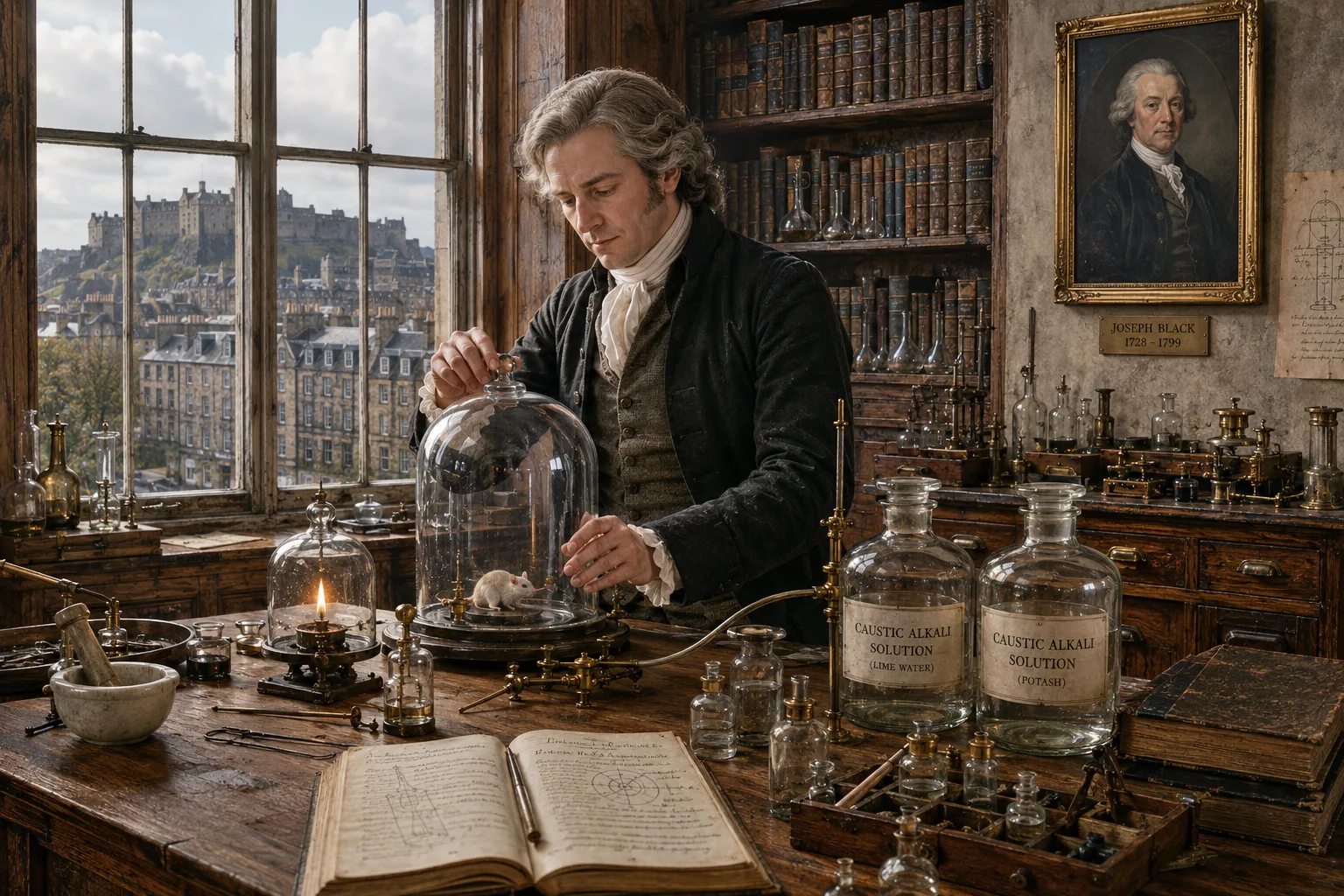
- His 1772 method was vivid and rigorous: suffocate a mouse in sealed air, burn a candle and phosphorus in it, then scrub out the "fixed air" (CO₂) with caustic alkali — and find a gas still left over that supported neither flame nor life.
- Rutherford did not believe he had found a chemical element; he interpreted his gas through phlogiston theory, calling it air "saturated with phlogiston".
- In his thesis, "mephitic air" means carbon dioxide, not nitrogen — a distinction many popular accounts get wrong.
- The name "nitrogen" came later, coined by Jean-Antoine Chaptal in 1790; Lavoisier preferred "azote", meaning "without life".
- In an irony worth savouring, the man who isolated the gas at the heart of plant nutrition spent his later career as Edinburgh's Professor of Botany.
Quick Facts
- Discovery
- First published identification of nitrogen as a distinct gas
- Year
- 1772 — MD thesis dated 12 September 1772
- Key figure
- Daniel Rutherford (1749–1819)
- Born / died
- Edinburgh, 3 November 1749 · Edinburgh, 15 November 1819
- Thesis
- De aere fixo dicto aut mephitico — 'On the air called fixed or mephitic'
- Supervisor
- Joseph Black, discoverer of 'fixed air' (carbon dioxide)
- Parallel investigators
- Henry Cavendish (England), Carl Wilhelm Scheele (Sweden), Joseph Priestley (England)
- Claim status
- Shared — priority of publication, not sole discovery
- What he called it
- 'Noxious', 'malignant' or 'phlogisticated' air — NOT 'mephitic air', which in his thesis means CO₂
- Name 'nitrogen'
- Coined by Jean-Antoine Chaptal in 1790; Lavoisier preferred 'azote'
- Share of dry air
- 78.08% by volume — the most abundant atmospheric gas
- Later career
- Professor of Botany, University of Edinburgh, from 1786
Who Was Daniel Rutherford?
Daniel Rutherford was born in Edinburgh on 3 November 1749, into one of the city's most distinguished medical families. His father, John Rutherford (1695–1779), had studied at Leiden under Herman Boerhaave and in 1726 became Professor of the Theory and Practice of Medicine at the University of Edinburgh — one of the founders of its celebrated medical school. Daniel's mother was John Rutherford's second wife, Anne Mackay.
The family connections reach into Scottish literary legend. Rutherford was the maternal uncle of Sir Walter Scott; Scott's mother, Anne Rutherford, was his sister. Sources genuinely conflict on whether she was a full sister or a half-sister from John Rutherford's earlier marriage, and this page flags that rather than choosing. The kinship itself is beyond dispute — Scott acknowledged his "uncle Dr Rutherford" — and in a poignant coincidence, when Rutherford died suddenly in November 1819, his two sisters, including Scott's mother, died within weeks of him.
He was educated at home, then at Mundell's School near the family home on Edinburgh's West Bow, and then at the University of Edinburgh, where he took an MA before turning to medicine. There he studied under two giants of the Scottish Enlightenment: William Cullen and, crucially, Joseph Black — the chemist who had discovered "fixed air", carbon dioxide. Black supervised the project that became Rutherford's MD dissertation, obtained on 12 September 1772. After graduating he travelled in England, France and Italy before returning to Edinburgh in 1775 to practise medicine.
What Was Known About Air in 1772
For more than two thousand years, "air" had been regarded as one of the four classical elements — a single, uniform substance. That ancient idea was being dismantled in the eighteenth century, and Edinburgh was at the heart of the demolition. In work for his own 1754 MD thesis and a classic 1756 paper, Joseph Black showed that heating magnesia alba released a distinct gas he named "fixed air" — our carbon dioxide — which would not support a flame and could be re-absorbed, or "fixed", back into solids. This founded the field of pneumatic chemistry.
By the early 1770s chemists understood that atmospheric air was not uniform. Burning and breathing both "spoiled" air, producing fixed air and leaving a residue. The dominant explanatory framework was phlogiston theory: combustible bodies were thought to contain a fire-principle called phlogiston, released into the air as they burned. Air that could no longer support a flame was "phlogisticated" — saturated, unable to absorb more.
That left an unresolved puzzle. When a candle burns out in a sealed jar, or an animal suffocates in one, and you then remove the fixed air, something is still left — a gas that supports neither flame nor life, yet is plainly not Black's fixed air. What was it? That was Rutherford's question.
The 1772 Experiments
Rutherford's approach, building directly on Black's methods, was both simple and convincing. He "destroyed" ordinary air — that is, removed its life- and flame-supporting component, the oxygen not yet identified — by a sequence of steps:
- He confined a living mouse in a fixed quantity of air until it died.
- He then burned a candle in the same air until it went out.
- He further burned phosphorus — and in other trials charcoal — in it until nothing more would burn.
- He passed the remaining air through a caustic alkaline solution to absorb and remove the "fixed air" produced by combustion and respiration: exactly the absorption trick he had learned from Black.
What remained was a gas that would not support combustion, would not sustain an animal, and — critically — would not turn lime water milky or behave like fixed air. It was therefore a different gas entirely. Rutherford had distinguished, clearly and in print, between carbon dioxide and what we now call nitrogen.
A point of precision the careful reader should note: Rutherford reserved the term "mephitic air" for Black's fixed air (CO₂), the gas named in his thesis title. The new residual gas he called variously "noxious", "malignant" or "phlogisticated" air. The word "mephitic" means foul-smelling or poisonous, which is a genuine oddity, because nitrogen is colourless, odourless and not directly toxic. Animals placed in it die of asphyxiation, not poisoning. The naming reflects the eighteenth-century habit of describing gases by their effects rather than their chemistry.
The Priority Dispute — an Honest Accounting
This is where credibility matters most, because the popular shorthand "Daniel Rutherford discovered nitrogen in 1772" hides a genuine, well-documented contest. At least three other major figures were investigating the very same gas at almost exactly the same moment.
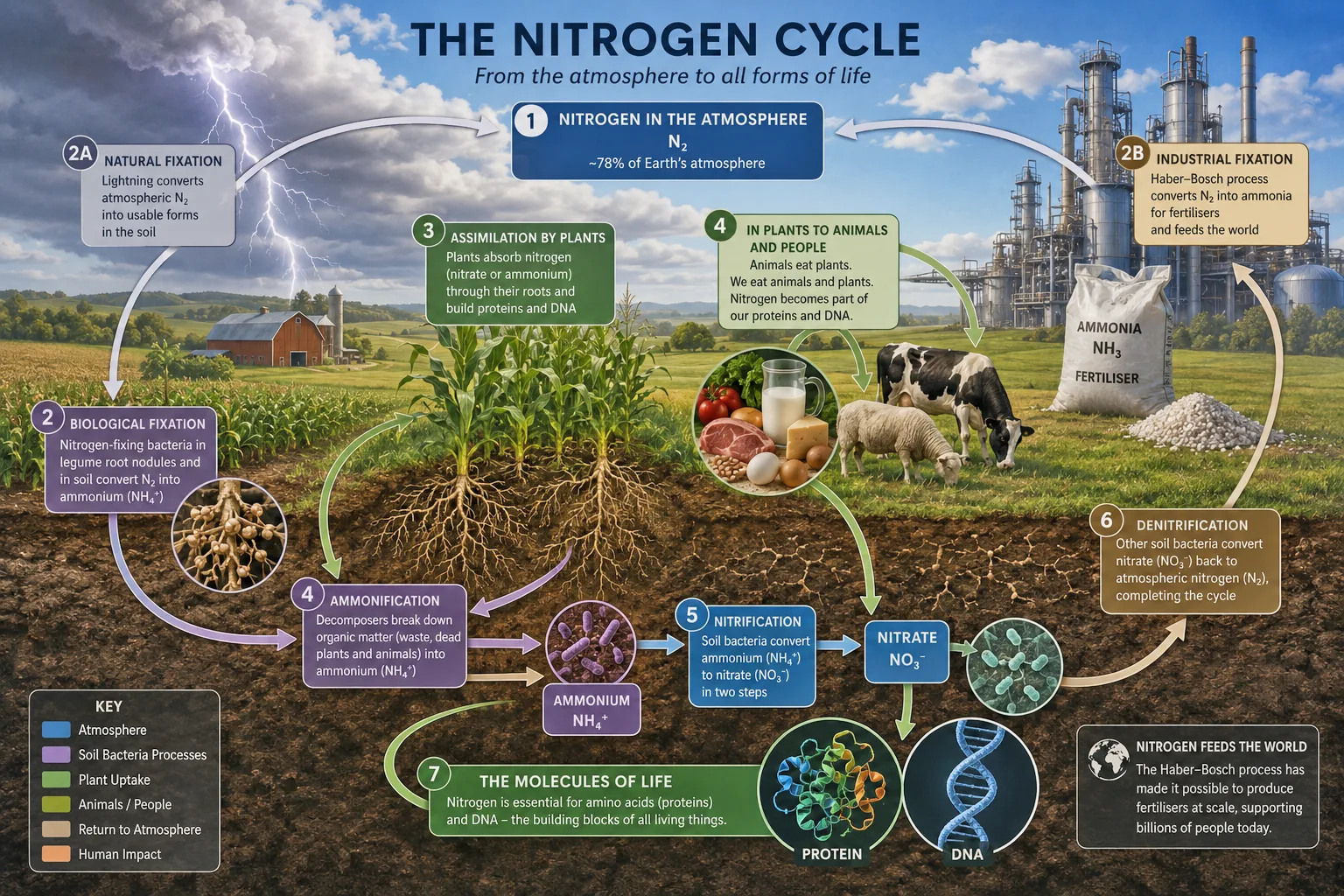
Henry Cavendish (England) had performed closely parallel work — passing ordinary air repeatedly over red-hot charcoal and removing the resulting fixed air with caustic alkali, leaving a residual gas whose density he found "differed little from common air, perhaps somewhat lighter". Historians credit Cavendish with giving the first clear description of this gas. He did not formally publish it himself at the time; it became partly public only because Joseph Priestley relayed a version of it to the Royal Society in a paper of 1772 — before Rutherford's thesis appeared. Cavendish's own account waited until his "Experiments on Air" papers in the Philosophical Transactions (Part I, vol. 74, read 15 January 1784; Part II, vol. 75, read 2 June 1785).
Carl Wilhelm Scheele (Sweden) independently isolated the gas around 1771–72, distinguishing "spoiled air" (nitrogen) from "fire air" (oxygen). His understanding was arguably more advanced than Rutherford's — he believed air "must be composed of two different kinds of elastic fluids", anticipating the modern view of a mixture — but he did not publish until his Chemical Treatise on Air and Fire appeared in 1777, five years after Rutherford's thesis.
Joseph Priestley (England) was working the same territory, preparing the gas — which he called "phlogisticated air" — and publishing prolifically on the different "airs".
So why does Rutherford get the conventional credit? Precisely — and only — because he was the first to publish a clear identification and description of nitrogen as a distinct gas, in his 1772 dissertation. Sir William Ramsay, who later discovered the noble gases, argued in The Gases of the Atmosphere (1915) that because Rutherford recognised his "malignant air" as a genuinely new substance, he "may well be credited" with the discovery. Modern historians of chemistry typically describe nitrogen as independently discovered by Rutherford, Scheele and Cavendish, with Rutherford given priority of publication. It is telling that the German-language tradition often credits Scheele as the discoverer and does not mention Rutherford at all — a useful reminder that "who discovered it" is partly a matter of national perspective and of what counts as discovery.
What Rutherford Did Not Know
It is essential not to flatter the past. Rutherford did not realise he had isolated a chemical element — the modern concept of an element did not yet exist, and Lavoisier's chemical revolution was still a decade away. Working firmly within phlogiston theory, Rutherford interpreted his residual gas not as a fundamental substance but as ordinary air that had become "saturated with phlogiston". In the words of his thesis, as rendered in the standard English translation, the residual air "cannot be converted into mephitic air by combustion", and he supposed it to be "atmospheric air as it were united with and saturated with phlogiston" — speculating that it was "pure phlogiston united to common air" seeming to "form another species of air". He had successfully isolated nitrogen gas; his explanation of what it was proved entirely wrong.
The correction came from Antoine Lavoisier, whose oxygen theory of combustion overturned phlogiston in the 1770s and 80s. (Oxygen itself was independently discovered by Scheele and Priestley around 1774.) Lavoisier was the first to recognise the gas as a chemical element.
Azote, Nitrogen and the Naming
Finding that the gas could not sustain life, Lavoisier favoured the name "azote", from the Greek for "without life". That name had in fact been proposed in 1787 by Louis-Bernard Guyton de Morveau in the collaborative Méthode de nomenclature chimique, written with Lavoisier, Berthollet and Fourcroy, and it survives today in French and in compound names such as "azide" and "hydrazine".
The English name "nitrogen" was coined in 1790 by the French chemist Jean-Antoine-Claude Chaptal, who recognised that the gas is an essential component of nitric acid and of nitre — saltpetre, potassium nitrate. "Nitrogen" literally means "nitre-forming", from the Greek nitron plus -gen, "producing". The word entered English around 1794, partly through George Pearson's translation of the new French nomenclature.
Why It Mattered
Rutherford had provided the first clear scientific identification of the single largest component of the air we breathe. Nitrogen gas makes up 78.08% of dry air by volume — far and away its most abundant constituent, with oxygen a distant second at 20.95%, argon at 0.93% and carbon dioxide at around 0.04%. The most common gas on the surface of our planet had gone entirely unrecognised until 1772.
His thesis was also a landmark moment in the chemical revolution. It followed directly from Black's "fixed air" and sat alongside Cavendish's isolation of hydrogen ("inflammable air", 1766) and the discovery of oxygen by Priestley and Scheele. Collectively, these discoveries shattered the ancient dogma that air was a single element and established the modern understanding of the atmosphere as a mixture of distinct gases — the foundation on which Lavoisier built modern chemistry.
Modern Relevance — the Nitrogen Cycle & Haber–Bosch
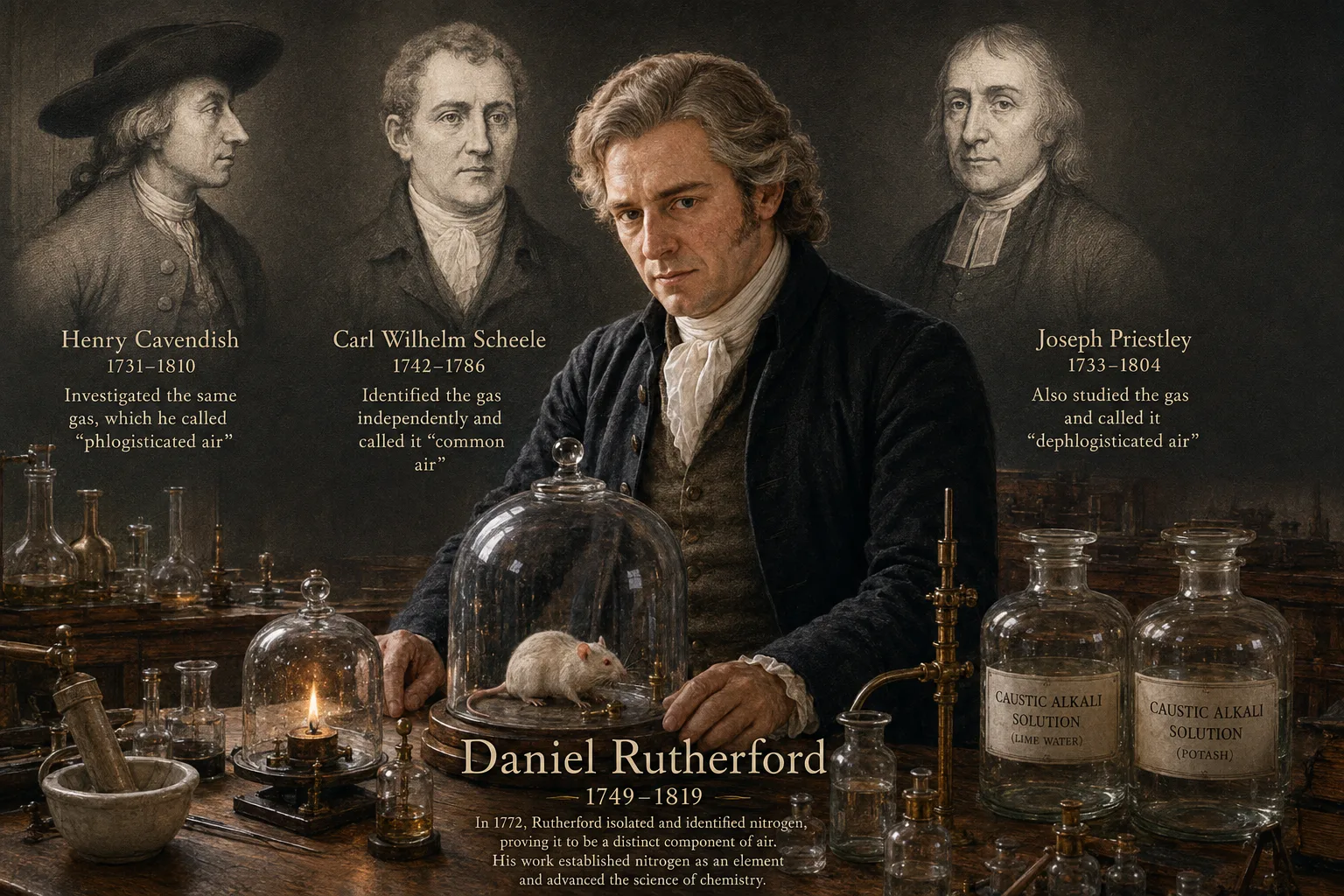
Life itself depends on it. Nitrogen is a building block of amino acids, proteins, DNA and RNA, and of the chlorophyll that powers photosynthesis. Yet almost no living thing can use atmospheric N₂ directly — the triple bond between its two atoms is one of the strongest in chemistry, making the gas remarkably unreactive. Nitrogen must be "fixed" into usable compounds such as ammonia or nitrate, a task performed in nature mainly by specialised bacteria, and balanced by denitrifying microbes that return N₂ to the air. This is the nitrogen cycle.
The Haber–Bosch process. In the early twentieth century, the German chemists Fritz Haber (who demonstrated the chemistry in 1909) and Carl Bosch (who scaled it up industrially from 1913) found a way to combine atmospheric nitrogen with hydrogen under high temperature and pressure to make ammonia — the basis of synthetic fertiliser. The consequences are staggering: in the landmark assessment by Erisman, Sutton, Galloway, Klimont and Winiwarter, "How a century of ammonia synthesis changed the world" (Nature Geoscience, 2008), synthetic fertiliser was estimated to have fed 44% of the world's population in 2000, rising to 48% in 2008. Vaclav Smil similarly estimated in Enriching the Earth (2001) that around 40% of people then alive owed the protein in their bodies to nitrogen fixed by this single industrial reaction.
Liquid nitrogen. Cooled to −195.79°C (77 K), its boiling point at atmospheric pressure, nitrogen becomes a colourless, inert cryogenic liquid used for flash-freezing food, preserving biological samples, cryosurgery, cooling superconductors and countless laboratory and industrial tasks.
Explosives and the chemical industry. Nitrogen compounds — ammonium nitrate, nitroglycerin, TNT — release enormous energy on detonation, much of it as stable nitrogen gas. Ammonium nitrate is both a major fertiliser and, mixed with fuel oil, one of the world's most widely used industrial explosives. The same element underpins nitric acid, dyes, plastics and pharmaceuticals.
Edinburgh: a City of Gases
There is something remarkable about the geography of these discoveries. Within a single generation and a single university, two of the foundational gases of modern chemistry were characterised: Joseph Black's carbon dioxide (1754–56) and Daniel Rutherford's nitrogen (1772) — and the two men were teacher and student. They worked in the milieu of the Scottish Enlightenment, in a city that also produced David Hume, Adam Smith and James Hutton. Edinburgh's medical and chemical teaching drew students from across Europe and North America, and Black's lecture demonstrations were famous.
And there is a delicious irony in Rutherford's later career. In 1786 the discoverer of nitrogen — the element without which no plant can grow — became Professor of Botany and Regius Keeper of the Royal Botanic Garden, holding both posts until his death in 1819. By all accounts he was not a distinguished botanist: his interest in plants was largely as material for chemical experiment, his lecturing was poorly reviewed, and his publications were few. He could not have known that his "noxious air" and the green world he now tended were bound together by a nitrogen cycle science would not understand for another century. Nitrogen was, as one historian put it, his first and last contribution to chemistry.
Timeline
1749
Daniel Rutherford born in Edinburgh, 3 November
Son of John Rutherford, professor of medicine and a founder of Edinburgh's medical school
1754–56
Joseph Black characterises 'fixed air' (carbon dioxide)
Founds pneumatic chemistry and supplies the alkali-absorption technique Rutherford would use
1766
Henry Cavendish isolates hydrogen, 'inflammable air'
Part of the same wave of gas discoveries dismantling air as a single element
1771–72
Carl Wilhelm Scheele independently isolates the gas in Sweden
Distinguishes 'spoiled air' from 'fire air' — but does not publish until 1777
1772
Priestley relays a version of Cavendish's work to the Royal Society
Cavendish's own closely parallel results reach print only in 1784–85
1772
Rutherford's MD thesis published, 12 September
The first clear published identification of nitrogen as a distinct gas
1774
Oxygen independently discovered by Scheele and Priestley
The missing piece that would eventually explain what Rutherford had actually removed
1786
Rutherford becomes Professor of Botany at Edinburgh
And Regius Keeper of the Royal Botanic Garden, posts held until his death
1787
'Azote' proposed in the Méthode de nomenclature chimique
By Guyton de Morveau with Lavoisier, Berthollet and Fourcroy; still the French name
1790
Jean-Antoine Chaptal coins 'nitrogen'
Meaning 'nitre-forming'; the word enters English around 1794
1819
Rutherford dies in Edinburgh, 15 November
His two sisters — one of them Sir Walter Scott's mother — died within weeks
1909–13
Haber and Bosch industrialise nitrogen fixation
Turning the gas Rutherford caught into synthetic fertiliser
Myths & Facts
Myth: Daniel Rutherford discovered nitrogen single-handedly in 1772.
Fact: He was the first to publish a clear identification, on 12 September 1772. Cavendish, Scheele and Priestley were investigating the same gas at almost exactly the same time. Rutherford wins priority chiefly because he published first, not because he worked alone.
Myth: Rutherford named nitrogen 'mephitic air'.
Fact: In his thesis, 'mephitic air' is Joseph Black's fixed air — carbon dioxide. The new gas he called 'noxious', 'malignant' or 'phlogisticated' air. Many websites reverse this.
Myth: Rutherford knew he had discovered a new element.
Fact: He did not. He interpreted the gas through phlogiston theory as ordinary air saturated with phlogiston. Recognising nitrogen as a chemical element was Lavoisier's step, a decade or more later.
Myth: Nitrogen is poisonous — hence 'noxious air'.
Fact: Nitrogen is colourless, odourless and not directly toxic. It simply supports neither flame nor life; animals in it asphyxiate rather than being poisoned. The name reflects 18th-century naming by effect.
Myth: Rutherford is universally recognised as nitrogen's discoverer.
Fact: The German-language tradition often credits Scheele alone and does not mention Rutherford. Priority here is a convention that differs by national tradition.
Myth: Rutherford was a chemist by career.
Fact: He was a physician who became Professor of Botany at Edinburgh in 1786. Nitrogen was, as one historian put it, his first and last contribution to chemistry.
Did You Know?
- Daniel Rutherford was the uncle of Sir Walter Scott — his sister Anne was the novelist's mother.
- He identified nitrogen by studying the air left behind after a mouse suffocated and a candle went out — then burning phosphorus in it for good measure.
- He called it 'noxious air', yet nitrogen is colourless, odourless and not directly poisonous; it simply cannot support life or flame on its own.
- He was a student of Joseph Black, who had discovered carbon dioxide at the very same university just sixteen years earlier.
- Nitrogen makes up 78.08% of every breath you take — the most abundant gas in the air — yet it took until 1772 for science to identify it.
- Despite his great chemical discovery, Rutherford spent the rest of his career as a Professor of Botany, not chemistry.
Honest Caveats
The discovery is legitimately shared. National traditions differ — German sources often credit Scheele alone. This page presents it as shared, with Rutherford holding priority of publication.
The thesis quotations are from a translation. The verbatim wording derives from the standard 1935 English translation (A. Crum Brown, communicated by Leonard Dobbin, Journal of Chemical Education 12: 370–375), as reproduced in peer-reviewed secondary sources. The original 1772 Latin is rare and the translation article is paywalled; the exact wording of the "saturated with phlogiston" passage should be verified against a primary copy before being quoted as definitive.
One genealogical point is unresolved. Sources conflict on whether Anne Rutherford, Sir Walter Scott's mother, was Daniel's full sister or a half-sister from his father's earlier marriage. This page states the conflict rather than picking a side.
The Haber–Bosch population figures are estimates. The 44% (2000) and 48% (2008) figures from Erisman et al., and Smil's ~40%, are scholarly estimates rather than precise measurements — well supported, but approximations.
Frequently Asked Questions
Who discovered nitrogen?
Daniel Rutherford is conventionally credited, and this page gives him that credit — but with the precise reason attached. He wins priority chiefly because he published first, in his MD thesis of 12 September 1772, not because he worked alone or understood the gas better than anyone else. Henry Cavendish, Carl Wilhelm Scheele and Joseph Priestley were all investigating the same gas at almost exactly the same time. Modern historians of chemistry generally describe nitrogen as independently discovered by Rutherford, Scheele and Cavendish, with Rutherford holding priority of publication.
How did Rutherford isolate nitrogen?
By systematically destroying everything else in a fixed quantity of air. He confined a living mouse in it until it died; burned a candle in the same air until it went out; burned phosphorus, and in other trials charcoal, in it until nothing more would burn; then passed the remaining air through a caustic alkaline solution to absorb the 'fixed air' (carbon dioxide) that respiration and combustion had produced — a technique he had learned from his supervisor Joseph Black. What was left supported neither flame nor life, and would not turn lime water milky, so it was clearly not carbon dioxide. That residue was nitrogen.
Did Rutherford call nitrogen 'mephitic air'?
No, and this is one of the most commonly repeated errors about him. In his thesis, 'mephitic air' means Black's fixed air — carbon dioxide — which is the gas named in the title, De aere fixo dicto aut mephitico. The new residual gas he called variously 'noxious', 'malignant' or 'phlogisticated' air. Many popular sources get this backwards.
Why is 'noxious air' a misleading name for nitrogen?
Because nitrogen is colourless, odourless and not directly toxic. Animals placed in it die of asphyxiation, not poisoning — it simply cannot support life or combustion on its own. Eighteenth-century chemists routinely named gases by their observed effects rather than their chemistry, so a gas in which mice died was 'noxious' or 'malignant' regardless of the mechanism.
Did Rutherford know he had found a chemical element?
No. The modern concept of a chemical element did not yet exist in the form we use, and Lavoisier's chemical revolution was still a decade away. Rutherford worked entirely within phlogiston theory and interpreted his residual gas not as a fundamental substance but as ordinary air that had become saturated with phlogiston. He had successfully isolated nitrogen gas; his explanation of what it was proved entirely wrong. It was Lavoisier who first recognised the gas as an element.
What role did Joseph Black play?
A decisive one. Black had characterised 'fixed air' (carbon dioxide) in work for his own 1754 thesis and a classic 1756 paper, founding pneumatic chemistry and establishing the alkali-absorption technique for removing CO₂ from a gas sample. He also supervised the project that became Rutherford's MD dissertation. The teacher-student line from Black's carbon dioxide to Rutherford's nitrogen, in one university within a single generation, is the distinctively Edinburgh part of this story.
Who were Cavendish, Scheele and Priestley in this story?
Henry Cavendish, in England, had performed closely parallel work — passing air repeatedly over red-hot charcoal and scrubbing out the resulting fixed air with caustic alkali, leaving a residual gas he found differed little in density from common air. Historians credit him with the first clear description of it, though he did not publish it himself at the time; his own account waited until his Experiments on Air papers of 1784–85. Carl Wilhelm Scheele, in Sweden, independently isolated the gas around 1771–72 and arguably understood it better, believing air must be composed of two different kinds of elastic fluid — but he did not publish until 1777. Joseph Priestley was working the same territory and publishing prolifically on the different 'airs'; it was Priestley who relayed a version of Cavendish's work to the Royal Society in 1772.
Why do German-language sources credit Scheele instead?
Because 'who discovered it' depends partly on what you count as discovery and partly on national perspective. Scheele's work was independent, was arguably conceptually more advanced, and reached similar conclusions at roughly the same time — his only disadvantage was a five-year publication delay. The German-language tradition often credits Scheele as the discoverer and does not mention Rutherford at all. That divergence is a useful reminder that priority claims are conventions, not facts of nature.
How much of the air is nitrogen?
Nitrogen gas (N₂) makes up 78.08% of dry air by volume — far and away its most abundant constituent, with oxygen a distant second at 20.95%, argon at 0.93% and carbon dioxide at around 0.04%. The most common gas at the surface of the planet went entirely unrecognised until 1772.
Why is nitrogen so unreactive?
The triple bond between the two atoms in N₂ is one of the strongest in chemistry, which makes the molecule extremely stable and reluctant to react. That is why, despite nitrogen being a building block of amino acids, proteins, DNA, RNA and chlorophyll, almost no living thing can use atmospheric N₂ directly. It must first be 'fixed' into usable compounds such as ammonia or nitrate — in nature mainly by specialised bacteria, and balanced by denitrifying microbes that return N₂ to the air.
What is the Haber–Bosch process and why does it matter here?
In the early twentieth century, the German chemists Fritz Haber (who demonstrated the chemistry in 1909) and Carl Bosch (who scaled it industrially from 1913) found a way to combine atmospheric nitrogen with hydrogen under high temperature and pressure to make ammonia — the basis of synthetic fertiliser. In the landmark assessment by Erisman and colleagues in Nature Geoscience (2008), synthetic fertiliser was estimated to have fed 44% of the world's population in 2000, rising to 48% in 2008. Vaclav Smil similarly estimated in 2001 that around 40% of people then alive owed the protein in their bodies to this single reaction. These are scholarly estimates, not measurements — but the scale is not in doubt.
Was Rutherford related to Sir Walter Scott?
Yes. Daniel Rutherford was the maternal uncle of the novelist Sir Walter Scott; Scott's mother, Anne Rutherford, was his sister. Sources genuinely conflict on whether she was a full sister or a half-sister from John Rutherford's earlier marriage, and this page does not assert either. The kinship itself is beyond dispute — Scott acknowledged his 'uncle Dr Rutherford'.
Is it true the discoverer of nitrogen became a professor of botany?
It is, and it is a genuine irony. In 1786 Rutherford succeeded John Hope as Professor of Botany at the University of Edinburgh and Regius Keeper of the Royal Botanic Garden, holding both posts until his death. By most accounts he was not a distinguished botanist. He could not have known that his 'noxious air' and the plants he now tended were bound together by a nitrogen cycle science would not understand for another century.
Sources & Further Reading
Tier 1 · Primary
- Rutherford, D. — De aere fixo dicto aut mephitico, MD dissertation, University of Edinburgh, 12 September 1772.
- Crum Brown, A. (trans.), communicated by Dobbin, L. — English translation of Rutherford's thesis, Journal of Chemical Education 12 (1935): 370–375.
- Cavendish, H. — "Experiments on Air," Philosophical Transactions of the Royal Society, vol. 74 (read 15 January 1784) and vol. 75 (read 2 June 1785).
- Scheele, C. W. — Chemical Treatise on Air and Fire, 1777.
- Black, J. — "Experiments upon Magnesia Alba, Quicklime, and Some Other Alcaline Substances," 1756.
Tier 2 · Scholarly and institutional
- Ramsay, W. — The Gases of the Atmosphere: The History of Their Discovery, 1915 (argues Rutherford "may well be credited").
- Oxford Dictionary of National Biography — entry for Daniel Rutherford.
- Marshall, J. L., and Marshall, V. R. — article on Rutherford and nitrogen, The Hexagon, 2015.
- Erisman, J. W., Sutton, M. A., Galloway, J., Klimont, Z., and Winiwarter, W. — "How a century of ammonia synthesis changed the world," Nature Geoscience, 2008.
- Smil, V. — Enriching the Earth: Fritz Haber, Carl Bosch, and the Transformation of World Food Production, MIT Press, 2001.
Tier 3 · Site source document
docs/sources/discoveries/isolation-of-nitrogen.md— the commissioned source document underlying this article.