Discoveries · No. 9 of 50 · Physics
Robert Brown and Brownian Motion: The Scottish Botanist Who Saw Atoms Dance
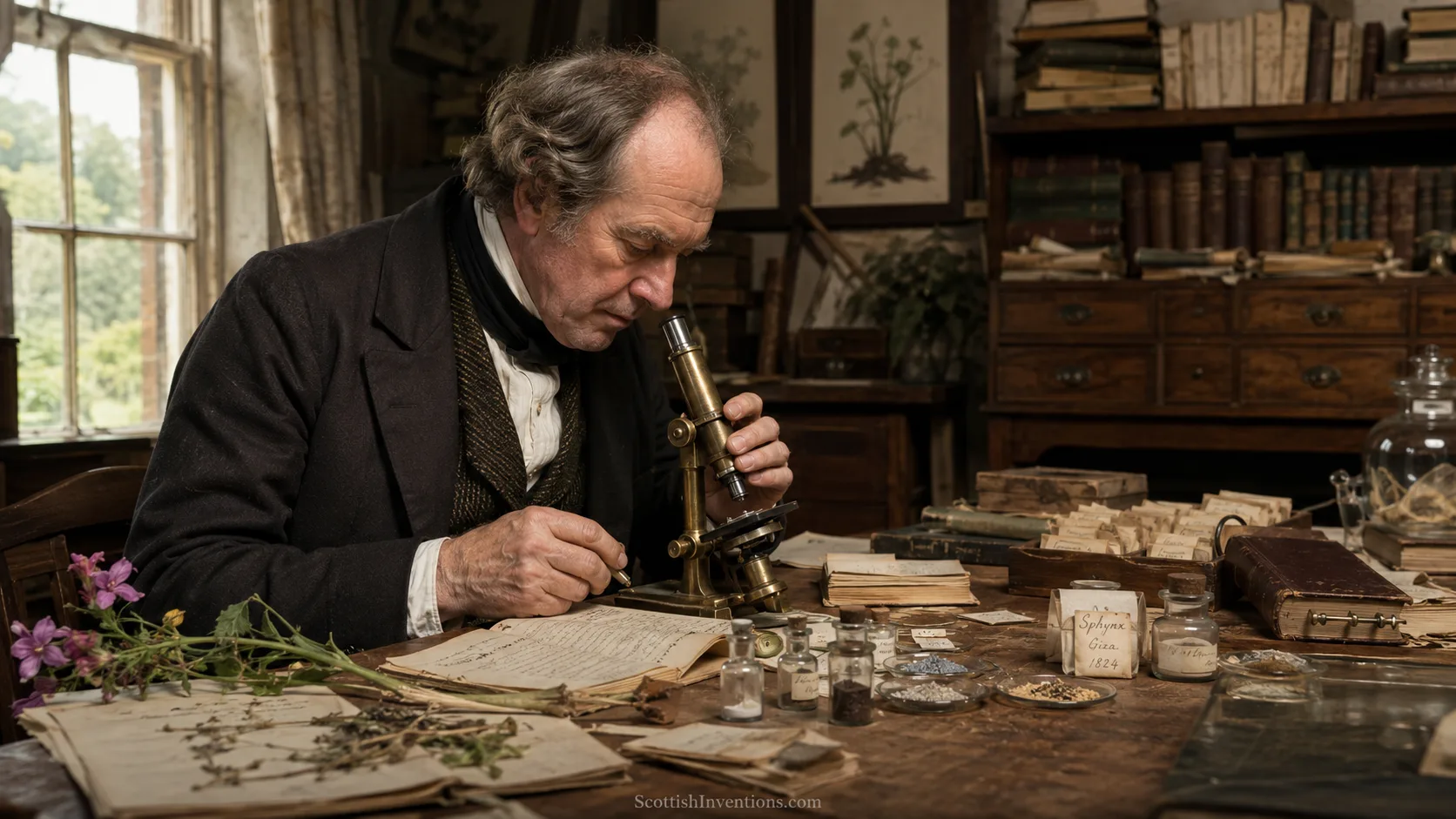
In 1827 a botanist from Montrose watched particles from a pollen grain move without ceasing. He tested dead matter. He tested minerals. He tested dust from a fragment of the Great Sphinx. Nothing stopped the motion — and nobody could explain it for seventy-eight years.
Robert Brown · 1773–1858Montrose · Edinburgh · LondonReading time · 17 minUpdated 2 August 2026
In Brief
Robert Brown, a botanist born in Montrose in 1773, carried out the first rigorous investigation of the ceaseless jittering of microscopic particles suspended in water — a phenomenon observed in London between June and August 1827 and published in 1828. Brown was not the first to see the motion, but he was the first to prove it was not caused by life, finding it in dead pollen, ground glass, minerals and even a fragment of the Great Sphinx. It matters because Albert Einstein's 1905 explanation of that motion became decisive evidence that matter is made of atoms.
Scottish Impact Index (SI Score)
- Global Impact
- 8/10
- Longevity
- 9/10
- Economic / Material Impact
- 4/10
- Originality / Distinctiveness
- 8/10
- Legacy (Built Upon)
- 9/10
- Recognition
- 4/10
Key Facts
- Discovery
- The first systematic investigation of Brownian motion, and the proof that it is not caused by life
- Key figure
- Robert Brown (1773–1858), botanist
- Born
- 21 December 1773, Montrose, Angus
- Died
- 10 June 1858, Soho Square, London, aged 84
- Observation
- June–August 1827, London
- Published
- 1828 — “A Brief Account of Microscopical Observations…”
- Field
- Botany · Microscopy · Physics legacy
- Test subject
- Pollen of Clarkia pulchella, then dead plant matter, glass, metals, coal, minerals, volcanic ash, meteorites and a fragment of the Great Sphinx
- Second discovery
- Named and generalised the cell nucleus, Linnean Society, 1831
- Explained by
- Albert Einstein, 1905; independently developed by Marian Smoluchowski, published 1906
- Confirmed by
- Jean Perrin, from 1908 — Nobel Prize in Physics, 1926
- Modern legacy
- Statistical physics, stochastic processes, cell biology, nanotechnology and quantitative finance
From Montrose to Science
Robert Brown was born on 21 December 1773 in Montrose, a burgh on the Angus coast of eastern Scotland. His father, the Reverend James Brown, was a minister in the Scottish Episcopal Church and a man of famously strong convictions, with Jacobite sympathies so firm that in 1788 he defied his own church's decision to swear allegiance to George III. His mother, Helen, was the daughter of a Presbyterian minister, Robert Taylor. Brown was reportedly born in a house on the site where Montrose Library now stands, and attended the local grammar school — now Montrose Academy — where his schoolfellows included the philosopher and historian James Mill.
At fourteen he proceeded to Marischal College in Aberdeen as a bursar. In 1789–90 the family moved to Edinburgh, where Brown enrolled to study medicine at the University of Edinburgh. Medicine lost out to his consuming passion for plants: he botanised in the Scottish Highlands, joined the Natural History Society of Edinburgh, and built a reputation among British botanists before holding any formal position.
In 1795, lacking the means to set up in medical practice, Brown took a commission as ensign and surgeon's mate in the Fifeshire Regiment of Fencibles, a home-defence unit raised during the French Revolutionary Wars. His letter of appointment, signed by Colonel James Durham, survives in the Natural History Museum. The regiment was posted to the north of Ireland, saw little action, and left him ample leisure — which he poured into botany, German grammar, and the study of mosses and liverworts.
HMS Investigator and the Making of a Botanist
The turning point came in London in 1798, where Brown met the most powerful man in British natural history: Sir Joseph Banks, the wealthy naturalist who had sailed with Captain Cook and now effectively directed British scientific exploration. When the naturalist Mungo Park withdrew from a planned voyage to New Holland — Australia — Banks recommended the young Scot, describing him as “a Scotchman, fit to pursue an object with constance and a cold mind.” Brown left the army and, in July 1801, sailed as naturalist aboard HMS Investigator under Captain Matthew Flinders on the first circumnavigation of Australia.
The voyage of 1801–1805 made Brown as a botanist. Working alongside the brilliant botanical illustrator Ferdinand Bauer and the gardener Peter Good, he amassed a vast collection of Australian plants, the great majority new to science. The exact tally varies by source: Wikipedia and Undiscovered Scotland state “about 3400 species, of which about 2000 were previously unknown”; Encyclopædia Britannica gives “approximately 3,900 species he had gathered, almost all of which were new to science”; and the Linnean Society records that the expedition “collected over 4,000 botanical specimens, of which Brown classified 2,040”. Part of the discrepancy is explained by the loss of much of the southern-coast collection when HMS Porpoise was wrecked on the Great Barrier Reef in August 1803.
Brown remained in Australia until May 1805, returning to England that October. His 1810 masterwork, Prodromus Florae Novae Hollandiae et Insulae Van Diemen, was the first systematic account of the Australian flora and established the “natural system” of classification. He is justly called the father of Australian botany.
Back in Britain, Brown was appointed clerk, librarian and housekeeper to the Linnean Society in December 1805, and succeeded Jonas Dryander as Banks's librarian in 1810. When Banks died in 1820 he bequeathed Brown the use of his library, herbarium and house in Soho Square. In 1827 these collections passed to the British Museum, and Brown negotiated for himself the position of Keeper of the new Botanical Department, a post he held until his death. He was elected a Fellow of the Royal Society in 1811, received its Copley Medal in 1839 “for his discoveries on the subject of vegetable impregnation”, and served as President of the Linnean Society from 1849 to 1853. Alexander von Humboldt called him Princeps Botanicorum — prince of botanists.
Microscopy and the “Life Force”, 1820s
To understand why Brown's observation mattered, you have to understand the science of the 1820s. The compound microscopes of the day suffered badly from optical aberrations — colour fringing and blurring that limited what could be trusted. The finest, sharpest work was often done with simple single-lens instruments, essentially superb magnifying glasses. Brown was a master of the simple microscope, and the instrument he used is preserved by the Linnean Society of London.
The intellectual climate was dominated by a debate now largely forgotten: vitalism, the widely held belief that living organisms possessed a unique “life force” — a vis vitalis or Lebenskraft — distinguishing living matter from dead and irreducible to ordinary physics and chemistry. Spontaneous, self-generated motion in organic matter was exactly the sort of thing naturalists took as evidence of that animating spark.
So when, in June 1827, Brown turned his lens on the fresh pollen of Clarkia pulchella — a pretty flowering plant newly introduced from North America — and saw the granules inside the grains in continuous, rapid, jittery, utterly random motion, the obvious first thought was that he was watching the machinery of life itself.
The 1827 Experiment: Clarkia pulchella
What separates Robert Brown from everyone who came before is what he did next. He did not leap to a conclusion; he set out to destroy it.
First he established the basic observation. Suspending pollen of Clarkia pulchella in water, he saw that the grains were filled with particles that were “very evidently in motion.” In his own words from the 1828 paper, the granules were “of unusually large size, varying from nearly 1/4000th to about 1/5000th of an inch in length, and of a figure between cylindrical and oblong”, alongside smaller, apparently spherical bodies that moved even more vigorously. He satisfied himself that the motion “arose neither from currents in the fluid, nor from its gradual evaporation, but belonged to the particle itself.”
What was he actually looking at?
Minerals, Meteorites and a Fragment of the Sphinx
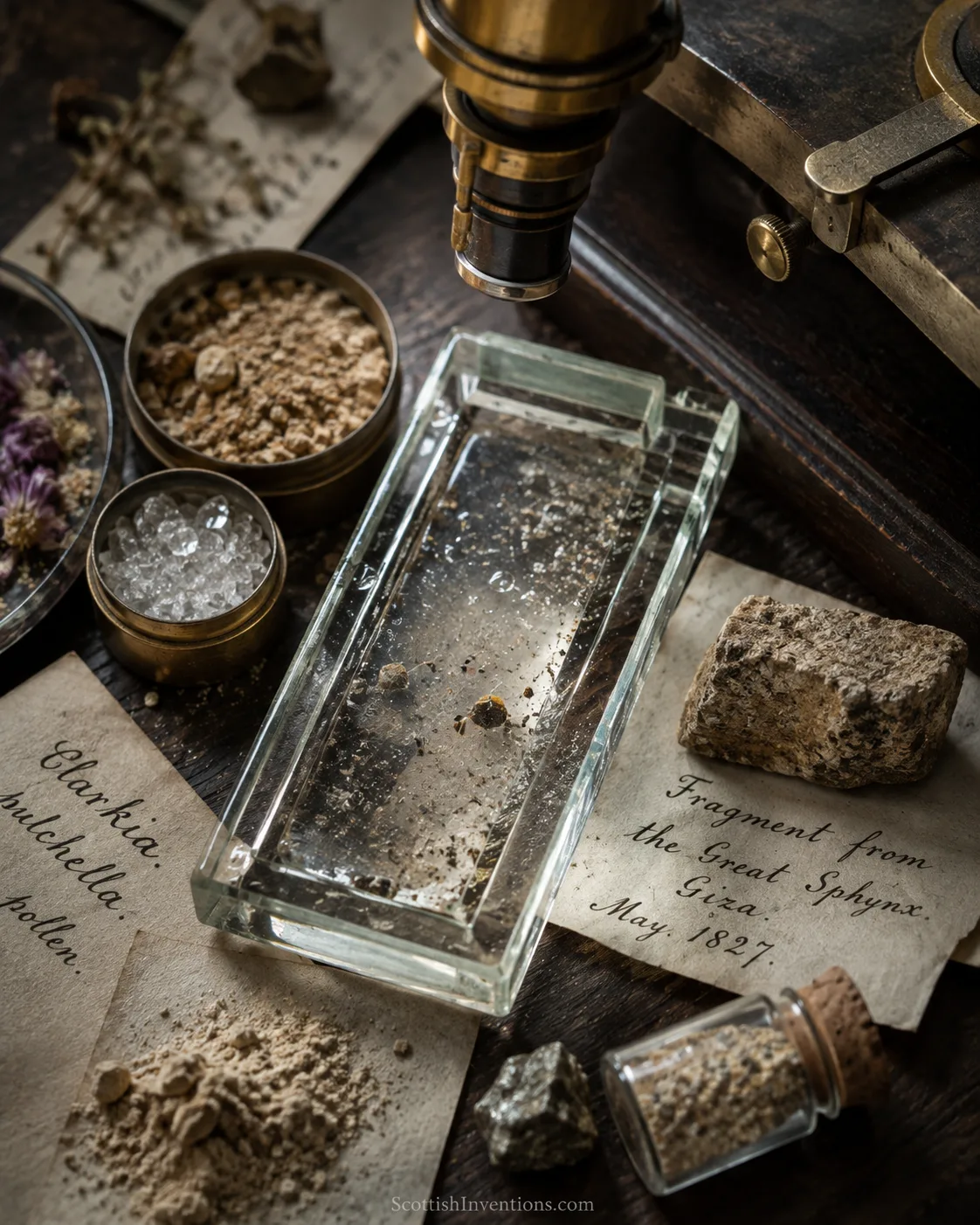
Then came the systematic demolition of the life-force hypothesis. Brown tested the pollen of plants that had been dead and dried for many years, even pollen stored for a century — and the motion continued. He tested other parts of plants. And then he took the decisive step: he tested matter that had never been alive at all.
He ground up window glass, metals, coal and minerals of every kind, and suspended the fine powder in water. Every sufficiently small particle danced. As a peer-reviewed history of the field records, Brown repeated his experiments with particles derived not only from dead plants but also from “rocks of all ages,…a fragment of the Sphinx…volcanic ashes, and meteorites from various localities.” The stone of one of humanity's oldest monuments jittered in his water drop exactly as the living pollen had.
Brown's conclusion was as bold as it was honest. The motion was a general property of all sufficiently small particles suspended in a fluid, whether organic or inorganic, living or dead. It had nothing to do with life. And — crucially — he confessed that he could not explain why it happened.
Observation is not explanation
Publication, 1828
Brown published his findings in 1828 in the celebrated pamphlet “A Brief Account of Microscopical Observations Made in the Months of June, July, and August, 1827, on the Particles Contained in the Pollen of Plants; and on the General Existence of Active Molecules in Organic and Inorganic Bodies.” Dated 30 July 1828, it was first printed privately in a small edition by Richard Taylor in London, then published in the Edinburgh New Philosophical Journal (pp. 358–371) and the Philosophical Magazine (vol. 4, pp. 161–173), and reprinted widely. He followed it in 1829 with “Additional Remarks on Active Molecules.”
Was Robert Brown Really the First?
No — and he knew it. As far back as around 60 BC the Roman poet Lucretius described the restless jiggling of dust motes in a sunbeam. More directly, the first to report the observation was the Dutch-born British scientist Jan Ingenhousz, best known as a discoverer of photosynthesis. In a small article published in 1784 called “Remarks on the use of the microscope”, Ingenhousz described his observations of the erratic movement of small pieces of charcoal in a drop of alcohol — an observation in inorganic matter that predates Brown by more than forty years. Some sources date it to 1785, and the priority claim is itself disputed: several commentators argue Ingenhousz may have been describing evaporation currents in rapidly drying alcohol rather than true Brownian motion. Other microscopists had also noticed motion in suspended particles.
What, then, justifies the name? The earlier observers tended either to connect the motion with some vitality of the moving particles or to note it in passing without serious investigation. Brown's claim to priority lies in establishing that the movement of microscopic particles suspended in liquids was a general phenomenon exhibited by all sufficiently small particles, independent of their chemical nature — and in systematically ruling out the obvious wrong explanations. He brought rigour, controls and the crucial inorganic experiments. That is why the phenomenon bears his name, and the credit is well earned even though the first sighting was not his.
Brown's Other Great Gift: Naming the Cell Nucleus
Remarkably, the man who gave his name to Brownian motion also gave biology one of its most fundamental words. Studying fertilisation in orchids and milkweeds, Brown noticed a single, consistent, slightly opaque circular body inside the cells of the orchid leaf epidermis. In a paper read to the Linnean Society in November 1831 — “Observations on the Organs and Mode of Fecundation in Orchideae and Asclepiadeae”, published in the Transactions of the Linnean Society in 1833 — he wrote that “In each cell of the epidermis of a great part of this family…a single circular areola, generally somewhat more opake than the membrane of the cell, is observable…This areola, or nucleus of the cell as perhaps it might be termed…” He gave the structure the name it still bears: the nucleus.
Honesty requires a note on priority here too. A few earlier observers had glimpsed the nucleus in particular cells. Brown's contribution, as the Dictionary of Scientific Biography puts it, was to be “the first specially to demonstrate its general occurrence in living cells and to give it the name ‘nucleus.'” That naming helped lay the groundwork for cell theory and modern cytology. Two foundational discoveries from one microscope is an extraordinary record.
The 78-Year Mystery
Here is the most extraordinary part of the story. From Brown's 1827 observations until 1905 — seventy-eight years — nobody could explain what caused the motion. A parade of hypotheses was proposed and found wanting. The vital-force idea Brown himself had demolished with his mineral and Sphinx experiments. Convection currents from heat or evaporation were ruled out; Brown had been careful about sealed environments. Surface tension, tiny temperature differences, electrical effects, mutual attraction or repulsion between particles: all were tried, and none survived scrutiny. The motion never stopped, never tired, never settled — and that perpetual quality is precisely what made it so baffling to nineteenth-century physics.
The true cause turns out to be both simple and profound. A speck suspended in water is being bombarded, ceaselessly and from every direction, by the individual molecules of the liquid, themselves in constant thermal motion. A large object feels these countless tiny impacts averaged out to nothing. But a particle small enough — a few thousandths of a millimetre — is small enough that, at any instant, the impacts from one side slightly outnumber those from the other purely by chance. Those random imbalances kick the particle this way and that, thousands of times a second, producing the endless jitter Brown saw. Brownian motion is the visible footprint of invisible molecules.
Einstein's 1905 Explanation
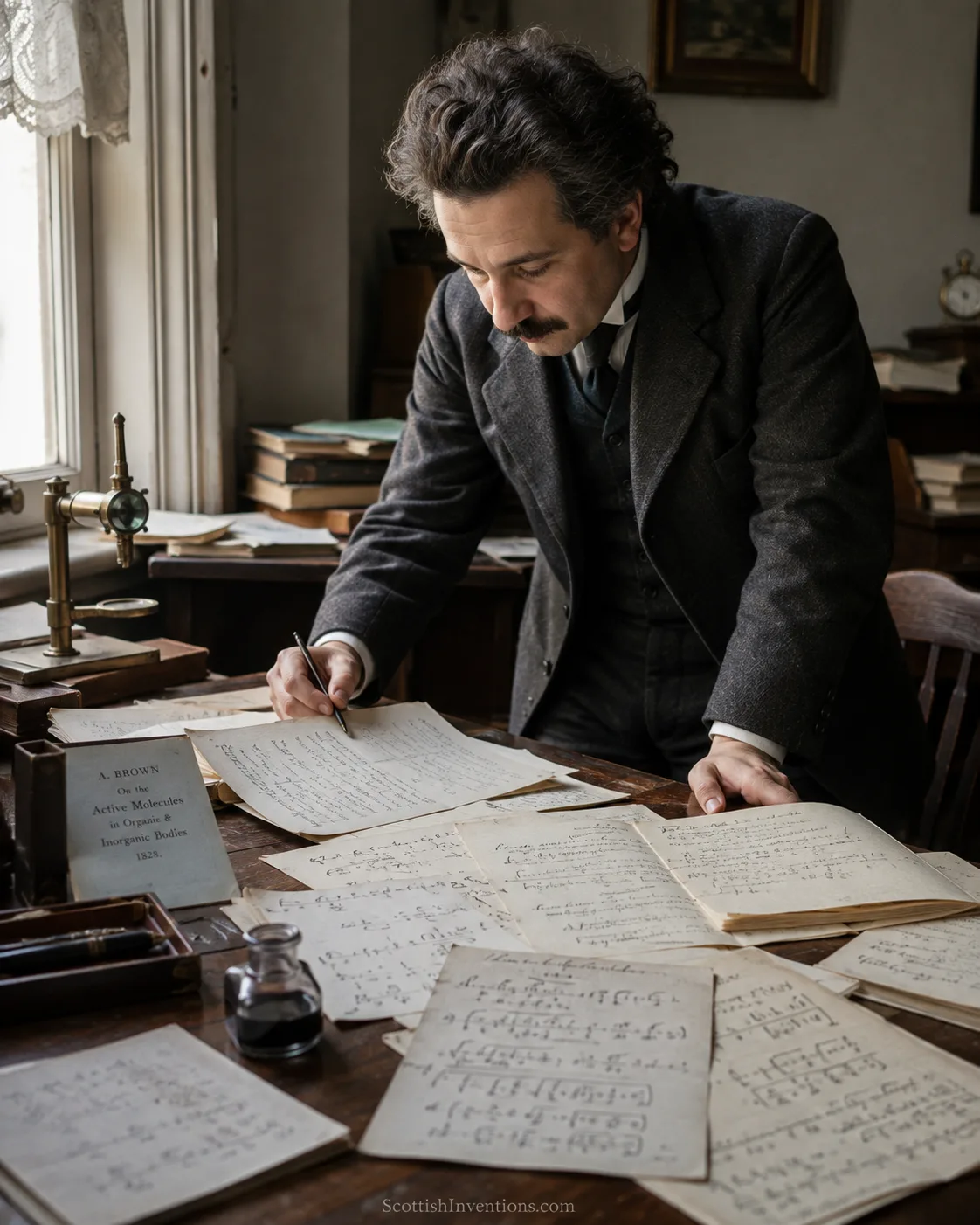
The explanation came from an unlikely quarter and at an astonishing moment. In 1905 — his annus mirabilis, the miracle year in which he also published special relativity, the mass–energy relation and the photoelectric-effect paper that would win him the Nobel Prize — a young patent clerk named Albert Einstein turned his attention to the motion of small suspended particles. His paper, received by Annalen der Physik on 11 May 1905, bore the title “Über die von der molekularkinetischen Theorie der Wärme geforderte Bewegung von in ruhenden Flüssigkeiten suspendierten Teilchen” — “On the Movement of Small Particles Suspended in a Stationary Liquid Required by the Molecular-Kinetic Theory of Heat.”
Einstein's genius was not merely to say that molecular bombardment caused the motion; others had guessed as much. It was to make the idea quantitative and testable. He derived a precise mathematical relationship showing that the mean square displacement of a suspended particle — how far, on average, it wanders — is proportional to time and temperature and inversely related to the fluid's viscosity and the particle's size. This is now known as the Einstein–Smoluchowski relation, after the Polish physicist Marian Smoluchowski, who arrived at essentially the same result by a different, collision-based method and published it in 1906.
The formula contained Avogadro's number — the number of molecules in a mole of substance. That meant an experimenter could watch particles jiggle under a microscope, measure their displacement, and calculate how many atoms are in a mole. If the answer came out sensible and consistent with other methods, atoms were real. If it came out as nonsense, the atomic theory was wrong. Einstein had handed experimentalists a recipe to settle one of the deepest debates in science.
Jean Perrin and the Reality of Atoms
That this debate still raged in 1905 is easy to forget. Influential scientists such as Wilhelm Ostwald and Ernst Mach genuinely doubted that atoms and molecules were real physical objects rather than convenient bookkeeping fictions. Brownian motion became the battleground.
The challenge was taken up by the French physicist Jean Perrin. Beginning in 1908, Perrin and his students conducted a meticulous series of experiments on suspensions of uniformly sized particles, measuring their distribution and displacement and extracting Avogadro's number by several independent methods. The results matched Einstein's predictions and converged on the same value. Perrin laid out the overwhelming case in his 1913 book Les Atomes, and the resistance collapsed; Ostwald publicly conceded. Perrin's definitive paper, “Le Mouvement Brownien et la Réalité Moléculaire”, appeared in 1909, and he was awarded the Nobel Prize in Physics in 1926 “for his work on the discontinuous structure of matter, and especially for his discovery of sedimentation equilibrium.”
The 1926 Nobel presentation speech
A Scottish botanist's puzzle had become the final proof that the world is made of atoms.
From a Pollen Grain to Wall Street
A final mathematical chapter completed the story. In 1923 the American mathematician Norbert Wiener gave Brownian motion its first rigorous mathematical construction, proving that a continuous-time random process with the required properties actually exists. In his honour, the mathematical idealisation of Brownian motion is called the Wiener process — the cornerstone of the modern theory of stochastic processes.
In finance, the Wiener process is the mathematical heart of quantitative modelling. The French mathematician Louis Bachelier had, in his 1900 thesis “Théorie de la spéculation”, used Brownian motion to model stock prices five years before Einstein's physics paper. That insight, refined into geometric Brownian motion, underlies the Black–Scholes model for pricing options, developed in 1973 — work for which Robert Merton and Myron Scholes received the 1997 Nobel Memorial Prize in Economic Sciences. Every day, vast volumes of financial derivatives are priced on mathematics whose ancestry runs straight back to a Scottish botanist watching pollen twitch in a water drop.
In biology and medicine, Brownian motion governs how proteins and molecules diffuse inside the crowded interior of living cells, and it is central to the design of drug-delivery systems, where nanoparticle “nanocarriers” must navigate the bloodstream to reach their targets. In nanotechnology it dominates behaviour at the nanometre scale, both as a challenge — jiggling that destabilises nanostructures and adds noise to nanosensors — and as a tool, driving the self-assembly of ordered structures. It appears too in atmospheric and environmental physics, in the diffusion and aggregation of fine particles. And in statistical physics it remains the most direct, visible macroscopic evidence for the kinetic theory of matter: you can literally watch the consequences of molecular motion through a lens.
Robert Brown's Legacy
Brown died on 10 June 1858 at Soho Square, London, aged 84. By all accounts he was an extraordinarily precise microscopist: modest, patient and intellectually scrupulous.
His legacy is honoured on two continents. The standard botanical author abbreviation “R.Br.” marks his name in plant taxonomy to this day, and over a hundred Australian plant species bear epithets such as brownii in his honour. His Australian herbarium specimens are dispersed across the world: the main set, particularly rich in Australian type material, is held at the Natural History Museum in London (herbarium code BM), with duplicate sets at institutions including the National Herbarium of Victoria (MEL) in Melbourne and the National Herbarium of New South Wales in Sydney — no complete set exists in Australia. In London, a 1938 London County Council plaque at 32 Soho Square commemorates Brown alongside Joseph Banks and the meetings of the Linnean Society. In his native Scotland, a memorial bust of Robert Brown — unveiled in Montrose on 18 October 1896 by his kinswoman Miss Hope Paton and sculpted by Mr Stevenson, R.S.A., of Edinburgh — was originally set into the wall of the house where he was born and is recorded as standing in the entrance hall of Montrose Library.
The arc is remarkable: a Montrose minister's son; a pollen grain from a North American flower; an unexplained microscopic movement; a set of inorganic controls that killed the obvious answer; seventy-eight years of silence; Einstein; the reality of atoms; stochastic mathematics; and today the modelling of cells, nanoparticles and derivatives markets. Robert Brown could not know why the particles moved. But by refusing to pretend that he did, and by proving what did not cause the motion, he left science a mystery important enough to help establish the atomic nature of matter.
Did You Know?
- Brown proved the motion was not a “life force” by testing dust from a fragment of the Great Sphinx of Egypt — and it danced too, alongside specimens of “rocks of all ages…volcanic ashes, and meteorites.”
- The phenomenon Brown described in 1827 was not explained until Einstein's 1905 paper — a 78-year mystery.
- Einstein's Brownian motion paper was one of four revolutionary papers published in his “miracle year”, alongside special relativity, E=mc² and the photoelectric effect.
- Brown also named and described the cell nucleus in 1831 — two foundational discoveries from a single microscope.
- The mathematics of Brownian motion models stock-market prices: a direct line from a Scottish botanist's microscope to the Black–Scholes formula.
- Jean Perrin won the 1926 Nobel Prize in Physics for confirming the theory and calculating Avogadro's number.
Timeline
c.60 BC
Lucretius describes dust motes jiggling in a sunbeam
An ancient observation, not an investigation
21 Dec 1773
Robert Brown born in Montrose, Angus
Son of the Reverend James Brown of the Scottish Episcopal Church
1784
Jan Ingenhousz reports erratic movement of charcoal in alcohol
“Remarks on the use of the microscope” — the earliest clear precursor, though itself disputed
1787
Brown enters Marischal College, Aberdeen, as a bursar, aged fourteen
The family moves to Edinburgh in 1789–90, where he studies medicine
1795
Commissioned as ensign and surgeon's mate, Fifeshire Regiment of Fencibles
Posted to the north of Ireland; he spends his leisure on botany and mosses
1798
Meets Sir Joseph Banks in London
Banks recommends him as “a Scotchman, fit to pursue an object with constance and a cold mind”
1801–1805
Naturalist aboard HMS Investigator with Captain Matthew Flinders
The first circumnavigation of Australia; thousands of specimens collected
1810
Publishes Prodromus Florae Novae Hollandiae et Insulae Van Diemen
The first systematic account of the Australian flora
1827
Appointed Keeper of the new Botanical Department at the British Museum
Banks's collections pass to the Museum that year
June–Aug 1827
Observes ceaseless motion in particles from Clarkia pulchella pollen
Then tests dead, dried and wholly inorganic material — the motion never stops
30 July 1828
“A Brief Account of Microscopical Observations…” is dated
Privately printed, then in the Edinburgh New Philosophical Journal and the Philosophical Magazine
1829
Publishes “Additional Remarks on Active Molecules”
Responding to the debate his pamphlet provoked
Nov 1831
Reads his orchid paper to the Linnean Society
Names the cell nucleus; published in the Transactions, 1833
1839
Awarded the Copley Medal of the Royal Society
For his work on plant fertilisation — not for Brownian motion
11 May 1905
Einstein's Brownian motion paper received by Annalen der Physik
A quantitative, testable theory of molecular bombardment
1906
Marian Smoluchowski publishes his independent treatment
The Einstein–Smoluchowski relation
1908–1913
Jean Perrin's experiments confirm Einstein's predictions
Les Atomes (1913); Nobel Prize in Physics, 1926
1923
Norbert Wiener gives Brownian motion a rigorous mathematical construction
The Wiener process, cornerstone of stochastic analysis
1973
The Black–Scholes option-pricing model is published
Built on geometric Brownian motion; Nobel Memorial Prize, 1997
Notes on the Evidence
Specimen figures vary by source, partly because some count species and others individual specimens, and partly because of the losses in the 1803 Porpoise wreck. The range is given above rather than a single figure.
The identity of Brown's particles. Modern work, notably the recreations by the microscopist Brian J. Ford, confirms that Brown genuinely observed Brownian motion; the oblong and spherical particles he saw are now identified as amyloplasts and spherosomes. A 1991 suggestion that his microscope was inadequate has been refuted.
“First” claims are layered. Brown was not the first to see the motion — Ingenhousz in 1784, and arguably Lucretius — nor the absolute first to glimpse a cell nucleus. He was the first to investigate the motion systematically, and the first to name and generalise the nucleus. The Ingenhousz priority claim is itself disputed.
Einstein and Smoluchowski. Einstein published first, in 1905; Smoluchowski developed his theory independently and largely beforehand, but published in 1906 after seeing Einstein's paper. Louis Bachelier had described the mathematics in a financial context in 1900.
The Copley Medal was awarded in 1839 for Brown's botanical work on plant fertilisation, not for Brownian motion, whose significance was not understood in his lifetime.
The Sphinx detail, though widely repeated, is grounded in Brown's own published words — a fragment of the Sphinx was among the specimens he examined — which makes it reliable rather than apocryphal.
Frequently Asked Questions
What did Robert Brown discover?
Robert Brown carried out the first systematic investigation of the continuous, random jittering of microscopic particles suspended in a fluid — the phenomenon now called Brownian motion. Observing pollen of Clarkia pulchella in June 1827, he found ceaseless motion in the particles inside the grains, then proved the motion was not a sign of life by finding the same behaviour in long-dead pollen, ground glass, metals, coal, minerals, volcanic ash, meteorites and a fragment of the Great Sphinx.
What is Brownian motion?
Brownian motion is the ceaseless, random movement of microscopic particles suspended in a liquid or gas. It is caused by the molecules of the fluid, themselves in constant thermal motion, bombarding the particle from every direction. A large object feels those countless impacts averaged out to nothing, but a particle a few thousandths of a millimetre across is small enough that, at any instant, the impacts on one side slightly outnumber those on the other purely by chance — kicking it this way and that thousands of times a second.
What did Robert Brown observe in 1827?
Suspending fresh pollen of Clarkia pulchella in water, Brown saw that the grains contained particles that were, in his words, “very evidently in motion”: oblong granules “varying from nearly 1/4000th to about 1/5000th of an inch in length”, alongside smaller spherical bodies that moved even more vigorously. He satisfied himself that the motion “arose neither from currents in the fluid, nor from its gradual evaporation, but belonged to the particle itself.”
Was Robert Brown the first person to see Brownian motion?
No, and he knew it. Lucretius described dust motes jiggling in a sunbeam around 60 BC, and in 1784 Jan Ingenhousz reported the erratic movement of small pieces of charcoal in a drop of alcohol — though some commentators argue Ingenhousz may have been describing evaporation currents. Brown's claim rests not on being first to see the motion but on being the first to investigate it systematically, rule out the obvious wrong explanations, and establish that it occurs in all sufficiently small particles regardless of chemical nature.
Why did Robert Brown test inorganic particles?
Because the leading explanation of his day was vitalism — the belief that living matter possessed a unique “life force” capable of self-generated motion. Spontaneous movement in organic matter looked like evidence of that force. By grinding up window glass, metals, coal, minerals, volcanic ash and meteorites and finding that every sufficiently small particle danced in exactly the same way, Brown demonstrated that the motion had nothing whatever to do with life.
How did Einstein explain Brownian motion?
In a paper received by Annalen der Physik on 11 May 1905, Albert Einstein showed that the motion is produced by the thermal bombardment of the suspended particle by the molecules of the surrounding liquid — and, crucially, made the idea quantitative. He derived a relationship showing that the mean square displacement of a suspended particle is proportional to time and temperature and inversely related to the fluid's viscosity and the particle's size. Marian Smoluchowski reached essentially the same result independently, publishing in 1906.
How did Brownian motion prove that atoms exist?
Einstein's formula contained Avogadro's number, the number of molecules in a mole of substance. An experimenter could therefore watch particles jiggle under a microscope, measure their displacement and calculate how many atoms are in a mole. From 1908 Jean Perrin did exactly that, extracting consistent values by several independent methods; his results matched Einstein's predictions, sceptics such as Wilhelm Ostwald conceded, and the physical reality of atoms and molecules was settled.
Why is Brownian motion used in finance?
The mathematical idealisation of Brownian motion — the Wiener process, given rigorous form by Norbert Wiener in 1923 — is the standard model of a continuously fluctuating random quantity. Louis Bachelier had already used Brownian motion to model stock prices in his 1900 thesis, five years before Einstein's physics paper. Refined into geometric Brownian motion, it underpins the Black–Scholes option-pricing model of 1973, work for which Robert Merton and Myron Scholes received the 1997 Nobel Memorial Prize in Economic Sciences.
Sources & Further Reading
- Brown, R. — “A Brief Account of Microscopical Observations Made in the Months of June, July, and August, 1827, on the Particles Contained in the Pollen of Plants; and on the General Existence of Active Molecules in Organic and Inorganic Bodies,” dated 30 July 1828; Edinburgh New Philosophical Journal, pp. 358–371; Philosophical Magazine, vol. 4, pp. 161–173.
- Brown, R. — “Additional Remarks on Active Molecules,” 1829.
- Brown, R. — “Observations on the Organs and Mode of Fecundation in Orchideae and Asclepiadeae,” read to the Linnean Society November 1831; Transactions of the Linnean Society, 1833.
- Brown, R. — Prodromus Florae Novae Hollandiae et Insulae Van Diemen, 1810.
- Ingenhousz, J. — “Remarks on the use of the microscope,” 1784.
- Einstein, A. — “Über die von der molekularkinetischen Theorie der Wärme geforderte Bewegung von in ruhenden Flüssigkeiten suspendierten Teilchen,” Annalen der Physik, received 11 May 1905.
- Smoluchowski, M. — independent treatment of Brownian motion, 1906.
- Perrin, J. — “Le Mouvement Brownien et la Réalité Moléculaire,” 1909; Les Atomes, 1913.
- The Nobel Foundation — Nobel Prize in Physics 1926 presentation speech (Jean Perrin).
- Wiener, N. — rigorous mathematical construction of Brownian motion, 1923.
- Bachelier, L. — “Théorie de la spéculation,” doctoral thesis, 1900.
- Dictionary of Scientific Biography — entry on Robert Brown.
- Linnean Society of London; Natural History Museum, London; Encyclopædia Britannica — biographical and collection records.
- Ford, B. J. — modern recreations of Brown's microscopical observations.
Discoveries · No. 9 of 50
Brownian Motion joins the Discoveries series
Collector card artwork for this discovery is in production. In the meantime, explore the rest of the collection.