Discoveries · No. 25 of 50 · Medicine
Manson and Bruce: Tropical Medicine and Vector-Borne Disease
Two Scottish-linked doctors, working a generation apart in China and southern Africa, helped prove that insects — not bad air or dirty water — carry the parasites behind some of the world's deadliest diseases.
Sir Patrick Manson · 1844–1922Sir David Bruce · 1855–1931Amoy 1877–78 · Zululand 1894–95 · Uganda 1903Reading time · 19 min
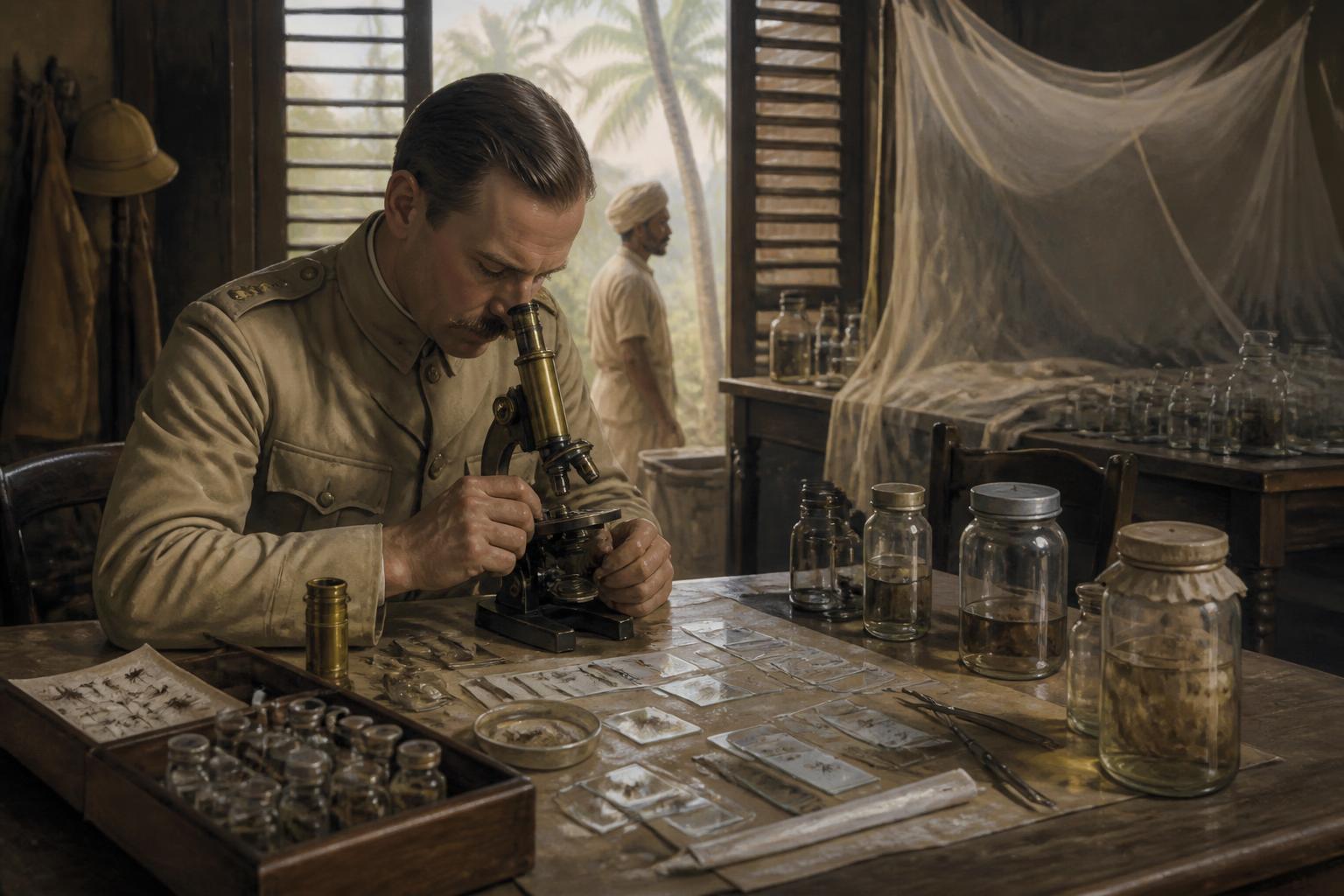
TL;DR
- This card covers two separate discoveries united by a single theme: that biting insects transmit the parasites causing major tropical diseases. They are not the same story and are told here in two clearly separate sections.
- Patrick Manson, born in Oldmeldrum, Aberdeenshire, proved in 1877–78 in Amoy, China, that mosquitoes ingest the microfilariae of a human parasite — the first demonstration that any insect could carry a human disease agent. He later proposed that mosquitoes spread malaria, a hypothesis proved by Ronald Ross and, independently, Giovanni Battista Grassi's Italian team.
- David Bruce, born in Melbourne to Scottish parents and raised in Stirling, identified the trypanosome parasite behind cattle nagana in Zululand (1894–95) and, with a 1903 Uganda commission, proved the tsetse fly transmits the parasite causing human sleeping sickness — work that depended on Aldo Castellani's prior finding and his wife Mary Bruce's largely uncredited laboratory contribution.
- Credit for both discoveries is genuinely shared. Neither Manson nor Bruce completed the chain of proof alone, and this article says so plainly, section by section.
Scottish Impact Index (SI Score)
- Global Impact
- 9/10
- Longevity
- 9/10
- Economic / Material Impact
- 7/10
- Originality / Distinctiveness
- 9/10
- Legacy (Built Upon)
- 9/10
- Recognition
- 4/10
Key Findings
- In 1877–78, Patrick Manson showed that Culex mosquitoes feeding on infected patients in Amoy took up Wuchereria bancrofti microfilariae, the parasite behind elephantiasis — the first proof an insect could transmit a human parasitic disease.
- Manson's 1894 "mosquito-malaria hypothesis" reasoned by analogy that mosquitoes might also spread malaria. It was Ronald Ross, working in India with Manson's guidance, who proved the transmission cycle in 1897–98 and won the 1902 Nobel Prize for it; Giovanni Battista Grassi's Italian team separately confirmed human malaria transmission by Anopheles mosquitoes.
- Manson founded the London School of Hygiene & Tropical Medicine in 1899, giving tropical medicine an institutional and academic home for the first time.
- In Zululand in 1894–95, David Bruce and Mary Bruce identified Trypanosoma brucei as the cause of nagana, a wasting disease of cattle and horses, and traced its transmission to the tsetse fly genus Glossina.
- Bruce's 1903 Uganda commission proved that Glossina palpalis transmits the related trypanosome causing human sleeping sickness — but the parasite's presence in human cerebrospinal fluid had already been demonstrated by Aldo Castellani, whose priority claim is still debated.
Quick Facts
- Discovery
- Insect (mosquito and tsetse fly) transmission of human and animal parasitic disease
- Discoverers
- Sir Patrick Manson (1844–1922) and Sir David Bruce (1855–1931)
- Manson born
- Oldmeldrum, Aberdeenshire, Scotland, 1844
- Bruce born
- Melbourne, Australia, 1855, to Scottish parents; raised in Stirling
- Field
- Medicine · Parasitology · Tropical Medicine
- Manson's key year
- 1877–78, Amoy (Xiamen), China — mosquito uptake of filarial microfilariae
- Bruce's key years
- 1894–95 Zululand (nagana); 1903 Uganda (sleeping sickness)
- Claim status
- Shared — credit divides between Manson, Ross, Grassi, Bruce, Castellani and Mary Bruce
- Legacy
- London School of Hygiene & Tropical Medicine (1899); modern vector-control medicine
- Nobel recognition
- Ronald Ross, 1902 Nobel Prize in Physiology or Medicine, for malaria transmission
A. Patrick Manson & the Mosquito-Parasite Link
Sir Patrick Manson was born in Oldmeldrum, Aberdeenshire, in 1844, the son of the local laird's factor. He studied medicine at the University of Aberdeen, graduating with distinction, and in 1866 joined the Chinese Imperial Maritime Customs Service as a medical officer — the beginning of a career spent almost entirely in the Far East rather than in Scotland. It was this expatriate medical practice, treating patients with grotesque and poorly understood tropical afflictions, that gave him his defining opportunity.
Manson's Early Life
After qualifying, Manson spent time in Formosa (Taiwan) before settling, from 1871, in the treaty port of Amoy (now Xiamen) on the Chinese coast. There he built a busy general practice among both Chinese and expatriate patients and became fascinated by elephantiasis, the grotesque swelling of limbs and other body parts caused by chronic lymphatic filariasis. Contemporary medicine had no idea how the disease was contracted or spread; Manson set out to find out, applying the patient, observational rigour more usually associated with natural history than with a busy colonial medical practice.
Amoy, 1877–78
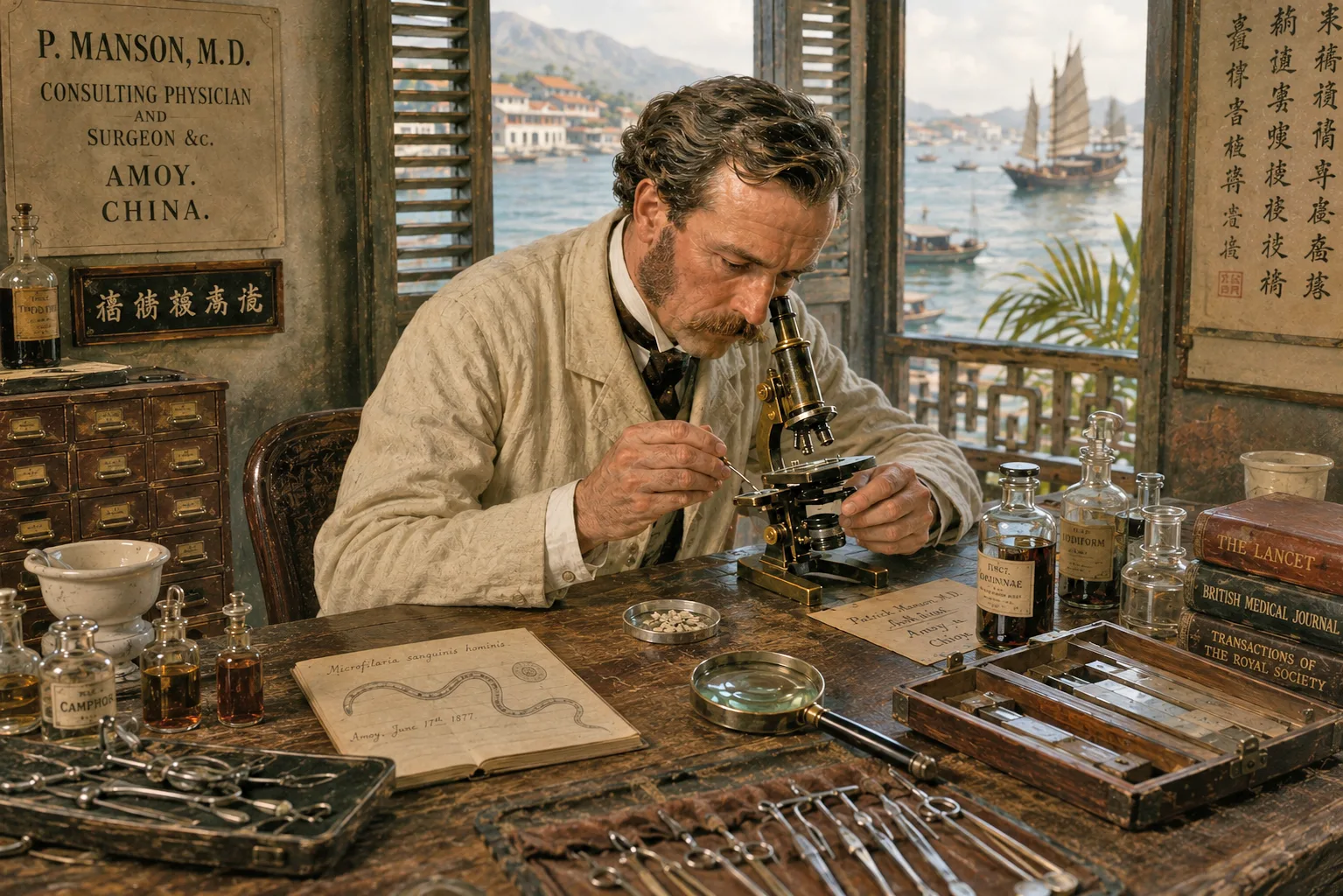
Manson knew that the blood of patients with elephantiasis contained microscopic thread-like larvae, later named microfilariae of Wuchereria bancrofti, which appeared in the peripheral blood mainly at night. He suspected a blood-feeding insect might be the means by which the parasite left one host and reached another, and he designed a direct experiment: he had mosquitoes of the genus Culex feed on an infected gardener, then dissected the insects at intervals afterwards.
In 1877–78 he found that the microfilariae, once ingested, developed further inside the mosquito's body. This was the crucial demonstration: an insect could act as an obligatory intermediate host, carrying a parasitic stage of a human disease agent from one person toward another. No one had previously proved that an insect could transmit any human disease at all. Manson's Amoy experiment is now recognised as the founding observation of the entire field of insect-vectored disease.
Manson's own theory of exactly how the parasite then reached a new human host was incomplete and in part mistaken — he initially believed people were infected by drinking water contaminated by dead mosquitoes, rather than by the bite of a live, blood-feeding insect. The details would be corrected by later workers, but the essential principle — mosquito as vector — was his, and it was decisive.
The Mosquito-Malaria Hypothesis
Manson moved his practice to Hong Kong and eventually, in 1890, to London, where he became physician to the Seamen's Hospital Society in Greenwich and medical adviser to the Colonial Office. Drawing on his Amoy work, in 1894 he proposed the "mosquito-malaria hypothesis": that malaria, like filariasis, might be transmitted by mosquitoes rather than by miasma ("bad air") or contaminated water, as most physicians still assumed.
Manson did not have the opportunity to test this hypothesis himself. Instead he mentored and urged a young army surgeon then working in India, Ronald Ross, to pursue it, coaching him by letter over several years and teaching him the dissection techniques Manson had developed at Amoy.
Ronald Ross & Grassi: Who Proved What
This is where credit must be divided carefully. It was Ronald Ross, working in Secunderabad and Calcutta in 1897–98, who first demonstrated the actual transmission cycle of a malaria parasite: he found the parasite developing inside the stomach wall of an Anopheles mosquito that had fed on an infected bird, and traced its migration to the mosquito's salivary glands, from which it could infect a new host on the next bite. This was the experimental proof Manson's hypothesis needed, and Ross alone was awarded the 1902 Nobel Prize in Physiology or Medicine for it.
Working largely independently in Italy, Giovanni Battista Grassi and colleagues went further and faster in one crucial respect: in 1898–1900 they identified the specific mosquito species, Anopheles claviger, responsible for transmitting human malaria, and confirmed the full cycle in humans rather than birds. A bitter and long-running priority dispute followed between Ross and Grassi over who deserved primary credit for the human malaria discovery; historians of medicine generally regard both contributions as essential and largely independent, with Ross credited for the foundational transmission-cycle proof and Grassi's team credited for establishing the human-specific vector and cycle.
Manson's role in all of this was that of theorist, teacher and institutional champion — indispensable, but distinct from the experimental proof itself. He should be credited as the man who first showed insects could carry human parasites and who correctly guessed malaria's mode of transmission, not as the discoverer of the malaria transmission cycle.
Founding Tropical Medicine
Manson's most durable institutional legacy came in 1899, when he helped found the London School of Hygiene & Tropical Medicine (originally the London School of Tropical Medicine), giving the field a permanent academic and research home and training generations of colonial and later international public-health doctors. He is widely known as the "Father of Tropical Medicine", a title that reflects his role as founder of the discipline rather than sole discoverer of every mechanism within it. He was knighted in 1903 and died in London in 1922.
B. David Bruce & the Tsetse Fly
Sir David Bruce is the second, entirely separate strand of this discovery card. He was born in Melbourne, Australia, in 1855, to Scottish parents; the family returned to Scotland when David was about five years old, and he was raised in Stirling and later educated at the University of Edinburgh, where he took his medical degree in 1881. His biography is properly described as Australian-born and Scottish-raised and -trained — not Scottish-born — and this article states that plainly rather than smoothing it over.
Bruce's Early Life
After Edinburgh, Bruce joined the Army Medical Service and served in Malta, where in 1887–89 he isolated the bacterium responsible for "Malta fever" (later named Brucella melitensis in his honour), an important but separate discovery from the tsetse-fly work covered here. In 1883 he married Mary Elizabeth Steele, herself a capable scientist and expert microscopist, who would work alongside him for the rest of his career, including on the investigations described below.
Zululand, 1894–95: Nagana
In 1894, Bruce was sent to Zululand (in present-day South Africa) to investigate nagana, a wasting disease that was devastating cattle, horses and other domestic animals across large parts of southern and central Africa, and had frustrated European agricultural and military efforts for decades. Working with Mary Bruce, who prepared and examined blood specimens under the microscope, David Bruce identified microscopic parasites — trypanosomes, later named Trypanosoma brucei in his honour — swimming in the blood of affected animals.
Crucially, the Bruces went beyond simply naming the parasite: they demonstrated that the disease was transmitted by the bite of the tsetse fly (genus Glossina), which was endemic to the areas where nagana occurred and absent from areas where it was not. This was one of the first clear demonstrations that a fly, rather than a mosquito, could transmit a parasitic disease, and it built directly on the conceptual foundation Manson had laid in China two decades earlier.
Uganda, 1903: Sleeping Sickness
A related but distinct disease, human sleeping sickness (African trypanosomiasis), was causing a catastrophic epidemic around Lake Victoria in Uganda in the early 1900s, killing hundreds of thousands of people. In 1903, Bruce led a Royal Society commission to investigate. Building on his Zululand methodology, and again working with Mary Bruce, he established that the trypanosome causing human sleeping sickness was transmitted by the tsetse fly Glossina palpalis, which bred along the shores of the lake. This finding allowed colonial and later independent public-health authorities to design vector-control measures — clearing lakeshore vegetation, resettling populations away from fly-infested areas — that measurably reduced transmission.
Castellani, Priority & Mary Bruce
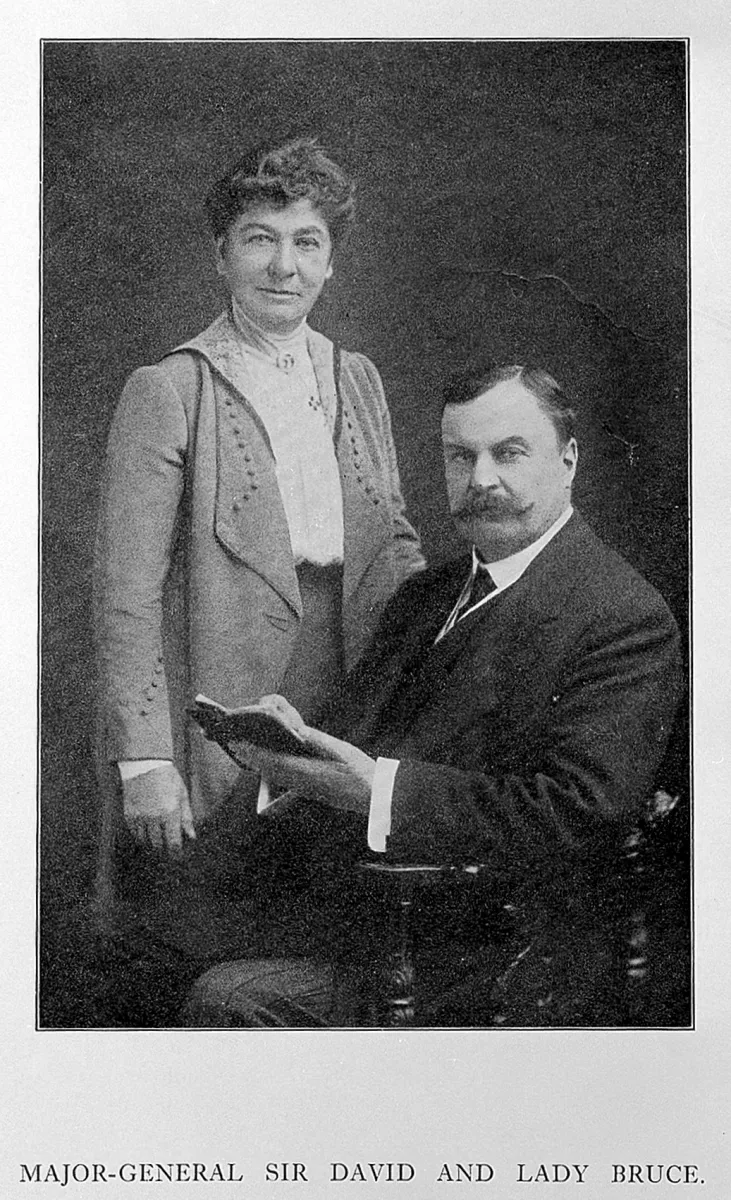
Bruce's Uganda triumph is genuinely shared, and the sharing is contested rather than tidy. The Italian bacteriologist Aldo Castellani arrived in Uganda slightly ahead of Bruce's 1903 mission and found trypanosomes in the cerebrospinal fluid of patients with sleeping sickness — the first demonstration that the parasite was actually present in the disease Bruce's commission had been sent to explain. Castellani, however, initially suspected a different organism (a streptococcus) might also be involved, and it was Bruce's team that established the trypanosome as the definite cause and, far more importantly for public health, identified the tsetse fly as the vector responsible for transmission. Castellani and Bruce disputed priority for years afterwards, each accusing the other of insufficient acknowledgement; most historical accounts credit Castellani with the human parasitological finding and Bruce's commission with the epidemiologically decisive vector identification, and this article follows that division rather than awarding either man sole credit.
Mary Elizabeth Bruce deserves explicit mention on her own terms. She trained in science, worked as her husband's principal laboratory collaborator for over three decades, prepared and examined the great majority of the microscope slides underlying both the Zululand and Uganda findings, and accompanied David Bruce on his fieldwork in conditions that were arduous and often dangerous. Contemporary scientific convention credited this labour to "Bruce" alone; modern historians of medicine increasingly treat the Bruces' trypanosomiasis discoveries as a genuine scientific partnership, and this article does the same.
Timeline
The two strands are interleaved below by date, with each entry clearly labelled A (Manson/malaria) or B (Bruce/tsetse) so the two discoveries are never conflated.
1844 · A · Manson / Malaria
Patrick Manson born in Oldmeldrum, Aberdeenshire
Son of a laird's factor; studies medicine at Aberdeen
1855 · B · Bruce / Tsetse
David Bruce born in Melbourne, Australia, to Scottish parents
Family returns to Stirling, Scotland, when David is five
1866 · A · Manson / Malaria
Manson takes his medical degree and sails for the Far East
Joins the Chinese Imperial Maritime Customs Service as a physician
1871 · A · Manson / Malaria
Manson settles in Amoy (Xiamen), China
Begins studying elephantiasis and filarial disease among his patients
1876–81 · B · Bruce / Tsetse
Bruce studies natural science and medicine at the University of Edinburgh
Graduates MB with honours in 1881
1877–78 · A · Manson / Malaria
Manson demonstrates Culex mosquitoes ingest Wuchereria bancrofti microfilariae
First proof that an insect can act as an intermediate host for a human parasite
1883 · A · Manson / Malaria
Manson relocates to Hong Kong; later moves to London (1890)
Becomes physician to the Seamen's Hospital Society and consultant to the Colonial Office
1883 · B · Bruce / Tsetse
Bruce marries Mary Elizabeth Steele, a fellow scientist and skilled microscopist
She becomes his lifelong, largely uncredited laboratory partner
1889 · B · Bruce / Tsetse
Bruce identifies the bacterium causing Malta fever (undulant fever/brucellosis)
Later named Brucella in his honour; separate from the mosquito/tsetse work
1894 · A · Manson / Malaria
Manson proposes the 'mosquito-malaria hypothesis'
Argues mosquitoes, not water or 'bad air', spread malaria; urges Ronald Ross to test it in India
1894–95 · B · Bruce / Tsetse
Bruce, with Mary Bruce, investigates 'nagana' in Zululand
Identifies the trypanosome parasite Trypanosoma brucei as the cause, transmitted by tsetse flies (Glossina)
1897–98 · A · Manson / Malaria
Ronald Ross demonstrates the malaria transmission cycle in Anopheles mosquitoes and birds, India
Confirms Manson's hypothesis experimentally; the decisive proof for human relevance
1898–1900 · A · Manson / Malaria
Giovanni Battista Grassi's Italian team establishes that Anopheles claviger transmits human malaria
A rival, largely independent line of proof, disputed with Ross over priority
1899 · A · Manson / Malaria
Manson co-founds the London School of Hygiene & Tropical Medicine
Establishes tropical medicine as a distinct academic discipline
1902 · A · Manson / Malaria
Ronald Ross awarded the Nobel Prize in Physiology or Medicine
For his work on malaria; Manson never received a Nobel
1902–03 · B · Bruce / Tsetse
Aldo Castellani, in Uganda, finds trypanosomes in the cerebrospinal fluid of sleeping-sickness patients
Establishes the parasite's presence in human disease, ahead of Bruce's arrival
1903 · B · Bruce / Tsetse
Bruce leads the Royal Society's Uganda sleeping-sickness commission
Establishes that Glossina palpalis transmits the trypanosome causing human sleeping sickness
1908–14 · B · Bruce / Tsetse
Bruce continues fieldwork on trypanosomiasis in Uganda and Nyasaland
Consolidates the transmission model still used in vector control today
Did You Know?
- Manson tested his mosquito-filaria hypothesis on his own gardener in Amoy, having the man bitten deliberately as part of the experiment.
- Manson never travelled to the tropics to see malaria transmission proved — he mentored Ronald Ross from London and India by letter.
- Ronald Ross and Giovanni Battista Grassi's priority dispute over malaria transmission became one of the most acrimonious in the history of medicine.
- David Bruce was born in Australia, not Scotland — his Scottish identity comes from his parents, his Stirling upbringing and his Edinburgh medical training.
- The bacterium Bruce discovered in Malta, Brucella, now names an entire disease, brucellosis, distinct from the trypanosome work covered here.
- Mary Bruce's name rarely appears on the papers describing 'Bruce's' trypanosome findings, despite her central laboratory role.
- The species name Trypanosoma brucei still honours David Bruce, more than a century after the Zululand fieldwork.
Honest Caveats
Manson did not discover malaria's transmission cycle. He proposed the mosquito hypothesis and trained Ross, but the experimental proof — and the 1902 Nobel Prize for it — belongs to Ronald Ross, with Giovanni Battista Grassi's team establishing the human-specific Anopheles vector largely independently. Treating Manson as the discoverer of malaria transmission would be inaccurate.
David Bruce was not born in Scotland. He was born in Melbourne, Australia, to Scottish parents, and his formative scientific identity was forged in Stirling and Edinburgh. His inclusion in a Scottish Inventions collection rests on his upbringing, education and career-long Scottish and British institutional ties, not on his birthplace.
Bruce did not discover the human sleeping-sickness parasite first. Aldo Castellani found trypanosomes in the cerebrospinal fluid of human patients in Uganda shortly before Bruce's 1903 commission arrived. Bruce's team's distinct and epidemiologically vital contribution was identifying the tsetse fly as the vector transmitting that parasite between people.
Mary Bruce's contribution was substantial and under-credited. Contemporary publications attributed the Zululand and Uganda findings to "Bruce" alone; this reflected the conventions of the era rather than the actual division of laboratory labour, and modern accounts increasingly name her as a genuine scientific collaborator.
Two discoveries, one card. Manson's mosquito-filaria and malaria-hypothesis work and Bruce's tsetse-nagana and sleeping-sickness work are unrelated in their specific parasites, insects and geography. They are grouped here because both concern insect-vectored tropical disease and both involve Scottish-linked physicians whose credit must be shared with collaborators and rivals — not because they are the same scientific event.
Frequently Asked Questions
Who first proved that insects transmit human parasitic disease?
Sir Patrick Manson, working in Amoy, China, in 1877–78, was the first to demonstrate that a mosquito (Culex) could take up the microfilariae of Wuchereria bancrofti, the parasite causing elephantiasis, from human blood. This was the first proof that any insect could act as an intermediate host for a human parasite, and it opened the door to the mosquito theory of malaria.
Did Patrick Manson discover that mosquitoes transmit malaria?
Not exactly. Manson proposed the mosquito-malaria hypothesis in 1894, reasoning by analogy from his filaria work, and he persuaded Ronald Ross, then working in India, to test it. It was Ross who demonstrated the actual transmission cycle of malaria parasites in Anopheles mosquitoes and birds in 1897–98, work for which Ross alone won the 1902 Nobel Prize in Physiology or Medicine. Giovanni Battista Grassi's Italian team separately and rapidly established that Anopheles claviger transmits human malaria specifically, and a bitter and still-debated priority dispute followed between Ross and Grassi. Manson is honoured as the theorist and mentor, not as the discoverer of the malaria cycle itself.
Was Patrick Manson Scottish?
Yes. Manson was born in Oldmeldrum, Aberdeenshire, in 1844 and trained in medicine at the University of Aberdeen before working for decades in China and Hong Kong.
Was David Bruce Scottish?
This needs care. David Bruce was born in Melbourne, Australia, in 1855, to Scottish parents. The family returned to Scotland when he was five, and he was raised in Stirling and educated at the University of Edinburgh, which is where his scientific identity was formed. He is properly described as Scottish-raised and Scottish-trained, not Scottish-born.
What did David Bruce discover?
In Zululand in 1894–95, Bruce identified the trypanosome parasite (later named Trypanosoma brucei) as the cause of nagana, a wasting disease of cattle and horses, and showed it was transmitted by tsetse flies of the genus Glossina. In 1903 he led a Royal Society commission to Uganda that established that Glossina palpalis transmits the related trypanosome causing human sleeping sickness (African trypanosomiasis).
Did David Bruce work alone?
No. His wife, Mary Elizabeth Bruce, a trained scientist and expert microscopist, worked alongside him throughout the Zululand and Uganda investigations, preparing specimens and making key microscopic observations. She received little formal credit in an era when a wife's scientific labour was routinely folded into her husband's name. The Italian bacteriologist Aldo Castellani also has a strong claim: working in Uganda slightly ahead of Bruce's 1903 mission, Castellani found trypanosomes in the cerebrospinal fluid of sleeping-sickness patients, establishing the parasite's role in human disease. Bruce's commission then identified the tsetse fly as the vector. Priority between Bruce and Castellani was disputed at the time and remains a matter of historical judgement rather than settled consensus.
Are the Manson and Bruce discoveries the same thing?
No — they are two distinct discoveries linked by a common theme (insect-vectored tropical disease) and a shared institutional legacy in British tropical medicine, but they involve different parasites, different insects, different diseases and different scientists. This article treats them as two separate strands, not one story.
Why is this card marked 'shared' rather than a clean Scottish first?
Because in both strands the decisive final proof, or an essential part of it, belongs partly or wholly to non-Scots: Ronald Ross and Giovanni Battista Grassi for the malaria transmission cycle, and Aldo Castellani for the human trypanosome finding in Uganda, alongside Mary Bruce's uncredited laboratory work. Manson and Bruce made foundational, indispensable contributions, but neither discovery is a solo Scottish achievement from first observation to final proof.
Sources & Further Reading
Tier 1 · Primary
- Manson, P. — "On the development of Filaria sanguinis hominis," Journal of the Linnean Society, Zoology, 1878.
- Manson, P. — "On the nature and significance of the crescentic and flagellated bodies in malarial blood," British Medical Journal, 1894.
- Ross, R. — "On some peculiar pigmented cells found in two mosquitoes fed on malarial blood," British Medical Journal, 1897.
- Grassi, G.B., Bignami, A., Bastianelli, G. — "Ulteriore ricerche sul ciclo dei parassiti malarici umani nel corpo del zanzarone," Atti della Reale Accademia dei Lincei, 1899.
- Bruce, D. — "Preliminary report on the tsetse fly disease or nagana in Zululand," Bennett & Davis, Durban, 1895.
- Bruce, D. — Reports of the Royal Society's Sleeping Sickness Commission, Uganda, 1903–1904.
- Castellani, A. — "On the discovery of a species of Trypanosoma in the cerebro-spinal fluid of cases of sleeping sickness," Proceedings of the Royal Society, 1903.
- Nobel Prize official records — Ronald Ross, Physiology or Medicine, 1902.
- London School of Hygiene & Tropical Medicine — institutional history, founding 1899.
- Cook, G.C. — "Sir Patrick Manson (1844–1922)," Notes and Records of the Royal Society, various.
Tier 2 · Scholarly and institutional
- Royal College of Physicians of Edinburgh — biographical records, Sir David Bruce.
Discoveries · No. 25 of 50
Tropical Medicine joins the Discoveries series
Collector card artwork for this discovery is in production. In the meantime, explore the rest of the collection.