Discoveries · No. 15 of 50 · Medicine
Fleming, Lysozyme & Penicillin: The Discovery, and the Team That Made It a Medicine
An Ayrshire farm boy's own nasal mucus gave him his first clue in 1921. Seven years later, a dirty Petri dish gave him the second, and greater one. But it took an Australian pathologist, a German-Jewish refugee chemist and a largely unsung Oxford engineer to turn Alexander Fleming's observation into the drug that changed medicine.
Sir Alexander Fleming · 1881–1955Lochfield, Darvel · Paddington, LondonReading time · 24 minUpdated 9 August 2026
In Brief
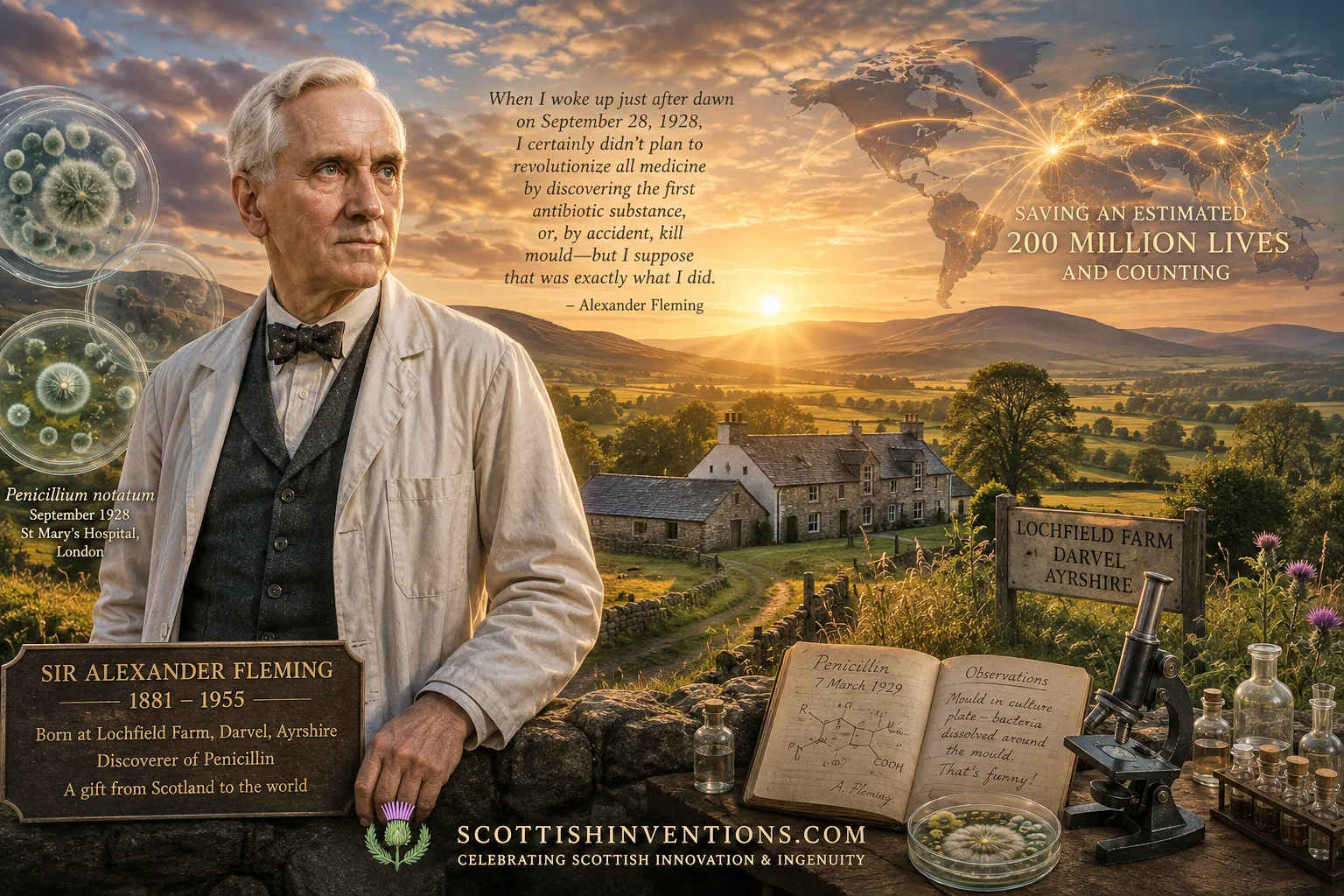
Sir Alexander Fleming, born on a hill farm at Lochfield near Darvel, Ayrshire, in 1881, made two related discoveries at St Mary's Hospital, London. In late 1921 he found lysozyme, a natural antibacterial enzyme present in tears, saliva and mucus — a comparatively minor discovery in its own right, but the training ground that taught him to recognise a zone of bacterial destruction when he saw one. In September 1928 that instinct paid off spectacularly: a contaminated culture plate showed a halo where a Penicillium mould had dissolved staphylococci around it. Fleming named the active substance "penicillin" in 1929. His observation and naming are not disputed. What must be said clearly, and what this card treats as the calibration point of the whole story, is that Fleming could not turn his finding into a medicine. That step — purification, animal proof, the first human trial, and mass production — was the work of Howard Florey, Ernst Chain and Norman Heatley at Oxford from 1939, and of wartime American industry. Fleming, Florey and Chain shared the 1945 Nobel Prize; Heatley, whose engineering made scale-up possible, did not.
Scottish Impact Index (SI Score)
- Global Impact
- 10/10
- Longevity
- 10/10
- Economic / Material Impact
- 10/10
- Originality / Distinctiveness
- 10/10
- Legacy (Built Upon)
- 10/10
- Recognition
- 10/10
Key Facts
- Discoveries
- Lysozyme, a natural antibacterial enzyme in bodily secretions (1921/22); penicillin, the first antibiotic (1928)
- Key figure
- Sir Alexander Fleming (1881–1955), bacteriologist
- Born
- 6 August 1881, Lochfield Farm, near Darvel, East Ayrshire
- Died
- 11 March 1955, London, aged 73 — ashes interred in the crypt of St Paul's Cathedral
- Workplace
- Inoculation Department, St Mary's Hospital, Paddington, London
- Lysozyme observed
- Late November 1921, from his own nasal mucus, on a plate of Micrococcus lysodeikticus
- Penicillin observed
- 3 September 1928, on a contaminated Staphylococcus culture plate
- Mould
- Penicillium notatum, reclassified in 2011 by genome sequencing as Penicillium rubens
- Made into a medicine by
- Howard Florey, Ernst Chain and Norman Heatley at Oxford's Sir William Dunn School of Pathology, 1939–41, with US wartime deep-tank fermentation industry
- Nobel Prize
- 1945, Physiology or Medicine, shared between Fleming, Florey and Chain — Heatley was not included
- Knighted
- 1944, by King George VI
- Estimated lives saved by penicillin
- Roughly 200 million by some counts; Oxford's Dunn School cites over 500 million
- Claim status
- Shared — Fleming's 1928 observation and naming of penicillin are undisputed; converting it into a life-saving drug required the separate, essential work of Florey, Chain, Heatley and wartime industry, honoured by the joint 1945 Nobel Prize
Lochfield to St Mary's
Alexander Fleming was born on 6 August 1881 at Lochfield Farm, a remote hill farm about four miles north of Darvel in East Ayrshire. He was the third of four children of the farmer Hugh Fleming and his second wife, Grace Stirling Morton, the daughter of a neighbouring farmer. Hugh already had four surviving children from an earlier marriage and was 59 when he married Grace. He died when "Alec" was seven, and his mother carried the farm on alone. Fleming's own recollections describe a poor but happy upbringing spent largely outdoors on the Ayrshire moors — the kind of patient, close observation of small living things that would, decades later, matter more than anyone could have guessed.
He attended Loudoun Moor School and Darvel School before winning a scholarship to Kilmarnock Academy. At around thirteen or fourteen he moved to London to live near his elder brother Tom, already a doctor there, and spent four unremarkable years as a shipping-office clerk. At twenty a small legacy from an uncle, John Fleming, let him — with Tom's encouragement — take up medicine. He enrolled at St Mary's Hospital Medical School, Paddington, in 1901 and qualified with distinction in 1906.
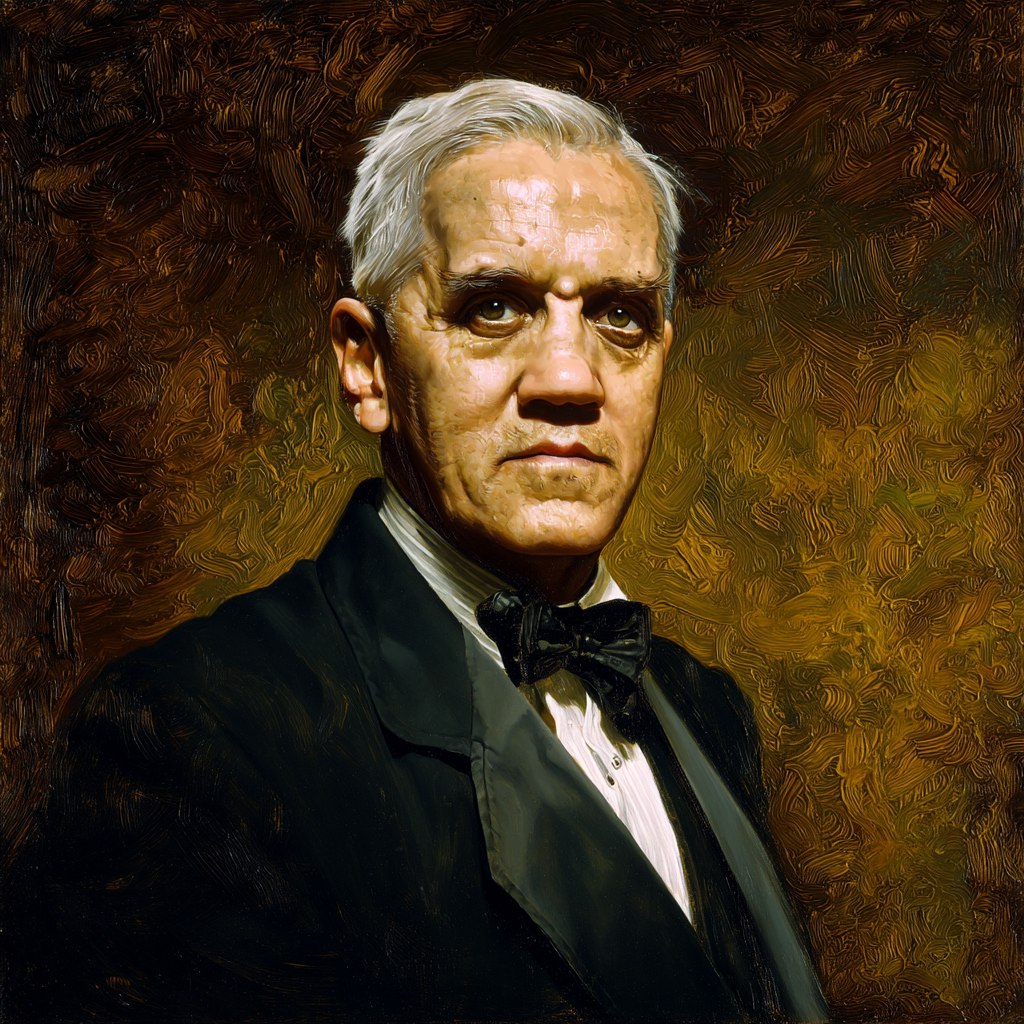
At St Mary's, chance intervened early, in a way that became characteristic of his career. A keen marksman, Fleming was reputedly persuaded to join the hospital's research department so its rifle club could keep him on the team, and so he became assistant bacteriologist to Sir Almroth Wright, the pioneer of vaccine therapy. During the First World War he served as a captain in the Royal Army Medical Corps in Wright's wound-research laboratory at Boulogne, where he watched soldiers die not of their wounds but of the infections that followed, and observed that the antiseptics of the day often killed the body's own defences faster than they killed bacteria buried deep in jagged wounds. The experience set a lifelong purpose: to find something that could destroy bacteria inside a living patient without harming the patient themselves.
The Lysozyme Rehearsal, 1921–22
Before penicillin, there was lysozyme — a discovery that deserves to be told in its own right, not simply as a footnote to the more famous story. In November 1921, while suffering from a cold, Fleming allowed a drop of his own nasal mucus to fall onto a culture plate seeded with a harmless yellow bacterium, Micrococcus lysodeikticus. A few days later he noticed that the bacteria immediately around the mucus had been dissolved away, leaving a clear zone. He had, by accident, found a natural antibacterial substance present in the body's own secretions: tears, saliva, mucus and egg white all contain it. He worked out with his colleague V.D. Allison that the active agent was an enzyme, which they published in 1922 as "lysozyme" — from the Greek for a substance that dissolves.
Lysozyme, on its own, is a modest discovery. It works chiefly against a narrow range of harmless environmental bacteria and against Gram-positive organisms with an exposed cell wall; it has almost no effect against the more dangerous Gram-negative bacteria and pathogens that cause serious human disease, and it never became an important therapeutic drug. Fleming himself understood its clinical limits.
Its real importance lies elsewhere, and this is the reason it belongs in the same story as penicillin rather than as a separate, minor curiosity. Lysozyme was Fleming's rehearsal. It taught him, in the most literal sense, what a zone of bacterial clearance around a substance looks like, and it trained him to ask, immediately and without embarrassment, what could have caused it. Seven years later, when a stray mould contaminated a Staphylococcus plate and produced exactly that kind of halo, Fleming recognised the pattern at once. Without the lysozyme years, there is a real possibility that the penicillin plate would simply have been washed and reused, as countless similar plates were by other bacteriologists before and since.
The 1928 Discovery
The famous moment came in Fleming's cramped, cluttered laboratory at St Mary's Hospital, Praed Street, London. In August 1928 he went on holiday to his country home at Barton Mills in Suffolk, leaving a stack of culture plates of Staphylococcus — the bacterium responsible for boils, sore throats and abscesses — piled in a corner of his bench. He returned on 3 September 1928, where his former assistant D.M. Pryce was waiting. Sorting through the plates, Fleming noticed that the lid had come off one, which had been contaminated by a blue-green mould. Around the mould was a clear "halo" in which the staphylococci had been dissolved away. "That's funny," he reportedly remarked.
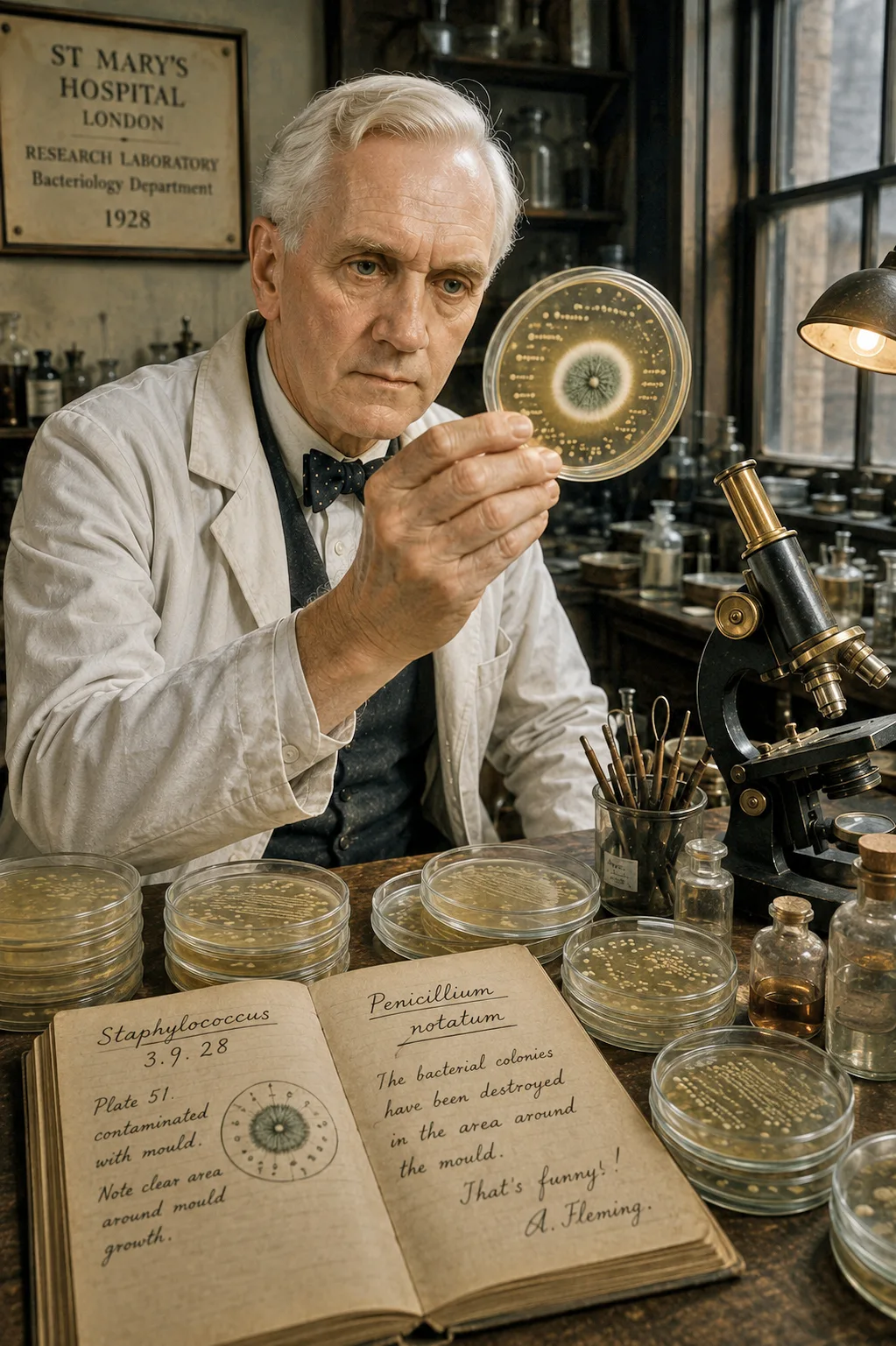
He identified the contaminant as a Penicillium mould — originally classified as Penicillium notatum, and reclassified in 2011, through genome sequencing, as Penicillium rubens. Growing it in broth, he found the "mould juice" could kill many Gram-positive bacteria — staphylococcus, streptococcus, diphtheria — even when diluted hundreds of times, and on 7 March 1929 named the active substance "penicillin", to avoid, in his own words, "the repetition of the rather cumbersome phrase mould broth filtrate". He published his findings in the British Journal of Experimental Pathology in 1929, to almost total indifference from the medical world.
A note on dates, because this is where myths breed. Fleming's own famous recollection — of waking just after dawn on 28 September 1928 — has led many accounts to give that as the discovery date. The documentary evidence points instead to his return and first observation on 3 September 1928; the 28 September quotation appears to be a later, dramatised recollection of his moment of realisation. The Alexander Fleming Laboratory Museum at St Mary's itself dates the discovery to 3 September 1928.
Chance and the Prepared Mind
The episode is a near-perfect illustration of Pasteur's maxim that "chance favours the prepared mind". Fleming was characteristically honest about the role of luck: "Nature makes penicillin; I just found it," and "One sometimes finds what one is not looking for." But he was equally clear that luck alone explained nothing: "My only merit is that I did not neglect the observation." Countless bacteriologists had seen mould interfere with bacterial growth and simply discarded the plate; Fleming, primed first by a decade hunting for antibacterials and specifically by the lysozyme work seven years earlier, recognised what he was looking at.
The romantic image of a spore wafting through an open window onto the dish is almost certainly false. Fleming himself gave contradictory accounts over the years. His co-workers, including Pryce, later testified that his laboratory window was normally kept shut and was awkward to reach. The consensus today — supported by his former assistant Ronald Hare's detailed 1966 reconstruction — is that the spore most likely drifted up the stairwell from the mycology laboratory one floor below, run by the Irish mycologist C.J. La Touche, who was growing large collections of moulds for asthma research. Hare also showed that an unusual cold spell in London in late August and early September 1928 created exactly the temperature sequence needed for the mould to establish itself before the bacteria could overrun the plate — another, separate stroke of luck layered on top of the first.
How Penicillin Kills Bacteria
Penicillin works by attacking the one structure that many bacteria possess and human cells do not: the cell wall. Bacteria such as Staphylococcus are constantly building and rebuilding a rigid outer wall to contain their high internal pressure. Penicillin binds to the very enzymes — penicillin-binding proteins — that bacteria use to stitch that wall together. With the wall weakened, the bacterium's own internal pressure does the rest: the cell swells, ruptures and dies, and the body's immune system clears the debris.
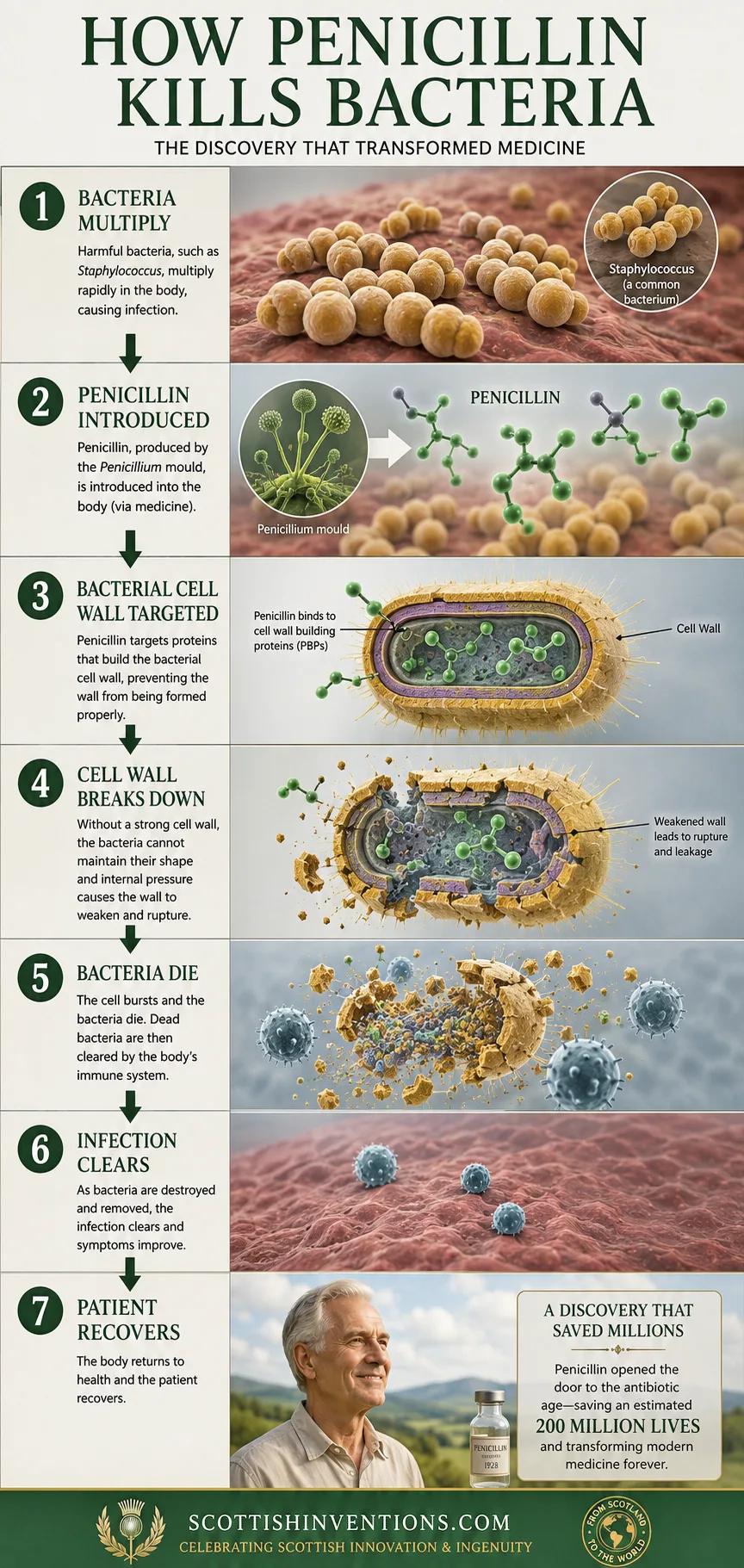
Because human cells have no cell wall, the drug largely spares the patient. That is the secret of its exceptional safety, and the reason penicillin and its descendants — amoxicillin, methicillin, the cephalosporins, the carbapenems — remain workhorses of medicine almost a century after Fleming saw his halo.
From Mould Juice to Medicine
This is the section that this article treats as decisive, and where honesty matters more than national pride. Fleming discovered penicillin, but he did not — and by his own repeated admission, could not — turn it into a usable drug. "I am a bacteriologist, not a chemist," he said, and his attempts, with assistants Stuart Craddock and Frederick Ridley, to isolate and stabilise the fragile compound failed. By the early 1930s the chemical work had largely stalled, and Fleming's 1929 paper sat almost unread for a decade.
The breakthrough came ten years later and fifty miles away, at the Sir William Dunn School of Pathology at the University of Oxford. From 1939, a team led by the Australian pathologist Howard Florey and including the German-Jewish biochemist Ernst Chain — a refugee who had fled Nazi Germany in 1933 — took up Fleming's neglected paper. With Norman Heatley, Edward Abraham, Margaret Jennings and others, they devised methods to grow, extract and purify penicillin, proved it could cure infected mice in 1940, and worked out how to measure and concentrate it. Heatley in particular deserves to be named clearly and often: it was his improvised extraction apparatus — built, famously, from bedpans, milk churns, biscuit tins and bathtubs, because wartime Britain had no laboratory-grade equipment to spare — and his assay techniques that made purification at any usable scale possible at all. Florey and Chain provided the biological proof and chemical insight; Heatley provided the engineering that turned insight into deliverable quantities of drug.
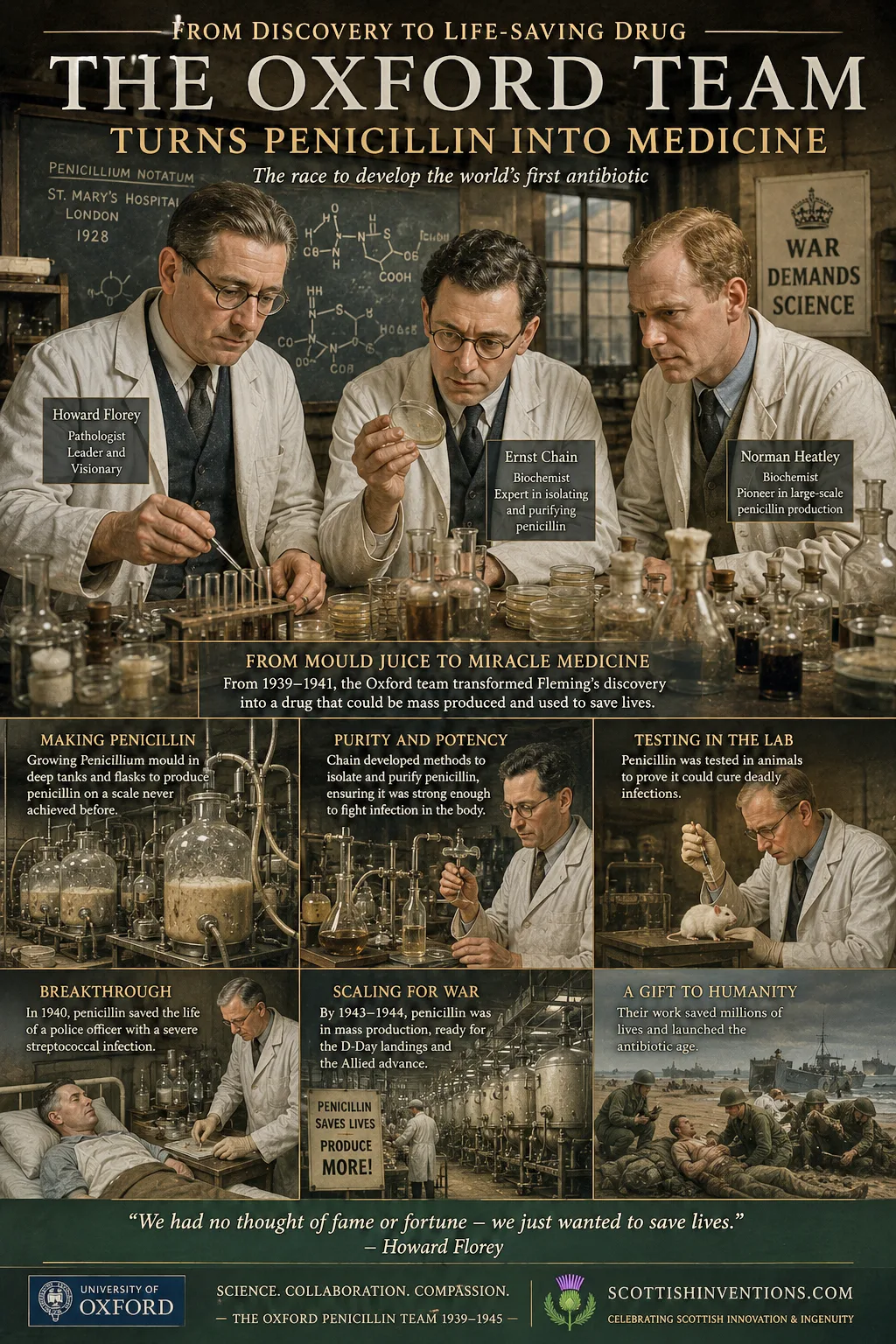
The first human trial, in February 1941, is one of medicine's most poignant episodes. The patient was Albert Alexander, a 43-year-old Oxford-area policeman with a catastrophic infection of staphylococcus and streptococcus that had already cost him an eye and spread across his face and lungs. On 12 February 1941 he was given the precious penicillin and improved dramatically within days. But the Oxford team had so little of the drug that — even after recovering and recycling it from his urine — they ran out. Albert Alexander relapsed and died on 15 March 1941. His case proved penicillin worked in humans; it also proved that without industrial-scale production, the discovery was of no practical use whatsoever.
Wartime Britain could not build that production capacity, so in 1941 Florey and Heatley took penicillin to the United States. There, the crucial breakthroughs in scale came: at the USDA's Northern Regional Research Laboratory in Peoria, Illinois, scientists found that corn-steep liquor and deep-tank fermentation dramatically boosted yields, and a high-yielding mould strain was famously found on a mouldy cantaloupe in a Peoria market. By June 1944, American drug companies were producing vast quantities of penicillin — enough that the antibiotic went ashore with Allied troops on D-Day, sparing countless soldiers from fatal wound infections. The honest summary, stated as plainly as the insulin story on this site states Best's and Collip's contributions: Fleming lit the spark; Florey, Chain, Heatley and American wartime industry built the fire that actually warmed anyone.
Earlier Observations of Mould Antibiosis
Fairness requires one further correction to the popular story: Fleming was not the first person ever to notice that mould could interfere with bacterial growth.
- Ernest Duchesne, a French military doctor, documented the antibacterial effects of a Penicillium mould in a doctoral thesis in 1897, using it to treat infected guinea pigs. His thesis was accepted but essentially ignored, and he died in 1912 without ever influencing later events; the Institut Pasteur did not even acknowledge his work until decades afterward.
- John Tyndall, the Irish-born physicist, reported in 1875 that a Penicillium mould growing in a culture tube appeared to be inhibiting bacterial growth nearby, though he did not pursue the observation as a medical lead.
- Joseph Lister, the pioneer of antiseptic surgery, experimented with Penicillium glaucum against a human wound infection in the 1870s, with some apparent benefit, but did not publish a systematic account or follow the observation through.
None of these earlier sightings led to a named compound, a reproducible method, or a published route that other scientists could act upon. What made Fleming's 1928 observation different was not novelty of phenomenon but rigour of interpretation, naming and (eventual, if belated) publication — precisely the qualities his lysozyme apprenticeship had sharpened in him.
Nobel Prize and a Warning
Recognition, when it came, was immense. Fleming was elected a Fellow of the Royal Society in 1943 and knighted by King George VI in 1944. In 1945 the Nobel Prize in Physiology or Medicine was awarded jointly to Fleming, Florey and Chain "for the discovery of penicillin and its curative effect in various infectious diseases". Norman Heatley, whose apparatus and assays had made the Oxford team's chemistry usable at all, was not included; the Nobel statutes limit a shared prize to three names, and the historical judgement of many since has been that Heatley drew the short straw. Oxford itself later acknowledged the debt: in 1990 it awarded Heatley the first honorary doctorate of medicine in the university's 800-year history, a category previously reserved for people with a formal medical qualification.
It is Fleming's Nobel lecture, delivered on 11 December 1945, that now reads as almost eerily prophetic. He warned that misusing penicillin could breed resistant bacteria: "The time may come when penicillin can be bought by anyone in the shops. Then there is the danger that the ignorant man may easily underdose himself and by exposing his microbes to non-lethal quantities of the drug make them resistant." He concluded with a line that could be carved over every pharmacy door: "Moral: If you use penicillin, use enough." Eighty years on, with antimicrobial resistance recognised as one of the gravest threats to global health, that warning reads like a message sent forward from the future.
Myth vs Evidence
| Popular Version | Evidence-Based Correction |
|---|---|
| A spore blew in through an open window | Colleagues say the window was normally shut; the spore most likely drifted up a stairwell from the mycology lab below. |
| Fleming discovered penicillin and it saved millions immediately | It sat almost unused for a decade until Florey, Chain and Heatley at Oxford made it into a real drug in 1939–41. |
| Fleming alone deserves the 1945 Nobel Prize | The prize was, correctly, shared with Florey and Chain; Heatley, arguably as essential, was excluded by the three-person limit. |
| The Fleming statue commemorating penicillin stands in London | The most famous bullfighting-linked Fleming monument is in Madrid, unveiled in 1964 by grateful matadors. |
| Fleming was the first to notice mould killing bacteria | Duchesne (1897), Tyndall (1875) and Lister (1870s) all observed related effects earlier, without developing them. |
Legacy
The scale of the gift begun in that Paddington laboratory is hard to grasp. The New World Encyclopedia states that penicillin has saved at least 200 million lives since its first use as a medicine in 1942; Oxford's own Sir William Dunn School of Pathology puts the figure even higher, at over 500 million. Either way, it conquered once-deadly scourges including pneumonia, syphilis, gangrene, scarlet fever and meningitis, and made modern surgery, childbirth, cancer therapy and organ transplantation vastly safer.
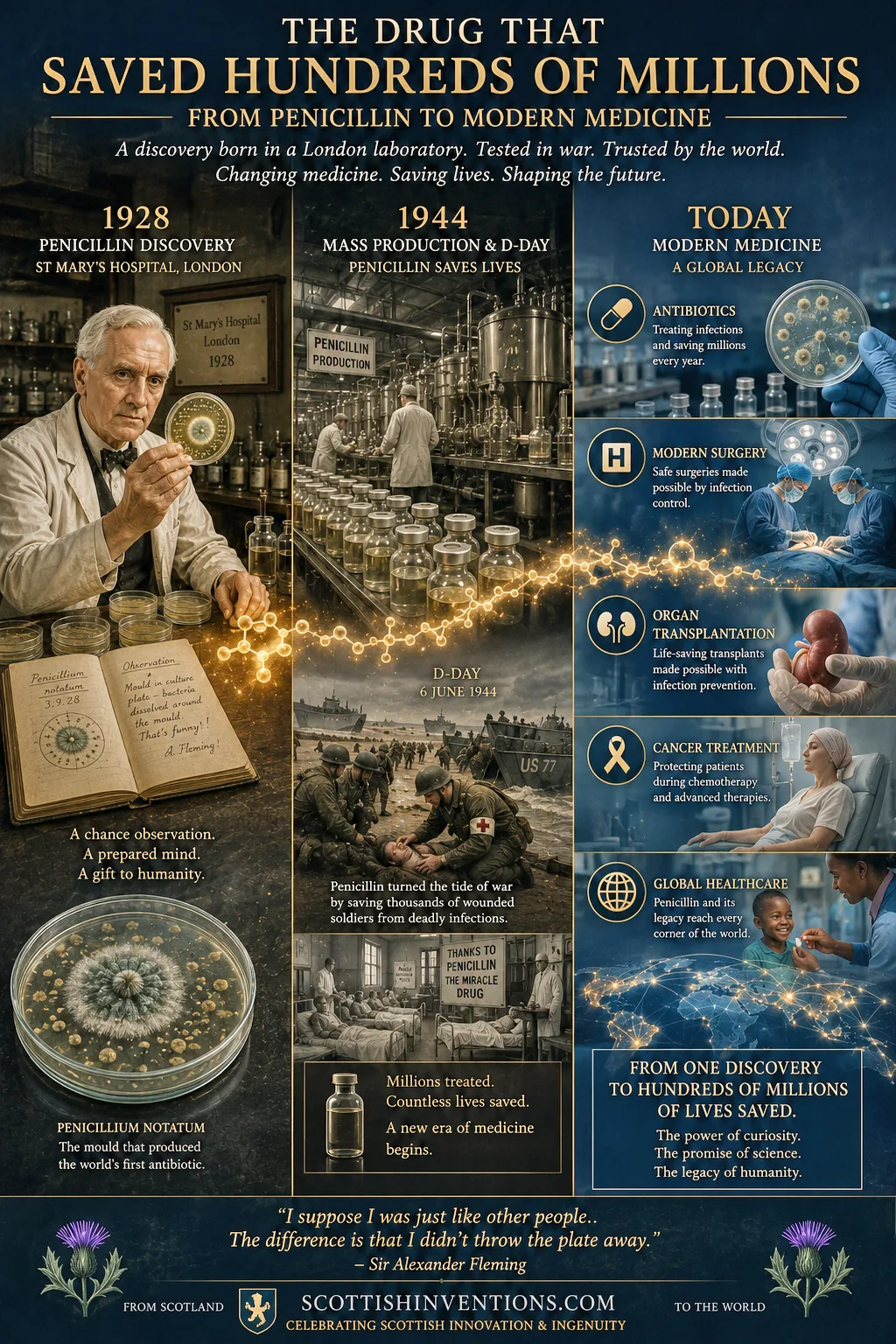
Fleming died of a heart attack at his London home on 11 March 1955, and his ashes are buried in the crypt of St Paul's Cathedral — a rare honour. His old laboratory at St Mary's is preserved as the Alexander Fleming Laboratory Museum, reconstructed to its 1928 condition. He has never been forgotten in Scotland: in 2009 the Clydesdale Bank put his face on its £5 note, and his Nobel medal was acquired by National Museums Scotland in 1989 and is on public display. In Darvel, a memorial in Hastings Square — featuring a bust of Fleming and a circular flower bed inspired by the shape of a Petri dish — honours the town's most famous son, and his birthplace at Lochfield Farm is marked and still stands.
He was named one of Time magazine's 100 Most Important People of the 20th Century, one of the BBC's 100 Greatest Britons, and was voted the third "greatest Scot" in a 2009 STV poll, behind only Robert Burns and William Wallace. The grandest monument of all is abroad: a bronze bust by the Spanish sculptor Emilio Laiz Campos, with a full-length bronze matador saluting Fleming with his montera, was unveiled outside Madrid's Plaza de Toros de Las Ventas on 14 May 1964 — inscribed "To Dr Fleming with the gratitude of bullfighters", because penicillin had so reduced deaths from goring infections in the ring.
The deepest irony is the one Fleming himself foresaw. The man who gave the world its first antibiotic also gave it the first clear warning that the gift might be squandered — and the antimicrobial resistance crisis of today proves just how right the quiet Ayrshire farmer's son turned out to be.
Did You Know?
- Fleming's first antibacterial discovery, lysozyme, came from a drop of his own nasal mucus in 1921 — seven years before penicillin.
- The "dirty lab" was the key: had Fleming tidied his bench before his 1928 holiday, the contaminated plate would never have existed.
- An unusual cold spell in London in late summer 1928 let the mould and bacteria grow in exactly the sequence needed to form the halo.
- Fleming himself said, "I am a bacteriologist, not a chemist" — it took Oxford's Florey, Chain and Heatley to make penicillin a medicine.
- The first patient, Constable Albert Alexander, improved dramatically on penicillin in February 1941, then died in March when the tiny hand-made supply ran out.
- Norman Heatley built the extraction apparatus that scaled up penicillin from bedpans and milk churns — and was left off the 1945 Nobel Prize.
- D-Day ran partly on mould from a Peoria market: a high-yielding strain found on a mouldy cantaloupe helped American industry supply Normandy.
- The most famous Fleming statue is in Madrid, not Britain — unveiled in 1964 by grateful Spanish bullfighters.
Timeline
6 Aug 1881
Alexander Fleming born at Lochfield Farm, near Darvel, East Ayrshire
Third of four children of farmer Hugh Fleming and his second wife Grace Stirling Morton
1901–06
Studies medicine at St Mary's Hospital Medical School, Paddington
Qualifies with distinction in 1906; joins Sir Almroth Wright's research department, reputedly to stay on the rifle club
1914–18
Serves as a captain in the RAMC, wound-research laboratory, Boulogne
Watches antiseptics fail against wound infection — the experience that sets his life's purpose
Nov 1921
Discovers lysozyme from his own nasal mucus
A plate of Micrococcus lysodeikticus is cleared in a ring around a drop of his nasal secretion
1922
Publishes lysozyme findings with V.D. Allison
"On a remarkable bacteriolytic element found in tissues and secretions", Proc. Roy. Soc. B
3 Sep 1928
Returns from holiday to find a contaminated Staphylococcus plate
A blue-green mould has cleared a halo of bacteria around itself
7 Mar 1929
Names the active substance "penicillin"
Publishes in the British Journal of Experimental Pathology to almost total indifference
1939–41
Howard Florey, Ernst Chain and Norman Heatley, Oxford, purify and test penicillin
Cure infected mice (1940); devise extraction and concentration methods that make human treatment possible
12 Feb–15 Mar 1941
Albert Alexander, Oxford policeman, becomes the first human patient
Recovers dramatically, then dies when the tiny hand-made supply runs out
1941–44
Florey and Heatley take the project to the United States
Peoria's Northern Regional Research Laboratory develops deep-tank fermentation and a high-yield mould strain
6 Jun 1944
Mass-produced American penicillin goes ashore with Allied troops on D-Day
Wound infection deaths fall dramatically among Allied forces
1944
Fleming knighted by King George VI
Elected FRS the previous year, 1943
1945
Fleming, Florey and Chain share the Nobel Prize in Physiology or Medicine
Norman Heatley, whose engineering made scale-up possible, is not included
11 Dec 1945
Fleming's Nobel lecture warns of antibiotic resistance
"Moral: If you use penicillin, use enough"
11 Mar 1955
Fleming dies in London, aged 73
Ashes interred in the crypt of St Paul's Cathedral
1990
Oxford belatedly honours Norman Heatley
Awarded the first honorary doctorate of medicine in the university's 800-year history, a doctorate previously reserved for medically qualified people
Notes on the Evidence
3 September or 28 September 1928? The Alexander Fleming Laboratory Museum and most documentary reconstructions date the discovery to Fleming's return on 3 September 1928. His own oft-quoted line about waking "just after dawn on September 28" is best read as a later, dramatised recollection of his moment of realisation, not a precise date of first observation.
Species name. The mould was originally identified as Penicillium notatum. Genome sequencing in 2011 reclassified the actual strain used by Fleming, Florey and Chain as Penicillium rubens, a distinct but closely related species.
Lives saved figures vary widely — from roughly 200 million (New World Encyclopedia) to over 500 million (Oxford's Sir William Dunn School of Pathology) — because sources differ on start dates, whether to include penicillin's chemical descendants, and methodology. Both figures are presented above with their sources rather than being averaged into a single false-precision number.
Heatley's exclusion. The Nobel Prize in Physiology or Medicine can be shared by at most three people under the Nobel Foundation's statutes, which structurally excluded a fourth contributor no matter how essential. This is the same statutory limit, and broadly the same pattern of an essential technical contributor being left off a prize later partly corrected by other honours, seen in the University of Toronto's insulin story with Charles Best.
Earlier mould observations. Duchesne's 1897 thesis is well documented but had no causal influence on Fleming, who almost certainly worked independently and in ignorance of it. We therefore credit Duchesne, Tyndall and Lister as earlier observers of a related phenomenon, without suggesting Fleming's work was derivative of theirs.
Frequently Asked Questions
Who discovered penicillin?
Sir Alexander Fleming (1881–1955), a Scottish bacteriologist born at Lochfield Farm near Darvel, Ayrshire, observed the antibacterial effect of a Penicillium mould on 3 September 1928 in his laboratory at St Mary's Hospital, London, and named the active substance "penicillin" in 1929. His observation and naming are not in dispute. What is often left out is that Fleming could not turn his finding into a usable drug; that step required an entirely separate team at Oxford a decade later.
Did Fleming invent penicillin as a medicine?
No. Fleming discovered the phenomenon and published it, but by his own admission he was "a bacteriologist, not a chemist", and his attempts to isolate and stabilise the compound in the early 1930s failed. Penicillin became a usable medicine only through the work of Howard Florey and Ernst Chain's team at Oxford's Sir William Dunn School of Pathology from 1939, with the essential engineering and production contribution of Norman Heatley, and the mass-manufacturing breakthroughs made by American industry during the Second World War.
What did Norman Heatley contribute, and why didn't he get the Nobel Prize?
Heatley was the Oxford team's practical engineer: he devised the improvised extraction apparatus (built from bedpans and milk churns), the assay methods that measured penicillin's potency, and the back-extraction techniques that made purification at any useful scale possible. Without his ingenuity Florey and Chain's biological and chemical insights could not have been converted into treatable quantities of the drug. The 1945 Nobel Prize in Physiology or Medicine went to Fleming, Florey and Chain; the Nobel statutes cap a shared prize at three recipients, and Heatley — regarded by many historians as unlucky to miss out — was excluded. Oxford later made amends: in 1990 it awarded Heatley the first honorary doctorate of medicine in the university's 800-year history, a category previously reserved for the medically qualified. It is a close parallel to Charles Best's exclusion from the 1923 insulin Nobel.
What is lysozyme, and why does it matter?
Lysozyme is a naturally occurring enzyme, present in tears, saliva, mucus and other bodily secretions, that can destroy the cell walls of certain bacteria. Fleming discovered it in late 1921, when a drop of his own nasal mucus, added to a bacterial culture plate, produced a clear zone where the bacteria had been dissolved. He published the finding with V.D. Allison in 1922. Lysozyme itself proved to be a comparatively weak antibacterial of only modest clinical value, but the discovery mattered enormously as a rehearsal: it trained Fleming to recognise a zone of bacterial clearance around a substance, and to ask what had caused it — the exact instinct that let him interpret the mould-contaminated plate of 1928 correctly instead of discarding it.
Was Fleming the first person to notice that mould kills bacteria?
No, and honest history should say so plainly. The French military doctor Ernest Duchesne documented antibacterial effects of Penicillium mould in a doctoral thesis in 1897, though it went unread and had no influence on later events. John Tyndall observed mould inhibiting bacterial growth in 1875, and Joseph Lister experimented with Penicillium against human infection in the 1870s. None of these observations, however, led to systematic proof, an isolated compound, a name or a published route to a medicine. Fleming's distinct contribution was to identify the phenomenon rigorously, characterise the mould, name the active principle and publish it in a form the scientific community could in principle build upon — even though almost nobody did, for over a decade.
Is the open-window story about penicillin true?
Almost certainly not. Colleagues, including Fleming's assistant D.M. Pryce, testified that his laboratory window was normally kept shut and was awkward to open. The more likely route, reconstructed by his former assistant Ronald Hare in 1966, is that mould spores drifted up the stairwell from a mycology laboratory on the floor below, and that an unusual cold spell in London in late August and September 1928 created exactly the temperature sequence needed for the mould to establish itself before the bacteria overran the plate.
How does penicillin actually kill bacteria?
Penicillin binds to enzymes called penicillin-binding proteins that bacteria use to build and repair their rigid cell wall. With wall synthesis disrupted, the bacterium's own internal pressure ruptures it. Human cells have no cell wall, so the drug is largely harmless to the patient — the basis of its exceptional safety record.
How many lives has penicillin saved?
Estimates vary by source and by what is counted. The New World Encyclopedia states that penicillin has saved at least 200 million lives since 1942; Oxford's own Sir William Dunn School of Pathology, where it was developed into a drug, puts the figure at over 500 million. Either figure marks it among the most consequential medical discoveries in history.
Did Fleming predict antibiotic resistance?
Yes. In his Nobel lecture of 11 December 1945 he warned that underdosing penicillin could let bacteria develop resistance: "the ignorant man may easily underdose himself and by exposing his microbes to non-lethal quantities of the drug make them resistant," concluding, "Moral: If you use penicillin, use enough." Eight decades on, with antimicrobial resistance recognised as one of the greatest threats to global health, the warning reads as strikingly prescient.
Sources & Further Reading
Tier 1 · Primary
- Fleming, A. & Allison, V.D. — "On a remarkable bacteriolytic element found in tissues and secretions," Proceedings of the Royal Society B, 1922.
- Fleming, A. — "On the antibacterial action of cultures of a penicillium, with special reference to their use in the isolation of B. influenzae," British Journal of Experimental Pathology, vol. 10 (1929), pp. 226–236.
- Chain, E., Florey, H.W. et al. — "Penicillin as a chemotherapeutic agent," The Lancet, 24 August 1940.
- Duchesne, E. — Contribution à l'étude de la concurrence vitale chez les micro-organismes, doctoral thesis, Lyon, 1897.
Tier 2 · Scholarly and institutional
- Fleming, A. — Nobel Lecture, "Penicillin," 11 December 1945, Nobel Foundation.
- Hare, R. — The Birth of Penicillin and the Disarming of Microbes, George Allen & Unwin, 1970.
- Bud, R. — Penicillin: Triumph and Tragedy, Oxford University Press, 2007.
- Lax, E. — The Mold in Dr Florey's Coat, Henry Holt, 2004.
- Nobel Foundation — "The Nobel Prize in Physiology or Medicine 1945," nobelprize.org.
- Sir William Dunn School of Pathology, University of Oxford — history of penicillin development.
- Alexander Fleming Laboratory Museum, St Mary's Hospital, Imperial College Healthcare NHS Trust.
- National Museums Scotland — Fleming Nobel medal and related collections.