Discoveries · No. 19 of 50 · Earth Science
Arthur Holmes and the Age of the Earth
The man who built a clock out of radioactivity, gave geology its timescale, and guessed the engine of plate tectonics forty years early — from the Regius Chair of Geology in Edinburgh.
Arthur Holmes · 1890–1965First age-dating analysis · 1911Reading time · 18 minUpdated 11 August 2026
TL;DR
- Arthur Holmes (1890–1965) pioneered radiometric dating, used it to build the first reliable geological timescale, and proved the Earth is billions — not millions — of years old.
- He was English by birth, born in Hebburn-on-Tyne near Newcastle, but adopted Scotland for the crowning chapter of his career: Regius Professor of Geology at the University of Edinburgh, 1943–1956, where he wrote his landmark textbook and published the refined timescale the world still uses.
- An honest note for this collection: Holmes was not Scottish-born and was never knighted. What he was, is one of the most consequential earth scientists of the twentieth century — whose radioactive-heat idea also anticipated the mechanism of plate tectonics by decades.
Scottish Impact Index (SI Score)
- Global Impact
- 9/10
- Longevity
- 9/10
- Economic / Material Impact
- 5/10
- Originality / Distinctiveness
- 9/10
- Legacy (Built Upon)
- 9/10
- Recognition
- 5/10
Key Findings
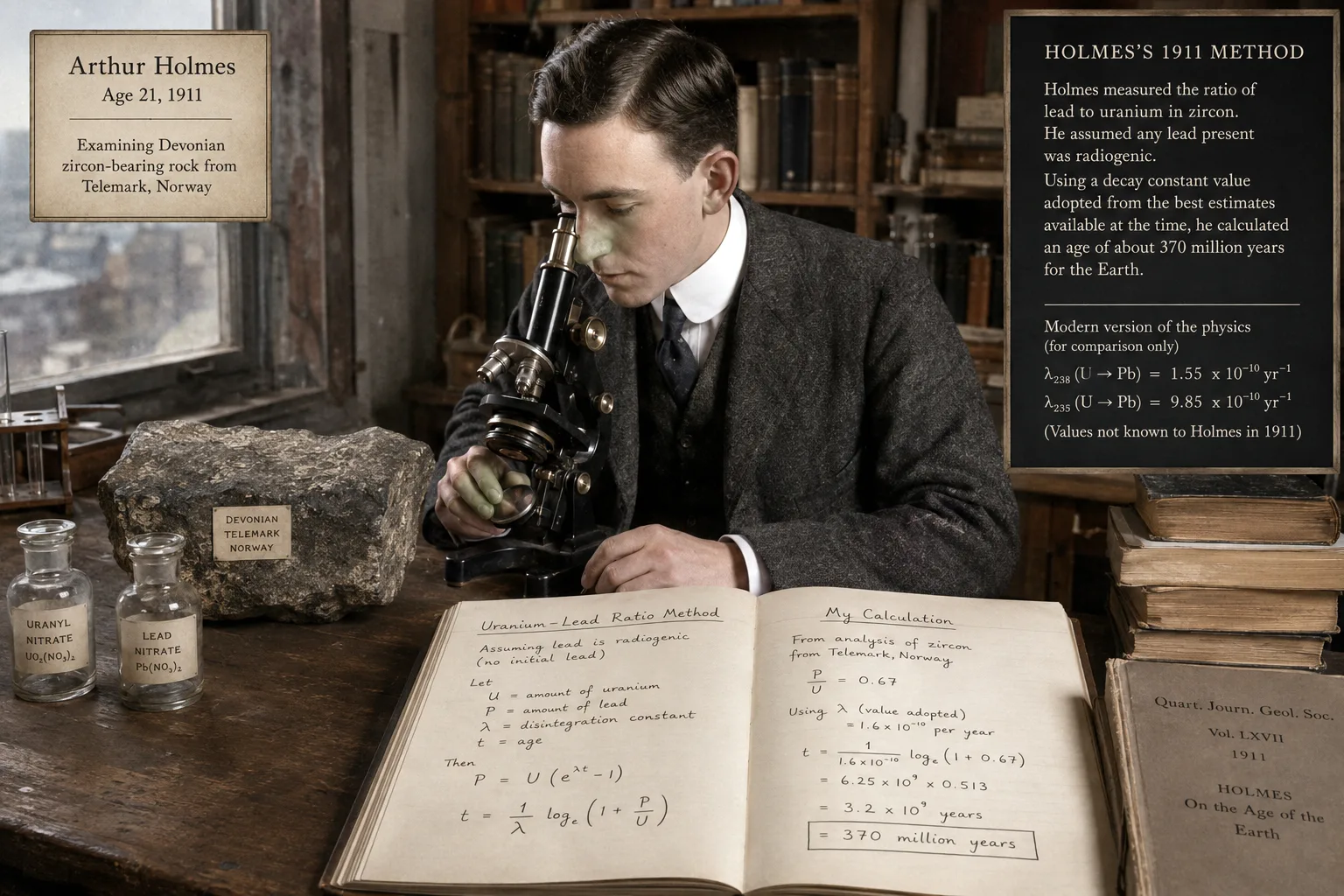
- Holmes performed the first uranium–lead radiometric date designed specifically to measure the age of a rock while still essentially a student — 370 million years for a Devonian rock from Norway, in a paper read to the Royal Society in April 1911, when he was twenty-one.
- His 1913 book The Age of the Earth, written at 23, argued that the planet's oldest rocks were around 1,600 million years old — more than ten times Kelvin's estimate for the entire Earth.
- He was appointed Regius Professor of Geology at Edinburgh in 1943 and held the chair until 1956, writing Principles of Physical Geology (1944) and publishing his definitive revised timescale (1959–60) during those Scottish years.
- He proposed that heat from radioactive decay drives slow convection currents in the mantle — a mechanism for continental drift set out in 1928–1931, decades before plate tectonics was confirmed in the 1960s.
- The modern age of the Earth, 4.54 billion years, descends directly from the radiometric principles Holmes pioneered, refined by Clair Patterson's 1956 dating of meteorites.
Quick Facts
- Discovery
- Radiometric (uranium–lead) dating and the first quantitative geological timescale
- Year
- 1911 — first U–Pb analysis performed specifically to date a rock
- Key figure
- Arthur Holmes FRS FRSE (1890–1965)
- Born
- Hebburn-on-Tyne, County Durham, England, 14 January 1890
- Died
- Battersea, London, 20 September 1965
- Scottish connection
- Regius Professor of Geology, University of Edinburgh, 1943–1956
- First date obtained
- 370 million years for a Devonian rock from Norway, aged 21
- Landmark book
- The Age of the Earth (1913), written at 23
- Textbook
- Principles of Physical Geology (1944), begun on wartime fire-watch
- Second great idea
- Radioactive heat drives mantle convection — proposed 1928–1931
- Revised timescale
- Transactions of the Edinburgh Geological Society, 1959–60
- Claim status
- Established — with an honest note: English-born, never knighted
- Modern age of Earth
- 4.54 billion years ± ~50 million (Patterson, 1956)
A Tyneside Beginning
Arthur Holmes was born on 14 January 1890 at 62 Glen Terrace, Hebburn-on-Tyne, County Durham, near Newcastle upon Tyne. He was the only child of David Holmes and Emily Dickinson, a schoolteacher, both of Northumbrian stock of which Holmes remained quietly proud all his life. (The Royal Society's biographical memoir describes his father as a cabinet-maker; his biographer Cherry Lewis and the Oxford Dictionary of National Biography call him a hardware shop assistant — a minor discrepancy in the record, noted rather than resolved.)
He was educated at Gateshead Higher Grade School, and there a single inspirational teacher changed everything. His physics master, James McIntosh, introduced him to Lord Kelvin's Popular Lectures and Addresses and to the work of the geologist Eduard Suess, planting the seed of a lifelong fascination with the great controversy over the age of the Earth.
In 1907, at seventeen, Holmes won a scholarship to study physics at the Royal College of Science in London, now part of Imperial College. There, working under Robert John Strutt — son of Lord Rayleigh, and later the 4th Baron Rayleigh himself — he encountered the brand-new science of radioactivity; Strutt had been showing that radioactive minerals are widespread in ordinary rocks. Holmes graduated in physics in 1909 but, fascinated by geological problems and reasoning that jobs were easier to find for geologists, switched to geology against the advice of his tutors, taking his associateship in 1910. Crucially, he stayed under Strutt's guidance to pursue the question that would define his life: could radioactivity be used to measure geological time?
Money was always tight. In 1911 Holmes took a contract prospecting for minerals in Mozambique, where he contracted a near-fatal tropical fever — a false report of his death even reached London. But he also found abundant ancient rocks to study, and it was there that he conceived his vision of a geological timescale anchored in radioactive dates.
How Old Is the Earth?
For most of the nineteenth century, the age of the Earth was one of science's fiercest battlegrounds. The towering Victorian physicist Lord Kelvin (William Thomson) calculated it by assuming the Earth had cooled from an initially molten ball. In 1862 his estimate ran between 20 and 400 million years; over the following decades he narrowed it dramatically, and by 1897 was insisting the Earth was probably between 20 and 40 million years old, "much nearer 20 than 40."
This was a serious problem. Geologists in the tradition of James Hutton and Charles Lyell — uniformitarians who saw the landscape shaped by slow, steady processes — needed vast stretches of time. So did Charles Darwin, whose theory of evolution by natural selection required immense ages for life to diversify; Darwin wrote of the "incomprehensibly vast… periods of time" his theory demanded. Kelvin's short timescale threatened to strangle both.
The flaw, unknown to Kelvin, lay in a discovery being made even as he wrote. Henri Becquerel discovered radioactivity in 1896; Marie and Pierre Curie isolated radium and polonium soon after; and Ernest Rutherford and Frederick Soddy worked out that radioactive elements decay at fixed rates. Radioactivity generates heat — meaning the Earth was not simply cooling from a molten origin as Kelvin assumed, but was being warmed from within. The planet could be cooling far more slowly, and could therefore be vastly older. Radioactivity would not only expose Kelvin's error; it would provide a clock to measure the Earth's true age.
The Radioactive Clock
Rutherford and Soddy established the principle of the half-life — the fixed, predictable time it takes for half of a radioactive substance to decay. In a celebrated 1904 lecture at the Royal Institution, with Kelvin himself in the audience, Rutherford suggested that radioactivity could keep the Earth warm and that Kelvin's age was therefore too low. Rutherford later told the story with relish: spotting Kelvin in the half-dark room he feared trouble — "To my relief he fell fast asleep," but as Rutherford reached the crucial point, "I saw the old bird sit up, open an eye and cock a baleful glance at me!" Rutherford diplomatically noted that Kelvin had allowed for an unknown future energy source, and "Behold! the old boy beamed upon me." The encounter is genuine; historians caution that the anecdote is often retold too neatly, and that the physics of radioactive heating is more complicated than the popular version suggests.
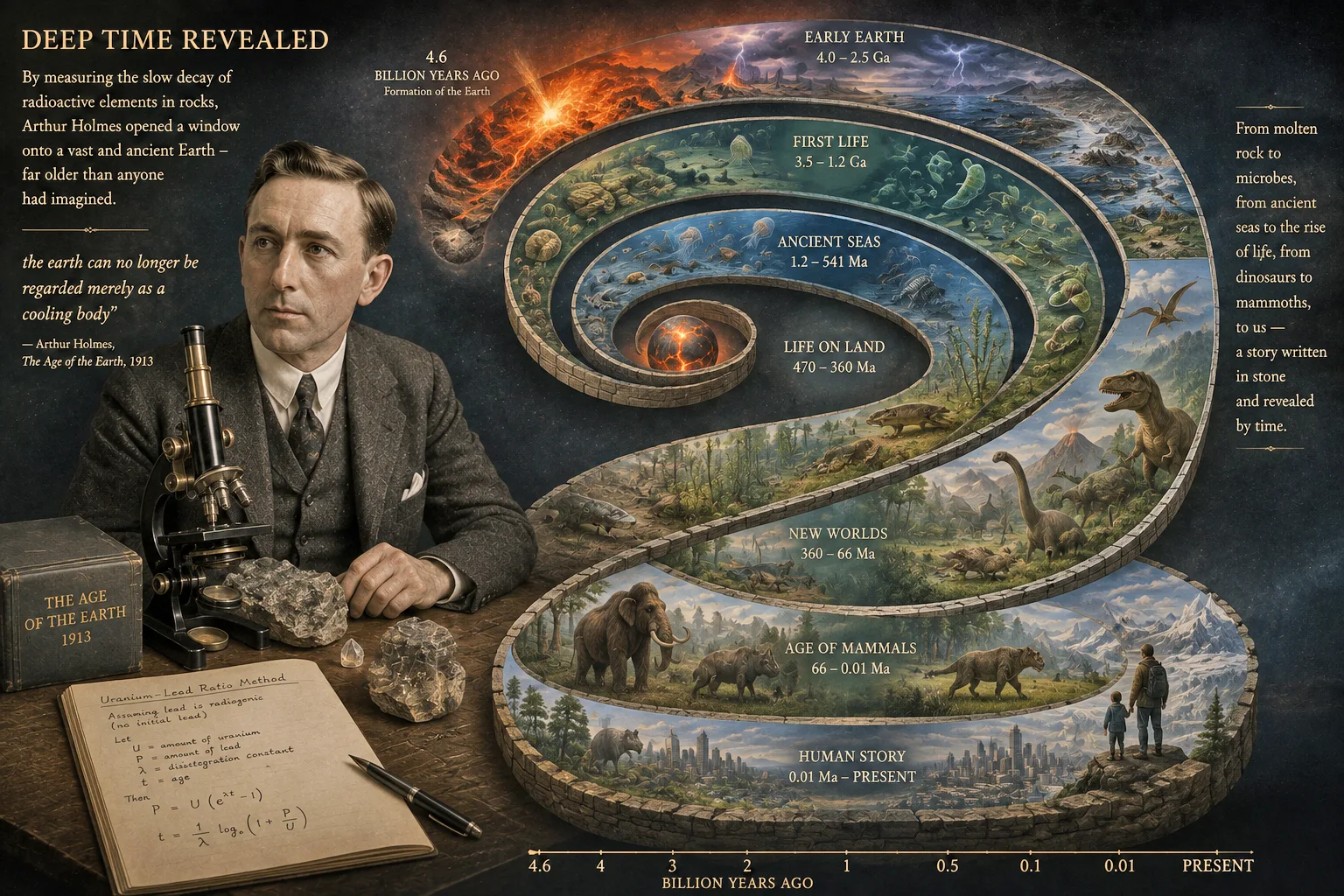
The American chemist Bertram Boltwood made the first serious attempts at uranium–lead dating around 1907, calculating ages for a handful of samples. The principle is elegantly simple. Uranium is radioactive and decays, step by step, into lead at a known and unchanging rate. Lead does not normally find its way into a fresh crystal of a mineral such as zircon, but uranium does. So every atom of lead locked inside that crystal is there only because it was once uranium that has since decayed. Measure the ratio of remaining uranium to accumulated lead, apply the known decay rate, and you can calculate how long the clock has been running — like reading the sand that has fallen through an hourglass.
1911 — The First Age-Dating Analysis
It was the young Holmes who turned the idea into a precise tool. Working under Strutt, he chose lead over the rival helium method, which leaked and therefore gave only minimum ages. As the Geological Society of America's GSA Today records, "Holmes performed the very first uranium-lead analysis specifically determined for age-dating purposes. It yielded 370 Ma for a Devonian rock. Aged only 21… In April 1911, the paper was read to members of the Royal Society while Holmes was in Mozambique."
That paper — "The Association of Lead with Uranium in Rock-Minerals, and Its Application to the Measurement of Geological Time," Proceedings of the Royal Society, Series A 85: 248–256 (1911) — established him as a pioneer of geochronology. The single figure of 370 million years for the Devonian was already far older than Kelvin's age for the entire planet, and it caused exactly the kind of controversy a young upstart might expect.
The Age of the Earth (1913)
In 1913, aged just 23 and working as a demonstrator at Imperial College, Holmes published The Age of the Earth. Issued by Harper & Brothers — a popular publisher, not a narrow scientific imprint — it was a passionate, lucid case for radiometric dating over methods based on sedimentation rates or the cooling of the Earth. In it Holmes wrote that "if our interpretation is correct, some of the oldest Archean rocks must date back 1600 million years," while many of his elders still clung to Kelvin's figure of less than 100 million years for the whole planet. The book also contained what is often regarded as the first quantitative geological timescale.
Holmes caught the irony of his own achievement in the book's own words: "Not many years ago geologists were dissatisfied with the shortness of their time allowance; to-day they are confronted with an embarrassing super-abundance." The book met real resistance. Many geologists distrusted physicists intruding into their field, and the new radioactive method was viewed with suspicion. Acceptance came only slowly, over decades, as Holmes refined his methods and the evidence mounted.
Building the Geological Timescale
Through the 1920s, 30s and 40s Holmes laboured to convert relative geological ages into actual numbers of years, assigning dates to the great periods — Cambrian, Devonian, Carboniferous and the rest. Building on his 1911 Devonian date of 370 million years, he later added figures such as 340 million years for the Carboniferous and 430 million for the Silurian or Ordovician. In The Age of the Earth: An Introduction to Geological Ideas (1927) he offered a range of 1.6 to 3.0 billion years for the oldest rocks. He revised his estimate of the Earth's own age upward over the years — toward 3,000 million by 1927, and to 4,500 ± 100 million in the 1940s, drawing on Alfred O. C. Nier's measurements of the relative abundance of uranium isotopes. The dating model of this era is still known as the Holmes–Houtermans model, after Fritz Houtermans, who published similar work in 1946.
His final great contribution to the timescale, "A Revised Geological Time-Scale," appeared in the Transactions of the Edinburgh Geological Society in 1959–60 (volume 17, pages 183–216) and became a standard reference — fittingly, published through an Edinburgh society during his Scottish years. Nier dubbed him "the Father of Geological Timescales" in 1960.
Edinburgh — The Scottish Chapter
Here we should be plain, in the spirit this collection demands. Arthur Holmes was not born in Scotland; he was a Tynesider by birth and upbringing. But the most senior and significant post of his entire career was a Scottish one, and Edinburgh can rightly claim it.
After two decades building the geology department at Durham, and election as a Fellow of the Royal Society in 1942, Holmes was appointed Regius Professor of Geology at the University of Edinburgh in 1943, succeeding Thomas John Jehu. He held the chair until his retirement in 1956. It was in Edinburgh, despite increasingly poor health, that he completed some of his most important work — on the age of the Earth, the geological timescale, the Precambrian and the geology of Africa. He also served as Vice President of the Edinburgh Geological Society in 1948–49.
It was at Edinburgh that his masterpiece reached the world: Principles of Physical Geology (1944), begun, remarkably, while he stood fire-watch against German incendiary bombs at Durham during the war, and published during his Edinburgh tenure. Written with rare clarity and warmth, it became an international best-seller and shaped the thinking and training of geologists across the world for generations. He shared his Edinburgh life with his second wife, the distinguished petrologist Doris Reynolds — the first woman elected a Fellow of the Royal Society of Edinburgh — whom he had married in 1939, and who later edited the third edition of the Principles.
Holmes's work was richly honoured: the Murchison Medal (1940) and Wollaston Medal (1956) of the Geological Society of London, the Penrose Medal (1956) of the Geological Society of America, and in 1964 the prestigious Vetlesen Prize, often called the geologist's Nobel. A second honest note: contrary to a common assumption, Holmes was never knighted — every authoritative source styles him "Arthur Holmes FRS FRSE," and the 1964 honour sometimes mistaken for a knighthood was the Vetlesen Prize. He died on 20 September 1965 of bronchial pneumonia at Bolingbroke Hospital in Battersea, his home being in Putney, London. He was cremated, his ashes given to Doris — so, unlike some figures in this collection, he has no grave in Scotland. That does not diminish the Edinburgh chapter; it simply tells the truth about a man who spent his final, productive years as Edinburgh's Professor of Geology.
Mantle Convection & Continental Drift
Holmes's second claim to scientific immortality connects directly to this collection's Hutton and deep time story. When the German scientist Alfred Wegener proposed continental drift in 1912, he could not explain what force could possibly move continents — and most geologists rejected the idea outright. Holmes was one of the very few prominent geologists to take it seriously.
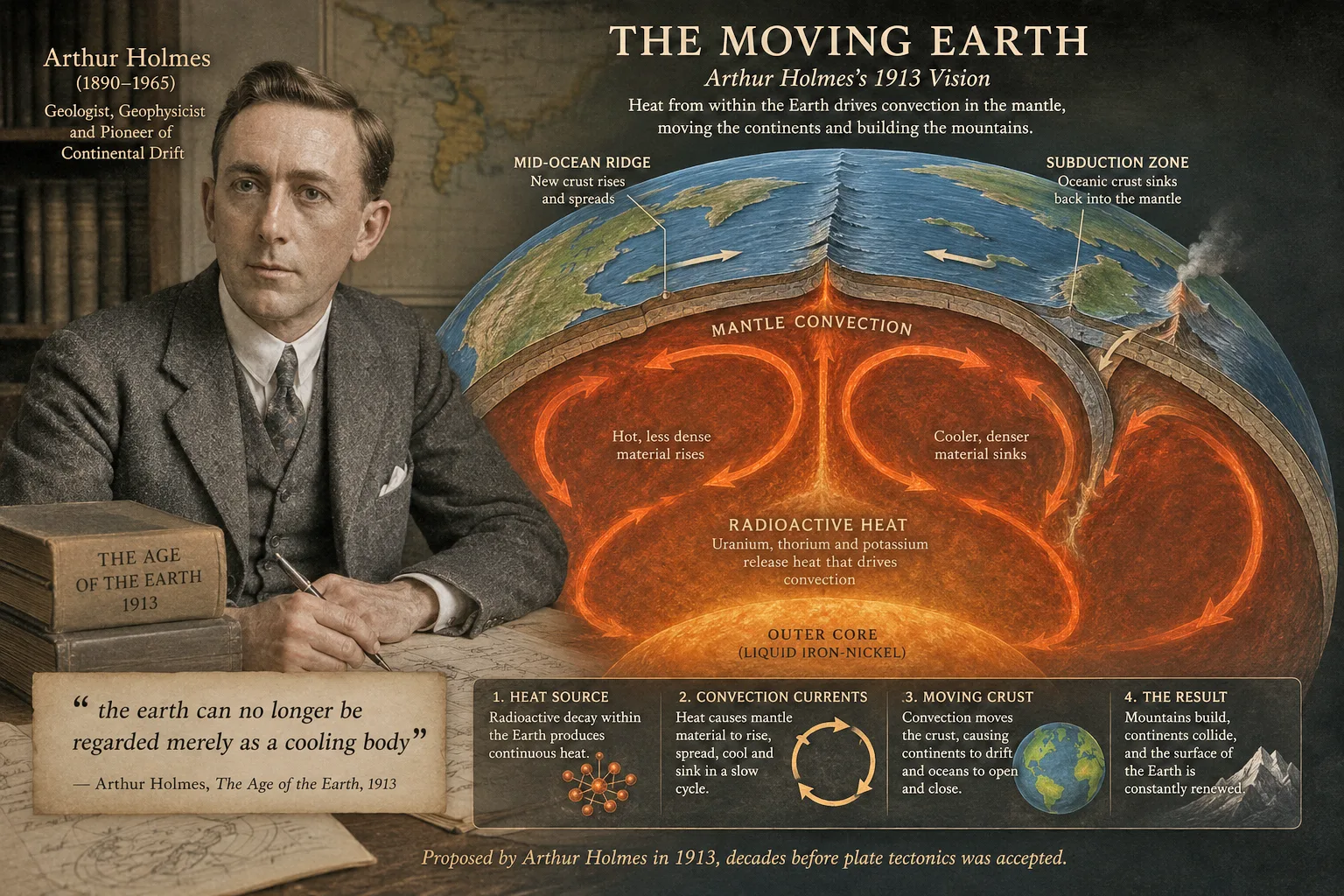
His genius was to link the problem to his own deepest expertise: radioactive heat. In 1928–1931, Holmes proposed that heat from radioactive decay deep inside the Earth drives slow convection currents in the mantle — hot material rising, cooling and sinking, much as heated air circulates in a room — and that these currents could carry the continents and even tear them apart. He presented the idea in a lecture to the Geological Society of Glasgow on 12 January 1928, published in summary that year in Geological Magazine and in full as "Radioactivity and Earth Movements" in the society's Transactions (1929, volume 18). He gave it pride of place in the final chapter of Principles of Physical Geology, complete with diagrams that strikingly anticipate the modern concepts of sea-floor spreading and subduction.
This was decades ahead of its time. Mantle convection is now understood to be the actual engine of plate tectonics, confirmed only in the 1960s through the work of Harry Hess, Fred Vine, Drummond Matthews and J. Tuzo Wilson. Tellingly, at none of Holmes's medal presentations was his work on continental drift ever mentioned; it was simply too far ahead of mainstream opinion.
Legacy — 4.54 Billion Years
Today, radiometric dating is the standard worldwide method for dating rocks and reconstructing Earth history. The modern age of the Earth — 4.54 billion years, give or take about 50 million — was pinned down by the American geochemist Clair Patterson, who in 1956 dated the troilite phase of the Canyon Diablo iron meteorite and other samples by lead–lead methods. As Patterson wrote in "Age of Meteorites and the Earth" (Geochimica et Cosmochimica Acta, October 1956): "The most accurate method (Pb207/Pb206) gives an age of 4.55 ± 0.07 × 10⁹ yr… It is therefore believed that the age for the earth is the same as for meteorites." Patterson's triumph rested squarely on the radiometric principles Holmes had pioneered, and Holmes himself revised his own estimate to about 4.5 billion years in light of it.
The geological timescale maintained today by the International Commission on Stratigraphy descends directly from the dating tables Holmes published throughout his career; the modern Geologic Time Scale literature acknowledges him as "the father of the geologic time scale."
His memory endures. The European Geosciences Union awards the Arthur Holmes Medal, one of its three most prestigious honours, for exceptional achievement in solid Earth science. A crater on Mars bears his name. Durham University's Isotope Geology Laboratory and its student geology society are named for him. And in 2015 the University of Edinburgh marked the 50th anniversary of his death with an exhibition aptly titled "Arthur Holmes: The most famous British geologist you have never heard of."
Timeline
1890
Arthur Holmes born at 62 Glen Terrace, Hebburn-on-Tyne
Tyneside, England — this collection states his birthplace plainly
1896–1904
Becquerel, the Curies, Rutherford and Soddy establish radioactivity and half-lives
The physics that would both break Kelvin's argument and supply a clock
1897
Kelvin narrows the Earth's age to 20–40 million years
'Much nearer 20 than 40' — a timescale too short for geology or evolution
1907
Holmes wins a scholarship to the Royal College of Science, London
Studies physics under Robert John Strutt, who was measuring radioactivity in rocks
1907
Bertram Boltwood makes the first serious uranium–lead age attempts
The idea existed; Holmes turned it into a tool
1910
Holmes switches from physics to geology
Against his tutors' advice, but keeping Strutt's guidance
1911
First U–Pb analysis performed specifically to date a rock
370 million years for a Devonian rock; paper read to the Royal Society in April while Holmes was in Mozambique, aged 21
1913
The Age of the Earth published
At 23; argues the oldest rocks are ~1,600 million years old
1927
The Age of the Earth: An Introduction to Geological Ideas
Offers 1.6–3.0 billion years for the oldest rocks
1928–31
Holmes proposes radioactive-heat-driven mantle convection
Lecture to the Geological Society of Glasgow, 12 January 1928; 'Radioactivity and Earth Movements', 1929
1940s
Holmes revises the Earth's age to 4,500 ± 100 million years
Using Nier's uranium isotope abundance measurements; the Holmes–Houtermans model
1942
Elected Fellow of the Royal Society
After two decades building Durham's geology department
1943
Appointed Regius Professor of Geology, University of Edinburgh
Succeeding Thomas John Jehu; the most senior post of his career
1944
Principles of Physical Geology published
Begun while fire-watching against incendiary bombs at Durham; an international best-seller
1956
Clair Patterson dates meteorites to 4.55 ± 0.07 billion years
The modern figure, built on Holmes's principles; Holmes retires from Edinburgh the same year
1959–60
'A Revised Geological Time-Scale' published in Edinburgh
Transactions of the Edinburgh Geological Society, vol. 17, 183–216
1960
Nier calls Holmes 'the Father of Geological Timescales'
The title has stuck
1960s
Plate tectonics confirmed by Hess, Vine, Matthews and Wilson
Vindicating Holmes's convection mechanism decades late
1964
Awarded the Vetlesen Prize
Often called the geologist's Nobel — and often misremembered as a knighthood
1965
Holmes dies of bronchial pneumonia in London, 20 September
Cremated; his ashes given to his widow, the petrologist Doris Reynolds
Myths & Facts
Myth: Arthur Holmes was Scottish.
Fact: He was born in Hebburn-on-Tyne, County Durham, in 1890 and schooled in Gateshead. He belongs in this collection for his Edinburgh chair (1943–1956) and the work he did there, not for his birthplace.
Myth: Sir Arthur Holmes was knighted for his work.
Fact: He was never knighted. Every authoritative source styles him Arthur Holmes FRS FRSE. The 1964 honour sometimes mistaken for a knighthood was the Vetlesen Prize.
Myth: Holmes invented radiometric dating from nothing.
Fact: Rutherford and Soddy established radioactive decay and half-lives; Bertram Boltwood attempted uranium–lead dating around 1907. Holmes's achievement was turning the idea into a working geological tool and building a timescale from it.
Myth: Radioactivity single-handedly demolished Kelvin's age of the Earth.
Fact: Historians regard that story as too neat. Radioactive heating is a genuine flaw in Kelvin's model, but the physics is more complicated and other assumptions were also at fault. The Rutherford–Kelvin 1904 lecture anecdote is genuine but frequently oversimplified.
Myth: The Age of the Earth (1913) claimed the planet was 1.6 billion years old.
Fact: It gave ~1,600 million years for the oldest Archean rocks. Holmes largely declined to speculate on the Earth's total age in that book.
Myth: Holmes proposed mantle convection in 1919.
Fact: That date appears in some popular sources, but scholarly consensus places his key statements in 1928–1931, beginning with his Geological Society of Glasgow lecture of 12 January 1928.
Myth: Holmes is buried in Edinburgh.
Fact: He died in London in 1965 and was cremated, his ashes given to his widow. No public source identifies a final resting place, and there is no known grave or physical memorial to him in Scotland.
Did You Know?
- Holmes was twenty-one when his first age-dating paper was read to the Royal Society — and he was in Mozambique at the time, prospecting for minerals.
- While in Mozambique he caught a near-fatal tropical fever, and a false report of his death reached London.
- He began writing Principles of Physical Geology while standing fire-watch against German incendiary bombs during the Second World War.
- His wife, Doris Reynolds, was the first woman elected a Fellow of the Royal Society of Edinburgh, and edited the third edition of his textbook.
- He was never knighted — the 1964 honour often mistaken for a knighthood was the Vetlesen Prize, the geologist's Nobel.
- A crater on Mars is named after him, as is the European Geosciences Union's Arthur Holmes Medal.
- Edinburgh's 2015 exhibition marking his death called him 'the most famous British geologist you have never heard of'.
Honest Caveats
Nationality. Holmes was English-born and died in London. He appears in this collection on the strength of his Edinburgh Regius Chair (1943–1956) and the work he produced there, framed the same way this collection frames Peter Higgs.
His father's occupation is disputed. The Royal Society memoir and most sources say cabinet-maker; Cherry Lewis's biography and the Oxford DNB say hardware shop assistant.
The mantle-convection date. Some sources, including the American Museum of Natural History, give 1919. Scholarly consensus places his key statements in 1928–1931, and this article uses the latter.
The 1913 figure. The Age of the Earth reported ~1.6 billion years for the oldest rocks; some sources note Holmes deliberately avoided speculating on the Earth's total age in that book.
The Rutherford–Kelvin anecdote. Genuine, but frequently oversimplified. The claim that radioactive heating alone overturned Kelvin's calculation is regarded by historians as too neat.
Resting place. Holmes was cremated in London and his ashes given to his widow. No public source identifies a final resting place, and there is no known grave or physical memorial to him in Scotland — his true memorial, in the words of the Dictionary of Scientific Biography, is his great textbook.
Birthplace shorthand. Consistently given as Hebburn-on-Tyne (62 Glen Terrace); some references say "Gateshead," where he grew up and was schooled. Both reflect the same Tyneside origin.
Frequently Asked Questions
Was Arthur Holmes Scottish?
No, and this collection says so plainly. Holmes was born on 14 January 1890 at 62 Glen Terrace, Hebburn-on-Tyne, County Durham, near Newcastle, and was educated at Gateshead Higher Grade School — Tyneside by birth and upbringing. He is included here because the most senior and arguably most significant post of his career was Scottish: he was Regius Professor of Geology at the University of Edinburgh from 1943 until his retirement in 1956, and it was during those Edinburgh years that he wrote Principles of Physical Geology and published his definitive revised geological timescale. Edinburgh can claim the crowning chapter of his career; it cannot claim his birth.
Was Holmes ever knighted?
No. This is a widespread but unverified assumption and we do not repeat it. Every authoritative source styles him 'Arthur Holmes FRS FRSE'. The 1964 honour that is sometimes mistaken for a knighthood was in fact the Vetlesen Prize, often described as the geologist's Nobel.
What is radiometric dating and how does it work?
Uranium is radioactive and decays, step by step, into lead at a known and unchanging rate. Lead does not normally find its way into a freshly formed crystal of a mineral such as zircon, but uranium does. So every atom of lead locked inside that crystal is there only because it was once uranium that has since decayed. Measure the ratio of remaining uranium to accumulated lead, apply the known decay rate, and you can calculate how long the clock has been running — much like reading the sand that has fallen through an hourglass.
What exactly did Holmes do first?
He performed the very first uranium–lead analysis undertaken specifically to determine the age of a rock. It yielded 370 million years for a Devonian rock from Norway. He was twenty-one. The paper — 'The Association of Lead with Uranium in Rock-Minerals, and Its Application to the Measurement of Geological Time', Proceedings of the Royal Society A 85: 248–256 — was read to the Royal Society in April 1911 while Holmes himself was prospecting in Mozambique.
Did Holmes invent radiometric dating on his own?
No. The underlying physics came from Ernest Rutherford and Frederick Soddy, who established radioactive decay and the concept of the half-life, and the American chemist Bertram Boltwood made the first serious attempts at uranium–lead dating around 1907. Holmes's distinct contribution was to turn a suggestive idea into a precise geological tool — choosing lead over the leaky helium method, applying it deliberately to date rocks, and then spending a career building an entire timescale from it.
Why was Lord Kelvin's estimate of the Earth's age wrong?
Kelvin assumed the Earth had simply been cooling from an initially molten state, and by 1897 concluded it was probably 20 to 40 million years old, 'much nearer 20 than 40'. What he could not know was that radioactive decay generates heat inside the Earth — so the planet is not merely cooling but is also being warmed from within, and can therefore cool far more slowly and be vastly older. Historians caution that the popular version is too neat: radioactive heating alone does not tidily overturn Kelvin's calculation, and other assumptions in his model were also flawed. But the direction of the correction is not in doubt.
Why did the short timescale matter so much?
Because two of the nineteenth century's biggest ideas needed deep time. Geologists in the tradition of James Hutton and Charles Lyell required vast stretches for slow, steady processes to shape the landscape; Charles Darwin needed immense ages for life to diversify by natural selection, writing of the 'incomprehensibly vast… periods of time' his theory demanded. Kelvin's short Earth threatened to strangle both. Radiometric dating settled the argument decisively in geology's favour.
What did The Age of the Earth (1913) actually claim?
Written when Holmes was just 23 and published by Harper & Brothers, it made a passionate, lucid case for radiometric dating over methods based on sedimentation rates or planetary cooling. In it he wrote that 'if our interpretation is correct, some of the oldest Archean rocks must date back 1600 million years' — more than ten times Kelvin's figure for the entire planet. It is often regarded as containing the first quantitative geological timescale. Notably, Holmes largely refrained from speculating on the Earth's total age in that book; the 1.6 billion figure refers to the oldest rocks.
How was the book received?
With real resistance. Many geologists distrusted a physicist-trained newcomer intruding on their field, and the radioactive method was viewed with suspicion. Acceptance came only slowly across decades, as Holmes refined his methods and the evidence accumulated. He caught the irony himself: 'Not many years ago geologists were dissatisfied with the shortness of their time allowance; to-day they are confronted with an embarrassing super-abundance.'
What was Holmes's connection to continental drift?
When Alfred Wegener proposed continental drift in 1912, he could not explain what force could move continents, and most geologists dismissed the idea. Holmes was one of very few prominent geologists to take it seriously, and he supplied a mechanism from his own deepest expertise: heat from radioactive decay driving slow convection currents in the mantle, which could carry continents and tear them apart. He set this out in a lecture to the Geological Society of Glasgow on 12 January 1928, in Geological Magazine that year, and in full as 'Radioactivity and Earth Movements' (Transactions of the Geological Society of Glasgow, 1929, vol. 18), and gave it pride of place in the final chapter of Principles of Physical Geology with diagrams that strikingly anticipate sea-floor spreading and subduction.
Was Holmes credited for the mantle-convection idea in his lifetime?
Barely. Mantle convection is now understood to be the engine of plate tectonics, confirmed in the 1960s through the work of Harry Hess, Fred Vine, Drummond Matthews and J. Tuzo Wilson. Tellingly, at none of Holmes's many medal presentations was his work on continental drift ever mentioned — it was simply too far ahead of mainstream opinion.
How old is the Earth, and who established the modern figure?
4.54 billion years, give or take about 50 million. The figure was pinned down by the American geochemist Clair Patterson, who in 1956 dated the troilite phase of the Canyon Diablo iron meteorite and other samples by lead–lead methods, reporting 'an age of 4.55 ± 0.07 × 10⁹ yr' and concluding that 'the age for the earth is the same as for meteorites'. Patterson's result rested squarely on the radiometric principles Holmes pioneered, and Holmes revised his own estimate to about 4.5 billion years in its light.
What did Holmes do during his Edinburgh years?
A great deal, despite increasingly poor health. He completed major work on the age of the Earth, the geological timescale, the Precambrian and the geology of Africa; served as Vice President of the Edinburgh Geological Society in 1948–49; published Principles of Physical Geology (1944), which shaped the training of geologists worldwide for generations; and published 'A Revised Geological Time-Scale' through the Transactions of the Edinburgh Geological Society in 1959–60. He shared his Edinburgh life with his second wife, the petrologist Doris Reynolds — the first woman elected a Fellow of the Royal Society of Edinburgh — who later edited the third edition of the Principles.
How is Holmes remembered today?
The European Geosciences Union awards the Arthur Holmes Medal, one of its three most prestigious honours, for exceptional achievement in solid Earth science. A crater on Mars bears his name. Durham University's Isotope Geology Laboratory and its student geology society are named for him. In 2015 the University of Edinburgh marked the 50th anniversary of his death with an exhibition aptly titled 'Arthur Holmes: The most famous British geologist you have never heard of.'
Sources & Further Reading
Tier 1 · Primary
- Holmes, A. — "The Association of Lead with Uranium in Rock-Minerals, and Its Application to the Measurement of Geological Time," Proceedings of the Royal Society A 85 (1911): 248–256.
- Holmes, A. — The Age of the Earth, Harper & Brothers, 1913.
- Holmes, A. — "Radioactivity and Earth Movements," Transactions of the Geological Society of Glasgow 18 (1929).
- Holmes, A. — Principles of Physical Geology, 1944.
- Holmes, A. — "A Revised Geological Time-Scale," Transactions of the Edinburgh Geological Society 17 (1959–60): 183–216.
- Patterson, C. — "Age of Meteorites and the Earth," Geochimica et Cosmochimica Acta, October 1956.
Tier 2 · Scholarly and institutional
- Royal Society — Biographical Memoirs of Fellows of the Royal Society, memoir of Arthur Holmes.
- Lewis, C. — The Dating Game: One Man's Search for the Age of the Earth, Cambridge University Press.
- Oxford Dictionary of National Biography — entry for Arthur Holmes.
- GSA Today, Geological Society of America — on Holmes's first uranium–lead age determination.
- Dictionary of Scientific Biography — entry for Arthur Holmes.
- University of Edinburgh — "Arthur Holmes: The most famous British geologist you have never heard of," 2015 exhibition.
Tier 3 · Site source document
docs/sources/discoveries/radiometric-dating.md— the commissioned source document underlying this article.