Discoveries · No. 35 of 50 · Earth Science
James Croll and the Astronomical Theory of the Ice Ages
A Perthshire crofter's son who left school at thirteen and became a museum janitor worked out, in a Glasgow library, the essential astronomical mechanism behind the ice ages — decades before Milutin Milankovic gave the theory its modern name and rigour, and more than a century before deep-sea sediment cores proved him right.
James Croll · 1821–1890Theory published · 1864Reading time · 19 minUpdated 16 August 2026
TL;DR
- James Croll (1821–1890), a self-taught crofter's son turned museum janitor, proposed from 1864 that cyclical changes in Earth's orbit — eccentricity and the precession of the equinoxes — drive the ice ages, developing the idea fully in Climate and Time (1875).
- His original 1864 theory covered eccentricity and precession only; axial tilt (obliquity) entered his thinking later, from 1867, in separate papers. He should not be credited with the full three-cycle scheme from the start.
- The mathematical synthesis and the modern name belong to Milutin Milankovic, working from 1912; the theory was finally confirmed from deep-sea sediment cores by Hays, Imbrie and Shackleton in 1976. Croll's priority for the core mechanism is real, but the completed, proven theory is a shared, multi-generational achievement.
Scottish Impact Index (SI Score)
- Global Impact
- 7/10
- Longevity
- 8/10
- Economic / Material Impact
- 3/10
- Originality / Distinctiveness
- 9/10
- Legacy (Built Upon)
- 8/10
- Recognition
- 3/10
Key Findings
- James Croll (1821–1890), born at Little Whitefield in Cargill parish, Perthshire, left school at about 13 and was overwhelmingly self-taught, working as a millwright, tea merchant, hotel keeper, insurance agent and finally museum janitor in Glasgow.
- In an 1864 paper in the Philosophical Magazine, and fully in Climate and Time (1875), he proposed that ice ages occur when high orbital eccentricity coincides with a hemisphere's winter falling at aphelion, amplified by ice-albedo feedback.
- His 1864 theory covered eccentricity and precession only; obliquity was added in later papers from 1867, and should not be attributed to his founding work.
- The 1864 paper brought him scientific recognition and an 1867 post at the Geological Survey of Scotland; he was elected FRS in 1876, nominated by Charles Darwin.
- His theory fell out of favour by the late nineteenth century over dating discrepancies, and Croll died in 1890 in relative poverty without seeing it vindicated.
- Milutin Milankovic mathematically synthesised and corrected the theory from 1912, publishing his Canon of Insolation in 1941 — the cycles bear his name because of this rigour and his summer-insolation correction.
- Hays, Imbrie and Shackleton confirmed the theory from deep-sea sediment cores in their landmark 1976 Science paper, "Pacemaker of the Ice Ages."
Quick Facts
- Discovery
- The astronomical theory of the ice ages: cyclical changes in Earth's orbit drive the timing of glaciations
- Year
- 1864 — 'On the Physical Cause of the Change of Climate during Geological Epochs', Philosophical Magazine
- Key figure
- James Croll (1821–1890)
- Background
- Crofter's son from Perthshire; largely self-taught; worked as millwright, tea merchant, hotelier, insurance agent and museum janitor
- Major work
- Climate and Time, in Their Geological Relations, 1875
- 1864 mechanism
- Orbital eccentricity plus precession of the equinoxes determining hemispheric winter insolation
- Obliquity caveat
- Axial tilt entered Croll's thinking only from 1867 onward, not in the founding 1864 paper or in Climate and Time
- Signature insight
- Ice-albedo feedback — growing ice reflects sunlight and amplifies cooling — described as his 'main achievement'
- Career vindication
- 1867 post at the Geological Survey of Scotland; FRS 1876; honorary LLD, St Andrews, 1876
- Later refinement
- Milutin Milankovic (1879–1958) mathematically synthesised the theory from 1912, published 1941, gave it its modern name
- Milankovic's correction
- Northern-hemisphere summer insolation, not Croll's winter insolation, is decisive; obliquity given central role
- Confirmation
- Hays, Imbrie and Shackleton, 'Variations in the Earth's Orbit: Pacemaker of the Ice Ages', Science, 1976
- Claim status
- Shared — genuine Scottish priority for the essential mechanism, but the name, mathematical rigour and full three-cycle synthesis belong to Milankovic, and empirical proof to Hays, Imbrie and Shackleton
- Modern relevance
- Distinguishes slow natural orbital forcing from rapid human-driven CO₂ warming
Cargill to Glasgow
James Croll's life is one of the most improbable in the history of science. He was born on 2 January 1821 at Little Whitefield, a small farm in the parish of Cargill, north of Perth, the second son of David Croll, a stonemason who also worked a rented smallholding of around twenty acres, and his wife Janet (recorded in different sources as either Janet Ellis or Janet Geddes — an unresolved minor discrepancy that does not affect anything of substance). Ill-health dogged Croll from childhood, and his formal schooling in parish and village schools ended at about the age of thirteen, when he was needed to work. Everything else he ever knew, he taught himself, drawing heavily in his early years on cheap self-improvement periodicals such as the Penny Magazine.
What followed was a remarkable, restless sequence of trades. Croll served an apprenticeship as a wheelwright and millwright, worked for a time as a house joiner, and then — his health unsuited to heavy manual labour — became a tea merchant in Elgin, kept a temperance hotel in Blairgowrie, and worked as an insurance agent in Glasgow, Edinburgh and Leicester. None of these ventures made him prosperous, and each in its own way seems to have left him restless and unfulfilled. Then, in 1859, he took the post that would change the course of his life: janitor of the museum at Anderson's College in Glasgow, an institution also known at the time as the Andersonian, and the direct ancestor of today's University of Strathclyde.
Croll himself reportedly regarded the janitor's post as the "perfect job," and it is not hard to see why. The physical duties were light, and much of the actual labour was carried out by his disabled younger brother David, whom Croll supported financially throughout this period. Crucially, the post gave Croll free access to the college library and to that of the Glasgow Philosophical Society — a resource he used with extraordinary diligence, reading his way, entirely without formal instruction, into contemporary physics, astronomy and geology.
The Theory From the Library
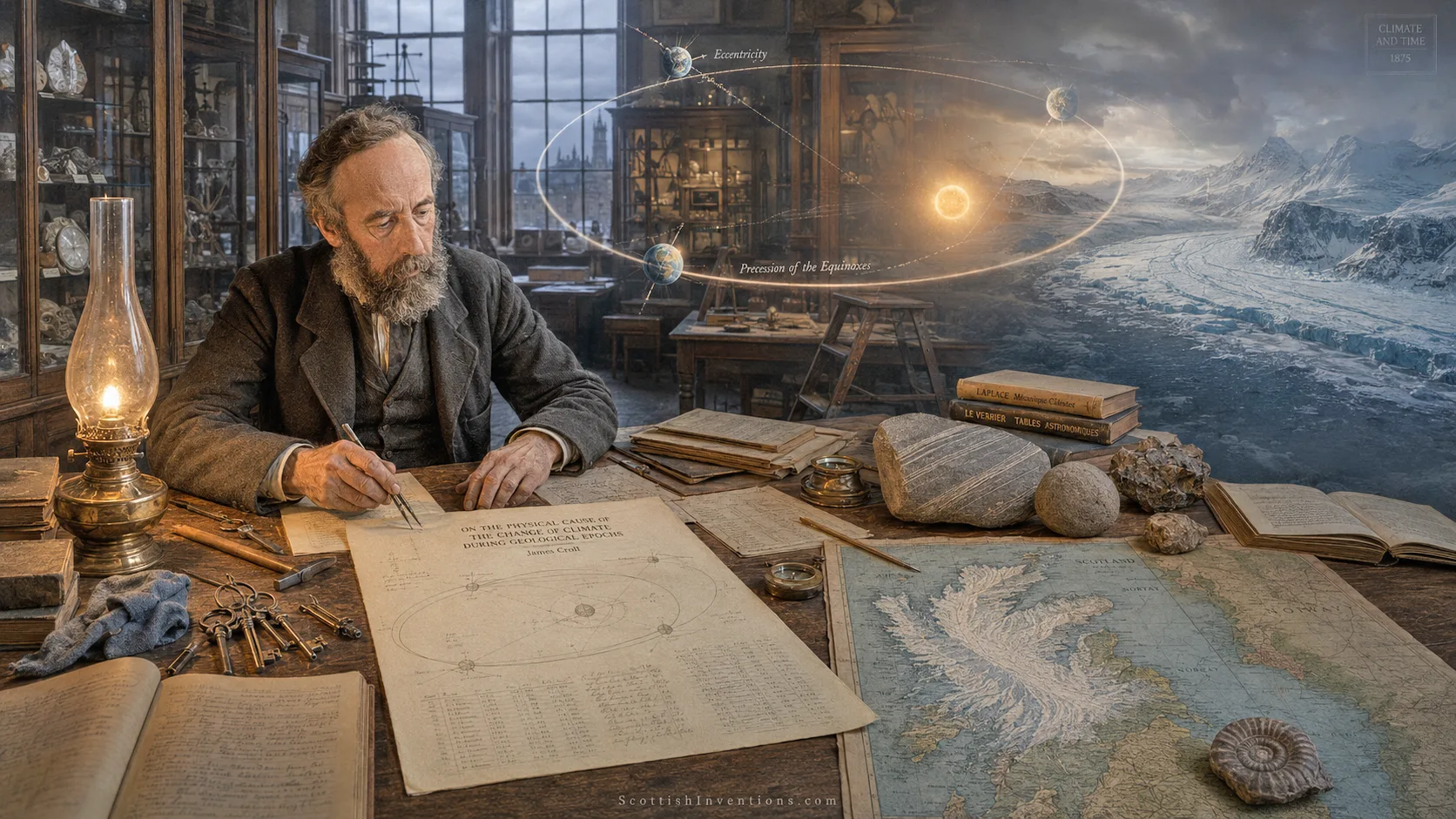
Reading voraciously in physics and astronomy, Croll became fascinated by a problem that had stumped the geological establishment: the Swiss-born naturalist Louis Agassiz and others had by then firmly established that great ice sheets had once covered large parts of the northern hemisphere, but no one had a convincing explanation of why such ice ages came and went. Croll found his answer in the sky rather than in the rocks. Drawing on the precise orbital calculations of the French astronomer Urbain Le Verrier — whose mathematics, famously, had already led to the discovery of the planet Neptune — and building on Joseph Adhémar's 1842 book Révolutions de la mer, Croll set out his answer in an 1864 paper for the Philosophical Magazine, titled in full "On the Physical Cause of the Change of Climate during Geological Epochs." The paper was modestly signed "James Croll, Anderson's Institution." The scientific establishment, when it took notice, was astonished to discover that the author was a museum janitor.
Croll was not working in a vacuum. Adhémar had already proposed, in 1842, that the precession of the equinoxes could be a cause of glaciation, and the astronomer John Herschel had mused, around 1830, on the possible climatic effects of eccentricity. What Croll did that neither of them had done was combine the two orbital elements into a single, worked-out mechanism, calculate in detail how each affected the solar radiation received by a hemisphere through the year, predict that ice ages should recur multiple times rather than occur once, and — his single most original contribution — introduce a physical feedback mechanism that could turn a comparatively modest astronomical nudge into a full continental glaciation.
The Mechanism
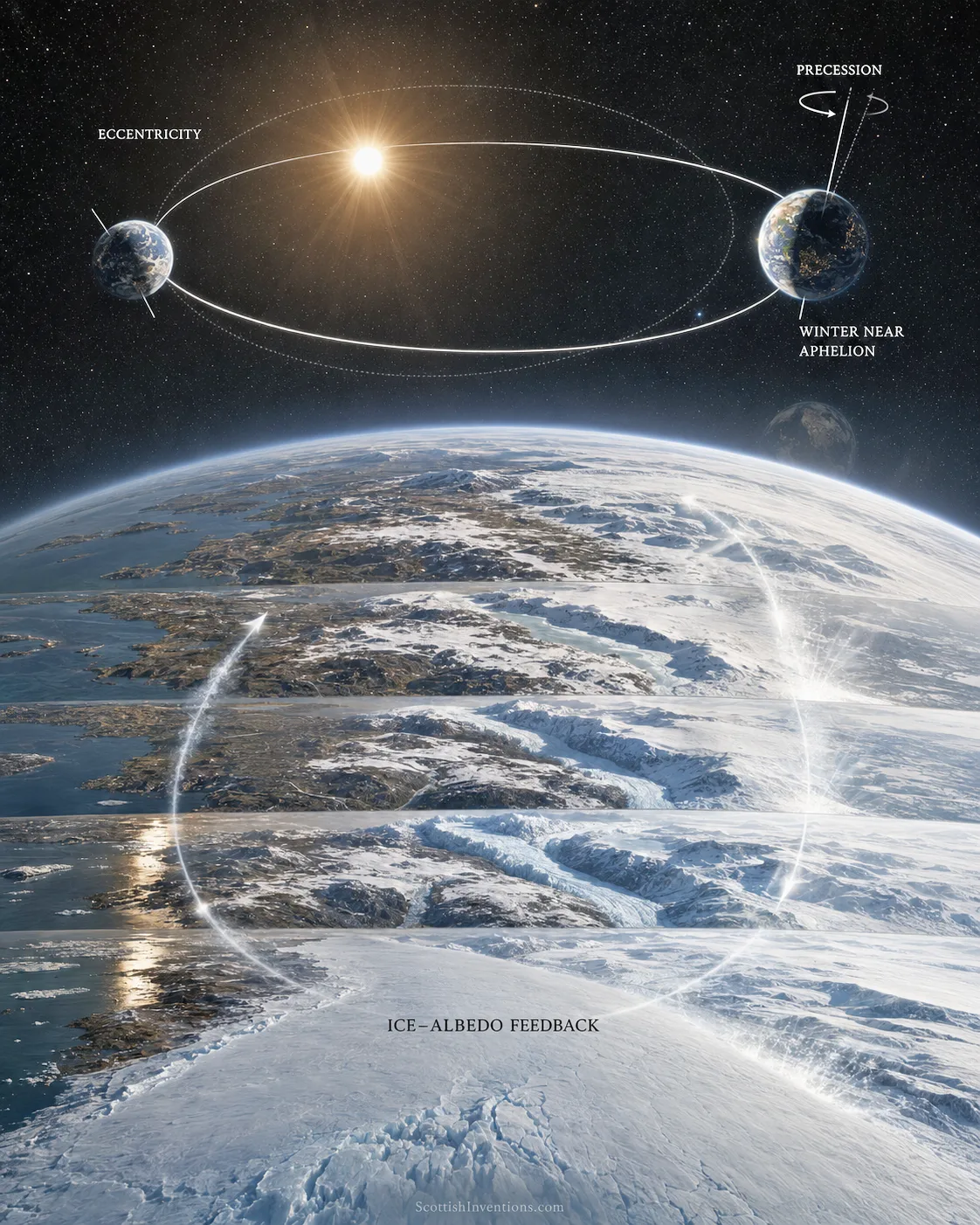
Croll's theory rested on two orbital ingredients. The first was orbital eccentricity: Earth's orbit around the Sun slowly shifts, over a cycle of roughly 100,000 years, between being nearly circular and noticeably more elliptical, changing how much the Earth–Sun distance varies through the year. The second was the precession of the equinoxes — Earth's slow wobble on its rotational axis, completing a cycle on the order of 22,000 to 26,000 years — which determines whether a given hemisphere's winter falls when Earth happens to be closest to the Sun (perihelion) or farthest away (aphelion).
Croll's key mechanism combined the two: when eccentricity is high and a hemisphere's winter coincides with aphelion, that hemisphere receives markedly less solar radiation during its winter months, allowing snow and ice to accumulate rather than melt away. Croll spelled out just how dramatic he thought the effect could be, writing in 1864 that at latitudes of around 54–55 degrees the ground might, "at the very height of summer, be almost covered with frozen snow, in some places many fathoms deep."
Most presciently of all, Croll proposed a genuine positive feedback loop: once snow and ice begin to accumulate, they reflect substantially more sunlight back into space than bare ground or open ocean does — what climate scientists today call the ice-albedo feedback — cooling the local climate still further and reinforcing the glaciation that produced it in the first place. He layered further amplifying effects on top of this, arguing that an expanding ice sheet would alter prevailing trade winds and deflect warm ocean currents such as the Gulf Stream away from the affected hemisphere, starving it of additional heat. This coupling of a small astronomical trigger to powerful terrestrial feedbacks is why modern historians of science regard Croll as an early, largely self-taught practitioner of what we would now call Earth-system science — thinking about climate as an interconnected system of feedbacks rather than a simple, linear response to sunlight.
Croll's work landed in the middle of a golden age of climate physics on the other side of the Channel and in London. His contemporary John Tyndall was, from 1859 onward, running celebrated experiments at the Royal Institution demonstrating that certain gases — notably water vapour and carbon dioxide — absorb and re-emit radiant heat, laying the laboratory foundation for what we now call the greenhouse effect. Croll and Tyndall knew one another personally; Tyndall exchanged scientific correspondence with Croll and later lent his support to Croll's pension application, a rare instance of one largely self-taught and one formally trained scientist recognising each other's work as part of the same emerging field.
What Croll Did — and Did Not — Claim
It is tempting, in retrospect, to credit Croll with the full modern three-cycle scheme of eccentricity, precession and obliquity — the complete "Milankovitch" picture — simply because he is so clearly its forerunner. That temptation should be resisted, and this article deliberately does not give in to it. Croll's landmark 1864 paper, and his 1875 masterwork Climate and Time, were built on eccentricity and precession alone. The Croll specialist Kevin Edwards, writing in the Journal of Quaternary Science in 2022, is explicit on this point: obliquity and albedo considerations, he notes, "make their first appearance in other papers (viz. Croll 1867b, c) and Croll (1870a)... though not in the 1864 paper or in Climate and Time." In plainer terms: Croll's core, famous theory did not include axial tilt at all. Obliquity was a later addition to his thinking, developed in separate papers from 1867 onward, and it remained a secondary rather than central element of his overall framework — quite unlike the role it would eventually play for Milutin Milankovic.
This distinction matters for reasons beyond pedantry. Popular accounts of Croll frequently compress his career into a single moment — "in 1864 he discovered the Milankovitch cycles" — that flattens a real intellectual development spanning years and, more importantly, overstates what his founding paper actually contained. The accurate account, and the one this article follows, is that Croll pioneered the eccentricity-plus-precession mechanism in 1864, extended his thinking to include obliquity from 1867, and that the fully integrated, mathematically rigorous three-cycle theory — with obliquity restored to a central role, alongside a correct emphasis on summer rather than winter insolation — is properly credited to Milutin Milankovic, working from 1912.
The Vindication of a Janitor
Croll's 1864 paper brought him swiftly to the attention of the leading figures of British science of the day — Charles Lyell, William Thomson (Lord Kelvin), Andrew Ramsay and Archibald Geikie among them. In 1867, Geikie arranged for Croll to join the Edinburgh office of the Geological Survey of Scotland, as secretary and accountant and keeper of maps, a post that gave him a modest but reliable salary and, crucially, time to continue writing. The appointment came with a hitch entirely in keeping with the "genius janitor" character of his story: to join the civil service, Croll had to sit a formal examination — and he failed both the arithmetic and the English papers. His scientific patrons persuaded the authorities that his already-published calculations on the eccentricity of Earth's orbit were more than sufficient evidence of his arithmetical capacity, and the appointment went ahead regardless.
Climate and Time, in Their Geological Relations: A Theory of Secular Changes of the Earth's Climate appeared in 1875, published in London by Daldy, Isbister & Co. of 56 Ludgate Hill, with a simultaneous United States edition from D. Appleton & Co. of New York. It is worth correcting a publishing myth here: popular sources, including at times the Wikipedia article on Croll, have wrongly credited the 1875 first edition to Edward Stanford (who published only some of Croll's later works) or to Adam and Charles Black (who issued a reprint in 1885). The 1875 title page and library catalogues confirm Daldy, Isbister as the original publisher. The book had a genuinely significant effect on contemporary science: Charles Lyell revised his influential Principles of Geology in direct response to Croll's theory, and Croll himself corresponded with Charles Darwin, Alfred Russel Wallace, Joseph Hooker and other leading naturalists of the period.
The year 1876 marked the summit of Croll's public recognition. He was elected a Fellow of the Royal Society of London, his nomination certificate headed by the signature of Charles Darwin, with John Tyndall, Andrew Ramsay, Archibald Geikie and Lord Kelvin among his supporters; he was awarded an honorary LLD by the University of St Andrews; and he was made an honorary member of the New York Academy of Sciences. He also received several monetary awards from the Geological Society of London over the years: the balance of the Wollaston Donation Fund in 1872, the Murchison Fund in 1876, and the Barlow-Jamieson Fund in 1884. A myth worth debunking directly: Croll did not receive the Wollaston Medal or the Lyell Medal, the Geological Society's senior honours — the awards he received were cash fund distributions of similar name, and he was never even elected a Fellow of that particular society. He went on to publish two further books, Discussions on Climate and Cosmology (1885) and Stellar Evolution and Its Relations to Geological Time (1889), the latter containing an early attempt at explaining the chemical composition of the stars.
Overshadowed, Then Confirmed
For all its influence, Croll's theory faded significantly within his own lifetime. It predicted that ice ages should alternate between hemispheres and that the last one ended around 80,000 years ago, but improving geological dating techniques — including, notably, estimates based on the recession rate of Niagara Falls — pointed instead to a much more recent end to the last glaciation. That mismatch, combined with growing doubts about the theory's emphasis on winter insolation, meant the astronomical theory of the ice ages was widely regarded as discredited by the close of the nineteenth century. Croll retired in 1880 after suffering a stroke, living on a meagre superannuation of £75 16s 8d a year; his scientific friends helped arrange a move to a more comfortable house in Perth in 1886. He died there, in relative poverty, on 15 December 1890, his estate valued at only a few hundred pounds.
The theory did not die with him. It was revived and mathematically transformed by Milutin Milankovic (1879–1958), a Serbian mathematician and engineer who began his own climate work in 1912 and published his complete synthesis, the Canon of Insolation of the Earth and Its Application to the Ice-Age Problem, in 1941. Milankovic's contribution was not a mere restating of Croll's ideas; it involved two genuinely crucial corrections. First, he calculated insolation for specific latitudes rather than treating the globe as a single unit, giving the theory far greater precision. Second, and most importantly, he argued that the decisive factor for glaciation was northern-hemisphere summer insolation — whether summers are cool enough to leave the previous winter's snow unmelted — rather than the winter insolation that Croll had emphasised. Milankovic also restored obliquity to a central place in the theory. It is because of this mathematical rigour and this crucial correction that the orbital cycles now bear his name — "Milankovitch cycles" — even though Croll had proposed the essential astronomical mechanism roughly half a century earlier. The honest verdict, and the one this article adopts, is that Croll's priority for the underlying mechanism is genuine, but Milankovic's mathematical completeness and his summer-insolation correction were essential to the theory's eventual scientific acceptance. Some scholars accordingly refer to the combined framework as "Croll–Milankovitch cycles," a label that fairly credits both men.
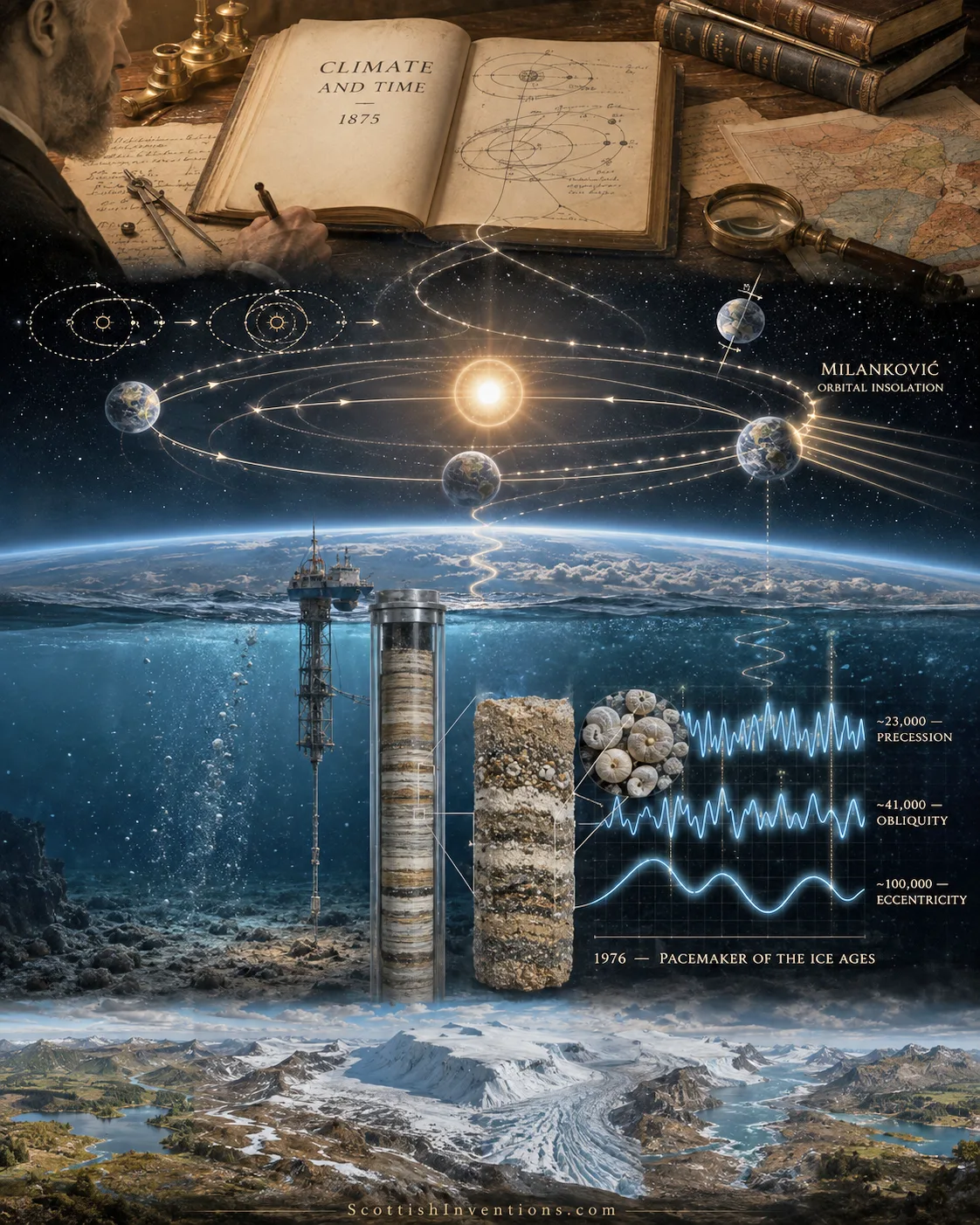
Final vindication came in 1976, when J. D. Hays, John Imbrie and Nicholas Shackleton published "Variations in the Earth's Orbit: Pacemaker of the Ice Ages" in Science (volume 194, issue 4270, pages 1121–1132). Analysing deep-sea sediment cores recovered from the southern Indian Ocean, they identified dominant climate cycles at roughly 23,000, 41,000 and 100,000 years — matching precession, obliquity and eccentricity almost exactly. The orbital cycles that Croll had first identified in outline, and that Milankovic had mathematically refined, did indeed pace the rhythm of the ice ages, more than a century after Croll's original 1864 paper.
Why Croll Still Matters
The dominant glacial cycle of roughly the last 800,000 years runs at approximately 100,000 years — closely matching the eccentricity cycle Croll identified, although the underlying physics of why eccentricity, the astronomically weakest of the three forcings, comes to dominate the geological record remains an active area of research known as the "100,000-year problem," and this article does not present it as settled. Understanding these natural orbital rhythms remains fundamental to modern palaeoclimatology and to climate modelling more broadly.
It is also essential, today, to distinguishing natural climate variation from human-driven change. NASA is explicit that orbital forcing cannot account for present-day warming: across glacial cycles, atmospheric CO₂ fluctuated between roughly 180 and 280 parts per million, whereas human activity has now pushed concentrations past 420 ppm, and the resulting greenhouse warming overwhelms the much slower orbital signal that Croll first described. On orbital grounds alone, Earth's climate would eventually drift toward another glaciation; but Ganopolski, Winkelmann and Schellnhuber, writing in Nature in 2016, calculate that even the cumulative emissions already released are "already sufficient to postpone the next ice age for another 50,000 years," concluding that "we are basically skipping a whole glacial cycle, which is unprecedented." The very orbital framework Croll built in a Glasgow museum library to explain the coming and going of the ice ages now helps scientists measure precisely how far human activity has pushed the climate off its natural, orbit-driven course.
Croll is honoured today by the James Croll Medal, the highest award of the Quaternary Research Association, established in 2010; a matching medal instituted at the University of Edinburgh in 2011; and a memorial in Perth, in a courtyard near the Fair Maid's House. Not a bad legacy for a Perthshire crofter's son who never attended university and spent years as a museum janitor.
Timeline
c. 1830
John Herschel muses on eccentricity's possible climatic effects
An early, undeveloped suggestion that orbital geometry might matter to climate
1821
James Croll born at Little Whitefield, Cargill parish, Perthshire
Son of a stonemason-crofter; formal schooling ends at about age 13
1842
Joseph Adhémar publishes Révolutions de la mer
Proposes precession as a cause of glaciation; an important influence on Croll
1859
Croll becomes janitor of the museum at Anderson's College, Glasgow
Light duties and library access let him pursue physics and astronomy self-study
1864
Croll publishes 'On the Physical Cause of the Change of Climate during Geological Epochs'
Sets out eccentricity plus precession as the driver of ice ages, with ice-albedo feedback as an amplifier
1867
Croll begins extending his theory to obliquity and albedo in further papers
The three-cycle scheme develops only from this point, not in the original 1864 paper
1867
Croll appointed to the Geological Survey of Scotland in Edinburgh
Brought in by Archibald Geikie after the 1864 paper drew wide scientific attention
1870
Further papers refine Croll's treatment of obliquity
Continuing development of the theory beyond its 1864 core
1875
Climate and Time, in Their Geological Relations published (Daldy, Isbister & Co., London; D. Appleton, New York)
Croll's masterwork; prompts Charles Lyell to revise Principles of Geology
1876
Croll elected FRS, nominated by Charles Darwin; honorary LLD from St Andrews
The summit of his public scientific recognition
1880
Croll retires after a stroke, on a small pension
His theory is already fading under pressure from conflicting geological dating evidence
1885
Croll publishes Discussions on Climate and Cosmology
Continues defending and extending his ideas late in life
1890
James Croll dies in Perth, in relative poverty
His astronomical theory is largely out of favour at the time of his death
1912–1941
Milutin Milankovic develops and publishes his Canon of Insolation
Recalculates insolation by latitude, emphasises northern-hemisphere summer insolation, and gives the cycles their modern name
1976
Hays, Imbrie and Shackleton publish 'Pacemaker of the Ice Ages' in Science
Deep-sea sediment cores confirm dominant climate cycles matching precession, obliquity and eccentricity
2010–2011
The James Croll Medal and an Edinburgh memorial medal are instituted
Modern recognition of Croll's pioneering, once-discredited theory
Myths & Facts
Myth: James Croll worked out the complete Milankovitch cycles — eccentricity, precession and obliquity — in 1864.
Fact: His landmark 1864 paper and his 1875 book Climate and Time were built on eccentricity and precession only. Obliquity entered his thinking in separate papers from 1867 onward. The full three-cycle synthesis, with obliquity as a central factor, is properly credited to Milutin Milankovic, working from 1912.
Myth: Croll's theory is basically the same as the modern Milankovitch theory, just under a different name.
Fact: The mechanisms differ in an important way: Croll emphasised winter insolation as the decisive factor, while Milankovic argued — correctly, as later evidence showed — that northern-hemisphere summer insolation is what actually determines whether ice sheets grow or retreat. Milankovic's correction, not just his renaming, was essential to the theory's eventual acceptance.
Myth: Croll received the Wollaston Medal and the Lyell Medal from the Geological Society.
Fact: He received cash fund awards from the Geological Society of London — the Wollaston Donation Fund balance, the Murchison Fund, and the Barlow-Jamieson Fund — but never the Society's senior medals of similar name, and he was never a Fellow of the Geological Society at all.
Myth: Climate and Time was published by Edward Stanford in 1875.
Fact: Stanford published some of Croll's later works, but the 1875 first edition of Climate and Time was published by Daldy, Isbister & Co. in London, with a simultaneous US edition from D. Appleton & Co. in New York, as confirmed by the 1875 title page and library catalogues.
Myth: Croll's astronomical theory of the ice ages was scientifically accepted throughout his life and only grew in stature after his death.
Fact: The opposite is closer to the truth for much of his later career: his theory fell out of favour by the late nineteenth century when improving geological dating (such as estimates from the recession of Niagara Falls) conflicted with his predicted timing for the end of the last ice age. It was not empirically vindicated until the 1976 Hays–Imbrie–Shackleton sediment-core study, eighty-six years after Croll's death.
Myth: The astronomical theory of the ice ages explains today's global warming.
Fact: It does not. Orbital forcing changes climate over tens of thousands of years and, on its own, points toward a slow future cooling. Current warming is driven by a rapid, human-caused rise in CO₂ — from roughly 180–280 ppm during glacial cycles to over 420 ppm today — operating on a timescale far too fast to be explained by orbital cycles.
Did You Know?
- James Croll left school at about age thirteen and was almost entirely self-taught, reading his way into physics and astronomy from a museum janitor's post in Glasgow.
- Croll failed the arithmetic and English examinations required to join the Geological Survey of Scotland's civil service in 1867 — his published orbital calculations were accepted instead as proof of his mathematical ability.
- Charles Darwin personally headed Croll's nomination certificate for election as a Fellow of the Royal Society in 1876.
- Croll's 1864 theory did not include axial tilt (obliquity) at all — that came only in later papers from 1867 onward.
- Croll never received the Wollaston Medal or Lyell Medal, despite what some popular sources claim; he received Geological Society cash funds of similar names instead.
- The orbital cycles are named 'Milankovitch cycles' after Milutin Milankovic, who corrected Croll's theory by showing that summer insolation, not winter insolation, controls glaciation.
- It took 112 years — from Croll's 1864 paper to the 1976 'Pacemaker of the Ice Ages' study — for the astronomical theory of the ice ages to be confirmed by physical evidence.
- Croll died in relative poverty in Perth in 1890, a decade before his theory would even begin to be taken seriously again.
Honest Caveats
Croll's 1864 theory did not include obliquity. His founding paper and his 1875 book Climate and Time were built on eccentricity and precession only; axial tilt entered his thinking in separate papers from 1867 onward, and it would be inaccurate to credit him with the full three-cycle Milankovitch scheme from the start.
The theory's modern name and mathematical completeness belong to Milutin Milankovic, not to Croll. Milankovic's identification of northern-hemisphere summer insolation, rather than Croll's winter insolation, as the decisive factor was an essential correction, not a mere restatement.
Empirical confirmation is credited specifically to Hays, Imbrie and Shackleton's 1976 sediment-core study, not to Croll or Milankovic themselves, neither of whom had the geological evidence to prove the theory in their own lifetimes.
Croll did not receive the Wollaston or Lyell Medals, contrary to some popular accounts; his Geological Society honours were cash fund awards, and he was never a Fellow of that Society.
The astronomical theory does not explain modern human-driven climate change. Orbital forcing operates far too slowly to account for the rapid CO₂-driven warming of the industrial era, and this article does not suggest otherwise.
Minor biographical discrepancies exist and are not treated as resolved. Croll's exact birthplace is described slightly differently across sources (Cargill parish, near Wolfhill, or St Martin's — neighbouring Perthshire localities), and his mother's maiden name appears as both "Ellis" and "Geddes." The "100,000-year problem" in glacial cycle physics also remains a genuinely unresolved research question, not a settled matter.
Frequently Asked Questions
Did James Croll discover the astronomical theory of the ice ages?
He gave the theory its first detailed, quantitative scientific formulation, in an 1864 paper and fully in his 1875 book Climate and Time. He was not the very first to link orbital changes to climate in general terms — Joseph Adhémar had proposed precession as a cause of glaciation in 1842, and John Herschel had mused on eccentricity's effects even earlier — but Croll was the first to combine eccentricity and precession into a working mechanism, predict multiple ice ages, and add the crucial ice-albedo feedback. His priority for the core mechanism is genuine and widely credited by specialists.
Did Croll's 1864 theory include axial tilt (obliquity)?
No, and this is an important correction to a common overstatement. Croll's landmark 1864 paper, and his 1875 book Climate and Time, were built on eccentricity and precession alone. According to Croll specialist Kevin Edwards, writing in the Journal of Quaternary Science in 2022, obliquity and albedo considerations 'make their first appearance in other papers... though not in the 1864 paper or in Climate and Time.' Obliquity entered Croll's thinking only from 1867 onward, in separate papers. The full three-cycle scheme popularly attributed to Croll from the start is therefore an overstatement of what he actually proposed in 1864.
Who gets credit for the full three-cycle Milankovitch theory?
Milutin Milankovic (1879–1958), the Serbian mathematician who began his climate work in 1912 and published his mathematical synthesis, the Canon of Insolation of the Earth and Its Application to the Ice-Age Problem, in 1941. Milankovic calculated insolation by specific latitude rather than for the globe as a whole, gave obliquity a central place alongside eccentricity and precession, and — decisively — argued that northern-hemisphere summer insolation, not the winter insolation Croll had emphasised, was the factor that actually controls whether ice sheets grow. The cycles are named after him — 'Milankovitch cycles' — precisely because he supplied the rigorous, complete mathematical version of the theory, even though Croll had proposed the essential astronomical mechanism roughly half a century earlier.
So who was right, Croll or Milankovic?
Both were right about different, essential parts of the puzzle, and the honest way to describe it is that Croll had priority for the core idea while Milankovic supplied the correction that made it work. Croll's winter-insolation logic turned out to be the less accurate driver of glaciation; Milankovic's summer-insolation logic proved closer to how ice sheets actually behave. Some scholars call the combined framework 'Croll–Milankovitch cycles' in recognition of both contributions.
Who actually proved the theory was correct?
James D. Hays, John Imbrie and Nicholas Shackleton, in their 1976 paper 'Variations in the Earth's Orbit: Pacemaker of the Ice Ages', published in Science. By analysing deep-sea sediment cores from the southern Indian Ocean, they identified dominant climate cycles at roughly 23,000, 41,000 and 100,000 years — matching precession, obliquity and eccentricity almost exactly. This was the empirical confirmation that neither Croll nor Milankovic had been able to provide from theory and geological dating alone; it came more than a century after Croll's original 1864 paper and 35 years after Milankovic's 1941 synthesis.
Who was James Croll, and how did a janitor come to write serious astronomy?
Croll was born in 1821 to a stonemason-crofter's family near Cargill in Perthshire, left school at about 13, and worked through a remarkable sequence of trades — millwright's apprentice, house joiner, tea merchant, temperance hotel keeper, insurance agent — before taking, in 1859, the post of janitor at the museum of Anderson's College in Glasgow (now part of the University of Strathclyde). He considered it the 'perfect job': the physical work was light, much of it done by his disabled brother David whom he supported, and it gave him access to the college's scientific library. There, almost entirely self-taught, he read his way into the physics and astronomy that produced his 1864 paper.
What was Croll's central mechanism?
Croll argued that ice ages occur when high orbital eccentricity coincides with a hemisphere's winter falling at aphelion (Earth's farthest point from the Sun), which reduces the solar radiation that hemisphere receives in winter and allows snow and ice to accumulate. He then added a crucial second step: once ice begins to accumulate, it reflects more sunlight back into space — the ice-albedo feedback — cooling the climate further and reinforcing the glaciation, an effect he also thought could divert warm ocean currents like the Gulf Stream. Specialists such as Bol'shakov and Kapitsa have called this feedback insight 'the most important discovery in paleoclimatology.'
Did Croll receive the Wollaston Medal or Lyell Medal?
No — this is a myth worth actively debunking. Croll received cash awards from the Geological Society of London (the balance of the Wollaston Donation Fund in 1872, the Murchison Fund in 1876, and the Barlow-Jamieson Fund in 1884), but these are funds, not the Society's senior medals of similar names, and he was never even a Fellow of the Geological Society. His major honours were instead election as a Fellow of the Royal Society (1876, with Charles Darwin heading his nomination) and an honorary LLD from the University of St Andrews.
Why did Croll's theory fall out of favour in his own lifetime?
His theory predicted that the last ice age ended around 80,000 years ago, but improving geological dating methods — for example estimates based on the recession rate of Niagara Falls — pointed to a much more recent end. This mismatch, combined with the theory's reliance on winter insolation (which later proved less important than summer insolation), led to the theory being widely discredited by the close of the nineteenth century. Croll died in 1890 in relative poverty, without seeing his core mechanism vindicated.
Does the astronomical theory explain modern climate change?
No, and this needs to be stated plainly. Orbital forcing operates on timescales of tens of thousands of years and, left alone, points toward a very slow drift back toward glacial conditions. NASA notes that during glacial cycles atmospheric CO₂ fluctuated between roughly 180 and 280 parts per million, whereas human activity has driven it past 420 ppm — a change orders of magnitude faster than orbital forcing can produce. Research by Ganopolski, Winkelmann and Schellnhuber, published in Nature in 2016, calculates that even the emissions already released are sufficient to postpone the next ice age by around 50,000 years. Croll's framework helps explain the planet's natural climate rhythm; it does not explain, and cannot be used to dismiss, current human-driven warming.
Is the 'shared' claim status fair to Croll?
Yes, and this article uses it deliberately rather than either overclaiming or underselling his role. Croll gets genuine, well-documented priority for identifying the core orbital mechanism — eccentricity, precession and ice-albedo feedback — in 1864, decades before anyone else worked it out in comparable detail. But the theory as most people know it today, including its name, its mathematical completeness, its correct emphasis on summer insolation, and the central role of obliquity, belongs to Milutin Milankovic, and its empirical proof belongs to Hays, Imbrie and Shackleton in 1976. Treating this as a shared, multi-generational achievement is the accurate description.
How is Croll remembered today?
The Quaternary Research Association's highest award, established in 2010, is the James Croll Medal; the University of Edinburgh instituted a matching medal in 2011; and there is a memorial to him in Perth near the Fair Maid's House. These honours recognise a theory that was largely dismissed in his own lifetime and only vindicated by sediment-core evidence eighty-six years after his death.
Sources & Further Reading
Tier 1 · Primary
- Croll, J. — "On the Physical Cause of the Change of Climate during Geological Epochs," Philosophical Magazine, 1864.
- Croll, J. — Climate and Time, in Their Geological Relations, Daldy, Isbister & Co., London / D. Appleton & Co., New York, 1875.
- Milankovic, M. — Canon of Insolation of the Earth and Its Application to the Ice-Age Problem, 1941.
- Hays, J. D., Imbrie, J., and Shackleton, N. J. — "Variations in the Earth's Orbit: Pacemaker of the Ice Ages," Science, vol. 194, no. 4270, 1976, pp. 1121–1132.
Tier 2 · Scholarly and institutional
- Edwards, K. — assessments of James Croll's scientific development, Journal of Quaternary Science, 2021–2022.
- Bol'shakov, V. A., and Kapitsa, A. P. — assessment of Croll's contribution to paleoclimatology, Polar Record, 2012.
- Ganopolski, A., Winkelmann, R., and Schellnhuber, H. J. — on human-driven postponement of the next glacial cycle, Nature, 2016.
- NASA climate science communications on orbital forcing versus anthropogenic CO₂ change.
- Quaternary Research Association — James Croll Medal citation materials.
Tier 3 · Site source document
docs/sources/discoveries/astronomical-theory-of-ice-ages.md— the commissioned source document underlying this article.