Discoveries · No. 17 of 50 · Chemistry
Scotland's Adopted Genius: Charlotte Auerbach and the Discovery That Chemicals Can Rewrite Life
A Jewish refugee from Nazi Germany, working in wartime Edinburgh on a substance she was forbidden to name, proved that the chemicals around us can rewrite heredity itself. Her result was classified for five years — and founded an entire science.
Charlotte Auerbach · 1899–1994Krefeld · Berlin · EdinburghReading time · 14 minUpdated 3 August 2026
In Brief
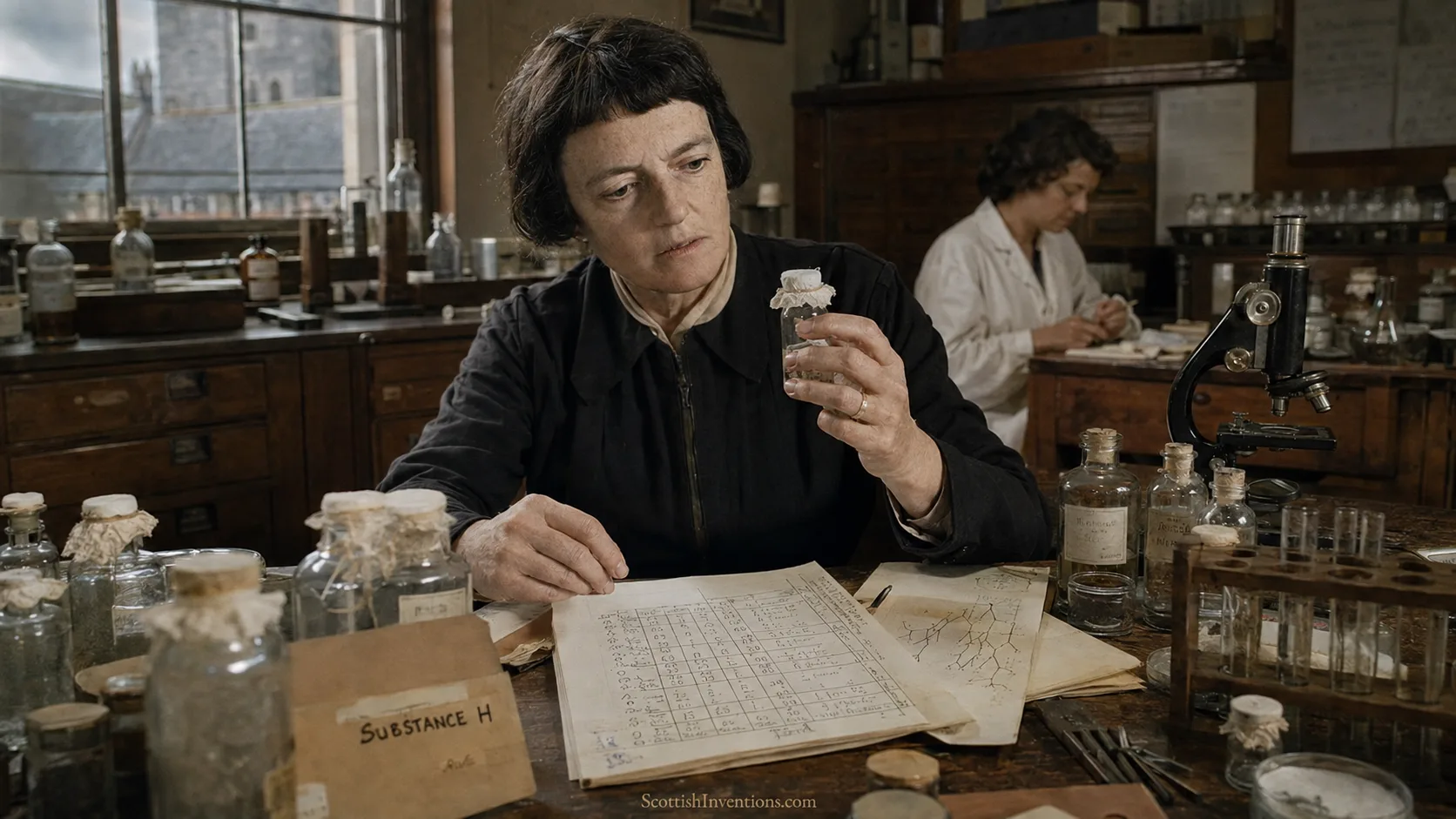
In 1927 Hermann Muller had shown that X-rays cause mutations. Whether a chemical could do the same was an open question, and earlier attempts had all failed. Working at the University of Edinburgh's Institute of Animal Genetics with the pharmacologist J. M. Robson, Charlotte Auerbach began exposing fruit flies to mustard-gas vapour around November 1940. By June 1941 she had her answer: the mutation rate rose as sharply as under X-rays. Because mustard gas was a chemical weapon, the work was classified — in reports it was only ever "substance H" — and could not be named in public until a short letter in Nature on 9 March 1946. Everything that follows from it, from cancer biology to the safety testing of every new drug, begins there.
Scottish Impact Index (SI Score)
- Global Impact
- 7/10
- Longevity
- 8/10
- Economic / Material Impact
- 5/10
- Originality / Distinctiveness
- 9/10
- Legacy (Built Upon)
- 7/10
- Recognition
- 3/10
Key Facts
- Discovery
- The first proof that a chemical — mustard gas — can cause hereditary mutations, founding chemical mutagenesis
- Key figure
- Charlotte “Lotte” Auerbach (1899–1994), geneticist
- Born
- 14 May 1899, Krefeld am Rhein, Germany
- Died
- 17 March 1994, Edinburgh, aged 94
- Came to Scotland
- 1933, fleeing Nazi persecution — Institute of Animal Genetics, University of Edinburgh
- Collaborator
- J. M. Robson (John Michael Rabinovich, 1900–1982), pharmacologist
- Experiments began
- c. November 1940; first clear positive results June 1941
- Codename
- “Substance H” — the work was classified war research for the Ministry of Supply
- First published naming the substance
- C. Auerbach & J. M. Robson, “Chemical Production of Mutations,” Nature 157, p. 302, 9 March 1946
- Test organism
- Drosophila melanogaster, using Muller's ClB method for sex-linked recessive lethals
- Highest honour
- The Royal Society's Darwin Medal, 1976 — the first awarded to a woman
- Claim status
- Established, shared credit — an adopted Scot, like Peter Higgs and Arthur Holmes
Krefeld to Edinburgh
Charlotte Auerbach was born on 14 May 1899 in Krefeld am Rhein, into a cultured German-Jewish family with science in its blood. Her father Friedrich was a chemist; an uncle was a physicist; and her grandfather was the anatomist Leopold Auerbach of Breslau, who in 1862 first described the myenteric plexus of the gut — known ever since as Auerbach's plexus. Charlotte was the third scientific generation.
She grew up largely in Berlin and, after a schoolgirl epiphany about chromosomes at fourteen, studied biology and chemistry at Würzburg, Freiburg and Berlin, passing her state teaching examinations with distinction in 1924. She taught in schools in Heidelberg and Berlin, and began doctoral research in Berlin under Otto Mangold at the Kaiser Wilhelm Institute — abandoning it after a clash with a dictatorial supervisor who later joined the Nazi party. As a Jew she was ultimately barred by law from teaching. On her mother's advice, she left Germany in 1933.
She arrived that year at the University of Edinburgh's Institute of Animal Genetics, run by the charismatic F. A. E. Crew. She took a PhD on leg development in Drosophila in 1935 and became a naturalised British citizen in 1939 — which spared her internment as an enemy alien when war came. Her early years were financially precarious and her position lowly. Edinburgh nonetheless became her permanent home: Lecturer in 1947, later Reader, Honorary Director of the MRC's Mutagenesis Research Unit from 1959 to 1969, a personal Chair in Genetics in 1967, and Professor Emeritus from 1969 until her death.
Genetics Before Auerbach
By the 1930s genetics rested on Mendel's laws and on the understanding that genes are carried on chromosomes. Crucially, DNA had not yet been identified as the genetic material — that came with Avery's work in the 1940s and, decisively, the double helix of 1953. Mutations were known to occur spontaneously, but rarely and unpredictably.
The breakthrough had come in 1927, when Hermann Joseph Muller proved that X-rays sharply raise the mutation rate in Drosophila — work that won him the 1946 Nobel Prize. Mutations could be induced artificially, then, but only by physical radiation. Whether chemicals could do it remained open, and the record was discouraging: Morgan had tried in 1914, Mann in 1923, both without success. Even direct carcinogen experiments on flies proved fruitless; as the geneticist M. Demerec later confirmed, such experiments "were negative in each case".
Muller himself spent 1938 to 1940 in Edinburgh, having left Stalin's USSR, and it was he who urged Auerbach to abandon developmental studies for mutation research. She later called his enthusiasm "infectious". He remained her lifelong mentor and hero.
Substance H, 1940–46
Sulfur mustard — dichloro-diethyl-sulphide — had blistered and blinded soldiers in the First World War, and in the Second there was real fear it would be used again. Working under Ministry of Supply contract, pharmacologists at Edinburgh noticed something striking: mustard-gas burns healed slowly and reopened, closely resembling the long-lasting damage caused by X-rays. And X-ray burns were by then understood to reflect damage to chromosomes. The inference — that mustard gas might therefore be mutagenic — is credited to J. M. Robson and/or to A. J. Clark, the professor of pharmacology.
At Muller's suggestion Auerbach had first tested known carcinogens on flies, without result. The mustard-gas work, begun with Robson around November 1940, was different. Using Muller's ClB method for detecting sex-linked recessive lethal mutations, she found the mutation rate rising as powerfully as under X-rays.
The experiments were crude and genuinely dangerous. The team volatilised mustard gas over a Bunsen burner on the roof of the Pharmacology building, and burned their hands doing it. The first striking positive results came in June 1941. Muller, by then back in the United States, cabled:
"We are thrilled by your major discovery opening great theoretical and practical field. Congratulations."H. J. Muller to Charlotte Auerbach, 1941
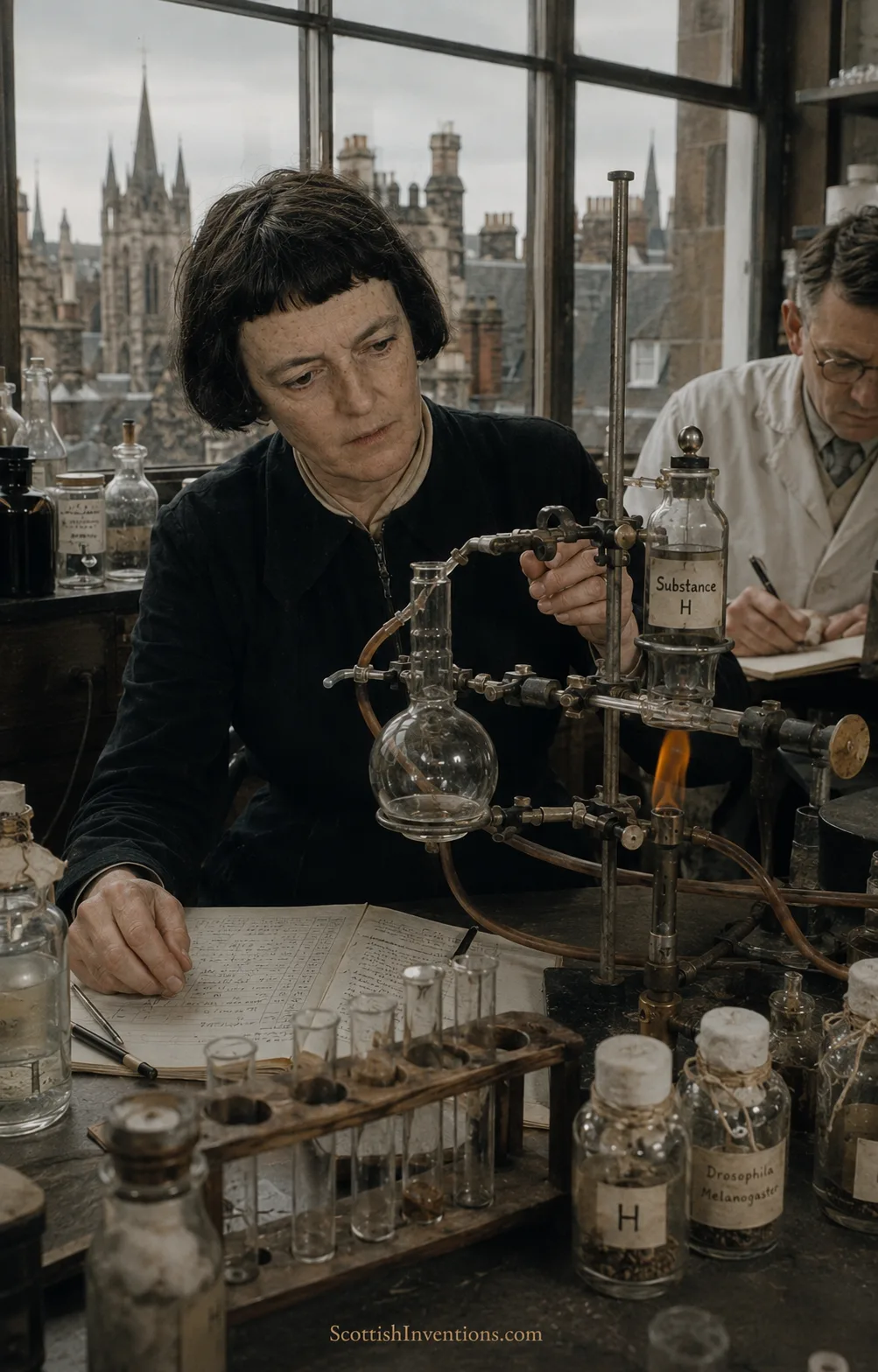
The findings went into a series of secret reports to the Ministry of Supply, the first dated 14 March 1942, with further reports in 1942 and 1943. A censored letter in Nature in 1944 mentioned that certain chemicals were as effective as X-rays, without naming them. The ban held until after the war. The substance was finally named in a short landmark letter — C. Auerbach & J. M. Robson, "Chemical Production of Mutations," Nature, vol. 157, p. 302, 9 March 1946 — which stated plainly that "the chemical nature of the main substance used can now be stated. It is dichloro-diethyl-sulphide, or mustard gas." Fuller data followed in 1947, in a paper with J. G. Carr in Science and detailed papers in the Proceedings of the Royal Society of Edinburgh.
The damage profile differed subtly from radiation: gene mutations, chromosome breaks, deletions and rearrangements, but proportionally fewer large translocations. Notably, about half the visible mutations from treated males appeared as mosaics — affecting only some cells — and the same mutation could reappear in successive generations, suggesting delayed or "replicating" effects. She pursued that puzzle for decades.
What Mutagenesis Is
A mutation is a change in the DNA sequence — a single-base change, an insertion or deletion, or a larger chromosomal rearrangement. Such changes happen spontaneously at a low natural rate. A mutagen raises that rate sharply.
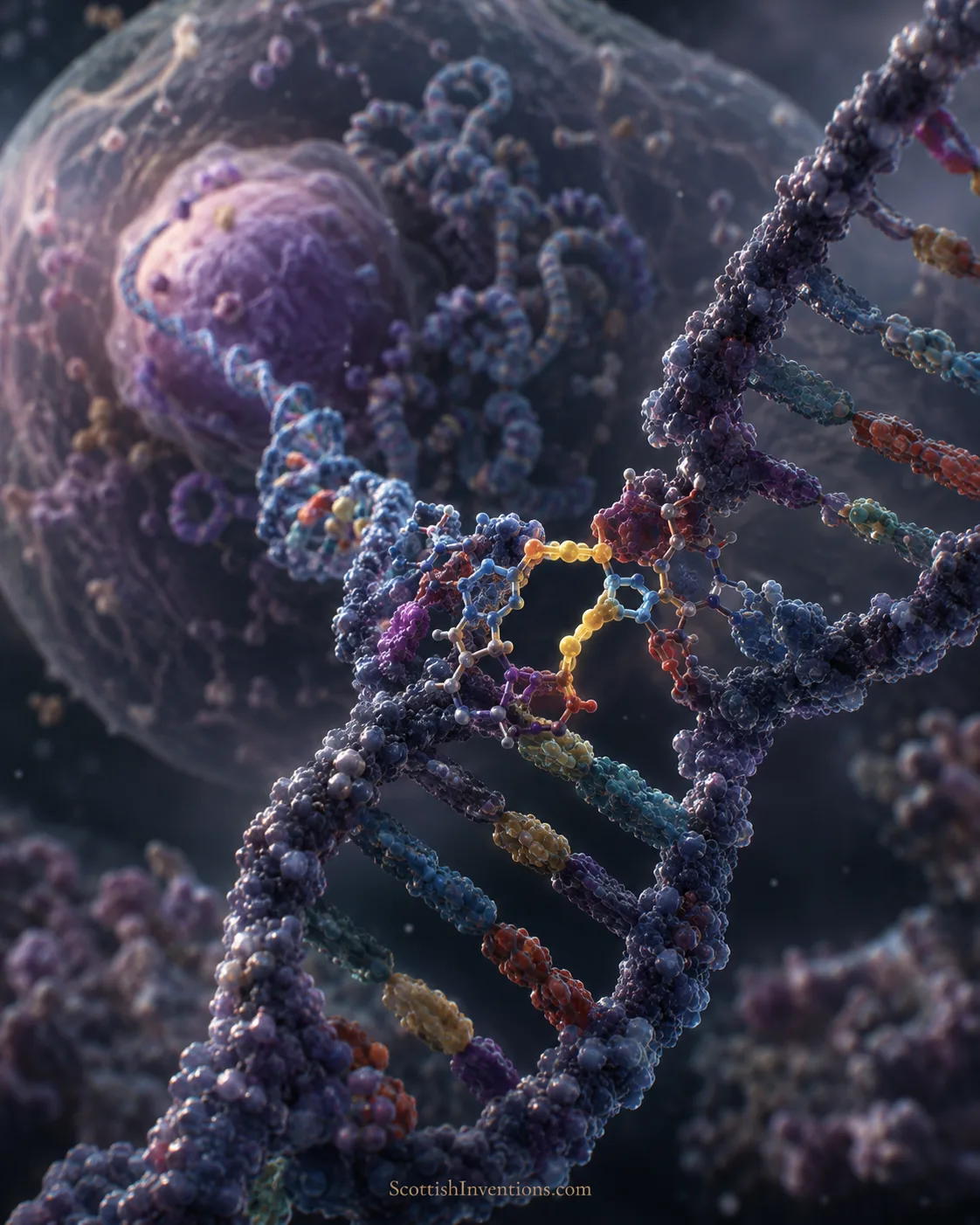
Mustard gas is an alkylating agent. It attaches alkyl groups to the bases of DNA, especially at the N7 position of guanine, causing mispairing during replication and therefore point mutations, and it can form crosslinks — covalent bridges between the two DNA strands, or between DNA and protein — that block replication outright. This is a direct chemical attack on the genetic material. X-rays, by contrast, act largely indirectly: ionising radiation strips electrons from molecules, especially water, generating reactive free radicals that then break strands and damage bases.
Auerbach's central insight followed immediately. If one chemical could mutate genes, others in our environment might too — and since mutations can cause cancer, chemical exposure might drive cancer. In 1941 she could not have put it in molecular terms; nobody yet knew that DNA was the genetic material. She spoke of genes and chromosomes. The mechanism was elucidated later. The conclusion was right anyway.
Why It Matters
- The chemical theory of cancer. Muller had suggested in 1927 that mutations might cause cancer. Auerbach showed chemicals could cause mutations — and connected the two, giving environmental carcinogenesis its experimental foundation.
- The Ames test. Bruce Ames published his assay in two seminal 1973 papers from Berkeley: a rapid, inexpensive bacterial test using Salmonella for whether a chemical is mutagenic. It rests on the standard estimate that around 90% of carcinogens are also mutagens, and regulators such as the FDA use it to screen chemicals cheaply. It flows directly from the field Auerbach founded.
- Drug and chemical safety testing. Every new pharmaceutical, food additive and industrial chemical is now screened for mutagenicity before approval — a whole regulatory architecture that exists because she proved chemicals can mutate genes.
- Chemotherapy. The very property that makes mustard dangerous makes it lethal to fast-dividing cancer cells. Nitrogen mustard (HN2) was developed during the Second World War and became the first non-hormonal chemotherapy agent; mechlorethamine, chlorambucil, melphalan, cyclophosphamide and ifosfamide remain in use today. The weapon that scarred soldiers became a family of drugs that save lives.
The Later Career
After the war Auerbach abandoned mustard gas — she never regarded that work as her most important — and turned to other chemical mutagens in fungi (Neurospora) and yeast, making lasting contributions on mosaicism, storage and delayed mutations, "replicating instabilities" and mutational specificity. She published more than ninety scientific papers and several books, including the influential Mutation Research: Problems, Results and Perspectives (1976) and the earlier Mutation: An Introduction to Research on Mutagenesis (1962).
She was also a gifted populariser. Genetics in the Atomic Age (1956) and The Science of Genetics (1961) brought the subject to general readers, and under the pen name Charlotte Austen she wrote a children's book of fairy stories, Adventures with Rosalind (1947).
The honours accumulated: the Keith Prize of the Royal Society of Edinburgh (1947 or 1948, sources differ), FRSE in 1949, FRS in 1957, foreign membership of the Danish Academy (1968) and the U.S. National Academy of Sciences (1970), honorary degrees from Leiden, Dublin, Cambridge and Indiana, and in 1976 the Royal Society's Darwin Medal — the first ever awarded to a woman.
Auerbach the Person
Her life carried a bitter irony: a Jewish refugee from Nazism, she made her greatest discovery using mustard gas, a weapon of the kind her persecutors themselves stockpiled. In Britain she carried the double burden of being a woman and a refugee in the male-dominated academia of the 1930s and 40s, and her early Edinburgh posts were menial.
She became, nonetheless, a beloved teacher — lecturing without notes, with famous clarity — and a person of wide humanitarian conviction: a supporter of the Campaign for Nuclear Disarmament and a fierce opponent of apartheid, which she confronted on scientific grounds during a visit to South Africa. Her Edinburgh scientific community was extraordinary, including the developmental theorist C. H. Waddington and the geneticist Douglas Falconer. She never married but unofficially adopted two boys, Michael Avern and Angelo Alecci, and cared devotedly for her mother. She loved music and the West Highlands. She died in Edinburgh on 17 March 1994, aged 94.
The Nobel That Never Came
Auerbach is remembered as the "mother of mutagenesis" and the acknowledged founder of chemical mutagenesis. The University of Edinburgh has named Charlotte Auerbach Road at its King's Buildings campus for her, and there is a Charlotte-Auerbach-Straße in Stuhr-Brinkum, Germany. Her papers, thesis, degree certificates and correspondence with Muller are preserved in the University of Edinburgh's Heritage Collections.
She never received the Nobel Prize and, by at least one scholarly account, was never even nominated — regarded by historians as a notable oversight, comparable in kind to Rosalind Franklin's. The wartime secrecy that hid her discovery for some five years blunted its timely recognition, while her mentor Muller took the Nobel for the analogous radiation work in the very year her paper finally named the substance.
Did You Know?
- Auerbach made her greatest discovery using mustard gas — and had to keep it secret for years, calling it only “substance H”.
- She was a Jewish refugee from Nazi Germany who arrived in Edinburgh in 1933 and founded a new branch of science there.
- Her grandfather Leopold Auerbach gave his name to Auerbach's plexus in the gut — three scientific generations.
- Mustard chemistry led to the nitrogen-mustard drugs that still treat lymphoma and myeloma today.
- Every new drug, food additive and industrial chemical must now be tested for mutagenicity — a safeguard that traces to her wartime result.
- The team volatilised mustard gas on a Bunsen burner on the Pharmacology roof and burned their own hands doing it.
Timeline
1862
Leopold Auerbach describes the myenteric plexus
Charlotte's grandfather; the structure is still called Auerbach's plexus
14 May 1899
Charlotte Auerbach born in Krefeld am Rhein
Third generation of a German-Jewish scientific family
1924
Passes state teaching examinations with distinction
After studying at Würzburg, Freiburg and Berlin
1927
Muller proves X-rays cause mutations in Drosophila
Nobel Prize 1946 — the physical half of the story
1933
Barred as a Jew from teaching, leaves Germany for Edinburgh
Joins F. A. E. Crew's Institute of Animal Genetics
1935
PhD awarded, on leg development in Drosophila
Her Edinburgh apprenticeship in fly genetics
1938–40
H. J. Muller spends two years in Edinburgh
Urges her to switch to mutation research; she calls his enthusiasm “infectious”
1939
Naturalised as a British citizen
Which spares her wartime internment as an enemy alien
Nov 1940
Mustard-gas experiments begin with J. M. Robson
Under Ministry of Supply contract; the idea credited to Robson and/or A. J. Clark
Jun 1941
First striking positive results
Muller cables: “We are thrilled by your major discovery…”
14 Mar 1942
First secret report to the Ministry of Supply
Further classified reports follow in 1942 and 1943
1944
A censored letter in Nature mentions unnamed chemicals
As effective as X-rays — but the substance cannot be named
9 Mar 1946
“Chemical Production of Mutations” published in Nature
The substance is finally named: dichloro-diethyl-sulphide
1947
Fuller data in Science and the Proceedings of the Royal Society of Edinburgh
D.Sc. awarded; appointed Lecturer
1949
Elected a Fellow of the Royal Society of Edinburgh
Among the first five women elected
1957
Elected a Fellow of the Royal Society of London
FRS at 58
1959–69
Honorary Director of the MRC Mutagenesis Research Unit
Personal Chair in Genetics, 1967
1973
Bruce Ames publishes the Ames test
A rapid bacterial mutagenicity assay — the field Auerbach founded, industrialised
1976
Awarded the Royal Society's Darwin Medal
The first woman to receive it
17 Mar 1994
Dies in Edinburgh, aged 94
Sixty-one years after arriving as a refugee
Notes on the Evidence
Discovery date. Sources say 1940, 1941 or 1942. The best reconciliation: experiments began around November 1940; the first clear positive results came in June 1941, confirmed by Muller's telegram; the first Ministry of Supply report is dated 14 March 1942. Beale's authoritative history is titled for 1941, and that is the date used here.
Publication date. The substance was first named in Nature on 9 March 1946; fuller papers followed in 1947. Some accounts loosely give 1947 for the whole discovery.
Who suggested mustard gas. Genuinely disputed between J. M. Robson and A. J. Clark; Auerbach herself credited Clark in one account. We present it as unresolved.
Two myths we do not repeat. Auerbach did not win a Wolf Prize — no record exists; her highest honour was the Darwin Medal of 1976. And J. M. Robson's name was John Michael Rabinovich, not "James Murdoch Robson".
Muller's Nobel was for X-ray mutagenesis, not, as some popular accounts loosely state, for showing X-rays to be carcinogenic.
Keith Prize year is given as 1947 by some sources and 1948 by others. The FRSE (1949) and FRS (1957) dates are firm.
Nobel nomination. The claim that she was never nominated rests on a secondary scholarly source; Nobel nomination records before 1970 are checkable in the Nobel archive, but this has not been independently confirmed here.
Frequently Asked Questions
What did Charlotte Auerbach discover?
She proved that a chemical can cause hereditary mutations. Working in Edinburgh with the pharmacologist J. M. Robson from around November 1940, and using Muller's ClB method on Drosophila, she showed that mustard gas (dichloro-diethyl-sulphide) raised the mutation rate as powerfully as X-rays did. Until then, only physical radiation was known to induce mutations. Her result founded the science of chemical mutagenesis.
Was Charlotte Auerbach Scottish?
She was an adopted Scot, and this site says so plainly. She was born in Krefeld, Germany, on 14 May 1899, and fled Nazi persecution in 1933. Her entire scientific career — PhD in 1935, the discovery itself, a personal Chair in 1967, and her death in 1994 — belongs to the University of Edinburgh. The Scottish claim rests wholly on her career, exactly as with Peter Higgs and Arthur Holmes.
Why was the discovery kept secret?
Because mustard gas was a chemical weapon and the work was classified war research carried out under contract to the British Ministry of Supply. In reports and discussion the team could not even name the substance, calling it “substance H”. A censored letter in Nature in 1944 referred to unnamed chemicals as being as effective as X-rays. The substance was only named publicly in Nature on 9 March 1946.
When exactly was the discovery made — 1940, 1941 or 1942?
All three dates circulate, and each refers to something real. Experiments began around November 1940; the first clear positive results came in June 1941, confirmed by Muller's congratulatory telegram; and the first Ministry of Supply report is dated 14 March 1942. Geoffrey Beale's authoritative history dates the discovery to 1941, which is the date this collection uses.
Was it her discovery alone?
No, and she never claimed it was. Auerbach performed the genetic analysis; the pharmacologist J. M. Robson and colleagues carried out much of the mustard-gas dosing. The original idea that mustard gas might damage genes — because its burns resembled X-ray damage — is credited variously to Robson and to A. J. Clark, the professor of pharmacology; Auerbach herself credited Clark in one account. That question is genuinely unresolved.
How is this different from Muller's X-ray work?
Hermann Joseph Muller showed in 1927 that X-rays raise the mutation rate, winning the 1946 Nobel Prize for it. That is physical mutagenesis, and it works largely indirectly: ionising radiation strips electrons from molecules, especially water, generating free radicals that damage DNA. Auerbach proved that a chemical could do the same thing by direct chemical attack on the genetic material. They are separate discoveries, and hers built on his.
How does mustard gas actually damage genes?
It is an alkylating agent. It attaches alkyl groups to DNA bases, especially at the N7 position of guanine, causing mispairing during replication and therefore point mutations. It can also form crosslinks — covalent bridges between the two DNA strands, or between DNA and protein — that block replication outright. Auerbach found it produced gene mutations, chromosome breaks, deletions and rearrangements, though proportionally fewer large translocations than X-rays.
Why does chemical mutagenesis matter today?
Three reasons. It gave the experimental foundation for understanding environmental carcinogens, since mutations can cause cancer. It led to routine mutagenicity screening — every new pharmaceutical, food additive and industrial chemical is now tested before approval, and Bruce Ames's 1973 bacterial assay made that fast and cheap. And the same DNA-damaging chemistry gave medicine nitrogen-mustard chemotherapy: mechlorethamine, chlorambucil, melphalan, cyclophosphamide and ifosfamide all descend from it.
Sources & Further Reading
Tier 1 · Primary
- Auerbach, C. — papers in the Proceedings of the Royal Society of Edinburgh, 1947.
- Beale, G. H. — "Charlotte Auerbach, 14 May 1899–17 March 1994," Biographical Memoirs of Fellows of the Royal Society, vol. 41 (1995), pp. 20–42; and his 1993 Genetics paper reconstructing the discovery.
- Muller, H. J. — "Artificial Transmutation of the Gene," 1927.
- University of Edinburgh Heritage Collections — Auerbach papers, thesis and Muller correspondence.
Tier 2 · Scholarly and institutional
- Auerbach, C. & Robson, J. M. — "Chemical Production of Mutations," Nature, vol. 157, p. 302, 9 March 1946.
- Auerbach, C., Robson, J. M. & Carr, J. G. — Science, vol. 105 (1947), pp. 243–247.
- Auerbach, C. — Mutation: An Introduction to Research on Mutagenesis, 1962; Mutation Research: Problems, Results and Perspectives, 1976.
- Ames, B. N. et al. — the Salmonella mutagenicity assay papers, 1973.
- The Royal Society — Darwin Medal records, 1976.