Discoveries · No. 39 of 50 · Medicine
The Glasgow Knife: Pioneer of Modern Brain Surgery
A Glasgow surgeon, a fourteen-year-old patient, and a hole bored through a skull with no X-ray to guide it — the story of how symptom-reading, antiseptic discipline and other men's brain science combined to make intracranial surgery survivable for the first time.
Sir William Macewen · 1848–1924Barbara Watson operation · July 1879Reading time · 24 minUpdated 16 August 2026
TL;DR
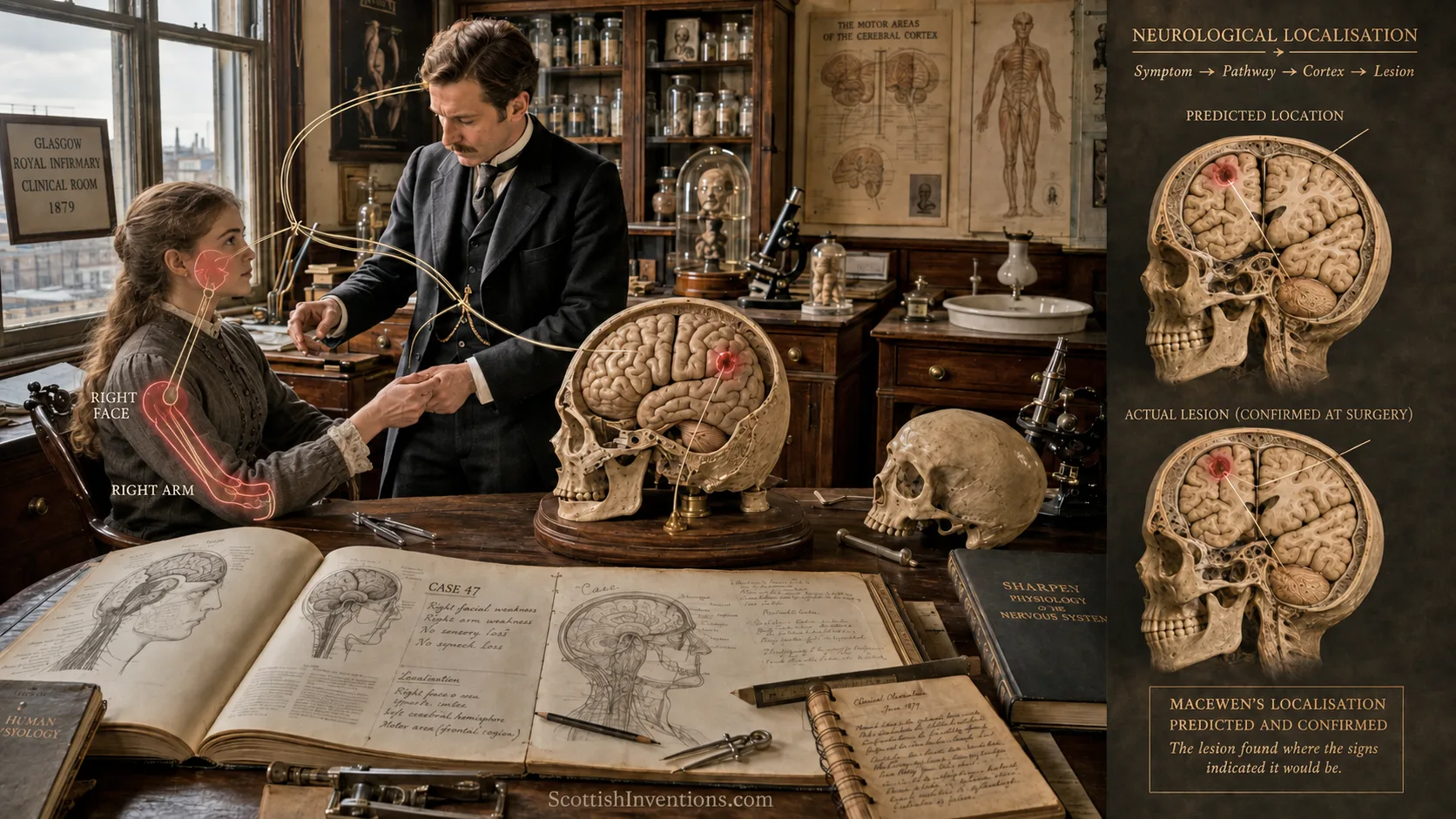
- In July 1879, the Glasgow surgeon Sir William Macewen localised and removed a brain tumour from fourteen-year-old Barbara Watson using clinical signs alone, under antiseptic conditions. She lived another eight years — now recognised as the first such operation of its kind.
- Macewen did not invent the science that made this possible. He built directly on the cerebral-localisation work of Paul Broca, Gustav Fritsch and Eduard Hitzig, David Ferrier and John Hughlings Jackson, and on the antiseptic principles of his teacher Joseph Lister.
- The claim of "first" is genuinely shared and contested: Rickman Godlee's 25 November 1884 London operation, with tumour localisation by Alexander Hughes Bennett, is the case most often cited internationally as the founding event of modern brain-tumour surgery, even though archival evidence broadly supports Macewen operating first but being poorly publicised.
Scottish Impact Index (SI Score)
- Global Impact
- 7/10
- Longevity
- 5/10
- Economic / Material Impact
- 4/10
- Originality / Distinctiveness
- 8/10
- Legacy (Built Upon)
- 7/10
- Recognition
- 3/10
Key Findings
- Sir William Macewen (1848–1924), a Glasgow Royal Infirmary surgeon trained under Joseph Lister, localised and removed a brain tumour from fourteen-year-old Barbara Watson in July 1879, using clinical signs alone, under antiseptic conditions. She survived a further eight years.
- His neurosurgery rested on cerebral-localisation science built by others: Paul Broca's speech-area work, Gustav Fritsch and Eduard Hitzig's cortical stimulation experiments, David Ferrier's cortical mapping, and John Hughlings Jackson's clinical-physiological observations of epilepsy.
- Macewen did not invent antisepsis — that was Lister — but extended it into a more rigorous asepsis, designing instruments such as his single-piece osteotome specifically to eliminate infection-harbouring crevices.
- His priority over the internationally celebrated 1884 Bennett–Godlee London operation is archivally plausible but was poorly publicised; this collection presents the claim as shared rather than settled.
- He performed the first documented living-donor human bone allograft (1878–81) — a genuine landmark, though not "the first tissue transplant in history" as sometimes claimed.
- He also carried out an early elective oral endotracheal intubation (1878) and what is generally credited as the first successful pneumonectomy (1895), and left a family of surgical eponyms.
Quick Facts
- Discovery
- Localisation-guided removal of a brain tumour, diagnosed by clinical signs alone, performed under antiseptic conditions
- Year
- July 1879 — operation on 14-year-old patient Barbara Watson, Glasgow Royal Infirmary
- Key figure
- Sir William Macewen (1848–1924)
- Category
- Medicine — neurosurgery, orthopaedics, general surgery
- Role
- Surgeon, Glasgow Royal Infirmary; later Regius Professor of Surgery, University of Glasgow
- Method
- Clinical reasoning from seizure pattern and symptoms to predict lesion location, then surgical confirmation
- Built on
- Cerebral-localisation science of Paul Broca, Gustav Fritsch and Eduard Hitzig, David Ferrier, and John Hughlings Jackson
- Rival/parallel claim
- Alexander Hughes Bennett and Rickman Godlee's 25 November 1884 London operation is the operation most often cited internationally as the founding brain-tumour removal
- Claim status
- SHARED — Macewen's priority over Bennett and Godlee is plausible and archivally supported (Macmillan), but poorly publicised at the time; the 1884 London case became the internationally cited landmark. Not the first brain-tumour operation in absolute terms (Pecchioli, Siena, 1835)
- Other firsts
- First documented living-donor human bone allograft (1878–81); early elective oral endotracheal intubation (1878); first successful pneumonectomy (1895)
- Eponyms
- Macewen's sign, Macewen's triangle, Macewen's operation, the Macewen osteotome
- Died
- 22 March 1924, Glasgow, aged 75
The Bute Boy Who Learned Surgery by Hand
William Macewen was born on 22 June 1848 near Port Bannatyne, close to Rothesay on the Isle of Bute, the youngest of twelve children of John Macewen, a man with maritime trade interests among the islands of the Firth of Clyde. He entered the University of Glasgow to study medicine, taking his MB, CM in 1869 and his MD in 1872. Crucially, he was a student during the years when Joseph Lister — then Regius Professor of Surgery at Glasgow — was pioneering antiseptic surgery using carbolic acid. Macewen absorbed Listerism directly and completely; some accounts note he trained under George Macleod, himself a Lister disciple. This inheritance would become the load-bearing wall of his entire career.
Macewen rose fast. He was made a Fellow of the Faculty of Physicians and Surgeons of Glasgow in 1874, became an assistant surgeon at the Glasgow Royal Infirmary in 1875, and a full surgeon in 1877 at the age of just 29. In 1892 he became Regius Professor of Surgery at the University of Glasgow — the very chair Lister had occupied when Macewen was a student — and moved his practice to the Western Infirmary. He was a difficult, autocratic, brilliant man, notorious for his intolerance of stupidity. He was knighted in 1902, made a Fellow of the Royal Society in 1895, and served as President of the British Medical Association in 1922.
None of what follows should be read as diminishing his achievement. It should be read as this collection's ordinary standard: precise credit, stated plainly, with every debt to earlier and parallel work made explicit rather than glossed over for the sake of a cleaner national story.
Antisepsis to Asepsis: Extending Lister, Not Inventing Him
Let us dispose of the biggest potential overclaim first. Macewen did not invent antiseptic surgery. That was Lister. What Macewen did — and it matters enormously — was to take Listerian principles further than Lister himself and apply them with obsessive rigour, moving from antisepsis (killing germs with chemicals such as carbolic) toward asepsis (excluding germs altogether through sterilisation, scrubbing, and clean technique). He sterilised instruments, insisted on the deep cleansing of hands and arms, used surgical gowns, and — tellingly — had his osteotomes forged in a single piece with no wooden handles, because crevices and porous wood harboured bacteria.
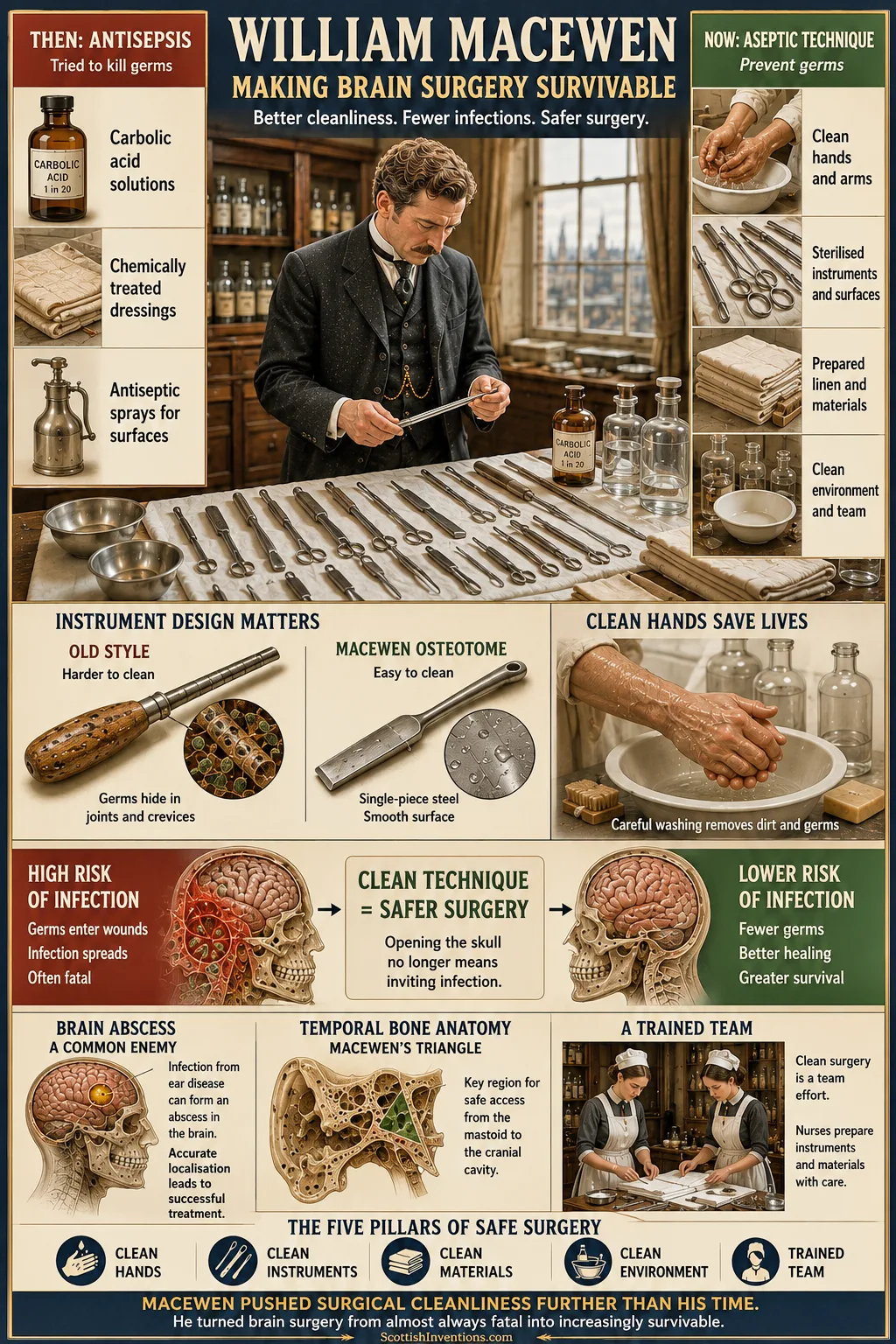
This is the hinge on which everything else turns. Brain surgery before antisepsis was very nearly a death sentence, with infection the near-inevitable killer; in the pre-antiseptic era the mortality for any operation that opened the skull ran to around 90 percent. Macewen's fanatical cleanliness is precisely what made intracranial surgery survivable. His achievement in neurosurgery is inseparable from, and downstream of, his mastery of aseptic technique. He was not the first to apply antisepsis; he was arguably the man who most convincingly demonstrated what it made newly possible.
He also understood that surgery is a team endeavour. Around 1880 he began a training programme for nurses focused on sterilisation, working with the Glasgow Royal Infirmary's matron, Rebecca Strong. Together they developed the "block system" of nurse training — periods of classroom instruction alternating with ward practice, formalised at the Preliminary Training School opened in January 1893 — which was later adopted worldwide. It is a reminder that Macewen's legacy is institutional as well as surgical.
The Localisation Revolution — and the Priority War
The intellectual heart of Macewen's neurosurgery was cerebral localisation: the then-radical idea that specific functions map to specific brain regions, so that symptoms can reveal the location of a lesion. This was not Macewen's discovery. It rested on the physiological work of John Hughlings Jackson, on the experimental cortical mapping of David Ferrier, on the German experiments of Gustav Fritsch and Eduard Hitzig, and further back on Paul Broca's identification of a speech centre in the frontal lobe. Macewen's genius was translational: he was among the first to trust localisation enough to cut.
He began cautiously. In 1876 he correctly diagnosed a frontal-lobe abscess in a boy, but the family refused permission to operate; at autopsy his localisation was vindicated. His documented neurosurgical debut, in August 1876, was actually a post-mortem study. Then came Barbara Watson in July 1879, and a growing series of operations on abscesses, haematomas, and the spine.
Here the historical record becomes genuinely contested, and honesty requires laying the dispute out plainly. The operation conventionally credited as the founding event of modern brain-tumour surgery is not Macewen's at all: it is the 25 November 1884 operation in London in which the neurologist Alexander Hughes Bennett localised a tumour and the surgeon Rickman Godlee removed it — from a patient named Henderson, a farmer from Dumfries, who died 28 days later of infection. Within weeks of that celebrated operation, supporters of Macewen went to the newspapers and medical journals arguing that the Glasgow surgeon had done comparable work years earlier. In an 1888 address in Glasgow, Macewen described seven pre-1884 cases.
Who is right? The most rigorous modern assessment comes from the historian of neuroscience Malcolm Macmillan, whose two-part study examined Macewen's private journals and the Glasgow Royal Infirmary ward records. Macmillan concluded that the primary sources confirm the operations happened when Macewen said they did, and broadly support his priority — while cautioning that gaps in the records make it hard to establish exactly how much explicit localisation reasoning Macewen used at the time versus reconstructed later. The fairest verdict: Macewen very probably did operate successfully on localised intracranial lesions before Bennett and Godlee, but his work was poorly publicised, buried in Glasgow, while the London operation was a media sensation that galvanised the field. Priority and influence are not the same thing.
And even Macewen's 1879 tumour operation was not the first brain-tumour removal in absolute terms. Nearly half a century earlier, in 1835, the Italian surgeon Zanobi Pecchioli of Siena successfully removed a "fungus of the dura mater" — a meningioma — from a 45-year-old farmer, who recovered and remained free of recurrence for at least thirty months. So the precise, defensible claim for Macewen is narrow and specific: the first documented successful removal of a brain tumour localised purely by clinical signs and performed under antiseptic technique. Not the first brain-tumour operation full stop, and not the internationally best-known one — that recognition, for better or worse, went to London.
Brain Abscess: the Quieter, Larger Achievement
If the tumour case is the dramatic set-piece, Macewen's work on brain abscess may be his most substantial and least disputed neurosurgical contribution. Without X-rays, he diagnosed and localised intracranial abscesses — many arising from chronic ear and sinus infection — using clinical reasoning grounded in his deep knowledge of the anatomy of the temporal bone. His 1893 monograph, Pyogenic Infective Diseases of the Brain and Spinal Cord, accompanied by his Atlas of Head Sections, reported extraordinary results for the era. As D.J. Canale documented in his centennial study in the Journal of Neurosurgery (1996), Macewen recorded 25 cases of brain abscess; 19 patients reached him in time for surgery, of whom 18 recovered — and all five of his patients with extradural abscess recovered. At a time when intracranial infection was almost uniformly fatal, these were near-miraculous outcomes, and they rested on the marriage of anatomical mastery and aseptic technique.
Bone: the First Inter-Human Graft — With Caveats
Macewen was, if anything, more revolutionary in bone than in brain. Working in a Glasgow where rickets was endemic among the urban poor, he developed the antiseptic osteotomy to correct deformities such as genu valgum (knock-knee), and designed the bevelled, single-piece chisel still known as the "Macewen osteotome," engineered to cut without producing bone dust or splinters that could seed infection.
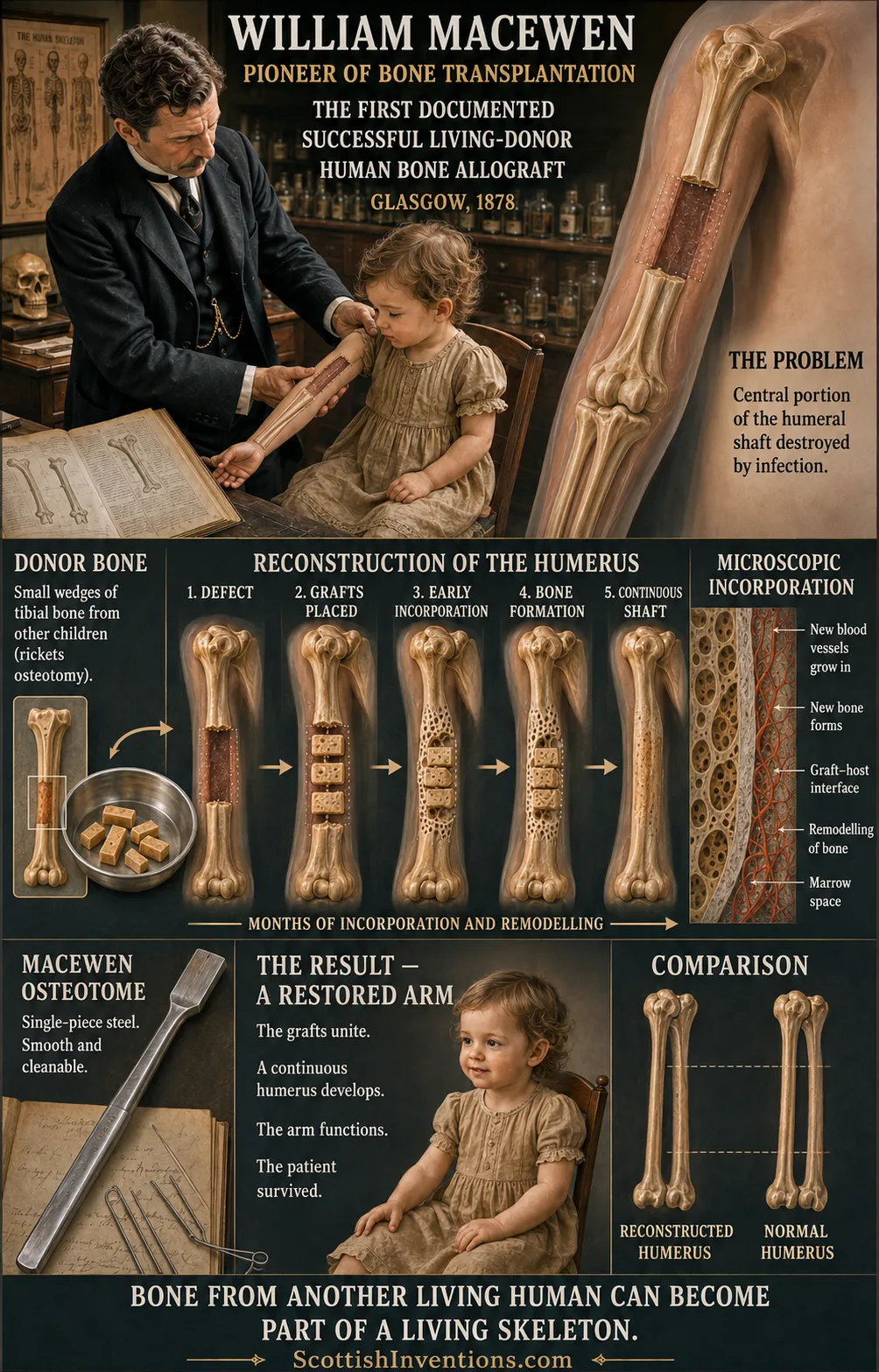
His most celebrated bone achievement is the one most prone to exaggeration, so it deserves care. Macewen rebuilt the destroyed humeral shaft of a young boy — roughly three years old — who had lost the middle two-thirds of the bone to infection. He did this by implanting small wedges of healthy tibia harvested from other children undergoing osteotomy for rickets. Because the donor bone came from other living humans, this was an allograft, and Macewen published it in the Proceedings of the Royal Society in 1881 under the title "Observations concerning transplantation of bone." Sources scatter the operation across 1877 to 1881; the best reconstruction, based on Macewen's own account, is that the initial operation was in 1878, the grafting was staged across 1879–1880, and he demonstrated the restored limb — only about half an inch shorter than its opposite — to the Pathological and Clinical Society of Glasgow in 1881.
Is it "the first inter-human tissue transplantation in medical history," as a 2013–14 orthopaedic history paper in Knee Surgery, Sports Traumatology, Arthroscopy claims? That framing is too strong — and worth noting, it is a Level V (expert-opinion) historical review. Bone grafting long predates Macewen: Jacob van Meekeren performed a bone xenograft (dog to human skull) in 1668, and Philipp von Walther performed a bone autograft around 1820, while Louis Ollier's experimental work in the 1860s established the science of bone regeneration. The defensible claim is narrower and still remarkable: Macewen performed the first documented, successful human-to-human (living-donor) bone allograft — a genuine landmark in transplantation, but one standing on identifiable shoulders. Notably, Macewen disagreed with Ollier about the osteogenic role of the periosteum, and pursued his own experimental programme, later gathered in The Growth of Bone (1912).
Airways, Lungs, Hernias, and a Family of Eponyms
Macewen's restless ingenuity spilled across surgery. On 5 July 1878 he performed what is generally described as the first elective oral endotracheal intubation for anaesthesia, passing a tube into the trachea of a patient — famously by feel, by the mouth — as an alternative to tracheotomy, and reporting several cases in the British Medical Journal in 1880. Even here the prior-art caution applies: Friedrich Trendelenburg in Germany had performed endotracheal anaesthesia via tracheotomy cannula in 1869, and Wilhelm Hack was working on orotracheal intubation in the same period. Macewen's contribution was the elective oral route as a deliberate airway for anaesthesia — a direct ancestor of modern practice, later transformed by Magill and others.
In 1895 he performed what is generally credited as the first successful pneumonectomy, removing a tuberculous, infected lung in stages. As the American College of Surgeons' Bulletin recounted (February 2025), the lung "was riddled with both tuberculosis and bacterial infection" and Macewen removed it "by essentially shelling it out" — there was "no attempt to control hilar structures." Crude as it was, it worked: the patient, a porter identified as R.W., was still working in 1906, could walk ten miles at a stretch, and — Macewen noted with evident satisfaction — could climb the 80 stairs to his clinic without arriving out of breath.
His name is stamped across the anatomy and vocabulary of surgery: Macewen's sign, the resonant "cracked-pot" percussion note over the skull indicating raised intracranial pressure in hydrocephalus and abscess; Macewen's triangle (the suprameatal triangle), a landmark of the temporal bone; and Macewen's operation for inguinal hernia. A myth-busting note is warranted on the sign: Macewen himself did not use the phrase "cracked pot." He described a "differential cranial percussion note," and the folksier "cracked-pot" label was popularised later, partly through an 1898 paper by Norman Bruce Carson on cerebellar tumours. On hydrocephalus specifically, Macewen contributed the diagnostic sign rather than a definitive cure; the surgical treatment of hydrocephalus was advanced by contemporaries such as Wernicke, Quincke, and Mikulicz.
Father of Neurosurgery?
So is Macewen the "father of neurosurgery"? The honest answer is that the title is contested and probably belongs to no single man. In the United States, the paternity is near-universally assigned to Harvey Cushing, who in the early twentieth century systematised the specialty and, over more than two thousand brain-tumour operations, drove neurosurgical mortality down from roughly 90 percent to under 10 percent. In Britain, Victor Horsley — appointed in 1886 to the National Hospital at Queen Square in the world's first dedicated neurosurgical post — is frequently called the first true neurosurgeon, and Cushing himself acknowledged Horsley as the forebear of the specialty. Macewen's own claim is real but different in kind: he was a versatile general surgeon who demonstrated, earlier than almost anyone, that the brain could be operated on successfully and survivably. He proved the possibility; Horsley and Cushing built the profession.
The fairest formulation is the one used by careful medical historians: Macewen was among the earliest — arguably the first — to perform successful, deliberate, localisation-guided intracranial surgery under aseptic conditions, and thus a founder of modern neurosurgery, but not its sole father. To crown him "the" father is to flatter Scotland at the expense of accuracy.
The Long Shadow
In his later years Macewen's energies turned outward. In 1916, during the First World War, he helped found the Princess Louise Scottish Hospital for Limbless Sailors and Soldiers at Erskine, near Glasgow, serving as its first chief surgeon and designing — with engineers from the nearby Clydeside shipyards — the "Erskine limb," a mass-producible artificial limb for the war's flood of amputees. He died in Glasgow on 22 March 1924, aged 75, and was buried near his home at Garrochty on the Isle of Bute, in the churchyard of St Blane's at Kingarth.
His honours multiplied after death. The Macewen Medal in Surgical Nursing was established at the Glasgow Royal Infirmary in 1942; a laboratory block at the Infirmary was named for him when it opened in 1981; and his archives are preserved by the University of Glasgow and the Royal College of Physicians and Surgeons of Glasgow. He was, in the end, a Victorian titan whose reputation has been both under-sung (he was genuinely first at several difficult things, and poorly publicised for it) and over-sung (the sweeping "firsts" need trimming). The truest tribute is the precise one: a surgeon of formidable technique and colder nerve who, more than most, turned the human brain from forbidden territory into operable ground.
Timeline
1848
William Macewen born near Port Bannatyne, Isle of Bute
Youngest of twelve children of a Clyde maritime-trade family
1869–72
Studies medicine at the University of Glasgow under Joseph Lister
Takes MB, CM (1869) and MD (1872); absorbs Listerian antisepsis directly
1875
Appointed assistant surgeon at Glasgow Royal Infirmary
Begins his surgical career under Lister's antiseptic regime
1876
Correctly diagnoses a frontal-lobe abscess in a boy by clinical signs
Family refuses operation; autopsy later vindicates the localisation
1877
Made full surgeon at Glasgow Royal Infirmary, aged 29
Rapid rise reflecting his technical reputation
5 July 1878
Performs an early elective oral endotracheal intubation for anaesthesia
Reported in the British Medical Journal, 1880; Trendelenburg (1869) and Hack precede him with related approaches
1878
Begins the staged bone-allograft reconstruction of a child's humerus
Uses tibial wedges from other children undergoing osteotomy for rickets
July 1879
Localises and removes a brain tumour from 14-year-old Barbara Watson
Diagnosis made purely from clinical signs; patient survives another eight years
1879–80
Bone-graft procedure staged and completed
Restored limb demonstrated as only about half an inch shorter than its opposite
1881
Publishes 'Observations concerning transplantation of bone' in Proceedings of the Royal Society
First documented, successful human-to-human living-donor bone allograft
1888
Macewen describes seven pre-1884 localisation cases in a Glasgow address
Responds to the 1884 Bennett–Godlee sensation by asserting his own priority
25 November 1884
Alexander Hughes Bennett localises and Rickman Godlee removes a brain tumour in London
Patient dies 28 days later of infection; operation becomes the internationally cited 'first' brain-tumour removal
1892
Macewen becomes Regius Professor of Surgery, University of Glasgow
Occupies the chair once held by his teacher, Joseph Lister
1893
Publishes Pyogenic Infective Diseases of the Brain and Spinal Cord
Reports 18 of 19 operable brain-abscess patients recovering
1895
Performs what is generally credited as the first successful pneumonectomy
Removes a tuberculous lung in stages; patient still active a decade later
1895
Elected Fellow of the Royal Society
Recognition of his surgical and scientific standing
1902
Knighted
Formal national recognition
1916
Co-founds the Princess Louise Scottish Hospital for Limbless Sailors and Soldiers, Erskine
Designs the mass-producible 'Erskine limb' with Clydeside shipyard engineers
1922
Serves as President of the British Medical Association
Caps a career of institutional as well as surgical leadership
1924
Sir William Macewen dies in Glasgow, aged 75
Buried at St Blane's, Kingarth, Isle of Bute
Myths & Facts
Myth: Macewen invented antiseptic surgery.
Fact: That was Joseph Lister, Macewen's teacher and predecessor in the Glasgow chair of surgery. Macewen extended Lister's antisepsis into a more rigorous asepsis, but he did not originate the underlying idea.
Myth: Macewen's 1879 operation was the first brain-tumour removal in history.
Fact: It was not. The Italian surgeon Zanobi Pecchioli removed a meningioma in Siena in 1835, decades earlier, and the patient recovered. Macewen's precise claim is narrower: the first documented successful removal of a brain tumour localised purely by clinical signs and performed under antiseptic technique.
Myth: Macewen is unambiguously 'the father of neurosurgery'.
Fact: The title is contested. Victor Horsley in Britain and Harvey Cushing in the United States are each credited with building neurosurgery into a systematic specialty; Macewen's role was to prove, earlier than almost anyone, that intracranial surgery could succeed.
Myth: Macewen's bone graft was the first tissue transplant in history.
Fact: Bone grafting long predates him — van Meekeren (1668, xenograft), von Walther (c.1820, autograft) and Ollier (1860s, experimental science of bone regeneration) all came earlier. Macewen's specific, defensible achievement is the first documented human-to-human living-donor bone allograft.
Myth: Macewen's sign is described using the phrase 'cracked-pot' in his own writing.
Fact: Macewen wrote of a 'differential cranial percussion note'. The 'cracked-pot' description was popularised later by other authors, including Norman Bruce Carson in 1898.
Myth: Macewen's 1884-adjacent priority claim over Bennett and Godlee is proven beyond doubt.
Fact: It is well-supported but not fully settled. Malcolm Macmillan's archival study of Macewen's journals and Glasgow Royal Infirmary ward records broadly supports his priority, but notes real gaps in the record about exactly how explicit his localisation reasoning was at the time. This article follows the weight of specialist historical opinion rather than asserting an uncontested Scottish triumph.
Did You Know?
- Barbara Watson, the fourteen-year-old whose brain tumour Macewen localised and removed in 1879, lived a further eight years — a remarkable outcome for the era.
- Macewen had his surgical osteotomes forged in a single piece with no wooden handle, purely to eliminate the crevices where bacteria could hide.
- Rickman Godlee, whose 1884 London operation is often called the founding event of brain-tumour surgery, was Joseph Lister's nephew.
- The Italian surgeon Zanobi Pecchioli removed a brain tumour in Siena as early as 1835 — nearly half a century before Macewen's operation.
- Macewen's own writing describes a 'differential cranial percussion note', not the folksier 'cracked-pot sound' later attached to his name.
- Macewen designed the wartime 'Erskine limb' with engineers from the Clydeside shipyards, applying industrial manufacturing logic to prosthetics.
- Macewen occupied the same Regius Chair of Surgery at Glasgow once held by his own teacher, Joseph Lister.
Honest Caveats
Macewen did not invent antisepsis or cerebral localisation. He is a translator and extender of both — antisepsis from Lister, localisation from Broca, Fritsch and Hitzig, Ferrier, and Hughlings Jackson — not their originator.
His priority over Bennett and Godlee cannot be resolved with total certainty. This article follows the weight of specialist historical opinion, notably Malcolm Macmillan's archival study, rather than asserting an uncontested Scottish triumph.
Date discrepancies dog the bone-graft story, with sources citing years from 1877 to 1881; the staged 1878–1881 reconstruction used here is the best available, but rests partly on secondary interpretation of Macewen's own 1881 paper.
The intubation and pneumonectomy "firsts" have international parallels (Trendelenburg, Hack) and, for the pneumonectomy, some doubt in the literature as to whether the 1895 procedure meets the strict modern definition.
The "father of neurosurgery" title is not awarded to Macewen alone in this article. Victor Horsley and Harvey Cushing are named as co-claimants with stronger institutional claims to founding the specialty.
Frequently Asked Questions
Did William Macewen invent brain surgery?
No, and this article does not claim that. Macewen performed, in July 1879, what is now recognised as the first successful removal of a brain tumour localised purely by clinical signs and carried out under antiseptic conditions. But brain-tumour surgery itself predates him — the Italian surgeon Zanobi Pecchioli removed a meningioma in Siena in 1835 — and the science he relied on to localise the lesion, cerebral localisation, was built by others: Paul Broca, Gustav Fritsch and Eduard Hitzig, David Ferrier, and John Hughlings Jackson. Macewen's genuine achievement was translational: trusting localisation science enough to operate, and doing so safely thanks to rigorous antiseptic technique.
Is Macewen's 1879 operation the 'first' brain-tumour removal?
This is genuinely shared and contested territory, and the claim needs precise wording. Macewen's 1879 operation on Barbara Watson is best described as the first documented successful removal of a brain tumour localised purely by clinical signs and performed under antiseptic technique. It is not the first brain-tumour operation in absolute terms — Pecchioli's 1835 Siena case predates it by decades. And internationally, the operation most often cited as the founding event of modern brain-tumour surgery is a different one entirely: Alexander Hughes Bennett's localisation and Rickman Godlee's removal of a tumour in London on 25 November 1884, a case that became a medical sensation even though the patient died 28 days later of infection.
So did Macewen or Godlee operate first?
Macewen almost certainly did, but the record is not perfectly clean. Within weeks of the celebrated 1884 London operation, supporters of Macewen argued in the press and medical journals that he had done comparable work years earlier, and in an 1888 address he described seven pre-1884 cases. The historian of neuroscience Malcolm Macmillan examined Macewen's private journals and the Glasgow Royal Infirmary ward records and concluded that the primary sources confirm the operations happened when Macewen said they did, broadly supporting his priority — while cautioning that gaps in the records make it hard to establish exactly how much explicit localisation reasoning Macewen used at the time, as opposed to reconstructing later. The fairest verdict is that Macewen probably operated first, but his Glasgow work was poorly publicised, while the London case became a media sensation that actually galvanised the field. Priority and influence are not the same thing, and this collection reports both.
What is cerebral localisation, and did Macewen discover it?
Cerebral localisation is the idea that specific brain functions map to specific regions, so that a patient's symptoms can reveal where in the brain a lesion sits. Macewen did not discover this. It rested on the physiological work of John Hughlings Jackson, the experimental cortical mapping of David Ferrier, and the German experiments of Gustav Fritsch and Eduard Hitzig, all of which built in turn on earlier localisation ideas associated with Paul Broca's work on speech. Macewen's contribution was to be among the first surgeons willing to trust this science enough to cut — turning a physiological theory into an operative decision, at real risk to the patient and his own reputation.
Did Macewen invent antiseptic surgery?
No. That achievement belongs to Joseph Lister, who was Regius Professor of Surgery at Glasgow while Macewen was a student there and whose carbolic-acid antisepsis Macewen absorbed directly. What Macewen did was extend Listerian principles further than Lister himself, moving from antisepsis (killing germs chemically) toward asepsis (excluding germs altogether through sterilisation and clean technique) — engineering instruments such as his single-piece osteotome specifically to eliminate the crevices where bacteria could hide. His neurosurgical achievements are inseparable from, and dependent on, this obsessive cleanliness, since brain surgery before reliable infection control carried a mortality rate of roughly 90 percent.
Was Macewen's bone graft really 'the first tissue transplant in history'?
No, and this is one of the clearer overclaims in the popular literature. A 2013–14 orthopaedic history paper made that broad claim, but bone grafting long predates Macewen: Jacob van Meekeren performed a bone xenograft from a dog to a human skull in 1668, Philipp von Walther performed a bone autograft around 1820, and Louis Ollier's experimental work in the 1860s established the underlying science of bone regeneration. The defensible and still genuinely remarkable claim is narrower: Macewen performed the first documented successful human-to-human, living-donor bone allograft, reconstructing a child's infection-destroyed humerus with tibial bone taken from other children, published in 1881.
Is Macewen the 'father of neurosurgery'?
The title is contested and probably belongs to no single man. In the United States it is near-universally assigned to Harvey Cushing, who systematised the specialty in the early twentieth century and drove neurosurgical mortality from roughly 90 percent to under 10 percent over more than two thousand operations. In Britain, Victor Horsley — appointed in 1886 to the world's first dedicated neurosurgical post at Queen Square in London — is frequently called the first true neurosurgeon, and Cushing himself acknowledged Horsley as the forebear of the specialty. Macewen's real claim is different in kind: he was a versatile general surgeon who demonstrated, earlier than almost anyone, that the brain could be operated on successfully and survivably. He proved the possibility; Horsley and Cushing built the profession. This article calls him 'a pioneer' or 'a founder', not 'the father'.
Did Macewen coin the phrase 'cracked-pot' for his percussion sign?
No. Macewen described a 'differential cranial percussion note' indicating raised intracranial pressure in hydrocephalus and brain abscess. The catchier 'cracked-pot' label was popularised later, partly through an 1898 paper by Norman Bruce Carson on cerebellar tumours. Macewen's sign remains real and useful; the folk phrasing attached to it is not his.
How successful was Macewen's treatment of brain abscess and hydrocephalus?
His brain-abscess results were exceptional for the era: his 1893 monograph reported 25 documented cases, of which 19 patients reached him in time for surgery and 18 recovered, including all five of his extradural-abscess patients — remarkable outcomes when intracranial infection was almost uniformly fatal. On hydrocephalus, his contribution is narrower: he identified a valuable diagnostic sign but did not deliver a definitive surgical cure, which was advanced by contemporaries including Wernicke, Quincke, and Mikulicz.
What should modern readers take away from Macewen's story?
That he was a genuine pioneer whose reputation has been both under-sung and over-sung. He was very probably first at several difficult and important things — localisation-guided intracranial surgery under antiseptic conditions, human-to-human bone allografting — and was poorly publicised for them in his own time. But several of the sweeping 'firsts' attached to his name later need trimming once the international prior art (Pecchioli, van Meekeren, Trendelenburg, Bennett and Godlee) is set alongside his work. The precise, calibrated version of his story is more interesting, and more honest, than the inflated one.
Sources & Further Reading
Tier 1 · Primary
- Macewen, W. — "Observations concerning transplantation of bone," Proceedings of the Royal Society, 1881.
- Macewen, W. — Pyogenic Infective Diseases of the Brain and Spinal Cord, 1893, with the accompanying Atlas of Head Sections.
- Macewen, W. — The Growth of Bone, 1912.
- Macewen, W. — reports on elective oral endotracheal intubation, British Medical Journal, 1880.
Tier 2 · Scholarly and institutional
- Macmillan, M. — two-part archival study of Macewen's journals and Glasgow Royal Infirmary ward records, assessing his priority over Bennett and Godlee.
- Canale, D. J. — centennial study of Macewen's brain-abscess series, Journal of Neurosurgery, 1996.
- American College of Surgeons — Bulletin, February 2025, account of Macewen's 1895 pneumonectomy.
- Orthopaedic history review, Knee Surgery, Sports Traumatology, Arthroscopy, 2013–14, on the Macewen bone graft (Level V expert-opinion review).
- History-of-medicine scholarship on cerebral localisation: Broca, Fritsch and Hitzig, Ferrier, and Hughlings Jackson.
Tier 3 · Site source document
docs/sources/discoveries/glasgow-knife.md— the commissioned source document underlying this article.