Discoveries · No. 30 of 50 · Physics
Sir John Leslie and the Leslie Cube
How a Fife-born physicist used a deceptively simple experiment to reveal why black surfaces radiate heat far more effectively than polished metal.
1804EdinburghPhysics · Thermal radiationReading time · 17 minUpdated 11 August 2026
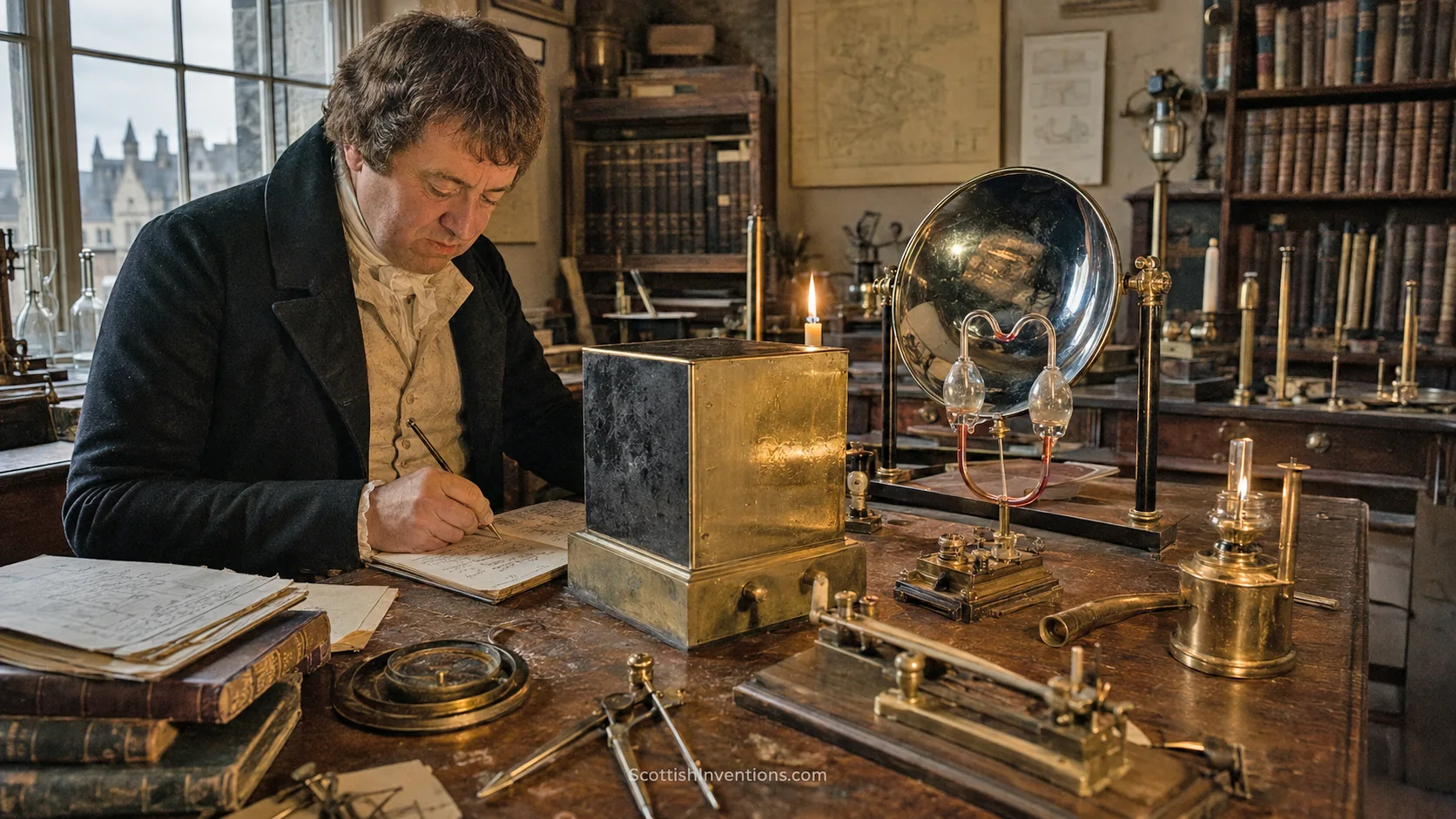
TL;DR
- Sir John Leslie (1766–1832), born at Largo in Fife and later Professor of Mathematics and then of Natural Philosophy at the University of Edinburgh, invented the Leslie Cube and, in An Experimental Inquiry into the Nature and Propagation of Heat (1804), was the first to establish the laws of surface radiation by measurement: that a surface's emitting power equals its absorbing power, and that dull black surfaces radiate far more than polished ones.
- Leslie did not discover radiant heat. Marc-Auguste Pictet (1790) showed radiant heat could be reflected and focused, Pierre Prévost (1791) stated the theory of exchanges, and William Herschel (1800) discovered infrared radiation. Leslie's original contribution was quantification, not discovery — and he was explicitly spurred by Herschel's result.
- The Leslie Cube is still standard teaching apparatus more than two centuries later, including as a required practical in UK GCSE physics. Three widely repeated claims about Leslie are wrong or contested: that he invented the thermopile (he did not — that was Nobili and Melloni around 1830), that he alone invented the differential thermometer (disputed with Count Rumford), and that he was the first to make artificial cold (William Cullen preceded him in 1748).
Claim status · Established, at two levels of confidence
Solidly Leslie's: the cube itself and the quantitative laws of emission and absorption drawn from it. Chemistry World frames this as a rare earned exception to Stigler's Law — "John Leslie really did invent the Leslie canister or cube" — and the Dictionary of Scientific Biography credits the 1804 Inquiry with establishing that emissivity and absorptivity are equal for any surface, that emissivity rises as reflectivity falls, and that emitted intensity varies with the angle of the rays.
Not Leslie's: the discovery of radiant heat. Pictet (1790), Prévost (1791) and Herschel (1800) all precede him, and Carl Wilhelm Scheele had distinguished radiation from conduction and convection in 1777. This page keeps the two claims separate rather than flattening them into a single tag, because the distinction is the whole point of the story.
Key Facts
- Key figure
- Sir John Leslie (1766–1832)
- Born
- Largo (Lower Largo), Fife — April 1766; sources give 10, 16 or 17 April
- Died
- 3 November 1832, Coates, near Largo, Fife
- Field
- Physics and mathematics
- Landmark work
- An Experimental Inquiry into the Nature and Propagation of Heat (London, 1804)
- Best known for
- The Leslie Cube, and the first systematic quantitative laws of surface emission and absorption
- Action verb
- QUANTIFIED — not discovered, not invented
- Major recognition
- Rumford Medal of the Royal Society of London (cited variously as 1804 or 1805)
- University
- University of St Andrews (from 1779); University of Edinburgh — Mathematics 1805, Natural Philosophy 1819
- Claim status · the cube and the laws
- Established. The apparatus and the emissivity/absorptivity relationships are genuinely his — a rare earned exception to Stigler's Law.
- Claim status · radiant heat itself
- Not his. Marc-Auguste Pictet (1790), Pierre Prévost (1791) and William Herschel (1800) all precede him.
- Predecessor sequence
- Scheele 1777 · Pictet 1790 · Prévost 1791 · Herschel 1800 · Leslie 1804
What Did Sir John Leslie Actually Discover?
Sir John Leslie discovered how much heat a surface radiates depends overwhelmingly on the surface itself. Working in Edinburgh in the first years of the nineteenth century, Leslie showed by measurement that two faces of the same vessel, at the same temperature, could pour out dramatically different quantities of radiant heat purely because one was blackened and the other polished. He did not discover radiant heat, and he did not discover infrared radiation. He was the first person to turn radiant heat into a quantity that could be measured, compared and governed by stated laws.
The results Leslie published in 1804 amount to a set of relationships that thermal physics still uses. The emitting power of a surface equals its absorbing power. Emitting power rises as reflectivity falls, which is why bright metal is a poor radiator and lamp-black an excellent one. And the intensity of the heat leaving a surface varies with the angle at which it departs, a result Leslie stated in terms of the sine of the angle of the rays to the surface.
Two of those findings matter more than the rest. The reciprocity of emission and absorption — the fact that a good absorber is necessarily a good emitter — is the discovery most emphatically credited to Leslie as genuinely original, and it anticipates the relationship later generalised as Kirchhoff's law of thermal radiation in 1859–60. Leslie did not formulate Kirchhoff's law. He measured, half a century early and without the thermodynamic framework that would eventually explain it, the behaviour that law describes. The word emissivity was itself decades in the future.
How Does a Leslie Cube Work?
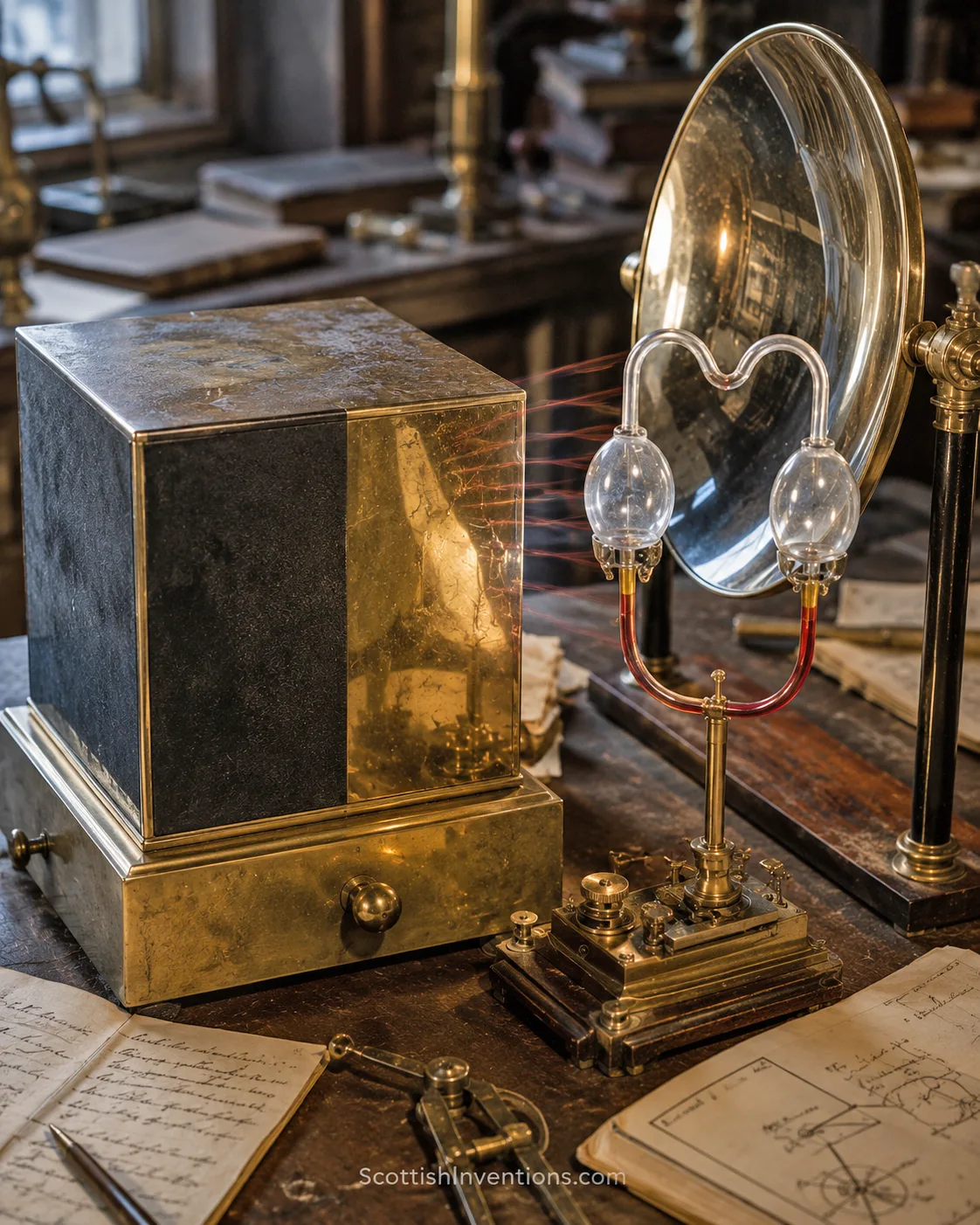
A Leslie Cube is a hollow metal box filled with hot or boiling water. The water holds every external face at approximately the same temperature, while each face is given a different finish: classically one coated with lamp-black, one left as dull metal, one polished bright. Because temperature is held constant across all of them, the only thing that varies between the faces is the surface itself. Any difference in the heat they radiate must come from the finish.
That is the whole elegance of the design, and the reason it has survived two hundred years of physics teaching. Most experiments on heat in Leslie's period struggled to separate radiation from conduction and convection, and to hold temperature steady while something else was changed. The cube solves both problems at once with a bucket of hot water and four coats of paint.
Leslie's detector was his own differential thermometer: a U-shaped glass tube with a sealed bulb at each end, containing sulphuric acid tinted red with carmine. Radiant heat falling on one bulb warmed the air within it and displaced the coloured liquid, so the instrument read a difference rather than an absolute temperature — exactly what a comparison experiment needs. One bulb was blackened and placed at the focus of a polished concave reflector, which gathered radiation from the cube face and concentrated it.
There was no thermopile in this apparatus, and it is worth stating plainly because the claim circulates. The thermopile did not exist in 1804.
Why Does the Black Face Radiate More Heat?
At the same temperature, different surfaces can emit dramatically different amounts of infrared radiation. A matte black surface reflects almost nothing, absorbs almost everything that reaches it, and — by the reciprocity Leslie established — radiates correspondingly well. Polished metal does the opposite: it reflects strongly, absorbs little and radiates little.
Matte black / lamp-black
Very high emission
Leslie's blackened face radiated far more strongly than any other surface on the cube.
Dull or oxidised metal
High to moderate emission
Roughened and tarnished surfaces emit appreciably more than the same metal polished.
Varnished surface
Surface-dependent emission
Tyndall's later version of the cube used an isinglass varnish, which emitted the most of his four faces.
Polished metal
Very low emission
The bright metallic face of Leslie's cube gave a reading he recorded as roughly one-eighth that of lamp-black.
The one number Leslie's own experiments give is a ratio, not a modern constant: he set the radiation from his lamp-black coating at 100 and the bare metallic surface of the same cube at about 12, a ratio of roughly eight to one, as later reported by John Tyndall. That is a historical experimental result from a particular apparatus, not a universal emissivity value. Modern thermopile-based demonstrations produce broadly comparable relative figures.
The scientific takeaway
Good absorbers are good emitters.
This mattered historically because it converted a vague sense that dark things "get hotter" into a symmetrical, testable relationship between two measurable properties of a surface. It is the foundation on which nineteenth-century radiation physics — Melloni, Tyndall, and eventually Kirchhoff — was built.
Inside Leslie's 1804 Experiment
Leslie's apparatus had three principal components, and each did one job.
1 · The cube
A cubical metal vessel filled with boiling or hot water, each vertical face given a different finish — classically polished metal, dull metal, and a face coated with lamp-black. The water is the temperature control: it holds every face at essentially the same temperature so that finish is the only variable.
2 · The differential thermometer
A U-shaped capillary tube with a sealed, air-filled glass bulb at each end, the tube holding sulphuric acid tinted red with carmine or cochineal. A temperature difference between the bulbs displaced the coloured column, making very small differences in heating visible. One bulb was blackened so that it absorbed the incoming radiation efficiently.
3 · The concave reflector
A polished concave mirror that collected radiant heat leaving the cube face and concentrated it onto the blackened bulb at its focus. The technique of focusing radiant heat with mirrors was not Leslie's: Pictet had demonstrated it in 1790. Leslie's contribution was to use it as a measuring instrument rather than a demonstration.
Editorial note · priority
Leslie is closely associated with the differential thermometer, although Count Rumford independently developed a similar instrument and priority was disputed. Sanborn C. Brown, writing in the American Journal of Physics in 1954, put it flatly: the instrument "was simultaneously discovered by Sir John Leslie and Count Rumford". Sir Humphry Davy later depreciated Leslie's claim; Tyndall's judgement was that where the two men's work overlapped, the credit belonged to both.
Leslie Did Not Discover Radiant Heat
Leslie worked in the middle of an intense European effort on radiant heat, and his place in that sequence has to be stated precisely for the credit to mean anything at all.
1777
Carl Wilhelm Scheele
Distinguished radiant transfer from conduction and convection.
1790
Marc-Auguste Pictet
Demonstrated the reflection and focusing of radiant heat by concave mirrors.
1791
Pierre Prévost
Stated the theory of exchanges: all bodies radiate at all temperatures.
1800
William Herschel
Discovered invisible infrared radiation beyond the red end of the spectrum.
1804
John Leslie
Quantified how surface finish and angle govern thermal emission and absorption.
Leslie was, by the record, pushed into this work by the last of those names. Chemistry World notes that in 1801 Leslie was galvanised by Herschel's observation of invisible radiation just beyond the red end of the visible spectrum. Pictet's own demonstration, in turn, confirmed conclusions already reached by Johann Heinrich Lambert and Horace-Bénédict de Saussure. Nobody in this story worked alone.
Leslie's achievement was not the discovery of radiant heat. It was turning radiant heat into a quantitatively investigated physical phenomenon.
ScottishInventions.com editorial summary
From Largo to Enlightenment Edinburgh
John Leslie was born at Largo — Lower Largo — on the Fife coast in April 1766, the son of Robert Leslie, a joiner and cabinetmaker, and Anne Carstairs. The exact day is not settled: 10 April in Wikipedia and Undiscovered Scotland, 16 April in the 1911 Encyclopaedia Britannica and the Dictionary of Scientific Biography, 17 April in MacTutor. He was taught mathematics at home by his father and his elder brother Alexander, and entered the University of St Andrews in 1779, at the age of thirteen, studying under Nicholas Vilant.
The scholarship that took him there came with an expectation attached: that he would enter the Church of Scotland. In 1785 he moved to the University of Edinburgh as a divinity student, and there the expectation quietly dissolved. He attended John Playfair, who became a lifelong friend and whom he would eventually succeed in two separate chairs; the chemist Joseph Black, whose work on latent and specific heat had already made heat a measurable quantity; and the moral philosopher Dugald Stewart. Leslie abandoned the ministry.
What followed was the ordinary precarious life of a talented young man without money. He tutored in Virginia from 1788 for the Randolph family, then from about 1790 to the end of 1792 acted as tutor to the family of Josiah Wedgwood at Etruria in Staffordshire, particularly to Thomas Wedgwood. He translated Buffon's Natural History of Birds, published in 1793, and wrote for the Monthly Review, for income. In 1797 Thomas Wedgwood granted him a pension for life. That patronage is what bought Leslie the freedom to spend the following years on experiments rather than employment.
A note on a figure often quoted: the "£150 annuity" attached to Wedgwood's pension in popular accounts is not supported by the standard scholarly source, which says only that Wedgwood gave Leslie a pension for life. The sum risks being a conflation with the separate annuity the Wedgwoods famously offered Samuel Taylor Coleridge in 1798. This page says what the evidence says.
An Experimental Inquiry into the Nature and Propagation of Heat
Leslie published An Experimental Inquiry into the Nature and Propagation of Heat in London in 1804, dedicated to Thomas Wedgwood. Its importance is not rhetorical. Where earlier writers on radiant heat had described effects, Leslie built apparatus capable of producing numbers, then reported the regularities those numbers revealed.
Primary source
John Leslie, An Experimental Inquiry into the Nature and Propagation of Heat
London, 1804. Dedicated to Thomas Wedgwood. Awarded the Rumford Medal of the Royal Society of London, cited variously as 1804 or 1805. Contains the description of the cube, the differential thermometer measurements, and the laws of surface emission and absorption.
Richard G. Olson's summary in the Dictionary of Scientific Biography is the standard scholarly statement of what the book achieved: that it "established several fundamental laws of heat radiation: that the emissivity and absorptivity for any surface are equal, that the emissivity of a surface increases with the decrease of reflectivity, and that the intensity of heat radiated from a surface is proportional to the sine of the angle of the rays to the surface". Those are retrospective formulations, in vocabulary Leslie did not have, of relationships he was the first to measure systematically.
The Physicist Accused of Atheism
In 1805 Leslie stood for the chair of mathematics at Edinburgh, vacated by John Playfair's move to natural philosophy. What should have been a straightforward appointment became one of the most notorious academic controversies of the Scottish Enlightenment, remembered as the Leslie Affair.
The objection was not to Leslie's mathematics. It was to a footnote — note xvi — in the 1804 heat book, in which Leslie spoke favourably of David Hume's account of causation. To sections of the Church of Scotland, endorsing Hume on cause and effect amounted to endorsing atheism, and the moderate and evangelical parties of the Kirk turned the appointment into a public trial of Leslie's orthodoxy. The dispute reached the General Assembly of the Church of Scotland.
In May 1805 the Assembly decided, in MacTutor's phrasing, "by the narrow majority of 96 to 84 that the affair be dropped and Leslie be left undeposed from his mathematics chair". Ninety-six votes to eighty-four: a margin of twelve, in a church court, determining whether one of Britain's most capable experimental physicists would hold a university post. Leslie took the chair, and held it until 1819, when Playfair's death moved him to natural philosophy.
More Than the Leslie Cube
The cube is what carries his name, but Leslie's working life produced instruments and results across half a dozen areas of physical science.
Artificial ice, 1810
Leslie froze water by rapid evaporation under the receiver of an air pump, using concentrated sulphuric acid to absorb the vapour and hold the pressure down, reportedly producing a pound or more of ice in a single operation, and demonstrating the method at Raith near Kirkcaldy. Per Olson, this supplied the principle later exploited by Ferdinand Carré in the first laboratory ice machines. It was not the first artificial cold — see the myths section, and William Cullen.
Capillary action, 1802
Leslie gave what is generally regarded as the first account of capillary action consistent with modern theory, stimulating subsequent work by Thomas Young and James Ivory.
Hygrometry
He developed a wet-and-dry-bulb hygrometer, announced around 1799–1800, together with an essentially correct theory of how it works, alongside a photometer and an atmometer.
The aethrioscope, 1818
An instrument for measuring the chilling effect of a clear sky — the radiative heat loss from a surface to open air on a cloudless night, which is why frost forms under clear skies and not under cloud.
Electrical conduction, 1791
An early paper analysing the leakage of static electricity through conductors arrived at a relationship prefiguring aspects of Ohm's law, decades before Georg Ohm. This is a prefiguring noted by later scholars, not a published statement of the law, and Leslie did not develop it. The Royal Society refused the communication.
Mathematics
As Edinburgh's professor of mathematics he wrote widely used textbooks — Elements of Geometry, Geometrical Analysis, and Plane Trigonometry (1809), Geometry of Curve Lines (1813) and The Philosophy of Arithmetic (1817) — blending classical geometry with continental analysis.
On refrigeration the distinction must be kept sharp. Leslie did not invent refrigeration and did not make artificial cold first. William Cullen demonstrated artificial refrigeration at Glasgow in 1748 and published the first public demonstration from Edinburgh in 1756. What Leslie built in 1810 was a distinct and genuinely original ice-making apparatus using the absorption of water vapour by sulphuric acid.
The Experiment Is Still Being Taught 220 Years Later
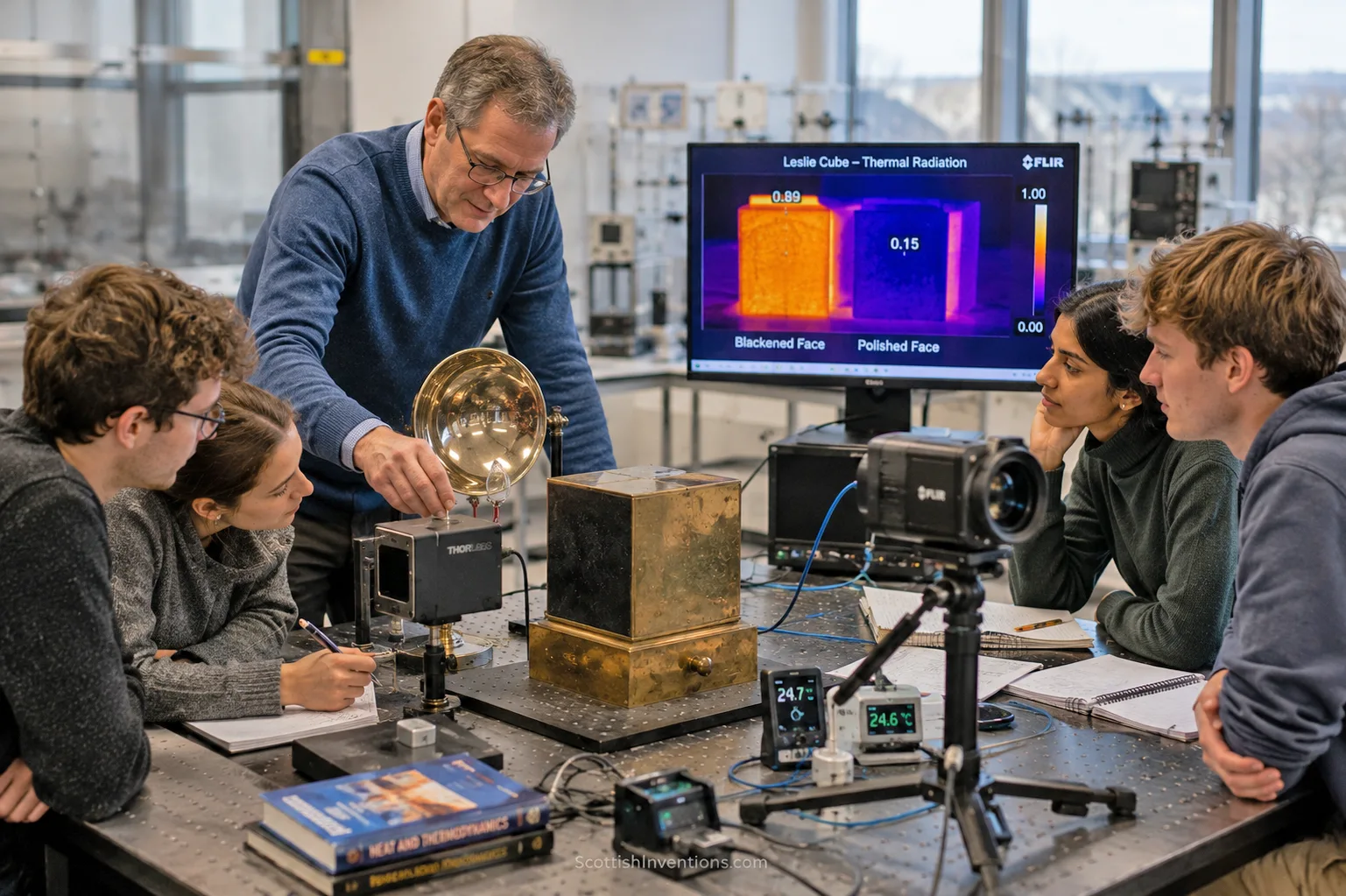
Very few pieces of early-nineteenth-century laboratory apparatus are still bought new, in quantity, for classrooms. The Leslie Cube is one. In the United Kingdom it forms a required practical in GCSE physics — AQA's Required Practical 10, investigating how infrared emission and absorption depend on surface finish, using a Leslie cube and an infrared detector — and it appears in university lecture demonstrations and infrared-imaging teaching worldwide.
It survives because the experiment is honest. The variable is genuinely isolated, the effect is large enough to see immediately, and the conclusion is not obvious in advance to someone who has not met it. A miniaturised version even flew on the FUNcube-1 educational satellite, launched on 21 November 2013, so that pupils can compare orbital thermal-emission data with their own classroom results.
What has changed is the detector, and the chronology needs to be explicit. Modern demonstrations use thermopiles, infrared thermometers, digital temperature sensors and thermal cameras of the kind shown above, which render the emissivity difference as a false-colour image in real time. These are modern detection methods.
Leslie did not use a thermopile in 1804. The thermopile was invented by Leopoldo Nobili around 1829–1830 and refined by Macedonio Melloni, following Seebeck's 1821 discovery of thermoelectricity — some twenty-five years after the Inquiry. Leslie's detector was the differential thermometer with a concave reflector. The equipment on the modern bench is almost certainly where the persistent online claim that Leslie invented the thermopile comes from.
Why Emissivity Still Matters
Leslie did not invent any of the technologies below. What he established is the physics they all depend on: that the radiation leaving a surface is a property of the surface as much as of its temperature, and that emission and absorption track one another.
- Thermal imaging and infrared thermometry. Every non-contact temperature reading requires an emissivity assumption. Point an infrared thermometer at polished steel and it will read badly wrong unless corrected — precisely Leslie's polished face.
- Building heat-loss surveys. Thermal cameras used to find missing insulation are reading emitted infrared, and surveyors must account for the different emissivities of glass, brick, render and metal flashing.
- Spacecraft thermal control. With no air to conduct heat away, radiation is the only route. Spacecraft surfaces are engineered by their ratio of solar absorptivity to infrared emissivity; multi-layer insulation and radiator coatings are applied Leslie.
- Climate and Earth-observation instruments. Satellite retrieval of land-surface temperature depends on knowing the emissivity of the surface being observed, which varies with soil, vegetation and water.
- Industry. Furnace design, radiator efficiency, heat shields and industrial temperature measurement all turn on how well particular surfaces radiate and absorb.
Timeline
- 1766John Leslie born at Largo, FifeSon of Robert Leslie, joiner and cabinetmaker, and Anne Carstairs. Sources disagree on the day: 10, 16 or 17 April.
- 1777Carl Wilhelm Scheele distinguishes radiant heat from conduction and convectionThe phenomenon is already under investigation across Europe
- 1779Enters the University of St Andrews aged 13Studies mathematics under Nicholas Vilant; a scholarship is granted on the expectation he will enter the Church
- 1785Moves to the University of Edinburgh as a divinity studentAttends John Playfair, Joseph Black and Dugald Stewart; abandons the ministry
- 1790Marc-Auguste Pictet shows radiant heat can be reflected and focusedEssai sur le feu, including the famous 'reflection of cold' demonstration
- 1790–92Tutor to the Wedgwood family at Etruria, StaffordshireParticularly to Thomas Wedgwood; earlier tutored in Virginia from 1788
- 1791Pierre Prévost states the theory of exchangesAll bodies radiate at all temperatures; equilibrium is a balance of exchange
- 1791Leslie's early paper on electrical leakage through conductorsArrives at a relationship prefiguring aspects of Ohm's law; the Royal Society refuses the communication
- 1797Thomas Wedgwood grants Leslie a pension for lifeFinancial independence for research. The often-quoted '£150 annuity' figure is not supported by the standard scholarly source.
- 1800William Herschel discovers infrared radiationInvisible radiant heat beyond the red end of the spectrum — the discovery Leslie did not make
- 1802Leslie publishes on capillary actionGenerally regarded as the first account consistent with modern theory; stimulates Thomas Young and James Ivory
- 1804An Experimental Inquiry into the Nature and Propagation of HeatThe Leslie Cube and the quantitative laws of surface radiation. Dedicated to Thomas Wedgwood.
- 1804/1805Rumford Medal of the Royal Society of LondonRoyal Society records and Wikidata give 1804; several biographies point to an 1805 presentation
- 1805The Leslie Affair, and the Edinburgh mathematics chairThe General Assembly votes 96 to 84 that the affair be dropped and Leslie left undeposed
- 1810Freezes water by evaporation under an air pumpSulphuric acid absorbs the vapour. An important ice-making method — but William Cullen had made artificial cold in 1748.
- 1818Invents the aethrioscopeAn instrument for measuring the chilling effect of a clear sky
- 1819Professor of Natural Philosophy at EdinburghSucceeding John Playfair on his death
- 1820Corresponding member of the Institut de FranceReportedly the only distinction of the kind he valued
- 1832Knighted, and dies on 3 NovemberDies at Coates, near Largo, after a fever following a cold caught working outdoors
- c. 1829–30Nobili and Melloni develop the thermopileA quarter-century after Leslie's book — which is why no thermopile belongs in the 1804 apparatus
- TodayA required practical in UK GCSE physicsThe Leslie Cube remains standard equipment in school and university laboratories worldwide
Sir John Leslie: Myths and Facts
Myth: John Leslie discovered radiant heat.
No. Marc-Auguste Pictet demonstrated the reflection and focusing of radiant heat in 1790, Pierre Prévost stated the theory of exchanges in 1791, and William Herschel discovered infrared radiation in 1800. Leslie's contribution — genuine and substantial — was the systematic, quantitative investigation of how emission and absorption depend on the nature of a surface.
Myth: Leslie invented or used a thermopile.
False, and worth naming directly because the claim currently circulates online. The thermopile was invented by Leopoldo Nobili around 1829–1830 and refined by Macedonio Melloni in the 1830s, following Thomas Seebeck's 1821 discovery of thermoelectricity — roughly twenty-five years after Leslie's book. Leslie used his own differential thermometer at the focus of a concave reflector. Modern classroom versions of his experiment do use thermopiles, which is the likely source of the anachronism.
Myth: Leslie alone invented the differential thermometer.
Disputed. Count Rumford (Benjamin Thompson) developed a very similar instrument, and Sanborn C. Brown wrote in the American Journal of Physics (1954) that the differential thermometer "was simultaneously discovered by Sir John Leslie and Count Rumford". John Tyndall's later judgement was that credit belonged to both, working independently. Sir Humphry Davy publicly depreciated Leslie's claim.
Myth: Leslie was the first person to make artificial cold.
No. His fellow Scot William Cullen demonstrated artificial refrigeration at Glasgow in 1748 and gave the first public demonstration at Edinburgh in 1756. Edward Nairne had noted sulphuric acid's cooling effect in 1777. Leslie's 1810 achievement is best described as an important early ice-making process, and the specific apparatus was genuinely his.
Caveat: Leslie was not a Fellow of the Royal Society of London.
He won the Society's Rumford Medal, but the evidence indicates he was never elected FRS — the Society had refused his first communication in 1791, and his relationship with the London establishment stayed cool. His fellowship was of the Royal Society of Edinburgh, from 1807. The FRS post-nominal should not be attached to his name.
Caveat: two dates in his life are genuinely unsettled.
His birth day is given as 10 April 1766 (Wikipedia, Undiscovered Scotland), 16 April (1911 Britannica, Dictionary of Scientific Biography) or 17 April (MacTutor). The Rumford Medal is dated 1804 by Royal Society records and 1805 by several biographies and by Cambridge University Press's edition of the Inquiry. This page states both rather than quietly choosing one.
Caveat: the "£150 annuity" figure.
Thomas Wedgwood's 1797 patronage is documented; the specific sum is not. MacTutor says only that Wedgwood "gave him a pension for life", and the £150 figure risks being a conflation with the separate annuity the Wedgwoods offered Samuel Taylor Coleridge in 1798. This page says "a pension for life".
Sir John Leslie's Legacy
Leslie's 1804 Inquiry won him the Rumford Medal of the Royal Society of London, dated 1804 in the Society's own records and 1805 in several biographies and in Cambridge University Press's edition of the book. He was elected a Fellow of the Royal Society of Edinburgh in 1807 and a corresponding member of the Institut de France in 1820 — reportedly the only distinction of the kind he valued. He was not, on the evidence, a Fellow of the Royal Society of London: that body had refused his first communication in 1791, and relations stayed cool.
He held the Edinburgh chair of mathematics from 1805 and the chair of natural philosophy from 1819, was knighted in 1832 — a knighthood he had himself solicited, in a letter to the Lord Chancellor in September 1831, tied to the coronation of William IV — and died on 3 November of the same year at his estate of Coates, near Largo, after a fever following a cold caught working outdoors in winter.
The scientific legacy runs forward from his measurements rather than his instruments. Leslie's quantitative radiant-heat laws fed into the work of Melloni and Tyndall, and ultimately into Kirchhoff's law of thermal radiation, which generalised the reciprocity Leslie had measured into a statement about thermal equilibrium at every wavelength. Framed precisely: Leslie transformed qualitative observations about radiant heat into controlled quantitative experiments. That is a smaller claim than "discovered radiant heat", and a far more durable one.
Frequently Asked Questions
Who was Sir John Leslie?
Sir John Leslie (1766–1832) was a Scottish physicist and mathematician, born at Largo in Fife, who held the chairs of Mathematics (from 1805) and Natural Philosophy (from 1819) at the University of Edinburgh. He is best known for the Leslie Cube and for An Experimental Inquiry into the Nature and Propagation of Heat (1804), the first systematic quantitative study of how surfaces emit and absorb radiant heat. He was knighted in 1832 and died the same year.
What did Sir John Leslie discover?
Leslie established, by measurement, the fundamental laws of surface radiation: that a surface's emitting power equals its absorbing power, that emitting power rises as reflectivity falls, and that the intensity of radiation depends on the angle at which it leaves the surface. He did not discover radiant heat or infrared radiation. His achievement was to turn radiant heat from a described phenomenon into a measured one.
What is a Leslie Cube?
A Leslie Cube is a hollow metal vessel, filled with hot or boiling water, whose vertical faces are given different surface finishes — typically lamp-black, dull metal and polished metal. Because all the faces are held at essentially the same temperature by the water inside, any difference in the heat they radiate must come from the surface finish alone. It is one of the cleanest controlled experiments in physics teaching.
Who invented the Leslie Cube?
Sir John Leslie invented it, and this is a rare case where the eponymous credit is fully deserved rather than an example of Stigler's Law. He described the apparatus in An Experimental Inquiry into the Nature and Propagation of Heat in 1804. Later variants, notably John Tyndall's four-faced version coated with gold, silver, copper and isinglass varnish, are refinements of Leslie's original design.
When was the Leslie Cube invented?
Leslie carried out the experiments in the years immediately following 1800 — he was, by his own account, spurred by William Herschel's 1800 discovery of invisible radiation beyond the red end of the spectrum — and published the apparatus and results in 1804 in An Experimental Inquiry into the Nature and Propagation of Heat.
How does a Leslie Cube work?
Hot water fills the cube, bringing all four external faces to approximately the same temperature. Each face carries a different finish. A detector placed the same distance from each face in turn measures the radiation it receives. Because temperature and distance are held constant, the differences recorded are due to the surfaces themselves. Leslie's detector was his differential thermometer, with one blackened bulb at the focus of a polished concave reflector.
Why does the black side of a Leslie Cube emit more infrared radiation?
A matte black surface is a poor reflector: radiation arriving at it is absorbed rather than turned away. Leslie's measurements showed that this works in both directions — a surface that absorbs well also emits well. Polished metal reflects strongly, absorbs little and therefore radiates little. The black face and the polished face are at the same temperature; they differ in how efficiently they couple to the radiation field.
Did John Leslie discover infrared radiation?
No. Infrared radiation was discovered in 1800 by William Herschel, who found heating beyond the red end of the visible spectrum. Leslie's own work was prompted by that result. Any claim that Leslie discovered infrared radiation, or radiant heat generally, is wrong.
Who discovered infrared radiation?
William Herschel, in 1800. Earlier steps in the science of radiant heat belong to Carl Wilhelm Scheele (1777), who distinguished radiation from conduction and convection, Marc-Auguste Pictet (1790), who showed radiant heat could be reflected and focused, and Pierre Prévost (1791), whose theory of exchanges held that all bodies radiate at all temperatures.
Did John Leslie invent the differential thermometer?
Partly, and the priority is disputed. Count Rumford developed a very similar instrument at around the same time, and the American Journal of Physics (1954) records that the differential thermometer "was simultaneously discovered by Sir John Leslie and Count Rumford". Historians generally treat the two as independent, near-simultaneous inventors rather than crediting either alone.
Did John Leslie invent the thermopile?
No. The thermopile was invented by Leopoldo Nobili around 1829–1830 and developed by Macedonio Melloni, following Seebeck's 1821 discovery of thermoelectricity — about twenty-five years after Leslie's 1804 book. Leslie used a differential thermometer and a concave reflector. Sources that place a thermopile in Leslie's apparatus are in error.
What did John Leslie contribute to refrigeration?
In 1810 Leslie froze water by evaporating it rapidly under the receiver of an air pump, using concentrated sulphuric acid to absorb the vapour and maintain the low pressure, reportedly producing a pound or more of ice in a single operation. This is an important early ice-making process and, per the Dictionary of Scientific Biography, supplied a principle later exploited by Ferdinand Carré. It was not the first artificial cold: William Cullen preceded him in 1748.
Is the Leslie Cube still used today?
Yes. It is standard equipment in physics teaching more than two centuries after 1804, including as a required practical in UK GCSE physics, where pupils investigate how infrared emission depends on surface finish. University laboratories use it with thermopiles, infrared thermometers and thermal cameras, and a miniaturised version flew on the FUNcube-1 educational satellite launched in November 2013.
What is emissivity?
Emissivity is a measure of how effectively a surface radiates thermal energy compared with an ideal black body at the same temperature, on a scale from 0 to 1. A matte black surface is close to 1; polished metal may be around 0.1 or lower. The word itself postdates Leslie by decades, but the physical relationships it describes are the ones his 1804 measurements were the first to establish systematically.
What is the connection between Leslie's experiments and Kirchhoff's law?
Kirchhoff's law of thermal radiation, formulated in 1859–60, states that for a body in thermal equilibrium its emissivity equals its absorptivity at every wavelength. Leslie's 1804 measurements established the reciprocity of emission and absorption experimentally, without the wavelength-resolved, thermodynamic generality Kirchhoff later supplied. Leslie anticipated the relationship; he did not formulate Kirchhoff's law.
Sources & Further Reading
Primary sources
- John Leslie, An Experimental Inquiry into the Nature and Propagation of Heat (London, 1804).
- John Tyndall, Heat Considered as a Mode of Motion — reports Leslie's lamp-black to bare-metal ratio and describes Tyndall's own four-faced version of the cube.
- Marc-Auguste Pictet, Essai sur le feu (1790); Pierre Prévost on the theory of exchanges (1791).
Scholarly sources
- Richard G. Olson, "John Leslie", Dictionary of Scientific Biography — the standard scholarly summary of the 1804 laws.
- Richard G. Olson, "A Note on Leslie's Cube in the Study of Radiant Heat", Annals of Science 25 (1969), 203–208; and "Count Rumford, Sir John Leslie, and the study of the nature and propagation of heat", Annals of Science 26 (1970), 273–304.
- Sanborn C. Brown, American Journal of Physics 22:1 (1954) — on the simultaneous discovery of the differential thermometer by Leslie and Rumford.
Institutional and reference sources
- MacTutor History of Mathematics Archive, University of St Andrews — biography, and the 96-to-84 General Assembly vote.
- Royal Society of London — Rumford Medal records.
- Dictionary of National Biography (1885–1900) and the 1911 Encyclopaedia Britannica — biography and the 1810 ice experiments.
- Chemistry World — on Leslie as an earned exception to Stigler's Law, and on Herschel's 1800 result as the spur to Leslie's work.
- AQA GCSE Physics Required Practical 10 — current teaching use of the Leslie cube.
Note on sources not used: several popular and AI-generated web pages state that Leslie used or invented a bismuth–antimony thermopile in 1804. This is demonstrably false and those pages are not cited here.