Discoveries · No. 26 of 50 · Astronomy
Robert Innes and the Discovery of Proxima Centauri
A Scottish-born astronomer who left school at twelve, sold wine in Sydney, and found the nearest star to the Sun from a Johannesburg observatory — precisely credited, with the 1915 and 1917 claims kept apart.
R. T. A. Innes · 1861–1933Discovery paper · 12 October 1915Reading time · 16 minUpdated 12 August 2026
TL;DR
- Robert Thorburn Ayton Innes — born Edinburgh, 10 November 1861; died 13 March 1933 — was a genuinely self-taught, formally school-less astronomer who really did leave school at about age twelve, work as a wine merchant in Sydney, and rise to become founding director of the Johannesburg observatory that became the Union Observatory. In 1915 he really did discover Proxima Centauri, the nearest star to the Sun. These core claims are documented and hold up.
- The single most important correction: in his 1915 paper Innes documented a faint star sharing Alpha Centauri's proper motion; he did not prove it was closer than Alpha Centauri that year. His claim that it was the nearest star, and the name "Proxima", came in 1917, on what historian Ian Glass calls an "unjustifiable conclusion" drawn without proper discussion of measurement error — a lucky, correct guess later confirmed by others.
- Innes is correctly called Scottish-born, but his career and this discovery were institutionally South African. He was not formally trained, and he did not personally discover asteroids. Proxima's gravitational binding to Alpha Centauri AB was only demonstrated with high confidence in 2017.
Scottish Impact Index (SI Score)
- Global Impact
- 8/10
- Longevity
- 9/10
- Economic / Material Impact
- 2/10
- Originality / Distinctiveness
- 9/10
- Legacy (Built Upon)
- 8/10
- Recognition
- 5/10
Key Findings
Documented — highest tier
- Birth and death: Edinburgh, 10 November 1861; died 13 March 1933. Sources include the MNRAS obituary (de Sitter, 1934), the Dictionary of Scientific Biography (Finsen 1973), the Biographical Encyclopedia of Astronomers (Snedegar 2007), and the S2A3 Biographical Database of Southern African Science.
- He left school at about age twelve and was thereafter entirely self-taught — confirmed by the DSB and the Biographical Encyclopedia, so the "self-taught" claim is documented, not legend. He was elected FRAS at about seventeen years and two months.
- Wine merchant in Sydney: documented. He sailed for Sydney in 1890 and set up as a wine and spirit merchant; his double-star work there, with borrowed telescopes, launched his professional career.
- Career path: invited by Sir David Gill to the Royal Observatory, Cape of Good Hope (invited 1894, arrived 1896); founding director of the Transvaal Observatory, Johannesburg, from 1903; first Union Astronomer when the Union Observatory was established in 1912.
- The discovery paper: "A faint star of large proper motion," Circular of the Union Observatory Johannesburg, vol. 30, pp. 235–236, dated 12 October 1915.
- Proxima Centauri is the nearest star to the Sun, 4.2465 light-years away — parallax 768.5004 ± 0.2030 mas, Gaia Data Release 2, 2018 — about 1.301 parsecs or 268,400 astronomical units; a red dwarf of apparent visual magnitude around 11.05–11.13, normally invisible to the naked eye.
Requiring correction or precision
- The 1915-versus-1917 distinction, set out in full below.
- "Discovered in 1912", repeated by Astronomy.com's birthday feature, is an error; the discovery paper is October 1915.
- Innes did not personally discover asteroids.
Quick Facts
- Discovery
- A faint star sharing Alpha Centauri's proper motion — later confirmed as the nearest star to the Sun
- Discovery paper
- 'A faint star of large proper motion', Union Observatory Circular 30, pp. 235–236, dated 12 October 1915
- Key figure
- Robert Thorburn Ayton Innes FRSE (1861–1933)
- Born
- Edinburgh, 10 November 1861
- Died
- Surbiton / London area, 13 March 1933, of a heart attack
- Education
- Left school at about age 12; thereafter entirely self-taught. FRAS at 17
- Institution
- Union Observatory, Johannesburg — the discovery is institutionally South African
- The 1917 paper
- 'Parallax of the Faint Proper Motion Star Near Alpha of Centaurus', Union Observatory Circular 40, pp. 331–336
- Name proposed
- Proxima Centaurus (1917), later standardised to Proxima Centauri; IAU-approved 21 August 2016
- Confirmed by
- Voûte (1917), Alden (1928), and definitively Kervella, Thévenin & Lovis (2017)
- Modern distance
- 4.2465 light-years; parallax 768.5004 ± 0.2030 mas (Gaia DR2, 2018)
- Double stars found
- About 1,628; compiler of the Southern Double Star Catalogue (1927)
- Claim status
- Disputed / requires precision — 1915 established common proper motion only
Background
Robert Thorburn Ayton Innes was born in Edinburgh on 10 November 1861, the eldest of a large family — the eldest of twelve children of John Innes and Elizabeth, née Ayton, according to the Dictionary of Scientific Biography and the Biographical Encyclopedia of Astronomers; some sources phrase this as "eleven younger siblings". He showed early promise in mathematics but left school at about age twelve, and thereafter was entirely self-taught.
The Dictionary of Scientific Biography notes that his lack of formal schooling "was apparent only in his unprejudiced and often unconventional outlook", and that his mathematical proficiency showed in his published work in celestial mechanics. He was elected a Fellow of the Royal Astronomical Society at seventeen. He married Anne Elizabeth Fennell in 1884; they had three sons.
In 1890 Innes and his wife sailed for Sydney, where he became a successful wine and spirit merchant. Under Australian skies his interest in observational astronomy blossomed; encouraged by Australian astronomers including Walter Gale and John Tebbutt, and using borrowed telescopes including a Cooke refractor, he began searching for southern double stars and published his first double-star list in 1895. This amateur-turned-professional trajectory is documented in detail in Wayne Orchiston's peer-reviewed history "From Amateur Astronomer to Observatory Director: The Curious Case of R. T. A. Innes" (Publications of the Astronomical Society of Australia, vol. 18, 2001, pp. 317–327).
From Wine Merchant to Union Astronomer
On the strength of his published double-star work, Innes wrote to Sir David Gill, HM Astronomer at the Royal Observatory, Cape of Good Hope. Gill invited him in 1894 and Innes took up a modest post — secretary, librarian and accountant — at the Cape in 1896. There he continued double-star and proper-motion work in his own time, published his Reference Catalogue of Southern Double Stars in 1899, and was involved in the identification of the high-proper-motion star now called Kapteyn's Star in 1897: Kapteyn, analysing Cape plates in the Netherlands, found a catalogued star apparently "missing", and Innes located it about 15 arcseconds from its expected position, revealing its very large proper motion.
With Gill's support, Innes became founding director of the new Transvaal (Meteorological) Observatory in Johannesburg in 1903. It was initially a meteorological station; Innes transformed it into an astronomical institution, acquiring its first telescope — a 9-inch Grubb refractor — in 1909, and became the first Union Astronomer when it was renamed the Union Observatory in 1912.
His southern-hemisphere location was essential to the Proxima discovery. Alpha Centauri is a far-southern object at declination around −60°, invisible from most of the northern hemisphere, so a systematic proper-motion survey around it was practically a southern-hemisphere task.
1915 — A Faint Star of Large Proper Motion
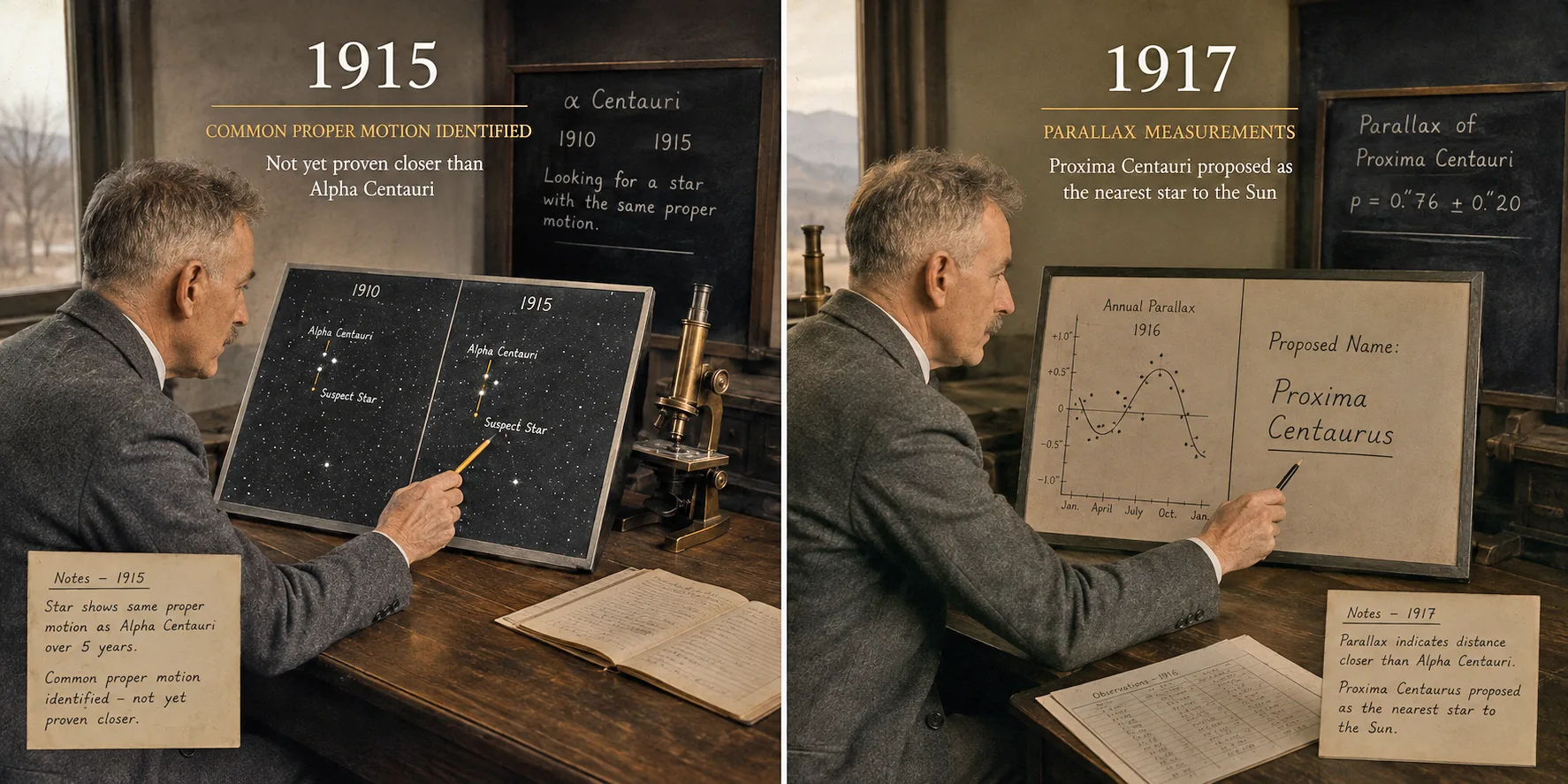
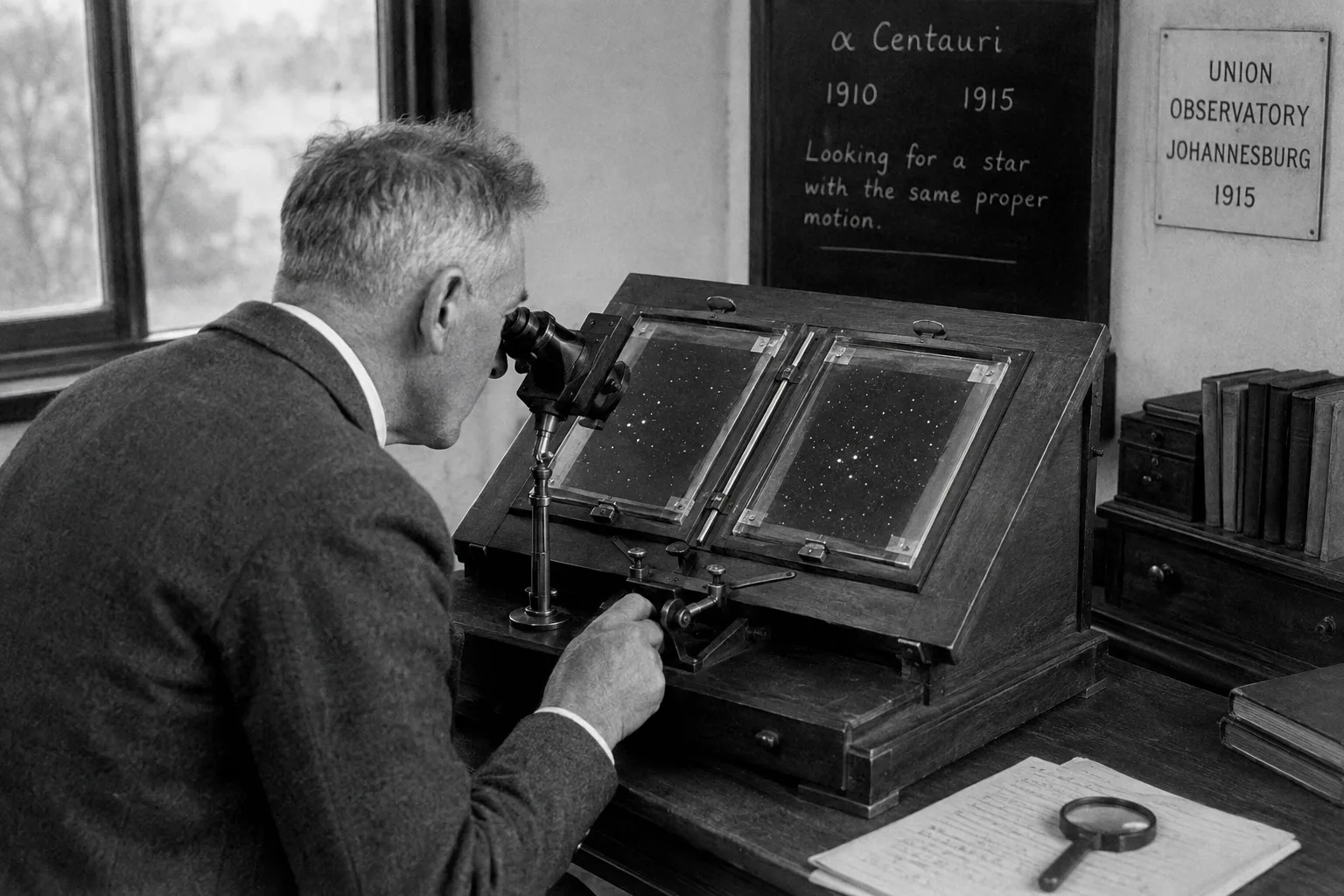
Innes suspected that Alpha Centauri — then thought to be the nearest star system to the Sun — might have a faint additional companion. Using a blink comparator, or blink microscope, to compare photographic plates of a large field of about 60 square degrees around Alpha Centauri taken several years apart — a 1910 plate against a 1915 plate — he identified the new star after painstaking study. In the account of historian Ian Glass, relayed in Centauri Dreams ("Finding Proxima Centauri", 24 April 2013): "Forty hours of painstaking study revealed a star with a proper motion similar to Alpha Centauri (4.87″ per year), and about two degrees away from it." He announced this in "A faint star of large proper motion" (Union Observatory Circular 30, pp. 235–236), dated 12 October 1915.
Crucially — and this is the point an accuracy-first article must make — in 1915 Innes had established that the star shared Alpha Centauri's proper motion, making it a candidate common-proper-motion companion. He had not yet proven it was closer to the Sun than Alpha Centauri. Resolving that required better parallax measurements.
1917 — The Name and the Claim
The claim that it was the nearest star, and the name "Proxima", came in 1917, in his paper "Parallax of the Faint Proper Motion Star Near Alpha of Centaurus" (Union Observatory Circular 40, pp. 331–336). Innes proposed "Proxima Centaurus", Latin for "nearest", later standardised to the genitive "Proxima Centauri".
Glass, in "The Discovery of the Nearest Star" (African Skies vol. 11, 2007, p. 39) and in his 2008 book Proxima, the Nearest Star (other than the Sun), records that Innes, "without a proper discussion of the probable error of the measurement, drew the unjustifiable conclusion that his star was closer than α Cen and therefore must be the nearest star to the Solar System" — a correct guess that later measurements vindicated.
The name "Proxima Centauri" was formally approved by the IAU Working Group on Star Names on 21 August 2016, ninety-nine years after Innes proposed it.
Confirmation, 1917 to 2017
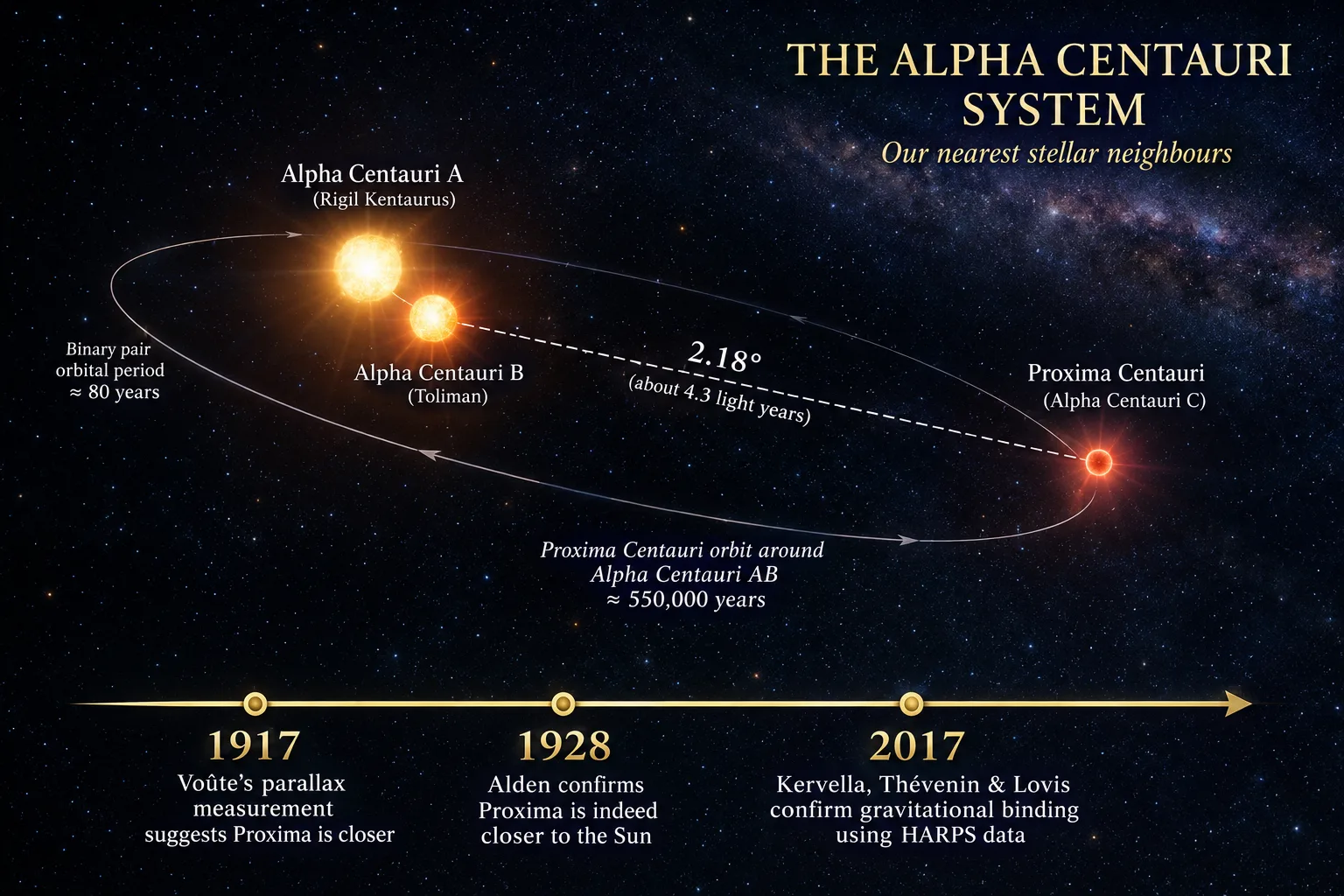
Confirmation came from others. The Dutch astronomer Joan Voûte, at the Royal Observatory, Cape of Good Hope, measured Proxima's trigonometric parallax at 0.755″ ± 0.028″ in 1917, finding it at about the same distance as Alpha Centauri and the lowest-luminosity star then known; Voûte had begun his parallax work in February 1916 and published before Innes. The American astronomer Harold L. Alden, at the Yale Southern Station in Johannesburg, confirmed in 1928 that Proxima is indeed closer, with a parallax of 0.783″ ± 0.005″ (Alden, "Alpha and Proxima Centauri," Astronomical Journal 39, 1928). In 1951 Harlow Shapley showed Proxima is a flare star.
Proxima Centauri is confirmed as the nearest star to the Sun, 4.2465 light-years away, identified as component Alpha Centauri C, about 2.18° from the Alpha Centauri AB pair. Whether Proxima is gravitationally bound to Alpha Centauri AB — a genuine third component of a triple system rather than a chance neighbour — was open for a century. Wertheimer and Laughlin (2006), using Hipparcos kinematics, found it likely bound and near apastron in a highly eccentric orbit.
The question was resolved with high confidence by Kervella, Thévenin and Lovis, "Proxima's orbit around α Centauri" (Astronomy & Astrophysics vol. 598, L7, 2017), using HARPS high-precision radial-velocity data. Per the paper's abstract: "The orbital period of Proxima is ≈ 550 000 yr. With an eccentricity of 0.50, Proxima comes within 4.3 kau of α Cen at periastron, and is currently close to apastron (13.0 kau)." Kervella et al. placed Proxima closer to Earth than α Cen AB by roughly 7,800 AU — Proxima at 1.3008 ± 0.0006 pc, α Cen AB at 1.3384 ± 0.0011 pc. Later work (Kervella et al. 2019; Akeson et al. 2021) raised the statistical significance of the binding from about 4.4σ to 8.3σ.
Other Contributions
Innes is credited with the discovery of about 1,628 new double stars and compiled the definitive Southern Double Star Catalogue (−19° to −90°, Johannesburg, 1927), a landmark of southern-hemisphere astronomy. He was the first astronomer to properly study — and telegraph the world about — the Great January (Daylight) Comet of 1910, C/1910 A1, observing it from the Transvaal Observatory on 17 January 1910 after being alerted by a Johannesburg newspaper editor. The comet itself was first spotted by Transvaal diamond miners around 12 January and had no single discoverer.
He worked on the secular perturbations of the Earth's orbit by Mars and Venus, in 1890s papers in MNRAS, and later on the variability of the Earth's rotation. He advanced the practical astronomical use of the blink comparator. He received an honorary doctorate from Leiden University in 1923 and was a Fellow of the Royal Society of Edinburgh, elected 1904. He retired at the end of 1927 and died suddenly, of a heart attack, in the London area on 13 March 1933.
Innes did not personally discover asteroids. The Union Observatory became a prolific minor-planet discovery site — the Minor Planet Center credits it with 147 minor-planet discoveries — but those are credited to later staff astronomers: Harry Wood, Cyril Jackson, Hendrik van Gent, Ernest Johnson, Ejnar Hertzsprung, Jacobus Bruwer and Joseph Churms. Asteroid 1658 Innes is named in his honour but was discovered on 13 July 1953 by Jacobus Bruwer. A lunar crater Innes and the high-proper-motion red dwarf "Innes' Star" also bear his name.
How This Card Frames Nationality
Innes is accurately described as Scottish-born — Edinburgh, 10 November 1861 — and is often styled "Scottish–Australian–South African". Calling him simply "a Scottish astronomer" is defensible for birth and heritage.
But the discovery is institutionally South African. It was made at the Union Observatory in Johannesburg, on plates taken from the southern hemisphere, of a field invisible from Scotland, by an astronomer whose entire professional life was spent at the Cape and in the Transvaal. This collection includes Innes for his Scottish birth and self-made formation, and states the institutional facts plainly. Patriotic overstatement that frames Proxima as a Scottish triumph is the one thing this card is written to avoid.
Timeline
1861
Robert Thorburn Ayton Innes born in Edinburgh, 10 November
Eldest of twelve children of John Innes and Elizabeth née Ayton
c.1873
Leaves school at about age 12
Thereafter entirely self-taught — a romantic-sounding claim that happens to be documented
1878
Elected a Fellow of the Royal Astronomical Society at 17
Roughly 17 years and 2 months old
1884
Marries Anne Elizabeth Fennell
They had three sons
1890
Sails for Sydney and becomes a wine and spirit merchant
Under Australian skies his interest in observational astronomy blossoms
1895
Publishes his first double-star list
Using borrowed telescopes, encouraged by Walter Gale and John Tebbutt
1894
Invited by Sir David Gill to the Royal Observatory, Cape of Good Hope
On the strength of his published double-star work
1896
Takes up a modest post at the Cape
Secretary, librarian and accountant — continuing double-star work in his own time
1897
Involved in the identification of Kapteyn's Star
Locates the apparently 'missing' star about 15 arcseconds from its expected position
1899
Publishes the Reference Catalogue of Southern Double Stars
The foundation of his professional reputation
1903
Founding director of the Transvaal (Meteorological) Observatory, Johannesburg
Initially a meteorological station; Innes turns it into an astronomical institution
17 Jan 1910
Observes the Great January (Daylight) Comet, C/1910 A1
The first astronomer to properly study it and telegraph the world; the comet itself had no single discoverer
1912
The observatory is renamed the Union Observatory; Innes becomes the first Union Astronomer
This 1912 date is often wrongly reported as the year of the Proxima discovery
12 Oct 1915
'A faint star of large proper motion' — Union Observatory Circular 30
Forty hours of blink-comparator work on 1910 and 1915 plates reveals a star with proper motion of 4.87″ per year, about two degrees from Alpha Centauri
Feb 1916
Joan Voûte begins his parallax work at the Cape
He would publish before Innes
1917
Innes claims the star is the nearest to the Sun and proposes the name 'Proxima Centaurus'
Union Observatory Circular 40, pp. 331–336 — drawn, per Ian Glass, without proper discussion of measurement error
1917
Voûte measures the parallax at 0.755″ ± 0.028″
About the same distance as Alpha Centauri, and the lowest-luminosity star then known
1923
Honorary doctorate from Leiden University
Elected FRSE in 1904
1927
Publishes the Southern Double Star Catalogue and retires
Covering −19° to −90°; a landmark of Southern-Hemisphere astronomy
1928
Alden confirms Proxima is closer, parallax 0.783″ ± 0.005″
Alden, 'Alpha and Proxima Centauri', Astronomical Journal 39
1933
Innes dies suddenly of a heart attack, 13 March
In the London area; sources give Surbiton, Surrey, or simply 'London'
1951
Harlow Shapley shows Proxima is a flare star
Explaining the small variation in its recorded magnitude
2016
'Proxima Centauri' formally approved by the IAU Working Group on Star Names, 21 August
Nearly a century after Innes proposed it
2017
Kervella, Thévenin & Lovis demonstrate Proxima is gravitationally bound to Alpha Centauri AB
A&A 598 L7; orbital period ≈ 550,000 years, eccentricity 0.50
Myths & Facts
Myth: Innes concluded in 1915 that Proxima was the closest star.
Fact: The 1915 paper established common proper motion only. The nearest-star claim and the name Proxima came in 1917, in Union Observatory Circular 40 — on evidence Ian Glass explicitly calls 'unjustifiable' at the time.
Myth: Proxima Centauri was discovered in 1912.
Fact: The discovery paper is dated 12 October 1915. The 1912 date, repeated by Astronomy.com's birthday feature, likely confuses the observatory's 1912 renaming as the Union Observatory with the discovery.
Myth: Innes proved Proxima was closer than Alpha Centauri.
Fact: He argued it. Proof came from Voûte's parallax in 1917 and definitively from Alden in 1928. Innes holds priority for the identification and the name, not for the confirming measurement.
Myth: Innes discovered asteroids at the Union Observatory.
Fact: He did not. The observatory's 147 minor-planet discoveries belong to later staff — Wood, Jackson, van Gent, Johnson, Hertzsprung, Bruwer and Churms. Asteroid 1658 Innes is named after him and was found by Jacobus Bruwer in 1953.
Myth: This was a Scottish triumph.
Fact: Innes was Edinburgh-born and Scottish by heritage, but the discovery is institutionally South African: made at the Union Observatory in Johannesburg, on southern-hemisphere plates, in a field invisible from Britain. The collection states this rather than dressing it up.
Myth: The 'self-taught astronomer' story is embroidery.
Fact: This one is true. Innes left school at about twelve and was thereafter entirely self-taught, as documented by the Dictionary of Scientific Biography and the Biographical Encyclopedia of Astronomers. He was an FRAS at seventeen.
Myth: Innes hunted systematically for a third Alpha Centauri companion and found it.
Fact: True in outline, but tidied up in the retellings. He did suspect Alpha Centauri might have a faint additional companion and did conduct a systematic search — but the narrative as usually told smooths over the forty hours of blink-comparator work and the two years of uncertainty that followed before he ventured the proximity claim.
Did You Know?
- Innes left school at about twelve and was elected a Fellow of the Royal Astronomical Society at seventeen.
- Before he was an astronomer he was a wine and spirit merchant in Sydney, observing with borrowed telescopes in his spare time.
- The discovery took roughly forty hours of blink-comparator work comparing a 1910 plate with a 1915 plate across about 60 square degrees of sky.
- The name 'Proxima Centauri' was only formally approved by the IAU on 21 August 2016 — ninety-nine years after Innes proposed it.
- Proxima's orbit around Alpha Centauri AB takes roughly 550,000 years, and was only established in 2017.
- Asteroid 1658 Innes is named after him but was discovered by Jacobus Bruwer in 1953; Innes found no asteroids himself.
- He was the first astronomer to properly study and telegraph the world about the Great January Comet of 1910 — after a newspaper editor tipped him off.
Honest Caveats
The verbatim wording of the 1915 discovery paper could not be retrieved directly. The ADS full text blocks automated access, so the 1915-versus-1917 distinction rests on the scholarly secondary literature — Glass, and the sourced Innes biography citing Circular 40 — rather than on a direct quotation from the 1915 text. Should a direct reading of the ADS scan of Circular 30 show that Innes explicitly claimed proximity, or used the word "Proxima", in 1915, this article's correction should be softened accordingly. Absent that evidence, the 1917 attribution stands.
Sources vary on minor biographical details — "eldest of twelve children" versus "eleven younger siblings"; one history says he went to school in Dublin, most say Edinburgh; his place of death is variously given as Surbiton, Surrey, or simply "London". These are minor and noted where relevant.
Distance and parallax figures cited as "modern" are the Gaia DR2 (2018) values. Historical parallaxes — Voûte's 0.755″, Alden's 0.783″ — are given as reported at the time. Apparent-magnitude values in the literature range from about 11.05 to 11.13 depending on epoch and source, reflecting Proxima's flare activity.
Frequently Asked Questions
What did Robert Innes actually discover in 1915?
A faint star, about two degrees from Alpha Centauri, that shared Alpha Centauri's proper motion — 4.87 arcseconds per year. He found it using a blink comparator to compare photographic plates of a field of roughly 60 square degrees around Alpha Centauri, taken several years apart: a 1910 plate against a 1915 plate. In the account of historian Ian Glass, 'Forty hours of painstaking study revealed a star with a proper motion similar to Alpha Centauri (4.87″ per year), and about two degrees away from it.' He announced it in 'A faint star of large proper motion', Union Observatory Circular 30, pp. 235–236, dated 12 October 1915.
So did he prove in 1915 that it was the nearest star?
No, and this is the heart of the card. In 1915 Innes had established that the star shared Alpha Centauri's proper motion, making it a candidate common-proper-motion companion. He had not shown it was closer to the Sun than Alpha Centauri; resolving that required better parallax measurements. Many popular sources — EarthSky, Fandom, various blogs — state that Innes 'concluded in 1915 that Proxima was the closest star'. The careful record does not support that.
When did the name 'Proxima' appear?
In 1917, in his paper 'Parallax of the Faint Proper Motion Star Near Alpha of Centaurus' (Union Observatory Circular 40, pp. 331–336). Innes proposed 'Proxima Centaurus', Latin for 'nearest', later standardised to the genitive form 'Proxima Centauri'. The name was formally approved by the IAU Working Group on Star Names on 21 August 2016.
Was his 1917 claim justified by the evidence he had?
Not according to the historian who has studied it most closely. Ian Glass, in 'The Discovery of the Nearest Star' (African Skies vol. 11, 2007, p. 39) and in his 2008 book Proxima, the Nearest Star (other than the Sun), records that Innes, 'without a proper discussion of the probable error of the measurement, drew the unjustifiable conclusion that his star was closer than α Cen and therefore must be the nearest star to the Solar System'. It was, in short, a correct guess that later measurements vindicated — which is not the same thing as a proof.
Who actually confirmed it?
Others, and fairly quickly. The Dutch astronomer Joan Voûte, at the Royal Observatory, Cape of Good Hope, measured Proxima's trigonometric parallax at 0.755″ ± 0.028″ in 1917, finding it at about the same distance as Alpha Centauri and the lowest-luminosity star then known; Voûte had begun his parallax work in February 1916 and published before Innes. The American astronomer Harold L. Alden, at the Yale Southern Station in Johannesburg, confirmed in 1928 that Proxima is indeed closer, with a parallax of 0.783″ ± 0.005″. Priority of the identification and the naming is Innes's; priority of the confirming parallax is not.
Is Proxima Centauri actually part of the Alpha Centauri system?
Yes, and this took a century to establish. Whether Proxima is gravitationally bound to Alpha Centauri AB — a genuine third component rather than a chance neighbour — was open until recently. Wertheimer and Laughlin (2006), using Hipparcos kinematics, found it likely bound and near apastron in a highly eccentric orbit. The question was resolved with high confidence by Kervella, Thévenin and Lovis, 'Proxima's orbit around α Centauri' (Astronomy & Astrophysics vol. 598, L7, 2017), using HARPS high-precision radial-velocity data: 'The orbital period of Proxima is ≈ 550 000 yr. With an eccentricity of 0.50, Proxima comes within 4.3 kau of α Cen at periastron, and is currently close to apastron (13.0 kau).' Later work (Kervella et al. 2019; Akeson et al. 2021) raised the statistical significance of the binding from about 4.4σ to 8.3σ.
How far away is Proxima Centauri?
4.2465 light-years, from a parallax of 768.5004 ± 0.2030 milliarcseconds measured by Gaia Data Release 2 in 2018 — equivalently about 1.301 parsecs, or 268,400 astronomical units. It is a red dwarf of apparent visual magnitude around 11.05 to 11.13, normally invisible to the naked eye. Kervella et al. placed it closer to Earth than Alpha Centauri AB by roughly 7,800 astronomical units: Proxima at 1.3008 ± 0.0006 pc against Alpha Cen AB at 1.3384 ± 0.0011 pc.
Was Innes really self-taught?
Yes — and unusually for a romantic biographical claim, this one is documented rather than legendary. He left school at about age twelve and was thereafter entirely self-taught, confirmed by the Dictionary of Scientific Biography and the Biographical Encyclopedia of Astronomers. The DSB notes that his lack of formal schooling 'was apparent only in his unprejudiced and often unconventional outlook', and that his mathematical proficiency showed in his published work in celestial mechanics. He was elected a Fellow of the Royal Astronomical Society at seventeen.
How did a wine merchant become an observatory director?
In 1890 Innes and his wife sailed for Sydney, where he became a successful wine and spirit merchant. Under Australian skies his interest in observational astronomy blossomed; encouraged by Australian astronomers including Walter Gale and John Tebbutt, and using borrowed telescopes including a Cooke refractor, he began searching for southern double stars and published his first double-star list in 1895. On the strength of that work he wrote to Sir David Gill at the Cape, who invited him in 1894; Innes took up a modest post as secretary, librarian and accountant in 1896. The trajectory is documented in Wayne Orchiston's peer-reviewed history 'From Amateur Astronomer to Observatory Director: The Curious Case of R. T. A. Innes' (Publications of the Astronomical Society of Australia, vol. 18, 2001, pp. 317–327).
Why did the discovery have to be made from the southern hemisphere?
Because Alpha Centauri is a far-southern object, at declination around −60°, invisible from most of the northern hemisphere. A systematic proper-motion survey of the field around it was practically a southern-hemisphere task. Innes's location in Johannesburg was not incidental to the discovery — it was essential to it.
Did Innes discover asteroids?
No, and this is a plausible confusion worth correcting. The Union Observatory became a prolific minor-planet discovery site — the Minor Planet Center credits it with 147 minor-planet discoveries — but those are credited to later staff astronomers: Harry Wood, Cyril Jackson, Hendrik van Gent, Ernest Johnson, Ejnar Hertzsprung, Jacobus Bruwer and Joseph Churms. Asteroid 1658 Innes is named in his honour but was discovered on 13 July 1953 by Jacobus Bruwer.
Was the discovery made in 1912?
No. Astronomy.com's birthday feature gives 1912, but the discovery paper is dated 12 October 1915. The 1912 date most likely confuses the Union Observatory's 1912 renaming and founding-as-Union with the discovery itself.
Should this be called a Scottish discovery?
Innes is accurately described as Scottish-born — Edinburgh, 10 November 1861 — and is often styled 'Scottish–Australian–South African'. Calling him a Scottish astronomer is defensible for birth and heritage. But the discovery itself is institutionally South African: it was made at the Union Observatory in Johannesburg, with South African plates, in a field only observable from the southern hemisphere. This collection includes him on the strength of his birth and formation, and states the institutional facts plainly rather than framing Proxima as a Scottish triumph.
What else did Innes contribute?
A great deal. He is credited with the discovery of about 1,628 new double stars and compiled the definitive Southern Double Star Catalogue (−19° to −90°, Johannesburg, 1927), a landmark of southern-hemisphere astronomy. He was the first astronomer to properly study — and telegraph the world about — the Great January (Daylight) Comet of 1910, C/1910 A1, observing it from the Transvaal Observatory on 17 January 1910 after being alerted by a Johannesburg newspaper editor. He worked on the secular perturbations of the Earth's orbit by Mars and Venus and later on the variability of the Earth's rotation, and he advanced the practical astronomical use of the blink comparator. He received an honorary doctorate from Leiden in 1923 and was elected a Fellow of the Royal Society of Edinburgh in 1904.
Sources & Further Reading
Tier 1 · Primary
- Innes, R. T. A. — "A faint star of large proper motion," Circular of the Union Observatory Johannesburg 30 (12 October 1915): 235–236. Bibcode 1915CiUO...30..235I.
- Innes, R. T. A. — "Parallax of the Faint Proper Motion Star Near Alpha of Centaurus," Union Observatory Circular 40 (1917): 331–336. Bibcode 1917CiUO...40..331I.
- Innes, R. T. A. — Reference Catalogue of Southern Double Stars, 1899.
- Innes, R. T. A. — Southern Double Star Catalogue (−19° to −90°), Johannesburg, 1927.
- Alden, H. L. — "Alpha and Proxima Centauri," Astronomical Journal 39 (1928).
- Kervella, P., Thévenin, F. and Lovis, C. — "Proxima's orbit around α Centauri," Astronomy & Astrophysics 598, L7 (2017).
- Gaia Data Release 2 (2018) — parallax 768.5004 ± 0.2030 mas.
Tier 2 · Scholarly and institutional
- Glass, I. S. — "The Discovery of the Nearest Star," African Skies 11 (2007), p. 39; and Proxima, the Nearest Star (other than the Sun), 2008.
- de Sitter, W. — obituary of R. T. A. Innes, Monthly Notices of the Royal Astronomical Society 94 (1934).
- Finsen, W. S. — entry for Innes, Dictionary of Scientific Biography, 1973.
- Snedegar, K. — entry for Innes, Biographical Encyclopedia of Astronomers, Springer, 2007.
- Orchiston, W. — "From Amateur Astronomer to Observatory Director: The Curious Case of R. T. A. Innes," Publications of the Astronomical Society of Australia 18 (2001): 317–327.
- S2A3 Biographical Database of Southern African Science — entry for Innes.
- Minor Planet Center — Union Observatory discovery credits.
- IAU Working Group on Star Names — approval of "Proxima Centauri," 21 August 2016.
- Centauri Dreams — "Finding Proxima Centauri," 24 April 2013, relaying Glass's account.
Tier 3 · Site source document
docs/sources/discoveries/proxima-centauri.md— the commissioned source document underlying this article.