Discoveries · No. 24 of 50 · Astronomy
The Dundee Maid Who Classified the Stars
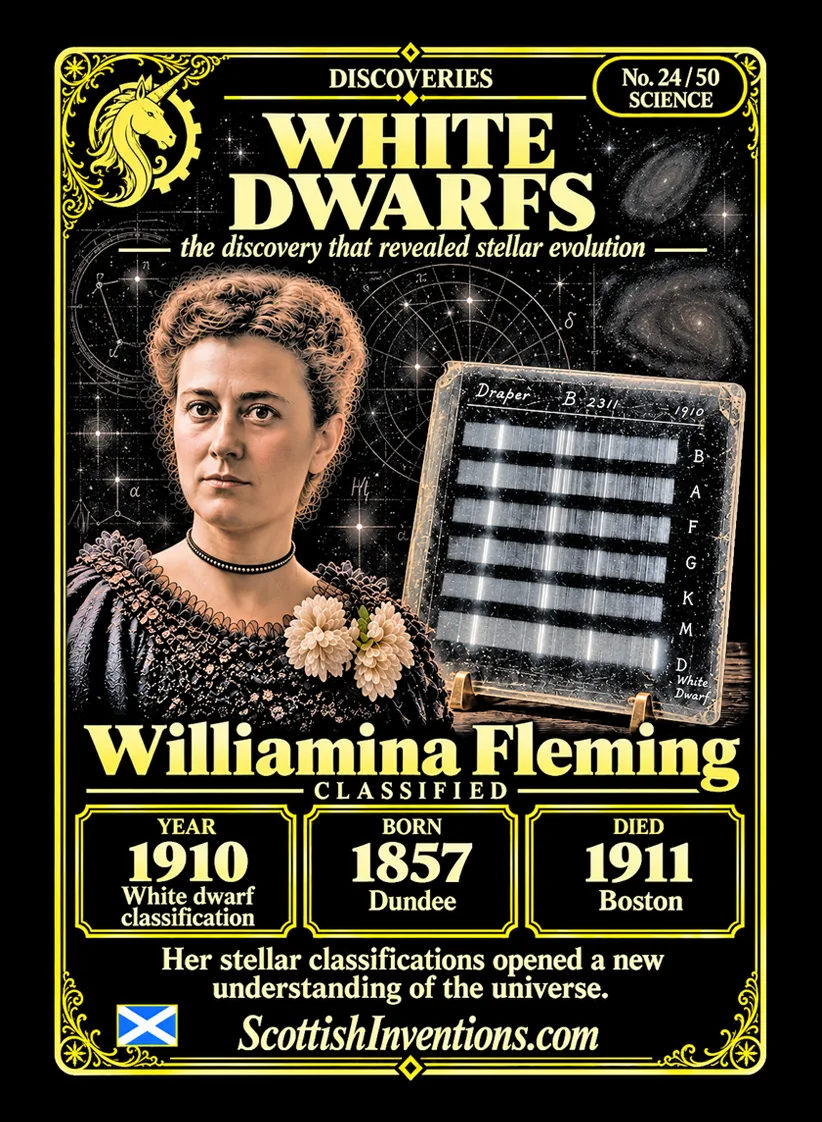
Williamina Fleming arrived in America abandoned and pregnant, took work as a housemaid, and ended by building the classification system that mapped the sky — and by spotting the star that became the first recognised white dwarf.
Williamina Fleming · 1857–191140 Eridani B classified · 1910Reading time · 17 minUpdated 12 August 2026
TL;DR
- Williamina Paton Stevens Fleming (1857–1911), born in Dundee, rose from being Edward Pickering's housemaid to one of the most important astronomical classifiers of the nineteenth century — discovering the Horsehead Nebula in 1888, cataloguing more than 10,000 stars, and providing the spectral classification of 40 Eridani B that made it the first-recognised white dwarf.
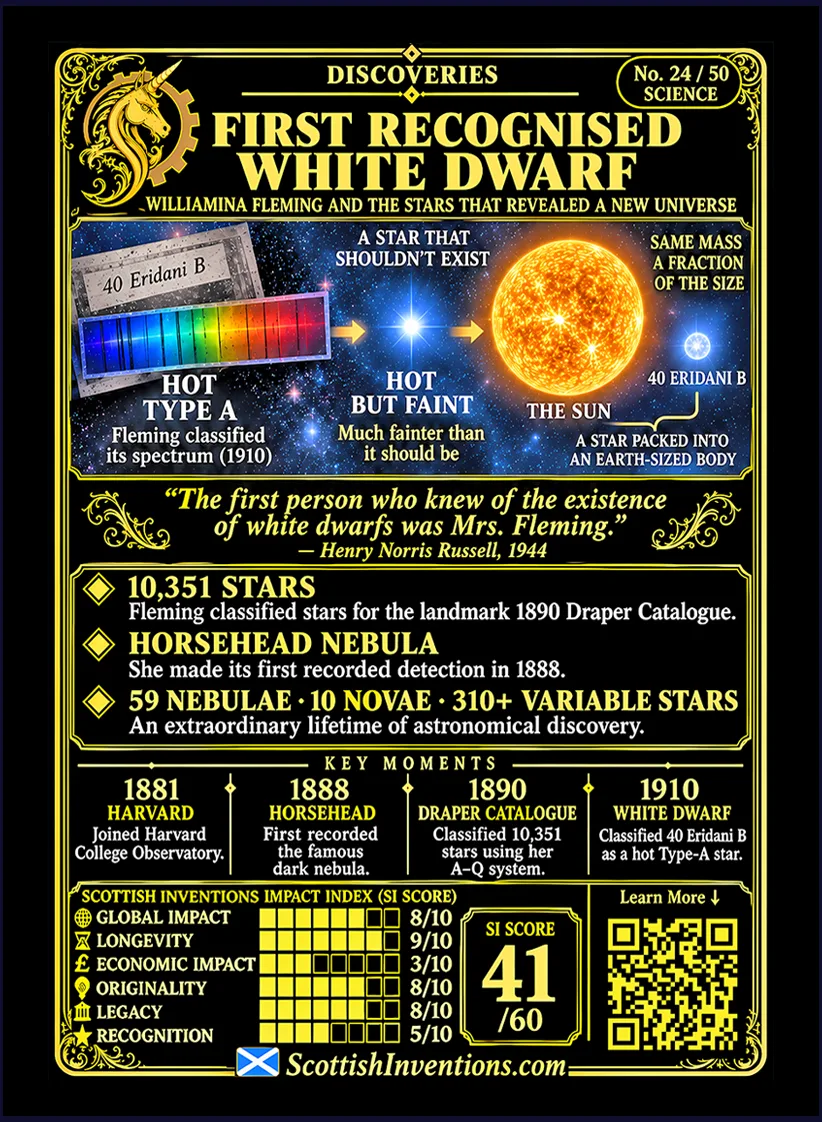
- Her "discovery of the white dwarf" needs careful framing. In 1910 Fleming classified the faint star 40 Eridani B as a hot, blue-white type-A star — an anomaly that Henry Norris Russell recognised implied an extraordinarily dense object. The term "white dwarf" was not coined until 1922, eleven years after her death.
- Fleming built the first practical stellar classification system, the Pickering–Fleming system, A through Q — the direct ancestor of the OBAFGKM sequence still taught today — all while paid roughly half a man's wage.
Scottish Impact Index (SI Score)
- Global Impact
- 8/10
- Longevity
- 9/10
- Economic / Material Impact
- 3/10
- Originality / Distinctiveness
- 8/10
- Legacy (Built Upon)
- 8/10
- Recognition
- 5/10
Key Findings
- Born in Dundee, 15 May 1857, at 86 Nethergate, one of nine children of Robert Stevens, a carver and gilder, and Mary Walker. She became a pupil-teacher at 14, married James Orr Fleming in Dundee on 26 May 1877 and emigrated to Boston in 1878; her husband abandoned her while she was pregnant.
- Hired at Harvard College Observatory in 1881 by Edward Charles Pickering, after working as his family's maid. She became a founding member of the "Harvard Computers"; female computers earned 25 to 50 cents an hour, about half what a man would have been paid.
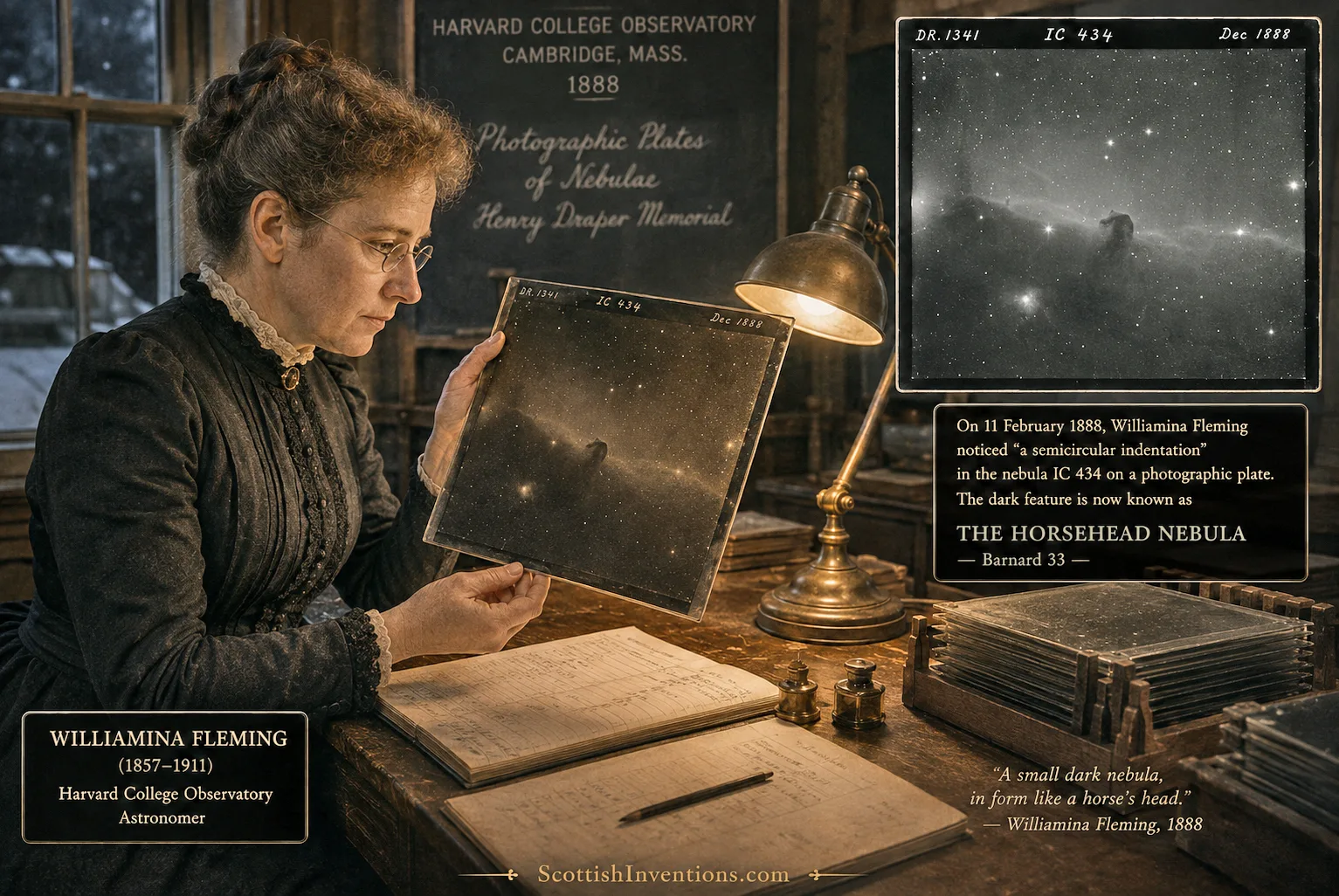
- Discovered the Horsehead Nebula in 1888 on Harvard photographic plate B2312, describing "a semicircular indentation" in the bright nebula IC 434 south of Zeta Orionis.
- Built the first practical photographic stellar classification system, classifying stars A through Q by the strength of their hydrogen absorption lines, and classified 10,351 stars for the 1890 Draper Catalogue of Stellar Spectra. Her scheme was later refined by Annie Jump Cannon into OBAFGKM.
- Provided the type-A classification of 40 Eridani B in 1910, the spectral measurement that led Russell and Pickering to recognise the first white dwarf.
- Appointed Curator of Astronomical Photographs in 1898 — the first woman to hold such a Harvard title — and elected an honorary member of the Royal Astronomical Society in 1906.
- She discovered 59 gaseous nebulae, 10 novae and over 310 variable stars. A lunar crater, Fleming, and asteroid 5747 Williamina are named for her.
Quick Facts
- Contribution
- The 1910 spectral classification of 40 Eridani B as type A — the observation that led to the first recognised white dwarf
- Key figure
- Williamina Paton Stevens Fleming (1857–1911)
- Born
- 86 Nethergate, Dundee, 15 May 1857
- Died
- Boston, Massachusetts, 21 May 1911, of pneumonia, aged 54
- Hired at Harvard
- 1881, by Edward Charles Pickering — after working as his family's maid
- Stars classified
- 10,351 in the 1890 Draper Catalogue of Stellar Spectra
- Classification scheme
- Letters A through Q, ordered by hydrogen absorption line strength — ancestor of OBAFGKM
- Horsehead Nebula
- Detected in 1888 on Harvard plate B2312, near Zeta Orionis
- Other finds
- 59 gaseous nebulae, 10 novae, over 310 variable stars
- Harvard title
- Curator of Astronomical Photographs, 1898 — the first woman to hold such a title
- Pay
- 25–50 cents an hour as a computer; about $1,500 a year as curator, against up to $2,500 for comparable male roles
- The term 'white dwarf'
- Coined by Willem Luyten in 1922 — eleven years after Fleming's death
- Claim status
- Shared attribution — Fleming classified; Russell and Pickering recognised the anomaly
Early Life in Dundee
Williamina Paton Stevens was born on 15 May 1857 at 86 Nethergate, Dundee, one of nine children. Her father, Robert Stevens, ran a carving and gilding business well known for its picture frames, and was among the first in Dundee to experiment with photography — a poignant detail, given his daughter's later life spent reading photographic plates of the sky. Robert died when Williamina was seven, and the family fell on hard times.
She was clearly gifted. Educated in Dundee's public schools, she became a pupil-teacher at the age of fourteen, teaching while continuing her own studies — a substantial education for a girl of her era and class. On 26 May 1877, aged twenty, she married James Orr Fleming, an accountant and widower some sixteen years her senior. In 1878 the couple emigrated to Boston, Massachusetts. Shortly after arriving, James abandoned her, leaving her pregnant and destitute in a new country. Her son, Edward Pickering Fleming, was born on 6 October 1879. To support herself and her child, she took work as a maid in the household of Professor Edward Charles Pickering.
Harvard and Edward Pickering
The famous story — that Pickering, exasperated by his male assistants' sloppy work, declared that his Scottish maid could do better — is frequently repeated but is regarded by historians as at least partly apocryphal. What is documented is that Pickering's wife Elizabeth recognised Fleming's talents, and that from 1881 Pickering employed her at the Harvard College Observatory, teaching her to analyse stellar spectra.
This was the dawn of a revolution. Photography had transformed astronomy: rather than squinting through an eyepiece, astronomers could now capture the spectra of hundreds of stars on a single glass plate using an objective prism, then study them by daylight at leisure. The problem was scale — there was far more data than there were people to analyse it. Pickering's solution was to hire women as "computers", the human calculators and classifiers who processed the plates. The group — later dubbed the Harvard Computers — grew to more than eighty women over Pickering's tenure and included Annie Jump Cannon, Henrietta Swan Leavitt and Antonia Maury. As Smithsonian Magazine records, they were "putting in six-day weeks poring over photographs, and earning 25 to 50 cents an hour (half what a man would have been paid)."
Fleming began with clerical and copying work and rose to become the observatory's leading classifier and, eventually, a manager supervising a dozen or more women.
The Pickering–Fleming System
When Mary Anna Draper endowed the Henry Draper Memorial in 1886 to fund the systematic photography and classification of stellar spectra, Fleming was placed in charge of the project. The existing system — Angelo Secchi's five visual classes — was too crude for the detail visible on the new photographs. Fleming devised a new scheme, subdividing Secchi's classes and assigning each a letter of the alphabet, A through Q, ordered principally by the strength of the hydrogen absorption lines in each spectrum, with type A having the strongest. The letter Q was used for spectra that fitted no other category.
This became the basis for the first Draper Catalogue of Stellar Spectra, published in 1890, containing spectral classifications for 10,351 stars — the majority classified by Fleming herself. It is important to be honest about the collaborative nature of the work: Pickering directed the overall project and is often credited as author, and the system is sometimes called the "Pickering–Fleming system". But the practical classification labour, and much of the scheme's design, was Fleming's.
Her system was empirical and had a flaw: the alphabetical order did not produce a smooth physical sequence. Antonia Maury and then Annie Jump Cannon refined it, dropping most letters and reordering the survivors into the now-famous O, B, A, F, G, K, M sequence, which turned out to track stellar surface temperature. Cannon's system, applied in the full Henry Draper Catalogue published 1918–1924 — classifying 225,300 stars, later extended to 359,083 — remains the foundation of stellar classification today.
The Horsehead Nebula (1888)
In 1888, examining a plate designated B2312 — taken in early February 1888 with the 8-inch Bache telescope in Cambridge, in a photograph associated with Pickering's brother William Henry Pickering — Fleming noticed something unusual near Orion's Belt. She described "a semicircular indentation" in the bright nebulosity, later catalogued as IC 434, south of Zeta Orionis. This was the first recorded detection of what we now call the Horsehead Nebula (Barnard 33), a dark cloud of dust silhouetted against glowing gas roughly 1,500 light-years away in Orion.
Fleming was not initially credited. When J. L. E. Dreyer compiled the first Index Catalogue in 1895, he attributed the Harvard discoveries simply to "Pickering". By the second Index Catalogue in 1908, Harvard's women were prominent enough to receive proper credit for later discoveries — but the Horsehead attribution was never fully corrected in that era. Today the Horsehead is among the most photographed and iconic objects in all of astronomy.
40 Eridani B — The Claim, Handled Carefully
This is the claim most often garbled, so precision matters.
The star. 40 Eridani B — also written Omicron² Eridani B, or o² Eri B — is a component of a triple star system about 16.3 light-years away in Eridanus. It is a white dwarf of apparent magnitude about 9.5, with roughly 57% of the Sun's mass packed into a body only about 1.4% of the Sun's radius, a little larger than Earth, and an effective temperature near 16,500–17,000 K. Its modern spectral type is DA2.9. It is the second-brightest white dwarf and by far the easiest to observe, because unlike the companions of Sirius and Procyon it is not drowned out by a dazzling primary.
The observation history. The B/C pair was first resolved by William Herschel on 31 January 1783, and observed again by Friedrich Struve in 1825 and Otto Struve in 1851. None of them recognised anything strange about it.
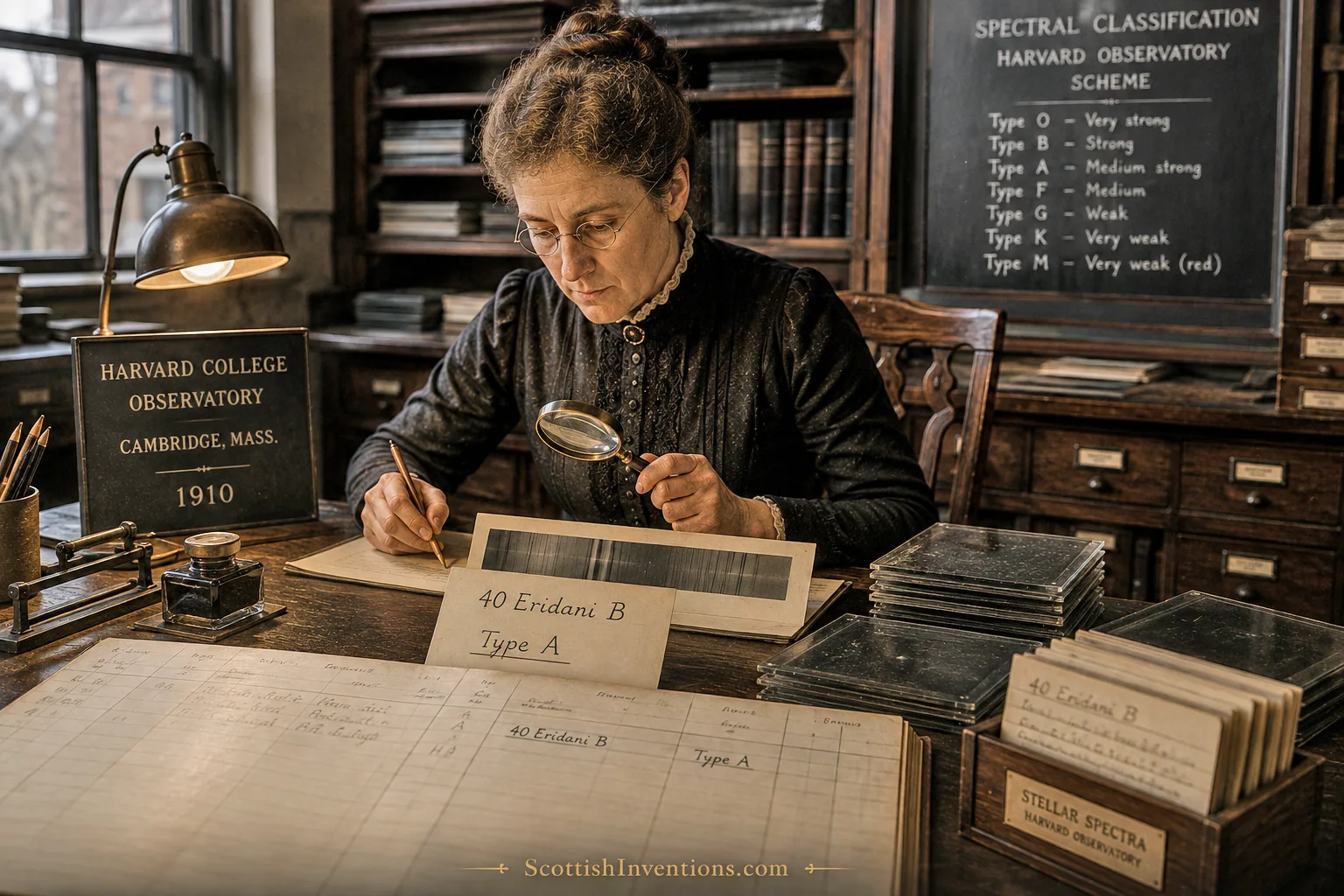
What Fleming actually did. In 1910 the American astronomer Henry Norris Russell was measuring stellar parallaxes — distances — and found 40 Eridani B to be intrinsically very faint. Pickering offered to have the Harvard plates checked. As Russell recounted decades later, Pickering telephoned Mrs Fleming, who reported within an hour or so that the star's spectrum was Class A: hot and blue-white. This was the puzzle. An A-type star should be luminous, yet this one was extremely faint. The only resolution was that the star had to be extraordinarily small and dense. Fleming's specific contribution, then, was the precise spectral classification — identifying 40 Eridani B as anomalously hot for so faint a star. She did not, and could not, describe it as a "white dwarf".
Who recognised the anomaly, and when. The realisation of the physical implication — that here was a new class of tiny, dense star — belongs to Russell, with Pickering, around 1910. In his 1944 note "Notes on White Dwarfs and Small Companions" in The Astronomical Journal (vol. 51, pp. 13–17), Russell recalled that he was "puzzled" and "crestfallen" at the discrepancy, and that "Pickering smiled and said, 'It is just such discrepancies which lead to the increase of our knowledge.'" In the same note, Russell wrote: "The first person who knew of the existence of white dwarfs was Mrs. Fleming; the next two, an hour or so later, Professor E. C. Pickering and I."
A note of caution. Some popular sources state that "in 1910 Fleming published her discovery of white dwarf stars." This appears to be a distortion. There is no 1910 publication by Fleming announcing white dwarfs; the concept and the term did not yet exist. The episode is known chiefly through Russell's 1944 recollection. What is accurate is that Fleming's 1910 spectral classification was the observational key that unlocked the eventual identification.
Sirius B, for comparison. Sirius B, the companion of the brightest star in the sky, was first seen by Alvan Graham Clark on 31 January 1862. But its true nature was not understood until Walter Adams obtained its spectrum at Mount Wilson in 1915, finding it hot and white like 40 Eridani B — thereby confirming a whole new class of underluminous stars. In terms of which white dwarf was recognised first in the historical record, 40 Eridani B (1910) preceded Sirius B (1915).
The term. "White dwarf" was coined by Willem Luyten in 1922, to describe these faint, hot, white A-type stars. Before that, astronomers had no single term — they spoke of anomalous or "subluminous" faint stars with early-type spectra. The theoretical understanding — degenerate electron-gas matter, from Fowler in 1926, and later the Chandrasekhar mass limit — came later still. Fleming, who died in 1911, never heard the words "white dwarf".
Other Discoveries and Honours
Across her career Fleming discovered 59 gaseous nebulae, 10 novae, and over 310 variable stars — she published a list of 222 in her 1907 study. She also established the first photographic standards of stellar magnitude. She published the Draper Catalogue of Stellar Spectra (1890), A Photographic Study of Variable Stars (1907), Spectra and Photographic Magnitudes of Stars in Standard Regions (1911), and, posthumously, "Stars Having Peculiar Spectra" (1912).
In 1898 the Harvard Corporation appointed her Curator of Astronomical Photographs — the first woman to hold such a title at Harvard. In 1906 she was elected an honorary member of the Royal Astronomical Society of London, the first American woman so honoured; women could not be elected full Fellows until 14 January 1916. Shortly before her death she received the Guadalupe Almendaro medal of the Astronomical Society of Mexico. A lunar crater, Fleming — on the Moon's far side, shared with Alexander Fleming and named by the IAU in 1970 — and the asteroid 5747 Williamina bear her name.
Pay, Character and Her Own Words
Fleming raised her son Edward alone, putting him through MIT. Her diary, quoted from her 1900 journal, records her frustration over pay. After raising the subject with Pickering, she wrote: "I am immediately told that I receive an excellent salary as women's salaries stand… Does he ever think that I have a home to keep and a family to take care of as well as the men?… And this is considered an enlightened age!" Her annual salary as a senior computer and curator was $1,500 around 1900 — while equivalent male roles at the observatory could earn up to $2,500.
She examined an enormous number of plates over her career, and her reputation as a strict, exacting supervisor lived after her. She became a US citizen in 1907, listing her occupation as "astronomer" — as does her gravestone in Mount Auburn Cemetery, Cambridge. She died of pneumonia in Boston on 21 May 1911, aged 54. She was one of eleven women charter members of the American Astronomical Society, and was succeeded as curator by her protégée, Annie Jump Cannon.
Legacy
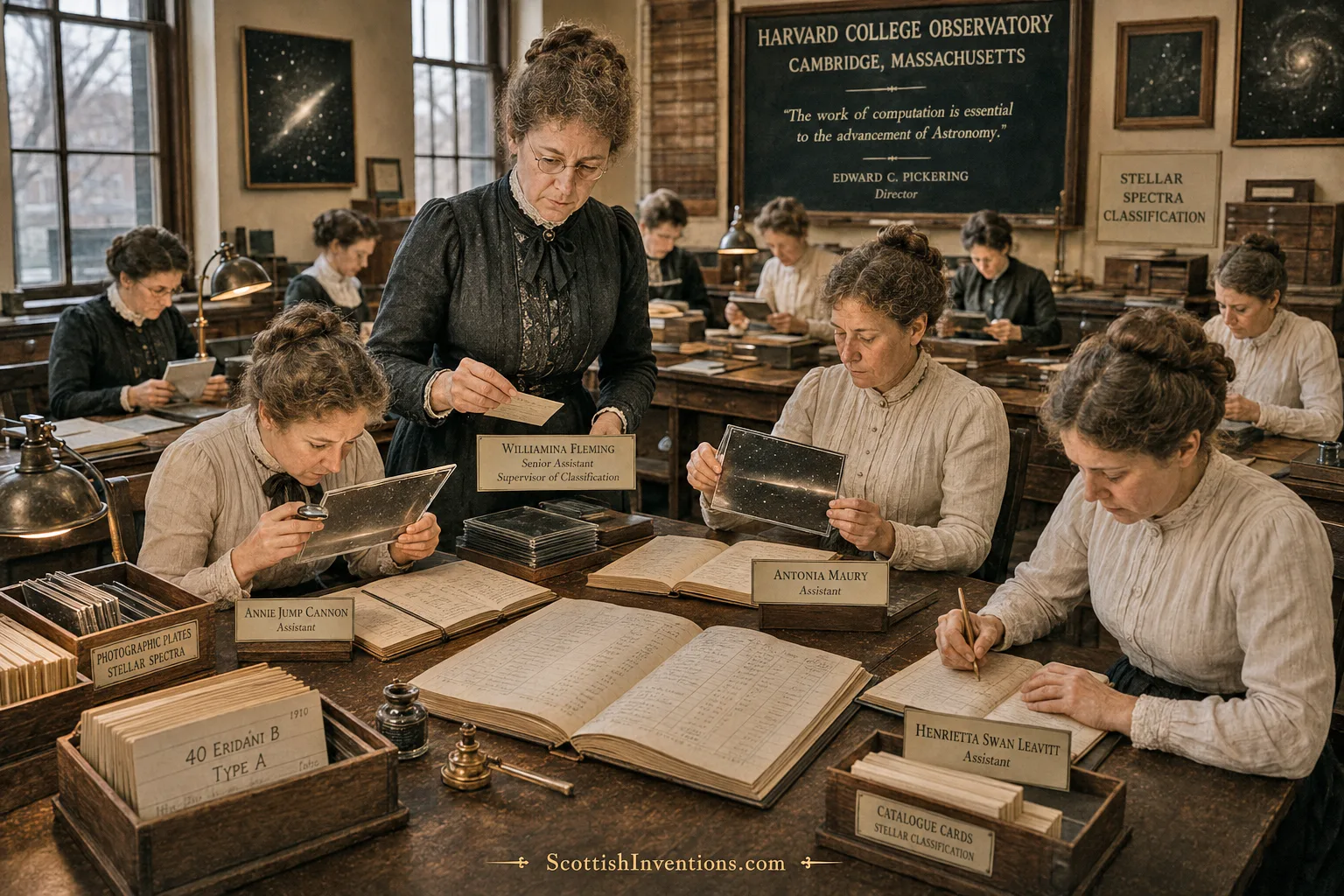
Fleming's classification work is the direct ancestor of the system astronomers use today. The Harvard scheme she helped build evolved through Cannon into the OBAFGKM sequence and ultimately the modern MK system. The Henry Draper Catalogue's HD numbers remain in daily use for identifying stars — Sirius, for instance, is HD 48915. The broader Harvard Computers programme she helped anchor produced Henrietta Swan Leavitt's period–luminosity relation for Cepheid variables, which gave astronomers their first reliable cosmic yardstick and, later, made possible the measurement of the expanding universe.
Fleming also did something less quantifiable but just as important: she demonstrated, in an age that doubted it, that a woman could perform rigorous, front-rank scientific analysis. She used her platform to say so — at the 1893 World's Fair in Chicago she delivered "A Field for Woman's Work in Astronomy", arguing that with real opportunities women could become men's equals in the discipline.
Scotland can rightly claim her. Born and educated in Dundee, she carried a hard-won education across the Atlantic and turned adversity into one of the most productive careers in the history of astronomy — while the institution that employed her paid her half a man's wage for it.
Timeline
1857
Williamina Paton Stevens born at 86 Nethergate, Dundee, 15 May
One of nine children of Robert Stevens, a carver and gilder, and Mary Walker
c.1864
Her father dies when she is seven
The family falls on hard times
1871
Becomes a pupil-teacher at 14
Teaching while continuing her own studies in Dundee's public schools
26 May 1877
Marries James Orr Fleming in Dundee
An accountant and widower some sixteen years her senior
1878
Emigrates to Boston, Massachusetts
Shortly after arriving, her husband abandons her — pregnant and destitute
6 Oct 1879
Her son Edward Pickering Fleming is born
She takes work as a maid in the household of Professor Edward Charles Pickering
1881
Hired at Harvard College Observatory
Pickering's wife Elizabeth recognised her talents; Pickering teaches her to analyse stellar spectra
1886
Mary Anna Draper endows the Henry Draper Memorial
Fleming is placed in charge of the systematic photography and classification project
1888
Detects the Horsehead Nebula on plate B2312
'A semicircular indentation' in the bright nebulosity later catalogued as IC 434, south of Zeta Orionis
1890
The Draper Catalogue of Stellar Spectra published
10,351 stars classified A through Q; the majority by Fleming herself
1893
Delivers 'A Field for Woman's Work in Astronomy' at the Chicago World's Fair
Argues that with real opportunities women could become men's equals in the discipline
1895
Dreyer's first Index Catalogue attributes Harvard discoveries to 'Pickering'
Fleming is not credited for the Horsehead
1898
Appointed Curator of Astronomical Photographs by the Harvard Corporation
The first woman to hold such a title at Harvard
1900
Her diary records her frustration over pay
'Does he ever think that I have a home to keep and a family to take care of as well as the men?'
1906
Elected an honorary member of the Royal Astronomical Society
The first American woman so honoured; women could not be elected full Fellows until 14 January 1916
1907
Publishes A Photographic Study of Variable Stars
Includes a list of 222 variables; she becomes a US citizen the same year, listing her occupation as 'astronomer'
1910
Classifies 40 Eridani B as spectral type A
Russell, measuring parallaxes, had found it intrinsically very faint; Pickering telephoned Fleming, who reported back within an hour or so
1911
Dies of pneumonia in Boston, 21 May, aged 54
Succeeded as curator by her protégée Annie Jump Cannon
1915
Walter Adams obtains the spectrum of Sirius B at Mount Wilson
Hot and white like 40 Eridani B — confirming a whole new class of underluminous stars
1918–24
Cannon's full Henry Draper Catalogue published
225,300 stars, later extended to 359,083, on the OBAFGKM sequence descended from Fleming's scheme
1922
Willem Luyten coins the term 'white dwarf'
Eleven years after Fleming's death
1944
Russell publishes 'Notes on White Dwarfs and Small Companions'
The Astronomical Journal 51: 13–17 — the recollection through which the 1910 episode is known
Myths & Facts
Myth: Williamina Fleming discovered white dwarf stars.
Fact: She classified 40 Eridani B as spectral type A in 1910. Russell, with Pickering, recognised what that implied — a tiny, extraordinarily dense star. The term 'white dwarf' was coined by Willem Luyten in 1922, eleven years after Fleming died. The accurate formulation is that she provided the classification that led to the first recognised white dwarf.
Myth: Fleming published her discovery of white dwarfs in 1910.
Fact: No such publication exists. This distortion is repeated widely, including on Wikipedia. The episode survives through Henry Norris Russell's 1944 note in The Astronomical Journal, not through any 1910 paper of Fleming's.
Myth: Pickering hired her after declaring his Scottish maid could do better than his assistants.
Fact: A good story, and frequently repeated, but historians regard it as at least partly apocryphal. What is documented is that Pickering's wife Elizabeth recognised Fleming's talents, and that Pickering employed her at the observatory from 1881.
Myth: She worked alone.
Fact: She worked at the head of a team and within one. The Harvard Computers numbered more than eighty women over Pickering's tenure, including Annie Jump Cannon, Henrietta Swan Leavitt and Antonia Maury, and Fleming eventually supervised a dozen or more of them. Her stature grows, not shrinks, when the team is named.
Myth: Her novae were supernovae.
Fact: They were novae. Object counts also vary between sources — 52 versus 59 nebulae, for example. The most commonly cited figures, from the Cannon obituary, are 59 gaseous nebulae, 10 novae and over 310 variable stars.
Myth: The OBAFGKM sequence was Fleming's.
Fact: Fleming's scheme ran A through Q, ordered by hydrogen line strength. Maury and then Cannon reordered it into the temperature sequence OBAFGKM. Fleming built the first practical photographic classification system; Cannon built the one still taught.
Myth: Williamina Fleming was related to Alexander Fleming.
Fact: She was not. They are two unrelated Scots who happen to share a surname, and the collection contains both. The lunar crater Fleming honours them jointly, which does not help.
Did You Know?
- Fleming arrived in America as an abandoned, pregnant immigrant working as a maid — and went on to discover the Horsehead Nebula and help classify the heavens.
- She discovered the Horsehead Nebula in 1888 from a single glass photographic plate; it is now one of the most iconic images in astronomy.
- She was paid 25 to 50 cents an hour at Harvard, about half a man's wage; even as curator her $1,500 salary trailed the up-to-$2,500 paid for comparable male roles.
- She classified over 10,000 stars for the Henry Draper survey — 10,351 in the 1890 catalogue.
- The term 'white dwarf' wasn't coined until 1922, by Willem Luyten, eleven years after Fleming died — yet her 1910 spectral classification of 40 Eridani B made the identification possible.
- She was elected an honorary member of the Royal Astronomical Society in 1906; women couldn't become full Fellows until 1916.
- Her father was among the first in Dundee to experiment with photography — the medium his daughter would spend her life reading.
Honest Caveats
The "my maid could do better" anecdote is likely apocryphal. It is presented here as legend, not as documented fact.
"Fleming discovered or published white dwarfs in 1910" is a popular distortion, repeated even on Wikipedia. The accurate account is that she classified 40 Eridani B's spectrum as type A, and Russell recognised the anomaly. The episode is documented via Russell's 1944 Astronomical Journal note, not a 1910 Fleming paper.
Object counts vary slightly between sources — 52 versus 59 nebulae, for example — and her novae are occasionally mislabelled "supernovae". The most commonly cited figures, from the Cannon obituary, are 59 gaseous nebulae, 10 novae and over 310 variable stars.
Her appointment as curator is dated 1898 by the Harvard Corporation records and 1899 by some biographies; 1898 is the better-sourced date.
The lunar crater Fleming honours both Williamina and Alexander Fleming jointly, which is a frequent source of confusion between two unrelated Scots.
Frequently Asked Questions
Did Williamina Fleming discover white dwarf stars?
No, and this collection will not put it that way. What she did was supply the crucial observation. In 1910 the American astronomer Henry Norris Russell was measuring stellar parallaxes and found 40 Eridani B to be intrinsically very faint. Pickering offered to have the Harvard plates checked, telephoned Mrs Fleming, and she reported back within an hour or so that the star's spectrum was Class A — hot and blue-white. That was the puzzle: an A-type star should be luminous, yet this one was extremely faint, and the only resolution was that it had to be extraordinarily small and dense. Fleming's contribution was the precise spectral classification. She did not, and could not, describe it as a 'white dwarf' — the term did not exist.
When was the term 'white dwarf' coined?
In 1922, by Willem Luyten, to describe these faint, hot, white A-type stars. Before that, astronomers had no single term and spoke of anomalous or 'subluminous' faint stars with early-type spectra. The theoretical understanding — degenerate electron-gas matter, worked out by Fowler in 1926, and later the Chandrasekhar mass limit — came later still. Fleming died in 1911 and never heard the words 'white dwarf'.
So who recognised the anomaly?
Russell, with Pickering, around 1910. In his 1944 note 'Notes on White Dwarfs and Small Companions' in The Astronomical Journal (vol. 51, pp. 13–17), Russell recalled that he was 'puzzled' and 'crestfallen' at the discrepancy, and that 'Pickering smiled and said, "It is just such discrepancies which lead to the increase of our knowledge."' In the same note Russell wrote: 'The first person who knew of the existence of white dwarfs was Mrs. Fleming; the next two, an hour or so later, Professor E. C. Pickering and I.' That sentence is the fairest summary of her role — and note that it is Russell's phrasing in 1944, looking back with terminology that did not exist in 1910.
Is there a 1910 Fleming paper announcing white dwarfs?
No. Some popular sources state that 'in 1910 Fleming published her discovery of white dwarf stars'. This appears to be a distortion. There is no 1910 publication by Fleming announcing white dwarfs; the concept and the term did not yet exist. The episode is known chiefly through Russell's 1944 recollection. What is accurate is that Fleming's 1910 spectral classification was the observational key that unlocked the eventual identification.
What is 40 Eridani B?
Also written Omicron² Eridani B or o² Eri B, it is a component of a triple star system about 16.3 light-years away in Eridanus. It is a white dwarf of apparent magnitude about 9.5, with roughly 57% of the Sun's mass packed into a body only about 1.4% of the Sun's radius — a little larger than Earth — and an effective temperature near 16,500–17,000 K. Its modern spectral type is DA2.9. It is the second-brightest white dwarf and by far the easiest to observe, because unlike the companions of Sirius and Procyon it is not drowned out by a dazzling primary.
Was 40 Eridani B the first white dwarf ever seen?
Seen, no; recognised, effectively yes. The B/C pair was first resolved by William Herschel on 31 January 1783 and observed again by Friedrich Struve in 1825 and Otto Struve in 1851 — none of whom recognised anything strange about it. Sirius B was first seen by Alvan Graham Clark on 31 January 1862, but its true nature was not understood until Walter Adams obtained its spectrum at Mount Wilson in 1915. In terms of which white dwarf was recognised first in the historical record, 40 Eridani B (1910) preceded Sirius B (1915).
How did a Dundee maid end up at Harvard College Observatory?
By an unlikely route. She emigrated to Boston with her husband in 1878; he abandoned her shortly after they arrived, leaving her pregnant and destitute, and she took work as a maid in Edward Pickering's household to support herself and her son. The famous story — that Pickering, exasperated by his male assistants' sloppy work, declared that his Scottish maid could do better — is frequently repeated but is regarded by historians as at least partly apocryphal. What is documented is that Pickering's wife Elizabeth recognised Fleming's talents, and that from 1881 Pickering employed her at the observatory and taught her to analyse stellar spectra.
Who were the Harvard Computers?
Photography had transformed astronomy: rather than squinting through an eyepiece, astronomers could capture the spectra of hundreds of stars on a single glass plate using an objective prism, then study them by daylight at leisure. The problem was scale — far more data than people to analyse it. Pickering's solution was to hire women as 'computers', the human calculators and classifiers who processed the plates. The group grew to more than eighty women over his tenure and included Annie Jump Cannon, Henrietta Swan Leavitt and Antonia Maury. As Smithsonian Magazine records, they were 'putting in six-day weeks poring over photographs, and earning 25 to 50 cents an hour (half what a man would have been paid).'
What was the Pickering–Fleming classification system?
When Mary Anna Draper endowed the Henry Draper Memorial in 1886, Fleming was placed in charge of the project. Angelo Secchi's five visual classes were too crude for the detail visible on the new photographs, so Fleming devised a new scheme, subdividing Secchi's classes and assigning each a letter of the alphabet, A through Q, ordered principally by the strength of the hydrogen absorption lines — type A having the strongest. Q was used for spectra that fitted no other category. It is important to be honest about the collaborative nature of the work: Pickering directed the overall project and is often credited as author, which is why the system is sometimes called the Pickering–Fleming system. But the practical classification labour, and much of the scheme's design, was Fleming's.
How did her system become OBAFGKM?
Her scheme was empirical and had a flaw: the alphabetical order did not produce a smooth physical sequence. Antonia Maury and then Annie Jump Cannon refined it, dropping most letters and reordering the survivors into the now-famous O, B, A, F, G, K, M sequence, which turned out to track stellar surface temperature. Cannon's system, applied in the full Henry Draper Catalogue published in 1918–1924 — 225,300 stars, later extended to 359,083 — remains the foundation of stellar classification today.
Did she really discover the Horsehead Nebula?
Yes. In 1888, examining plate B2312 — taken in early February 1888 with the 8-inch Bache telescope in Cambridge, in a photograph associated with Pickering's brother William Henry Pickering — she noticed something unusual near Orion's Belt and described 'a semicircular indentation' in the bright nebulosity later catalogued as IC 434, south of Zeta Orionis. That was the first recorded detection of what we now call the Horsehead Nebula, Barnard 33, a dark cloud of dust silhouetted against glowing gas roughly 1,500 light-years away.
Was she credited for it at the time?
Not initially. When J. L. E. Dreyer compiled the first Index Catalogue in 1895, he attributed the Harvard discoveries simply to 'Pickering'. By the second Index Catalogue in 1908, Harvard's women were prominent enough to receive proper credit for later discoveries — but the Horsehead attribution was never fully corrected in that era. Today the Horsehead is among the most photographed and iconic objects in all of astronomy.
What did she say about her pay?
Her 1900 journal records her frustration directly. After raising the subject with Pickering, she wrote: 'I am immediately told that I receive an excellent salary as women's salaries stand… Does he ever think that I have a home to keep and a family to take care of as well as the men?… And this is considered an enlightened age!' Her annual salary as a senior computer and curator was $1,500 around 1900, while equivalent male roles at the observatory could earn up to $2,500.
Which Fleming is this? The collection has more than one.
Three, in fact, and they are unrelated. Williamina Fleming is the Dundee-born astronomer of this card. Sir Alexander Fleming appears in the collection for penicillin and for lysozyme. There is no family connection between them. Confusingly, the lunar crater Fleming honours both Williamina and Alexander jointly — it was named by the IAU in 1970 and sits on the Moon's far side. The asteroid 5747 Williamina is hers alone.
Sources & Further Reading
Tier 1 · Primary
- Fleming, W. P. S. — Draper Catalogue of Stellar Spectra, Harvard College Observatory, 1890.
- Fleming, W. P. S. — A Photographic Study of Variable Stars, 1907.
- Fleming, W. P. S. — Spectra and Photographic Magnitudes of Stars in Standard Regions, 1911.
- Fleming, W. P. S. — "Stars Having Peculiar Spectra," published posthumously, 1912.
- Fleming, W. P. S. — journal entry, 1900, on salary and workload.
- Fleming, W. P. S. — "A Field for Woman's Work in Astronomy," World's Columbian Exposition, Chicago, 1893.
- Russell, H. N. — "Notes on White Dwarfs and Small Companions," The Astronomical Journal 51 (1944): 13–17.
Tier 2 · Scholarly and institutional
- Cannon, A. J. — obituary of Williamina Fleming, the source of the 59 nebulae / 10 novae / 310+ variables figures.
- Harvard College Observatory — plate archive records, including plate B2312.
- Dreyer, J. L. E. — Index Catalogue (1895) and second Index Catalogue (1908), on attribution practice.
- Smithsonian Magazine — on the Harvard Computers and their pay.
- Royal Astronomical Society — records of honorary membership, 1906, and of the admission of women Fellows from 14 January 1916.
- IAU — lunar crater Fleming (named 1970) and asteroid 5747 Williamina.
Tier 3 · Site source document
docs/sources/discoveries/white-dwarf-stars.md— the commissioned source document underlying this article.
White Dwarf Stars · Card No. 24