Discoveries · No. 21 of 50 · Astronomy
Thomas Henderson and the Measurement of Stellar Parallax
A Dundee-born lawyer's clerk measured the distance to a star before anyone else alive — and then, by hesitating, let a German astronomer publish first. This is the honest, unvarnished version of that story.
Thomas Henderson · 1798–1844Cape of Good Hope, 1832–33Reading time · 15 minUpdated 1 August 2026
TL;DR
- Thomas Henderson (1798–1844), a Dundee-born, largely self-taught astronomer, observed Alpha Centauri repeatedly at the Royal Observatory, Cape of Good Hope, in 1832–33 and derived an annual parallax of roughly one arcsecond — meaning the star lay only a few light years away. This was one of the first measurements ever made of a star's true distance, solving a problem astronomers had chased for two thousand years.
- Henderson did not publish. He wanted confirming data first, from Lieutenant William Meadows, and by the time his paper appeared in January 1839, Friedrich Wilhelm Bessel had already published a secure parallax for the star 61 Cygni in December 1838. In science, priority belongs to publication, so Bessel — not Henderson — is credited as the discoverer of stellar parallax.
- Henderson measured first; Bessel published first. Both facts are true, and this page states them plainly, repeatedly and without spin. Henderson returned to Scotland in 1834 as the first Astronomer Royal for Scotland, rebuilt the Calton Hill observatory, and died in 1844, aged only forty-five.
Key Findings
- Stellar parallax — the tiny apparent shift of a nearby star against the distant background, caused by Earth's orbital motion — had been sought as decisive proof of heliocentrism since antiquity. Its near-invisibility (always under one arcsecond) was precisely why it took roughly two thousand years to detect.
- Henderson's 1832–33 Cape observations of Alpha Centauri produced a parallax of about one arcsecond, correctly implying it was one of the very nearest stars to the Sun — a result he judged provisional and withheld pending confirmation.
- Friedrich Wilhelm Bessel published the parallax of 61 Cygni in December 1838, months ahead of Henderson's January 1839 paper, and is credited with the first published stellar parallax. Friedrich Georg Wilhelm Struve's 1837 measurement of Vega's parallax also preceded Henderson's publication, though it later proved less securely established than Bessel's or Henderson's.
- Henderson's caution — waiting for Lieutenant William Meadows's confirming data — was scientifically responsible but cost him priority. This is a case study in how publication timing, not the moment of observation, determines who a discovery is credited to.
- Henderson became the first Astronomer Royal for Scotland in 1834, rebuilt the observing programme at Calton Hill in Edinburgh, and modern Gaia-era astrometry now fixes Alpha Centauri's distance at 4.37 light years — close to the ballpark Henderson's earlier, cruder measurement had already suggested.
Quick Facts
- Discovery
- First measurement (not first publication) of a star's annual parallax — Alpha Centauri
- Observations
- Royal Observatory, Cape of Good Hope, 1832–33
- Publication
- January 1839, Memoirs of the Royal Astronomical Society
- Key figure
- Thomas Henderson (1798–1844), born Dundee
- Rival claim
- Friedrich Wilhelm Bessel published the parallax of 61 Cygni in December 1838 — first to press
- Also earlier
- Friedrich Georg Wilhelm Struve measured Vega's parallax in 1837, though less securely
- Field
- Astronomy · Astrometry
- Born / died
- 28 December 1798, Dundee · 23 November 1844, Edinburgh
- Title
- First Astronomer Royal for Scotland, 1834; Regius Professor of Practical Astronomy, Edinburgh
- Claim status
- Disputed / shared — Henderson measured first, Bessel published first
- Modern figure
- Alpha Centauri distance: 4.37 light years (Gaia-era astrometry)
Scottish Impact Index (SI Score)
- Global Impact
- 8/10
- Longevity
- 9/10
- Economic / Material Impact
- 2/10
- Originality / Distinctiveness
- 7/10
- Legacy (Built Upon)
- 8/10
- Recognition
- 3/10
Who Was Thomas Henderson?
Thomas Henderson was born in Dundee on 28 December 1798, the son of a hosiery manufacturer. He had little formal scientific education. He trained instead as a lawyer's clerk and eventually a Writer to the Signet in Edinburgh, working for the eminent judge Lord Advocate Sir James Mackintosh and later a leading conveyancer. Astronomy was a private passion, pursued in whatever hours a busy legal career left him. He was largely self-taught in mathematics and observational technique, and he made a habit — unusual for an amateur — of correcting errors in the published work of professional astronomers, which slowly earned him a reputation in the small world of British astronomy.
That reputation was enough to secure him, in 1831, the post of His Majesty's Astronomer at the Royal Observatory, Cape of Good Hope — succeeding the observatory's first director, Fearon Fallows, who had died there. It was at the Cape, over little more than a year, that Henderson made the observations for which he is now remembered: a measurement of the annual parallax of Alpha Centauri, the closest naked-eye star system to the Sun. What he did with that result afterwards is the more instructive part of the story.
The Two-Thousand-Year Problem
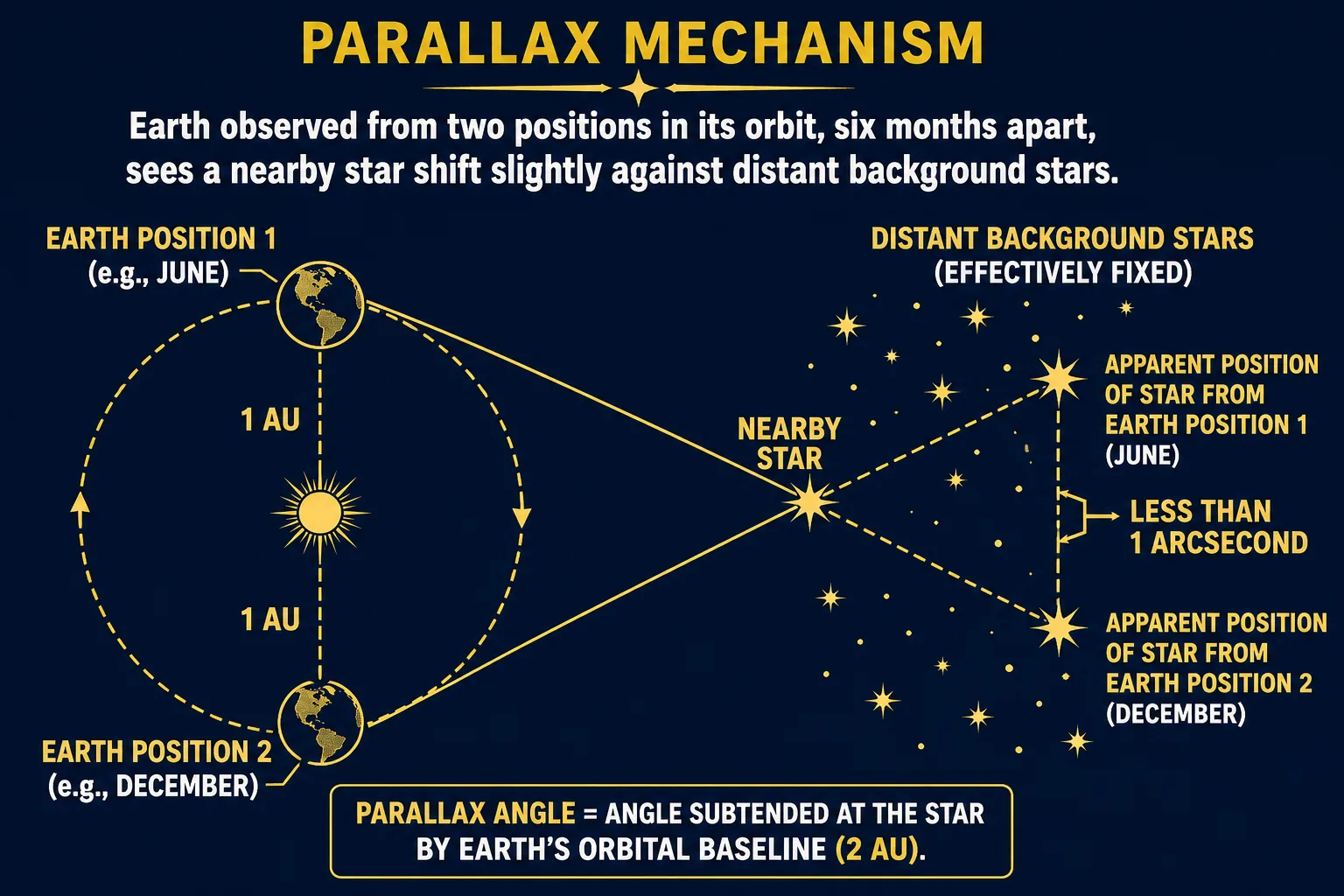
Stellar parallax is the apparent shift in a star's position, measured against far more distant background stars, produced purely by the Earth's own motion around the Sun. Observe a nearby star in January, and again in July from the opposite side of Earth's orbit, and it should appear to have shifted very slightly — the same effect that makes a nearby lamppost seem to jump against a distant skyline when you move your head from side to side. Measure the size of that shift, and simple trigonometry gives the star's distance.
Ancient astronomers understood the logic perfectly well. Aristarchus of Samos, around 270 BC, proposed that the Earth orbits the Sun; his contemporaries objected that if this were true, the stars ought to show a parallax shift, and none could be seen. That absence of observed parallax became the standard argument against a moving Earth for the better part of two millennia, cited seriously as late as the debates surrounding Copernicus and Galileo. The real problem, unknown to those ancient critics, was one of scale: the stars are so overwhelmingly far away that even the nearest of them shows a parallax angle of less than one arcsecond — a slice of sky roughly 1/3600th of a single degree, far beyond the resolving power of any instrument before the early nineteenth century.
By the 1830s, improvements in telescope optics, filar micrometers and, crucially, the discipline of repeated, systematic observation had finally brought that vanishingly small angle within reach. Three astronomers, working independently and almost simultaneously on three different stars, closed the case within about eighteen months of each other: Thomas Henderson on Alpha Centauri, Friedrich Georg Wilhelm Struve on Vega, and Friedrich Wilhelm Bessel on 61 Cygni. It is one of the more remarkable near-coincidences in the history of science, and it makes the question of exactly who gets credit unusually pointed.
The Cape of Good Hope, 1832–33
Henderson arrived at the Royal Observatory, Cape of Good Hope, in 1832, taking up a post that was poorly funded, thinly staffed and located in a climate that had already proved hard on his predecessor. Alpha Centauri was an obvious target: it is the brightest star system in the southern constellation Centaurus, visible only from southern latitudes, and its unusually large proper motion across the sky — the amount it shifts year on year relative to the background stars — had already led some astronomers to suspect it might be relatively close to the Sun. A large proper motion is a reasonable, if imperfect, hint that a star is nearby, and Henderson set out to test that hint directly.
Between April 1832 and May 1833, Henderson made repeated meridian and micrometer observations of Alpha Centauri's position, tracking the tiny periodic shift that parallax would produce as the Earth completed its orbit. Working through the data, he derived an annual parallax of roughly one arcsecond — a value that, however imprecise by later standards, correctly implied a distance of only a few light years, making Alpha Centauri one of the very closest stars to the Sun. It was a genuinely pioneering achievement, obtained with modest instruments at a badly resourced colonial outpost, and it came before any other astronomer had a comparable, secure result in hand for any star.
The Fatal Delay
Henderson's health, like that of his predecessor at the Cape, suffered under the post's demands, and he left the observatory in 1833 after just over a year, returning to Britain. Crucially, he did not publish his Alpha Centauri parallax before leaving. He regarded the result as provisional: the instruments at his disposal were imperfect, the observations difficult, and he wanted a check against independent data before committing a claim of this magnitude to print. That confirming data eventually came from Lieutenant William Meadows, who had continued observations at the Cape after Henderson's departure.
The decisive fact
It is worth being precise about what this delay was and was not. It was not negligence, and it was not a failure of scientific ability — if anything, it reflects a scrupulous, conservative approach to publishing an extraordinary claim. But it was, in the plainest sense, a missed opportunity. Had Henderson published in 1833 or 1834 on the strength of his Cape observations alone, the history of astronomy would very likely credit him as the discoverer of stellar parallax outright. He chose caution over speed, and the field moved on without him.
Bessel, Struve and the Race
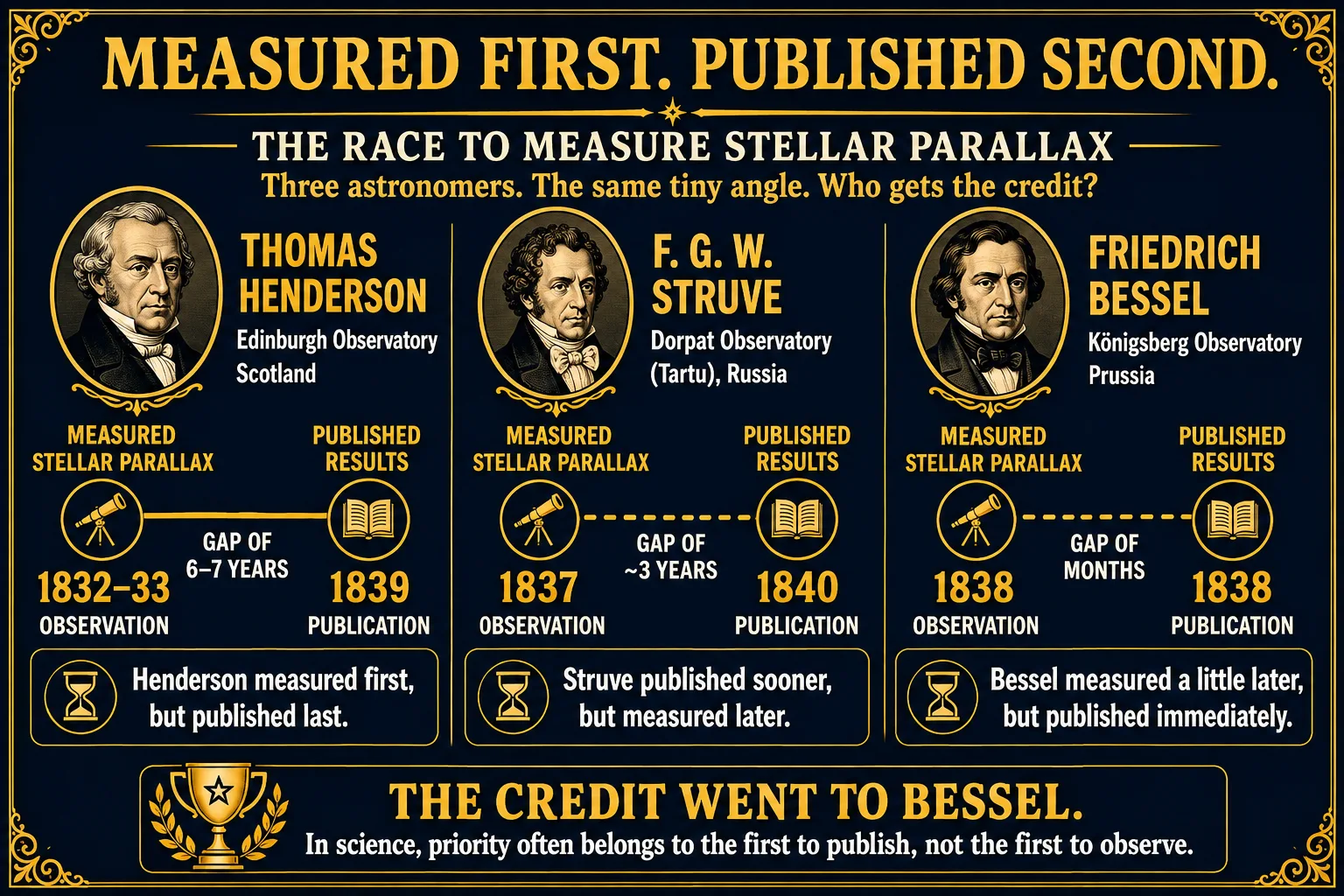
While Henderson sat on his Cape result, two continental astronomers were closing in on the same prize by different routes. Friedrich Georg Wilhelm Struve, director of the Dorpat Observatory in the Russian Empire (now Tartu, Estonia), announced a parallax measurement for the bright star Vega in 1837 — earlier than either Henderson's or Bessel's published results. Struve's figure, however, later proved to be considerably less accurate and less securely established than the other two, and it did not settle the question with the same authority.
Friedrich Wilhelm Bessel, director of the Königsberg Observatory in Prussia, took a different and more deliberate approach. Rather than chasing an unusually bright star, he selected 61 Cygni, a faint but obscure star already known for a conspicuously large proper motion — a strong indicator, as with Alpha Centauri, that it might be close to the Sun. Using a specialised instrument, the heliometer, Bessel made a long, methodical series of measurements and, in December 1838, published a parallax result for 61 Cygni that the astronomical community immediately accepted as rigorous and reliable. Bessel's paper appeared roughly one month before Henderson's, and it did so with a completeness and precision that left little room for doubt.
Henderson measured first. Bessel published first. In the practice of science, priority is awarded to publication — and so the discovery of stellar parallax is credited, correctly, to Bessel.
The Royal Astronomical Society itself, awarding Bessel its Gold Medal in 1841 for the 61 Cygni result, acknowledged the near-simultaneity of the three measurements. Modern historians of astronomy generally treat the matter the same way: Bessel is named as the discoverer of stellar parallax because his was the first complete, confirmed, published measurement; Henderson and Struve are credited with independent, essentially concurrent achievements that either preceded Bessel's observations in time (Henderson) or his publication (Struve), without displacing his priority.
Return to Edinburgh
Henderson's Cape posting, though scientifically productive, had been short and physically taxing. Back in Britain in 1833–34, his reputation as a careful and capable observer — reinforced by his Cape work even before its most significant result was published — led to his appointment in 1834 as the first Astronomer Royal for Scotland and Regius Professor of Practical Astronomy at the University of Edinburgh, a newly created position pairing an academic chair with responsibility for the City Observatory on Calton Hill.
It was a demanding role. The Calton Hill observatory Henderson inherited was under-equipped and its observing programme had lapsed; he spent much of the following decade rebuilding it into a working scientific institution, establishing a systematic programme of meridian observations of stars, the Sun, Moon and planets — the routine, unglamorous positional astronomy that underpins navigation, timekeeping and the broader astronomical catalogue of the day. It was against this backdrop, in January 1839, that he finally published his Alpha Centauri parallax, now bolstered by Lieutenant Meadows's confirming observations from the Cape.
Calton Hill and the Astronomer Royal for Scotland
The title Astronomer Royal for Scotland — distinct from the Astronomer Royal in England, based at Greenwich — was created specifically for Henderson in 1834, tying it permanently to the Regius Chair of Practical Astronomy at Edinburgh and to the City Observatory on Calton Hill. The arrangement gave Scotland its own dedicated national astronomer for the first time, and Henderson used the decade left to him to put the office on a sound scientific footing: modernising instruments where funds allowed, training assistants, and producing a steady stream of positional data that fed into the wider international effort to catalogue the fixed stars with precision.
His work at Calton Hill was less spectacular than his Cape parallax measurement, but arguably more consequential for Scottish science institutionally: it established a durable model — a working observatory tied to a university chair and a public office — that shaped Scottish astronomy for generations of successors who held the same title after him.
Illness, Death and Reputation
The frailty that had cut short Henderson's time at the Cape did not leave him in Edinburgh. He worked at a punishing pace, combining observation, calculation, teaching and administration, and his health deteriorated through the early 1840s. He died in Edinburgh on 23 November 1844, aged only forty-five, having held the Astronomer Royal for Scotland post for exactly a decade.
His death came only a few years after his Alpha Centauri result had finally received due recognition, and well within Bessel's own lifetime (Bessel died in 1846). Because Henderson published second, and because he died relatively young and left less by way of a wider popular legacy than contemporaries such as Hutton or Kelvin, his name has slipped further from general memory than the scale of his achievement deserves. Among historians of astronomy, however, his priority in observation — if not in print — is well documented and widely acknowledged.
The Modern Figure
Modern instruments have refined the distance to Alpha Centauri far beyond anything available to Henderson. Ground-based interferometry through the twentieth century steadily tightened the figure, and the European Space Agency's Gaia space telescope, launched in 2013, now measures stellar parallaxes for more than a billion stars to precisions of a fraction of a milliarcsecond — a thousand times finer than what Bessel, Struve or Henderson could achieve with nineteenth-century instruments. The currently accepted distance to the Alpha Centauri system is about 4.37 light years, making it, together with its faint red-dwarf companion Proxima Centauri, the nearest star system to the Sun.
How close was Henderson?
Timeline
c. 270 BC
Aristarchus of Samos proposes a Sun-centred cosmos
No parallax is seen; ancient astronomers conclude the Earth cannot be moving, or the stars are impossibly far away
1543
Copernicus revives heliocentrism in De revolutionibus
The absence of observed stellar parallax remains the standard objection
1728
James Bradley discovers the aberration of light
Confirms the Earth's motion indirectly, but true parallax still eludes every observer
1798
Thomas Henderson born in Dundee, 28 December
Son of a hosiery manufacturer; largely self-taught in mathematics
1810s–20s
Trains as a lawyer's clerk and Writer to the Signet in Edinburgh
Pursues astronomy as an amateur, correcting professionals' errors in his spare time
1831
Appointed His Majesty's Astronomer at the Cape of Good Hope
Successor to Fearon Fallows; arrives at a poorly resourced, unhealthy station
Apr 1832 – May 1833
Observes Alpha Centauri repeatedly at the Cape
Derives an annual parallax of roughly one arcsecond — placing the star at only a few light years
1833
Leaves the Cape after just over a year, in poor health
Returns to Britain without publishing his parallax result
1834
Appointed first Astronomer Royal for Scotland and Regius Professor of Practical Astronomy, Edinburgh
Takes up residence at the City Observatory, Calton Hill
Oct–Dec 1838
Friedrich Wilhelm Bessel publishes the parallax of 61 Cygni
The first published, secure measurement of a star's distance
1837
Friedrich Georg Wilhelm Struve announces a parallax for Vega
Also precedes Henderson's publication, though the result proves less reliable
Jan 1839
Henderson finally publishes his Alpha Centauri parallax
Confirmed by further data from Lieutenant William Meadows; too late for priority
1834–1844
Henderson rebuilds Calton Hill's observing programme
Systematic meridian observations of stars, the Sun, Moon and planets
23 Nov 1844
Henderson dies in Edinburgh, aged 45
Overwork and ill health, the same frailty that shortened his Cape posting
2013–present
ESA's Gaia mission maps stellar parallax to microarcsecond precision
Alpha Centauri's distance is now fixed at 4.37 light years, and billions of other stars besides
Did You Know?
- Henderson trained as a Writer to the Signet in Edinburgh and pursued astronomy largely as a self-taught amateur before being appointed His Majesty's Astronomer at the Cape.
- Three astronomers — Henderson, Struve and Bessel — independently measured stellar parallax within about eighteen months of each other, on three entirely different stars.
- Bessel deliberately chose the faint star 61 Cygni, not a bright one, because its unusually large proper motion suggested it was close to the Sun.
- Henderson's confirming data came from Lieutenant William Meadows, who kept observing at the Cape after Henderson had already left.
- Alpha Centauri's distance, as modern Gaia astrometry has fixed it, is about 4.37 light years — roughly 25,000,000,000,000 miles.
- The title 'Astronomer Royal for Scotland' was created specifically for Henderson in 1834 and still exists as a public honorary post today.
Honest Caveats
Henderson did not discover stellar parallax in the sense historians normally use that word. He measured it first, in 1832–33, but he did not publish before leaving the Cape, and by the time his paper appeared in January 1839, Bessel's December 1838 publication on 61 Cygni had already secured priority. Any account that credits Henderson alone, without qualification, is not being straight with the reader.
Struve's claim is real, if weaker. His 1837 Vega parallax predates both Henderson's and Bessel's publications, but it was subsequently shown to be less accurate and less secure than either, which is why it is rarely cited as the discovery, even though it appeared first.
The observation was not made in Scotland. Henderson's decisive Alpha Centauri observations were taken at the Royal Observatory, Cape of Good Hope, in southern Africa, not in Scotland. His Scottish claim rests on his birth in Dundee, his formation as an astronomer in Edinburgh, and his later decade as the first Astronomer Royal for Scotland — not on the location of the 1832–33 observations themselves.
Henderson's 1832–33 figure was approximate. His roughly one-arcsecond parallax for Alpha Centauri indicated the right general distance but was less precise than later, better-confirmed nineteenth-century measurements, and vastly less precise than modern Gaia-era astrometry.
No hindsight rewriting. Bessel is the name properly associated with the discovery of stellar parallax in the standard history of astronomy. This page presents Henderson's earlier measurement honestly, as a case of scientific caution costing priority — not as evidence that Scotland was somehow cheated of a discovery it did not, in the end, publish first.
Frequently Asked Questions
What is stellar parallax?
Stellar parallax is the tiny apparent shift in a star's position against the background of more distant stars, caused by the Earth's own movement around the Sun. Observed six months apart, from opposite sides of Earth's orbit, a nearby star appears to shift very slightly. Measuring the size of that shift — always less than one arcsecond for even the nearest stars — lets astronomers calculate the star's distance by simple trigonometry. It was the decisive observational test of heliocentrism, sought unsuccessfully for roughly two thousand years because stars are so far away that the effect is almost too small to detect.
Did Thomas Henderson discover stellar parallax?
He measured it first, but he did not publish first, and in science priority belongs to publication. Henderson observed Alpha Centauri repeatedly at the Cape of Good Hope in 1832–33 and derived a parallax of roughly one arcsecond, correctly implying it was one of the nearest stars to the Sun. He held back, wanting confirming data from Lieutenant William Meadows before committing himself. That caution cost him: Friedrich Wilhelm Bessel published a secure parallax for 61 Cygni in December 1838, and Henderson's own result did not appear until January 1839.
So who gets credit — Henderson or Bessel?
Both, for different things, and the distinction matters. Bessel holds priority for the first published measurement of a star's parallax, and this is the standard, uncontroversial answer to “who discovered stellar parallax first”. Henderson made his observations earlier and, on some readings, obtained a result for a nearer and more dramatic star — but he sat on it. Historians of astronomy generally credit Bessel with the discovery and Henderson with an independent, near-simultaneous, unpublished-in-time measurement. Struve's 1837 Vega parallax also predates Henderson's publication, though it was the least secure of the three.
Why did Henderson delay publishing?
Henderson was a careful, cautious observer who did not want to publish a result he could not fully defend. His Alpha Centauri observations at the Cape had been made with instruments and under conditions he judged imperfect, and he wanted independent confirming measurements — which he eventually obtained from Lieutenant William Meadows — before committing to print. By the time he had satisfied himself, Bessel had already published.
Was Thomas Henderson Scottish?
Yes, unambiguously. He was born in Dundee on 28 December 1798, trained as a lawyer's clerk and Writer to the Signet in Edinburgh, pursued astronomy as a largely self-taught amateur, and later became the first Astronomer Royal for Scotland and Regius Professor of Practical Astronomy at the University of Edinburgh in 1834. His observations were made at the Cape of Good Hope, not in Scotland, but the man, his early training and his life's later work were thoroughly Scottish.
How far away is Alpha Centauri really?
Modern astrometry, refined through ground-based work and especially the European Space Agency's Gaia mission, puts the Alpha Centauri system at about 4.37 light years from the Sun — making it, together with the faint companion Proxima Centauri, the closest star system to us. Henderson's 1832–33 estimate, of roughly one arcsecond of parallax, was in the right ballpark for a distance of a few light years, a remarkable feat given the instruments available, though not as precise as later, confirmed measurements.
Why did it take two thousand years to measure stellar parallax?
Ancient astronomers understood that if the Earth orbited the Sun, nearby stars should show a detectable parallax shift, and used the absence of any observed shift as an argument against heliocentrism. The real problem was scale: even the nearest stars are so far away that their parallax angles are less than one arcsecond — a fraction of a fraction of a degree, invisible to the naked eye and beyond the resolving power of instruments until the early nineteenth century. It took precision telescopes, filar micrometers and disciplined repeated observation, developed over centuries, to finally detect an effect that small.
What did Henderson do after the Cape, and why does it still matter in Scotland?
In 1834 Henderson became the first Astronomer Royal for Scotland and Regius Professor of Practical Astronomy at the University of Edinburgh, a post tied to the City Observatory on Calton Hill. He inherited an under-equipped observatory and rebuilt its observing programme, running systematic meridian observations of stars, the Sun, Moon and planets until his death in 1844. That decade of patient, unglamorous work was less spectacular than the Cape parallax measurement but arguably more consequential for Scottish astronomy, because it left the country with a functioning professional observatory and a permanent national astronomical office.
Sources & Further Reading
Tier 1 · Primary
- Henderson, T. — “On the Parallax of Alpha Centauri,” Memoirs of the Royal Astronomical Society, vol. 11, 1839.
- Bessel, F. W. — “Bestimmung der Entfernung des 61sten Sterns des Schwans,” Astronomische Nachrichten, 1838.
- Struve, F. G. W. — Stellarum duplicium et multiplicium mensurae micrometricae, Dorpat, 1837.
- Royal Astronomical Society — Gold Medal citation for Friedrich Wilhelm Bessel, 1841.
- Dictionary of National Biography — entry on Thomas Henderson (1798–1844).
Tier 2 · Scholarly and institutional
- Royal Observatory, Edinburgh / Astronomer Royal for Scotland — institutional history.
- South African Astronomical Observatory — history of the Royal Observatory, Cape of Good Hope.
- European Space Agency — Gaia mission astrometric data releases, distance to Alpha Centauri.
- Hoskin, M. (ed.) — The Cambridge Concise History of Astronomy, Cambridge University Press, 1999.
Discoveries · No. 21 of 50
Stellar Parallax joins the Discoveries series
Collector card artwork for this discovery is in production. In the meantime, explore the rest of the collection.