Discoveries · Card No. 42 · Medicine
James Lind and the Scurvy Cure
An Edinburgh-trained naval surgeon, twelve sick sailors aboard a ship in the Channel, and a six-day citrus experiment that is now regarded as the ancestor of every modern clinical trial — though the cure it proved was already suspected, the theory behind it was wrong, and the Royal Navy waited 48 years to act on it.
James Lind · 1716–1794Trial · May 1747Reading time · 22 minUpdated 16 August 2026

TL;DR
- James Lind (1716–1794), an Edinburgh-born naval surgeon, conducted what is now regarded as the first reported controlled clinical trial in medical history aboard HMS Salisbury in May 1747, proving that citrus fruit cured scurvy — published six years later in his 1753 Treatise of the Scurvy.
- His genuine breakthrough was the method — a fair, controlled comparison — not the first suggestion that citrus helped, which had circulated since at least 1617; and he never knew why it worked, because vitamin C was not identified until the 1930s.
- The Royal Navy waited until 1795 to mandate lemon juice — a 48-year delay caused partly by Lind's own hedging and his ruinous recommendation of a boiled "rob," and finally overcome by a second Scot, Sir Gilbert Blane.
Scottish Impact Index (SI Score)
- Global Impact
- 10/10
- Longevity
- 10/10
- Economic / Material Impact
- 7/10
- Originality / Distinctiveness
- 9/10
- Legacy (Built Upon)
- 9/10
- Recognition
- 6/10
Key Findings
- James Lind (1716–1794), an Edinburgh-born naval surgeon, ran a controlled comparison of six scurvy remedies aboard HMS Salisbury in May 1747, now regarded as the first reported controlled clinical trial in medical history.
- Twelve scurvy patients "as similar as I could have them" were split into six pairs, each given a different remedy; only the pair given two oranges and one lemon daily recovered dramatically — one was fit for duty within six days, at which point the fruit supply ran out and that arm of the trial ended.
- Lind was not first to suspect citrus — John Woodall recommended lemon juice in 1617, and sailors knew empirically for generations — but Lind supplied the controlled experimental proof.
- Lind did not know why citrus worked; he mistakenly blamed blocked perspiration and faulty digestion, and his recommended boiled "rob" concentrate was largely useless because heating destroys vitamin C.
- The 48-year gap between his 1753 publication and the Navy's 1795 lemon-juice order is one of medicine's great cautionary tales about failing to act on evidence.
- The Navy finally acted through Sir Gilbert Blane, another Scot, who gathered mortality statistics and used his position on the Sick and Hurt Board to secure the 1795 order.
Quick Facts
- Discovery
- That citrus fruit — specifically oranges and lemons — cured scurvy, demonstrated through history's first reported controlled clinical trial
- Year
- 1747 — trial aboard HMS Salisbury; published in A Treatise of the Scurvy, 1753
- Key figure
- James Lind (1716–1794), Edinburgh-born Royal Navy surgeon
- Category
- Medicine
- The trial
- 12 scurvy patients, paired into six groups of two, each given a different remedy; only the citrus pair recovered
- Trial duration
- The citrus arm ran for only six days before the ship's supply of fruit ran out
- Claim status
- Established that Lind ran the first reported controlled trial and proved citrus worked — but citrus was already suspected before him (Woodall, 1617), his own theory of the cause was wrong, and the Royal Navy did not adopt it until 1795. Lind's landmark is the method, not the discovery of the cure.
- Predecessor claim
- John Woodall recommended lemon juice in The Surgeon's Mate, 1617, over a century before Lind; sailors' lore predates both
- Lind's error
- He believed scurvy was caused by blocked perspiration and faulty digestion, and wrongly thought citrus acid was the active ingredient — leading him to recommend a useless boiled concentrate ('rob')
- Adoption delay
- 48 years — from Lind's 1753 publication to the Royal Navy's 1795 lemon-juice order
- Who implemented it
- Sir Gilbert Blane (1749–1834), a second Scot, born at Blanefield near Kirkoswald, Ayrshire, and Edinburgh-trained
- True cause
- Vitamin C (ascorbic acid) deficiency, disrupting collagen formation — not identified until 1928–32, nearly 140 years after Lind's death
- Legacy institutions
- The James Lind Library (2003) and James Lind Alliance (2004); International Clinical Trials Day, 20 May
- Not a modern trial
- Lind's trial was controlled but neither randomised nor blinded — the 'double-blind' description sometimes applied to it is incorrect
Edinburgh Beginnings
James Lind was born in Edinburgh on 4 October 1716, the son of James Lind, a merchant, and Margaret Smelholme (also spelled Smellum), who came from an Edinburgh family with medical connections. He had an elder sister and a younger brother, and was schooled in the city, learning Latin and Greek; some accounts suggest the Royal High School, though this is not confirmed by surviving records.
In December 1731, aged just 15, Lind was apprenticed to George Langlands, a fellow of the Incorporation of Surgeons — the body that preceded the Royal College of Surgeons of Edinburgh. For roughly eight years he learned the trade of an eighteenth-century surgeon: mixing medicines, dressing wounds, and bleeding patients. In 1739 he joined the Royal Navy as a surgeon's mate. Over the following nine years he served widely — in the Mediterranean, off West Africa, in the West Indies, and in the English Channel, including time in the squadron of Nicholas Haddock blockading the Spanish coast, where he confronted a serious typhus epidemic among the crew. In 1747 he was promoted to surgeon of HMS Salisbury, the posting that would make him famous.
The year after his celebrated experiment, in 1748, Lind left the Navy and returned to Edinburgh, taking his MD from the University of Edinburgh — his thesis, notably, addressed venereal disease rather than scurvy. He was licensed to practise and, in 1750, elected a Fellow of the Royal College of Physicians of Edinburgh, later serving as its treasurer. In 1758 he was appointed chief physician of the new Royal Naval Hospital at Haslar, near Gosport in Hampshire, a post he held until 1783, when his son John succeeded him. He was a founding fellow of the Royal Society of Edinburgh in 1783. He died at Gosport on 13 July 1794 and was buried in the churchyard of St Mary's, Portchester — though, as later chapters of this article note, accounts of the exact burial arrangements vary.
His major published works were A Treatise of the Scurvy (1753), An Essay on the Most Effectual Means of Preserving the Health of Seamen in the Royal Navy (1757), and An Essay on Diseases Incidental to Europeans in Hot Climates (1768) — a body of work that marks him as far more than a one-experiment figure, as later sections of this article set out.
The Horror of Scurvy
Scurvy is one of the oldest recorded diseases and, in the age of sail, one of the deadliest. Its progress was gruesome. Sufferers grew lethargic and depressed; their gums became putrid, swollen and bleeding; teeth loosened and fell out; the skin bruised and erupted in spots (petechiae) from tiny haemorrhages; joints ached and swelled; and, most eerily of all, old, long-healed wounds and even old bone fractures reopened. Left untreated, victims died.
The underlying mechanism, only understood in the twentieth century, is elegant. Scurvy is caused by a deficiency of vitamin C (ascorbic acid), an essential cofactor for the enzymes prolyl hydroxylase and lysyl hydroxylase, which hydroxylate proline and lysine residues to stabilise the triple-helix structure of collagen — the structural protein holding skin, blood vessels, gums, bone and scar tissue together. Without vitamin C, the body cannot make sound collagen, so connective tissue breaks down: gums bleed, capillaries leak, and old scars, literally held together by collagen, fall apart. Humans are unusually vulnerable to this because, unlike most animals, we cannot synthesise our own vitamin C and must obtain it from diet.
Sailors were the perfect victims. On voyages lasting months, the standard naval diet of salt beef and pork, hardtack biscuit, dried peas and beer contained almost no vitamin C. The scale of the resulting mortality was staggering: the U.S. Naval Institute's Naval History magazine reports that it has been estimated the disease killed more than two million sailors between the sixteenth and eighteenth centuries. Figures of this kind should be treated with some caution, however — the naval historian N.A.M. Rodger has warned that eighteenth-century "scurvy" was often used loosely as a catch-all diagnosis, and that fevers such as typhus and malaria also killed heavily on long voyages, so headline scurvy tolls may overstate the disease's specific share of the death toll.
The most notorious single disaster was Commodore George Anson's circumnavigation of 1740–44: of the 1,854 crew and officers who set out, only 188 survived, the overwhelming majority lost to scurvy. One modern reassessment, by J.H. Baron in 2009, puts it starkly: of 1,415 deaths on the voyage, 997 were from scurvy — though even this figure, like others describing Anson's losses (variously given as roughly 1,300, 1,400 or 1,415 deaths from crews totalling somewhere between 1,854 and 1,900), carries some uncertainty. It was reading of Anson's catastrophe that spurred Lind to his research, and he dedicated his Treatise to Anson.
Before Lind, there was no agreement on the cause of scurvy. Prevailing theories blamed "bad air," damp, excess salt in the diet, blocked perspiration, laziness, or even moral failing. Lind himself did not entirely escape this confusion, as the following sections make clear.
The 1747 Trial
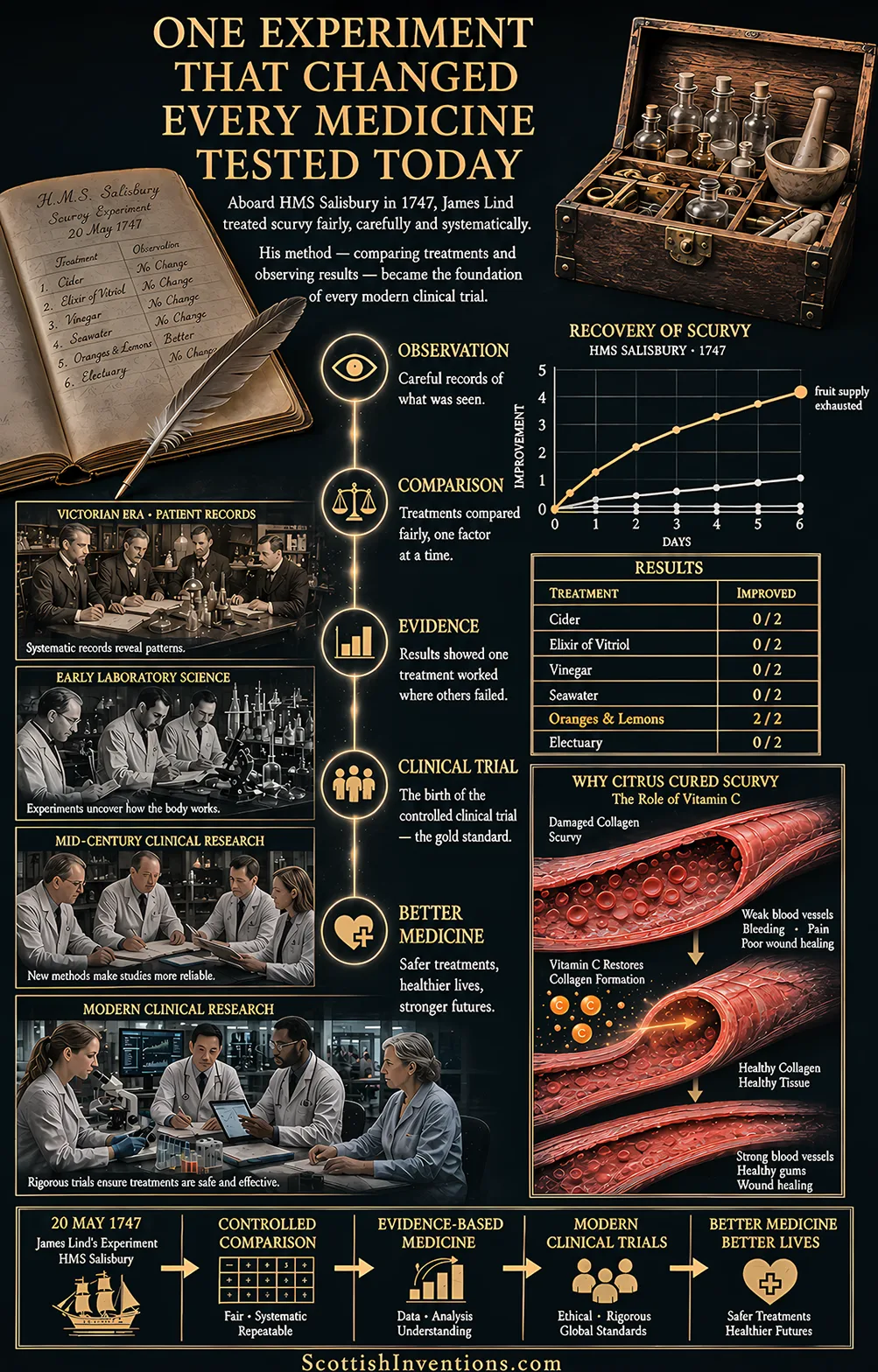
HMS Salisbury was a 50-gun fourth-rate ship of the line, launched at East Cowes in 1746. In 1747 she was patrolling the Bay of Biscay and the western approaches of the English Channel with the Western Squadron. When scurvy broke out among the crew, Lind seized his chance to test what he already suspected.
In his own words: "On the 20th of May 1747, I selected twelve patients in the scurvy, on board the Salisbury at sea. Their cases were as similar as I could have them." He housed them together in the same part of the ship — the forehold — and put them on the same basic diet, so that the only difference between them was the treatment being tested. He then divided them into six pairs and gave each pair one of the remedies then in vogue:
- a quart of cider a day;
- twenty-five drops of elixir of vitriol (dilute sulphuric acid) three times a day;
- two spoonfuls of vinegar three times a day;
- half a pint of seawater a day;
- two oranges and one lemon a day;
- a spicy medicinal paste — an electuary of garlic, mustard seed, balsam of Peru and myrrh — plus barley water.
The result, again in Lind's own words, was that "the most sudden and visible good effects were perceived from the use of the oranges and lemons; one of those who had taken them, being at the end of six days fit for duty." The second citrus patient was nearly recovered. The pair on cider improved slightly; the other eight sailors showed no benefit at all. Critically, the citrus arm of the trial had to be stopped after six days because the ship's supply of fruit ran out — Lind could not extend it, and this short duration and small sample (just two patients) are real limitations on what is otherwise a genuinely striking result.
Why does this episode count as the first controlled clinical trial? Because Lind deliberately compared like with like: same disease stage, same environment, same background diet, with treatment as the single variable, and outcomes directly observed. He was, in effect, guarding against selection bias and confounding factors. It was not perfect by modern standards — there was no randomisation, no blinding, and only two patients per arm — but it contains the essential logic of every drug trial run today. Historians are careful to note precursors: the Flemish physician Jan Baptist van Helmont had proposed a randomised comparison of fever treatments in 1648, though he probably never carried it out, and recent scholarship suggests Lind may have been influenced by a 1743 methodological essay by Francis Hauksbee the Younger. Lind's is generally called the first reported, systematic, controlled therapeutic trial — a careful phrase, and the correct one.
He set out the evidence in A Treatise of the Scurvy, published in Edinburgh in 1753 by the printers Sands, Murray and Cochran for the booksellers A. Kincaid and A. Donaldson. Tellingly, the trial itself occupies only about four pages of the 450-page book and is not even given its own heading — one reason its significance was slow to be appreciated, both by contemporaries and, for a long time afterwards, by history.
The Science Lind Didn't Know
Lind proved an empirical fact — citrus cures scurvy — without any idea of the underlying cause. The concept of vitamins did not exist in the eighteenth century. Vitamin C (ascorbic acid) was first isolated as "hexuronic acid" by the Hungarian biochemist Albert Szent-Györgyi in 1928, and in 1932 he and Joseph Svirbely proved it was identical to the anti-scurvy factor; Charles Glen King's laboratory reached the same conclusion almost simultaneously. Szent-Györgyi received the Nobel Prize in Physiology or Medicine in 1937.
Lind's lack of theory was more than an academic gap — it led him into a genuinely damaging error. He believed scurvy was fundamentally a disease of faulty digestion and blocked perspiration, and he suspected that the acid in citrus, rather than any specific dietary factor, was the active ingredient. This mistaken belief, combined with the practical problem of storing fresh fruit at sea, led him to recommend a concentrate called a "rob," made by boiling citrus juice down to a syrup. Heating destroys vitamin C, so the rob was nearly useless as a preventative measure. As one historian has observed, "if there was ever a researcher who doubted his own findings, it was James Lind."
For context, modern vitamin C recommendations sit at roughly 75–90 mg a day, easily obtained from citrus fruit, blackcurrants, peppers, broccoli and many other fresh vegetables — a small daily requirement that, unmet for long enough at sea, could kill.
The 48-Year Delay
Lind published his findings in 1753. The Royal Navy did not order a routine lemon-juice ration until 1795 — a 48-year gap that is one of the most famous failures to implement scientific evidence in the history of medicine. The reasons were tangled, and none of them is a simple villain story:
- Lind's own equivocation. His book was long, contradictory and hesitant. He never clearly and forcefully told the Admiralty to issue fresh citrus to every sailor. In a later edition he even conceded that other remedies might work as well as lemons.
- The "rob" problem. Because Lind recommended a boiled concentrate stripped of its vitamin C, trials of his recommendation often disappointed. When Captain Cook tested a rob of oranges and lemons, he reported no measurable benefit — undermining the case for citrus generally, through no fault of the fruit itself.
- Competing theories. Much of the medical establishment still attributed scurvy to bad air, damp, salt diet or putrefaction, and dismissed citrus evidence as merely anecdotal.
- Cost and logistics. Fresh citrus was expensive and hard to keep at sea, and the Admiralty balked at the expense. Sir Gilbert Blane later countered with a blunt cost-benefit argument, persuading authorities — as recounted in the U.S. Naval Institute's Proceedings — that "every fifty lemons might be considered as a hand in the fleet."
What finally broke the logjam was systematic evidence and persistent advocacy. On a 23-week, non-stop voyage to India in 1794, at the insistence of Rear Admiral Alan Gardner, HMS Suffolk issued its crew a daily ration of about two-thirds of an ounce of lemon juice mixed in grog — roughly the minimum 10 mg of vitamin C a day — and completed the long passage with no serious outbreak of scurvy. That demonstration created demand within the fleet. According to J.H. Baron's peer-reviewed reassessment, the result went to Blane's Board, "and by August the admiralty ordered lemon juice for the fleet at Portsmouth" — three- quarters of an ounce per man per day, typically mixed with sugar into the sailors' grog. The effect was near-miraculous: scurvy all but vanished from the Royal Navy. When the First Lord visited Haslar in 1797 and asked to see a case of scurvy, none could be found.
The human cost of the delay is impossible to quantify precisely, but during the Seven Years' War (1756–63) and the American Revolutionary War (1775–83) scurvy remained catastrophic. The U.S. Naval Institute's Proceedings records that "after a mere ten weeks cruise in the English Channel in 1780, no less than 2,400 cases of scurvy were landed at Portsmouth," where Lind was still in charge of Haslar. Historians estimate the delay cost tens of thousands of lives — and note the bitter irony that Anson himself, whose ruined circumnavigation had inspired Lind, later became First Lord of the Admiralty and could have acted, but did not.
Lind's Wider Contributions
Lind was far more than a one-experiment man. At Haslar — reputedly the largest brick building in Europe when built, and the largest hospital in the country — he oversaw an enormous caseload: in his first two years, 5,734 admissions, of which 1,146 were scurvy. He was a tireless advocate for naval hygiene, urging fresh air and ventilation below decks, clean clothing and bedding, delousing and regular washing of sailors, and the use of hospital ships in tropical ports. His work on typhus led to the practice of stripping, shaving and scrubbing incoming sailors and issuing clean kit — measures that dramatically cut infection rates. He also experimented with distilling fresh drinking water from seawater. His Essay on Diseases Incidental to Europeans in Hot Climates (1768) became a foundational text of tropical medicine.
Legacy and Recognition
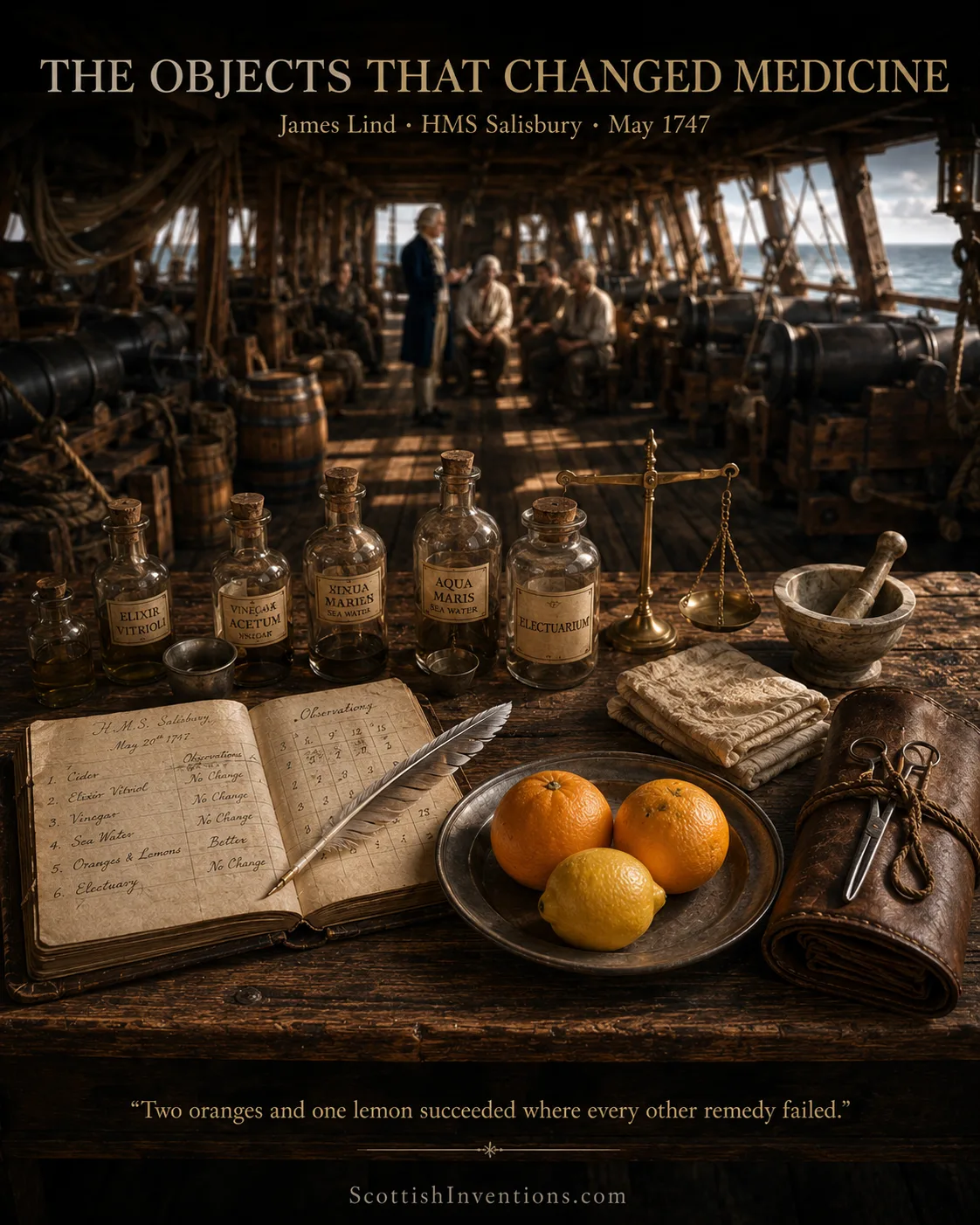
Lind is celebrated today as a pioneer of the controlled clinical trial and the "father of naval medicine." His name endures in two modern institutions dedicated to evidence-based medicine: the James Lind Library, an open-access resource on the history of fair tests of treatments, relaunched in 2003 to mark the 250th anniversary of the Treatise; and the James Lind Alliance, a UK initiative founded in 2004 to bring patients, carers and clinicians together to set research priorities. International Clinical Trials Day is celebrated on 20 May, the anniversary of the day Lind began his experiment.
We know his face from a portrait by Sir George Chalmers, now lost but preserved through a widely reproduced engraving, showing him proudly displaying his books with Haslar in the background. In Edinburgh, he is commemorated by a plaque bearing his likeness at Teviot Place, the former Medical School, unveiled in the 1950s (sources differ on whether it was 1953 or 1955) by the Sunkist Growers of Citrus Fruit of California and Arizona and hailing him as "the Hippocrates of Naval Medicine." His name is also among those inscribed on the frieze of the London School of Hygiene and Tropical Medicine. No Royal Navy ship was ever named after him, and — contrary to some assumptions — there is no freestanding statue of Lind in Edinburgh, only the commemorative plaque.
Two Scots, Start to Finish
Lind's story belongs to the golden age of Edinburgh medicine, when the city's Medical School was among the greatest in the world, home to figures like William Cullen, Joseph Black and the Monros. And the defeat of scurvy was doubly Scottish: the man who finally persuaded the Navy to act, Sir Gilbert Blane (1749–1834) — physician to Admiral Rodney's West Indies fleet, and later a Commissioner on the Sick and Hurt Board — was born at Blanefield, near Kirkoswald in Ayrshire (not to be confused with a separate, better-known Blanefield in Stirlingshire), and studied medicine at Edinburgh. Blane gathered systematic mortality statistics, championed Lind's citrus evidence, and had the bureaucratic position to make it policy. Some historians credit Blane as much as Lind for the practical conquest of scurvy: Lind proved it; Blane implemented it. Together, two Scots saved the British Navy from its deadliest enemy — though it took nearly half a century to do so.
Timeline
1617
John Woodall publishes The Surgeon's Mate, recommending lemon juice for scurvy
Citrus as a remedy was already suspected more than a century before Lind — his contribution was proof, not the original idea
1716
James Lind born in Edinburgh, 4 October
Son of a merchant, from a family with medical connections through his mother
1731
Apprenticed, aged 15, to Edinburgh surgeon George Langlands
Roughly eight years learning to mix medicines, dress wounds and bleed patients
1739
Lind joins the Royal Navy as a surgeon's mate
Nine years of service in the Mediterranean, West Africa, the West Indies and the Channel followed
1740–44
Commodore George Anson's disastrous circumnavigation
Of 1,854 crew, only 188 survived; the great majority lost to scurvy — the event that spurred Lind's research
1747
Lind promoted surgeon of HMS Salisbury
The post that gave him the opportunity to run his experiment
20 May 1747
Lind selects 12 scurvy patients aboard HMS Salisbury and begins his controlled trial
Six pairs, six different remedies, same diet and conditions otherwise — the design later recognised as history's first reported controlled clinical trial
26 May 1747
The citrus pair recovers; the fruit supply runs out and the citrus arm ends after six days
One patient was fit for duty within six days; the trial could not be extended for lack of further fruit
1748
Lind leaves the Navy and returns to Edinburgh; takes his MD
His thesis addressed venereal disease, not scurvy
1750
Elected a Fellow of the Royal College of Physicians of Edinburgh
Later served as its treasurer
1753
A Treatise of the Scurvy published in Edinburgh
The trial itself occupies only about four pages of a 450-page book and has no heading of its own
1758
Lind appointed chief physician of the Royal Naval Hospital, Haslar
Held the post until 1783; oversaw thousands of admissions, many for scurvy
1768
Lind publishes An Essay on Diseases Incidental to Europeans in Hot Climates
Becomes a foundational text of tropical medicine
1780
2,400 cases of scurvy landed at Portsmouth after a ten-week Channel cruise
Illustrates the continuing, unnecessary cost of the delay in adopting citrus
1783
Lind a founding fellow of the Royal Society of Edinburgh
Recognition within the Scottish scientific establishment
1794
HMS Suffolk issues daily lemon juice on a 23-week voyage to India, at Rear Admiral Alan Gardner's insistence
The voyage is completed with no serious outbreak of scurvy, providing the systematic evidence that finally moved the Admiralty
13 July 1794
James Lind dies at Gosport
He does not live to see the Navy act on his evidence
August 1795
The Admiralty orders lemon juice for the fleet at Portsmouth, championed by Sir Gilbert Blane
48 years after Lind's trial and 42 years after his book — scurvy all but vanishes from the Royal Navy
1797
The First Lord visits Haslar and asks to see a case of scurvy — none can be found
A striking practical demonstration of the citrus order's effect
1928–1932
Vitamin C isolated and confirmed as the anti-scurvy factor
Albert Szent-Györgyi, Joseph Svirbely and Charles Glen King establish the true cause, nearly 140 years after Lind's death
2003–2004
The James Lind Library and James Lind Alliance are founded
Modern evidence-based medicine institutions named in his honour
Myths & Facts
Myth: James Lind discovered that citrus fruit cures scurvy.
Fact: Citrus was already suspected as a remedy before Lind. John Woodall recommended lemon juice in The Surgeon's Mate in 1617, and sailors had informal lore about citrus for generations. Lind's real achievement was the controlled experimental proof, delivered in his 1747 trial, not the original idea.
Myth: Lind's 1747 trial immediately changed Royal Navy practice.
Fact: It did not. The Royal Navy did not mandate a routine lemon-juice ration until 1795 — 48 years after the trial and 42 years after Lind's book was published. Lind's own hesitant recommendations, his flawed 'rob' concentrate, and institutional inertia all delayed adoption until Sir Gilbert Blane forced the issue.
Myth: Lind understood why citrus worked.
Fact: He did not. Lind believed scurvy was caused by blocked perspiration and faulty digestion, and thought the acid in citrus was the active ingredient. The true cause — a deficiency of vitamin C, needed for collagen formation — was not established until 1928–32, well over a century later.
Myth: Lind's trial was a randomised, double-blind clinical trial like modern ones.
Fact: It was neither randomised nor blinded. Lind selected patients with similar cases and paired them by remedy under matched conditions, which is a genuine methodological advance, but the design lacks the randomisation and blinding that define a modern rigorous trial. Some heritage sources incorrectly call it 'double-blind' — this article does not repeat that claim.
Myth: The citrus arm of Lind's trial ran for the full length of the experiment.
Fact: It did not. The citrus pair's dramatic recovery is genuine, but the arm was cut short after only six days because the ship's supply of oranges and lemons ran out, leaving Lind unable to extend or repeat that part of the comparison.
Myth: Lind alone defeated scurvy.
Fact: Lind proved the cure; he did not implement it. That fell to a second Scot, Sir Gilbert Blane, who gathered mortality statistics, championed the citrus evidence, and used his position on the Sick and Hurt Board to secure the Admiralty's 1795 order. The story is properly told as a partnership across two Scots and nearly half a century.
Did You Know?
- Lind's 1747 experiment on HMS Salisbury is now regarded as the first reported controlled clinical trial in medical history — the direct methodological ancestor of the trials that test every new medicine today.
- The Royal Navy took 48 years after Lind's proof (1747) to mandate a lemon-juice ration (1795) — a delay historians estimate cost tens of thousands of lives.
- Lind never knew about vitamins; vitamin C was not isolated until 1928 and confirmed as the anti-scurvy factor in 1932, nearly 140 years after his death. He proved the cure without knowing the cause.
- Lord Anson's 1740–44 circumnavigation lost all but 188 of 1,854 men, mostly to scurvy — and Anson later became First Lord of the Admiralty, in a position to act on Lind's findings, but did not.
- The Navy's eventual practice of issuing citrus juice — lemons, later the cheaper West Indian limes — gave rise to the nickname 'limey' for British sailors and, in time, all Britons.
- The Scot who finally forced the Navy's hand in 1795, Sir Gilbert Blane, was born at Blanefield in Ayrshire — making the defeat of scurvy a story of two Scots, start to finish.
- The citrus arm of Lind's landmark trial lasted only six days before the ship's fruit supply ran out.
Honest Caveats
Citrus was suspected before Lind. John Woodall recommended lemon juice in 1617, and sailors' lore predates both Woodall and Lind. Lind's contribution was the controlled proof, not the original idea.
Lind's theory of the cause was wrong. He blamed blocked perspiration and faulty digestion, and thought the acid, not a specific dietary factor, was what worked — a mistaken theory that led him to recommend a nearly useless boiled "rob."
The citrus arm ran only six days. Lind's dramatic result rests on two patients treated for less than a week, cut short only because the ship's fruit ran out — a genuine limitation of sample size and duration.
Disputed casualty figures. Anson's losses are variously given as roughly 1,300, 1,400 or 1,415 deaths from crews totalling 1,854–1,900; the scurvy-specific figure of 997 comes from one modern reassessment. N.A.M. Rodger has warned that eighteenth-century "scurvy" was used loosely as a catch-all, and that fevers such as typhus and malaria were also major killers — so headline scurvy tolls, including the "two million" estimate, should be treated with caution.
Was the trial exactly as described? A minority of scholars, notably J.H. Baron, note that Lind's 12 patients do not appear on the Salisbury's surviving sick list and have questioned whether the trial happened precisely as written. The mainstream view accepts Lind's account; regardless, its importance as a model of fair testing is not seriously disputed.
The "double-blind" claim is wrong. Some heritage and museum websites describing Haslar erroneously call Lind's trial "double blind." It was not blinded at all, and this article does not repeat that claim.
The Royal Navy did not adopt citrus until 1795. Sources agree on the year and generally on a three-quarter-ounce daily ration, though the exact administrative wording of the order is not reproduced in the surviving literature, and a minority of sources give the earlier HMS Suffolk trial ration as two-thirds of an ounce.
Burial and plaque dates vary. Lind's remains could not be found when his Portchester vault was later opened, and accounts of his burial place differ (Portchester versus St Mary's, Gosport). The Edinburgh plaque is dated to 1953 by some sources and 1955 by others.
A namesake to avoid confusing. Lind had a near-contemporary cousin, also named James Lind (1736–1812), a physician to the household of George III and a noted natural philosopher. Early biographies sometimes conflate the two; they are different men.
Frequently Asked Questions
Did James Lind discover that citrus cures scurvy?
Not in the sense of being first to suggest it. John Woodall recommended lemon juice for scurvy in The Surgeon's Mate as early as 1617, more than a century before Lind, and sailors had long-standing empirical lore about citrus. What Lind supplied in 1747 was the controlled experimental proof — a systematic, fair comparison of six competing remedies that demonstrated citrus worked far better than the alternatives. His landmark achievement is the method, not the idea.
What exactly did Lind's 1747 trial show?
Lind selected 12 sailors suffering from scurvy aboard HMS Salisbury, kept their conditions and background diet as similar as possible, and divided them into six pairs. Each pair received a different remedy: cider, elixir of vitriol (dilute sulphuric acid), vinegar, seawater, an electuary of garlic, mustard and myrrh with barley water, or two oranges and one lemon daily. Only the citrus pair improved significantly — one sailor was fit for duty within six days. The other five remedies produced no comparable benefit.
Was the citrus part of the trial really only six days long?
Yes, and this is an important limitation to state plainly. The dramatic recovery of the citrus pair is well documented, but the arm of the trial had to be stopped after just six days because the ship's supply of oranges and lemons ran out. Lind could not extend the comparison, run a larger sample, or repeat it at sea in that voyage. The result is genuine and striking, but it rests on a very short exposure and only two patients.
Was this really the first controlled clinical trial?
It is generally described as the first reported, systematic, controlled therapeutic trial, and this article uses that careful phrasing deliberately. Lind compared like with like — same disease stage, same environment, same background diet — with treatment as the single deliberately varied factor, which is the essential logic of every modern drug trial. It was not randomised and not blinded, and there were only two patients per arm. Earlier precursors exist too: the Flemish physician Jan Baptist van Helmont proposed (but probably never carried out) a randomised comparison of fever treatments in 1648, and a 1743 methodological essay by Francis Hauksbee the Younger may have influenced Lind. Lind's trial is a landmark of method, not an unprecedented invention from nothing.
Was Lind's trial double-blind?
No — and some heritage and museum sources incorrectly describe it that way. Lind's trial was controlled, in that he compared remedies under matched conditions, but there was no blinding of any kind: the sailors knew what they were being given, and Lind knew which patients received which remedy. Describing it as 'double-blind' is a common but inaccurate embellishment that this article does not repeat.
Did Lind understand why citrus worked?
No. Lind proved an empirical fact without any idea of the underlying cause, because the concept of vitamins did not exist in the eighteenth century. He believed scurvy was fundamentally a disease of blocked perspiration and faulty digestion, and he suspected that the acid in citrus fruit was the active therapeutic ingredient. Vitamin C (ascorbic acid) was not isolated until 1928, by the Hungarian biochemist Albert Szent-Györgyi, and its identity as the anti-scurvy factor was confirmed in 1932 — 138 years after Lind's death.
If Lind's theory was wrong, did it cause problems?
Yes, significantly. Because Lind believed the acid, not a specific dietary factor, was what mattered, and because fresh fruit was hard to store aboard ship, he recommended boiling citrus juice down into a concentrate called a 'rob'. Heating destroys vitamin C, so the rob was largely useless as a preventative — and when Captain Cook later tested a rob of oranges and lemons on his voyages, he found no measurable benefit, which actually undermined confidence in citrus generally. Lind's mistaken theory of cause directly damaged the practical case for his own correct empirical finding.
Why did the Royal Navy wait so long to adopt citrus?
The Navy did not mandate a routine lemon-juice ration until 1795 — 48 years after Lind's trial and 42 years after his book was published. The reasons were tangled: Lind's own book was long, hesitant and contradictory, and he never forcefully told the Admiralty to issue fresh citrus to every sailor; his recommended 'rob' concentrate was nearly useless and its failure in field tests undermined the case for citrus generally; much of the medical establishment still blamed scurvy on bad air, damp or salt diet; and fresh citrus was expensive and logistically difficult to keep at sea. It took a deliberate demonstration voyage and a determined advocate to break the impasse.
Who actually got the Royal Navy to adopt citrus?
Sir Gilbert Blane, a Scottish physician born at Blanefield near Kirkoswald in Ayrshire and trained at Edinburgh. Blane served with Admiral Rodney's West Indies fleet, gathered systematic mortality statistics, championed Lind's citrus evidence, and — crucially — held a position on the Sick and Hurt Board that let him translate evidence into policy. After a 1794 demonstration voyage by HMS Suffolk showed a long passage could be completed with no serious scurvy outbreak using a daily lemon-juice ration, Blane's Board secured the Admiralty's 1795 order. Lind proved the cure; Blane implemented it.
So is Lind's fame as the 'father of the cure for scurvy' accurate?
It needs the qualification this article insists on throughout. Lind deserves genuine, durable credit for designing and running the controlled trial that proved citrus worked — a landmark in the history of medical method, still marked today by International Clinical Trials Day on 20 May. But he was not the first to suspect citrus (Woodall predates him by over a century), his own explanation of the cause was wrong, his practical recommendation (the rob) was flawed, and the Navy he served did not act on his findings in his lifetime. His true achievement is the fair, comparative experimental method, not the singular discovery of a cure that was already suspected and that others had to implement.
How many sailors died of scurvy, and how reliable are the figures?
Scurvy is estimated to have killed more than two million sailors between the 16th and 18th centuries, and Commodore Anson's 1740–44 circumnavigation alone lost the great majority of his 1,854 crew, mostly to scurvy — a modern reassessment attributes 997 of 1,415 deaths on the voyage to the disease. These figures should be treated with some caution: naval historian N.A.M. Rodger has warned that eighteenth-century 'scurvy' was often used as a catch-all term, and that other diseases such as typhus and malaria also killed heavily on long voyages, so headline totals may overstate scurvy specifically.
Did Lind's trial really happen exactly as he described it?
The mainstream historical view accepts Lind's account, but it should be noted that a minority of scholars, notably J.H. Baron, have pointed out that Lind's 12 named patients do not appear on HMS Salisbury's surviving sick list, and have questioned whether the trial occurred precisely as written up years later. Whatever the exact facts of the ship's log, the trial's significance as a model of fair, comparative testing is not seriously disputed.
Sources & Further Reading
Tier 1 · Primary
- Lind, J. — A Treatise of the Scurvy, Edinburgh, 1753.
- Lind, J. — An Essay on the Most Effectual Means of Preserving the Health of Seamen in the Royal Navy, 1757.
- Lind, J. — An Essay on Diseases Incidental to Europeans in Hot Climates, 1768.
- Woodall, J. — The Surgeon's Mate, 1617.
Tier 2 · Scholarly and institutional
- Baron, J.H. — peer-reviewed reassessment of Lind's trial and the Royal Navy's adoption of citrus.
- U.S. Naval Institute — Naval History magazine and Proceedings, on scurvy mortality and the 1795 Admiralty order.
- James Lind Library (jameslindlibrary.org) and James Lind Alliance, on the history and legacy of fair tests of treatments.
- Rodger, N.A.M. — naval historical scholarship on disease and mortality in the eighteenth-century Royal Navy.
- Szent-Györgyi, A.; Svirbely, J.; King, C.G. — isolation and identification of vitamin C, 1928–1932.
- Royal College of Surgeons of Edinburgh — biographical records on Sir Gilbert Blane and the Blane Medal.
Tier 3 · Site source document
docs/sources/discoveries/scurvy-cure.md— the commissioned source document underlying this article.