Discoveries · No. 22 of 50 · Chemistry
Scotland's Only Element: Thomas Charles Hope and Strontium
A strange pale mineral out of an Argyll lead mine, a Glasgow laboratory, and a crimson flame that still lights every firework display in the world.
Thomas Charles Hope · 1766–1844Paper read · 4 November 1793Reading time · 17 minUpdated 12 August 2026
TL;DR
- Thomas Charles Hope carried out the systematic 1791–93 experiments that proved the mineral from the Argyll village of Strontian contained a genuinely new "earth", distinct from lime and baryta, and he is the chemist most authoritatively credited with establishing strontium's tell-tale crimson flame. The element remains the only one on the periodic table named after a Scottish place.
- The credit is honestly shared: Adair Crawford and William Cruickshank first suspected a new earth in 1790, Hope characterised it decisively in 1793, and Sir Humphry Davy isolated the pure silvery metal by electrolysis in 1808 — three distinct achievements that together made strontium a true element.
- Hope's crimson flame lives on in every red firework, and his second great discovery — that water is densest at about 4 °C — explains why Scottish lochs freeze from the top and fish survive the winter.
Scottish Impact Index (SI Score)
- Global Impact
- 6/10
- Longevity
- 8/10
- Economic / Material Impact
- 4/10
- Originality / Distinctiveness
- 8/10
- Legacy (Built Upon)
- 6/10
- Recognition
- 2/10
Key Findings
- Hope (1766–1844) was the son of John Hope, Regius Professor of Botany at Edinburgh, and became one of the most celebrated science lecturers in British history, teaching chemistry at Edinburgh for nearly fifty years to more than 15,000 students.
- The Strontian mineral — later named strontianite (SrCO₃) — came out of lead mines in Argyll. Crawford and Cruickshank concluded in 1790 that it was probably "a new species of earth"; Hope, in a paper read on 4 November 1793 and published in full in 1798, proved it and named the earth strontites.
- Davy isolated the metal on 30 June 1808 by electrolysis, in the same extraordinary run that yielded potassium, sodium, calcium, barium and magnesium.
- The village of Strontian in Sunart is the naming source — the smallest settlement in the world to have an element named after it.
- Hope's other landmark discovery, the maximum density of water at about 4 °C (published 1805), is still demonstrated by the apparatus called Hope's experiment.
- Charles Darwin, a medical student at Edinburgh in 1825–27, singled out Hope's chemistry lectures as the one bright spot in an otherwise dull education.
Quick Facts
- Discovery
- Strontia (strontites) identified as a new alkaline earth, distinct from lime and baryta
- Year
- Experiments from 1791; paper read to the Royal Society of Edinburgh 4 November 1793
- Key figure
- Thomas Charles Hope MD FRSE (1766–1844)
- Born
- Edinburgh, 21 July 1766
- Died
- 31 Moray Place, Edinburgh, 13 June 1844, aged 77
- Where the work was done
- Glasgow — not Edinburgh, despite Hope's fame as the Edinburgh chemistry professor
- Source mineral
- Strontianite (SrCO₃), from the lead mines above Strontian, Loch Sunart, Argyll
- Named by Hope
- Strontites — after the village, not after any chemical property
- Prior claim
- Adair Crawford & William Cruickshank, 1790 — 'probably… a new species of earth'
- Metal isolated
- Sir Humphry Davy, 30 June 1808, by electrolysis
- Diagnostic test
- The crimson flame — the reason every red firework is red
- Second discovery
- Water is densest at about 4 °C — published 1805
- Claim status
- Shared attribution — suspected, characterised, isolated by three different parties
- Distinction
- The only element named after a place in Scotland, or anywhere in Britain
An Edinburgh Academic Dynasty
Thomas Charles Hope was born in Edinburgh on 21 July 1766, the third son in a family of five children. His father was John Hope, Professor of Botany at the University of Edinburgh and one of the foremost botanists of the Scottish Enlightenment; his mother, Juliana Stevenson, was the daughter of an Edinburgh physician. The family lived at High School Yards in the old town, and young Thomas was educated next door at the High School of Edinburgh, after a year at a school in Dumfries, before entering the University of Edinburgh at the age of thirteen in 1779 — a young age, but not unusual then.
Hope followed an Arts curriculum for four years and then the medical course, voluntarily re-attending compulsory courses and even taking subjects outside the medical curriculum such as Natural History and Natural Philosophy. His ambition, at first, was to succeed his father in the Chair of Botany; when John Hope died in 1786 the twenty-year-old was a strong, if ultimately unsuccessful, candidate. He graduated MD in 1787 with a thesis on the movements and life of plants, de Plantarum Motibus et Vita, and also studied at Paris.
In October 1787 Hope was appointed Lecturer in Chemistry at the University of Glasgow, where he spent eight years. He became assistant Professor of Medicine in 1789 and Professor of Medicine in 1791. Crucially for the history of science, Hope was the first university teacher in Britain to abandon the old phlogiston theory outright and to teach the new oxygen-based chemistry of Antoine Lavoisier, whom he had met in Paris in 1788.
In 1795 the ageing Joseph Black — Hope's own former teacher, and one of the giants of eighteenth-century chemistry — chose Hope as his assistant and successor. On 4 November 1795 the Town Council appointed Hope conjoint Professor of Chemistry with Black at Edinburgh. Black last lectured in the 1796–97 session, and from October 1797 Hope was sole teacher of chemistry; Black died in 1799. Hope held the Edinburgh chair until he resigned in 1843, and died at his home, 31 Moray Place, on 13 June 1844, aged 77. He is buried in Greyfriars Kirkyard.
The Strontian Mine
The story begins not in a laboratory but in the West Highlands. Strontian sits on the north shore of Loch Sunart in Sunart, Argyllshire — since 1975 part of Highland. Its Gaelic name, Sròn an t-Sìthein, means "the point of the fairy hill." In 1722 the landowner Sir Alexander Murray began mining lead — galena — in the hills above the village, the beginning of some 250 years of mining and the reason the village exists at all. In a nice historical footnote, lead from Strontian was cast into bullets during the Napoleonic Wars, and captured French soldiers were reportedly put to work in the mines.
Among the lead ore, miners turned up an unusual pale-green to brown mineral. It reached Edinburgh around 1787 and was at first assumed to be a form of the barium mineral witherite, which it superficially resembled. But it behaved differently in acids and in its precipitation reactions. The scientific question crystallised: was this simply an odd barium or calcium mineral, or did it contain an entirely new "earth"?
In 1790 the Irish physician-chemist Adair Crawford, working with William Cruickshank — both connected with the Royal Military Academy at Woolwich, though the specimens came through Edinburgh — published experiments in Medical Communications concluding that the Strontian mineral differed from barium minerals and that "it is probable indeed, that the scotch mineral is a new species of earth which has not hitherto been sufficiently examined." That careful, cautious statement gives Crawford and Cruickshank priority for first recognising the new earth. The German mineralogist Friedrich Gabriel Sulzer, with Johann Friedrich Blumenbach, analysed the mineral and gave it the name strontianit — strontianite — in 1791.
Hope's Experiments at Glasgow
This is where Thomas Charles Hope enters decisively. Hope began working on the Strontian mineral in 1791, in his laboratory at Glasgow — a detail sometimes muddled in secondary sources, which tend to place all of Hope's work in Edinburgh because that is where his chair and his fame lie. He carried out a systematic comparison of the new "strontian earth" against baryta, the barium earth, and lime, the calcium earth, running the same chemical tests on each and showing repeatedly that the strontian earth behaved as neither. He prepared pure strontium oxide and hydroxide and described the preparation of some thirteen other strontium compounds — a far fuller chemical characterisation than had gone before.
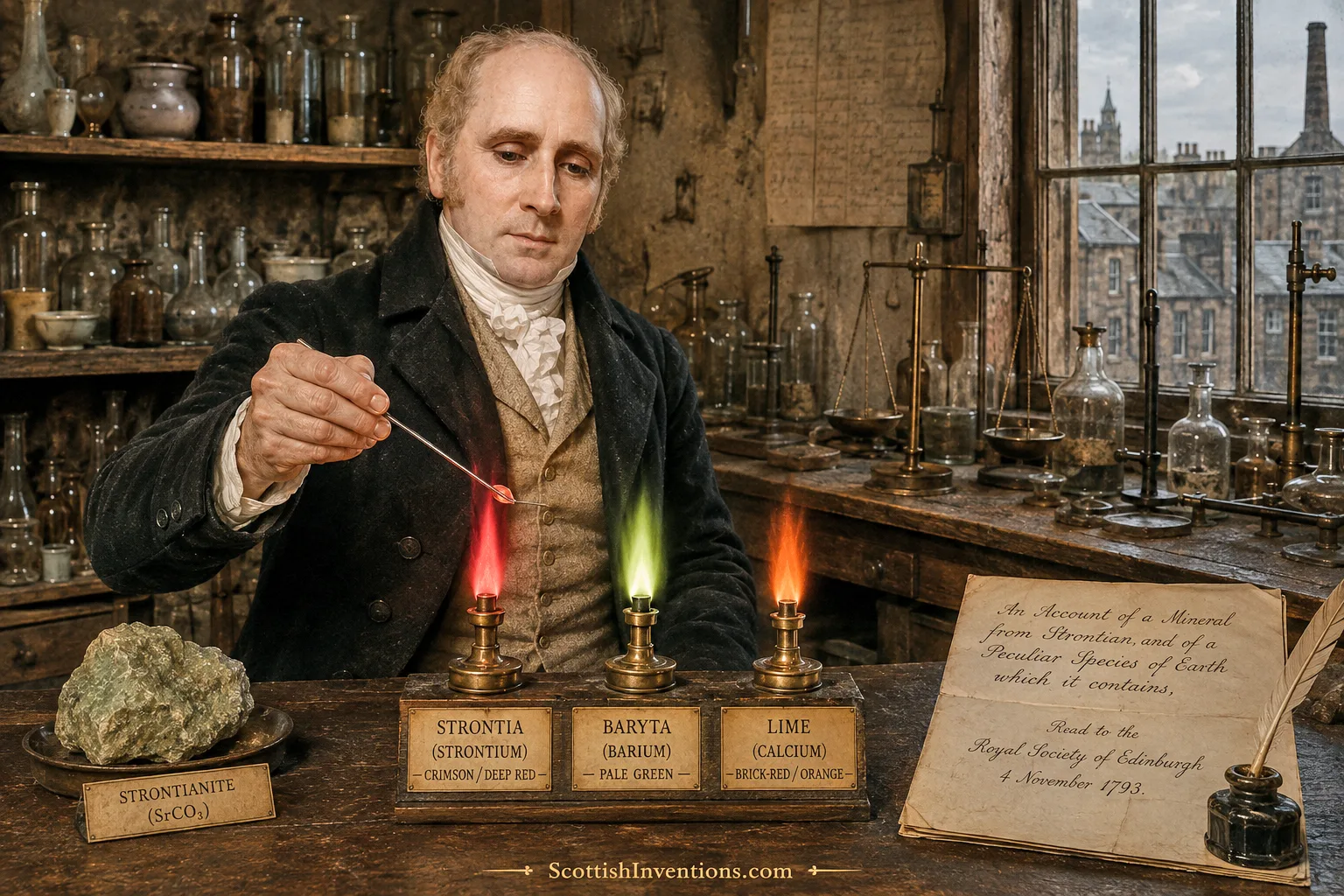
Two of Hope's contributions stand out. First, the flame test. Hope observed that strontian compounds coloured a flame a brilliant red — crimson — completely unlike the pale green of barium and distinct from the brick-red of calcium. The Royal Society of Chemistry's own periodic-table entry credits him directly: "In 1791, another Edinburgh man, Thomas Charles Hope, made a fuller investigation of it and proved it was a new element. He also noted that it caused the flame of a candle to burn red." A caution for accuracy: some popular accounts imply Crawford noted the flame colour in 1790, but a clear 1790 flame observation by Crawford or Cruickshank is not well attested in primary sources, whereas Hope's association with the red flame is firmly documented.
Second, his publication and conclusion. Hope read his paper, An Account of a Mineral from Strontian, and of a Peculiar Species of Earth which it contains, to the Royal Society of Edinburgh on 4 November 1793. It was summarised in the Society's Transactions in 1794 but not published in full until 1798, in volume 4, pages 3–39. Hope's conclusion was unambiguous: the mineral contained a "hitherto unknown kind of earth," a distinct new alkaline earth different from both lime and baryta. In a surviving letter to Black of 18 October 1793 he even asked whether he might "exhibit specimens of the Strontian mineral and of its more remarkable combinations" to the Society. Two glass flasks labelled "Strontia" and "Baryta," traditionally held to be Hope's own preparations, are still preserved in the Department of Chemistry at Edinburgh.
The honest historical verdict, set out by the historian of chemistry J. R. Partington in "The Early History of Strontium" (Annals of Science, 1947 and 1951), is that the discovery of the individual nature of strontianite belongs to Crawford and Cruickshank, while Hope — along with Martin Klaproth in Germany and Richard Kirwan in Ireland, all working independently in 1793–94 — contributed to characterising the new earth and its compounds. Hope's work was the most systematic, and that is the reason his name is so closely tied to strontium.
Strontian to Strontium
Hope named the new earth strontites, and he was refreshingly candid about his reasoning. He proposed the name "from the place it was found; a mode of derivation in my opinion, fully as proper as any quality it may possess, which is the present fashion." In other words: never mind naming an element for a chemical property — name it for the little Highland village that produced it.
The modern form strontium, with the "-ium" ending that marks a metal and matches sodium, potassium, calcium and barium, was settled when Humphry Davy isolated the metal in 1808. So the naming, too, is a shared achievement: Hope gave us the root, by way of the village and the mineral strontianite, and Davy fixed the modern metallic form.
This makes strontium the only chemical element named after a place in Scotland — indeed the only one named after a place anywhere in Britain. Geographic element names are a rare and charming club: the Swedish village of Ytterby alone gave its name to four (yttrium, terbium, erbium and ytterbium), and elements such as polonium and germanium honour countries. But Strontian, a tiny West Highland village, stands alone for Scotland — and National Museums Scotland notes it is the smallest settlement in the world, by population, to have an element named after it.
Davy and the Pure Metal
Identifying a new "earth" is not the same as holding the pure element in your hand. In the 1790s chemists worked with metal oxides — "earths" — and had no way to reduce these stubborn alkaline earths to their metals. That final step fell to Sir Humphry Davy, and it is only fair to be generous about his achievement.
Davy had concluded that electrolysis — passing an electric current through compounds — was the most powerful way to tear substances apart into their elements. In 1807 he electrolysed molten potash and soda and isolated potassium and sodium. Then, building on work by the Swedish chemists Berzelius and Pontin, who had obtained calcium and barium amalgams using a mercury cathode, Davy extended the method. On 30 June 1808 he reported to the Royal Society that he had isolated four new metals, which he named barium, calcium, strontium and magnium — soon changed to magnesium. Strontium was thus one of a remarkable cluster of elements Davy first isolated in 1807–08.
The division of credit is clean and worth stating plainly: Crawford and Cruickshank suspected a new earth; Hope characterised it and named it; Davy isolated the pure metal. All three steps were essential to establishing strontium as a genuine element in the modern sense. There is a lovely Scottish coda: it was Hope who, in 1799, first recommended the young Davy to the Royal Institution in London — Hope later said that recommending Davy was "the greatest service which it has been in my power to render to Chemistry."
The Density of Water
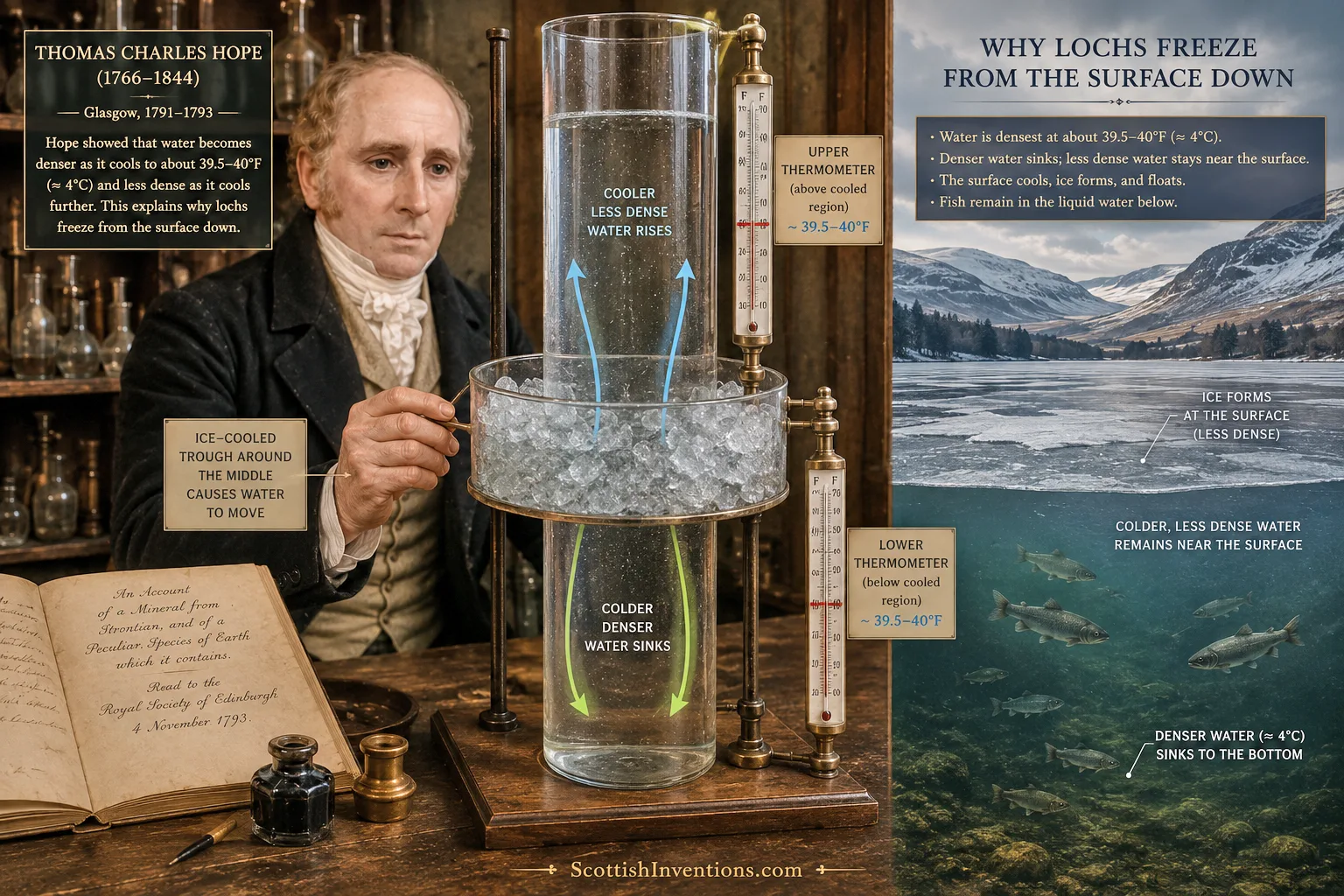
Hope's second great contribution has nothing to do with strontium and everything to do with everyday life. After returning to Edinburgh he investigated the puzzling thermal behaviour of water, and in 1805 published Experiments on the Contraction of Water by Heat in the Transactions of the Royal Society of Edinburgh, volume 5. Through careful experiment he established that water does not become steadily denser as it cools to freezing; instead it reaches its maximum density a few degrees above freezing. He measured between 39.5° and 40 °F, remarkably close to the modern value of 39.2 °F, roughly 4 °C.
The demonstration is still known as Hope's experiment, using Hope's apparatus: a tall cylinder of water is surrounded at its middle by a trough of freezing ice, with thermometers above and below. As the water cools towards 4 °C it becomes denser and sinks, so the lower thermometer settles at about 4 °C while the water above continues to cool towards 0 °C and freezes at the top.
This "anomalous expansion" of water is one of the most consequential quirks in nature. Because the densest water sits at 4 °C and ice is less dense still, lakes and lochs freeze from the top down rather than the bottom up. A layer of surface ice insulates the water beneath, so fish and other aquatic life survive even a hard Scottish winter — and, as Hope's contemporaries put it, it also explains why icebergs float.
Strontium Today
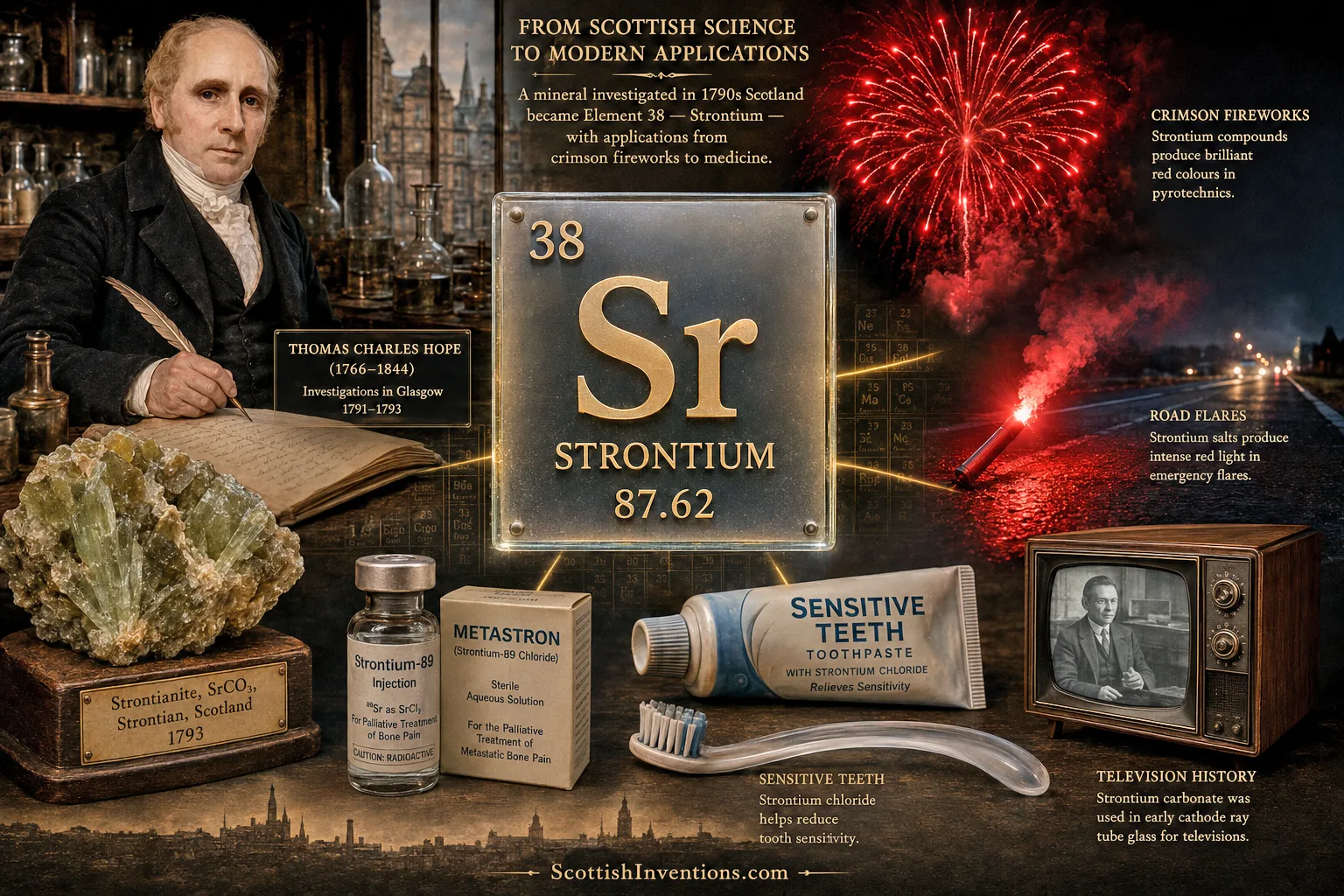
Hope's crimson flame turned out to be commercially priceless.
Fireworks and flares. Strontium salts — chiefly strontium nitrate and strontium carbonate — produce the brilliant red in fireworks and emergency flares. When the salt is heated, strontium ions emit light in the red part of the spectrum; the effect is the direct, everyday descendant of the flame Hope characterised. Figures from the US Geological Survey record that "about a third of all strontium nitrate in the United States is used for pyrotechnics", and more recent USGS Mineral Commodity Summaries put pyrotechnics and signals at 29% of US end use, alongside ceramic ferrite magnets at 29% and drilling fluids at 23%. Every red firework in a Guy Fawkes, Fourth of July or Hogmanay display owes its colour to strontium's flame.
Strontium-90. The radioactive isotope strontium-90 is a fission product of nuclear weapons and reactors, and became one of the defining fears of the Cold War. Because strontium behaves chemically like calcium, fallout travelled from bomb tests through grass, into cattle, into milk, and finally into the growing bones and teeth of children. The St Louis "Baby Tooth Survey," led by Dr Louise Reiss and running from 1958 to 1970, collected roughly 320,000 teeth; it found that children born in St Louis in 1963 had about fifty times as much strontium-90 in their teeth as children born in 1950. The findings helped persuade President Kennedy to sign the 1963 Partial Nuclear Test Ban Treaty, which ended atmospheric testing.
Medicine. Strontium ranelate — two stable strontium atoms bound to ranelic acid — was used to treat osteoporosis, but was withdrawn and then heavily restricted by the European Medicines Agency after reports of increased cardiovascular risk; it is now reserved for severe cases in patients without heart or circulatory disease. This is historical and restricted use, not current first-line practice. The radioactive isotope strontium-89, marketed as Metastron, is given intravenously to relieve the bone pain of metastatic cancers such as prostate cancer.
Cathode ray tubes. For decades, strontium carbonate was added to the faceplate glass of colour television and monitor CRTs to absorb the X-rays generated by the electron beam; the US ATSDR/USGS Toxicological Profile for Strontium records that "major manufacturers of television picture tube glass incorporate about 8% by weight of strontium oxide (SrO) into the glass faceplate material." According to the USGS, at its peak as much as 75% of strontium consumed in the United States went into faceplate glass for colour CRTs — a market that collapsed when the last US CRT glass plant closed in 2006 and flat panels took over.
Toothpaste. Strontium chloride and strontium acetate are active ingredients in some toothpastes for sensitive teeth, such as Sensodyne, where they help block pain signals from exposed dentine.
Hope the Lecturer
If Hope's research output was modest — essentially strontium and the density of water — his influence as a teacher was immense. He considered teaching, not research, his vocation, and he raised the lecture-demonstration to an art. He was the first in Britain to use large-scale demonstrations so extensively, a practice that continued in Edinburgh first-year chemistry courses into the 1950s. Contemporaries admired that he "simplified and legitimately popularized chemistry without vulgarizing it. There were no needless blazings of phosphorus, or showy exhibitions of blue lights."
His reputation was extraordinary. Attendance at his classes rose from 293 in 1799 to a peak of 559 in 1823. Robert Christison, who attended in 1814, recalled that although Hope's manner was "somewhat pompous," this was "more than counterbalanced by uncommon clearness of exposition, and unexampled splendour and success in experimental demonstration" — and that with a class of 500 requiring experiments on a huge scale, "there was not a single failure to attain exactly what he announced." In spring 1826 Hope even gave a fashionable public course open to "Ladies and Gentlemen"; the fees allowed him to endow a chemistry prize at Edinburgh with £800 in 1828.
His most famous student needs no introduction. Charles Darwin studied medicine at Edinburgh from 1825 to 1827, and in his autobiography wrote that the lectures "were intolerably dull, with the exception of those on chemistry by Hope" — a striking endorsement from a man who found most of his Edinburgh education tedious.
Hope's legacy at Edinburgh is tangible. His 1828 endowment funds the Hope Prize Scholarships, still awarded to outstanding chemistry students. A memorial fountain, gifted by his nephew, stands in the quadrangle of Old College. And a point of accuracy worth flagging: the Hope Park area of Edinburgh, and the Meadows, historically "Hope Park", are not named after Thomas Charles Hope or his botanist father John Hope. They commemorate Sir Thomas Hope of Rankeillor, the 8th Baronet (c. 1681–1771), who drained the old Borough Loch and laid out the park from 1722 — a different Hope entirely.
Timeline
1722
Sir Alexander Murray begins mining lead above Strontian, Argyll
The village and its mines exist because of this; the mineral comes out of the galena workings
1766
Thomas Charles Hope born in Edinburgh, 21 July
Third son of John Hope, Regius Professor of Botany
1779
Enters the University of Edinburgh aged thirteen
Arts, then medicine; MD in 1787 with a thesis on plant movement
c.1787
The unusual Strontian mineral reaches Edinburgh
Initially mistaken for the barium mineral witherite
1787
Hope appointed Lecturer in Chemistry at the University of Glasgow
Eight formative years; the first British university teacher to abandon phlogiston for Lavoisier's chemistry
1790
Crawford and Cruickshank publish in Medical Communications
'It is probable indeed, that the scotch mineral is a new species of earth' — the first published recognition
1791
Sulzer and Blumenbach name the mineral strontianit
The mineral gets its name before the earth inside it is proven
1791
Hope begins his own experiments, in his Glasgow laboratory
Systematic comparison of strontian earth against baryta and lime
18 Oct 1793
Hope writes to Joseph Black about exhibiting his specimens
A surviving letter asking to show 'the Strontian mineral and of its more remarkable combinations'
4 Nov 1793
Hope reads his paper to the Royal Society of Edinburgh
'An Account of a Mineral from Strontian, and of a Peculiar Species of Earth which it contains'
1793–94
Klaproth in Germany and Kirwan in Ireland work independently on the same earth
Hope's characterisation was the most systematic, but not the only one
1794
The paper is summarised in the Society's Transactions
Full publication is delayed
1795
Joseph Black chooses Hope as his assistant and successor
Appointed conjoint Professor of Chemistry at Edinburgh, 4 November 1795
1798
The strontium paper is published in full
Transactions of the Royal Society of Edinburgh, vol. 4, pp. 3–39
1799
Hope recommends the young Humphry Davy to the Royal Institution
He later called it 'the greatest service which it has been in my power to render to Chemistry'
1805
Hope publishes Experiments on the Contraction of Water by Heat
Water's maximum density measured between 39.5° and 40 °F — close to the modern 39.2 °F
30 Jun 1808
Davy isolates strontium metal by electrolysis
Reported to the Royal Society alongside barium, calcium and 'magnium'
1823
Hope's Edinburgh class peaks at 559 students
Up from 293 in 1799
1825–27
Charles Darwin studies medicine at Edinburgh
He later rated Hope's chemistry the only interesting lectures he attended
1828
Hope endows a chemistry prize with £800
Funded by his fashionable 1826 public course; the Hope Prize Scholarships still run
1843
Hope resigns the Edinburgh chair
After nearly fifty years teaching chemistry
1844
Hope dies at 31 Moray Place, 13 June
Buried in Greyfriars Kirkyard
Myths & Facts
Myth: Thomas Charles Hope discovered strontium.
Fact: He characterised and named the new earth in 1793, which is a real and substantial achievement — but Crawford and Cruickshank had published the suspicion of a new earth in 1790, and Davy isolated the metal in 1808. The historian of chemistry J. R. Partington concluded that the discovery of the individual nature of strontianite belongs to Crawford and Cruickshank, while Hope, along with Klaproth in Germany and Kirwan in Ireland, characterised the new earth and its compounds.
Myth: Hope did his strontium work in Edinburgh.
Fact: He did it at Glasgow, where he was Lecturer in Chemistry from 1787 and Professor of Medicine from 1791. He did not take up the Edinburgh chemistry chair until 1795, two years after reading his strontium paper.
Myth: Hope held pure strontium metal in his hand.
Fact: He could not have. Eighteenth-century chemists worked with earths — oxides. Reducing an alkaline earth to its metal required electrolysis, which Davy applied in 1808.
Myth: Crawford noticed the crimson flame in 1790.
Fact: Some popular accounts imply this, but a clear 1790 flame observation by Crawford or Cruickshank is not well attested in the primary sources. The flame is firmly associated with Hope by authoritative modern sources including the Royal Society of Chemistry.
Myth: Davy named the element after the village.
Fact: The name comes from Hope, who coined strontites after Strontian. Davy fixed the modern '-ium' form when he isolated the metal.
Myth: Edinburgh's Hope Park is named after the chemist or his botanist father.
Fact: Neither. It honours Sir Thomas Hope of Rankeillor, who laid out the park from 1722 after draining the Borough Loch.
Myth: The mineral was first studied in 1787.
Fact: 1787 is when the rock reached Edinburgh, and it was then assumed to be a form of witherite. This article treats 1790 as the first published recognition of a possible new earth, and 1791 as the start of Hope's own experiments — the dates in circulation vary and the distinction matters.
Did You Know?
- Strontium is named after Strontian, a tiny village on Loch Sunart in Argyll — the only element named after a Scottish place, and the smallest settlement in the world to have an element named after it.
- Every red firework you have ever seen owes its crimson to the strontium flame Thomas Charles Hope first characterised in the 1790s.
- Hope was born into an Edinburgh academic dynasty: his father John Hope was Professor of Botany, and Thomas succeeded the great Joseph Black in the chemistry chair.
- Charles Darwin attended Edinburgh in 1825–27 and rated Hope's chemistry lectures the only interesting part of his studies.
- Hope also discovered that water is densest at about 4 °C, not 0 °C — the reason lochs freeze from the top and fish survive winter.
- Strontium-90 fallout from 1950s bomb tests entered children's bones through grass, cattle and milk, helping drive the 1963 Partial Nuclear Test Ban Treaty.
- Lead from the Strontian mines was cast into bullets during the Napoleonic Wars, and captured French soldiers were reportedly put to work in the mines.
Honest Caveats
Priority for the crimson flame is not absolutely settled. Authoritative modern sources, including the Royal Society of Chemistry and IUPAC/CIAAW, credit Hope with the diagnostic red flame and this article follows them — but a direct quotation from Hope's original paper was not available in open sources, and a few popular accounts attribute an early flame observation to Crawford.
Dates for first scientific attention to the mineral vary between 1787, when the rock reached Edinburgh, and 1790, when Crawford published. This article treats 1790 as the first published recognition of a new earth and 1791 as the start of Hope's own experiments.
Hope did his key strontium work at Glasgow, not Edinburgh, even though his fame and his chair are associated with Edinburgh — a point sometimes muddled in secondary sources.
Who "named" the element depends on definitions. Hope coined strontites for the earth; Davy is often said to have named the metal strontium in 1808, when he fixed the modern "-ium" form.
Strontium ranelate's status is restricted, not current. Its medical use is presented here as historical and limited rather than as current best practice.
Frequently Asked Questions
Did Thomas Charles Hope discover strontium?
Not on his own, and this collection will not say that he did. The honest sequence has three stages. Adair Crawford and William Cruickshank published in 1790 that the Strontian mineral differed from barium minerals and that 'it is probable indeed, that the scotch mineral is a new species of earth which has not hitherto been sufficiently examined' — that cautious sentence gives them priority for first suspecting a new earth. Hope then carried out the systematic experiments, from 1791, that proved it, and he read his conclusion to the Royal Society of Edinburgh on 4 November 1793. Humphry Davy isolated the pure metal by electrolysis on 30 June 1808. All three steps were needed before strontium was an element in the modern sense.
Where did Hope actually do the strontium work?
In Glasgow. This is the single most commonly muddled point about him. Hope was Lecturer in Chemistry at the University of Glasgow from October 1787, became Professor of Medicine there in 1791, and it was in his Glasgow laboratory that he began working on the Strontian mineral that same year. He did not move to Edinburgh until 1795, when Joseph Black chose him as his assistant and successor. His fame, his chair and his reputation are Edinburgh; his strontium experiments are Glasgow.
What is the difference between an 'earth' and an element?
In the 1790s chemists worked with what they called earths — what we would now call metal oxides. They could tell that an earth was chemically distinct from other earths, but they had no method for stripping the oxygen away to reach the metal underneath. So when Hope proved that the Strontian mineral contained a 'hitherto unknown kind of earth', he had genuinely identified something new, but he had never seen strontium metal and could not have. That step needed electrolysis, a technology that did not exist when he did his work.
What exactly did Hope prove?
He ran the same chemical tests on strontian earth, on baryta (barium earth) and on lime (calcium earth), side by side, and showed repeatedly that the strontian earth behaved as neither. He prepared pure strontium oxide and hydroxide and described the preparation of some thirteen further strontium compounds — a far fuller chemical characterisation than anyone had produced before. His conclusion was unambiguous: the mineral contained a distinct new alkaline earth, different from both lime and baryta.
Who first noticed strontium's crimson flame?
The authoritative modern attribution is to Hope, and this article follows it. The Royal Society of Chemistry's periodic-table entry states: 'In 1791, another Edinburgh man, Thomas Charles Hope, made a fuller investigation of it and proved it was a new element. He also noted that it caused the flame of a candle to burn red.' Hope observed that strontian compounds coloured a flame a brilliant crimson, quite unlike the pale green of barium and distinct from the brick-red of calcium — which made the flame a practical diagnostic test. A caution for accuracy: some popular accounts imply Crawford noted the flame colour in 1790, but a clear 1790 flame observation by Crawford or Cruickshank is not well attested in the primary sources.
Why is the element named after a Highland village?
Because Hope chose to name it that way, and was refreshingly candid about why. He proposed the name 'from the place it was found; a mode of derivation in my opinion, fully as proper as any quality it may possess, which is the present fashion.' In other words, never mind naming an element for one of its chemical properties — name it for the place that produced it. Strontian sits on the north shore of Loch Sunart in Sunart, Argyllshire; its Gaelic name, Sròn an t-Sìthein, means 'the point of the fairy hill'.
Is strontium really the only element named after a Scottish place?
Yes — and the only one named after a place anywhere in Britain. Geographic element names are a small and charming club: the Swedish village of Ytterby alone gave its name to four (yttrium, terbium, erbium and ytterbium), while polonium and germanium honour countries. Strontian stands alone for Scotland, and National Museums Scotland notes that it is the smallest settlement in the world, by population, to have an element named after it.
Who named it 'strontium' rather than 'strontites'?
Hope coined strontites for the earth. The modern form strontium — with the '-ium' ending that marks a metal, matching sodium, potassium, calcium and barium — was settled when Humphry Davy isolated the metal in 1808. So even the naming is shared: Hope supplied the root, by way of the village and the mineral strontianite, and Davy fixed the modern metallic form.
How did Davy isolate the metal?
By electrolysis, which he had concluded was the most powerful way to tear compounds apart into their elements. In 1807 he electrolysed molten potash and soda and isolated potassium and sodium. Building on work by the Swedish chemists Berzelius and Pontin, who had obtained calcium and barium amalgams using a mercury cathode, Davy extended the method, and on 30 June 1808 reported to the Royal Society that he had isolated four new metals: barium, calcium, strontium and magnium, soon renamed magnesium. There is a pleasing Scottish coda — it was Hope who had recommended the young Davy to the Royal Institution in 1799.
What was Hope's other great discovery?
That water reaches its maximum density a few degrees above freezing rather than at freezing point. In Experiments on the Contraction of Water by Heat (Transactions of the Royal Society of Edinburgh, vol. 5, 1805) he established the maximum at between 39.5 and 40 °F — remarkably close to the modern value of 39.2 °F, roughly 4 °C. The demonstration is still called Hope's experiment and uses Hope's apparatus: a tall cylinder of water surrounded at its middle by a trough of freezing ice, with thermometers above and below.
Why does the density of water matter?
Because it is one of the most consequential quirks in nature. Since the densest water sits at about 4 °C, and ice is less dense still, lakes and lochs freeze from the top down rather than the bottom up. The surface ice then insulates the water beneath, so fish and other aquatic life survive even a hard Scottish winter. As Hope's contemporaries also observed, it explains why icebergs float.
What is strontium used for today?
Strontium salts, chiefly the nitrate and the carbonate, give fireworks and emergency flares their brilliant red — the direct commercial descendant of Hope's crimson flame. Recent USGS Mineral Commodity Summaries put pyrotechnics and signals at 29% of US end use, alongside ceramic ferrite magnets at 29% and drilling fluids at 23%. Strontium chloride and strontium acetate are active ingredients in some toothpastes for sensitive teeth. The radioactive isotope strontium-89, marketed as Metastron, is given intravenously to relieve the bone pain of metastatic cancers. Strontium ranelate was used for osteoporosis but was withdrawn and then heavily restricted by the European Medicines Agency over cardiovascular risk, and is now reserved for severe cases in patients without heart or circulatory disease.
What was strontium-90 and why was it feared?
Strontium-90 is a radioactive fission product of nuclear weapons and reactors, and it became one of the defining fears of the Cold War for a specifically chemical reason: strontium behaves like calcium, so fallout travelled from bomb tests through grass, into cattle, into milk, and finally into the growing bones and teeth of children. The St Louis Baby Tooth Survey, led by Dr Louise Reiss between 1958 and 1970, collected roughly 320,000 teeth and found that children born in St Louis in 1963 had about fifty times as much strontium-90 in their teeth as children born in 1950. The findings helped persuade President Kennedy to sign the 1963 Partial Nuclear Test Ban Treaty, ending atmospheric testing.
Is Edinburgh's Hope Park named after him?
No, and it is a natural assumption worth heading off. The Hope Park area of Edinburgh, and the Meadows — historically 'Hope Park' — commemorate Sir Thomas Hope of Rankeillor, 8th Baronet (c. 1681–1771), who drained the old Borough Loch and laid out the park from 1722. He was a different Hope entirely, unrelated to this article's chemist or to his botanist father.
Sources & Further Reading
Tier 1 · Primary
- Hope, T. C. — "An Account of a Mineral from Strontian, and of a Peculiar Species of Earth which it contains," read 4 November 1793; Transactions of the Royal Society of Edinburgh, vol. 4 (1798), pp. 3–39.
- Hope, T. C. — Experiments on the Contraction of Water by Heat, Transactions of the Royal Society of Edinburgh, vol. 5 (1805).
- Crawford, A. and Cruickshank, W. — experiments on the Strontian mineral, Medical Communications, 1790.
- Davy, H. — report to the Royal Society of the isolation of barium, calcium, strontium and magnium, 30 June 1808.
- Hope, T. C. — letter to Joseph Black, 18 October 1793.
Tier 2 · Scholarly and institutional
- Partington, J. R. — "The Early History of Strontium," Annals of Science, 1947 and 1951.
- Royal Society of Chemistry — Periodic Table entry for strontium.
- IUPAC / CIAAW — element data and discovery attribution for strontium.
- National Museums Scotland — on Strontian and the naming of the element.
- US Geological Survey — Mineral Commodity Summaries, strontium end-use figures.
- ATSDR / USGS — Toxicological Profile for Strontium.
- Christison, R. — recollections of Hope's Edinburgh lectures, 1814.
- Darwin, C. — Autobiography, on the Edinburgh medical lectures of 1825–27.
- University of Edinburgh, Department of Chemistry — the preserved "Strontia" and "Baryta" flasks and the Hope Prize Scholarships.
Tier 3 · Site source document
docs/sources/discoveries/identification-of-strontium.md— the commissioned source document underlying this article.