Discoveries · No. 48 of 50 · Biology
John Goodsir and the Birth of Cell Biology & Cytology
A Fife doctor's microscope, a nucleus renamed a "centre of nutrition", and a dedication from the founder of cellular pathology himself — the story of a genuine pioneer whose credit is real, but shared.
John Goodsir · 1814–1867Observations published · 1845Reading time · 22 minUpdated 16 August 2026
TL;DR
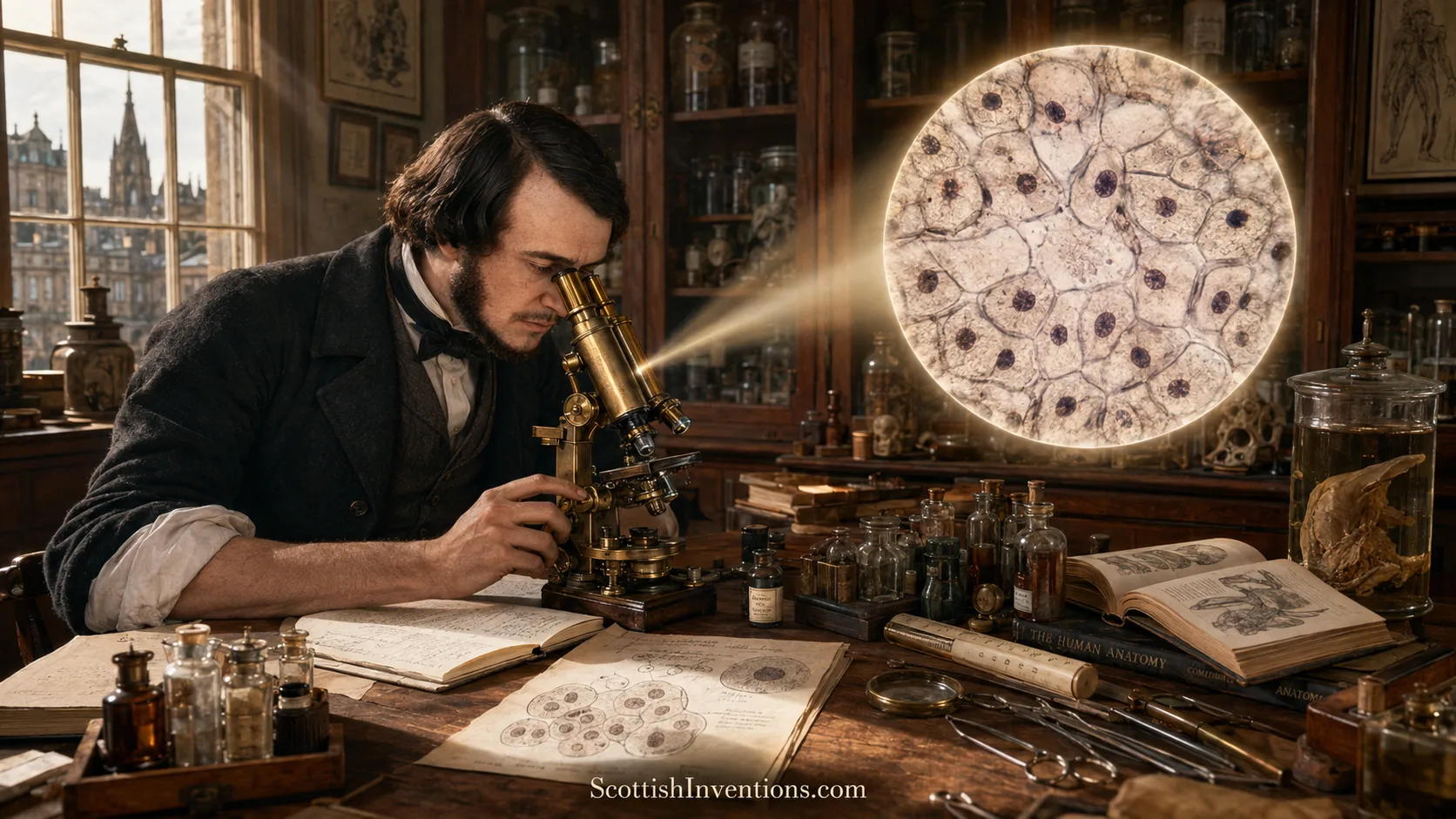
- John Goodsir (1814–1867), born in Anstruther, Fife, was one of the sharpest early observers of the living cell. In his 1845 book Anatomical and Pathological Observations he described nucleated cells as "centres of nutrition" — self-renewing units that produce successive generations of new cells by division.
- Rudolf Virchow, the German founder of cellular pathology, dedicated the first edition of his 1859 masterwork Die Cellularpathologie to Goodsir, calling him "one of the earliest and most acute observers of cell-life both physiological and pathological."
- But Goodsir did not invent cell theory. That was a shared, multinational achievement of Matthias Schleiden, Theodor Schwann, Robert Remak and Rudolf Virchow. Goodsir's place in the story is real, documented, and honoured — but it is a shared credit, not a sole one.
Scottish Impact Index (SI Score)
- Global Impact
- 7/10
- Longevity
- 8/10
- Economic / Material Impact
- 4/10
- Originality / Distinctiveness
- 8/10
- Legacy (Built Upon)
- 7/10
- Recognition
- 2/10
Key Findings
- John Goodsir (1814–1867), born in Anstruther, Fife, and later Professor of Anatomy at Edinburgh, published Anatomical and Pathological Observations in 1845, proposing that nucleated cells act as "centres of nutrition."
- He recognised that these centres are "the permanent source of successive broods of young cells" — a genuine, if loosely worded, anticipation of cell division as the source of growth.
- Rudolf Virchow dedicated Die Cellularpathologie (1859) to Goodsir, praising him as an early and acute observer of both healthy and diseased cell life.
- Goodsir was not the founder of cell theory: that credit belongs jointly to Schleiden, Schwann, Remak and Virchow.
- In 1842 Goodsir separately identified and named Sarcina ventriculi, a stomach micro-organism, linking it to a patient's disease decades before germ theory — though he believed it was a plant and did not prove causation in the modern sense.
- His younger brother Harry Goodsir died with the entire, 129-strong crew of Sir John Franklin's lost Arctic expedition, a tragedy that shadowed John's later life.
Quick Facts
- Discovery
- The nucleated cell as a 'centre of nutrition' — a self-renewing unit that produces successive broods of young cells by division
- Year
- 1845 — Anatomical and Pathological Observations, Edinburgh
- Key figure
- John Goodsir (1814–1867)
- Born
- 20 March 1814, Anstruther, Fife
- Role
- Conservator, Royal College of Surgeons Museum (1841); Professor of Anatomy, University of Edinburgh (1846)
- Also credited with
- Naming Sarcina ventriculi (1842), a stomach micro-organism linked to disease decades before germ theory
- Endorsed by
- Rudolf Virchow, who dedicated the first edition of Die Cellularpathologie (1859) to Goodsir
- Category
- Biology
- Claim status
- SHARED — Goodsir's 1845 work genuinely anticipated cell division as the source of new cells, but classical cell theory and 'omnis cellula e cellula' are co-credited to Schleiden, Schwann, Remak and Virchow
- What he did not do
- Formulate cell theory single-handedly, or state that the nucleus carries genetic information
- Family tragedy
- Younger brother Harry Goodsir died with all 129 men of the Franklin expedition, 1845–48
- Died
- 6 March 1867, Wardie, Edinburgh; buried in Dean Cemetery
A Fife Anatomist
John Goodsir was born on 20 March 1814 in Anstruther, a small fishing town on the East Neuk coast of Fife, into a dynasty of doctors. His father, also John Goodsir, was a surgeon in the town, and his grandfather had practised medicine in nearby Largo. He was baptised on 17 April 1814 and was the eldest of a large family: three of his brothers also became doctors — Harry, whose fate we return to below; Robert, who twice sailed to the Arctic searching for Harry; and Archibald — while another brother, Joseph Taylor Goodsir, entered the ministry.
Walking the shores of the Firth of Forth as a boy, collecting marine creatures, gave Goodsir a lifelong passion for natural history that never left him. He entered the University of St Andrews at around the age of twelve, matriculating in the arts course in December 1826, then moved to Edinburgh, where he was apprenticed in 1830 to the dental surgeon Robert Nasmyth. He built his medical education partly through university classes and partly through the celebrated extramural teachers Robert Knox, the anatomist, and James Syme, the surgeon. Knox in particular shaped Goodsir's conviction that comparative anatomy — the careful, comparative study of structure across species — was central to understanding how living things worked. Goodsir qualified as a Licentiate of the Royal College of Surgeons of Edinburgh (LRCSEd) in 1835 and returned to Anstruther to assist his father in general practice.
It is worth pausing on a claim that circulates in some popular accounts: that Goodsir trained in London, at St Bartholomew's Hospital, and took the MRCS in 1835. The best-sourced biographies do not support this. They point instead to St Andrews and Edinburgh training and the 1835 LRCSEd qualification, and this article follows that better-evidenced version rather than repeating the London claim as fact.
It was during this period, working as a country dentist and doctor in Fife, that Goodsir produced his first substantial piece of original science: a study of the development of human teeth, showing that the milk teeth were not, as had been thought, the "parents" of the permanent teeth, but developed independently of them. His paper, "On the Origin and Development of the Pulps and Sacs of the Human Teeth," was communicated to the British Association in 1838 and published in the Edinburgh Medical and Surgical Journal in 1839. It won him real international recognition as a careful, exact observer — the reputation that would carry him into the work on cells for which he is now remembered.
In 1840 Goodsir moved to Edinburgh proper. On 21 April 1841 he was appointed Conservator of the Museum of the Royal College of Surgeons of Edinburgh, succeeding William MacGillivray. In May 1843 he transferred to the University of Edinburgh as curator of part of the anatomical museum, adding the post of demonstrator of anatomy in 1844. When Alexander Monro tertius — the third and by far the weakest in a dynasty of Edinburgh anatomy professors, and an infamously poor lecturer — died, Goodsir was elected Professor of Anatomy at the University of Edinburgh in 1846.
Cell Science Before Goodsir
To understand what Goodsir actually achieved, it helps to see the state of cell science when he began his work — a field in genuine flux, with fundamental questions still wide open. The word "cell" itself had been coined as far back as 1665, when the English polymath Robert Hooke examined a thin slice of cork under an early microscope and saw a honeycomb of tiny, box-like chambers, which he named "cells" after the small rooms of a monastery. But Hooke was looking at dead plant tissue, and what he saw were empty walls — for well over a century afterwards, "cells" were widely understood as little more than empty pores or containers, not as living units in their own right.
In the 1670s the Dutch draper and pioneering microscopist Antonie van Leeuwenhoek pushed the technology further, observing living, moving micro-organisms he called "animalcules" — bacteria, protozoa and other single-celled life, seen for the first time by human eyes. But it would be another century and a half before the internal structure of cells, and their role as the building blocks of larger organisms, began to come into focus.
The turning point was the discovery of the nucleus — and here the story turns Scottish before it ever reaches Goodsir. Robert Brown, a botanist born in Montrose in 1773, named the "nucleus" as a regular feature of plant cells in a paper, "Observations on the Organs and Mode of Fecundation in Orchideæ and Asclepiadeæ," read to the Linnean Society of London on 1 and 15 November 1831 and published in the Transactions of the Linnean Society, volume 16, pages 685–746, in 1833. Others had glimpsed the structure before him, but Brown was, in the words of the Dictionary of Scientific Biography, "the first specially to demonstrate its general occurrence in living cells and to give it the name 'nucleus'."
From there, the pace quickened. The German botanist Matthias Schleiden proposed in 1838 that all plants are built of cells, and his compatriot Theodor Schwann extended the claim in 1839 to argue that all animal tissues are cellular too. Together, Schleiden and Schwann are rightly credited as the founders of classical cell theory — the idea that the cell is the basic structural and functional unit of all living things.
But crucial questions remained wide open exactly when Goodsir began his own investigations in the early 1840s. What did the nucleus actually do inside the cell? How did new cells actually form? What was the relationship between the nucleus and the ongoing life of the cell? Schleiden and Schwann, remarkably, got this last point wrong: they believed new cells crystallised out of a formless nutrient fluid, rather than arising from the division of existing cells. The correct answer — that cells arise only from pre-existing cells by division — would not be crisply and generally stated until Rudolf Virchow's omnis cellula e cellula, publicised in his lectures and 1858 book, itself building on Robert Remak's 1852 argument to the same effect. All of this observational progress was made possible by a technological leap: the achromatic microscope of the 1830s, which finally corrected the colour-fringing that had blurred the images produced by earlier lenses, letting anatomists see cellular detail clearly for the first time in history.
This, then, is the gap Goodsir stepped into: a field that had just gained the instruments to look properly at cells, had just gained the concept of the nucleus as a discrete structure, and had just proposed — in general and, on one crucial point, mistaken terms — that all living tissue was made of cells. What remained to be worked out was what cells and their nuclei were actually doing, moment to moment, inside a living, growing, healing or diseased body. That is precisely the question Goodsir set himself.
Centres of Nutrition
Goodsir's most important scientific contribution came out of his lectures of 1842–43 at the College of Surgeons, and crystallised in the small but influential book that grew from them, Anatomical and Pathological Observations, published jointly with his brother Harry in Edinburgh in 1845 by Myles Macphail.
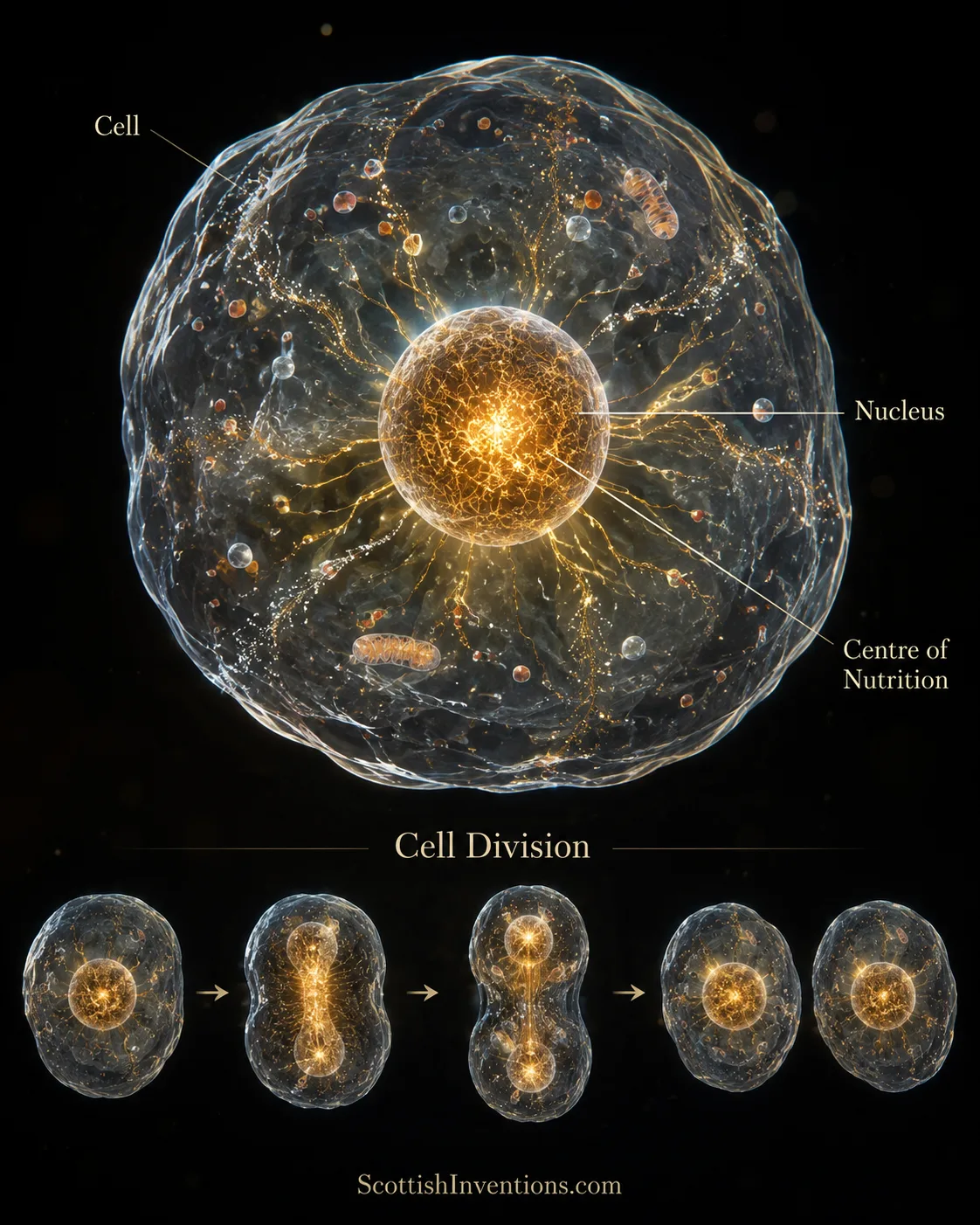
The book's leading idea was set out in its first paper, titled simply "Centres of Nutrition." Goodsir proposed that certain "minute cellular parts" — nucleated cells, scattered throughout the body's tissues — acted as engines of nutrition for the surrounding tissue. In his own words, these centres were "destined to draw from the capillary vessels, or from other sources, the materials of nutrition, and to distribute them by development to each organ or texture after its kind." He conceived of each such nucleus-and-cell unit as "the permanent source of successive broods of young cells" that filled the parent cell and were then passed off to become part of the tissue proper. He went further still, suggesting that the whole organism could be understood as subdivided into a number of these nutritive "departments," each supplied and maintained by its own local centres.
Read carefully, this is a genuinely original and forward-looking framework, for three distinct reasons. First, Goodsir recognised the importance of cell division specifically as the basis of growth and development — cells do not simply appear from nutrient fluid, as Schleiden and Schwann had supposed, but multiply from existing cellular material. Second, he differentiated the embryonic growth-centres of developing organs from the permanent "centres of nutrition" that maintain mature tissues throughout life — an early distinction between developmental and maintenance biology. Third, he established that cells are the active agents responsible for glandular secretion, rather than passive containers through which secretion merely passed. In all of this he built explicitly on the work of the Edinburgh-trained embryologist Martin Barry, who had already argued for the central importance of the nucleus in the formation of new cells.
Goodsir also examined the cells of specialised tissues, including cartilage and bone, and — crucially for what followed in the wider field — he studied pathological, diseased tissue alongside healthy tissue, an approach that fed directly into Virchow's later cellular pathology. It is important to be precise about what this body of work does, and does not, amount to. Goodsir did not formulate cell theory in the general sense that Schleiden and Schwann had already stated it, and he certainly did not state the modern principle that the nucleus contains the genetic instructions of the cell — that understanding lay an entire century in the future, awaiting the discovery of the structure and function of DNA. What Goodsir did was insist, ahead of most of his contemporaries, that the nucleated cell was the fundamental, active, self-renewing unit of the living body, and that its central role in that self-renewal was nutritive. That insight — modest in its exact terminology, prescient in its direction — is precisely why Virchow, dedicating the first edition of his Cellularpathologie (1859) to Goodsir, called him "one of the earliest and most acute observers of cell-life both physiological and pathological."
Sarcina ventriculi
In 1842, while Conservator at the College of Surgeons, Goodsir was consulted about a 19-year-old male patient who — in the words of the medical historians Ken Donaldson and Christopher Henry — "vomited a large volume of acidic, fermented-smelling, watery fluid every morning." Under his microscope Goodsir found the fluid teeming with a strange micro-organism, arranged in neat cubical packets of cells grouped in fours, giving the whole the appearance of tiny bales or bundles. He named it Sarcina ventriculi, from the Latin sarcina, the bundle or pack carried by a Roman legionary, which the organism's shape resembled.
He published the case in the Edinburgh Medical and Surgical Journal in 1842, under the title "History of a case in which a fluid periodically ejected from the stomach contained vegetable organisms (Sarcina ventriculi) of an undescribed form." A condensed version was reprinted the following year, 1843, in the Annals and Magazine of Natural History. The taxonomic authority for the organism is universally recorded as "Goodsir, 1842," and the name Sarcina ventriculi remains in scientific use today.
Two points of honesty are essential here, and this article states both plainly. First, a frequently repeated claim that the paper appeared in the London Medical Gazette is simply incorrect: the original and only publication was the Edinburgh Medical and Surgical Journal (1842, volume 57, pages 430–443). Second, Goodsir believed he was looking at a plant — a "vegetable organism" — because the concept of bacteria as a distinct biological kingdom did not yet exist in 1842. He classified the organism among the algae. We now know Sarcina ventriculi to be a Gram-positive anaerobic bacterium, still occasionally identified today in patients with delayed gastric emptying, gastric obstruction and related stomach conditions.
Even allowing for those qualifications, Goodsir's achievement here was remarkable for its time. He linked a specific micro-organism to a specific disease condition, treated the patient with the antiseptic creosote, and reported a cure — becoming, in Donaldson and Henry's assessment, "one of the first people to link a specific micro-organism with a disease." The microbiologist Milton Wainwright went further still, writing in "An Alternative View of the Early History of Microbiology" (Advances in Applied Microbiology, 2003): "Louis Pasteur is often, erroneously, credited with the discovery of the link between microbes and human disease; a far better candidate for this honour is however, Sir John Goodsir." That claim should be handled carefully: Goodsir did not culture the organism, did not satisfy what would later become Koch's postulates, and his conclusion rested on microscopy and correlation rather than controlled experiment. His insight was ahead of its time — roughly three decades before Pasteur's germ theory and Robert Koch's 1876 anthrax work — but it was not germ theory in the modern, rigorous sense, and this article does not present it as such.
There is a memorable, well-documented footnote to the story. In 1863 Charles Darwin, who suffered lifelong from debilitating vomiting and stomach trouble, read Goodsir's paper and consulted him directly. According to the Darwin Correspondence Project, three letters exchanged in August 1863 "indicate that Darwin had sent him a slide and a phial of vomit for analysis. Goodsir found no micro-organisms other than normal inhabitants of the mouth and stomach" — so, in this instance at least, the great naturalist's dyspepsia remained scientifically unexplained.
Professor of Anatomy
Goodsir took up the Edinburgh chair of anatomy in 1846 and transformed a department that had sunk into real disrepute under the ineffective Monro tertius. He extended and improved the dissecting rooms, recruited staff, and reorganised the museum, and his own enthusiasm and originality drew growing numbers of students — the anatomy class grew to 354 students by 1860–61. He was remembered as an inspiring, thoughtful lecturer, said to have opened his introductory lectures with his dissecting case in hand and the words: "Gentlemen, you have all got eyes; but..." — the point being that most people look without truly seeing.
His scientific range in these years was extraordinary and, by modern standards, almost dizzyingly broad. He lectured on the comparative anatomy of invertebrates from 1847, described the anatomy of the horse and the electric fish, worked on marine zoology — famously dredging around Orkney and Shetland with his close friend Edward Forbes in 1839 — and continued into embryology, sending a paper on the suprarenal, thyroid and thymus glands to the Royal Society, published in the Philosophical Transactions in 1846. At his home at 21 Lothian Street, shared with Forbes, he held the whimsical rank of "Triangle" in Forbes's convivial fellowship, the "Universal Brotherhood of the Friends of Truth."
From around 1850 Goodsir's health began to fail, with a slow, wasting neurological illness described by contemporaries as locomotor ataxia — a wasting affecting the spinal cord. His decline was made harder by the death of his brother Harry with Franklin, and then, in 1854, by the death of his beloved friend Forbes, whose natural-history lectures Goodsir took on in addition to his own already heavy teaching load. In his later years his thinking turned increasingly speculative and metaphysical, including a "triangle theory" holding that the triangle was the mathematical figure on which nature had built both the organic and inorganic worlds. He also, notably and perhaps surprisingly given his own cellular insights, remained a critic of Darwin's theory of evolution, believing that humans in particular could not have evolved from earlier forms.
Harry Goodsir and the Franklin Expedition
The most poignant thread running through the Goodsir story belongs to Harry — Henry Duncan Spens Goodsir — born in Anstruther on 3 November 1819. Like John, he trained in medicine, qualifying LRCSEd in 1840, and he was, if anything, an even more dedicated marine naturalist, publishing descriptions of new crustaceans found in the Firth of Forth. In August 1843 he succeeded John as Conservator of the Surgeons' Hall Museum. His three chapters in Anatomical and Pathological Observations (1845) contributed zoological and anatomical observations that John himself considered important in supporting his cellular ideas — the book was, in a real sense, a joint family achievement.
In 1845 — the very year the brothers' book appeared — Harry resigned his museum post to join Sir John Franklin's expedition in search of the Northwest Passage, sailing as acting assistant surgeon and naturalist aboard HMS Erebus, Franklin's own ship. The expedition, comprising HMS Erebus and HMS Terror, left England in May 1845; after five men were discharged and sent home from Disko Bay in Greenland, it continued, in the words of Parks Canada, "with 129 men on board." It was last seen by Europeans in Baffin Bay that summer and subsequently became icebound off King William Island. The ships were abandoned in April 1848; every single man died, in what remains the worst single disaster in the history of British polar exploration. Harry's last letter home, sent from Disko Island in June 1845, enclosed his final scientific paper, "On the Anatomy of Forbesia" — named, fittingly, for the friend the family shared with John.
Harry's fate has an extraordinary modern coda. In 1869 the American explorer Charles Francis Hall was led by Inuit guides to a grave on King William Island; the remains recovered there were interred beneath the Franklin Memorial at Greenwich, long believed to be those of Lieutenant Henry Le Vesconte. A forensic re-examination and facial reconstruction carried out in 2009 concluded that the remains were almost certainly Harry Goodsir's, matching a daguerreotype photograph taken of him in 1845, shortly before he sailed. This should be described precisely as it is: a strong forensic inference, not a DNA-confirmed certainty, since attempts to obtain usable DNA from the remains have so far failed. Harry's brother Robert made two Arctic voyages of his own, in 1849 and 1850, searching in vain for any trace of him.
Broader Contributions
Beyond the cell, Goodsir ranged widely across the sciences of his day. His dental embryology work of 1838–40 remained a reference point in odontology for decades. He contributed further to comparative anatomy and marine zoology, often publishing jointly with Forbes; he studied the mechanism of the knee joint; and in the 1850s he wrote on organic electricity and morphology. He briefly edited a journal, the Annals of Anatomy and Physiology, of which only three parts appeared, in 1851. Most of his papers were short, original notes on development, zoology, and microscopic physiology and pathology — around thirty in all — with the more important ones gathered into the 1845 Observations. His scientific circle included Forbes, Knox, Syme, the natural historian Robert Jameson (who lent him an Ehrenberg microscope), and the physicist Sir David Brewster — a genuine cross-section of the Edinburgh scientific establishment of the day.
Legacy
After Goodsir's death in 1867, his former student Sir William Turner edited his papers into the two-volume The Anatomical Memoirs of John Goodsir, F.R.S. (Edinburgh: Adam and Charles Black, 1868), with a biographical memoir by Henry Lonsdale; a portrait of Goodsir forms the frontispiece of volume one, and the plates were drawn by his late brother Harry — a final, moving collaboration between the two. His dying words to his student John Chiene — "Teach my students, Dr Chiene" — became a guiding motto for Chiene's own distinguished career, and something of a distillation of Goodsir's own priorities as a teacher.
Goodsir is buried in Dean Cemetery, Edinburgh, alongside his friend Edward Forbes. He is regarded today as a genuine pioneer of cytology whose international reputation rested chiefly on that one slim 1845 volume — and, above all, on the tribute paid by Virchow, who chose to dedicate his epoch-making book to a Scot rather than to his own living countrymen Schleiden and Schwann. The University of Edinburgh's Anatomical Museum and the Royal College of Surgeons of Edinburgh continue to preserve his memory and his collections.
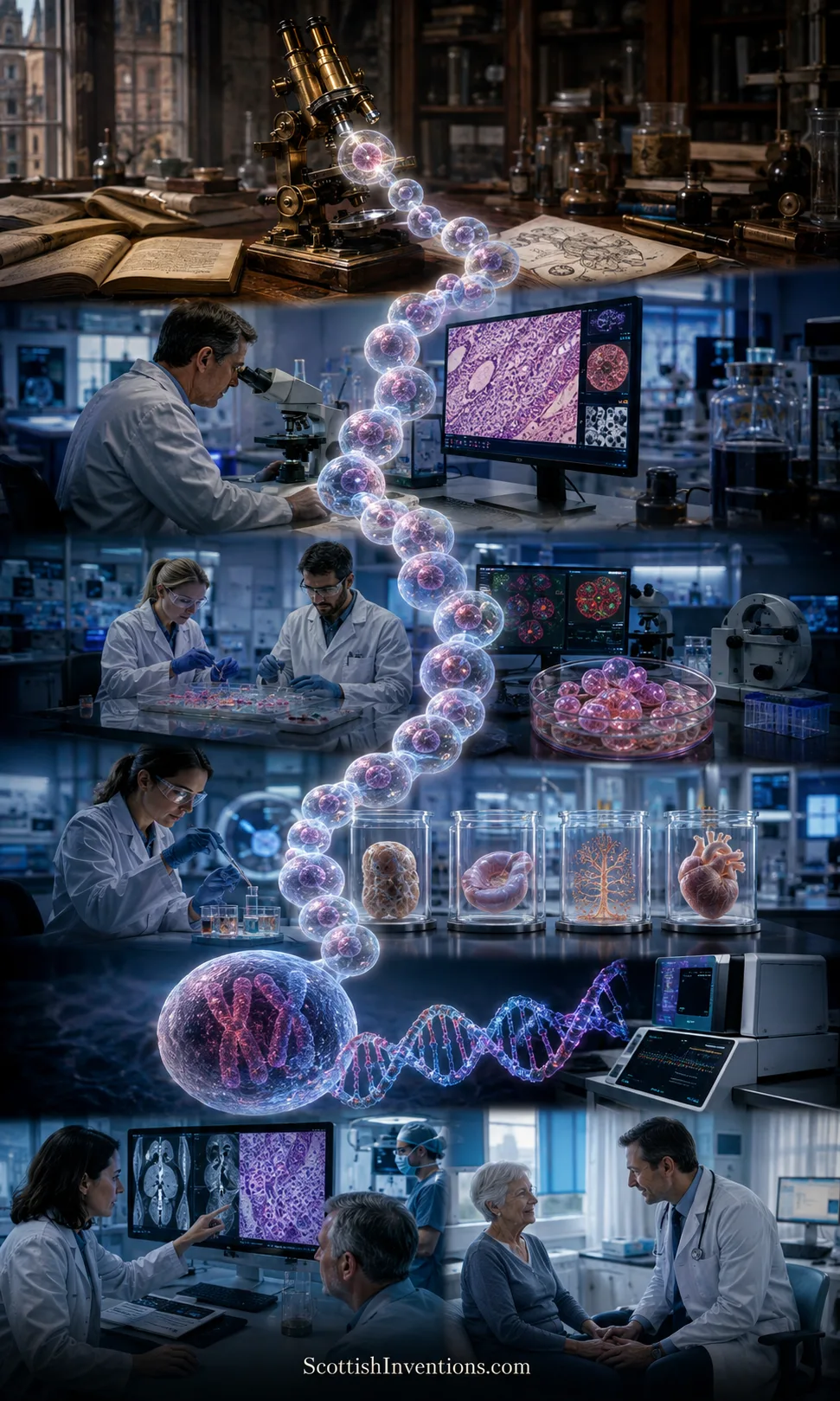
Cell biology is the foundation of essentially all modern medicine and biology. Every disease, from infection to cancer, is ultimately a story of what goes right or wrong inside cells. Goodsir's central instinct — that the nucleated cell is the active, self-renewing unit of the body, and that the nucleus is central to its life — pointed in exactly the right direction, even though the molecular machinery of the nucleus, DNA, genes and protein synthesis, would not be understood for another century. His close study of diseased cells prefigured the discipline of cellular pathology that underpins modern oncology, in which cancer is understood, at root, as a disease of uncontrolled cell division. And Sarcina ventriculi, the organism he named in 1842, is still encountered today in patients with delayed gastric emptying, gastric obstruction and other stomach conditions — a small, living link back to a young Fife doctor peering down his microscope nearly two centuries ago.
Timeline
1665
Robert Hooke coins the word 'cell'
Describes the box-like empty chambers he sees in cork under an early microscope
1670s
Antonie van Leeuwenhoek observes living micro-organisms
His 'animalcules' extend microscopy to living, moving cells
1773
Robert Brown born in Montrose
The Scottish botanist who will later name the cell nucleus
1814
John Goodsir born in Anstruther, Fife
Eldest son in a family of doctors; baptised 17 April 1814
1830s
The achromatic microscope arrives
Corrects colour-fringing and finally allows anatomists to see cellular detail clearly
1831–33
Robert Brown names the 'nucleus'
Published in the Transactions of the Linnean Society, establishing it as a regular feature of plant cells
1835
Goodsir qualifies LRCSEd
Trained at St Andrews and Edinburgh, not London, contrary to some popular accounts
1838
Matthias Schleiden proposes all plants are built of cells
The founding statement of what becomes classical cell theory
1839
Theodor Schwann extends the theory to animal tissues
Schleiden and Schwann are jointly credited as founders of cell theory
1841
Goodsir becomes Conservator, Royal College of Surgeons Museum
Succeeds William MacGillivray; begins the lectures that lead to his 1845 book
1842
Goodsir describes and names Sarcina ventriculi
Published in the Edinburgh Medical and Surgical Journal, vol. 57 — not the London Medical Gazette
1845
Goodsir publishes Anatomical and Pathological Observations
Sets out 'centres of nutrition' and the recognition that cell division underlies growth
1845
Harry Goodsir joins the Franklin expedition
Sails as assistant surgeon and naturalist on HMS Erebus; never returns
1846
Goodsir elected Professor of Anatomy at Edinburgh
Succeeds the poorly regarded Alexander Monro tertius
1852
Robert Remak argues new cells arise only by division of existing cells
An underacknowledged but crucial step towards omnis cellula e cellula
1855–58
Rudolf Virchow states 'omnis cellula e cellula'
Cells arise only from pre-existing cells — the doctrine that completes classical cell theory
1859
Virchow dedicates Die Cellularpathologie to Goodsir
Calls him 'one of the earliest and most acute observers of cell-life both physiological and pathological'
1863
Charles Darwin consults Goodsir about his stomach trouble
Sends a slide and a phial of vomit for microscopic analysis
1867
John Goodsir dies at Wardie, Edinburgh
Buried in Dean Cemetery beside his friend Edward Forbes
1868
The Anatomical Memoirs of John Goodsir published
Edited by his student Sir William Turner, with plates drawn by his late brother Harry
2009
Forensic reconstruction identifies remains as Harry Goodsir's
A grave on King William Island, long attributed to another officer, is matched to Harry's 1845 daguerreotype
Myths & Facts
Myth
John Goodsir invented cell theory.
Fact
Cell theory was proposed by Matthias Schleiden (1838) and Theodor Schwann (1839), and completed by Robert Remak and Rudolf Virchow's 'omnis cellula e cellula' (1855–58). Goodsir's 1845 work on 'centres of nutrition' anticipated part of this doctrine and earned Virchow's admiration, but he is a pioneering early contributor, not the theory's founder.
Myth
Goodsir proved that cells arise only from other cells.
Fact
That precise, generalised statement — omnis cellula e cellula — belongs to Virchow, building on Robert Remak's 1852 work. Goodsir in 1845 described nucleated cells producing 'successive broods of young cells' within specific tissues, a real anticipation, but stated less generally and a decade earlier than the doctrine that became standard.
Myth
Goodsir's Sarcina ventriculi paper appeared in the London Medical Gazette.
Fact
It did not. The original publication was the Edinburgh Medical and Surgical Journal (1842, volume 57, pages 430–443), with a condensed reprint in the Annals and Magazine of Natural History in 1843.
Myth
Goodsir discovered germ theory before Pasteur.
Fact
He linked a specific micro-organism to a specific disease in 1842, which is a genuine and early achievement, but he believed the organism was a plant, did not culture it, and did not establish anything resembling Koch's postulates. It is a striking anticipation of germ theory, not germ theory itself.
Myth
Goodsir trained in London and held the MRCS.
Fact
The best-sourced biographies indicate he trained at St Andrews and Edinburgh and qualified LRCSEd in 1835; the London/St Bartholomew's and MRCS claims are not well supported and are treated here as unverified.
Myth
Virchow's dedication of Cellular Pathology to Goodsir means Goodsir founded cellular pathology.
Fact
Virchow founded cellular pathology; his dedication to Goodsir was a tribute to Goodsir's acuity as an early observer of both healthy and diseased cell life, not an acknowledgement of priority over Virchow's own doctrine.
Did You Know?
- Goodsir's brother Harry sailed with Sir John Franklin's ill-fated Arctic expedition in 1845 and was never seen again — one of the 129 men who perished.
- Goodsir identified a stomach bacterium, Sarcina ventriculi, in 1842 — nearly two decades before Pasteur and Koch established germ theory — though he believed he was looking at a plant.
- The cell nucleus, discovered and named in plants by fellow Scot Robert Brown of Montrose, was studied by Goodsir as a "centre of nutrition" directing the life of the cell — two Scots helping to build the foundations of modern biology.
- Goodsir taught generations of Edinburgh medical students the cellular basis of disease, helping cement Edinburgh's reputation as one of the world's great medical schools; his dying words were "Teach my students."
- "Cell" as a word was coined by Robert Hooke in 1665; by the 1840s, Goodsir at Edinburgh was helping to work out what cells actually did.
Honest Caveats
- Priority in cell theory: cell theory was an international achievement. Schleiden (1838), Schwann (1839) and Virchow (1855–58), building on Remak (1852), are its principal authors; Goodsir's role was as an important early observer of cell nutrition and division, not as originator.
- The "London Medical Gazette" myth: the Sarcina paper's frequently claimed original venue is incorrect; the verified publication is the Edinburgh Medical and Surgical Journal (1842, vol. 57, pp. 430–443), with an 1843 reprint in the Annals and Magazine of Natural History.
- London training / MRCS 1835: not well supported by the best biographical sources and treated here as unverified.
- Harry Goodsir's remains: the 2009 identification is a strong forensic inference, not a DNA-confirmed certainty, since attempts to obtain usable DNA have so far failed.
- Sarcina as a pathogen: its role in human disease is still not fully established; it is often a harmless bystander, so Goodsir's causal claim should not be overstated.
- Cause of Goodsir's death: described in contemporary sources as locomotor ataxia, a wasting of the spinal cord; a precise modern diagnosis cannot be confirmed.
FAQ
Did John Goodsir invent cell theory?
No, and this article does not claim that he did. Classical cell theory — the idea that all living things are built of cells — was proposed by Matthias Schleiden (plants, 1838) and Theodor Schwann (animals, 1839), and completed by Robert Remak and Rudolf Virchow's 'omnis cellula e cellula' (all cells from cells, 1855–58). Goodsir's genuine contribution, in his 1845 book Anatomical and Pathological Observations, was to describe the nucleated cell as a 'centre of nutrition' that produces successive generations of young cells by division — a real anticipation of part of that later doctrine, but not the founding statement of cell theory itself.
So why is Goodsir remembered at all?
Because Rudolf Virchow, the German pathologist who completed cell theory, chose to dedicate the first edition of his epoch-making 1859 book Die Cellularpathologie to Goodsir, calling him 'one of the earliest and most acute observers of cell-life both physiological and pathological.' That is a remarkable, verifiable tribute from the man most associated with the modern doctrine — evidence that Goodsir's early, careful observations of cell nutrition and division were recognised as a genuine forerunner, even though Virchow did not credit him with priority over Schleiden and Schwann, his own countrymen.
What exactly did Goodsir's 1845 'centres of nutrition' idea say?
Goodsir proposed that nucleated cells throughout the body's tissues acted as engines of nutrition, drawing material from the capillaries and distributing it to build each organ 'after its kind'. He described each such nucleus-and-cell unit as 'the permanent source of successive broods of young cells' — meaning the cell produces further cells from within itself, which then leave to become part of the surrounding tissue. That is a genuine, if imprecisely worded, statement that new cells arise from existing ones through division, made a decade before Virchow's crisper formulation.
Who actually gets credit for 'omnis cellula e cellula'?
Rudolf Virchow, who popularised the Latin aphorism (itself reinterpreted from the earlier French naturalist François-Vincent Raspail) in his lectures and 1858 book. Robert Remak had already argued in 1852 that new cells arise only by division of pre-existing cells, and is now seen by historians as an underacknowledged co-author of the idea. Goodsir's 1845 work sits earlier still in the story, describing cell division as the basis of growth, but in less precise and less generalised terms than Remak or Virchow. Modern histories of science treat cell theory, including the division doctrine, as a shared, multinational achievement of Schleiden, Schwann, Remak and Virchow — with Goodsir as an important early contributor rather than a co-founder.
What was Sarcina ventriculi and did Goodsir really beat Pasteur to germ theory?
In 1842 Goodsir examined the vomit of a young patient under his microscope and found it full of a micro-organism arranged in neat cubical packets, which he named Sarcina ventriculi. He linked the organism to the patient's condition, treated him with the antiseptic creosote, and reported a cure — decades before Pasteur's germ theory or Koch's 1876 anthrax work. But this should not be overstated: Goodsir believed he was looking at a plant (the concept of bacteria as a distinct kingdom did not yet exist), he did not culture the organism, and his conclusion rested on microscopy and correlation rather than anything resembling Koch's postulates. It is a striking anticipation, not proof of germ theory.
Where was the Sarcina ventriculi paper actually published?
In the Edinburgh Medical and Surgical Journal in 1842 (volume 57, pages 430–443), with a condensed reprint in the Annals and Magazine of Natural History in 1843. A frequently repeated claim that it appeared in the London Medical Gazette is incorrect and is not repeated here.
Is it true Goodsir trained in London?
The claim that Goodsir trained at St Bartholomew's Hospital in London and took the MRCS in 1835 appears in some popular accounts, but the best-sourced biographies indicate he trained at St Andrews and Edinburgh and qualified as a Licentiate of the Royal College of Surgeons of Edinburgh (LRCSEd) in 1835. This article follows the better-supported version and flags the London claim as unverified.
What happened to Goodsir's brother Harry?
Harry Goodsir, John's younger brother and scientific collaborator, sailed in 1845 as assistant surgeon and naturalist aboard HMS Erebus on Sir John Franklin's expedition to find the Northwest Passage. The expedition became icebound off King William Island; the ships were abandoned in 1848, and all 129 men died in what remains the worst disaster in the history of British polar exploration. In 2009 forensic reconstruction identified remains long buried under the Franklin Memorial at Greenwich, and previously attributed to another officer, as almost certainly Harry's.
Did the discovery of the cell nucleus have another Scottish connection?
Yes. The nucleus that Goodsir studied and reinterpreted as a 'centre of nutrition' had been named a decade earlier by Robert Brown, a Scottish botanist born in Montrose, in a paper read to the Linnean Society in 1831. Two Scots — Brown and Goodsir — were involved in identifying and interpreting the structure that would prove central to the modern understanding of the cell, though neither worked out its full genetic significance, which lay a century in the future.
Why is the claim status for this entry marked 'shared' rather than 'established'?
Because Goodsir's role in cell theory is genuinely a shared one, and stating otherwise would overreach the evidence. He made a real, documented, and highly praised early contribution — his 'centres of nutrition' concept and his recognition of cell division as the basis of growth were acknowledged by Virchow himself. But the classical cell theory that his work anticipated is properly credited to Schleiden, Schwann, Remak and Virchow, whose formulations were more general, more precisely stated, and more widely adopted at the time. Presenting Goodsir as the sole or primary founder of cell theory would misrepresent the historical record; presenting him as an important, internationally recognised early contributor is accurate.
Does Goodsir's work still matter for modern medicine?
Yes, in spirit if not in molecular detail. His insistence that the nucleated cell was the fundamental, active, self-renewing unit of the body — and that the nucleus was central to its life — pointed in exactly the right direction, decades before DNA and the genetic mechanism of the nucleus were understood. His attention to diseased as well as healthy cells prefigured cellular pathology, the discipline (founded by Virchow) that today underpins the understanding of cancer as a disease of uncontrolled cell division. Sarcina ventriculi, the organism he named in 1842, is still identified today in patients with certain stomach conditions.
Sources
Tier 1 · Primary
- Goodsir, J. and Goodsir, H., Anatomical and Pathological Observations, Edinburgh: Myles Macphail, 1845.
- Goodsir, J., "History of a case in which a fluid periodically ejected from the stomach contained vegetable organisms (Sarcina ventriculi) of an undescribed form," Edinburgh Medical and Surgical Journal, vol. 57, 1842, pp. 430–443.
- Turner, W. (ed.), The Anatomical Memoirs of John Goodsir, F.R.S., 2 vols., Edinburgh: Adam and Charles Black, 1868, with biographical memoir by Henry Lonsdale.
- Virchow, R., Die Cellularpathologie, Berlin, 1859 (first edition, dedicated to John Goodsir).
- Brown, R., "Observations on the Organs and Mode of Fecundation in Orchideæ and Asclepiadeæ," Transactions of the Linnean Society, vol. 16, 1833, pp. 685–746.
- Darwin Correspondence Project, correspondence between Charles Darwin and John Goodsir, August 1863.
- Parks Canada, records and archaeology relating to the Franklin expedition (HMS Erebus and HMS Terror), 1845–48.
Tier 2 · Scholarly and institutional
- Donaldson, K. and Henry, C., historical account of Goodsir and Sarcina ventriculi (Scottish Medical Journal / Journal of the Royal College of Physicians of Edinburgh, variously attributed).
- Wainwright, M., "An Alternative View of the Early History of Microbiology," Advances in Applied Microbiology, vol. 52, 2003.
- Forensic identification of remains from the Franklin Memorial, Greenwich, published 2009.