Discoveries · No. 41 · Medicine
Respiratory Physiology & Decompression Science
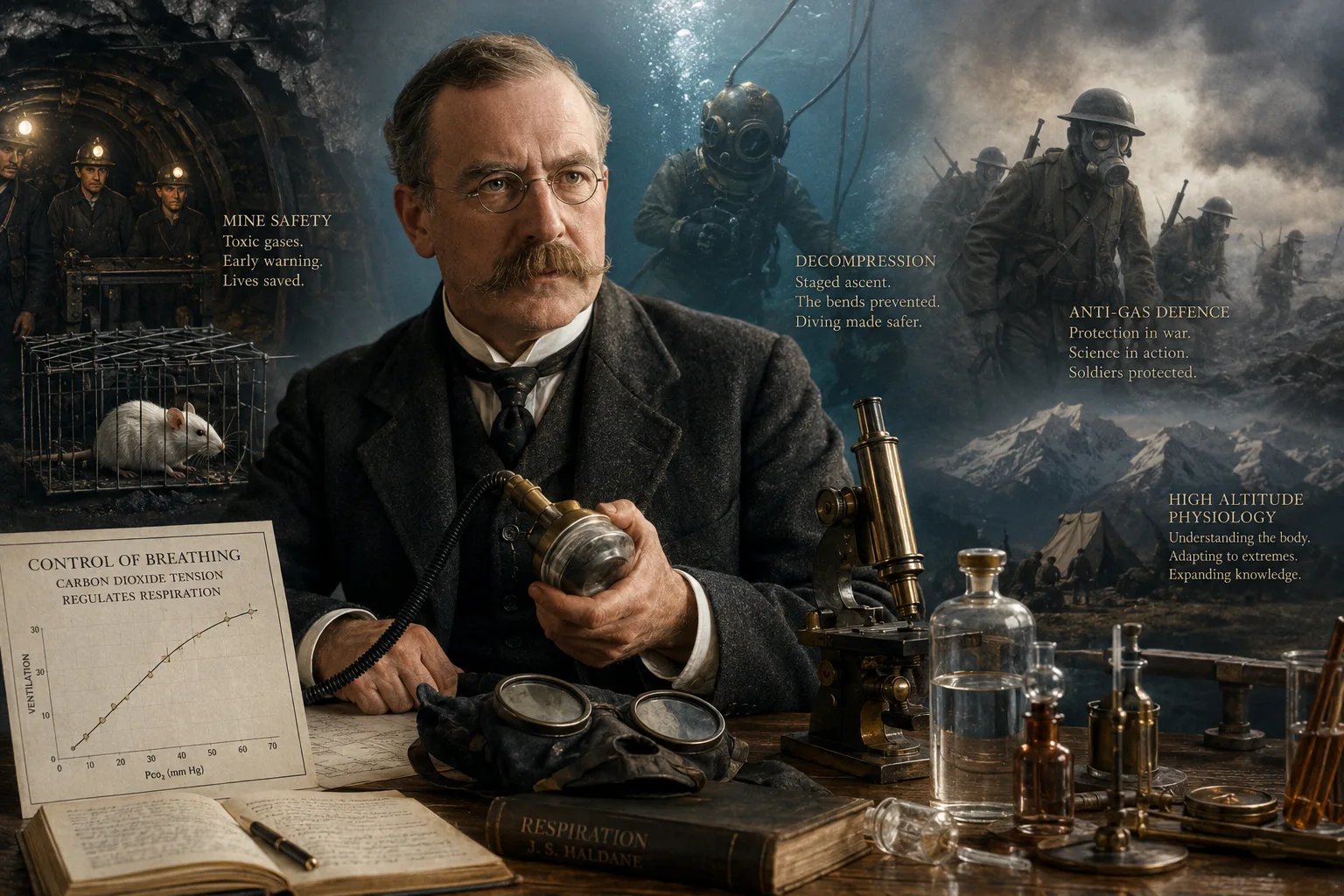
John Scott Haldane proved in 1905 that carbon dioxide, not oxygen, controls human breathing — then spent the next three decades applying that instinct for field-tested physiology to mines, diving bells and the Western Front, sometimes locking himself in gas chambers to find out.
John Scott Haldane · 1860–1936Discovery published · 1905Reading time · 32 minUpdated 16 August 2026
TL;DR
- Born in Edinburgh in 1860, John Scott Haldane established in 1905 that carbon dioxide tension, not oxygen lack, is the primary trigger governing human breathing, invented practical gas-analysis apparatus, investigated the toxic gases behind mining disasters, devised staged decompression to prevent "the bends" (1908), and built Britain's first wartime anti-gas respirator (1915).
- Much of his fame rests on genuinely foundational science, but several widely repeated claims need qualification: the canary-in-the-mine story is broadly true but he originally recommended mice, not canaries; his 1908 decompression "2:1 rule" was found unreliable within decades and revised; his "oxygen secretion" lung theory was experimentally refuted in his own lifetime; and the "father of the gas mask" label glosses over an early design that barely worked.
- Haldane remains a genuinely towering figure in occupational and environmental medicine — but the honest picture is of a brilliant, fearless self-experimenter whose theories were sometimes wrong, and whose son J. B. S. Haldane later became still more famous.
Scottish Impact Index (SI Score)
- Global Impact
- 8/10
- Longevity
- 9/10
- Economic / Material Impact
- 6/10
- Originality / Distinctiveness
- 9/10
- Legacy (Built Upon)
- 8/10
- Recognition
- 4/10
Key Findings
- Control of breathing (1905). With J. G. Priestley, Haldane demonstrated that breathing is governed chiefly by the tension of carbon dioxide in the blood acting on the brain's respiratory centre, not primarily by oxygen level — the foundation of modern respiratory physiology, though later shown to be incomplete.
- Decompression science (1906–1908). Commissioned by the Royal Navy, Haldane, Boycott and Damant ran extensive pressure-chamber and open-water trials, publishing "The Prevention of Compressed-Air Illness" in 1908 and establishing staged decompression — still the conceptual basis of modern dive computers.
- Mine safety and toxic gases. Investigating disasters such as the 1896 Tylorstown Colliery explosion, Haldane identified carbon monoxide in "afterdamp" as the principal killer of surviving miners and recommended carrying small, gas-sensitive animals underground — the documented origin of the "canary in the coal mine," though his own 1896 recommendation specified mice.
- Wartime respirator (1915). After the first German chlorine attacks at Ypres, Haldane designed the Black Veil Respirator, Britain's first purpose-built anti-gas mask — quickly found inadequate and superseded within months.
- High-altitude physiology (1911). Haldane co-led the Anglo-American Pikes Peak Expedition, studying acclimatisation and periodic breathing at 14,110 feet, alongside under-credited fieldwork by Mabel FitzGerald.
- The Haldane effect (1892). With J. Lorrain Smith, described the finding that deoxygenated haemoglobin binds carbon dioxide more readily than oxygenated haemoglobin — still taught in every physiology curriculum.
- A flawed theory never abandoned. Haldane's "oxygen secretion" theory of the lung was disproved by August and Marie Krogh in 1910, yet he defended a version of it as late as 1935.
Quick Facts
- Discovery
- Carbon dioxide tension in the blood, not oxygen lack, is the primary trigger controlling normal human breathing
- Year
- 1905 — with John Gillies Priestley
- Key figure
- John Scott Haldane (1860–1936)
- Born
- Edinburgh, 2 or 3 May 1860 (sources differ by a day)
- Category
- Medicine / Respiratory & Occupational Physiology
- Also known for
- Staged decompression diving (1908), mine gas safety (1896), wartime gas defence (1915), altitude physiology (1911)
- Decompression tables
- Developed jointly with Arthur E. Boycott and Guybon C. Damant — not by Haldane alone
- Mine gas recommendation
- 1896 report specified small rodents (mice); the canary is a later, popularised association from the early twentieth century
- Flawed theory
- 'Oxygen secretion' in the lung, disproved by August and Marie Krogh in 1910; Haldane never fully conceded
- Gas mask claim
- His 1915 Black Veil Respirator was Britain's first purpose-built chemical respirator, but was quickly superseded — not the definitive 'invention of the gas mask'
- Family
- Brother of Viscount Haldane; father of biologist J. B. S. Haldane; daughter Naomi Mitchison became a novelist
- Claim status
- Established — core discoveries genuinely foundational, but several popular claims (canary, gas mask, 2:1 rule) are simplified or contested and are stated explicitly below
- Died
- Oxford, night of 14–15 March 1936
Early Life and Career
John Scott Haldane was born in Edinburgh into a prominent Scottish family — his brother was Richard Burdon Haldane, later Viscount Haldane and Lord Chancellor of Great Britain. Sources differ by a single day on his exact birth date: most modern biographical entries and Wikipedia give 2 May 1860, while Encyclopaedia Britannica gives 3 May 1860. It is a minor discrepancy, but the honest approach is to flag it rather than silently pick one. He was educated at Edinburgh Academy and the University of Edinburgh, graduating in medicine in 1884, with short periods of further study at Jena and Berlin rounding out his early scientific formation on the Continent.
His earliest substantial research, on the composition of air in dwellings and schools, was carried out at Dundee and published in 1887 — an unglamorous but telling first project for a scientist who would spend the rest of his career asking, again and again, exactly what is in the air people are breathing and what it is doing to their bodies. He then joined his uncle, the physiologist John Burdon-Sanderson, at Oxford as a demonstrator in physiology, and Oxford remained his institutional base for the rest of his career. Notably, he was later denied the title of Professor of Physiology there, a career disappointment that some biographers link to his unconventional, field-based approach to science — an approach that sat uneasily with a purely laboratory-bound academic physiology department, but that produced results no laboratory-bound colleague matched.
Haldane's defining trait, noted by contemporaries and later biographers alike, was his refusal to separate laboratory theory from practical, often dangerous, field application. He frequently used himself as a test subject, locking himself in sealed gas chambers and recording his own physiological responses to potentially lethal concentrations of carbon monoxide, carbon dioxide and other gases — sometimes with his young daughter Naomi, later the prolific novelist Naomi Mitchison, stationed at the door to pull him out or perform resuscitation if he collapsed. His son, J. B. S. Haldane, later one of the twentieth century's most celebrated biologists, was drawn into his father's experiments from childhood and was formally co-credited on decompression research from around the age of thirteen — an almost unimaginable degree of family involvement in dangerous experimental science by today's standards, but characteristic of how the elder Haldane worked.
The 1905 Discovery: The Regulation of Breathing
Working with J. G. Priestley, Haldane established that the human respiratory centre in the brain is normally governed chiefly by the tension of carbon dioxide in arterial blood. Even small rises in blood CO2 trigger a marked, rapid increase in ventilation, while the body tolerates surprisingly low oxygen levels before hyperventilation kicks in purely on that basis. Haldane and Priestley's data, echoed by Haldane's earlier work with J. Lorrain Smith from the early 1890s, showed that hypoxic hyperventilation in human subjects did not reliably occur until inspired oxygen fell below roughly fourteen per cent — confirming that carbon dioxide, not oxygen, was the day-to-day driver of ordinary breathing.
This was a genuinely counterintuitive finding for its time. It would have been natural to assume that breathing exists chiefly to supply oxygen, and that the body would therefore be exquisitely sensitive to falling oxygen levels. Haldane and Priestley's careful measurements showed the opposite: the system is tuned above all to keep carbon dioxide, and by extension blood acidity, within a narrow range, with oxygen supply treated as a secondary and much less urgent signal under normal conditions. This finding underpinned decades of respiratory medicine and remains substantially correct today.
It was not, however, the complete story, and an accuracy-first account should say so plainly rather than leaving the impression that Haldane closed the book on the question. A separate, oxygen-sensitive pathway via the peripheral chemoreceptors — clusters of specialised cells in the carotid and aortic bodies — was identified across research spanning the 1920s to the 1960s, complicating the simple "carbon dioxide is everything" version of Haldane's model that persisted in some textbooks and clinical folklore for much of the twentieth century. Modern respiratory physiology teaches both pathways: a dominant central, CO2-and-pH-driven mechanism, essentially Haldane's discovery, alongside a real, separate, oxygen-sensitive peripheral mechanism that Haldane's original 1905 model did not include.
Mine Disasters, Toxic Gas, and the Canary
From the 1890s, Haldane was repeatedly called in to investigate the causes of death after coal-mine explosions and fires — work that culminated in an influential 1896 report examining the aftermath of disasters including the explosion at Tylorstown Colliery in the Rhondda Valley, Wales. Through direct examination of victims' blood, Haldane established that carbon monoxide in "afterdamp" — the toxic residual atmosphere left after an explosion — rather than the explosion or fire itself, was killing many miners who had survived the initial blast. Carbon monoxide is colourless and odourless, and binds haemoglobin far more readily than oxygen, meaning that rescuers and survivors alike could be poisoned with no warning whatsoever from their own senses.
Haldane's practical response was to recommend that rescue and exploration parties carry small animals with a fast metabolism, and correspondingly greater sensitivity to carbon monoxide poisoning, so that visible distress in the animal would give miners advance warning to retreat before they themselves were overcome. This is the genuine origin of what became known, in popular culture, as "the canary in the coal mine" — but the popular version compresses a considerably messier reality, and this article will not repeat the flattened version.
Haldane's own 1896 report focused on mice, not canaries; birds only began appearing in his published recommendations in the early twentieth century, some years after canaries were already being used informally in British collieries. Historians have also pointed out that European miners — notably in the Harz Mountains of Germany, itself supplied by Austrian Alpine miners — had informally used caged canaries as gas detectors since at least the seventeenth century, well before Haldane's work existed at all. The fairest formulation, and the one this article adopts, is that Haldane's research gave the practice its first scientific justification and helped make it standard and official policy — the UK's Coal Mines Act 1911 followed his recommendations — rather than that he invented the idea of using caged animals underground from nothing. The use of canaries in British mines continued, remarkably, until 1986, when they were finally replaced by electronic gas detectors — a full ninety years after Haldane's original report.
Decompression Sickness and Staged Decompression
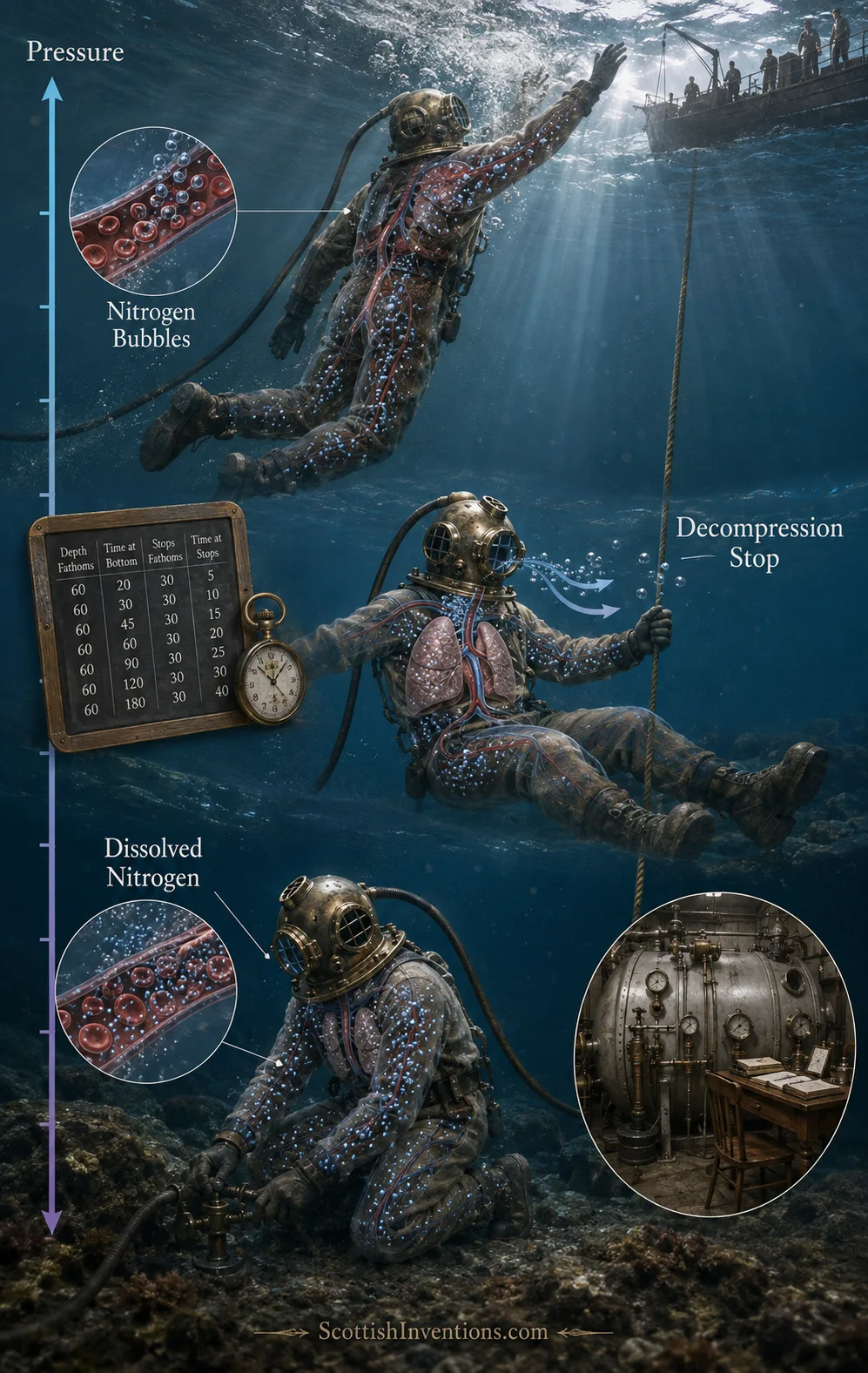
In 1906 the Royal Navy's Deep Diving Committee commissioned Haldane to investigate "caisson disease" — what divers and tunnel and bridge workers called "the bends," a painful and sometimes fatal condition caused by nitrogen bubbles forming in body tissue during ascent from high-pressure environments. Building on earlier work by the French physiologist Paul Bert, who had identified dissolved nitrogen as the underlying cause, and by Leonard Hill, who had proposed slow continuous decompression as a remedy, Haldane assembled a team that included Arthur E. Boycott and Guybon C. Damant. Together — and it is important to say together, since this was never a solo Haldane achievement — they ran hundreds of pressure-chamber trials on goats, chosen partly because their tissue mass and circulation made them a rough analogue for humans, along with human experiments in a chamber at the Lister Institute and open-water dives in Scottish sea lochs.
Their 1908 paper, "The Prevention of Compressed-Air Illness," published in the Journal of Hygiene, volume 8, established that different tissues in the body saturate and desaturate with nitrogen at different rates, modelled as a set of theoretical "compartments" with different half-times. Crucially, they showed that a diver could ascend rapidly through the early part of an ascent and then pause at set depths — staged decompression — rather than ascending continuously and slowly, as earlier theory had demanded. This was a genuine practical breakthrough. It made deep salvage work — famously the recovery of over five million pounds in gold from the wreck of the Laurentic in the 1920s — and commercial and naval diving dramatically safer than they had been.
The general architecture of staged decompression, with multiple tissue compartments of different speeds, remains the conceptual basis of virtually all diving computers and tables in use today, including the Bühlmann ZH-L16 model that underlies most recreational dive computers on the market. But popular retellings often compress the 1908 findings into a single, tidy "2:1 decompression ratio" — the idea that tissues could tolerate a halving of ambient pressure without bubble formation — and present that ratio as a permanent, simple rule that Haldane single-handedly worked out. In fact, the ratio was found within a few decades to be too conservative for fast tissues and not conservative enough for slow tissues on long or deep dives, and it was revised downward, for example to roughly 1.6:1 or 1.58:1, by later researchers such as Robert Workman. At least one detailed historical reconstruction of Haldane's original work argues that his own tables did not mechanically apply a strict 2:1 rule at all, and that he stated more caveats and qualifications than later popularisers generally credited him with. The honest summary is that Haldane, Boycott and Damant established the enduring conceptual framework of staged, multi-compartment decompression; the specific numbers have been revised repeatedly ever since, exactly as good applied science should be.
Wartime Chemical Defence and the Black Veil Respirator
After the German army's first large-scale chlorine gas attack against Allied troops at the Second Battle of Ypres on 22 April 1915, the British War Office urgently sought protective equipment. Haldane travelled to the front at the request of Lord Kitchener to help identify the gas being used and to design protection against it. His result, introduced within days, was the "Black Veil Respirator": cotton wool pads soaked in an absorbent chemical solution, principally sodium thiosulphate and related compounds, wrapped in black cotton veiling and tied over the mouth and nose.
In practice it performed poorly. Soldiers who used it reported that it became unusable within minutes in a live gas cloud, and it required constant re-moistening simply to keep functioning at all. It was superseded within months, first by prototype hood-style respirators such as the one developed by Canadian doctor Cluny Macpherson, adopted as the British Smoke Hood or PH Helmet from mid-1915, and then, through 1916, by the considerably more effective Small Box Respirator, which became the standard-issue British and Imperial gas mask for the remainder of the war.
Haldane continued to advise on chemical defence and toxicology throughout the conflict, and his rapid, urgent first response undoubtedly saved lives in the immediate weeks after Ypres when no protection at all existed. But the frequently repeated claim that he simply "invented the gas mask" flattens a fast-moving, collaborative and iterative wartime effort into a single act of invention. His real contribution was the first working, if flawed, British response, developed under enormous time pressure — not the definitive or lasting design that actually protected troops for most of the war.
High-Altitude Physiology: The Pikes Peak Expedition
In 1911, building on a conversation with Yandell Henderson of Yale at an international physiology congress in Vienna the previous year, Haldane co-organised the Anglo-American Pikes Peak Expedition with C. G. Douglas of Oxford, Henderson, and Edward C. Schneider of Colorado College. The four researchers spent five continuous weeks at the 14,110-foot summit of Pikes Peak, Colorado — reachable by cog railway, with rooms converted into a working laboratory — recording blood gas measurements, ventilation rates, and the periodic, or Cheyne-Stokes, breathing pattern that appears during acclimatisation to high altitude. The resulting 1913 paper in the Philosophical Transactions of the Royal Society remains a landmark study in high-altitude physiology, still cited in modern mountain and aerospace medicine.
A less-told part of the story deserves equal weight here rather than a passing mention. Physiologist Mabel FitzGerald was also part of the expedition but, rather than working in the summit laboratory alongside her male colleagues, conducted parallel fieldwork alone, travelling through Colorado mining towns at altitudes between roughly 6,000 and 10,800 feet to measure the breathing of long-term residents acclimatised to those elevations. Her data are still cited by researchers today, but for much of the twentieth century her contribution to the expedition received far less recognition than that of Haldane, Douglas, Henderson and Schneider — a documented historical imbalance, not a matter of speculation, and one this article states plainly rather than passing over.
A Theory Haldane Got Wrong: "Oxygen Secretion"
Not every Haldane theory held up, and an accuracy-first account should not omit this simply because it is unflattering. Partly influenced by the Danish physiologist Christian Bohr, Haldane championed the idea that the lung does not merely allow oxygen to passively diffuse into the blood, but actively "secretes" it against a pressure gradient, particularly at altitude or under physiological stress. It was an elegant idea, consistent with some of his own high-altitude data as he interpreted it, and he defended it vigorously for years.
The theory was directly and convincingly refuted by the Danish husband-and-wife physiologists August and Marie Krogh in a series of papers published in 1910, which showed that passive diffusion alone was entirely sufficient to explain gas exchange in the lung, with no need to invoke an active secretory mechanism. Notably — and this is worth stating explicitly rather than smoothing over — Haldane did not fully concede the point even after the Kroghs' work became widely accepted. The second edition of his major textbook Respiration, published in 1935, the year before his death, still devoted a chapter to defending a version of oxygen secretion. It stands as a genuinely interesting and well-documented reminder that even a scientist of Haldane's stature and track record could hold onto a disproven idea in the face of strong, repeated contrary evidence.
Later Life, Honours and Death
Haldane's later career combined continued industrial and physiological consultancy — he advised on ventilation for mines, tunnels, submarines and ships — with an increasing interest in the philosophy of science, particularly the relationship between biology, mechanism and personality, reflected in books such as Organism and Environment (1917), The New Physiology (1919) and The Philosophy of a Biologist (1936). His 1916 Silliman Lectures at Yale were published as Respiration in 1922 and, revised in 1935, remained a standard reference for respiratory physiologists for years afterward. He founded the Journal of Hygiene and held numerous honours, including Companion of Honour and fellowship of the Royal Society.
He died at Oxford on the night of 14–15 March 1936, shortly after returning from a trip to investigate heat stroke among oil-refinery workers in Persia, modern-day Iran — a fittingly field-based final research project for a scientist who spent his entire career studying how ordinary working people's bodies coped with dangerous environments, right up to the end of his life.
Legacy
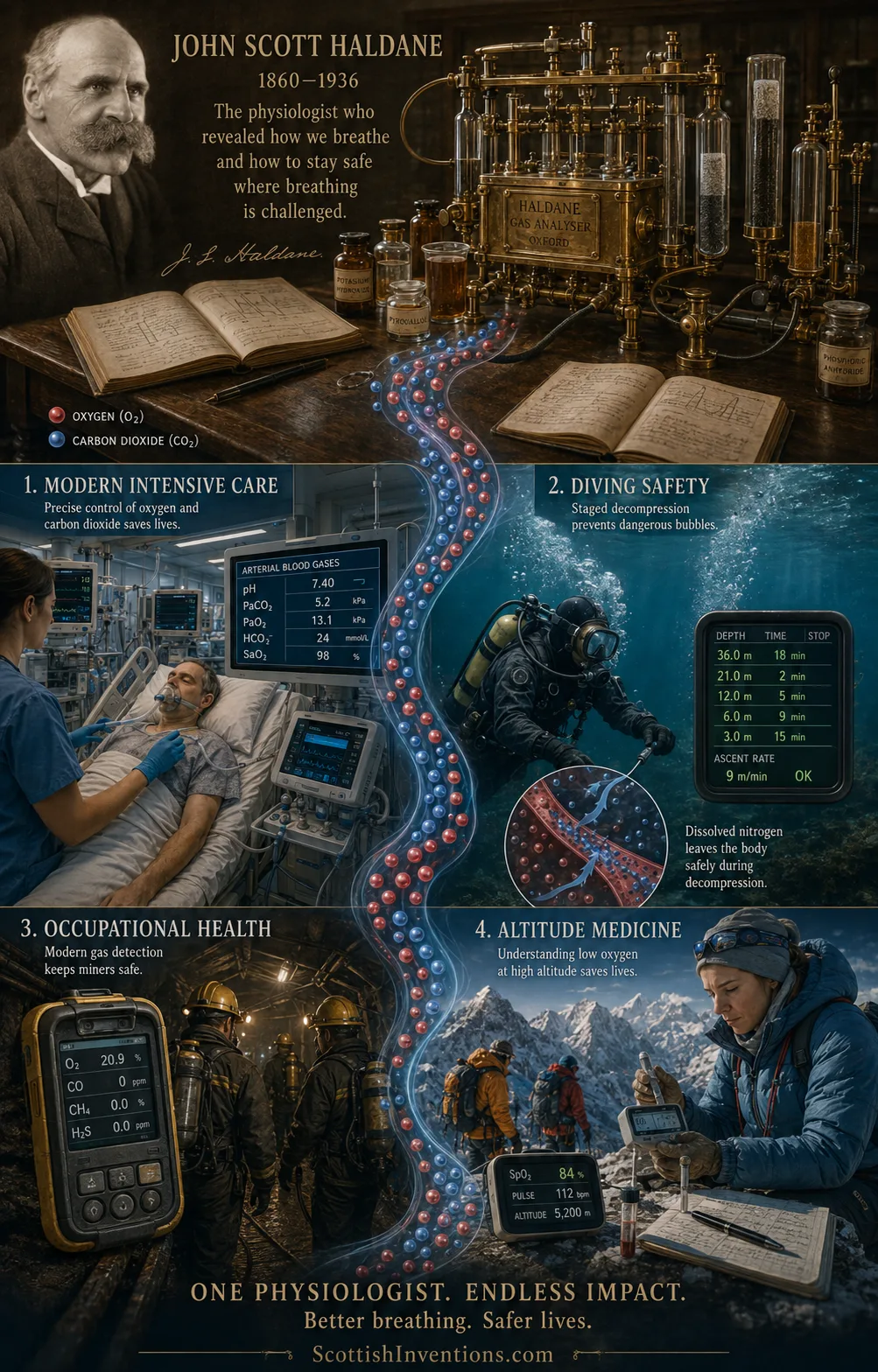
Haldane's influence on modern medicine and industry is broad and, in most areas, still directly traceable. Blood-gas analysis in intensive care units, where clinicians monitor arterial CO2 and oxygen tension to guide ventilator settings, rests on the physiological principles he and Priestley established in 1905. Every recreational and commercial diving computer in use today embeds, in updated and repeatedly revised form, the multi-compartment staged-decompression logic first set out by Haldane, Boycott and Damant in 1908. Digital and electrochemical gas detectors now used in mining operations worldwide are the direct engineering descendants of the early-warning principle Haldane established with his 1896 mine-gas recommendations, even though the canaries and mice themselves have long since been retired.
His occupational medicine legacy extends further still, into modern standards for ventilation in submarines, tunnels and confined industrial spaces, and into the broader discipline of industrial toxicology that grew out of his insistence on measuring, rather than guessing at, the exact composition of the air workers actually breathed. Even his failures are instructive: the "oxygen secretion" episode is now a staple teaching example in the history and philosophy of science, illustrating how even rigorous, field-tested scientists can resist a well-evidenced refutation of a theory they have personally championed.
Haldane's family also left an outsized mark. His son J. B. S. Haldane became one of the most influential biologists of the twentieth century, and his daughter Naomi Mitchison became a prolific and respected novelist. In the balance of historical memory, it is entirely possible that more people today have heard of J. B. S. Haldane than of John Scott Haldane himself — a reminder that scientific legacies, like the physiology Haldane studied, do not always distribute credit evenly or predictably.
Timeline
1860
John Scott Haldane born in Edinburgh (2 or 3 May, sources differ)
Son of a prominent Scottish family; brother Richard Burdon Haldane later became Viscount Haldane and Lord Chancellor
1884
Graduates in medicine from the University of Edinburgh
After study at Edinburgh Academy, Edinburgh University, and short periods at Jena and Berlin
1887
Publishes early research on air quality in dwellings and schools, carried out at Dundee
His first substantial research output, foreshadowing his lifelong interest in the air people actually breathe
1892
With J. Lorrain Smith, describes what becomes known as the Haldane effect
Deoxygenated haemoglobin binds carbon dioxide more readily than oxygenated haemoglobin
1896
Investigates the Tylorstown Colliery disaster and other mine explosions
Identifies carbon monoxide in 'afterdamp' as the main killer of miners who survived the initial blast; recommends carrying small rodents (mice) underground as an early-warning system
1905
Publishes, with J. G. Priestley, the discovery that CO2 tension governs breathing
Becomes the foundation of modern respiratory physiology
1906
Commissioned by the Royal Navy's Deep Diving Committee to investigate 'caisson disease'
Begins pressure-chamber and open-water trials with Arthur E. Boycott and Guybon C. Damant
1908
Publishes 'The Prevention of Compressed-Air Illness' with Boycott and Damant
Establishes staged decompression and the first practical dive tables — a genuine turning point in diving safety
1910
August and Marie Krogh disprove Haldane's 'oxygen secretion' theory of the lung
Haldane does not fully accept the refutation
1911
Co-leads the Anglo-American Pikes Peak Expedition on high-altitude physiology
With C. G. Douglas, Yandell Henderson and Edward C. Schneider; Mabel FitzGerald conducts parallel, later under-credited fieldwork
1911
UK's Coal Mines Act follows Haldane's mine gas-safety recommendations
Formalises the practice of carrying sensitive animals underground
1913
Pikes Peak results published in the Philosophical Transactions of the Royal Society
A landmark study in altitude medicine
1915
Designs the Black Veil Respirator after the Second Battle of Ypres
Britain's first purpose-built anti-gas respirator, but quickly found inadequate and superseded within months
1916
The Small Box Respirator becomes standard British issue
Developed collaboratively, superseding Haldane's earlier design
1922
Publishes Respiration, based on his 1916 Silliman Lectures at Yale
Becomes a standard reference text for respiratory physiologists
1935
Second edition of Respiration still defends a version of 'oxygen secretion'
The year before his death, despite the theory's refutation twenty-five years earlier
1936
Dies at Oxford on the night of 14–15 March, shortly after fieldwork in Persia
A fittingly field-based final research project studying heat stroke among oil-refinery workers
1986
Canaries are finally withdrawn from British mines, replaced by electronic detectors
The practical end of the tradition traceable to Haldane's 1896 recommendation
Myths & Facts
Myth: Haldane invented the canary in the coal mine.
Fact: His 1896 recommendation, following investigation of mine disasters such as Tylorstown Colliery, specified small rodents — mice — not canaries. Birds only appear in his published advice from the following decade, some years after canaries were already being used informally in British collieries, a practice with roots reaching back centuries in continental European mining. Haldane's real contribution was giving the underlying idea its first scientific justification and helping make it official policy under the Coal Mines Act 1911.
Myth: Haldane invented the gas mask.
Fact: His Black Veil Respirator of May 1915 was Britain's first purpose-built chemical respirator, developed at speed after the German chlorine attacks at Ypres, but it worked poorly and was superseded within months by better, collaboratively developed designs, including the Small Box Respirator. He deserves credit for the first urgent response, not for the definitive invention of the gas mask as a category.
Myth: Haldane single-handedly developed the decompression tables used in diving.
Fact: The 1908 paper that established staged decompression was joint work by Haldane, Arthur E. Boycott and Guybon C. Damant, commissioned by the Royal Navy's Deep Diving Committee. All three carried out the extensive pressure-chamber and open-water trials involved.
Myth: Haldane's decompression tables used a simple, fixed 2:1 ratio that is still applied today.
Fact: The popularised '2:1 rule' was found within decades to be unreliable for long or deep dives and was revised by later researchers such as Robert Workman. Detailed historical reconstruction suggests Haldane's original tables were more hedged than the popular summary implies. The general staged, multi-compartment architecture he helped establish endures; the specific numbers do not.
Myth: All of Haldane's major theories have stood the test of time.
Fact: His 'oxygen secretion' theory of the lung — that the lung actively pumps oxygen into the blood against a pressure gradient — was experimentally disproved by August and Marie Krogh in 1910. Haldane continued to defend a version of it as late as the 1935 edition of his textbook Respiration, the year before he died.
Myth: Haldane's 1905 CO2 theory of breathing control is the complete modern explanation.
Fact: It remains foundational and substantially correct, but incomplete: the discovery of oxygen-sensitive peripheral chemoreceptors between the 1920s and 1960s showed that oxygen tension also drives ventilation through a separate pathway, not solely through carbon dioxide as Haldane's original model implied.
Did You Know?
- Haldane's daughter, Naomi (later the prolific novelist Naomi Mitchison), acted as his safety observer during his gas-chamber self-experiments as a child, ready to pull him to safety or perform resuscitation.
- His son, J. B. S. Haldane, was formally credited as a co-author on decompression research at around age 13 and went on to become one of the most famous biologists of the twentieth century — arguably more famous today than his father.
- Haldane's original mine-safety recommendation was for mice, not canaries; canaries only entered his published advice in the following decade, by which point some British collieries were already informally using them.
- His flawed 'oxygen secretion' theory of the lung, though decisively disproved in 1910, was still being defended in the final (1935) edition of his own textbook the year before he died.
- The 1908 '2:1 ratio' widely, and often loosely, attributed to Haldane's decompression tables was, according to specialist reconstructions of his original work, more nuanced and hedged than later writers, including designers of modern dive computers, often gave him credit for.
- He is sometimes called 'the father of oxygen therapy' in modern medical literature, a retrospective title rather than one used in his own lifetime.
- Canaries remained in official use in British mines until 1986, ninety years after Haldane's original 1896 gas-safety report.
Honest Caveats
The canary story is real but simplified. Haldane's 1896 recommendation is the documented scientific origin of the official mine-canary practice, but his original recommendation specified mice; birds appear in his writing only later, and informal use of caged canaries by European miners predates his work by centuries. State it as "Haldane's recommendation is the documented scientific origin of the official mine-canary practice," not "Haldane invented the canary in the coal mine."
Haldane did not invent the gas mask. His Black Veil Respirator, May 1915, was Britain's first purpose-built chemical respirator, but was quickly found inadequate in the field and superseded within months by better designs developed with other contributors, notably Cluny Macpherson. Credit him with the first British response, not the definitive invention of the gas mask as a category.
The "2:1 decompression ratio" is a popular simplification. This ratio was found within a few decades to be too conservative for fast tissues and not conservative enough for slow tissues on long or deep dives, and was revised downward, for example to roughly 1.6:1, by later researchers such as Robert Workman. At least one detailed historical reconstruction argues Haldane's own tables did not mechanically apply a strict 2:1 rule and that he stated more caveats than later popularisers credited him with.
The 1908 decompression work was joint, not solo. Arthur E. Boycott and Guybon C. Damant were full collaborators in the research and the resulting paper, and this article credits them accordingly throughout.
The CO2 theory of breathing control is correct but incomplete. The discovery of oxygen-sensitive peripheral chemoreceptors in the 1920s–1960s showed that oxygen tension also directly drives ventilation via a separate pathway, not merely through CO2 and pH as Haldane's original model implied. This article presents his 1905 finding as a landmark first step, not the final word.
"Oxygen secretion" in the lung was experimentally wrong. It was disproved by August and Marie Krogh in 1910 and is not presented here as one of Haldane's successes.
Birth date discrepancy. Sources split between 2 May 1860 (Wikipedia and most modern biographical entries) and 3 May 1860 (Encyclopaedia Britannica). This article hedges rather than asserting one as definitive.
"Father of oxygen therapy" is a retrospective honorific, used in modern review literature such as a widely cited 2014 Indian Journal of Anaesthesia profile, not a contemporary title Haldane held or claimed himself.
Frequently Asked Questions
Did John Scott Haldane discover why we breathe?
He gave the founding scientific demonstration, in 1905 with J. G. Priestley, that the tension of carbon dioxide in arterial blood — not the level of oxygen — is what chiefly governs the rate and depth of normal human breathing. This remains a landmark and substantially correct finding, though it was later shown to be incomplete: oxygen-sensitive peripheral chemoreceptors, identified between the 1920s and 1960s, provide a separate pathway by which oxygen tension also directly drives ventilation. Haldane's 1905 discovery should be presented as a foundational first step, not the final or complete account of breathing control.
Did Haldane invent staged decompression diving alone?
No. The 1908 paper 'The Prevention of Compressed-Air Illness' was joint work between Haldane, Arthur E. Boycott and Guybon C. Damant, commissioned by the Royal Navy's Deep Diving Committee. All three ran the extensive pressure-chamber and open-water trials that established staged decompression. Crediting Haldane alone, as some popular accounts do, understates a genuinely collaborative research programme.
Did Haldane invent the canary in the coal mine?
Not quite as the popular story has it. Haldane's genuine 1896 contribution was identifying carbon monoxide in mine 'afterdamp' as the chief killer of miners who survived an initial explosion, and recommending that rescue parties carry small, fast-metabolism animals as an early-warning system. But his original 1896 recommendation specified mice, not canaries; birds only entered his published advice in the following decade, by which point some British collieries were already using canaries informally, a practice with roots going back centuries in European mining. The fair statement is that Haldane's work gave the practice its first scientific justification and helped make it official policy — not that he invented the idea of using caged animals underground from nothing.
Did Haldane invent the gas mask?
He designed Britain's first purpose-built chemical respirator, the Black Veil Respirator, in May 1915 after the German chlorine gas attacks at the Second Battle of Ypres. It was developed and issued under enormous time pressure, and it worked poorly in the field, becoming unusable within minutes and requiring constant moistening. It was superseded within months by better designs, including work associated with Cluny Macpherson, and then by the Small Box Respirator through 1916. Haldane deserves credit for the first urgent British response and for ongoing wartime toxicology advice, not for inventing the gas mask as a category.
What was Haldane's 2:1 decompression rule, and is it still used?
Popular accounts often summarise Haldane's 1908 approach as a simple rule of thumb: that body tissues could tolerate a halving of ambient pressure on ascent without forming dangerous nitrogen bubbles. In practice this was found within a few decades to be too conservative for fast tissues and not conservative enough for slow tissues on long or deep dives, and was revised (for example by researcher Robert Workman, to a ratio closer to 1.6:1). At least one detailed historical reconstruction argues that Haldane's original published tables were more hedged and less mechanically simple than the popularised '2:1 rule' suggests. The general architecture he introduced — multiple tissue compartments desaturating at different rates, with staged rather than continuous decompression — remains the conceptual basis of virtually every modern diving computer, even though the specific numbers have been repeatedly revised.
Was Haldane's 'oxygen secretion' theory correct?
No. Haldane argued that the lung actively 'secretes' oxygen into the blood against a pressure gradient, particularly under stress or at altitude. This was directly and convincingly disproved by the Danish husband-and-wife physiologists August and Marie Krogh in 1910, who showed passive diffusion was sufficient to explain gas exchange in the lung. Notably, Haldane did not fully concede the point: the 1935 second edition of his textbook Respiration, published the year before he died, still devoted a chapter to defending a version of the theory.
Who was Mabel FitzGerald, and why does she matter to this story?
Mabel FitzGerald was a physiologist who took part in the 1911 Anglo-American Pikes Peak Expedition alongside Haldane, C. G. Douglas, Yandell Henderson and Edward C. Schneider. Rather than working in the summit laboratory with her male colleagues, she conducted parallel fieldwork alone, travelling through Colorado mining towns at a range of altitudes to measure the breathing of long-term residents. Her data remain cited today, but for much of the twentieth century her contribution to the expedition received far less recognition than that of her male colleagues — a documented historical fact worth stating plainly.
Is Haldane really 'the father of oxygen therapy'?
That title appears in modern review literature, including a widely cited 2014 profile in the Indian Journal of Anaesthesia, but it is a retrospective honorific rather than a title Haldane held or claimed in his own lifetime. It is reasonable to use with clear attribution to later commentary, but it should not be presented as a contemporary description of how Haldane was known.
Was Haldane's son more famous than Haldane himself?
In many respects, yes, at least in later twentieth-century public recognition. J. B. S. Haldane, drawn into his father's experiments from childhood and formally co-credited on decompression research from around the age of 13, went on to become one of the most celebrated biologists of the twentieth century, contributing foundational work in genetics and evolutionary biology. John Scott Haldane's reputation today rests more on specialist recognition within occupational and respiratory medicine than on the broader public fame his son achieved.
What exactly is the 'Haldane effect'?
Described with J. Lorrain Smith from an 1892 study, the Haldane effect is the finding that deoxygenated haemoglobin binds carbon dioxide more readily than oxygenated haemoglobin does. It is still taught in every physiology curriculum and remains clinically relevant, for example in the management of chronic obstructive pulmonary disease (COPD), where excess supplemental oxygen can paradoxically reduce a patient's ability to offload carbon dioxide.
When exactly was Haldane born?
Sources genuinely disagree: most modern biographical entries and Wikipedia give 2 May 1860, while Encyclopaedia Britannica gives 3 May 1860. This article treats the discrepancy honestly rather than silently picking one date as definitive.
What should modern readers take away from Haldane's career?
That he was a genuinely field-based, self-experimenting scientist whose most durable achievements — the CO2 control of breathing, the architecture of staged decompression, and the scientific basis for mine gas safety — remain foundational in medicine and industry today. But several of the most repeated popular claims about him (the canary, the gas mask, the precise 2:1 decompression rule) are simplifications of a messier, more collaborative and more contested reality, and his own 'oxygen secretion' theory shows that even a scientist of his stature could be demonstrably wrong and reluctant to say so.
Sources & Further Reading
Tier 1 · Primary
- Haldane, J. S. and Priestley, J. G. — papers establishing CO2 regulation of breathing, 1905.
- Haldane, J. S., Boycott, A. E. and Damant, G. C. C. — "The Prevention of Compressed-Air Illness," Journal of Hygiene, vol. 8, 1908.
- Haldane, J. S. — Respiration, 1922, revised 2nd edition 1935.
- Haldane, J. S. — report on the Tylorstown Colliery and related mine-explosion investigations, 1896.
Tier 2 · Scholarly and institutional
- Krogh, A. and Krogh, M. — papers refuting the "oxygen secretion" theory of the lung, 1910.
- Douglas, C. G., Haldane, J. S., Henderson, Y. and Schneider, E. C. — Pikes Peak Expedition results, Philosophical Transactions of the Royal Society, 1913.
- Historical and clinical literature on the "father of oxygen therapy" epithet, including a widely cited 2014 Indian Journal of Anaesthesia profile.
- Historical reconstructions of Haldane's decompression tables and the "2:1 ratio," and of the mine-canary tradition in European mining.
Tier 3 · Site source document
docs/sources/discoveries/decompression.md— the commissioned source document underlying this article.