Discoveries · No. 40 of 50 · Mathematics
Peter Guthrie Tait and the First Knot Tables
A physics idea that failed, and a mathematics that outlived it: how an Edinburgh professor's smoke rings led to the first systematic classification of knots.
Peter Guthrie Tait · 1831\u20131901Tables, 1876\u20131885Reading time · 15 minUpdated 1 August 2026
TL;DR
- Peter Guthrie Tait (1831\u20131901), Professor of Natural Philosophy at the University of Edinburgh, produced between 1876 and 1885 the first systematic tables of knots, arranged by the number of crossings in their diagrams \u2014 the founding act of mathematical knot theory as an organised discipline.
- The project began as physics, not mathematics: Tait's smoke-ring experiments in 1867 prompted his friend William Thomson (Lord Kelvin) to propose that atoms were stable knotted vortices in the ether. That theory later collapsed completely, but the classification tool Tait built to support it survived and became permanent mathematics \u2014 which is why this page files the discovery under Mathematics while telling the physics story in full.
- Tait's tables were not a solo achievement: the English mathematician Thomas Kirkman produced an independent, competing enumeration, and the American Charles Newton Little extended and corrected both. Tait's own conjectures about alternating knots went unproven for a century, finally settled in 1987 using a tool \u2014 the Jones polynomial \u2014 that none of the original tabulators could have imagined.
Scottish Impact Index (SI Score)
- Global Impact
- 7/10
- Longevity
- 9/10
- Economic / Material Impact
- 3/10
- Originality / Distinctiveness
- 9/10
- Legacy (Built Upon)
- 8/10
- Recognition
- 2/10
Key Findings
- Tait's knot tables, published mainly in his 1885 paper On Knots, catalogued distinct knots up to ten crossings, building the first reference apparatus for what a "different" knot even meant mathematically.
- The project's origin was physics: Kelvin's 1867 vortex-atom theory, inspired directly by Tait's smoke-ring demonstrations, proposed that chemical elements were different knotted vortex rings in a universal ether. This theory was later abandoned entirely.
- Tait proposed several conjectures on alternating knots from his tabulation work, which resisted proof for over a hundred years until finally settled in 1987 by Kauffman, Murasugi and Thistlethwaite, independently, using the Jones polynomial.
- Tait did not work alone or first in every respect: Thomas Kirkman produced a rival, independent set of tables, and Charles Newton Little extended and corrected the combined record over the following two decades.
- The mathematics Tait built survives today in DNA topology, polymer physics and quantum field theory \u2014 fields whose existence he could not have anticipated, even though the physical theory that motivated his original work has been discarded.
Quick Facts
- Discovery
- The first systematic tables of knots, and the Tait conjectures on alternating knot diagrams
- Years
- Vortex-atom idea 1867; knot tabulation 1876–1885; conjectures proved 1987
- Key figure
- Peter Guthrie Tait (1831–1901)
- Born / died
- 28 April 1831, Dalkeith, Midlothian · 4 July 1901, Challenger Lodge, Edinburgh
- Post
- Professor of Natural Philosophy, University of Edinburgh, 1860–1901
- Category used here
- Mathematics — though the project began as physics (see below for why)
- Claim status
- Shared — tabulation was co-developed and cross-checked with rival tabulators
- Rival/parallel tabulators
- Thomas Kirkman (England) and Charles Newton Little (United States)
- Trigger
- Kelvin's 1867 vortex-atom theory of matter, prompted by Tait's smoke-ring demonstrations
- Proof of conjectures
- Louis Kauffman, Kunio Murasugi and Morwen Thistlethwaite, 1987, via the Jones polynomial
- Modern relevance
- DNA topology, polymer physics, statistical mechanics, quantum field theory
Who Was Peter Guthrie Tait?
Peter Guthrie Tait was a Scottish mathematical physicist who spent more than forty years as Professor of Natural Philosophy at the University of Edinburgh. He is best remembered in physics for co-authoring, with his lifelong friend William Thomson (Lord Kelvin), the monumental Treatise on Natural Philosophy \u2014 the standard physics textbook of its era. But Tait's most enduring legacy sits in an unexpected place: between 1876 and 1885 he produced the first systematic tables of knots, laying groundwork that grew, over the following century, into a permanent and active branch of pure mathematics.
The story is worth telling honestly because it does not flatter a simple narrative of solitary Scottish genius. Tait's tabulation project began life as an attempt to support a physical theory of matter that turned out to be wrong; it was carried out in parallel with, and partly in competition with, other mathematicians in England and the United States; and its central conjectures took a hundred years and several non-Scottish mathematicians to prove. All of that is what makes it an interesting and genuinely important episode in the history of ideas, rather than a simple invention story.
Early Life & Background
Peter Guthrie Tait was born in Dalkeith, Midlothian, on 28 April 1831, the son of John Tait, secretary to the Earl of Buccleuch. After his father's early death, Tait was raised largely by his mother's family and educated at Dalkeith Grammar School and then Edinburgh Academy, where he formed a close and lasting friendship with the slightly younger James Clerk Maxwell. He went on to the University of Edinburgh and then to Peterhouse, Cambridge, where in 1852 he graduated as Senior Wrangler \u2014 top of the Cambridge Mathematical Tripos \u2014 ahead of contemporaries who would themselves become distinguished scientists.
Tait taught mathematics at Queen's College, Belfast, from 1854 to 1860, working alongside the chemist Thomas Andrews on the properties of gases, before returning to Scotland in 1860 to take the Chair of Natural Philosophy at Edinburgh, succeeding James David Forbes. He held that chair until his death in 1901. Tait was combative in print, famously feuding in the scientific press over questions of priority (notably regarding the history of energy conservation, where he championed James Prescott Joule and William Thomson against claims for other contributors), and had a lifelong personal passion for golf that fed directly into some of his later scientific work.
Smoke Rings and the Vortex Atom
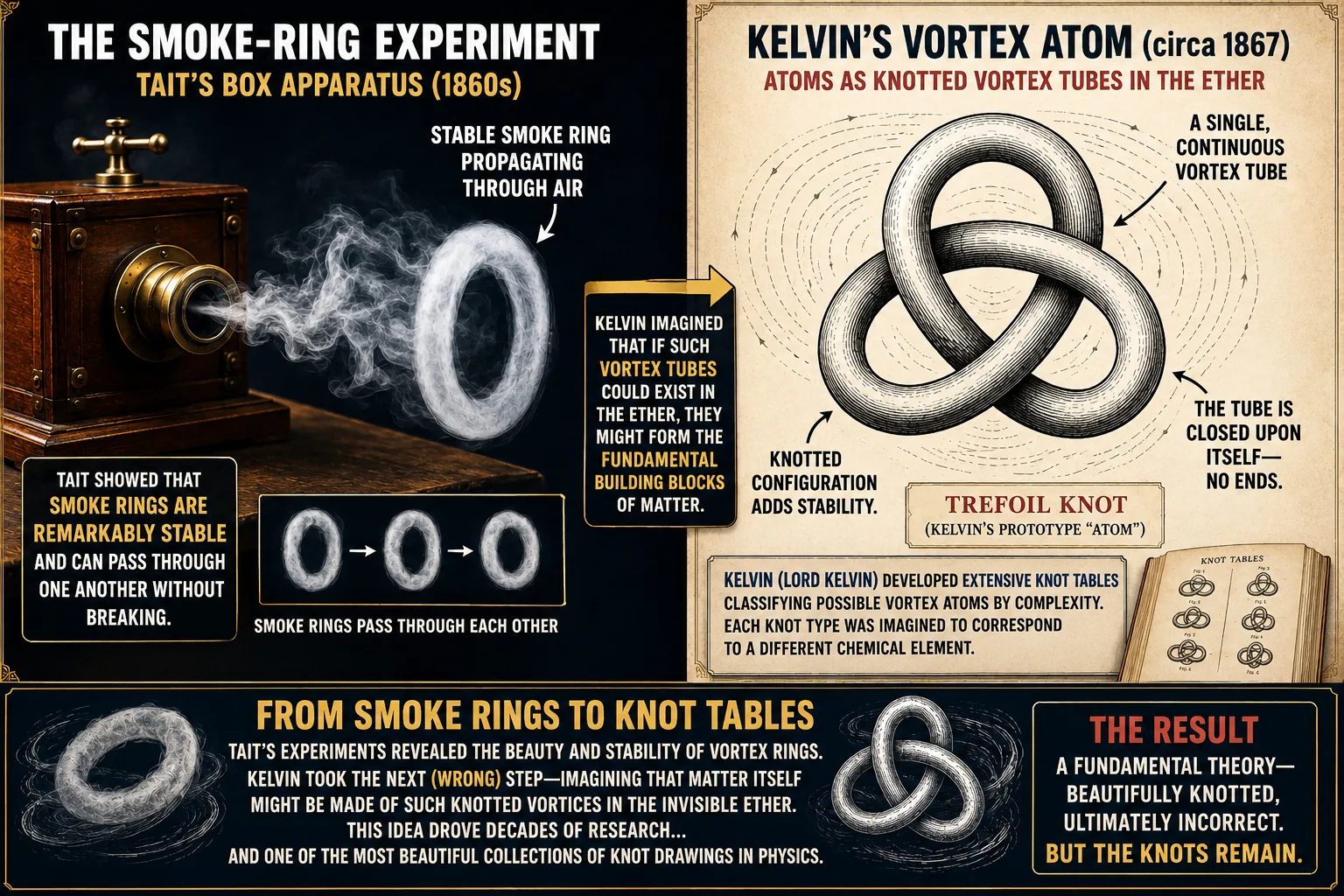
The knot-tabulation story begins, improbably, with smoke rings. In 1867, Tait built a simple apparatus \u2014 a box with a hole in one side and a flexible back, filled with smoke \u2014 that could be struck to fire crisp, stable rings of smoke across a room. He demonstrated the device to his friend William Thomson, later Lord Kelvin, showing that the rings behaved almost like durable, elastic objects: they could collide, bounce off one another, and vibrate, yet each kept its distinct identity.
Thomson, primed by earlier theoretical work by Hermann von Helmholtz on vortex motion in idealised frictionless fluids, saw in these smoke rings a possible model for the atom itself. If space were filled with a perfect, frictionless fluid \u2014 the hypothetical ether then widely believed to pervade the universe \u2014 then stable vortex rings in that fluid might be permanent, indestructible, and able to vibrate at characteristic frequencies, exactly the properties that atoms of different chemical elements seemed to have. Crucially, different elements might correspond to different knotted configurations of the vortex: a simple ring for one element, a trefoil-knotted loop for another, and so on. Thomson published this vortex-atom theory of matter in 1867, directly crediting Tait's smoke-ring experiments as the prompt.
Physics, Mathematics, or Both?
The vortex-atom theory presented an immediate practical problem for anyone who wanted to take it seriously: if different elements were different knots, then physicists needed a way to tell knots apart \u2014 to know how many genuinely distinct knots existed with a given number of crossings, and which diagrams, however differently drawn, actually represented the same underlying knot. No such classification existed. Tait, characteristically hands-on, set out to build one himself, sketching knot diagrams by hand and working through them systematically by increasing crossing number.
This is why the discovery genuinely straddles two disciplines, and this page is explicit about how it handles that. The motivation was physics: a real, published theory of atomic structure that Tait and Kelvin took seriously for a period. The lasting product was mathematics: a system of classification, invariants and conjectures that outlived the physical theory by well over a century and today belongs entirely to topology, a branch of pure mathematics, with no continuing reference to vortex atoms or the ether. Because the enduring, still-active legacy is mathematical rather than physical, this site lists the discovery under Mathematics \u2014 while telling the physics origin story in full, rather than quietly dropping it, because it is essential to understanding why Tait did this work at all.
Tabulating the Knots
Working through the late 1870s and into the 1880s, Tait developed a method for drawing knot diagrams and systematically listing every distinct knot obtainable with a given number of crossings, starting with the simplest cases and working upward. His culminating paper, On Knots (1885), presented tables of knots up to ten crossings, along with diagrams, a notation scheme, and a set of observations about patterns in the tables that he formalised as conjectures.
This was painstaking, largely manual work: with no computers, Tait had to draw, redraw and mentally manipulate knot diagrams to check whether two apparently different tangles were secretly the same knot in disguise, or whether a diagram could be simplified by removing an unnecessary crossing. Mistakes and omissions were inevitable at this stage of the field, and the historical record shows they occurred and were caught only through the combined, cross-checking efforts of several mathematicians working at roughly the same time.
Kirkman and Little
Tait was not alone in this effort, and the honest account of knot tabulation names all three contributors. The English clergyman-mathematician Thomas Kirkman, already well known for his work in combinatorics (notably Kirkman's schoolgirl problem), developed his own independent method for enumerating knot diagrams and published competing results in the late 1870s. Kirkman and Tait corresponded and disagreed over methods and results, in the normal, occasionally prickly manner of nineteenth-century scientific correspondence, but their two approaches together strengthened confidence in the emerging tables.
The American mathematician Charles Newton Little, working mostly independently through the 1880s and into the 1890s, took on the harder task of extending the tables to higher crossing numbers and auditing the earlier work of both Tait and Kirkman, catching errors and duplications in the process. Little's contribution is frequently underplayed in popular retellings that focus on Tait alone, but it was essential to the tables' eventual reliability. The knot tables that persisted into the twentieth century, and that were later re-verified with computers, are properly understood as the joint product of Tait, Kirkman and Little, not of Tait working in isolation.
The Tait Conjectures
From patterns he noticed in his tables, Tait proposed a set of conjectures about a special class of knots called alternating knots \u2014 knots that can be drawn as a diagram in which the strand alternates between passing over and under at each successive crossing as you trace it around. The central claims were that a reduced alternating diagram (one with no obviously removable crossing) achieves the minimum possible number of crossings for that knot, and that every reduced alternating diagram of the same knot has the same crossing number.
These sound almost obvious stated informally, which is part of why they proved so stubborn: intuition suggested they were true, but nineteenth- and early-twentieth-century mathematics had no tool sharp enough to prove that two knot diagrams, related by any sequence of legal deformations, really were or were not the same knot in any rigorous sense. The conjectures sat, tantalisingly unresolved, for over a hundred years.
Settled a Century Later, 1987
The breakthrough came from an unexpected direction. In 1984, the New Zealand mathematician Vaughan Jones discovered a new knot invariant \u2014 now called the Jones polynomial \u2014 while working on operator algebras, a discovery that itself later earned him the Fields Medal. The Jones polynomial gave mathematicians a genuinely powerful way to distinguish knots that had previously resisted classification.
Within three years, in 1987, three mathematicians \u2014 Louis Kauffman, Kunio Murasugi and Morwen Thistlethwaite \u2014 independently used the Jones polynomial to prove the main Tait conjectures on alternating knots. None of the three was Scottish, and none had any connection to the original nineteenth-century project; their tool came from an entirely different corner of mathematics that did not exist in Tait's lifetime. It is a clean, well-documented case of a conjecture surviving exactly as long as it did because the right mathematical technology had not yet been invented \u2014 not because anyone had been careless.
The Vortex Theory Collapses \u2014 the Mathematics Survives
It is important to state plainly what happened to the physics that started all of this: the vortex-atom theory failed. The luminiferous ether it depended on was never detected, most famously in the 1887 Michelson\u2013Morley experiment, and was eventually discarded altogether following Einstein's special relativity in 1905. Separately, the emerging fields of atomic and, later, quantum physics gave a completely different and experimentally verified account of what atoms actually are \u2014 nothing to do with knotted vortices in a universal fluid. By the early twentieth century, no serious physicist held the vortex-atom theory, and it is remembered today as a historical curiosity rather than a step on the path to modern atomic theory.
What did not fail was the mathematics. Tait's tables, Kirkman's cross-checks and Little's corrections had created a self-contained, rigorous classification project that no longer needed the vortex-atom theory to justify its existence. Once mathematicians recognised knots as interesting objects of study in their own right \u2014 independent of any claim about what atoms are made of \u2014 knot theory quietly detached itself from its physical origin story and became a permanent subfield of topology. This is a genuinely instructive case in the history of science: a discarded physical theory nonetheless generating a mathematical tool of lasting value.
Modern Applications
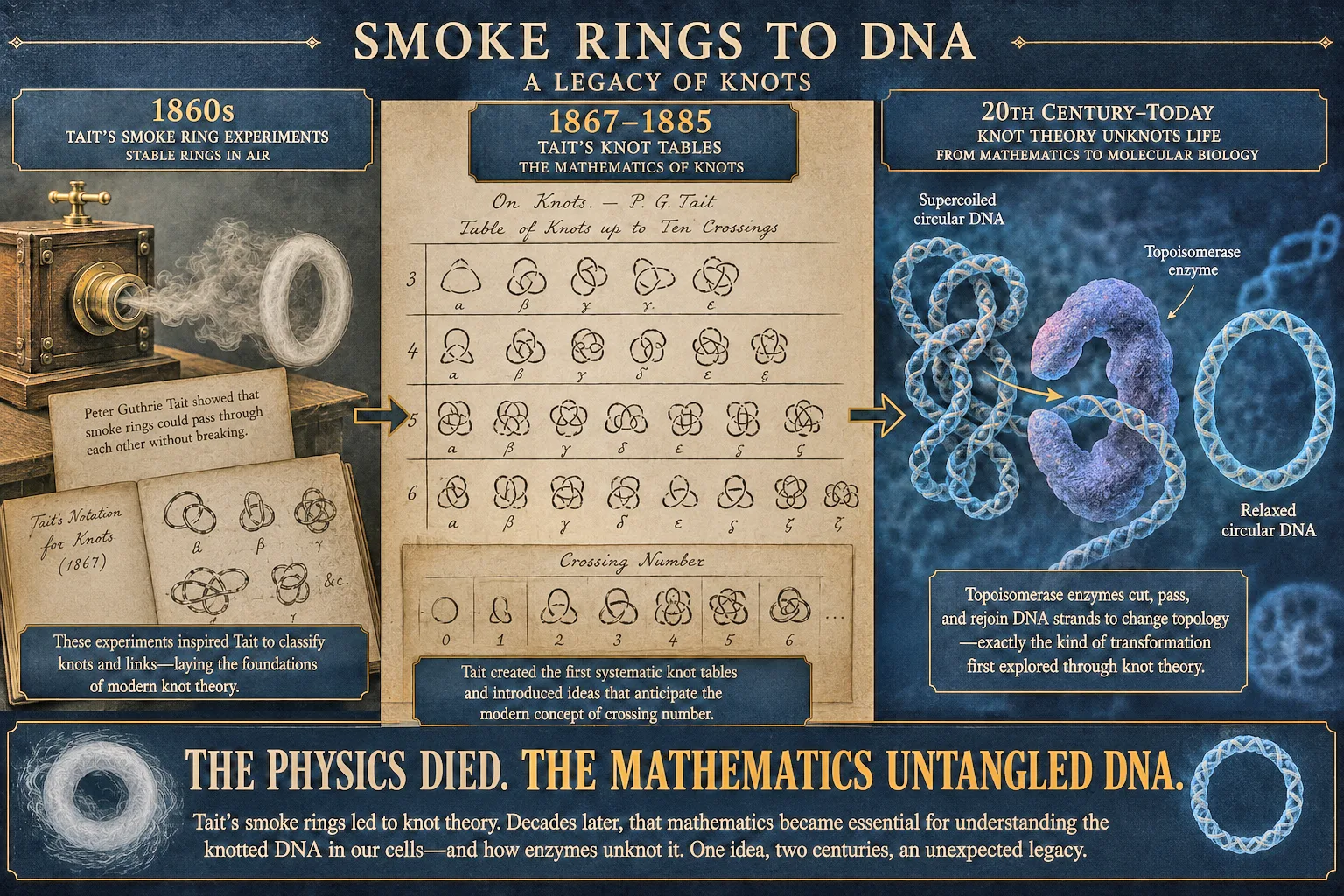
Knot theory today is an active field with applications Tait could not have foreseen. In molecular biology, DNA topology studies how circular and looped DNA molecules become knotted and linked during replication and recombination, and how enzymes called topoisomerases cut and rejoin DNA strands to resolve these tangles \u2014 work for which knot invariants provide precise mathematical language. In materials science, polymer physics uses knot theory to model how long-chain molecules become entangled and how that entanglement affects a material's mechanical properties. And in theoretical physics, the same invariants that finally settled the Tait conjectures, including the Jones polynomial, have turned out to have deep and still-active connections to statistical mechanics and quantum field theory, an irony given that knot theory's own origin lay in a failed piece of nineteenth-century physics.
The Treatise and the Flight of a Golf Ball
Knot tables were only one strand of Tait's career. With William Thomson, he co-authored the Treatise on Natural Philosophy (first volume, 1867, generally cited by physicists of the era simply as "T&T'"), an ambitious and rigorous attempt to lay out the whole of classical mechanics on firm mathematical foundations. It became the standard advanced physics textbook in Britain for decades and shaped how generations of students, including future giants of the field, were trained to think about energy, force and motion.
Late in his career, Tait turned his physicist's eye to a subject close to his own recreational passion: the flight of a golf ball. In papers from the early 1890s, he investigated why a well-struck golf ball, driven with backspin, travels considerably further than simple projectile mechanics (ignoring spin) would predict. His analysis showed that backspin generates lift through what is now recognised as an early practical description of the Magnus effect \u2014 the same aerodynamic principle that explains curving in a spinning ball of any kind. It was a small, genuinely original piece of applied aerodynamics, decades ahead of its wider recognition in ball sports.
Timeline
1831
Peter Guthrie Tait born in Dalkeith, 28 April
Son of John Tait, secretary to the Earl of Buccleuch
1852
Senior Wrangler at Cambridge, ahead of James Clerk Maxwell's year group
Establishes his reputation as one of Britain's foremost mathematical physicists
1854–60
Professor of Mathematics at Queen's College, Belfast
Works alongside Thomas Andrews on gas theory
1860
Appointed Professor of Natural Philosophy, University of Edinburgh
Succeeds James David Forbes; holds the chair for over 40 years
1867
Tait's smoke-ring experiments and William Thomson's vortex-atom theory
Kelvin proposes that atoms are knotted vortices in the ether
1867
Treatise on Natural Philosophy, with Kelvin, volume one published
“T&T'” becomes the standard physics text for a generation
1876
Tait begins systematically tabulating knots
Starts from simple diagrams, working up by number of crossings
1877
Thomas Kirkman publishes his own independent enumeration of knot diagrams
A parallel, competing approach from Lancashire
1885
Tait publishes “On Knots” with tables up to ten crossings
States the conjectures on alternating knots
1885–1900
Charles Newton Little (USA) extends and corrects the tables
Works independently, later cross-checking results with Tait and Kirkman's lists
1891
Tait's paper on the aerodynamics of a spinning golf ball
Explains why a backspin-driven ball flies further than expected from simple drag
1901
Tait dies at Challenger Lodge, Edinburgh, 4 July
The knot conjectures remain unproven at his death
1984
Vaughan Jones discovers the Jones polynomial
Supplies the missing tool to distinguish knots rigorously
1987
Kauffman, Murasugi and Thistlethwaite independently prove the Tait conjectures
A century after Tait first stated them
1990s–present
Knot theory applied to DNA topology and polymer physics
Enzymes such as topoisomerases are studied using the mathematics Tait began
Did You Know?
- Tait's smoke-ring machine — a box with a hole and a flexible back — could fire rings stable enough to bounce off each other, which is what first convinced Kelvin they might model something as durable as an atom.
- Tait was Senior Wrangler at Cambridge in 1852, the top mathematics graduate of his year, ahead of contemporaries who went on to their own major scientific careers.
- The vortex-atom theory that started the whole knot project was completely wrong about atoms, but it accidentally launched a mathematical field still active today.
- Tait's knot conjectures went unproven for about a hundred years — not through anyone's negligence, but because the necessary mathematical tool, the Jones polynomial, was not discovered until 1984.
- Tait and James Clerk Maxwell were childhood friends at Edinburgh Academy and remained close throughout their scientific careers.
- Tait's 1890s paper on golf-ball flight gave one of the earliest scientific explanations for why backspin makes a driven ball travel further — a genuine piece of applied aerodynamics from a knot theorist.
Honest Caveats
Tait did not found topology. Carl Friedrich Gauss had already studied linking numbers for closed curves, and his student Johann Benedict Listing had investigated knots and coined much of the vocabulary of topology decades before Tait's tabulation project began in 1876. Tait's specific and genuine contribution is systematic tabulation of knots and the conjectures that came from it, not the founding of the mathematical study of knots from nothing.
The tables were a shared effort, not a solo one. Thomas Kirkman produced independent, competing tables in the same period, and Charles Newton Little's later work extending and correcting both sets of results was essential to the tables' reliability. Framing this as a single Scottish discovery would misrepresent the historical record.
The motivating physical theory was wrong. The vortex-atom theory of matter that prompted Tait's knot work was abandoned entirely once the ether was discarded and quantum and nuclear physics gave the real, verified structure of atoms. This page tells that origin story honestly rather than quietly omitting it, because it explains why a physicist was drawing knot diagrams in the first place.
The conjectures were proved by others, a century later. Vaughan Jones, Louis Kauffman, Kunio Murasugi and Morwen Thistlethwaite \u2014 none Scottish, none contemporaries of Tait \u2014 supplied the proof, using mathematics that did not exist in the nineteenth century. Tait's achievement was the correct conjecture and the tabulated evidence for it, not the final proof.
Category choice. This page classifies the discovery under Mathematics because that is where its lasting, still-active legacy sits, even though the project began as physics. Readers interested in the physics side should also read about Kelvin's vortex-atom theory directly.
Frequently Asked Questions
Who was Peter Guthrie Tait?
Peter Guthrie Tait (1831–1901) was a Scottish mathematical physicist, born in Dalkeith, who held the Chair of Natural Philosophy at the University of Edinburgh from 1860 until his death. He is best known for co-authoring the influential Treatise on Natural Philosophy with William Thomson (Lord Kelvin), and for producing the first systematic tables of knots between 1876 and 1885, founding what became mathematical knot theory.
Did Tait invent knot theory?
Not outright, and this page is deliberately careful about that claim. Carl Friedrich Gauss had already investigated linking numbers, and his student Johann Benedict Listing had studied knots and coined much of the vocabulary of topology decades earlier. What Tait did, from 1876 to 1885, was found systematic knot tabulation — producing the first organised tables of distinct knots by crossing number, alongside independent efforts by Thomas Kirkman and Charles Newton Little. Credit for the founding insight of topology belongs to Gauss and Listing; credit for turning knots into a tabulated, conjecture-generating branch of mathematics belongs jointly to Tait, Kirkman and Little.
Why does this page classify Tait's knot work as Mathematics, not Physics?
The project began as physics: Kelvin's 1867 vortex-atom theory proposed that atoms were knotted vortex rings in a hypothetical ether, and Tait's smoke-ring experiments were built to explore that idea. But the vortex-atom theory itself was abandoned by physicists within a few decades — it explained nothing that the emerging atomic and, later, quantum picture did not explain better. What survived, and grew into a permanent field, was the mathematical apparatus Tait built to classify knots: it is now squarely a branch of topology within pure mathematics, taught and developed with no reference to vortex atoms. That later, mathematical legacy is why this site files the discovery under Mathematics, while being explicit in the body text that the work started life as physics.
What were the Tait conjectures?
Tait, working from his tables, proposed several conjectures about alternating knots (knots that can be drawn so that the strand alternates over and under at each crossing as you trace it). The best known state that a reduced alternating diagram has the fewest possible crossings for that knot, and that all reduced alternating diagrams of a given knot have the same number of crossings (the same writhe, up to sign conventions). They looked simple but resisted every attempt at proof for a century.
Who finally proved the Tait conjectures, and how?
Louis Kauffman, Kunio Murasugi and Morwen Thistlethwaite each independently proved the main Tait conjectures in 1987, using the Jones polynomial, a knot invariant discovered by Vaughan Jones in 1984. The Jones polynomial gave mathematicians a tool precise enough to confirm what Tait had guessed from hand-drawn diagrams more than a hundred years earlier.
Is the vortex-atom theory that inspired Tait still believed?
No. Kelvin's vortex-atom theory of matter, which held that atoms were stable knotted vortices in a universal ether, was abandoned by the early twentieth century once the ether itself was discarded and quantum and nuclear physics gave a completely different and experimentally verified picture of atomic structure. The theory was a dead end in physics. The knot mathematics it prompted Tait to develop, however, proved permanently useful and outlived the physics that inspired it.
Who were Thomas Kirkman and Charles Newton Little?
Thomas Kirkman was an English clergyman-mathematician who independently produced his own enumeration of knot diagrams in the late 1870s, working in parallel with and partly in competition with Tait. Charles Newton Little was an American mathematician who, working mostly independently in the 1880s and 1890s, extended, checked and in places corrected the tables produced by Tait and Kirkman, notably for knots of higher crossing number. The historically accurate picture is one of three tabulators working with overlapping but distinct methods, not a single Scottish discovery.
What practical use is knot theory today?
Knot theory underpins the study of DNA topology, where enzymes called topoisomerases must knot, unknot and untangle circular DNA molecules during replication; it appears in polymer physics, where the entanglement of long-chain molecules affects material properties; and it has deep connections to statistical mechanics and quantum field theory, particularly through the same invariants (such as the Jones polynomial) that finally proved Tait's conjectures.
Sources & Further Reading
Tier 1 · Primary
- Tait, P. G. \u2014 "On Knots," Transactions of the Royal Society of Edinburgh, vol. 28, 1877.
- Tait, P. G. \u2014 "On Knots, Part II and Part III," Transactions of the Royal Society of Edinburgh, vol. 32, 1885.
- Thomson, W. (Lord Kelvin) \u2014 "On Vortex Atoms," Proceedings of the Royal Society of Edinburgh, vol. 6, 1867.
- Thomson, W. and Tait, P. G. \u2014 Treatise on Natural Philosophy, Oxford, 1867.
- Kirkman, T. P. \u2014 "The Enumeration, Description and Construction of Knots of Fewer than Ten Crossings," Transactions of the Royal Society of Edinburgh, vol. 32, 1885.
- Little, C. N. \u2014 "Non-Alternate \u00b1 Knots," Transactions of the Royal Society of Edinburgh, vol. 39, 1900.
- Tait, P. G. \u2014 "On the Path of a Rotating Spherical Projectile," Transactions of the Royal Society of Edinburgh, vol. 37, 1893 (the golf-ball papers).
- Knott, C. G. \u2014 Life and Scientific Work of Peter Guthrie Tait, Cambridge University Press, 1911.
Tier 2 · Scholarly and institutional
- Jones, V. F. R. \u2014 "A Polynomial Invariant for Knots via von Neumann Algebras," Bulletin of the American Mathematical Society, vol. 12, 1985.
- Kauffman, L. H. \u2014 "State Models and the Jones Polynomial," Topology, vol. 26, 1987.
- Murasugi, K. \u2014 "Jones Polynomials and Classical Conjectures in Knot Theory," Topology, vol. 26, 1987.
- Thistlethwaite, M. B. \u2014 "A Spanning Tree Expansion of the Jones Polynomial," Topology, vol. 26, 1987.