Discoveries · No. 11 of 50 · Mathematics
Logarithms, Napier's Bones & the Decimal Point: John Napier's 1614 Invention
Working largely alone in a tower house on the edge of Edinburgh, John Napier spent roughly twenty years solving one of the great practical problems of his age: how to make the crushing arithmetic of astronomy and navigation bearable. In 1614 he published the answer. A Swiss clockmaker had quietly worked out something very similar first — and published it six years too late to be believed.
John Napier · 1550–1617Merchiston Castle, EdinburghReading time · 20 minUpdated 2 August 2026

In Brief
John Napier of Merchiston (1550–1617) published the first table of logarithms in 1614, in Mirifici Logarithmorum Canonis Descriptio, turning laborious multiplication and division into simple addition and subtraction. He is conventionally credited as the inventor of logarithms because he was first into print. The Swiss instrument-maker Jost Bürgi devised an equivalent system independently, quite possibly earlier — but did not publish until 1620, six years after Napier. Napier's other lasting contributions include Napier's Bones (1617), an early mechanical aid to calculation, and some of the earliest influential use of the decimal point. Henry Briggs then reworked Napier's tables into the base-10 “common” logarithm used ever since — a genuinely shared achievement rather than Napier's alone.
Claim status · Disputed priority
The scope of Napier's claim is precise: he was the first person to publish a working system of logarithms, in 1614. He was very probably not the first person to conceive one. Jost Bürgi appears to have arrived at an equivalent method independently, and by some accounts earlier, but his tables were not printed until 1620. Historians of mathematics generally credit Napier with priority on the strength of publication, while treating Bürgi's independent claim as well-established and genuine rather than a footnote to be dismissed. This article sets out both cases and does not resolve the dispute by rhetoric.
Scottish Impact Index (SI Score)
- Global Impact
- 10/10
- Longevity
- 10/10
- Economic / Material Impact
- 8/10
- Originality / Distinctiveness
- 10/10
- Legacy (Built Upon)
- 10/10
- Recognition
- 6/10
Key Facts
- Discovery
- Logarithms — a method for turning multiplication and division into addition and subtraction
- Key figure
- John Napier of Merchiston (1550–1617), 8th Laird of Merchiston
- Born
- 1550, Merchiston Castle, Edinburgh
- Died
- 4 April 1617, Merchiston Castle, Edinburgh, aged about 67, from gout
- Great work
- Mirifici Logarithmorum Canonis Descriptio — published in Edinburgh, 1614
- Also invented
- Napier's Bones (Rabdologiae, 1617) — an early mechanical calculating aid; and championed decimal-point notation
- Rival claimant
- Jost Bürgi (Switzerland/Prague), who devised an equivalent logarithmic system independently, probably by the late 1580s or 1590s, but published only in 1620
- Shared development
- Henry Briggs reworked Napier's tables into base-10 'common' logarithms after meeting him in 1615, published 1624
- Claim status
- Disputed priority — Napier published first (1614) and is conventionally credited as the inventor of logarithms; Bürgi has a credible, well-documented case for having worked out an equivalent method independently and arguably earlier, but he did not publish until 1620
- Legacy
- Slide rules built on logarithmic scales were the standard scientific calculating tool for roughly 350 years, into the Apollo era; logarithmic scales still underpin the Richter scale, decibels, pH and information theory
Merchiston to the Continent
John Napier was born in 1550 at Merchiston Castle, then a fortified tower house on the southern edge of Edinburgh and now the historic heart of the university campus that bears his name. He was the eldest son of Sir Archibald Napier, who became Laird of Merchiston and Master of the Mint in 1582. His mother, Janet Bothwell, was sister to Adam Bothwell, Bishop of Orkney. The Napiers were one of the more substantial landed families of late-sixteenth-century Scotland, and John became the 8th Laird of Merchiston.
He entered the University of St Andrews in 1563, aged just thirteen, lodging at St Salvator's College under the personal care of its Principal, John Rutherford. He left without a degree — unremarkable for the sons of the Scottish gentry — and historians believe he acquired his exceptional grounding in mathematics and classical literature abroad, most probably in Paris. By 1571 he was back in Scotland, married to Elizabeth Stirling, and living at a castle he had built at Gartness in Stirlingshire.
At Gartness, Napier lived the life of a scientific landowner. He experimented with agricultural improvement, applying common salts to boost yields, and was a fiercely committed Protestant. His 1593 anti-Catholic commentary, A Plaine Discovery of the Whole Revelation of Saint John, was a genuine sensation, translated into Dutch, French and German editions and read across Protestant Europe — making him, in his own lifetime, far more famous as a theologian than as a mathematician.

To his tenants, though, Napier was something stranger: a man widely suspected of dabbling in the black arts. He was said to walk his grounds in a long dark gown, to keep a black spider shut in a box, and to treat a black cockerel as a familiar spirit — a bird he reputedly used to expose a thieving servant, who confessed after handling the (soot-covered) “magical” bird and blackening his own hands. The contradiction is the essence of the man: eccentric, devout, a designer of weapons of war, and quietly, patiently obsessed with numbers.
The Problem Napier Solved
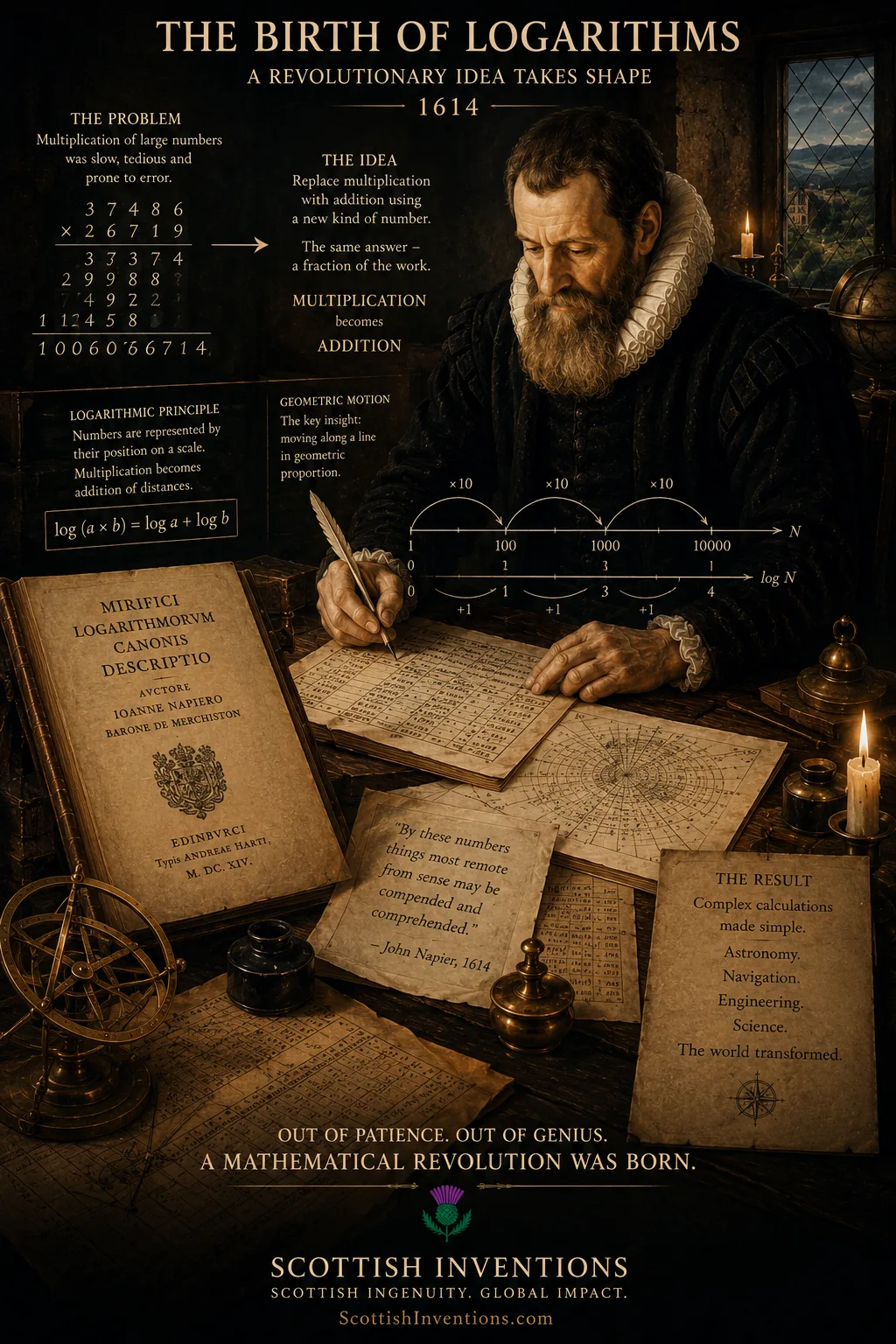
To appreciate what Napier achieved, it helps to understand the sheer drudgery of calculation in the late sixteenth century. Astronomy, navigation and gunnery all demanded multiplying and dividing enormous multi-digit numbers — work that could consume hours or days by hand and was riddled with opportunities for what Napier himself called “slippery errors”. Astronomers such as Tycho Brahe were producing vast tables of observations that needed processing; navigators relied on trigonometric calculation to fix a ship's position, and a single arithmetical slip could cost a crew its life.
Napier put the problem with real feeling in the preface to his great work: “There is nothing…so troublesome to mathematical practice, nor that doth more molest and hinder calculators, than the multiplications, divisions, square and cubical extractions of great numbers, which besides the tedious expense of time are for the most part subject to many slippery errors.” His goal was simply stated and revolutionary in effect: reduce laborious multiplication and division to easy addition and subtraction.

The 1614 Descriptio
Napier worked on the problem for roughly twenty years before publishing. A 1594 letter to Tycho Brahe shows he had already grasped the abstract principle, but converting that insight into a usable table took two more decades of solitary calculation, much of it at Gartness, where local tradition holds that the constant roar of the mill's water wheel did not disturb his concentration, but the occasional clack of the mechanism did — so he would ask the miller to stop the mill while he thought.
The result, Mirifici Logarithmorum Canonis Descriptio (“A Description of the Wonderful Canon of Logarithms”), was printed in Edinburgh by Andrew Hart in 1614: 57 pages of explanation followed by 90 pages of tables. The core idea is elegantly simple. A logarithm turns multiplication into addition: instead of multiplying two large numbers directly, a user looks up the logarithm of each, adds them, and converts back — in modern notation, log(a × b) = log(a) + log(b). Napier coined the word “logarithm” himself, from the Greek logos (ratio) and arithmos (number).
It is worth being precise about what Napier actually built, because it differs from the logarithm taught in schools today. He did not think in terms of a base raised to a power; algebra of that period was not developed enough to express the idea that way. Instead he defined his logarithm kinematically, imagining two points moving along lines — one travelling at constant speed, the other slowing in proportion to the distance it still had to cover. His system was anchored to 10,000,000, the largest entry then found in the best trigonometric tables, and in his original scheme the logarithm of 1 was not zero, which made his tables considerably less convenient than the ones that followed.
“There is nothing…so troublesome to mathematical practice, nor that doth more molest and hinder calculators, than the multiplications, divisions, square and cubical extractions of great numbers.”
Was Napier First? The Bürgi Question
A properly calibrated account of Napier cannot treat him as the sole, uncontested inventor of logarithms. That would flatter national pride at the expense of accuracy — and the honest history is, in any case, the more interesting one.
The case for Jost Bürgi. The Swiss clockmaker, instrument-maker and astronomer Jost Bürgi (1552–1632), who worked for the Landgrave of Hesse-Kassel and later at the imperial court in Prague alongside Johannes Kepler, is understood by most historians of mathematics to have devised his own logarithm-like system of progressions independently of Napier — and by some accounts as early as the late 1580s or 1590s, which would put his conception before Napier's earliest documented statement of the idea in 1594. Bürgi's method grew out of practical work on geometric and arithmetic progressions used in astronomical calculation, a different route to a mathematically related destination. Kepler himself, who used Bürgi's tables, praised his skill and regretted that Bürgi kept the method to himself for so long.
The case for Napier. Whatever Bürgi worked out privately, he did not publish it. His Arithmetische und geometrische Progress-Tabulen did not appear in print until 1620, in Prague — six years after Napier's Descriptio had already reached Edinburgh's presses, circulated to mathematicians across Europe, and prompted Henry Briggs's celebrated 1615 journey north to meet its author. In the normal conventions of the history of science, priority is generally awarded on the basis of publication and public disclosure, not private, undated invention that cannot be independently dated or verified beyond an author's later account of his own earlier work. By the time Bürgi's tables appeared, Napier's system was already established and spreading, and it was Napier's terminology — not Bürgi's — that the mathematical world adopted.
There is no firm evidence either man had heard of the other's project before 1614. Historians generally treat the two discoveries as genuinely, independently arrived at. The fairest summary is this: Napier earned the credit that publication confers, and which the historical record has attached to his name ever since; Bürgi has a serious, well-documented claim to having reasoned his way to an equivalent idea on his own, and quite possibly first, but the six years he let pass before publishing cost him the priority that history recognises. Both things are true, and neither cancels the other.
Briggs and Common Logarithms
The awkwardness of Napier's original system — a logarithm of 1 that was not zero, a base pinned to 10,000,000 — was resolved through one of the more celebrated meetings in the history of mathematics. Henry Briggs, professor of geometry at Gresham College in London, read the Descriptio and was electrified, writing to a friend that he “never saw a book which pleased me better or made me more wonder.” In the summer of 1615 he made the roughly four-day journey north to meet Napier in person at Merchiston. By one well-known contemporary account, the two men stood in silent mutual admiration for almost a quarter of an hour before either spoke.
Together they agreed that the new tables should be rebuilt on base 10, with the logarithm of 1 set to zero — the “common” logarithm still taught in schools today. Briggs then spent years computing these tables, publishing Arithmetica Logarithmica in 1624, seven years after Napier's death. This part of the story deserves to be told as a shared achievement rather than folded silently into Napier's biography: Napier supplied the founding insight and the name; Briggs supplied the practical, mathematically superior form in which logarithms actually entered everyday use.
Napier's Bones
Logarithms were not Napier's only calculating invention, and the two should not be confused — they were separate ideas published three years apart. In 1617, the year of his death, Napier published Rabdologiae, seu Numerationis per Virgulas (“the art of numbering by means of rods”), printed in Edinburgh and dedicated to Alexander Seton, Earl of Dunfermline. It described a set of numbered rods, quickly nicknamed “Napier's Bones” or “Napier's Rods”, that simplified multiplication, division and even the extraction of square and cube roots.
The principle drew on the old “lattice” or gelosia method of multiplication. Each rod, typically made of wood, bone or ivory, carried the multiples of a single digit. By laying out the rods for the number to be multiplied and reading off the correct row, adding figures along the diagonals, a user could complete a long multiplication almost mechanically. The bones were an immediate success: Napier himself wrote that even before publication his friends found them so pleasing that the rods were “already almost common and are even being carried to foreign countries.”
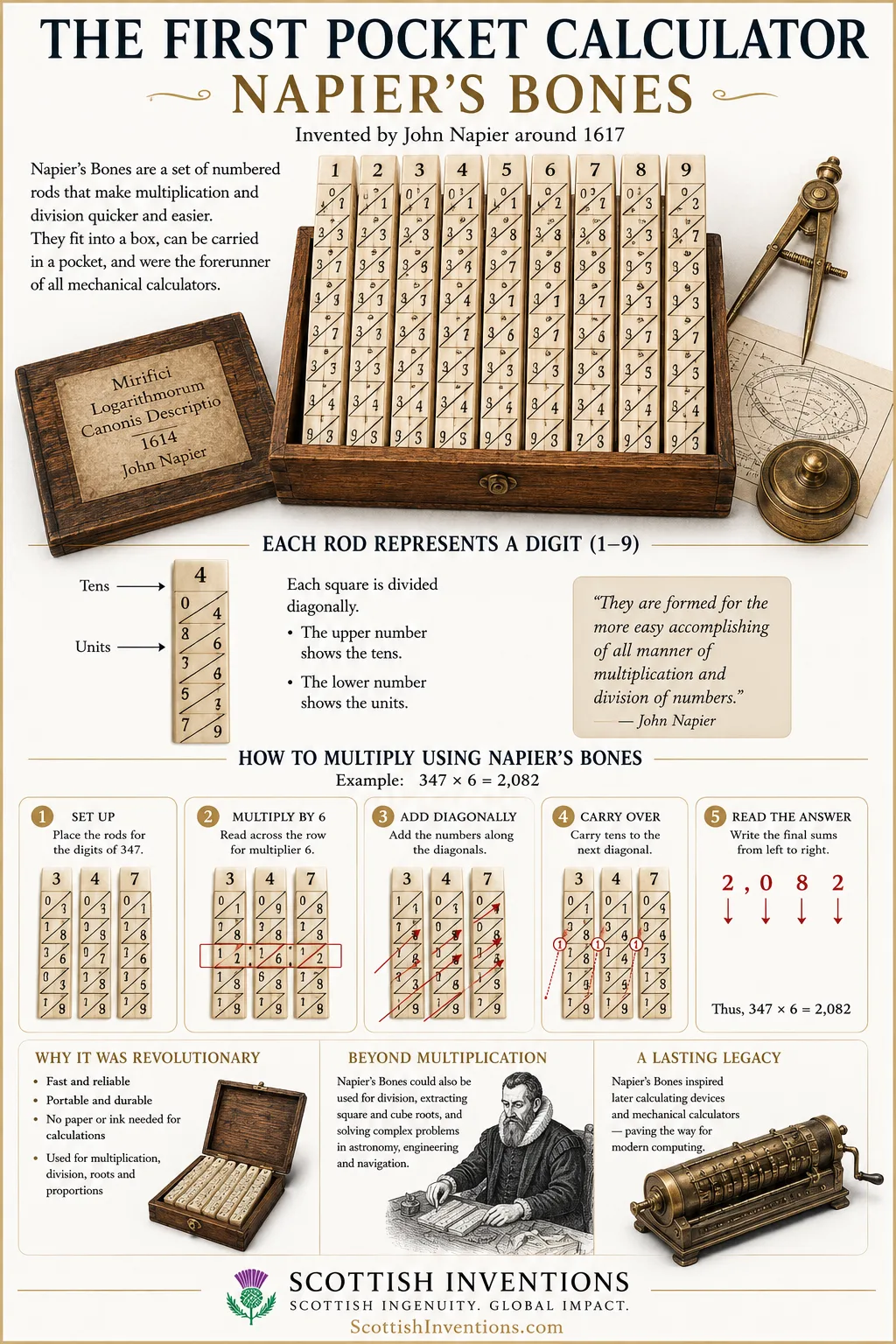
Napier's Bones are rightly seen as an ancestor of the slide rule and, more distantly, of the mechanical calculator — a portable aid to arithmetic that spread across Europe within Napier's own lifetime.
The Decimal Point
Napier's third contribution to practical mathematics is more modest, and needs to be stated carefully. He did not invent decimal notation from nothing — forms of decimal fractions were already in use on the Continent, most notably through the work of the Flemish mathematician Simon Stevin in his 1585 treatise De Thiende (“The Tenth”). What Napier did was become one of the earliest and most influential advocates of the modern decimal point in print, particularly in his posthumously published Mirifici Logarithmorum Canonis Constructio (1619), where the notation appears in a form very close to what is used today. That advocacy, arriving alongside his logarithms, helped popularise the decimal point in English and Scottish mathematical writing at a formative moment.
Kepler, the Slide Rule and Apollo
The reaction to Napier's logarithms was immediate and, among those who needed them most, close to rapturous. The most striking example is Johannes Kepler, who called the invention a “happy calamity” — recognising at once that it would transform the punishing computations of astronomy. Kepler put logarithms to work on his monumental Rudolphine Tables, finally published in 1627, and dedicated a 1620 astronomical work to Napier. It is a nice historical irony that Kepler, who used both Napier's published logarithms and Bürgi's private ones, sat at the exact crossing point of the priority dispute.
From logarithms grew the slide rule. Building on Napier's logarithms and Edmund Gunter's logarithmic scale of 1620, the English clergyman William Oughtred placed two such scales side by side and slid them against each other to multiply and divide directly — inventing the slide rule around 1622. That humble “slip stick” remained the essential calculating instrument of engineers and scientists for roughly 350 years, until electronic calculators became widely available in the early 1970s.
The slide rule's finest hour came with the Apollo programme. NASA engineers used slide rules to help design the rockets and plan the Moon missions, and according to the Smithsonian's National Air and Space Museum, Apollo crews carried a slide rule — the compact Pickett N600-ES — for “more routine calculations” as backup to onboard computers. Buzz Aldrin's own Apollo 11 example later sold at auction for tens of thousands of dollars, a direct four-century thread back to Merchiston.

Logarithms also underpin huge swathes of modern mathematics, science and technology beyond calculation itself. Logarithmic scales describe earthquake magnitude on the Richter scale, the loudness of sound in decibels, the acidity of solutions on the pH scale, and the intervals of musical tuning; they sit at the foundations of compound-interest mathematics and of Claude Shannon's measure of information entropy. Pierre-Simon Laplace summed up their value in a phrase still quoted today: logarithms, he said, “by shortening the labours, doubled the life of the astronomer.”
Theology and the Wizard of Merchiston
It is easy to forget, looking back from an age that reveres him as a mathematician, that Napier considered his theological writing his life's real work. A Plaine Discovery of the Whole Revelation of Saint John (1593) was an urgent, fiercely argued Protestant reading of the Book of Revelation, aimed squarely at the papacy, and it made Napier a name across Reformed Europe long before his logarithms did. He also drew up, in 1596, designs for national defence against a feared Spanish invasion — burning mirrors, novel artillery, and a musket-proof armoured war chariot — preserved today among the papers at Lambeth Palace.
To his own household and tenants at Merchiston, however, Napier's intense, secretive study habits earned him a very different reputation: that of a magician, in league with dark powers. Locally he was said to walk the grounds at night in a long gown, to keep a black spider shut in a box, and to keep a black cockerel as a “familiar” spirit. The story of the soot-blackened cockerel, used to expose a servant stealing from the household, has been told and retold for four centuries — a vivid, human counterpoint to the abstract brilliance of the mathematics for which he is now remembered.
Legacy
John Napier died on 4 April 1617 at Merchiston Castle, aged about 67, from the effects of gout. He was buried in the kirkyard of St Giles; when that ground was later lost to the building of Parliament House, his remains were moved, and he is now memorialised at St Cuthbert's Parish Church at the west end of Princes Street Gardens, Edinburgh.
His name is everywhere in Scottish mathematical memory. Edinburgh Napier University, built around the restored shell of Merchiston Tower where he was born, takes its name from him, and a statue of Napier stands within the tower today. An oil portrait of 1616, held by the University of Edinburgh, survives in several copies, including one in the National Galleries of Scotland captioned “Discoverer of Logarithms.” In 1914 the Royal Society of Edinburgh marked the tercentenary of the Descriptio with a major celebration of one of the great events in the history of science. His name even reaches the heavens, in the lunar crater Neper, and into electrical engineering, in the unit called the neper; several languages still call the natural logarithm “Napierian.”
Historians have struggled to find words grand enough for the achievement. J. W. L. Glaisher judged that, “with the exception of the Principia of Newton, there is no mathematical work published in this country which has produced such important consequences” as Napier's Descriptio. E. W. Hobson, in his 1914 tercentenary lecture, called the invention of logarithms “one of the very greatest scientific discoveries that the world has seen.” None of that need come at Jost Bürgi's expense — it is simply the historical verdict on the man who got the idea into print first, and into the hands of everyone who needed it.
Did You Know?
- Napier spent roughly twenty years computing his logarithm tables, much of it, tradition says, at a mill in Gartness — where he had the miller stop the wheel whenever its clacking, not its roar, broke his concentration.
- Jost Bürgi, who may have worked out an equivalent system before Napier, waited so long to publish that Kepler himself lamented the delay.
- Henry Briggs travelled roughly four days from London to meet Napier in 1615 — and the two men reportedly stood in silent admiration of one another for nearly fifteen minutes before speaking.
- Napier's Bones and logarithms are often confused, but they are two separate inventions, published three years apart, by the same man.
- Buzz Aldrin carried a slide rule — a direct descendant of Napier's logarithms — on Apollo 11; his own example later sold at auction for tens of thousands of dollars.
- Napier's own tenants believed he was a wizard, and used a soot-blackened black cockerel, treated as his “familiar”, to unmask a thief in his household.
Timeline
1550
John Napier born at Merchiston Castle, Edinburgh
Eldest son of Sir Archibald Napier, future Master of the Mint
1563
Enters the University of St Andrews aged 13
Leaves without a degree; likely continues study on the Continent, probably Paris
c. 1588
Jost Bürgi, working in Kassel and later Prague, is understood to have devised his own logarithm-like system
Not published for another three decades — the heart of the priority dispute
1593
Napier publishes A Plaine Discovery of the Whole Revelation of Saint John
The work he himself considered his most important; a Protestant sensation across Europe
1594
A letter to Tycho Brahe shows Napier already grasps the abstract principle of logarithms
Two more decades of solitary calculation lie ahead before publication
1596
Drafts 'Secret Inventions' for national defence
Designs for burning mirrors, artillery and a musket-proof chariot, now at Lambeth Palace
1614
Mirifici Logarithmorum Canonis Descriptio printed in Edinburgh by Andrew Hart
The first published table of logarithms — the work that fixes Napier's priority in the historical record
1615
Henry Briggs travels from London to meet Napier at Merchiston
The two agree on base-10 'common' logarithms with log(1) = 0
1617
Napier publishes Rabdologiae, describing Napier's Bones
Dies at Merchiston on 4 April, aged about 67
1619
Mirifici Logarithmorum Canonis Constructio published posthumously
Contains some of the earliest systematic use of the decimal point in print
1620
Jost Bürgi finally publishes his Arithmetische und geometrische Progress-Tabulen in Prague
Six years after Napier — too late to contest the priority Napier's earlier publication had already secured
1624
Briggs's Arithmetica Logarithmica establishes the modern common logarithm
The standard form used by scientists and engineers until electronic calculators
c. 1622
William Oughtred combines two logarithmic scales to build the slide rule
In use by engineers and scientists for roughly 350 years
1969
Apollo-era engineers still carry slide rules as backup calculating tools
Buzz Aldrin's own example later sold at auction
Notes on the Evidence
The Bürgi dating is not precise. Bürgi's own account, and later scholarship reconstructing his working papers, place his conception of a logarithm-like system somewhere between the late 1580s and the mid-1590s. No dated manuscript from that period survives to fix the date exactly; the estimate rests on later testimony and internal evidence in his 1620 publication. This is treated here as a credible, well-supported claim rather than a certainty.
Napier's own priority is dated by publication, not conception. A 1594 letter to Tycho Brahe shows Napier had grasped the underlying principle by that date, but this is evidence of an idea in progress, not a finished, published system. His claim to priority rests specifically on the 1614 Descriptio being in print before Bürgi's 1620 tables.
Napier's logarithms and Briggs's logarithms are not the same object. Popular accounts sometimes elide the two. Napier's 1614 system used a different base and did not set log(1) = 0; the base-10 “common” logarithm familiar today is a joint Napier–Briggs development, finalised and published by Briggs alone in 1624, after Napier's death.
The decimal point claim is bounded deliberately. This article does not claim Napier invented decimal notation; Simon Stevin's 1585 work predates Napier's use of it. Napier is credited here only with being an early and influential populariser of the modern decimal-point form, chiefly through the 1619 Constructio.
Anecdotal material is flagged as such. The mill story, the black-cockerel story and the Napier–Briggs fifteen-minutes-of-silence anecdote are long-standing traditions recorded in early biographical accounts of Napier; they are presented here as tradition, not as documented fact with primary-source verification.
Frequently Asked Questions
Who invented logarithms — John Napier or Jost Bürgi?
Both men worked out equivalent systems independently, and the fair answer depends on what is meant by ‘invented’. John Napier, Laird of Merchiston, is conventionally credited because he was first to publish, in Mirifici Logarithmorum Canonis Descriptio (Edinburgh, 1614). The Swiss clockmaker and instrument-maker Jost Bürgi, working in Kassel and later at the imperial court in Prague, is understood to have developed his own logarithm-like table by around the late 1580s or 1590s — plausibly before Napier — but he did not publish his Arithmetische und geometrische Progress-Tabulen until 1620, six years after Napier's book had already reached print and been read across Europe. Priority in the history of science is normally awarded on publication, not on private, undated invention, which is why Napier holds the credit — but Bürgi's independent claim is well documented and should not be waved away.
Did Napier and Bürgi know of each other's work?
There is no firm evidence that either man knew of the other's project before Napier's book appeared. Their approaches also differed in construction — Napier defined his logarithm kinematically, through the motion of two points, while Bürgi's method grew out of his work on progressions and geometrical series used in astronomical and clock calculation for Kepler's mentor Tycho Brahe's circle. The consensus among historians of mathematics is that the two discoveries were genuinely independent, arrived at by different routes for different immediate purposes.
What exactly did Napier publish in 1614?
Mirifici Logarithmorum Canonis Descriptio (‘A Description of the Wonderful Canon of Logarithms’), printed in Edinburgh by Andrew Hart: 57 pages of explanation followed by 90 pages of tables. It let a user look up the logarithm of a number, add or subtract logarithms instead of multiplying or dividing the numbers themselves, and convert back — log(a × b) = log(a) + log(b) in modern notation. Napier's original logarithms were built around 10,000,000 and, crucially, the logarithm of 1 was not zero, which made them considerably less convenient than the logarithms taught today.
What is the difference between Napier's logarithms and the 'common' logarithms used today?
Napier's original 1614 system is not the base-10 logarithm found in modern textbooks. That form — with log(1) = 0 and a base of 10 — was worked out jointly by Napier and the English mathematician Henry Briggs after Briggs travelled from London to Merchiston in 1615 specifically to meet him. Briggs then spent years computing the new 'common' logarithm tables, publishing Arithmetica Logarithmica in 1624. The achievement is properly shared: Napier supplied the founding concept, Briggs the practical, enduring form.
What are Napier's Bones?
Napier's Bones (or Napier's Rods) were a set of engraved rods — usually wood, bone or ivory — that Napier described in Rabdologiae (1617), a separate work from his logarithms. Based on the old lattice method of multiplication, they let a user perform long multiplication, division and even root extraction by laying out rods and reading off diagonals, almost mechanically. They are widely regarded as an early ancestor of the mechanical calculator, quite distinct from logarithms though invented by the same man in the same decade.
Did Napier invent the decimal point?
No single person can be credited with inventing decimal notation outright — forms of it appear earlier in the work of the Flemish mathematician Simon Stevin and others on the Continent. Napier's contribution was to be among the earliest and most influential users of the decimal point in the form recognisable today, particularly in his posthumously published Constructio (1619), which helped popularise the notation in English and Scottish mathematical practice.
Why did logarithms matter so much?
Before 1614, astronomers, navigators and surveyors lost enormous amounts of time — and made costly errors — multiplying and dividing large, many-digit numbers by hand. Logarithms reduced that labour to addition and subtraction. Johannes Kepler called the invention a 'happy calamity' and used logarithms to help complete his Rudolphine Tables. Pierre-Simon Laplace later said logarithms, 'by shortening the labours, doubled the life of the astronomer.'
How did logarithms lead to the slide rule and the Moon landings?
Around 1622 the English clergyman William Oughtred combined two logarithmic scales, sliding them against each other to multiply and divide directly — the slide rule. It remained the standard calculating tool of scientists and engineers for roughly 350 years. NASA engineers used slide rules to help design the Apollo rockets and plan the Moon missions, and Apollo crews carried compact slide rules as backup calculators; Buzz Aldrin's own example later sold at auction for tens of thousands of dollars.
Was John Napier really thought to be a wizard?
Yes, by his own tenants. Napier was a devout, publicly prominent Protestant — his 1593 biblical commentary A Plaine Discovery of the Whole Revelation of Saint John made him a minor celebrity across Protestant Europe, and he regarded it as his most important work, not his mathematics. But locally he had a reputation as a magician: he was said to walk his grounds in a long gown, kept a black cockerel he treated as a familiar spirit, and used it in a trick to catch a thieving servant. The eccentricity and the genius belonged to the same man.
Sources & Further Reading
Tier 1 · Primary
- Napier, J. — Mirifici Logarithmorum Canonis Descriptio, Edinburgh: Andrew Hart, 1614.
- Napier, J. — Mirifici Logarithmorum Canonis Constructio, published posthumously, 1619.
- Napier, J. — Rabdologiae, seu Numerationis per Virgulas, Edinburgh, 1617.
- Napier, J. — A Plaine Discovery of the Whole Revelation of Saint John, Edinburgh, 1593.
- Bürgi, J. — Arithmetische und geometrische Progress-Tabulen, Prague, 1620.
- Briggs, H. — Arithmetica Logarithmica, London, 1624.
- Hobson, E. W. — tercentenary lecture on John Napier and logarithms, Royal Society of Edinburgh, 1914.
- Stevin, S. — De Thiende (“The Tenth”), 1585, on early decimal notation.
Tier 2 · Scholarly and institutional
- Glaisher, J. W. L. — writings on the history and significance of Napier's logarithms.
- Smithsonian National Air and Space Museum — records on slide rule use in the Apollo programme.
- Dictionary of Scientific Biography — entries on John Napier and Jost Bürgi.
- Edinburgh Napier University — biographical and archival material on John Napier of Merchiston.