Discoveries · No. 43 of 50 · Mathematics
The Scot Who Found the Mathematics of Life
D'Arcy Wentworth Thompson spent 64 years in Scottish chairs, translated Aristotle, carried a parrot round St Andrews — and wrote the book that showed living shapes obey the laws of physics.
D'Arcy Wentworth Thompson · 1860–1948On Growth and Form · 1917Reading time · 17 minUpdated 12 August 2026
TL;DR
- D'Arcy Wentworth Thompson (1860–1948), born in Edinburgh and a professor in Scotland for his entire 64-year career — Dundee 1884–1917, then St Andrews 1917–1948 — showed in his 1917 masterpiece On Growth and Form that the shapes of living things obey precise mathematical and physical laws, not natural selection alone.
- His most original contribution was the theory of transformations: drawing a grid over one animal and mathematically distorting it to produce a related species — an idea now realised in computational morphometrics and echoed in the mesh-warping of modern computer graphics.
- The book is widely judged one of the greatest works of scientific prose ever written. Nobel laureate Peter Medawar called it "beyond comparison the finest work of literature in all the annals of science that have been recorded in the English tongue," and it seeded ideas later taken up by Alan Turing, Stephen Jay Gould, and the field of evo-devo.
Scottish Impact Index (SI Score)
- Global Impact
- 8/10
- Longevity
- 9/10
- Economic / Material Impact
- 3/10
- Originality / Distinctiveness
- 9/10
- Legacy (Built Upon)
- 8/10
- Recognition
- 4/10
Key Findings
- Thompson was Scottish by birth and career without qualification: born in Edinburgh on 2 May 1860, educated at the Edinburgh Academy, the University of Edinburgh and Trinity College, Cambridge, and a professor in Scotland from 1884 until his death in 1948. He never held a post outside Scotland.
- On Growth and Form was published by Cambridge University Press in 1917 (793 pages) and issued in a revised, enlarged second edition in 1942 (1,116 pages).
- His central thesis: physical forces — gravity, surface tension, mechanical stress — and mathematical law directly shape organisms, so that "no organic forms exist save such as are in conformity with physical and mathematical laws."
- Thompson was a polymath of rare breadth — zoologist, mathematician, and classical scholar who translated Aristotle's Historia Animalium (1910) and wrote A Glossary of Greek Birds (1895) and A Glossary of Greek Fishes (1947).
- He was a genuine eccentric, famous for walking around St Andrews with a parrot on his shoulder, and held his professorial chair for 64 years — a British record, though one asserted by his universities rather than independently audited.
Quick Facts
- Contribution
- The theory of transformations — relating the forms of species by continuous mathematical deformation
- Landmark book
- On Growth and Form, Cambridge University Press, 1917 (793 pp.); second edition 1942 (1,116 pp.)
- Key figure
- Sir D'Arcy Wentworth Thompson CB FRS FRSE (1860–1948)
- Born
- 3 Brandon Street, Edinburgh, 2 May 1860
- Died
- St Andrews, 21 June 1948, aged 88
- Chairs held
- First Professor of Biology (later Natural History), University College Dundee, 1884–1917; Natural History, St Andrews, 1917–1948
- Tenure
- 64 years as a professor — a British record, though an institutional claim rather than an audited statistic
- Central thesis
- 'No organic forms exist save such as are in conformity with physical and mathematical laws'
- Key chapter
- Chapter XVII, 'On the Theory of Transformations, or the Comparison of Related Forms'
- Modern heir
- Geometric morphometrics — thin-plate splines, landmark methods, statistical shape space
- Classical scholarship
- A Glossary of Greek Birds (1895), Aristotle's Historia Animalium (1910), A Glossary of Greek Fishes (1947)
- Honours
- C.B. 1898, FRS 1916, President of the Royal Society of Edinburgh 1934–39, Linnean Gold Medal 1938, Darwin Medal 1946, knighted 1937
- Claim status
- Established — with a clear scope-of-claim note on Fibonacci and phyllotaxis
An Edinburgh Double Inheritance
D'Arcy Wentworth Thompson was born on 2 May 1860 at 3 Brandon Street, Edinburgh. His father — confusingly, also named D'Arcy Wentworth Thompson (1829–1902) — was a classics master at the Edinburgh Academy and, from the early 1860s, Professor of Greek at Queen's College, Galway. The father's name was D'Arcy, not "George"; the "George Thompson" often cited is an error. His mother, Fanny Gamgee, died nine days after his birth, and the boy was raised largely by his maternal grandfather, the veterinary surgeon Joseph Gamgee. The Gamgee family teemed with scientists and doctors — his uncle Arthur Gamgee has been called "the first biochemist."
This double inheritance — classics from his father, science from the Gamgees — defined him. He attended the Edinburgh Academy from 1870 to 1877, winning prizes in Classics, Greek Testament, Mathematics and Modern Languages. In 1877 he entered the University of Edinburgh to study medicine, where he learned anatomy under Sir William Turner and zoology under Sir Charles Wyville Thomson, freshly returned from the Challenger expedition. After three years he moved in 1880 to Trinity College, Cambridge, to read the Natural Sciences Tripos, studying under the great physiologist Sir Michael Foster. He graduated with a BA in 1883 and spent a further year as a junior demonstrator in physiology before his life changed at the age of twenty-four.
The Dundee Years (1884–1917)
On 22 December 1884 Thompson was elected the first Professor of Biology at the newly founded University College, Dundee, taking up the post in early 1885 at just twenty-four years old. He would remain in Dundee for around thirty-two years; the title of his chair was later changed to Natural History. He immediately began building a teaching museum of zoology that grew into one of the largest of its kind in Britain, stocked with specimens he collected on Arctic voyages and through Dundee's whaling connections.
A large part of his Dundee work was in fisheries science. Appointed to the Fishery Board for Scotland in 1898, he served as a British commissioner in the Bering Sea fur-seal inquiry, visiting the Pribilof Islands in 1896 and 1897, for which he was made a Companion of the Bath in 1898. From 1902 he was a British representative on the newly created International Council for the Exploration of the Sea, serving on such bodies for over four decades.
Meanwhile he pursued his classical scholarship in parallel, publishing A Glossary of Greek Birds (Oxford, 1895) and his acclaimed translation of Aristotle's Historia Animalium (Oxford, 1910). These decades of interdisciplinary thinking in a small, closely-knit college — where he conversed daily with physicists and mathematicians — were the long incubation for the book that made him famous.
On Growth and Form
On Growth and Form appeared in 1917, a single volume of 793 pages from Cambridge University Press, and was greatly enlarged to 1,116 pages in the second edition of 1942. Thompson had originally promised the Press "a little book"; three decades of observation swelled it enormously.
Its central argument was a bold challenge to the Darwinian orthodoxy of the day. Where his contemporaries explained biological form through comparative anatomy and natural selection, Thompson insisted that form is first and foremost the product of physical forces acting on matter. As he wrote, "Cell and tissue, shell and bone, leaf and flower, are so many portions of matter, and it is in obedience to the laws of physics that their particles have been moved, moulded and conformed." His aim was to show that "no organic forms exist save such as are in conformity with physical and mathematical laws."
The argument from mechanics. Scale governs shape: because volume grows faster than the cross-sectional area of supporting limbs, a very large land animal must be relatively thicker-boned than a small one — gravity sets limits on size and proportion. Small organisms, by contrast, live in a world dominated by surface tension rather than gravity, which is why tiny creatures like radiolaria take shapes echoing those of liquid drops and films.
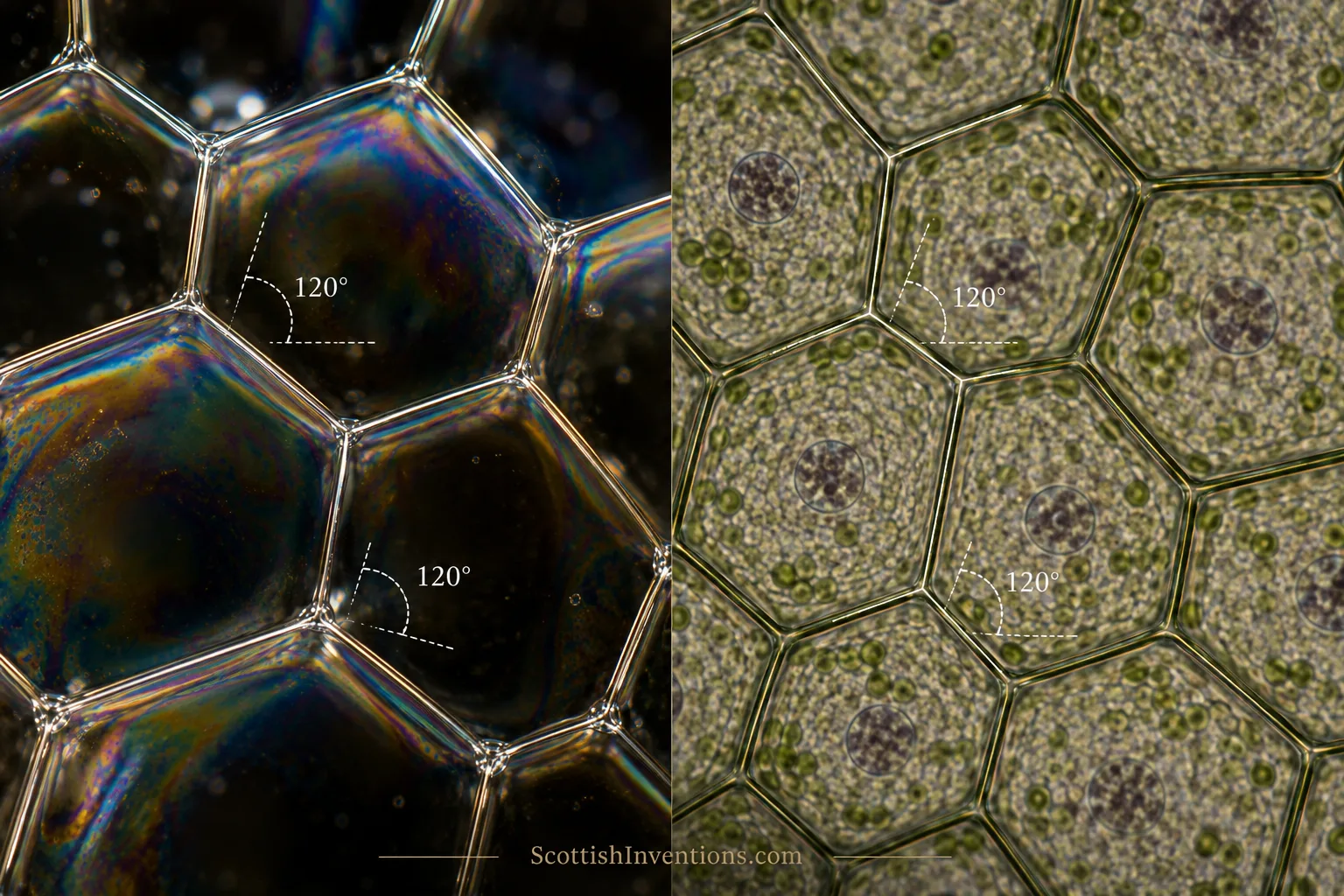
The mathematics of cells and soap bubbles. Thompson showed that cells packed in a tissue meet at the same angles as soap films in a foam. By the physics of minimal surfaces — Plateau's laws — three soap films meet along an edge at 120°. Living cells, minimising their surface energy, adopt the same geometry: biology reproducing the mathematics of the bubble bath.
Fibonacci spirals and phyllotaxis. The spiral arrangement of sunflower seeds, pine-cone scales and pineapple segments in Fibonacci numbers, and the logarithmic spiral of the nautilus shell and ram's horn, run through the book. Crucially, Thompson did not discover these patterns — Kepler had noted Fibonacci numbers in plants, and Charles Bonnet described phyllotaxis in the eighteenth century. Thompson's contribution was to insist the phenomenon be understood geometrically and mechanically, as a consequence of packing, rather than treated as mystical number-magic; he was famously sceptical of merely counting spirals without a physical cause.
The book's style is as celebrated as its science. Steeped in Greek and Latin, ranging across art, engineering and mathematics, it is written in magnificent prose. Stephen Jay Gould called it "the greatest work of prose in twentieth-century science", quoted by science writer Philip Ball in his May 2003 Dulwich Picture Gallery talk, "Patterns in art and nature".
The Transformation Grids
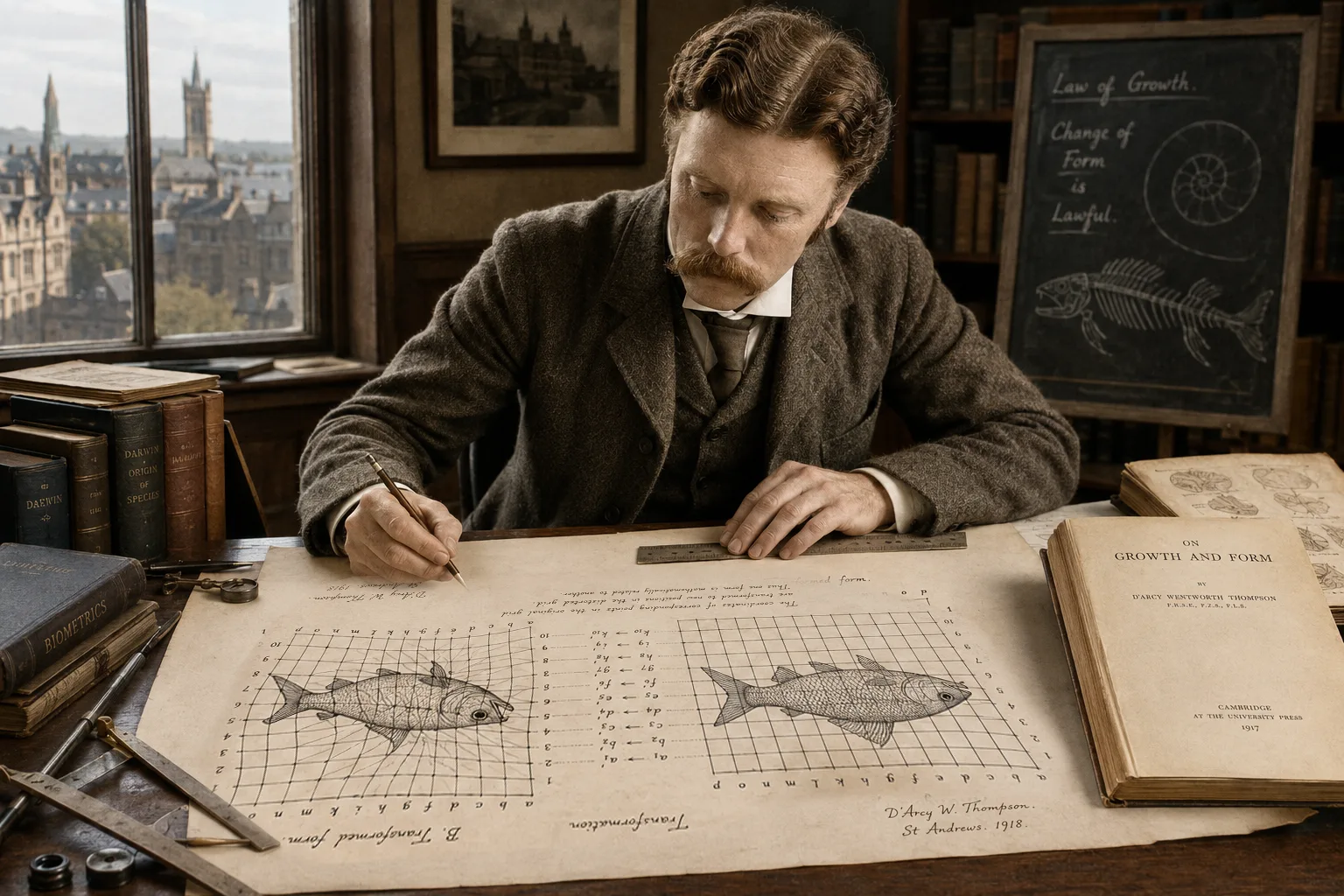
The book's final chapter — Chapter XVII, "On the Theory of Transformations, or the Comparison of Related Forms" — contains his most original idea. Draw a regular Cartesian grid over the outline of one animal; then systematically stretch, shear or curve that grid. Redraw the animal point-by-point onto the distorted grid, and the outline of a related species emerges.
His examples are vivid and specific. He transformed the porcupine fish Diodon into the sunfish Orthagoriscus, now Mola mola, by bending the vertical coordinates into concentric circles and the horizontals into hyperbola-like curves — the single most famous figure in the book. He transformed the parrotfish Scarus into the angelfish Pomacanthus, related the carapaces of different crabs, the pelvises of dinosaurs, the skulls of fossil horses, and — most strikingly for a general audience — stretched a human skull into those of a chimpanzee and a baboon.
What did this show? That closely related species differ not by a jumble of independent changes but by a single, smooth, coordinated transformation of the whole body — continuous deformations rather than discrete jumps. It was intuitively compelling and visually unforgettable. Scientifically, however, it was problematic: the grids showed correlation, not mechanism. They demonstrated that forms could be related by simple mappings but not why the transformations occurred, and Thompson's hand-drawn figures were not always mathematically exact.
The modern heir to this idea is geometric morphometrics. Beginning in the 1980s, Fred Bookstein and colleagues digitised Thompson's insight using landmark points and the "thin-plate spline", converting his artistic grids into rigorous, computable deformations; David Kendall's work on statistical "shape space" and principal component analysis provided the multivariate machinery. Thompson's hand-drawn grids of 1917 are the direct conceptual ancestor of these landmark-based deformation methods, and the same mathematics of grid-warping underlies image morphing in computer graphics.
Art and Architecture
Thompson's reach into art was remarkable. On Growth and Form has, as Nature Physics put it in 2017, "garnered an impressive array of followers — Alan Turing, Jackson Pollock, Stephen Jay Gould and Mies van der Rohe counting in their number" — and its vision of natural geometry rippled through modernist architecture and design.
Its most concrete artistic monument was the exhibition "Growth and Form", staged in 1951 at the Institute of Contemporary Arts in London as the ICA's contribution to the Festival of Britain, produced by the artist Richard Hamilton — later called the "father of Pop Art" — and opened by the architect Le Corbusier. The show was 1951, not 1961, a date frequently misreported. Hamilton had discovered the book through a fellow Slade student, the photographer Nigel Henderson; in Hamilton's own words, "This exhibition was the result of a fellow Slade student, Nigel Henderson, introducing me to D'Arcy Wentworth Thompson's (1860–1948) On Growth and form 1917... It opened my eyes to the idea that the world is as it is because it must follow certain mathematical principles." Hamilton filled the gallery with scientific models and imagery drawn from Thompson's pages and was permanently influenced by the book. The Scottish sculptor Eduardo Paolozzi was among the wider circle of artists shaped by Thompson's imagery, and the D'Arcy Thompson Zoology Museum in Dundee today holds an art collection — including works by Henry Moore, Salvador Dalí and Victor Pasmore — inspired by the book.
The Scientific Legacy
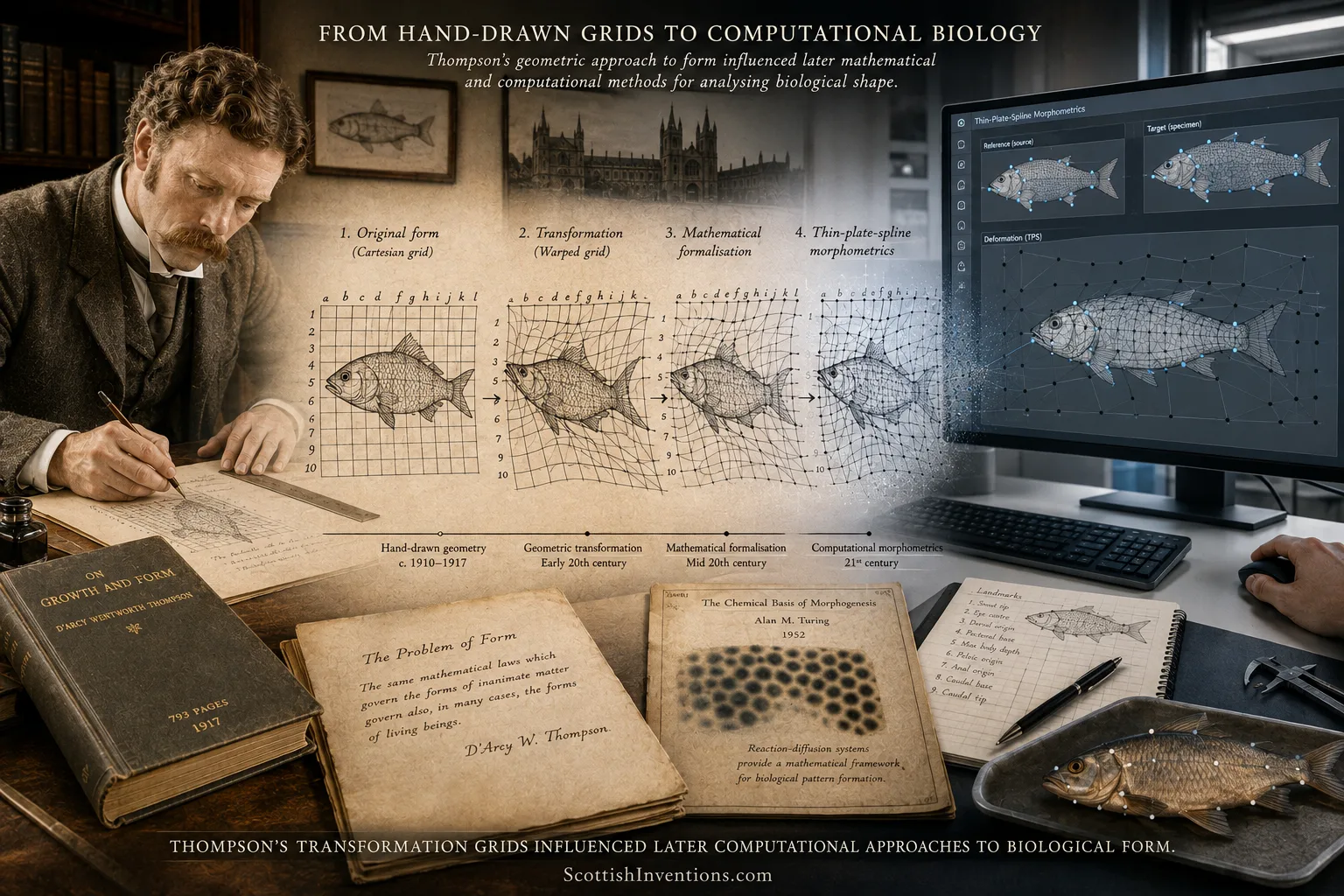
Thompson's deepest influence came after his death. In 1952 Alan Turing published "The Chemical Basis of Morphogenesis", proposing that reacting, diffusing chemicals could spontaneously generate biological patterns. Turing took his cue directly from Thompson's conviction that form arises from physical and mathematical law; On Growth and Form was among the few references in his thinking on morphogenesis, and Turing supplied a candidate mechanism for the very patterns Thompson had described.
Thompson is now widely regarded as an intellectual ancestor of evolutionary developmental biology, or evo-devo, the modern field studying how changes in development produce evolutionary change. His emphasis on physical self-organisation also runs through Stuart Kauffman's The Origins of Order (1993), which placed self-organisation alongside natural selection. Today, biologists working on "morphomechanics" and tissue self-organisation explicitly return to Thompson's differential-surface-tension ideas, and his approach informs bone biomechanics, biomimetic design and computational anatomy. Much of modern theoretical biology can be read as an attempt to reconcile Thompson's physics-first vision with Darwinian selection.
Thompson's Critics
Not everyone was persuaded. Even the book's warm initial reception carried reservations: reviewing the first edition in Nature on 13 September 1917, the naturalist J. Arthur Thomson hailed it as "at once substantial and stately... like one of Darwin's books, well-considered, patiently wrought-out, learned, and cautious," yet challenged Thompson's claim that physical science was "our only teacher and guide," writing that "it will be difficult to justify the word 'only'."
Darwinian biologists argued that Thompson undervalued natural selection, and later evolutionary biologists including Ernst Mayr were critical of physical-force explanations that seemed to bypass genetics and adaptation. Even his admirer Stephen Jay Gould, who found Thompson "characteristically prophetic," judged that physical forces are usually too weak to build complex form directly and that natural selection must do most of the work. The consensus verdict is that Thompson brilliantly identified the constraints physics places on form but overreached in making physical forces a rival to, rather than a complement of, natural selection.
Character and Legacy in Scotland
In 1917 Thompson moved to the senior Chair of Natural History at the University of St Andrews, which he held until his death — meaning he was a professor for 64 years, a British record. He was a spectacular figure: standing about six feet three inches, red-bearded in youth and white-bearded in age, crowned with a broad grey hat, and famous for carrying a parrot on his shoulder around the streets of St Andrews. He was a spellbinding lecturer who might produce a specimen from his pocket mid-sentence; at his last lecture, aged 87, he made his point with a live chicken under his arm.
Honours accumulated: Fellow of the Royal Society (1916), President of the Classical Association (1929), President of the Royal Society of Edinburgh (1934–39), the Linnean Gold Medal (1938), and the Royal Society's Darwin Medal (1946). He was knighted in 1937, as a Knight Bachelor. He died in St Andrews on 21 June 1948, aged 88, after contracting pneumonia on his return from India.
His memory is kept vividly alive in Scotland. The D'Arcy Thompson Zoology Museum at the University of Dundee, which he founded in the 1880s, still holds his specimens in the Carnelley Building; the University of St Andrews Library holds the vast D'Arcy Thompson papers of his manuscripts and correspondence, and his specimens survive in the Bell Pettigrew Museum there. A lecture theatre in Dundee's Tower Building was renamed in his honour, and a commemorative plaque marks his life in the city.
Timeline
1860
Born at 3 Brandon Street, Edinburgh, 2 May
His mother, Fanny Gamgee, dies nine days later; he is raised largely by his grandfather Joseph Gamgee
1870–77
Attends the Edinburgh Academy
Winning prizes in Classics, Greek Testament, Mathematics and Modern Languages
1877
Enters the University of Edinburgh to study medicine
Anatomy under Sir William Turner, zoology under Sir Charles Wyville Thomson of the Challenger expedition
1880
Moves to Trinity College, Cambridge, for the Natural Sciences Tripos
Studying under the physiologist Sir Michael Foster
1883
Graduates BA
Then a year as a junior demonstrator in physiology
22 Dec 1884
Elected first Professor of Biology at University College, Dundee
Aged 24; he takes up the post in early 1885 and stays around 32 years
1885 on
Builds a teaching museum of zoology at Dundee
It grows into one of the largest of its kind in Britain, stocked from Arctic voyages and Dundee's whaling connections
1895
Publishes A Glossary of Greek Birds
Classical scholarship pursued in parallel with zoology throughout his career
1896–97
Visits the Pribilof Islands as a British commissioner in the Bering Sea fur-seal inquiry
Made a Companion of the Bath in 1898
1898
Appointed to the Fishery Board for Scotland
A large part of his Dundee work was fisheries science
1902
British representative on the newly created International Council for the Exploration of the Sea
He served on such bodies for over four decades
1910
Publishes his translation of Aristotle's Historia Animalium
Oxford — the work of a classicist as much as a zoologist
1916
Elected Fellow of the Royal Society
1917
On Growth and Form published
793 pages; he had promised Cambridge University Press 'a little book'
13 Sep 1917
J. Arthur Thomson reviews it in Nature
'At once substantial and stately… like one of Darwin's books' — but challenges the word 'only'
1917
Moves to the senior Chair of Natural History at St Andrews
He holds it until his death, making 64 years in a professorial chair
1937
Knighted as a Knight Bachelor
Not a baronetcy or higher order — he already held the C.B. of 1898
1938
Awarded the Linnean Gold Medal
President of the Royal Society of Edinburgh 1934–39
1942
The enlarged second edition of On Growth and Form appears
1,116 pages; he had declined to reprint the first edition, insisting on a full revision
1946
Awarded the Royal Society's Darwin Medal
1947
Gives his last lecture, aged 87
Making his point with a live chicken under his arm; publishes A Glossary of Greek Fishes the same year
21 Jun 1948
Dies in St Andrews, aged 88
After contracting pneumonia on his return from India
1951
The 'Growth and Form' exhibition at the ICA, London
The ICA's contribution to the Festival of Britain, produced by Richard Hamilton and opened by Le Corbusier
1952
Alan Turing publishes 'The Chemical Basis of Morphogenesis'
Supplying a candidate mechanism for the very patterns Thompson had described
1980s
Bookstein and colleagues formalise geometric morphometrics
The thin-plate spline turns Thompson's artistic grids into rigorous, computable deformations
Myths & Facts
Myth: D'Arcy Thompson discovered Fibonacci patterns and phyllotaxis in nature.
Fact: He did not. Kepler had noted Fibonacci numbers in plants and Charles Bonnet described phyllotaxis in the eighteenth century. Thompson's contribution was to demand a geometric and mechanical explanation for the patterns — as a consequence of packing — rather than to treat them as number-magic.
Myth: E. O. Wilson called it the greatest work of literature in twentieth-century science.
Fact: That attribution could not be verified and appears to be a conflation of two real quotations: Peter Medawar's 'beyond comparison the finest work of literature in all the annals of science that have been recorded in the English tongue', and Stephen Jay Gould's 'the greatest work of prose in twentieth-century science'. Use Medawar and Gould, who are verifiable; do not attribute the line to Wilson.
Myth: His father was named George Thompson.
Fact: His father was also D'Arcy Wentworth Thompson (1829–1902), a classics master at the Edinburgh Academy and later Professor of Greek at Queen's College, Galway. 'George Thompson' is an error.
Myth: The ICA 'Growth and Form' exhibition was in 1961.
Fact: It was 1951, staged as the ICA's contribution to the Festival of Britain, produced by Richard Hamilton and opened by Le Corbusier.
Myth: Thompson invented computer graphics or CGI morphing.
Fact: He did not, and this card does not claim it. His transformation grids are the direct conceptual ancestor of the thin-plate-spline deformation methods used in geometric morphometrics, and the same mathematics of grid-warping underlies image morphing — an intellectual lineage, not an invention claim.
Myth: The transformation grids explained why species differ.
Fact: They showed that related forms can be related by a single smooth mapping. They did not supply a mechanism, and Thompson's hand-drawn figures were not always mathematically exact. Being candid about this is what makes the rest of the claim credible.
Myth: The book overturned Darwinism.
Fact: It challenged the sufficiency of natural selection as an explanation of form, and was criticised for it from the first review onwards. The consensus verdict is that Thompson identified genuine physical constraints on form but overreached in setting physics against selection rather than alongside it.
Did You Know?
- Thompson held a professorial chair for 64 years without a break — one of the longest unbroken academic tenures in British history.
- He lectured with a parrot on his shoulder and, in his final lecture at 87, demonstrated his point using a live chicken.
- Nobel laureate Peter Medawar called On Growth and Form 'beyond comparison the finest work of literature in all the annals of science that have been recorded in the English tongue'.
- His hand-drawn transformation grids of 1917 are the direct ancestors of the thin-plate-spline deformation methods used in geometric morphometrics.
- Alan Turing cited Thompson's work as inspiration for his 1952 paper on the mathematical basis of biological patterns.
- Thompson was as accomplished in Greek and Latin as in biology, translating Aristotle's zoology and compiling glossaries of Greek bird and fish names.
- He promised Cambridge University Press 'a little book' and delivered 793 pages — then expanded it to 1,116 in 1942.
Honest Caveats
The book's operational influence on working biology is hard to characterise. It was more admired than used — "a book more often cited than read," as Philip Ball opened his 2013 Nature retrospective ("In retrospect: On Growth and Form," Nature 494, 7 February 2013, pp. 32–33).
Sources differ slightly on his Dundee tenure — thirty-two versus thirty-three years — and on whether the first edition was "sold out by 1922" or "out of print by 1923". The first edition did sell out within about five to six years, and Thompson declined to reprint it, insisting instead on the vastly expanded 1942 revision.
The 1942 second edition, not the 1917 first, is the version most often reproduced, and some famous transformation figures are elaborated across both editions.
Gould's dismissal of direct physical shaping in favour of selection is widely paraphrased but hard to pin to a single citable line; it is presented here as a summary of his position rather than as a verbatim quotation.
The 64-year "record" is an institutional assertion. It is repeated by the Universities of Dundee and St Andrews but is not an independently audited statistic.
Frequently Asked Questions
What is On Growth and Form actually about?
It argues that the shapes of living things are first and foremost the product of physical forces acting on matter, not of natural selection alone. Where his contemporaries explained biological form through comparative anatomy and descent, Thompson wrote that 'Cell and tissue, shell and bone, leaf and flower, are so many portions of matter, and it is in obedience to the laws of physics that their particles have been moved, moulded and conformed.' His aim was to show that 'no organic forms exist save such as are in conformity with physical and mathematical laws.' It appeared in 1917 as a single volume of 793 pages from Cambridge University Press, and was greatly enlarged to 1,116 pages in the second edition of 1942.
What was his genuinely original contribution?
The theory of transformations, set out in the book's final chapter, Chapter XVII, 'On the Theory of Transformations, or the Comparison of Related Forms'. Draw a regular Cartesian grid over the outline of one animal; then systematically stretch, shear or curve that grid; redraw the animal point-by-point onto the distorted grid, and the outline of a related species emerges. This was his master stroke and it was his own.
What were his most famous examples?
He transformed the porcupine fish Diodon into the sunfish Orthagoriscus, now Mola mola, by bending the vertical coordinates into concentric circles and the horizontals into hyperbola-like curves — the single most famous figure in the book. He transformed the parrotfish Scarus into the angelfish Pomacanthus, related the carapaces of different crabs, the pelvises of dinosaurs and the skulls of fossil horses, and — most strikingly for a general audience — stretched a human skull into those of a chimpanzee and a baboon.
What did the grids actually prove?
That closely related species differ not by a jumble of independent changes but by a single, smooth, coordinated transformation of the whole body — continuous deformations rather than discrete jumps. It was intuitively compelling and visually unforgettable. Scientifically, however, it was problematic, and the article says so: the grids showed correlation, not mechanism. They demonstrated that forms could be related by simple mappings but not why the transformations occurred, and Thompson's hand-drawn figures were not always mathematically exact.
Did Thompson discover Fibonacci patterns in nature?
No, and this is the scope-of-claim point that matters most on this card. The spiral arrangement of sunflower seeds, pine-cone scales and pineapple segments in Fibonacci numbers, and the logarithmic spiral of the nautilus shell and ram's horn, run through the book — but Kepler had already noted Fibonacci numbers in plants, and Charles Bonnet described phyllotaxis in the eighteenth century. Thompson's contribution was to insist the phenomenon be understood geometrically and mechanically, as a consequence of packing, rather than treated as mystical number-magic; he was famously sceptical of merely counting spirals without a physical cause. That is a more impressive claim than a discovery myth, and it has the advantage of being true.
What is the soap-bubble argument?
Thompson showed that cells packed in a tissue meet at the same angles as soap films in a foam. By the physics of minimal surfaces — Plateau's laws — three soap films meet along an edge at 120°. Living cells, minimising their surface energy, adopt the same geometry: biology reproducing the mathematics of the bubble bath.
What is the argument from mechanics?
That scale governs shape. Because volume grows faster than the cross-sectional area of supporting limbs, a very large land animal must be relatively thicker-boned than a small one — gravity sets limits on size and proportion. Small organisms, by contrast, live in a world dominated by surface tension rather than gravity, which is why tiny creatures like radiolaria take shapes echoing those of liquid drops and films.
Is the book's reputation as literature deserved?
It is one of the most quoted judgements in science writing. Nobel laureate Peter Medawar called it 'beyond comparison the finest work of literature in all the annals of science that have been recorded in the English tongue,' and Stephen Jay Gould called it 'the greatest work of prose in twentieth-century science' — quoted by science writer Philip Ball in his May 2003 Dulwich Picture Gallery talk, 'Patterns in art and nature'. Both attributions are verifiable. Steeped in Greek and Latin, and ranging across art, engineering and mathematics, the book is written in magnificent prose.
How does his work survive in modern science?
Through geometric morphometrics. Beginning in the 1980s, Fred Bookstein and colleagues digitised Thompson's insight using landmark points and the thin-plate spline, converting his artistic grids into rigorous, computable deformations; David Kendall's work on statistical 'shape space' and principal component analysis provided the multivariate machinery. Thompson's hand-drawn grids of 1917 are the direct conceptual ancestor of these landmark-based deformation methods, and the same mathematics of grid-warping underlies image morphing in computer graphics.
What was his connection to Alan Turing?
In 1952 Turing published 'The Chemical Basis of Morphogenesis', proposing that reacting, diffusing chemicals could spontaneously generate biological patterns. Turing took his cue directly from Thompson's conviction that form arises from physical and mathematical law; On Growth and Form was among the few references in his thinking on morphogenesis, and Turing supplied a candidate mechanism for the very patterns Thompson had described.
Did the book influence art?
Remarkably so. As Nature Physics put it in 2017, On Growth and Form has 'garnered an impressive array of followers — Alan Turing, Jackson Pollock, Stephen Jay Gould and Mies van der Rohe counting in their number'. Its most concrete artistic monument was the 'Growth and Form' exhibition staged in 1951 at the Institute of Contemporary Arts in London, as the ICA's contribution to the Festival of Britain, produced by the artist Richard Hamilton — later called the father of Pop Art — and opened by Le Corbusier. The show was 1951, not 1961, a date frequently got wrong. Hamilton had discovered the book through a fellow Slade student, the photographer Nigel Henderson, and said of it: 'It opened my eyes to the idea that the world is as it is because it must follow certain mathematical principles.'
What did his critics say?
Even the warm initial reception carried reservations. Reviewing the first edition in Nature on 13 September 1917, the naturalist J. Arthur Thomson hailed it as 'at once substantial and stately... like one of Darwin's books, well-considered, patiently wrought-out, learned, and cautious', yet challenged Thompson's claim that physical science was 'our only teacher and guide', writing that 'it will be difficult to justify the word "only".' Darwinian biologists argued that Thompson undervalued natural selection, and later evolutionary biologists including Ernst Mayr were critical of physical-force explanations that seemed to bypass genetics and adaptation. Even his admirer Stephen Jay Gould, who found Thompson 'characteristically prophetic', judged that physical forces are usually too weak to build complex form directly and that natural selection must do most of the work.
So what is the settled verdict?
That Thompson brilliantly identified the constraints physics places on form, but overreached in making physical forces a rival to, rather than a complement of, natural selection. Much of modern theoretical biology can be read as an attempt to reconcile his physics-first vision with Darwinian selection. He is now widely regarded as an intellectual ancestor of evolutionary developmental biology — evo-devo — and his emphasis on physical self-organisation runs through Stuart Kauffman's The Origins of Order (1993) and through current work on morphomechanics and tissue self-organisation.
Was he Scottish?
Without qualification. He was born in Edinburgh on 2 May 1860, educated at the Edinburgh Academy, the University of Edinburgh and Trinity College, Cambridge, and was a professor in Scotland from 1884 until his death in 1948 — Dundee from 1884 to 1917, then St Andrews. He never held a post outside Scotland.
Sources & Further Reading
Tier 1 · Primary
- Thompson, D. W. — On Growth and Form, Cambridge University Press, 1917 (793 pp.); second edition 1942 (1,116 pp.).
- Thompson, D. W. — A Glossary of Greek Birds, Oxford, 1895.
- Thompson, D. W. — translation of Aristotle's Historia Animalium, Oxford, 1910.
- Thompson, D. W. — A Glossary of Greek Fishes, 1947.
- Thomson, J. A. — review of On Growth and Form, Nature, 13 September 1917.
- Turing, A. M. — "The Chemical Basis of Morphogenesis," 1952.
- Hamilton, R. — recollections of the 1951 ICA "Growth and Form" exhibition.
Tier 2 · Scholarly and institutional
- Ball, P. — "In retrospect: On Growth and Form," Nature 494 (7 February 2013): 32–33; and "Patterns in art and nature," Dulwich Picture Gallery, May 2003.
- Medawar, P. — on On Growth and Form as a work of literature.
- Gould, S. J. — on Thompson as "characteristically prophetic," and on the limits of physical explanation.
- Nature Physics — 2017 centenary commentary on the book's followers.
- Bookstein, F. L. — landmark-based morphometrics and the thin-plate spline; Kendall, D. G. — statistical shape space.
- Kauffman, S. — The Origins of Order, 1993.
- University of Dundee — the D'Arcy Thompson Zoology Museum; University of St Andrews — the D'Arcy Thompson papers and the Bell Pettigrew Museum.
- Development — 2017 centenary special issue.
Tier 3 · Site source document
docs/sources/discoveries/on-growth-and-form.md— the commissioned source document underlying this article.