Scottish Inventions · Medicine · Card No. 31 of 50
Sir James Black: The Scottish Inventor of Beta-Blockers, Cimetidine and Rational Drug Design
The daydreamer from the Fife coalfields who invented two Nobel-worthy classes of medicines — propranolol and cimetidine — and rewrote the rules of pharmaceutical research.

TL;DR
- Sir James Whyte Black (1924–2010), a Scottish miner's son raised in the Fife coalfields, invented propranolol — the first clinically successful beta-blocker — and cimetidine (Tagamet), winning the 1988 Nobel Prize in Physiology or Medicine.
- He is the only scientist credited with pioneering two entirely separate, Nobel-worthy classes of drugs, both through his philosophy of rational drug design.
- Propranolol remains on the WHO Model List of Essential Medicines; Tagamet became the world's first billion-dollar drug; and Black's thinking became the template for modern pharmaceutical research.
1. Early Life and Background
Sir James Whyte Black was born on 14 June 1924 at Thirlwall, Sheepburn Road, Uddingston, Lanarkshire, the fourth of five sons of Walter Black, a miner who studied mining engineering at night school and rose to colliery manager, and his wife Catherine (née Whyte), a seamstress. The apparent conflict in the sources — Uddingston versus Cowdenbeath — is easily resolved: he was born in Uddingston, but the family moved while he was still an infant to the Fife coalfields, and he was raised and educated mainly in Fife, ending his schooling at Cowdenbeath Secondary School (later Beath High School). His was a staunchly Baptist, music-loving household; all five brothers became university graduates.
A gifted but dreamy pupil, Black was steered towards mathematics by a teacher and entered the University of St Andrews at the age of 16 on a Patrick Hamilton Scholarship. He graduated MB ChB in 1946 and remains the only St Andrews graduate to hold a Nobel Prize. Disliking the clinical treatment of patients he witnessed, he chose research over medical practice, joining the physiology department under Robert Campbell Garry. After three years teaching in Singapore to clear his student debts, he returned to Britain and, in the early 1950s, established a Veterinary Physiology department at the University of Glasgow, where his fascination with the effects of adrenaline on the heart took hold. In 1958 he moved to ICI Pharmaceuticals.
"All I ever promised was that I was sure I could develop a new pharmacological agent which might answer a physiological question. Any utility would be implicit in that answer."
2. The Problem — What Beta-Blockers Solved
By the mid-20th century, heart disease was the leading cause of death in the industrialised world. Angina pectoris — the crushing chest pain that strikes when the heart muscle cannot get enough oxygen during exertion or stress — was debilitating and, beyond the century-old nitroglycerin, largely untreatable. For Black the problem was deeply personal: his father died of a heart attack, an event that helped trigger his lifelong determination to "stop the effects of adrenaline on the heart."
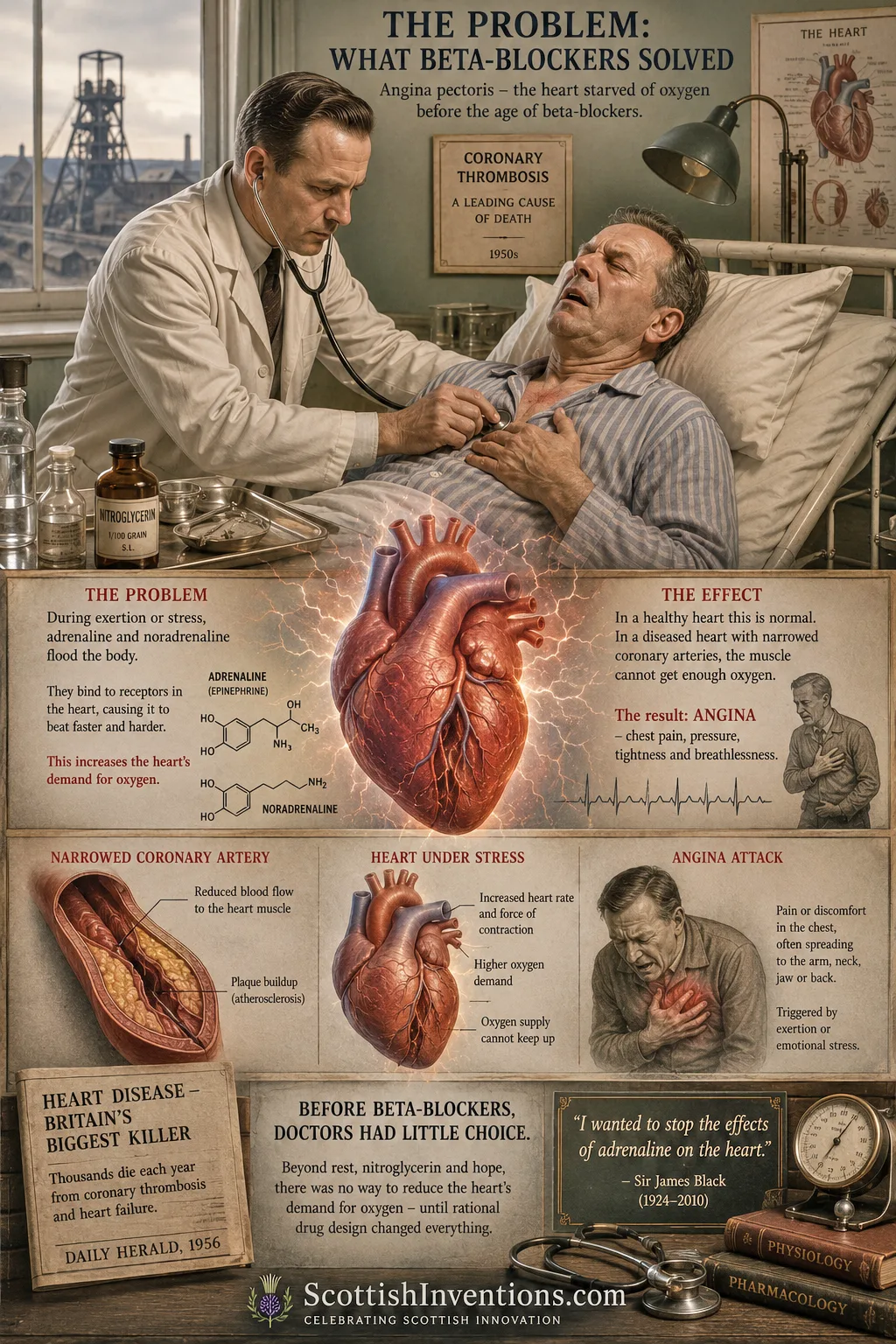
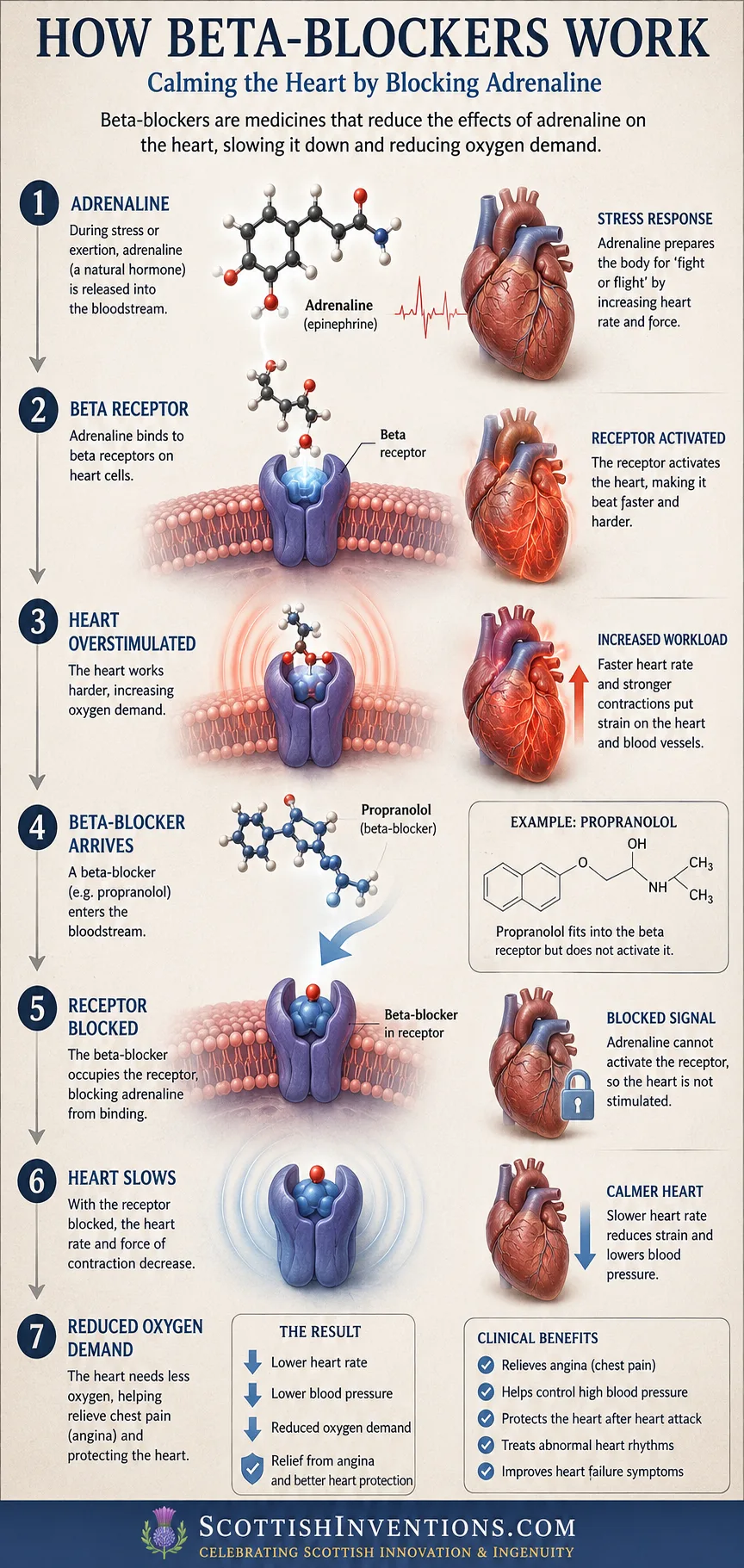
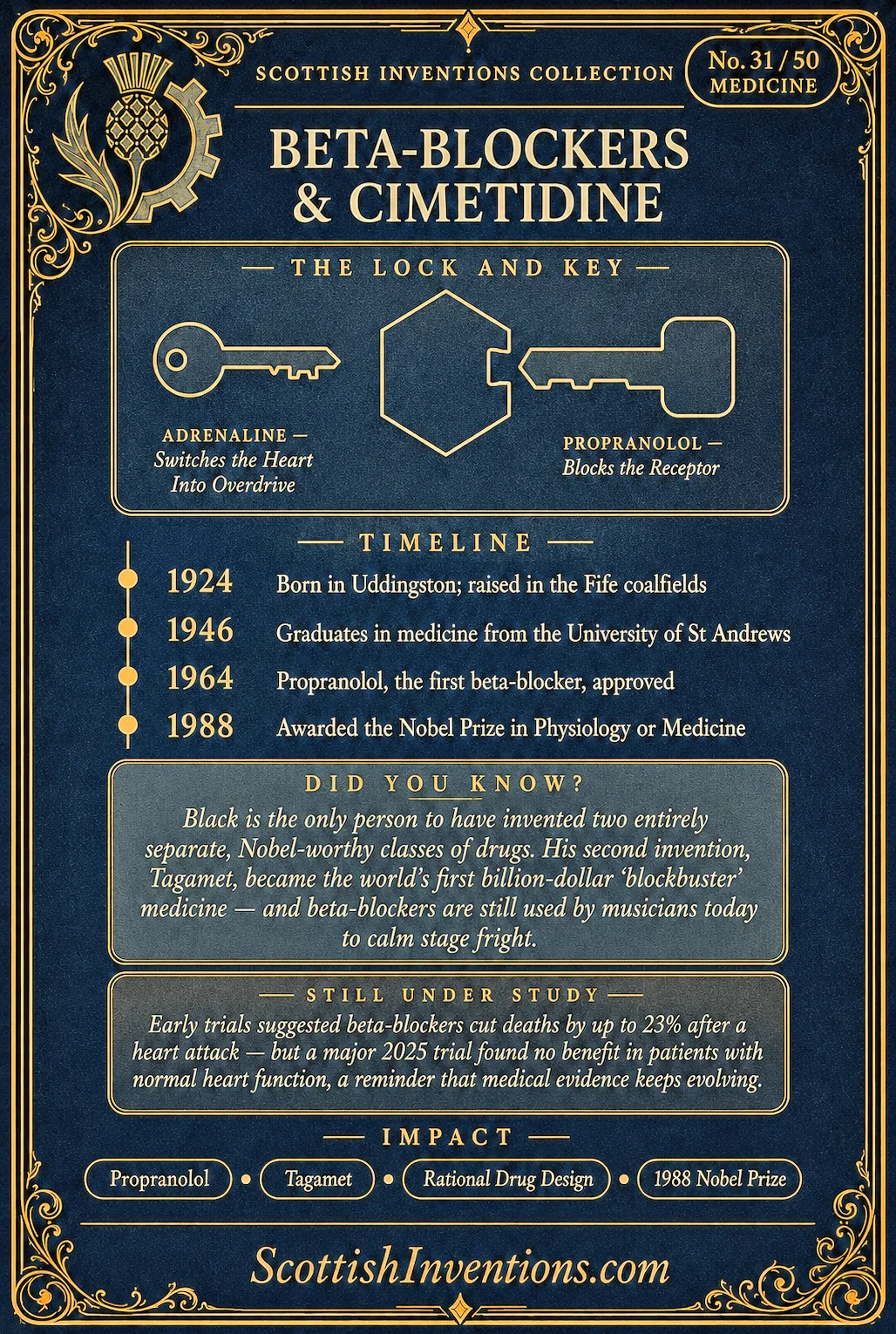
The physiology is elegant. The hormones adrenaline (epinephrine) and noradrenaline bind to receptors in the heart, driving up the rate and force of contraction — superb for fight-or-flight, but potentially lethal for a diseased heart starved of oxygen. Black's insight was to think like a physiologist: rather than trying to widen the arteries to supply more oxygen, why not reduce the heart's demand for it? If you could block adrenaline's receptors, you could calm the heart and relieve the angina. Receptor antagonism is the key idea: if adrenaline is a key that fits a lock (the receptor) to switch the heart into overdrive, a beta-blocker is a blank key that slips into the same lock, jams it, and prevents the real key from turning — without triggering the response itself.
3. The Invention of Propranolol — the First Beta-Blocker
At ICI's research centre at Alderley Park in Cheshire, Black built his programme on a then-neglected idea: the American pharmacologist Raymond Ahlquist's 1948 classification of adrenergic receptors into alpha and beta types. Ahlquist's paper, "A study of adrenotropic receptors" (American Journal of Physiology, 1948), had initially been rejected and was widely dismissed, but Black recognised it as the conceptual key to his project, and brought it with him into an industrial setting.
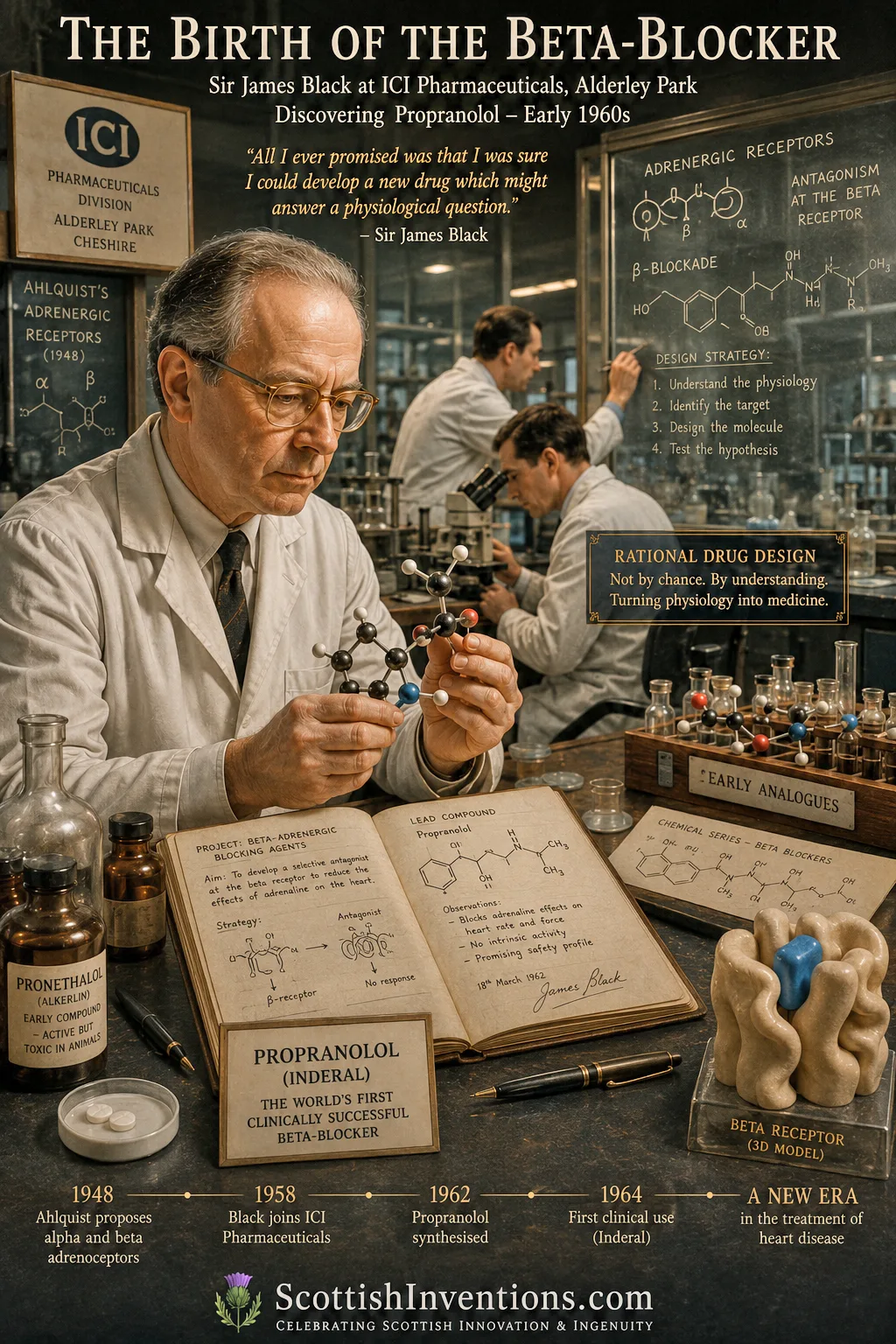
His first compound, pronethalol (trade name Alderlin), was effective but troubled: by April 1963 toxicity tests had shown it caused thymic tumours in mice, and it was restricted to life-threatening cases before being withdrawn. The team pressed on, and adding an oxymethylene bridge to the pronethalol structure produced propranolol (Inderal; ICI-45,520). It was more potent, had fewer side effects, and crucially produced no thymic tumours in long-term mouse studies (daily dosing over 18 months). Propranolol was patented in 1962, clinical trials ran from 1963–1964, and it was approved for medical use in 1964. Its very name — Inderal — is a near-anagram of Alderlin.
Propranolol became the world's first clinically successful beta-blocker, hailed as the greatest advance in treating angina since the discovery of digitalis. Its uses multiplied far beyond angina to encompass hypertension, cardiac arrhythmias, heart failure, anxiety, migraine prevention, thyrotoxicosis and essential tremor.
4. The Physiology Behind Beta-Blockers
Beta-blockers occupy the beta-adrenergic receptors on heart cells without activating them. Adrenaline, released during stress or exertion, is denied its usual binding site; heart rate and contraction force fall, blood pressure eases, and oxygen demand drops. This is why the same molecule can relieve angina, control high blood pressure, calm arrhythmias, prevent migraines and take the physical edge off stage fright.
5. Cimetidine — the Second Revolution
Fearing he would be pushed into management, Black left ICI in 1964 for the rival Smith Kline & French at Welwyn Garden City, where he turned the same rational approach onto peptic ulcers. The culprit was excess stomach acid, and Black reasoned that histamine — acting on a receptor distinct from the H1 receptor blocked by conventional antihistamines — was the final trigger of acid secretion. He set out to block this second receptor, which he termed H2.
The path was long and difficult. Black and four colleagues, who began the systematic H2-antagonist search at SK&F's Welwyn Garden City labs in 1964, synthesised some 200 histamine derivatives with modified rings and side chains. The breakthrough sequence ran burimamide (proof of concept, but not orally active) → metiamide, orally active and ten times more potent, but which caused the dangerous blood disorder agranulocytosis → cimetidine, in which the suspect thiourea group was replaced with a cyanoguanidine moiety. Cimetidine was synthesised in 1972, passed its toxicology in 1973, and was launched in the UK in November 1976 under the brand name Tagamet (from "anTAGonist" and "ciMETidine").
Tagamet became the world's first billion-dollar "blockbuster" drug. Per Oxford Academic's Blockbuster Drugs (Jie Jack Li), Tagamet emerged as the first blockbuster drug when its sales exceeded $1 billion in 1986, three years after its introduction in the US, and it generated some $14 billion during its 17 years of patent protection. The impact on patients was even more important than the money: peptic ulcer disease, which could be life-threatening and often demanded surgery, became a condition treatable with a pill.
6. The Nobel Prize and Recognition
In 1988 Black was awarded the Nobel Prize in Physiology or Medicine, shared with the Americans Gertrude B. Elion and George H. Hitchings, "for their discoveries of important principles for drug treatment." The Nobel Assembly at the Karolinska Institute announced the award on 17 October 1988, and Black delivered his Nobel lecture — "Drugs from Emasculated Hormones: The Principles of Syntopic Antagonism" — on 8 December 1988. The prize was widely seen as long overdue: propranolol had been in clinical use for over two decades.
"I wish I had my beta-blockers handy."
A private man horrified by publicity, Black had already been elected a Fellow of the Royal Society in 1976 (the same year he won the Lasker Award) and was knighted on 10 February 1981. He served as Professor of Analytical Pharmacology at King's College London from 1984 until 1992, and as Chancellor of the University of Dundee from 1992 to 2006. In 2000 he received the Order of Merit, of which only 24 living members exist at any one time. Underpinning it all was his concept of pharmacological analysis — using drugs as precision research tools to understand physiology.
7. Legacy
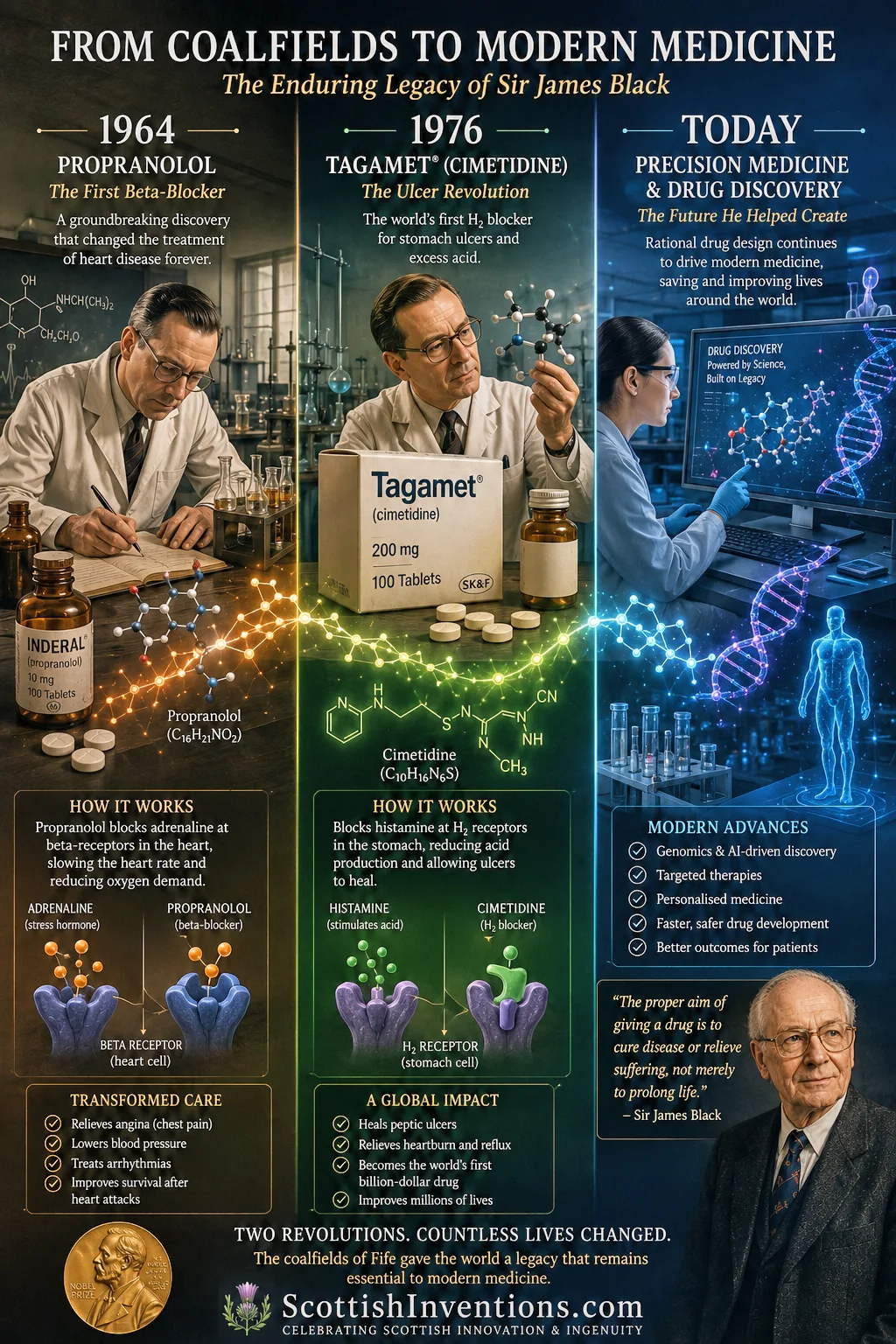
Black's twin inventions still shape medicine. Propranolol remains on the World Health Organization's Model List of Essential Medicines, and was the 69th most commonly prescribed medication in the United States in 2023, with more than nine million prescriptions (ClinCalc DrugStats Database). Cimetidine opened an entire field, soon followed by ranitidine (Zantac), famotidine (Pepcid) and ultimately the proton pump inhibitors that largely succeeded it.
His "rational drug design" transformed how the pharmaceutical industry searches for medicines, replacing trial-and-error screening with hypothesis-driven molecular design. The evidence on beta-blockers and survival is strong but evolving: early pre-reperfusion-era trials suggested a 23% reduction in mortality after a heart attack, but the 2025 REBOOT-CNIC trial (Ibáñez et al., New England Journal of Medicine) found no effect on death, reinfarction or heart-failure admission in 8,438 post-MI patients with preserved heart function. This is an area of active scientific debate and should not be overstated — but it does not diminish the historic importance of Black's discovery, which reshaped cardiology for a generation.
Black died on 22 March 2010 in London, aged 85, and is buried at Ardclach cemetery near Nairn. He is commemorated across Scotland: the £20 million Sir James Black Centre at the University of Dundee, the Sir James Black Building at the University of Glasgow, James Black Place at Ninewells Hospital, Sir James Black Gait in Lochgelly, and a portrait in the Booth Lecture Theatre at St Andrews. Shortly before his death he gifted his Nobel medal to the National Museum of Scotland, where it is displayed in the Enquire gallery.
Did You Know?
Timeline
14 Jun 1924
Born in Uddingston
Born at Thirlwall, Sheepburn Road, Uddingston, Lanarkshire — fourth of five sons of Walter Black, a miner turned colliery manager, and Catherine Whyte.
1930s
Raised in the Fife coalfields
Family moved while he was still an infant; schooled mainly in Cowdenbeath, Fife.
1940
St Andrews at 16
Entered the University of St Andrews on a Patrick Hamilton Scholarship.
1946
Graduates MB ChB
Only St Andrews graduate to hold a Nobel Prize.
Early 1950s
Veterinary Physiology, Glasgow
Established a new department at the University of Glasgow; his fascination with adrenaline and the heart takes root.
1958
ICI Pharmaceuticals
Joins ICI at Alderley Park, Cheshire, to build a rational programme against angina.
1962
Propranolol patented
The oxymethylene-bridged successor to pronethalol — potent, tumour-free in long-term mouse studies.
1964
Inderal approved
Propranolol enters medical use; the world's first clinically successful beta-blocker.
1964
Moves to Smith Kline & French
Fearing promotion into management, Black moves to SK&F's Welwyn Garden City labs and turns rational drug design onto stomach acid.
1972
Cimetidine synthesised
The cyanoguanidine successor to burimamide and metiamide — safe, potent and orally active.
Nov 1976
Tagamet launched
Cimetidine reaches the UK market under the brand name Tagamet ('anTAGonist' + 'ciMETidine'). Fellow of the Royal Society; Lasker Award.
1981
Knighted
Made Knight Bachelor on 10 February 1981.
1986
First billion-dollar drug
US sales of Tagamet exceed $1 billion — the original pharmaceutical 'blockbuster'.
17 Oct 1988
Nobel Prize
Shares the Nobel Prize in Physiology or Medicine with Gertrude B. Elion and George H. Hitchings.
2000
Order of Merit
Admitted to the Order of Merit — one of only 24 living members at any time.
22 Mar 2010
Death in London
Dies aged 85; buried at Ardclach cemetery near Nairn.
Collector card
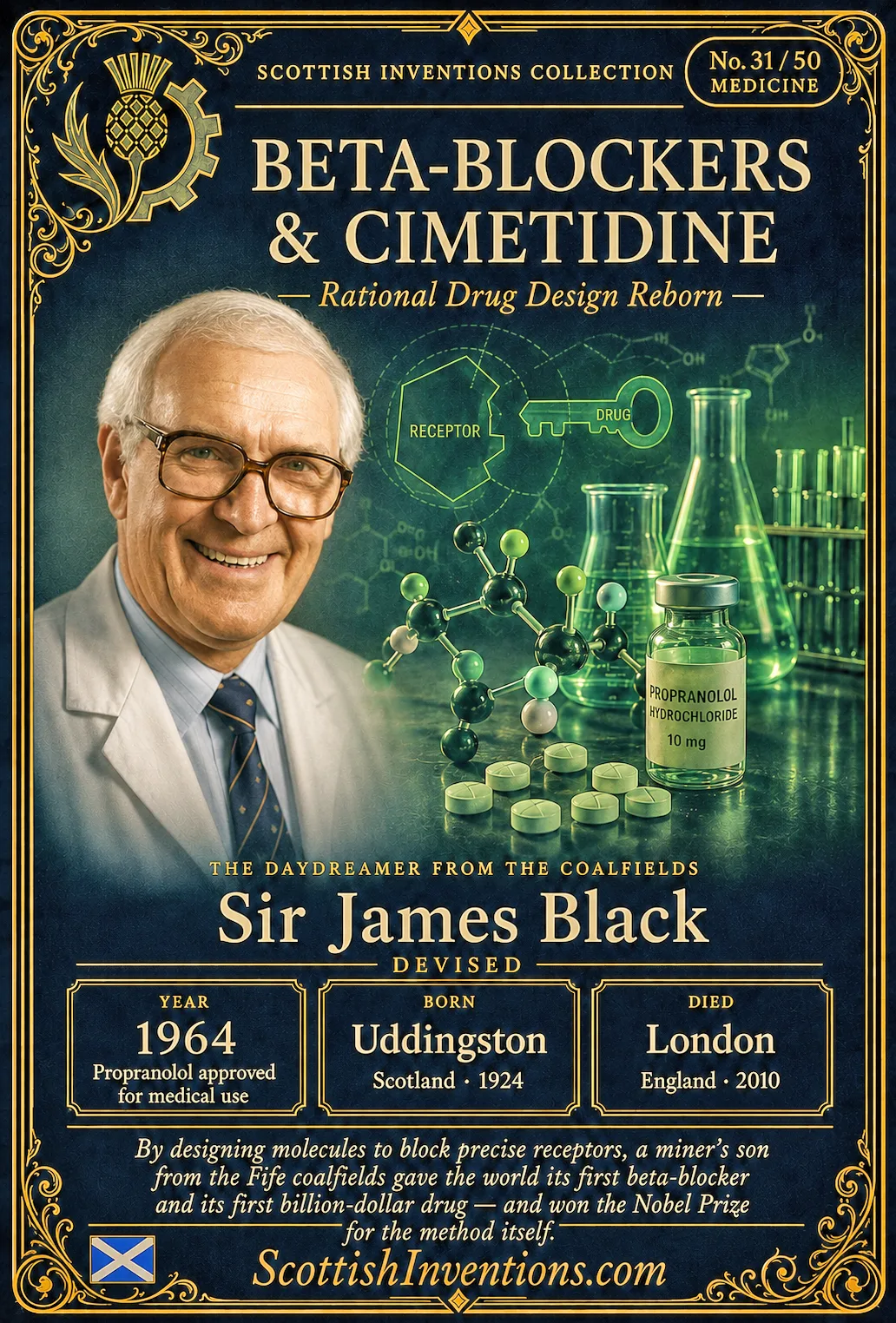
Beta-Blockers & Cimetidine is Card No. 31 in the Scottish Inventions Collection of 50 illustrated cards.
Frequently Asked Questions
- Who was Sir James Black?
- Sir James Whyte Black (14 June 1924 – 22 March 2010) was a Scottish pharmacologist born in Uddingston, Lanarkshire and raised in the Fife coalfields. A graduate of the University of St Andrews, he invented propranolol and cimetidine and won the 1988 Nobel Prize in Physiology or Medicine.
- What did Sir James Black invent?
- Black invented two Nobel-worthy classes of medicines: beta-blockers, beginning with propranolol (Inderal) at ICI Pharmaceuticals in 1962–1964, and H2 receptor antagonists, culminating in cimetidine (Tagamet) at Smith Kline & French, launched in the UK in November 1976.
- What are beta-blockers?
- Beta-blockers are medicines that block beta-adrenergic receptors in the heart, preventing adrenaline and noradrenaline from binding to them. This slows the heart, reduces the force of contraction and lowers oxygen demand, relieving conditions such as angina, high blood pressure, arrhythmias, migraine and performance anxiety.
- What is propranolol?
- Propranolol (brand name Inderal, code ICI-45,520) was the first clinically successful beta-blocker. It was patented in 1962 and approved for medical use in 1964. It remains on the World Health Organization's Model List of Essential Medicines.
- Why was propranolol revolutionary?
- It was the first drug designed through 'rational drug design' — building a molecule to block a specific receptor rather than screening thousands of compounds at random. It was hailed as the greatest advance in treating angina since the discovery of digitalis and opened up modern cardiology.
- What is cimetidine?
- Cimetidine (brand name Tagamet) is an H2 receptor antagonist that blocks histamine at the H2 receptor in the stomach, reducing acid secretion and healing peptic ulcers. It was launched in the UK in November 1976 and became the world's first billion-dollar 'blockbuster' drug.
- What is rational drug design?
- Rational drug design is the philosophy of building a medicine to answer a specific physiological question — identifying the biological target first, then designing a molecule to block or activate it. Black pioneered this approach, and it is now the template for modern pharmaceutical research.
- Why did Sir James Black win the Nobel Prize?
- In 1988 Black shared the Nobel Prize in Physiology or Medicine with Gertrude B. Elion and George H. Hitchings 'for their discoveries of important principles for drug treatment.' The prize honoured his method of thinking as much as the two drug classes it produced.
- Are beta-blockers still used today?
- Yes. Propranolol was the 69th most commonly prescribed medication in the United States in 2023 with more than nine million prescriptions, and beta-blockers remain in daily use worldwide for cardiovascular disease, migraine, anxiety and other conditions. Their role after uncomplicated heart attacks is an area of active clinical debate following the 2025 REBOOT-CNIC trial.
- What is Sir James Black's legacy?
- Two Nobel-worthy classes of medicines, a WHO Essential Medicine (propranolol) and the first billion-dollar drug (Tagamet), plus the intellectual template of rational drug design that guides modern pharmaceutical research. He is commemorated in buildings, streets and a portrait across Scotland, and his Nobel medal is on display at the National Museum of Scotland.
Continue Exploring Scottish Medical Innovation
From life-saving medicines to revolutionary surgical techniques
Scotland has repeatedly transformed global healthcare. Discover the remarkable inventors, physicians and scientific pioneers whose breakthroughs continue to improve millions of lives around the world.
Explore More Scottish Medical InventionsSources
- Nobel Prize in Physiology or Medicine 1988 — nobelprize.org.
- Oxford Dictionary of National Biography — Sir James Whyte Black.
- American Chemical Society, Tagamet National Historic Chemical Landmark.
- Jie Jack Li, Blockbuster Drugs (Oxford Academic).
- Mike Freemantle, "Cimetidine — a landmark of drug design," Chemistry World.
- Ibáñez B. et al., REBOOT-CNIC trial, New England Journal of Medicine, 2025.
- WHO Model List of Essential Medicines; ClinCalc DrugStats Database (US, 2023).
- Royal Society Biographical Memoirs; National Museums Scotland.