
Flush Toilet / S-bend
by Alexander Cumming
Introduction
Alexander Cumming is the most important British inventor you have never heard of. In 1775 the Edinburgh-born watchmaker patented a single, modest bend of pipe — the S-bend — and in doing so solved the problem that had blocked indoor sanitation for nearly two centuries.
Two hundred and fifty years later, every toilet, every sink and every shower drain on Earth still works on his principle. This is the story of the Scottish watchmaker who saved the world.
Early Life and Background
Alexander Cumming was born around 1733 in Edinburgh, the son of James Cumming, who came from the rural parish of Duthil in Inverness-shire. He was apprenticed to an Edinburgh watchmaker and grew up amid the intellectual ferment of the Scottish Enlightenment, belonging to the city's skilled artisan class — the world of guild-regulated precision trades that gave Scotland a formidable reputation for clockwork and instrument-making.
By the 1750s, while still in his twenties, Cumming's talent had already drawn aristocratic patronage. He and his brother John were engaged by Archibald Campbell, 3rd Duke of Argyll, to supply an organ and clock for Inveraray Castle. He later moved to London, and by 1763 had premises in New Bond Street, where he became one of the most respected instrument-makers of his era.
In 1763 he was appointed to the commission that adjudicated on John Harrison's marine 'timekeeper for discovering the longitude at sea'. In 1766 he published The Elements of Clock and Watch-Work, Adapted to Practice — the first English horological book of consequence after Derham. In 1783 he was a joint founder of the Royal Society of Edinburgh and elected FRSE. He died on 8 March 1814 in Pentonville, London.
The State of Sanitation Before Cumming
To understand why a bent pipe deserves to be called world-changing, picture the world before it. For most of human history, human waste was a constant, deadly companion. Town-dwellers used chamber pots, often emptied straight into the street with a shouted warning. Households dug cesspits beneath or beside their homes; medieval castles had the 'garderobe,' a closet jutting from the wall with a hole that dropped waste into the moat or a pit below.
The consequences were catastrophic. Human waste contaminated drinking water and spread killer diseases — typhoid and, above all, cholera. London's filth would eventually culminate, decades after Cumming, in the Great Stink of 1858, when the sewage-choked Thames baked in a summer heatwave and the stench drove Parliament itself to act.
A flushing toilet had, in fact, already been invented. Sir John Harington (1561–1612), godson of Queen Elizabeth I, built one in 1596, naming it the 'Ajax'. But Harington's device had one fatal omission: no water seal. Without a seal, a flush toilet simply opened a permanent pipe between the house and the cesspit, and noxious gases — hydrogen sulphide and methane — poured straight back up into the room. That missing piece is exactly what Cumming supplied.

The Invention — The S-Bend (1775)
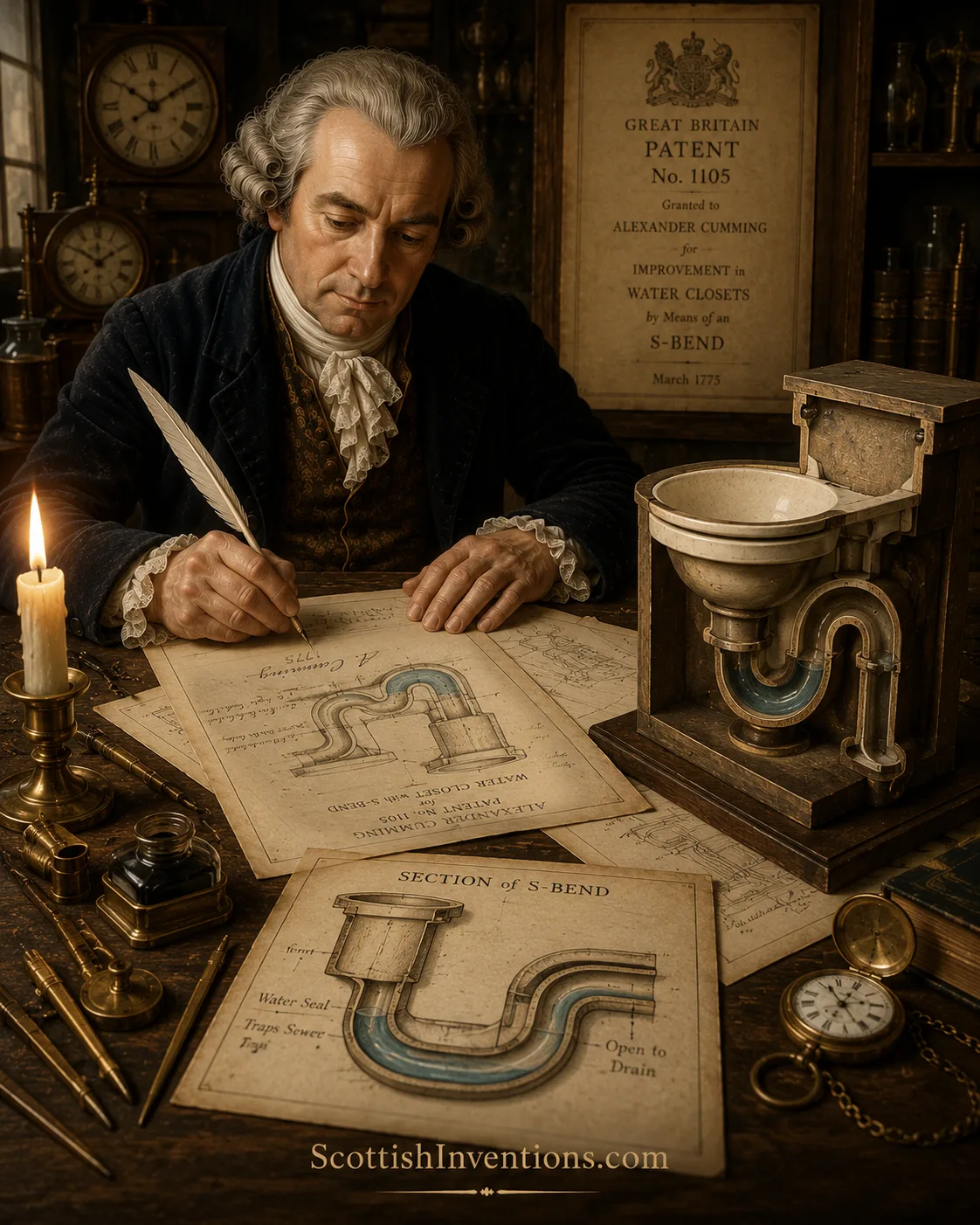
On 11 November 1775, Alexander Cumming was granted British Patent No. 1105 for an 'improvement in the construction of water closets'. The decisive feature was the S-shaped pipe beneath the bowl — a simple curve that retained a permanent plug of water after every flush. That water became a barrier. Sewer gases could no longer rise into the room. For the first time in history, an indoor toilet was safe to live with.
Cumming's design also introduced a sliding valve at the base of the bowl that opened to release waste and closed to refill the bowl with clean water. But the patent's enduring genius lay in the trap. Joseph Bramah refined the valve mechanism three years later, in 1778, and went on to build a thriving business selling water closets — but the principle that made the modern toilet possible was Cumming's.
It is essential to be clear about what Cumming did and did not do. Thomas Crapper did not invent the flush toilet. Crapper (baptised 1836, died 1910) was a genuine and successful Victorian sanitary engineer — but he was not born until 1836, 61 years after Cumming's patent, and he invented neither the toilet nor the S-bend. Much of the myth stems from a tongue-in-cheek 1969 book, Flushed with Pride: The Story of Thomas Crapper by satirist Wallace Reyburn. The word 'crap' is older still — the OED traces its application to bodily waste to 1846, with roots reaching back through Middle English.
How the S-Bend Works
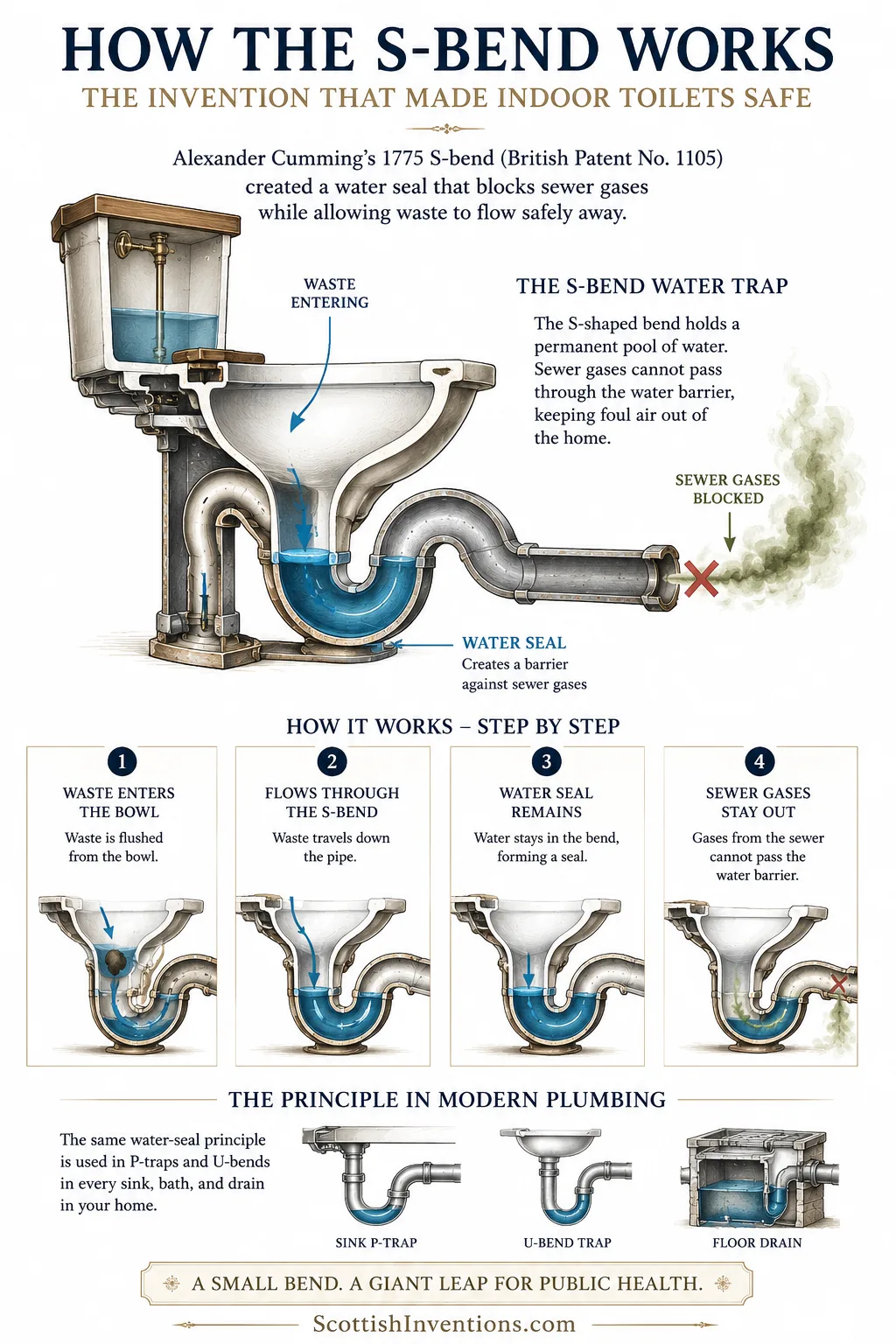
The S-bend's brilliance is its simplicity. Waste flushed from the bowl travels down through the curve and into the sewer pipe. But because the pipe bends sharply downward and then back up, a small pool of water is always left sitting in the lowest part of the bend after every flush.
That standing water is the seal. Sewer gases — methane, hydrogen sulphide and the cocktail of bacterial volatiles that rise from drains — cannot cross a body of water. The seal lets waste out and keeps gas in. The same principle is used today in the P-trap under every kitchen sink, the U-bend under every bath and the floor drain in every wet room. One small geometry, repeated trillions of times across the planet.
The Broader Context — Sanitation and Public Health
Cumming's bend was a precondition for the great sanitation revolution of the 19th century. In 1854, physician John Snow traced a deadly cholera outbreak in Soho's Broad Street to a single contaminated public water pump, providing the founding case study of modern epidemiology. Four years later, the Great Stink of 1858 finally forced Parliament's hand, and engineer Sir Joseph Bazalgette built London's vast network of intercepting sewers — around 1,100 miles of drains feeding into 82 miles of new brick-lined main intercepting sewers — which together banished cholera from the capital.
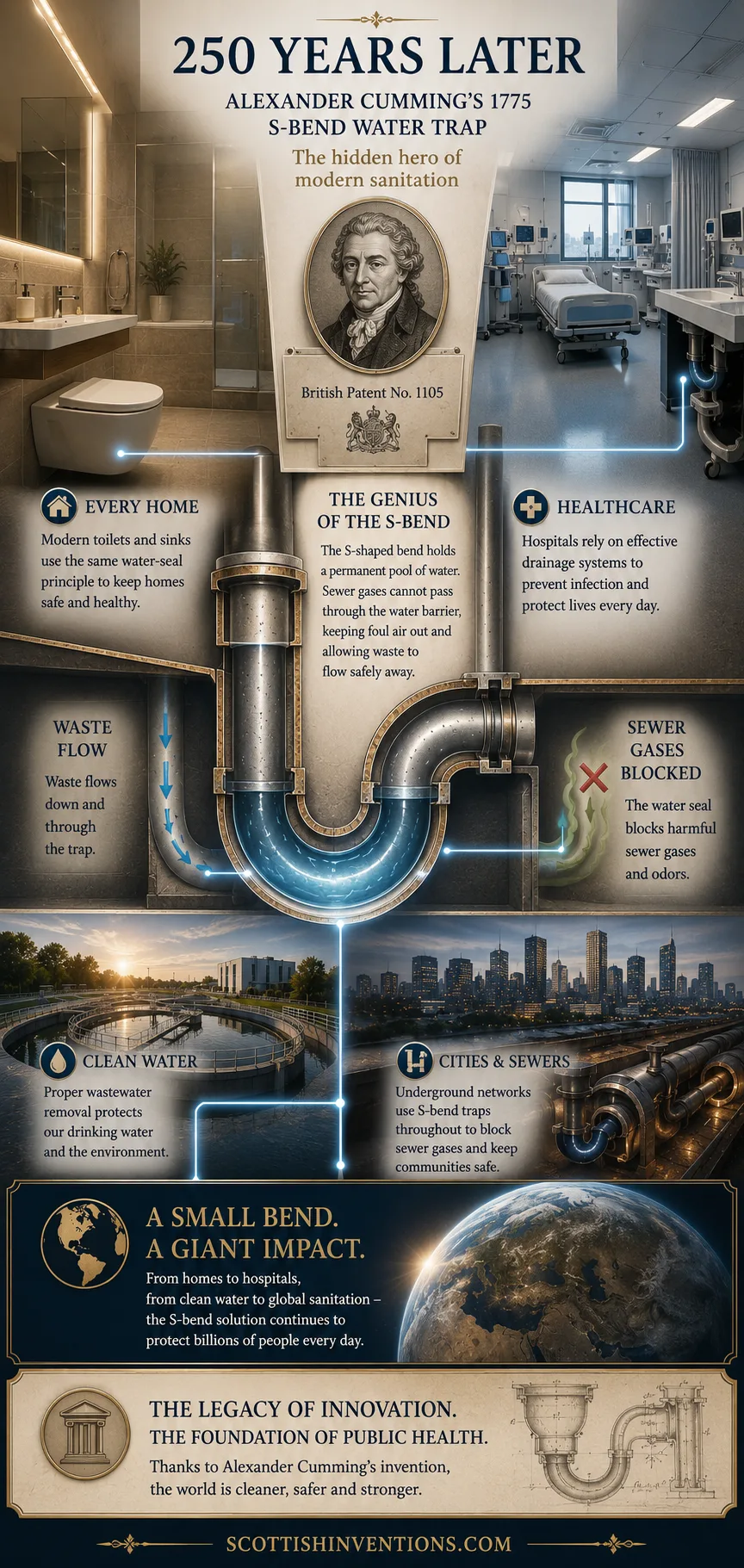
The flush toilet, the sewer and the clean water supply formed the system that roughly doubled human life expectancy. That system rests, quite literally, on Cumming's principle. According to the WHO/UNICEF Joint Monitoring Programme, as of 2024 some 3.4 billion people still lacked safely managed sanitation services — and every safe toilet that closes that gap relies on a water-sealed trap.
Cumming's Other Achievements
Cumming was not a one-invention man. He was instrument-maker to King George III, building precision clocks, organs and microtome-like scientific instruments for the royal collection. He invented the recording barograph — a clockwork-driven device that drew a continuous trace of atmospheric pressure onto a rotating paper drum, providing the first machine-readable record of the weather and a direct ancestor of every modern data logger.
He was a magistrate from 1779, made an honorary freeman of the Worshipful Company of Clockmakers in 1781, and a founding Fellow of the Royal Society of Edinburgh in 1783. His 1766 treatise on horology remained a standard reference for generations of British clockmakers.
Legacy
Here is the plain, astonishing fact: the S-bend principle Alexander Cumming patented in 1775 is used in every toilet, every sink drain and every shower drain on the planet, and has been in continuous use for two and a half centuries. Few inventions are so universal, so essential and so completely taken for granted. And few inventors are so thoroughly forgotten.
The global economy that flows from his idea is enormous: the sanitary ware market alone was valued at USD 34.3 billion in 2024 and is projected to reach USD 61.6 billion by 2034, with the toilet/water-closet segment generating USD 15.8 billion in 2024. Yet Cumming has almost no public memorial — no portrait in any major public collection, no blue plaque in Edinburgh or London. His commemorations amount to Cumming Street in Pentonville and his now-vanished grave in what is today Joseph Grimaldi Park.
Scotland gave the world the steam-engine improvements of James Watt, the telephone of Bell, the television of Baird and the antiseptics of Lister. It also gave the world the safe, indoor toilet — and his name was Alexander Cumming.
Frequently Asked Questions
Who invented the S-bend? The Scottish watchmaker Alexander Cumming, in British Patent No. 1105, granted in 1775.
Did Thomas Crapper invent the toilet? No. Crapper was a real and successful Victorian plumber, but he was not born until 1836 — 61 years after Cumming's patent — and invented neither the flush toilet nor the S-bend.
Was Alexander Cumming Scottish? Yes. He was born in Edinburgh around 1733 and apprenticed there as a watchmaker before moving to London.
What was British Patent No. 1105? It was the first British patent for a flushing water closet, granted to Alexander Cumming in 1775. Its decisive innovation was the S-shaped water trap.
Who really invented the flush toilet? Sir John Harington built the first flushing water closet, the 'Ajax', in 1596 — but his design lacked a water seal. Cumming's 1775 S-bend is what made the indoor flush toilet safe.
Is the S-bend still used today? Yes. The S-bend, and its descendants the P-trap and U-bend, are used in every toilet, sink, bath and floor drain in the world.
Weekly Scottish Innovation Facts
Delivered to your inbox every Sunday. No spam, just brilliance.