Scottish Inventions · Technology
Alexander Bain and the Electric Clock: The Scottish Inventor Who Electrified Time
Scottish Impact Index (SI Score)
- Global Impact
- 8/10
- Longevity
- 5/10
- Economic / Material Impact
- 7/10
- Originality / Distinctiveness
- 10/10
- Legacy (Built Upon)
- 8/10
- Recognition
- 6/10
A Caithness crofter's son patented the first British electric clock in 1841 — and, with a single sentence in that patent, invented the master-and-slave principle that still keeps every computer network on Earth in sync.
Key Takeaways
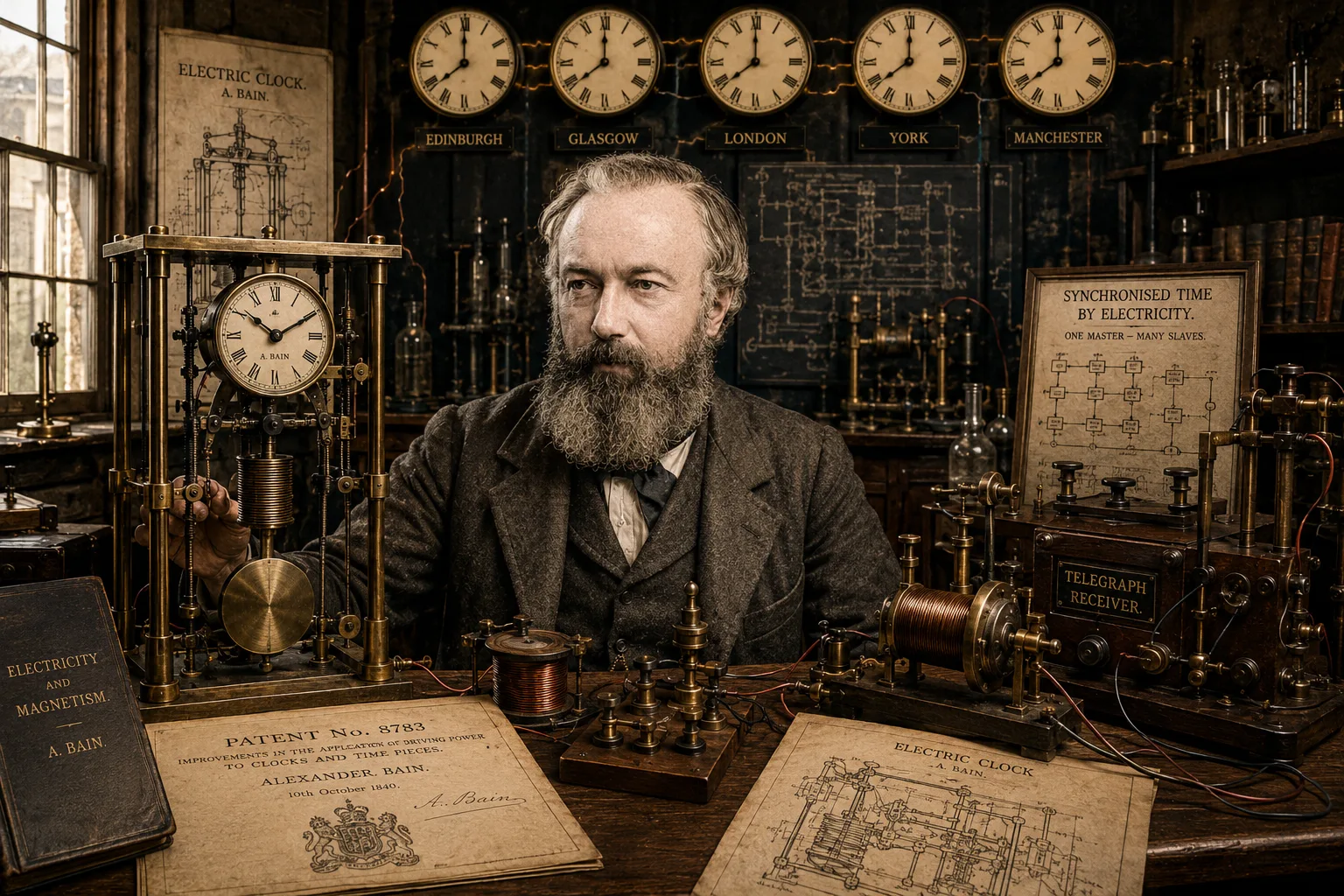
- Alexander Bain (1810–1877), a self-taught crofter's son from Watten in Caithness, patented the first British electric clock — a pendulum kept swinging by electromagnetic pulses rather than weights or springs.
- British Patent No. 8783, filed with chronometer-maker John Barwise on 10 October 1840 and granted on 11 January 1841.
- His real breakthrough was the master-and-slave principle: one accurate clock keeping any number of distant clocks in perfect step over a wire.
- That master-slave idea is the direct ancestor of the Network Time Protocol (NTP) that keeps every computer network on Earth in sync today.
- Bain proposed an earth battery — zinc and copper plates buried in damp soil — to power the clock indefinitely from the ground itself.
- His clocks and telegraph instruments survive in the National Museum of Scotland, the Science Museum in London, and the Deutsches Uhrenmuseum in Germany.
The Honest Verdict
Bain was the first to patent the electric clock in Britain — a German experimenter, Carl August Steinheil, had already built a working electric clock and transmitted time signals in Bavaria in 1839. Bain's most consequential contribution is not the clock itself but the master-and-slave synchronisation principle written into his 1841 patent — the same principle that governs the Network Time Protocol today.
Key Facts
Watten 1810
Born in Watten, Caithness in 1810 (baptismal record), a crofter's son who taught himself electromagnetism.
Patent No. 8783
Filed 10 October 1840, granted 11 January 1841 — the first British patent for an electric clock, with John Barwise.
No winding needed
Replaced falling weights and springs with an electromagnetic pulse on each pendulum swing.
Earth battery
Proposed powering the clock from zinc and copper plates buried in damp soil — a clock powered by the planet.
Master and slave
One master clock sends electrical pulses to keep any number of slave clocks in perfect step.
Edinburgh–Glasgow, 1845
Demonstrated time distribution along a 46-mile telegraph line he built for £50 a mile.
What is an Electric Clock — and Why Did it Matter?
For two centuries before Bain, the best clocks in the world were mechanical pendulum clocks. Christiaan Huygens had built the first in 1656, and it was a staggering leap: it improved accuracy from about fifteen minutes a day to about fifteen seconds. From 1656 until the 1930s, the pendulum clock was the world's most precise timekeeper.
But a mechanical clock had stubborn limitations. It had to be wound — daily, for most domestic clocks — as a falling weight or unwinding spring drove the mechanism. Its pendulum drifted with temperature and humidity. And, most importantly for a modernising world, there was no easy way to keep a whole network of clocks showing the same time.
Before electricity, a human "time-keeper" might literally walk from clock to clock with a reference watch, resetting each by hand. Cities used dramatic public signals: Edinburgh's time-ball on the Nelson Monument (1853) and the Edinburgh Castle time-gun (1861) let mariners and citizens set their watches. Until the railways, most towns simply kept their own local noon, meaning clocks in the east and west of Britain could differ by many minutes.
The railways broke this system. Trains running to a timetable across an east–west network needed every station on the line to agree on the time. An electromagnetically maintained pendulum that never needed winding, that could be tied to a master clock and kept in perfect synchrony, was exactly the tool this new world required.
Bain's Electric Clock — The Invention
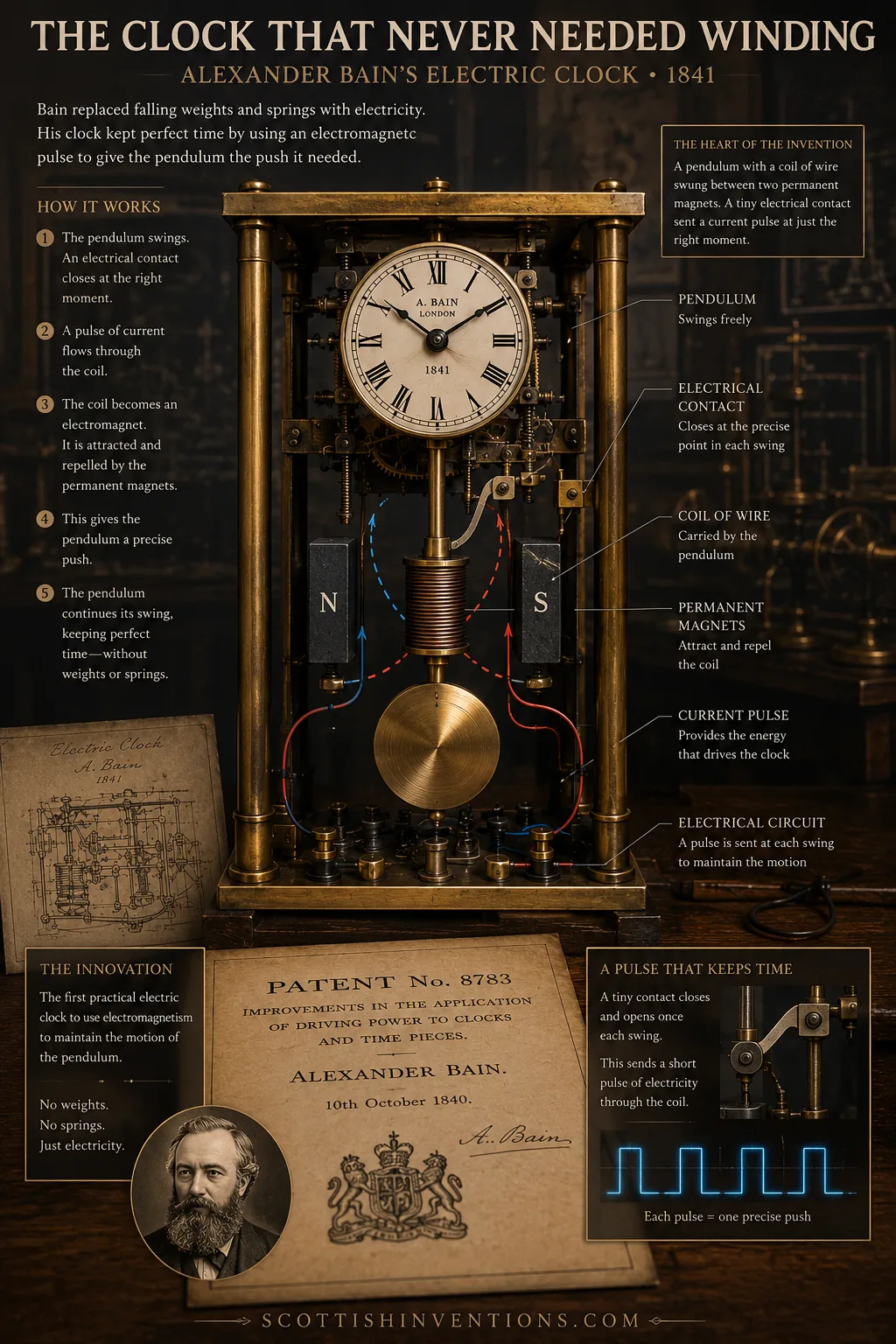
Bain's insight was to replace the mechanical "push" with an electromagnetic one. In an ordinary clock, a wound weight or spring feeds energy through the escapement to nudge the pendulum on each swing, replacing the energy lost to friction. Bain did away with the weight and the escapement-as-driver entirely.
In his clock, the pendulum carried a coil of wire that swung through the field of fixed permanent magnets. A small electrical contact on the pendulum — made of gold to resist corrosion — briefly completed a circuit at the right moment, sending a pulse of current through the coil. The coil became a momentary electromagnet, attracted and repelled by the fixed magnets, and so received its kick. The pendulum then drove the clock's hands by a light arm-and-hook engaging a ratchet wheel.
To this he added two visionary ideas. The first was the earth battery — a clock powered by the planet itself. The second was synchronisation: connecting multiple clocks together so that one "master" governed any number of "slaves." It is this idea, more than the clock itself, that makes Bain a giant of horological history — and it was written into that very first patent.
How the Electric Clock Worked — Explained
Picture an ordinary pendulum. Left alone, it slows and stops, because friction and air resistance steal a little energy from every swing. A mechanical clock replaces that lost energy with a tiny push delivered through the escapement, powered by a falling weight or an unwinding spring — which is why it has to be wound.
Bain's clock delivered the push electrically. Around the pendulum he mounted a coil of wire, arranged to swing between the poles of fixed permanent magnets. Partway through each swing, the gold contact briefly closed an electrical circuit. Current flowed through the coil, turning it into a temporary electromagnet. Because a current-carrying coil in a magnetic field experiences a force — the same principle behind every electric motor — the coil was pushed, and the pendulum got its kick.
The whole thing sipped only a trickle of electricity — little enough to be supplied by the earth battery or a small cell. And crucially, a contact on the pendulum could also send a pulse down a telegraph wire on each swing, so that a distant clock could be driven in step. The master clock did not merely keep good time; it forced the slave's pendulum to stay precisely synchronised with its own.
The Master-Slave Clock System
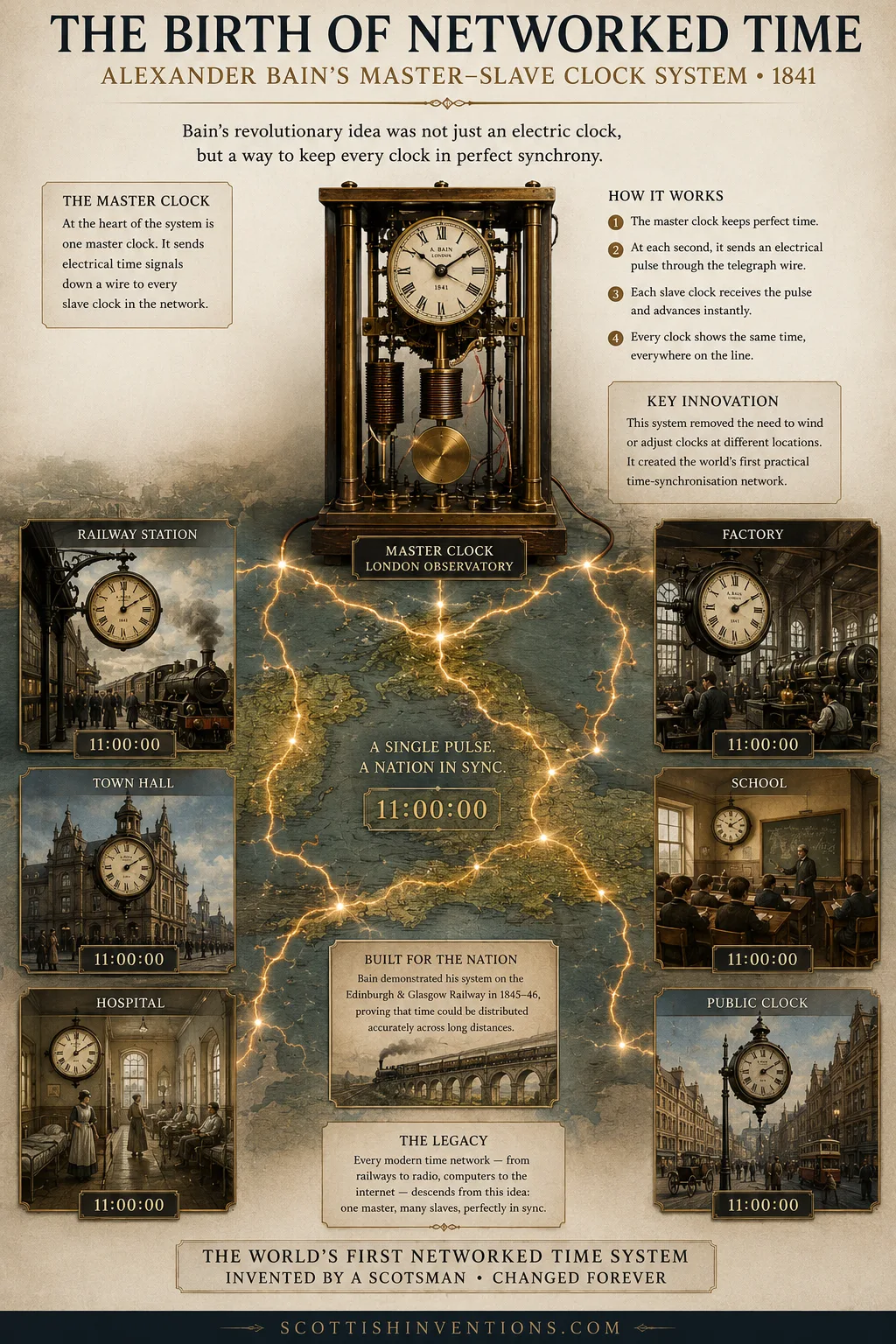
This is Bain's most consequential contribution. A single, accurately set master clock sends regular electrical pulses along a circuit to any number of slave clocks, each fitted with a simple electromagnet-and-ratchet movement that advances its hands one step per pulse. No human winds them; no human resets them. Correct the master, and every slave corrects itself.
The applications were transformative. Railways needed it most: timetables only work if every station clock agrees. Telegraph companies, factories, hospitals, courts and schools all needed coordinated time, and eventually so did the whole infrastructure of a punctual industrial society. Bain demonstrated the principle at scale in 1845–46, when — assisted by his brother John — he built a 46-mile telegraph line along the Edinburgh and Glasgow Railway. The price quoted was £50 per mile; by comparison, Cooke and Wheatstone were charging the Great Western Railway £250 per mile.
Bain's master-slave principle was carried forward by others. At the Royal Observatory, Greenwich, the Astronomer Royal George Airy installed Charles Shepherd's electric master-and-slave system in 1852; from then on it sent time pulses to the famous Shepherd Gate Clock and, by telegraph, along all the principal railways out of London — and from 1866, across the Atlantic to Harvard. By around 1900, master-slave clock networks from firms such as Gent of Leicester, Synchronome and Magneta were standard in factories, schools and stations across the British Empire. Every one of them is a descendant of the system Bain set down in his 1841 patent.
The Patent History and the Wheatstone Dispute
By July 1840 Bain had rough working models of both an electric clock and a printing telegraph but lacked the funds to develop them. Through the assistant editor of the Mechanics' Magazine he was introduced, on 1 August 1840, to Sir Charles Wheatstone, Professor of Experimental Physics at King's College London and one of the most eminent scientists in the country. At a second meeting on 18 August, Bain brought his models. Wheatstone bought the printing-telegraph model for £5, ordered working examples — and told Bain to suspend further work on the electric clock and tell no one.
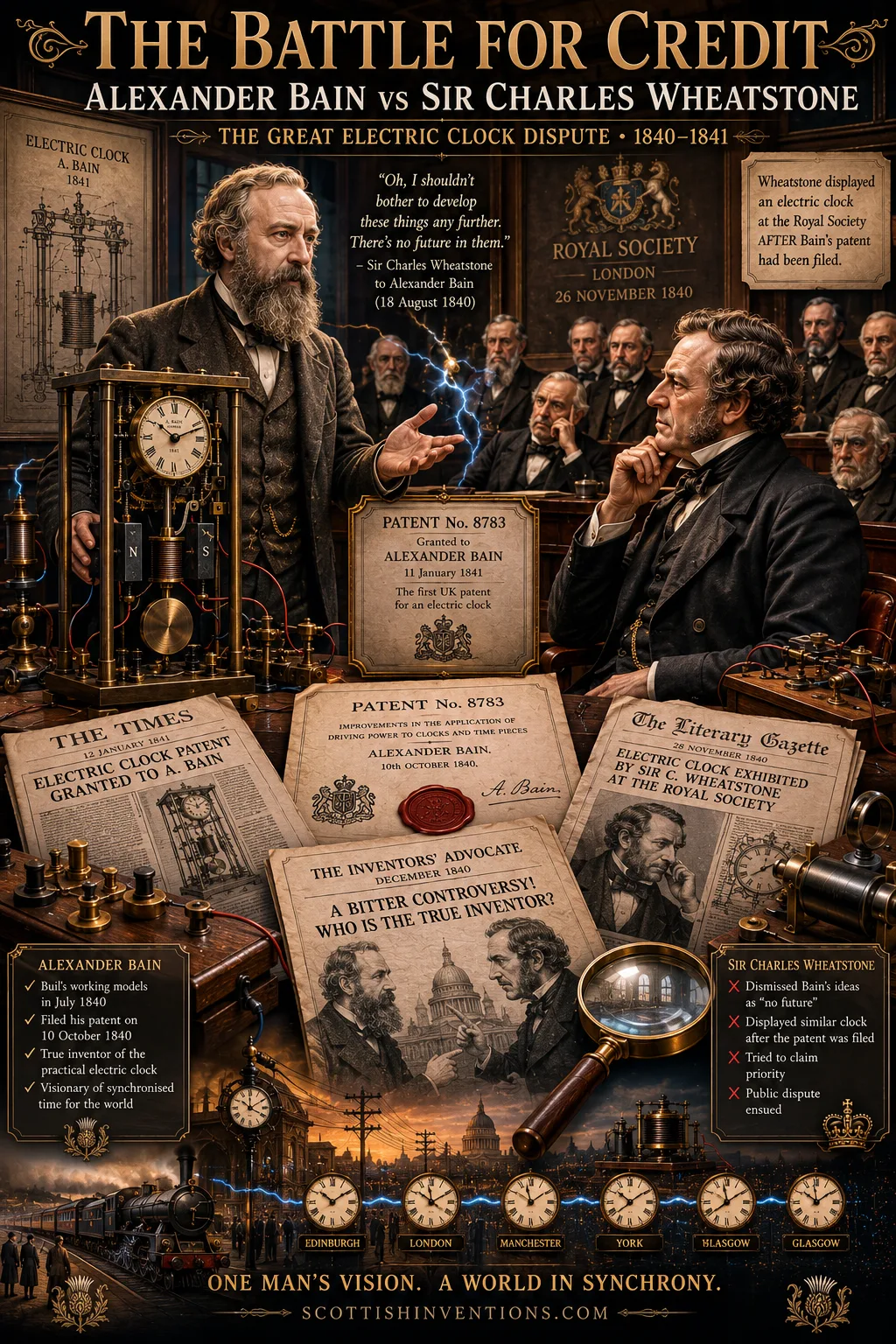
The famous version of the story has Wheatstone dismissing the inventions outright: "Oh, I shouldn't bother to develop these things any further! There's no future in them." Bain ignored the advice. With John Barwise, a chronometer-maker of St Martin's Lane, he applied on 10 October 1840 for what became Patent No. 8783, granted on 11 January 1841 and titled "Improvements in the application of driving power to Clocks and Time Pieces." A delay in sealing was caused by one of Queen Victoria's confinements that winter.
To Bain's fury, Wheatstone exhibited a similar electric clock at the Royal Society on 26 November 1840 — after Bain's filing — presenting it as his own invention. When Wheatstone then tried again to show an electric clock at the Adelaide Gallery just after the patent was granted, Barwise stopped him with a court injunction. A bitter, public feud erupted, fought out in the Literary Gazette and the Inventors' Advocate.
The reckoning came in 1846. Wheatstone, Cooke and others formed the Electric Telegraph Company and applied to Parliament for an Act of Incorporation. Bain opposed the Bill on grounds of patent infringement. When the Bill reached committee stage in the House of Lords, with the Duke of Beaufort as chairman, the committee was so impressed by Bain that it pressed the company to settle. The deal: Bain received £7,500 in compensation, plus a further £2,500 for the use of his printing-telegraph patent — £10,000 in total — together with a share of the profits on his clocks, a managerial role, and the promise that the dials would be marked "A. Bain — inventor." Wheatstone resigned from the company in response.
Bain's famous Patent No. 9745 of 27 May 1843 covered both improvements to his electric clock and the chemical/copying telegraph that is the ancestor of the fax machine — a connection explored in our companion article on Alexander Bain and the first fax machine. The synchronised-pendulum principle of the electric clock was, in fact, the same principle that let his facsimile machine scan and reconstruct an image line by line.
The Earth Battery — An Inspired Idea
Bain's earth battery exploited a fact of basic electrochemistry: place two different metals in a conducting medium and a voltage appears between them. Bury a zinc plate and a copper plate a yard or so apart in moist soil, connect them with a wire, and a small current flows — the soil moisture acting as the electrolyte. As Bain himself described it in 1852: "If we place a sheet of zinc and another of copper in the ground a little distance from each other, and a few feet deep, so that they are perfectly imbedded in the moist soil, we have, by this simple arrangement, a source of electricity."
The current was tiny — far too small for a telegraph or a motor — but a well-made pendulum clock needs almost nothing to keep going, and that was the genius of it: a clock requiring no winding, no fuel, and no human attention, drawing its life from the ground. For the parlour, Bain even devised a decorative version in which the zinc and copper plates were hidden inside ornamental vases of soil, one on each side of the mantel clock.
The practical reality was less tidy. Earth batteries were unreliable: soil conductivity falls in dry weather, and the plates "polarised" over time. Better wet cells and, eventually, mains electricity superseded them. But as a concept — drawing usable energy from the planet to run a machine indefinitely — it was decades ahead of the galvanic science of the 1840s that spawned it.
Timeline
- 1810
Born in Watten, Caithness
Alexander Bain is born in the tiny Caithness village of Watten, the son of a crofter, and grows up in the far north of Scotland.
- 1830s
Apprentice clockmaker
Apprenticed to a Wick clockmaker, Bain teaches himself electricity and magnetism from Michael Faraday's public lectures in London.
- Jul 1840
Working models
Has rough working models of both an electric clock and a printing telegraph but lacks the funds to develop them.
- 1 Aug 1840
Meets Wheatstone
Introduced through the Mechanics' Magazine to Sir Charles Wheatstone, Professor of Experimental Physics at King's College London.
- 18 Aug 1840
Wheatstone dismisses the clock
According to the traditional account, Wheatstone advises Bain there is 'no future in them' and tells him to suspend further work — then begins developing an electric clock of his own.
- 10 Oct 1840
Patent filed
Bain and chronometer-maker John Barwise file for Patent No. 8783: 'Improvements in the application of driving power to Clocks and Time Pieces.'
- 26 Nov 1840
Royal Society demonstration
Wheatstone exhibits a similar electric clock at the Royal Society as his own invention — after Bain's patent has been filed.
- 11 Jan 1841
Patent granted
Patent No. 8783 is granted — the first British patent for an electric clock. A subsequent Wheatstone exhibition is stopped by court injunction.
- 27 May 1843
Patent No. 9745
A second patent covers both improvements to his electric clock and the chemical/copying telegraph — the ancestor of the fax machine.
- 1845–46
Edinburgh & Glasgow Railway
Assisted by his brother John, Bain builds a 46-mile telegraph line along the railway and demonstrates time distribution between the two cities.
- 1846
House of Lords settlement
A Lords committee sides with Bain; the Electric Telegraph Company pays him £10,000 in total and Wheatstone resigns from the company.
- 1852
Greenwich master clock
The Astronomer Royal George Airy installs a Bain-derived master-and-slave system at the Royal Observatory, distributing time pulses along the principal railways out of London.
- 1893
Chicago World's Fair
Bain's name is listed on the wall of the Electricity Pavilion alongside Edison, Morse, Siemens, Thomson and Faraday.
- 2 Jan 1877
Death at Kirkintilloch
Bain dies in poverty at the Broomhill Home in Kirkintilloch, having received a Civil List pension in his final years secured by Sir William Thomson (Lord Kelvin), and is buried in the Auld Aisle Cemetery.
Did You Know?
- Bain's clock needed no winding — he proposed powering it from the earth itself, using zinc and copper plates buried in damp soil.
- Before electric clocks, someone literally had to walk around a building resetting every clock by hand against a reference timepiece.
- Bain demonstrated his working electric clock to the great Sir Charles Wheatstone, who dismissed it — then exhibited a copy at the Royal Society as his own invention weeks later.
- The master-slave clock system he invented is the ancestor of how every computer network keeps time today — the Network Time Protocol literally uses a "hierarchical-master-slave" design.
- The first large-scale demonstration ran along the Edinburgh and Glasgow Railway in 1845–46, a 46-mile line Bain built himself for £50 a mile — a fifth of what Wheatstone was charging the Great Western Railway.
- His 1841 patent with John Barwise (No. 8783) was the first electric clock patent in Britain — though a German, Carl Steinheil, had built a working electric clock and sent time signals in Bavaria in 1839.
- Bain's clocks survive in the National Museum of Scotland, the Science Museum in London and the Deutsches Uhrenmuseum in Germany.
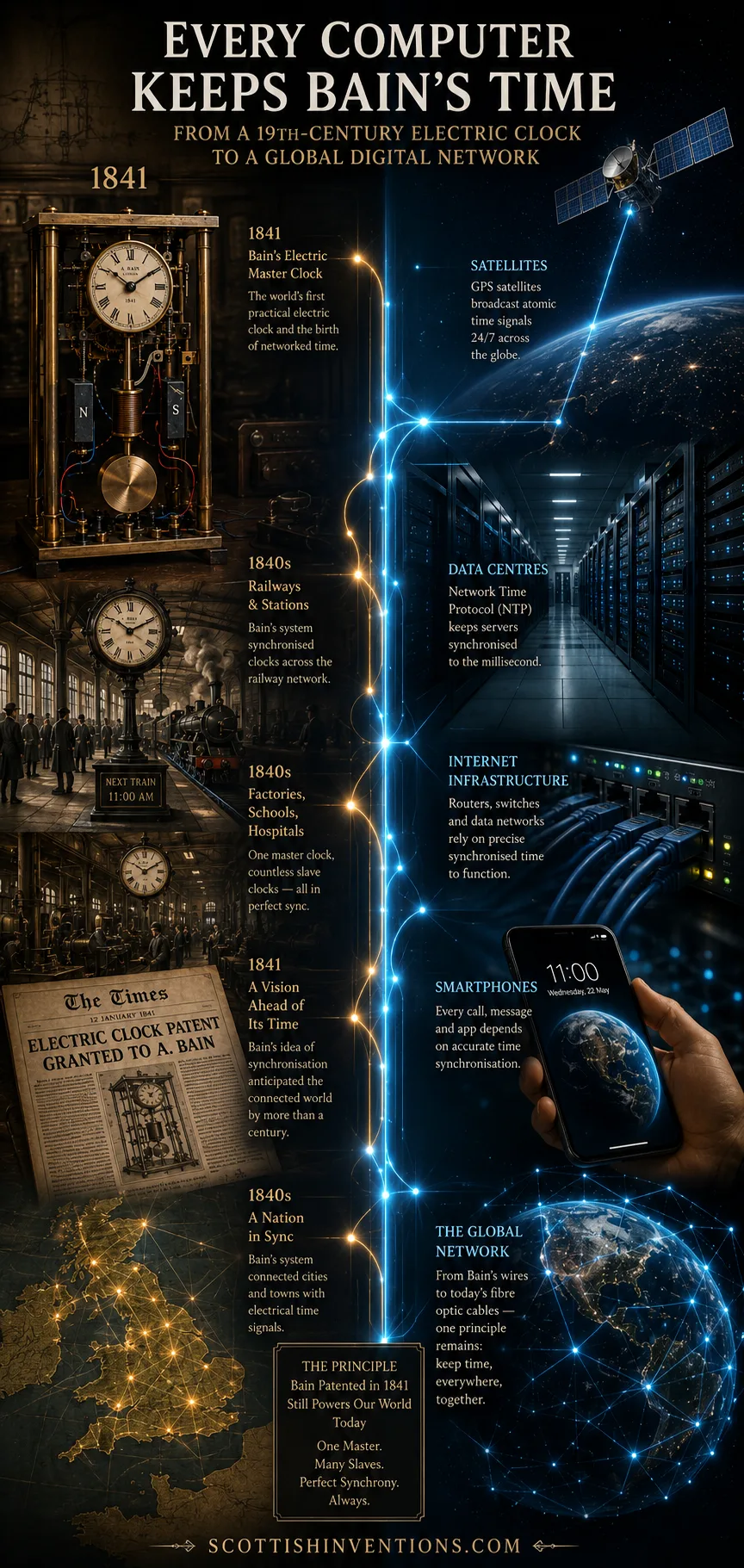
Legacy — The Electric Clock and the Modern World
For all his brilliance, Bain was ahead of his market. In the 1850s his electric clocks were costly luxuries, and less reliable than good mechanical ones. The electric clock did not come into its own until modern batteries and AC mains power arrived around 1900, and the synchronous mains clock displaced the mechanical clock in homes only in the 1930s and 40s.
But when it arrived, Bain's vision was everywhere. The network of electrically driven clocks in railway stations, hospitals, schools, offices and public buildings worldwide is his direct legacy. So, in a sense, are the speaking clock and broadcast time signals, GPS time, and the atomic clock — all built on the idea of distributing one authoritative time to many users.
The most striking inheritance is digital. The principle of a master clock distributing time to slaves is exactly how computer networks keep time today, through the Network Time Protocol (NTP) — designed by David L. Mills of the University of Delaware and in use since before 1985. NTP's own technical specification (RFC 1305, March 1992) describes how "the synchronization subnet of primary and secondary servers assumes a hierarchical-master-slave configuration with the primary servers at the root and secondary servers of decreasing accuracy at successive levels toward the leaves." The same master-slave language runs through its higher-precision successor, the IEEE 1588 Precision Time Protocol.
NTP keeps an estimated 25 million-plus computers, and through them effectively every smartphone and networked device on Earth, in synchrony. In a very real sense, every computer network on the planet runs on a descendant of the principle Alexander Bain patented in 1841.
Bain himself died in poverty on 2 January 1877 at the Broomhill Home in Kirkintilloch and was buried in the Auld Aisle Cemetery — a sad end softened only by a Civil List pension secured for him in his final years by Sir William Thomson (Lord Kelvin). In 1893, on the wall of the Electricity Pavilion at the Chicago World's Fair, his name was listed alongside Edison, Morse, Siemens, Thomson and Faraday.
Explore the Scottish Inventions Collection
Fifty collectible cards celebrating Scotland's greatest contributions to the modern world — from the steam engine to the electric clock.
Sources & Further Reading
Tier 1 · Primary
- IEEE 1588 Precision Time Protocol — the higher-precision successor built on the same master-slave concept.
- Royal Observatory, Greenwich — the Shepherd Gate Clock and Airy's 1852 electric master-slave installation.
Tier 2 · Scholarly and institutional
- Science Museum, London — Bain electric clocks and components.
- Deutsches Uhrenmuseum — one of the earliest electrically impulsed pendulum clocks, and Steinheil apparatus.
- RFC 1305 — Network Time Protocol (Version 3), David L. Mills, March 1992. The specification that describes NTP's "hierarchical-master-slave configuration".
- Aked, C. K., Electricity, Magnetism and Clocks, Antiquarian Horological Society.
- Hackmann, W., Bain's Electric Clocks, Bulletin of the Scientific Instrument Society.
Tier 3 · General reference
- National Museum of Scotland — Bain telegraph instrument and related collections.
Frequently Asked Questions
›Who invented the electric clock?
The Scottish inventor Alexander Bain (1810–1877), a self-taught crofter's son from Watten in Caithness, patented the first British electric clock — Patent No. 8783, filed with chronometer-maker John Barwise on 10 October 1840 and granted on 11 January 1841. In Bavaria the previous year, Carl August Steinheil had already built a working electric clock and transmitted time signals between two Munich buildings, so Bain is most accurately described as the first to patent the electric clock in Britain and the man who established the modern electromagnetic clock as a practical device — and the originator of the master-and-slave synchronisation principle.
›How did Alexander Bain's electric clock work?
Bain replaced the wound weight or spring of a mechanical clock with electromagnetism. A coil of wire on the pendulum swung between fixed permanent magnets; a small gold contact on the pendulum briefly closed an electrical circuit at the right moment, pulsing current through the coil. The coil became a momentary electromagnet, attracted and repelled by the magnets, giving the pendulum a precise push on each swing. The pendulum drove the clock's hands through a light arm-and-ratchet. No winding, no falling weight — just a tiny pulse of electricity per swing.
›What is a master-slave clock?
A master-slave clock system uses one accurate 'master' clock to send regular electrical pulses along a wire to any number of 'slave' clocks. Each slave has a simple electromagnet-and-ratchet movement that advances its hands one step per pulse, so every slave stays in perfect synchrony with the master. Correct the master and every slave corrects itself. Bain set the principle down in his 1841 patent, and it went on to power railway, factory, school and public clock networks worldwide.
›Why is Alexander Bain important?
Because he invented networked time. Bain's 1841 patent was not only the first British electric clock — it introduced the master-and-slave principle for synchronising many clocks from a single source. That idea underpins railway timekeeping, broadcast time signals, GPS and, most importantly, the Network Time Protocol (NTP) that keeps every computer network on Earth in sync today. NTP's own specification (RFC 1305) describes its architecture as 'hierarchical-master-slave' — the same phrase, and the same concept, that Bain patented.
›Did Bain invent networked clocks?
Yes. The master-slave clock network described in his 1841 patent is the foundation of every synchronised time network that followed. Bain demonstrated the principle at scale in 1845–46 when — assisted by his brother John — he built a 46-mile telegraph line along the Edinburgh and Glasgow Railway and used it to distribute time between the two cities. The Astronomer Royal George Airy later installed a Bain-derived electric master-and-slave system at the Royal Observatory, Greenwich in 1852, sending time pulses along every principal railway out of London.
›Was Alexander Bain before Wheatstone?
On the electric clock, yes — on paper. Bain filed his patent (No. 8783) on 10 October 1840 and it was granted on 11 January 1841. Sir Charles Wheatstone exhibited a similar electric clock at the Royal Society on 26 November 1840, after Bain's filing, and Bain's associate John Barwise stopped a subsequent Adelaide Gallery exhibition with a court injunction. In 1846 a House of Lords committee sided with Bain, awarding him £10,000 in total compensation from the Electric Telegraph Company. Wheatstone resigned from the company in response.
›Why are Bain's inventions still important today?
Because his master-and-slave synchronisation principle is the direct ancestor of the way modern computers keep time. Every server, smartphone and networked device on Earth ultimately depends on the Network Time Protocol (NTP), whose 'hierarchical-master-slave' architecture is the same idea Bain patented in 1841. GPS satellites, broadcast time signals, financial trading networks, telecommunications and the entire internet rely on distributing one authoritative time to many users — the exact concept Bain set down in a Victorian patent for a pendulum clock powered by an earth battery.