Scottish Inventions · Medicine
The Hypodermic Syringe: Edinburgh's Sharpest Gift to Medicine
How Dr Alexander Wood took the sting of a bee as his model — and gave the world the modern injection.
Introduction
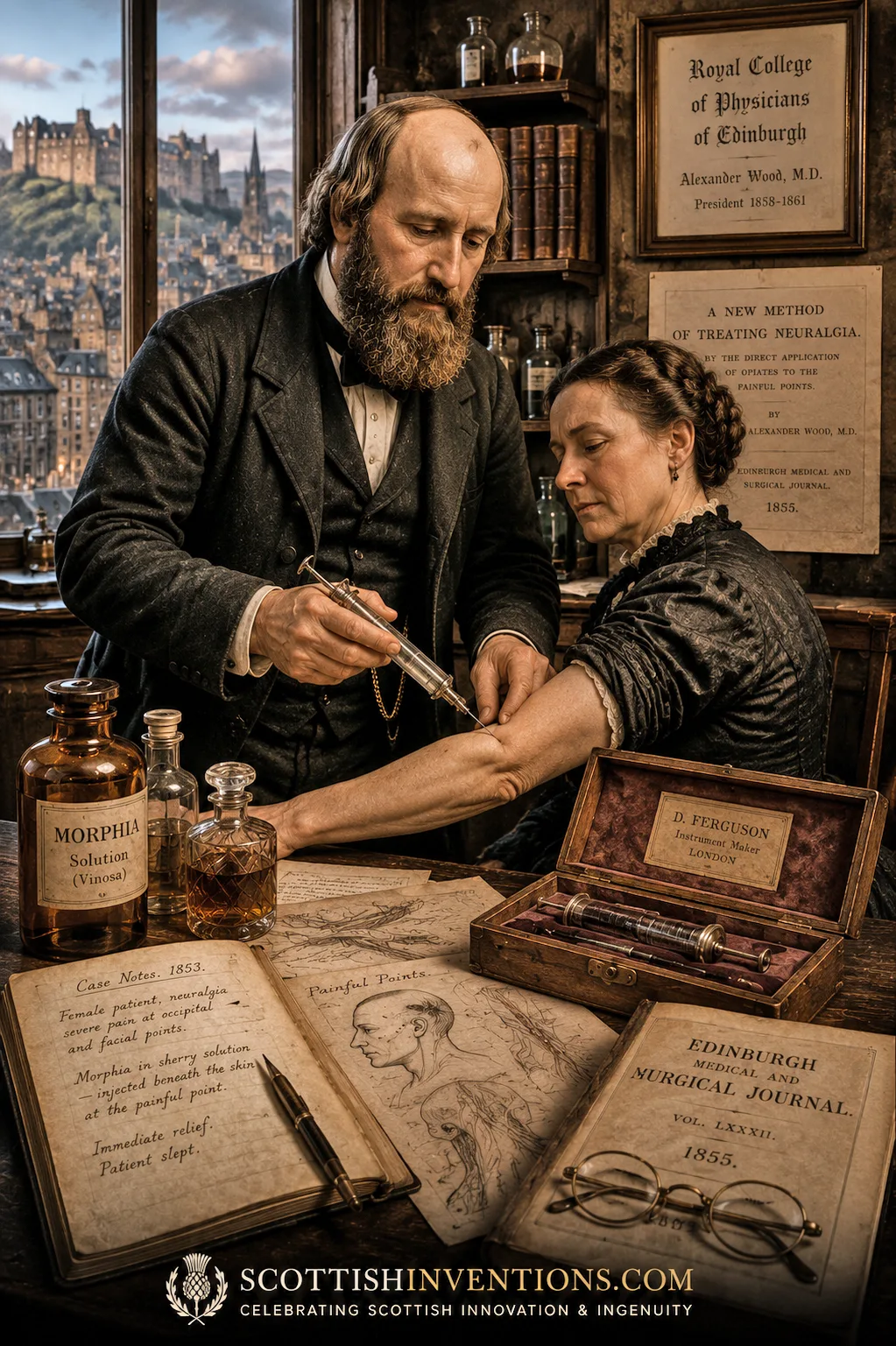
On a winter morning in Edinburgh in 1853, an elderly woman crippled by neuralgia received a small injection of morphine dissolved in sherry, beneath the skin of her temple. Within minutes the pain eased and she slept. The instrument in her physician's hand would become the most reproduced medical device in history.
That physician was Alexander Wood (1817–1884), a New Town doctor and future President of the Royal College of Physicians of Edinburgh. Wood is widely credited with inventing the first true hypodermic syringe: a graduated glass barrel, a piston, and a fine hollow needle. But the story is bigger and more honest than a single Scottish triumph — it is a three-way, multinational tale that involves a French surgeon in Lyon and an Irish surgeon in Dublin, alongside Edinburgh's other great gift to pain relief, chloroform anaesthesia.

On this page
- Key Takeaways
- Key Facts
- Alexander Wood of Edinburgh
- The Breakthrough: 1853–1855
- The Priority Dispute: Wood, Pravaz and Rynd
- The Dispute That Mattered: Wood vs Hunter
- How the Hypodermic Syringe Worked
- A Long Pre-history of the Needle
- Myth vs Fact
- Lasting Legacy
- Historical Timeline
- Related Scottish Inventions
- Further Reading
- FAQ
Key Takeaways
- Alexander Wood (Edinburgh, 1853) is widely credited with the first true hypodermic syringe — glass barrel, piston, fine hollow needle — and the first to use it for pain relief.
- His paper appeared in the Edinburgh Medical and Surgical Journal in 1855.
- The priority story is genuinely three-way: Francis Rynd (Dublin, 1844) performed the first subcutaneous injection; Charles-Gabriel Pravaz (Lyon, 1853) built a screw-driven syringe for aneurysms.
- The word "hypodermic" was coined in 1858 by Wood's rival, the English surgeon Charles Hunter.
- Wood's instrument was made by the London instrument-maker Daniel Ferguson; he dissolved his morphine in sherry, not water.
- The syringe made modern anaesthesia, vaccination and insulin therapy possible — but the popular story that Wood's wife died of the first overdose is a myth.
Key Facts
Edinburgh, 1853
First morphine injection for neuralgia in Edinburgh's New Town.
Published 1855
Edinburgh Medical and Surgical Journal, vol. 82.
Inspired by a bee
Wood's biographer says he modelled the needle on a bee's sting.
Morphine in sherry
Dissolved in wine, not water — gentler on skin and instrument.
RCPE President 1858–61
President of the Royal College of Physicians of Edinburgh.
Billions per year
The ancestor of every modern injection in use today.
Alexander Wood of Edinburgh
Alexander Wood was born on 10 December 1817 in Cupar, Fife, the son of a physician, Dr John Wood. The family moved to Edinburgh's New Town around 1825 and Wood was educated at Edinburgh Academy before matriculating at the University of Edinburgh, where he graduated MD in 1839.
He built a busy private practice in the New Town, worked at the Stockbridge and Royal Public Dispensaries, and from 1841 lectured at the Extramural School of Medicine. On 15 June 1842 he married Rebecca Massey. Wood was a pillar of the Scottish medical establishment — secretary and then President of the Royal College of Physicians of Edinburgh (1858–1861), a campaigner for medical reform and sanitary legislation, and a fierce public critic of homeopathy and mesmerism. He was elected a Fellow of the Royal Society of Edinburgh in 1863.
A man of strong Free Church faith and considerable civic energy, Wood served as an Edinburgh police commissioner and on poor-relief committees. Illness forced his retirement in 1873, and he died at his Edinburgh home on 26 February 1884.
The Breakthrough: 1853–1855
Wood's biographer and brother-in-law, the Very Reverend Thomas Brown, recorded that Wood took the sting of the bee as his model for the needle. Inspired by fellow Edinburgh man James Young Simpson's anaesthesia experiments, Wood became preoccupied with relieving localised pain. He was drawn to the French clinician Valleix's theory that neuralgic nerves have specific tender "painful points".
A second spur was an existing instrument: a syringe devised by the London maker Daniel Ferguson for injecting birthmarks (naevi). Wood adapted this "elegant little syringe," fitting it with a fine hollow needle so a measured dose of liquid drug could be pushed under the skin at the painful point. His first patient was an elderly woman with neuralgia, whom he treated with a vinous (sherry) solution of morphia. She experienced near-instant relief and slept.
Wood's 1855 paper, "A New Method of Treating Neuralgia by the Direct Application of Opiates to the Painful Points," appeared in the Edinburgh Medical and Surgical Journal (vol. 82). Crucially, the graduated glass barrel let the physician see and measure the dose — a genuine advance over blind, gravity-fed methods.
"The relief was almost instantaneous, and the patient slept." — Alexander Wood, reporting his first hypodermic injection of morphine, 1855.
The Priority Dispute: Wood, Pravaz and Rynd
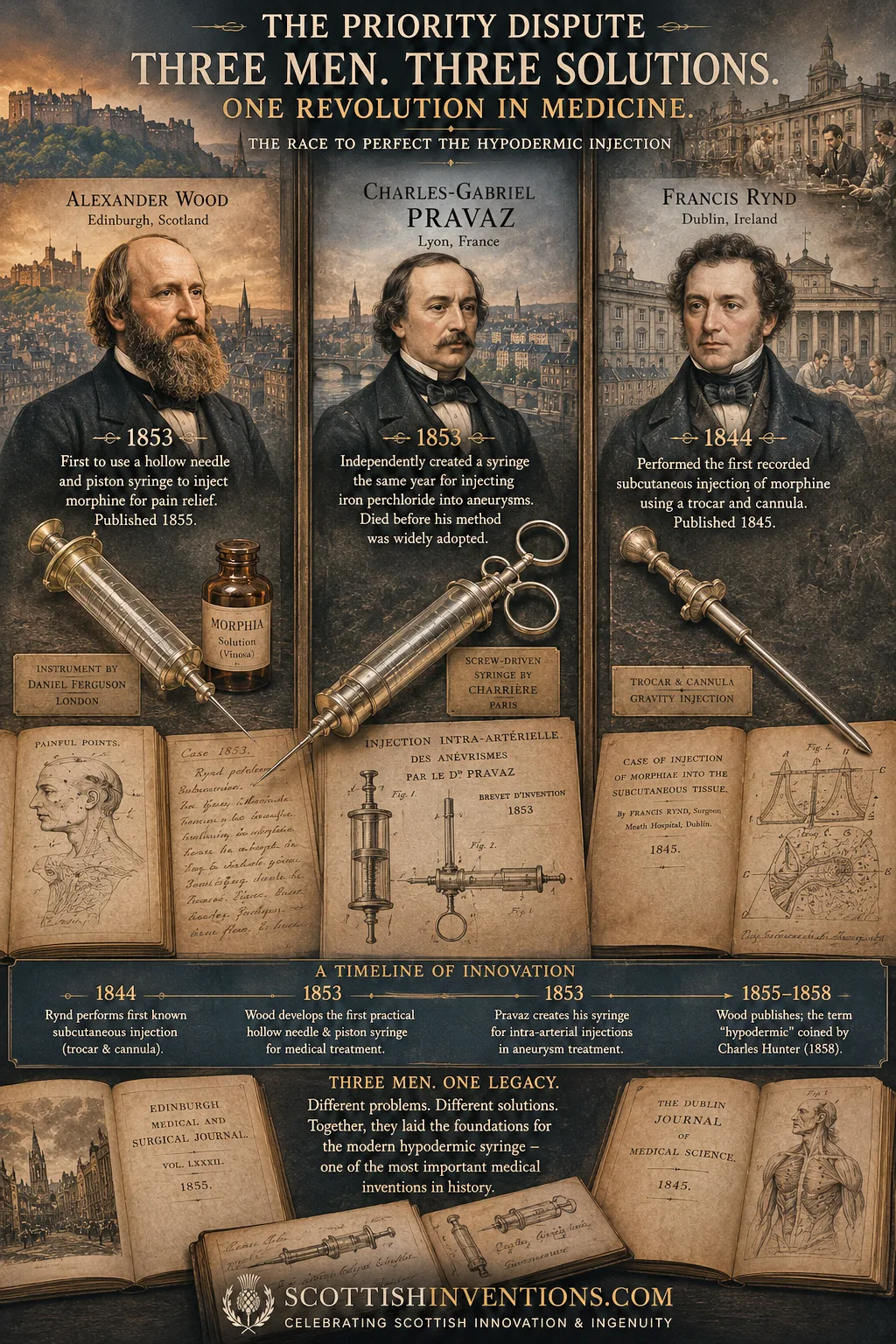
An honest Scottish history must resist the temptation to crown its own man too quickly. Three names belong in the same paragraph.
Charles-Gabriel Pravaz (Lyon, 1853)
Pravaz, an orthopaedic surgeon in Lyon, designed his syringe in the same year as Wood. But the two devices differed in nearly every respect: Pravaz's was silver, driven by a screw rather than a plunger, made by the Paris instrument-maker Charrière, and designed to inject iron perchloride into aneurysms to clot the blood. Wood's was glass, piston-driven, and aimed at pain relief. Pravaz announced his method to the Académie des Sciences in early 1853 and died that June, before the technique matured. The device was popularised by others and became known across Europe as the "Pravaz syringe."
Francis Rynd (Dublin, 1844)
At Dublin's Meath Hospital on 3 June 1844 — nine years before Wood and Pravaz — Rynd relieved a woman's facial neuralgia by introducing a morphine-and-creosote solution under the skin through a trocar and cannula. But Rynd's apparatus had no piston: the fluid flowed in by gravity. He published the case in 1845 and only described the instrument in detail in 1861, amid later priority disputes. Rynd is therefore best described as the pioneer of subcutaneous injection and of an early hollow needle, but not of the piston syringe.
A genuinely contested story
National framings diverge sharply, which is worth flagging. The dominant English-language account credits Wood with the first true hypodermic syringe and Rynd with the earlier hollow needle. The French-language tradition reverses part of this: it credits Pravaz with the syringe and attributes the hollow needle to Wood. There is no single tidy answer — different men solved different parts of the problem.
The Dispute That Actually Mattered: Wood vs Hunter
The more substantive Victorian quarrel was not with France but with London. The English surgeon Charles Hunter coined the term "hypodermic" (from the Greek hypo, under, and derma, skin) in a paper published in 1858. He challenged Wood's central theory: Wood believed the morphine worked only locally and so had to be injected into the painful spot itself; Hunter showed that the drug acted systemically through the bloodstream and could be injected anywhere — avoiding the abscesses and skin damage caused by repeated local jabs.
The two traded barbs in the medical press through 1859. In 1867 the Medical and Chirurgical Society of London appointed a committee to investigate whether injections were best delivered subcutaneously in the area of pain (as Wood insisted) or elsewhere to deliver systemic relief (as Hunter claimed). After roughly two years, it decided in Hunter's favour. Yet it is Wood who has been better remembered as the inventor. The historian D. Brunton, writing in the Journal of the Royal College of Physicians of Edinburgh in 2000, treats this as a genuine question of priority — noting that Wood's eminence and the fact that he outlived Hunter helped secure his reputation even though Hunter's understanding of the method ultimately prevailed.
How the Hypodermic Syringe Worked
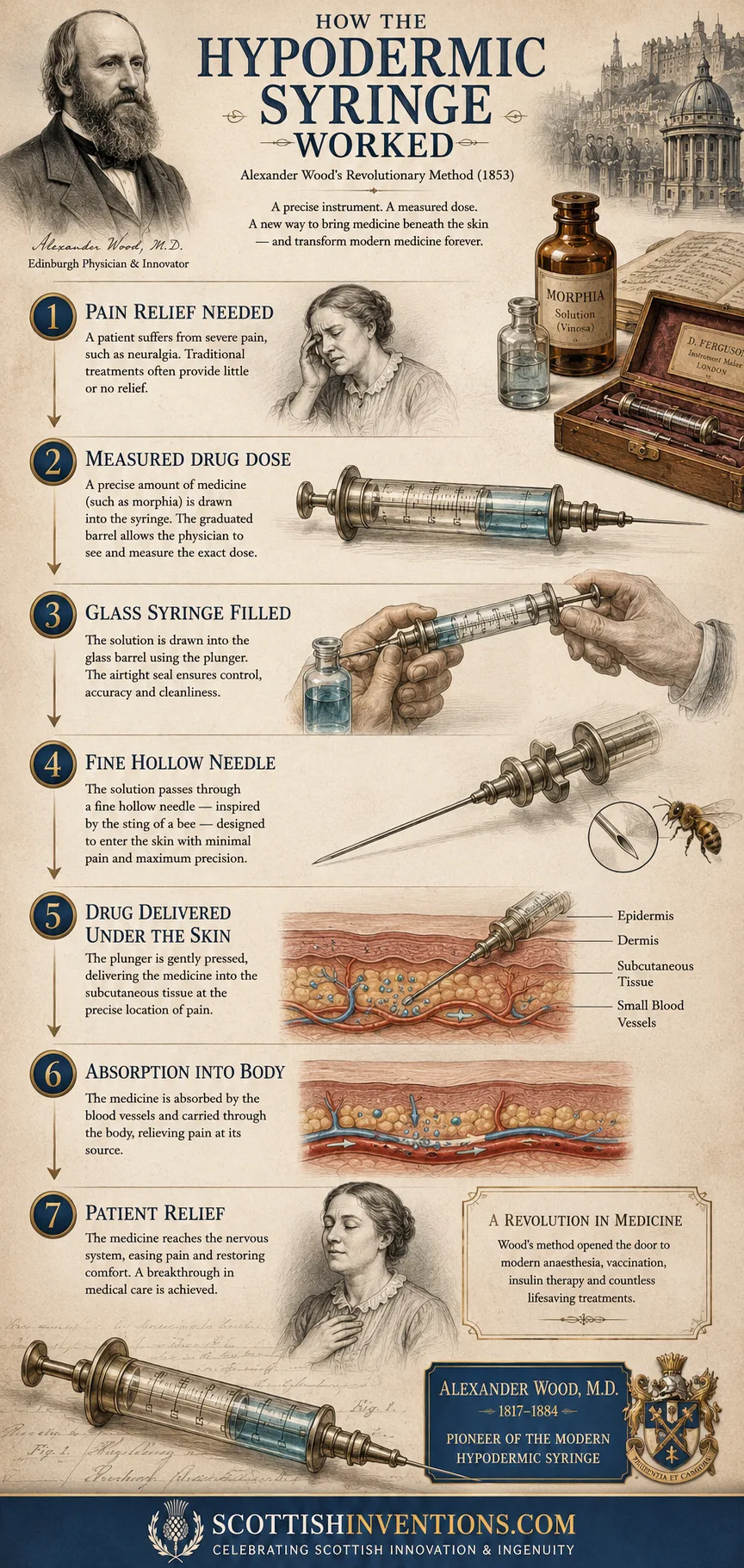
The brilliance of Wood's instrument lay in combining four simple elements into a precise, repeatable method.
- 1. Measured dose. A graduated glass barrel showed the physician exactly how much drug was being drawn up.
- 2. Glass syringe filled. The plunger created an airtight seal, ensuring control, accuracy and cleanliness.
- 3. Fine hollow needle. Modelled on a bee's sting, it pierced the skin with minimal pain and maximum precision.
- 4. Drug delivered under the skin. A gentle press on the plunger pushed the medicine into the subcutaneous tissue at the precise location of pain.
- 5. Absorption. Small blood vessels in the tissue carried the medicine through the body, reaching the nervous system and easing pain.
A Long Pre-history of the Needle
Injecting substances into the body is far older than 1853. The ancient Romans used metal syringes for enemas and nasal washes. In 1656, the architect Christopher Wren, working at Oxford, injected opium and wine into dogs' veins using a goose quill attached to an animal bladder — the first documented intravenous injections. In the 1660s, German experimenters such as J.D. Major and J.S. Elsholtz attempted injections in humans, usually with fatal results from infection. The pump syringe was refined by the French surgeon Dominique Anel around 1700.
The crucial missing piece was a fine hollow needle that could pierce the skin without an incision. Subcutaneous injection grew partly out of vaccination and inoculation practice — lacing a vaccination lancet with opium paste and pricking along a nerve was described in France in 1836. Rynd's 1844 hollow needle and the fine-bore needles that Wood and Pravaz fitted to their syringes finally closed the gap between "syringe" and "skin".
Myth vs Fact
Two stories that keep being repeated — and what the evidence actually says
Myth: Wood's wife died of the first morphine overdose
The historian Richard Davenport-Hines calls this flatly a myth. Rebecca Massey outlived her husband by about eleven years, dying in February 1895. Wood died in 1884. The gravestone in Edinburgh's Dean Cemetery confirms it. The "first overdose" story is a moralising legend, not history.
Myth: 400,000 Civil War soldiers were addicted by "soldier's disease"
The phrase itself dates only to 1915, half a century after the war. The 400,000 figure traces to a 1915 article by Jeannette Marks, who also implausibly estimated 4 million US drug addicts that year. Contemporary US Public Health Service estimates were far lower — Wilbert put the maximum at around 187,000 opium users. Opioid dependence among veterans was real and ruinous, but the tidy mass-epidemic framing is more myth than documented history.
Did You Know?
- Wood's morphine was dissolved in sherry, not water — he thought wine was gentler on the skin and wouldn't rust his instrument.
- He took the honey bee's sting as his design inspiration, according to his own biographer.
- The word "hypodermic" was coined by his rival Charles Hunter, not by Wood — Wood always called his technique "subcutaneous".
- Christopher Wren — yes, the architect of St Paul's Cathedral — performed the first recorded intravenous injection in 1656, dosing dogs with opium and wine via a goose quill and a bladder.
- Pravaz's syringe was solid silver and worked by a screw; Wood's was glass with a plunger you could see the dose through.
Lasting Legacy: Impact on Modern Medicine
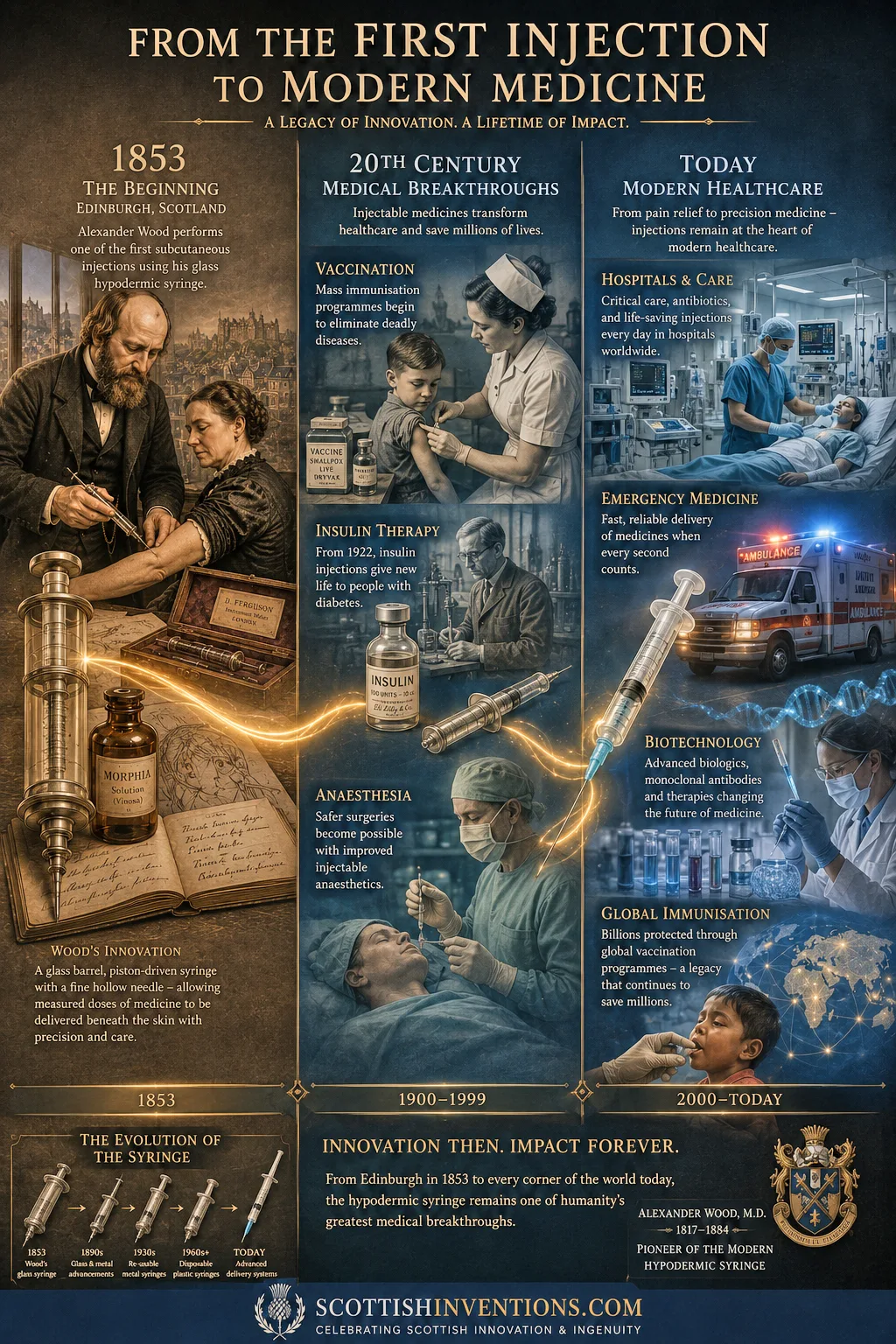
The hypodermic syringe became arguably the most consequential delivery device in medicine. It made possible the rapid, measured delivery of drugs directly into the body, and it underpinned later revolutions:
- Anaesthesia. Intravenous anaesthesia (such as the barbiturate thiopentone) became practical in the 1930s — building on the work of Sir James Young Simpson on chloroform.
- Insulin. The introduction of insulin in 1922–23 hugely expanded the market for syringes and made self-injection a daily reality for people with diabetes.
- Mass vaccination. Disposable, sterile syringes developed in the 1950s — spurred by the Korean War's blood-collection needs and the polio immunisation campaigns — enabled vaccination on a global scale. Becton Dickinson's Hypak, the first sterile disposable glass syringe with needle, supported Jonas Salk's 1954 polio field trial of more than a million children. This complemented other Scottish gifts to medicine, including penicillin and diagnostic ultrasound.
- Modern drug delivery. From the Luer-Lok connector to single-use cartridges and insulin pens, the basic architecture Wood helped establish remains in use billions of times a year.
A key caveat of the era: all of this happened before the germ theory of disease was understood. In the pre-antiseptic decades, injection could spread infection as readily as it cured — the importance of sterilisation only became clear after Lister, Pasteur and Koch, paving the way for antiseptic surgery.
Historical Timeline
- 1817
Born in Cupar, Fife
Alexander Wood is born on 10 December 1817, son of Dr John Wood.
- c. 1825
Family moves to Edinburgh
Wood is educated at Edinburgh Academy in the New Town.
- 1839
MD, University of Edinburgh
Graduates and begins private practice in Edinburgh's New Town.
- 1841
Lectures at the Extramural School
Begins teaching at Edinburgh's Extramural School of Medicine.
- 1844
Rynd's subcutaneous injection
Francis Rynd performs the first known subcutaneous injection in Dublin — nine years before Wood.
- 1853
First hypodermic injection
Wood injects morphine in sherry beneath the skin of a neuralgia patient using a piston-driven glass syringe made by Daniel Ferguson of London. The same year, Pravaz announces his screw-driven syringe in Lyon.
- 1855
Publication
'A New Method of Treating Neuralgia by the Direct Application of Opiates to the Painful Points' appears in the Edinburgh Medical and Surgical Journal.
- 1858
Term 'hypodermic' coined
English surgeon Charles Hunter coins the word 'hypodermic' and argues that injected drugs act systemically, not just locally.
- 1858–61
President, RCPE
Wood serves as President of the Royal College of Physicians of Edinburgh.
- 1863
Fellow of the Royal Society of Edinburgh
Elected FRSE in recognition of his contribution to medicine.
- 1884
Death in Edinburgh
Wood dies at his Edinburgh home on 26 February 1884.
- 1922
Insulin therapy
Insulin injections begin to give new life to people with diabetes — relying on the syringe Wood helped invent.
- 1954
Disposable syringes
Becton Dickinson's Hypak — the first sterile disposable glass syringe and needle — is used in Jonas Salk's polio field trial of over a million children.
Further Reading
- Royal College of Physicians of Edinburgh — Wood's professional home, of which he was President 1858–1861.
- University of Edinburgh — Wood's alma mater (MD, 1839).
- National Library of Scotland — holds the Edinburgh Medical and Surgical Journal, vol. 82 (1855), in which Wood's paper appeared.
- Wellcome Collection — extensive archives on the history of injection and Daniel Ferguson's instruments.
- British Medical Journal — historical articles on the priority dispute.
- Royal Society of Edinburgh — Wood was elected FRSE in 1863.
- Brunton, D. (2000), "A Question of Priority: Alexander Wood, Charles Hunter and the Hypodermic Method", Journal of the Royal College of Physicians of Edinburgh.
Frequently Asked Questions
›Who invented the hypodermic syringe?
Edinburgh physician Alexander Wood (1817–1884) is widely credited with inventing the first true hypodermic syringe — a glass, piston-driven barrel fitted with a fine hollow needle. In 1853 he used it to inject morphine to treat neuralgia, publishing his account in the Edinburgh Medical and Surgical Journal in 1855. The honest answer is that several pioneers solved different parts of the problem: Wood for the piston-driven hypodermic, Charles-Gabriel Pravaz for an independent screw-driven syringe the same year, and Francis Rynd for the earlier hollow needle in 1844.
›Why is Alexander Wood important?
Wood produced the first practical instrument for delivering a measured dose of drug beneath the skin and demonstrated its value for pain relief. His glass, piston-driven design is recognisably ancestral to today's syringe and made later breakthroughs — modern anaesthesia, vaccination programmes and insulin therapy — possible. He was also a leading figure in Edinburgh medicine, serving as President of the Royal College of Physicians of Edinburgh from 1858 to 1861.
›Did Alexander Wood invent the first syringe?
No. Syringes are far older than 1853 — the Romans used metal syringes for enemas and nasal washes, and Christopher Wren performed the first recorded intravenous injection in 1656 using a goose quill. Wood is credited with the first true hypodermic syringe: glass barrel, piston/plunger, fine hollow needle, designed for subcutaneous drug delivery.
›What was the priority dispute over the hypodermic syringe?
Three men have legitimate claims. Francis Rynd performed the first known subcutaneous injection in Dublin in 1844 using a trocar and cannula fed by gravity. Alexander Wood independently developed a piston-driven glass syringe in Edinburgh in 1853 for pain relief. Charles-Gabriel Pravaz, in Lyon, independently produced a screw-driven silver syringe the same year for injecting iron perchloride into aneurysms. Different inventors solved different parts of the same problem.
›Who were Francis Rynd and Charles-Gabriel Pravaz?
Francis Rynd (1801–1861) was an Irish surgeon at Dublin's Meath Hospital who, on 3 June 1844, treated a woman's facial neuralgia by introducing a morphine solution under the skin via a hollow needle — nine years before Wood. Charles-Gabriel Pravaz (1791–1853) was a Lyon orthopaedic surgeon who, in 1853, designed a silver screw-driven syringe intended to inject iron perchloride into aneurysms. He died in June 1853 before his method was widely adopted.
›How does a hypodermic syringe work?
A graduated glass or plastic barrel holds a measured dose of liquid medicine. A plunger creates an airtight seal so the dose can be drawn up accurately and then pressed out through a fine hollow needle. The needle pierces the skin into the subcutaneous tissue, where small blood vessels absorb the medicine and carry it to where it is needed in the body.
›Why was the hypodermic syringe revolutionary?
For the first time, a physician could see and measure a precise drug dose and deliver it directly into the body without surgery or swallowing. It bypassed the digestive system, gave faster and more reliable effect, and allowed treatments — anaesthetics, insulin, vaccines, antibiotics — that would not work taken by mouth.
›How did injections transform medicine?
The hypodermic syringe became one of the most consequential delivery devices in medicine. It underpinned intravenous anaesthesia in the 1930s, the introduction of insulin in 1922–23, the global polio vaccination campaigns of the 1950s (using Becton Dickinson's disposable Hypak syringe for Jonas Salk's 1954 field trial of over a million children), and modern biotechnology including biologics and monoclonal antibodies.
›Was Wood's wife the first morphine overdose victim?
No — this is a documented myth. Wood's wife Rebecca Massey outlived him by about eleven years. She died in February 1895; Wood died in 1884. The story of her dying from an overdose of his invention is a moralising legend, not history.
›Who coined the word 'hypodermic'?
The English surgeon Charles Hunter, in a paper published in 1858. Wood himself always called the technique 'subcutaneous'. Hunter and Wood disagreed sharply about whether injected drugs acted only locally (Wood) or systemically through the bloodstream (Hunter). After about two years of investigation, the Medical and Chirurgical Society of London decided in Hunter's favour — but Wood is still better remembered as the inventor.