Scottish Inventions · Communications · Card No. 17 of 50
William Kennedy Laurie Dickson
The Scot who built the movie machine
In a New Jersey laboratory in the 1890s, a Scottish-descended engineer took Thomas Edison's vague idea for a "visual phonograph" and turned it into the machinery of cinema — a camera, a film format and a viewing device that would run the movies for a hundred years.
TL;DR
- William Kennedy Laurie Dickson (1860–1935), a man of proud Scottish descent, was the hands-on technical inventor of motion pictures — the engineer who, in Thomas Edison's laboratory, actually built the Kinetograph camera and Kinetoscope viewer, designed the Black Maria studio and chose the 35mm sprocketed film format that became the global cinema standard.
- The Library of Congress puts it plainly: "Dickson apparently performed the bulk of the experimentation, leading most modern scholars to assign Dickson with the major credit for turning the concept into a practical reality." Edison had the vision and the credit; Dickson built the machine.
- The Lumière brothers beat Edison and Dickson to projected cinema for audiences (Paris, 28 December 1895) — partly because Edison failed to patent internationally — but the camera, film gauge and sprocket mechanism that made all cinema possible were Dickson's.
Key Findings
- A genuine Scottish heritage, born on French soil. Dickson was born on 3 August 1860 at Le Minihic-sur-Rance, Brittany. His mother Elizabeth Kennedy-Laurie was born at Portobello, near Edinburgh, in 1821, of the Lauries of Woodhall in Kirkcudbrightshire — the family behind the ballad "Annie Laurie."
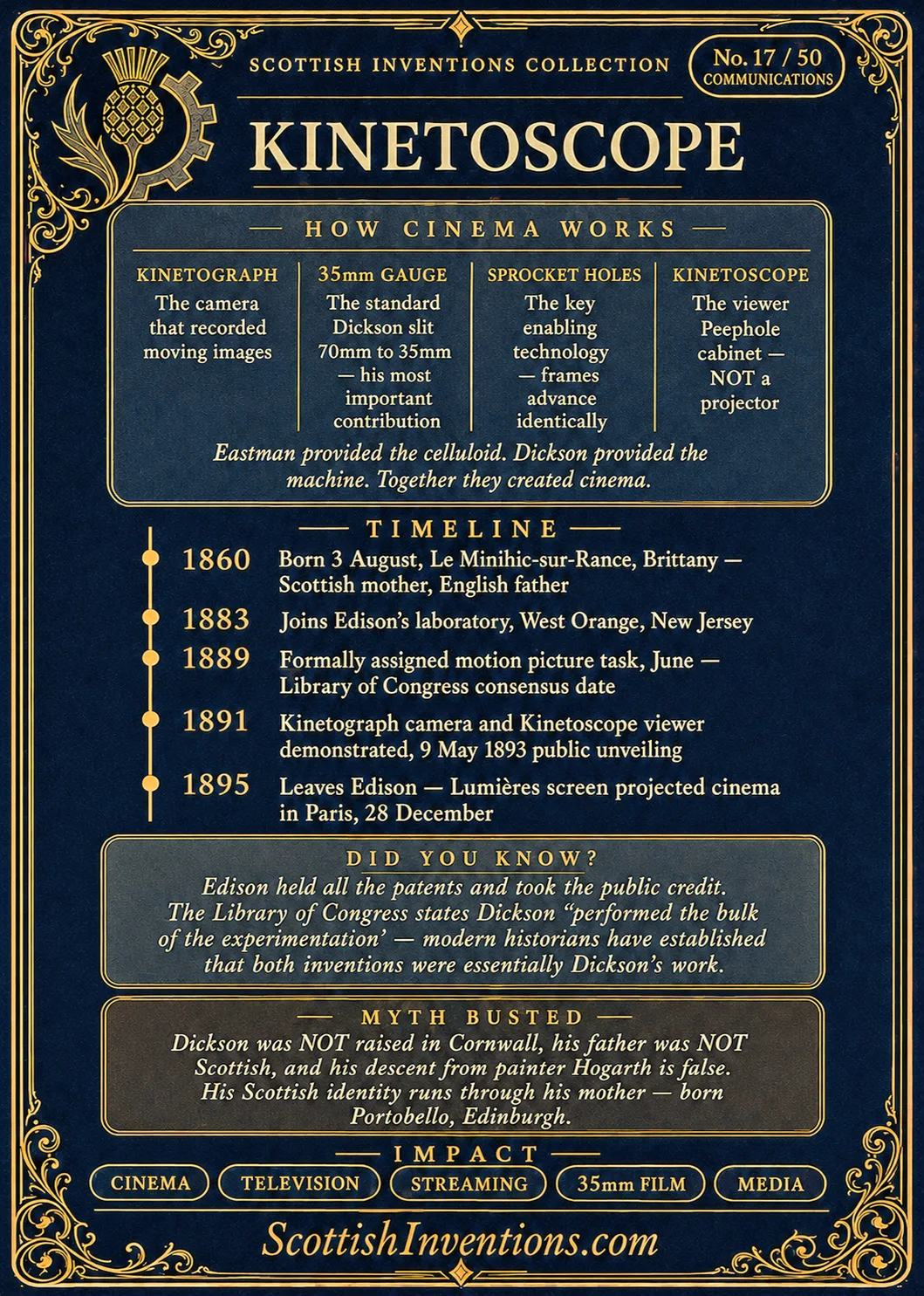
- Two linked inventions. The Kinetograph was the camera that recorded moving images; the Kinetoscope was a peephole cabinet that played them back for a single viewer. The Kinetoscope was emphatically not a projector.
- The 35mm standard. Dickson slit Eastman's 70mm celluloid down to 35mm, punched perforations along the edges and settled on a 4:3 (1.33:1) picture — a format that remained the world standard for professional filmmaking for more than a century.
- Myth-busting matters. Several widely repeated "facts" about Dickson are wrong. He did not grow up in Cornwall; his father was not Scottish; his mother was not American; and the family claim of descent from the painter William Hogarth is demonstrably false — Hogarth had no children.
Dickson at a glance
- Inventor
- William Kennedy Laurie Dickson
- Born
- Le Minihic-sur-Rance, Brittany — 3 August 1860
- Died
- Twickenham, London — 28 September 1935
- Scottish heritage
- Mother Elizabeth Kennedy-Laurie of Kirkcudbrightshire
- Central achievements
- Kinetograph camera · Kinetoscope viewer · 35mm film standard · Black Maria studio
- First film shown
- Dickson Greeting — 20 May 1891
- Kinetoscope unveiled
- Brooklyn Institute — 9 May 1893
- First commercial parlour
- 1155 Broadway, New York — 14 April 1894
- Later company
- American Mutoscope & Biograph (co-founder)
- Definitive biography
- Paul Spehr, 'The Man Who Made Movies' (2008)
- Card No.
- 17 of 50 · Communications
Early Life & Scottish Heritage
William Kennedy Laurie Dickson was born on 3 August 1860 at Le Minihic-sur-Rance, a village on the picturesque River Rance in Brittany, near Dinan in north-west France. The date and place are well established and consistent across the Library of Congress, the British Film Institute and the standard biographies.
His Scottish identity is real, but it runs through his mother. Elizabeth Kennedy-Laurie was born at Portobello, near Edinburgh, on 31 December 1821, daughter of William Baillie Kennedy Laurie of Woodhall in the parish of Balmaghie, Kirkcudbrightshire. She was descended from the Lauries of Woodhall — the family immortalised in the ballad "Annie Laurie." This is the most reliable account, established in Alvy Ray Smith's 2019 genealogical study, which quotes the Scottish parish baptismal registers directly.
Here we must do exactly what ScottishInventions.com prizes: separate fact from legend. Many sources — including, at the time of writing, Wikipedia — describe Dickson's mother as "American, born in Virginia." This is wrong: she only died in Virginia, in 1879. Even her Virginia death register records her birthplace as "Scotland." Likewise, his father James Waite Dickson is routinely called a "Scottish astronomer." In fact Smith showed James was born in Liverpool, England — as were all his siblings and his father. James was a real published artist and lithographer (he produced "Outlines of Celebrated Pictures"), but there is no evidence he was an astronomer or linguist beyond Dickson's own say-so. The romantic family claim of "direct lineage from the painter William Hogarth" is demonstrably false — Hogarth had no children.
So in what sense is Dickson Scottish? Through his mother's well-documented Kirkcudbrightshire line, and through his own proud self-identification — he carried both family names, Kennedy and Laurie, all his life. He was, strictly, French-born of British descent: a Scottish mother and an English father. We should also retire the common claim that he was raised in Cornwall — the scholarly biographies place his childhood in Brittany, France, where he lived until around the age of nineteen.
In 1879, at nineteen, Dickson wrote a striking letter to Thomas Edison describing himself as "a friendless and fatherless boy," offering "patience, perseverance, an ardent love of science, and above all a firm reliance on God." He was turned down. Undeterred, he emigrated to the United States that same year with his mother and two sisters, settling near Petersburg, Virginia — where his mother died within weeks of arrival. Largely self-taught in mechanics and photography, Dickson persisted, and in 1883 finally secured a job with Edison. Practically minded yet artistic and musical, he rose quickly to become the Edison company's official photographer. He died on 28 September 1935 at Montpelier House, Twickenham.
The Problem — Capturing Moving Images
By the 1880s still photography was mature: Daguerre had unveiled the daguerreotype in 1839, and Fox Talbot's paper-negative process followed in the 1840s. But these were frozen instants. The dream of capturing motion itself was alive — and one man brought it tantalisingly close. In June 1878, at Palo Alto, California, the English-born photographer Eadweard Muybridge used a bank of trip-wire-triggered cameras to photograph a galloping horse, proving for the first time that all four hooves leave the ground at once. Around 1879 he built the Zoopraxiscope, which projected painted versions of his sequences from a spinning glass disc — a true ancestor of the projector, but not a motion-picture camera.
The technical mountain was steep. To make real movies you needed a flexible film that could be moved rapidly through a camera; a mechanism to halt each frame for a fraction of a second while it was exposed; and a way to view or project the result. The missing material arrived in 1889, when George Eastman's company put flexible celluloid roll film on sale. Eastman's transparent film — 70mm wide — was the raw stock that early motion-picture experimenters seized upon. Eastman provided the medium; Dickson would provide the machine.
The Invention — The Kinetograph & the Kinetoscope
Edison's vision was a "visual phonograph" — a device that would "do for the Eye what the phonograph does for the Ear." He filed his first patent caveat in October 1888. But the man who turned that sentence into a working technology was Dickson, formally assigned the task in June 1889, according to the Library of Congress.
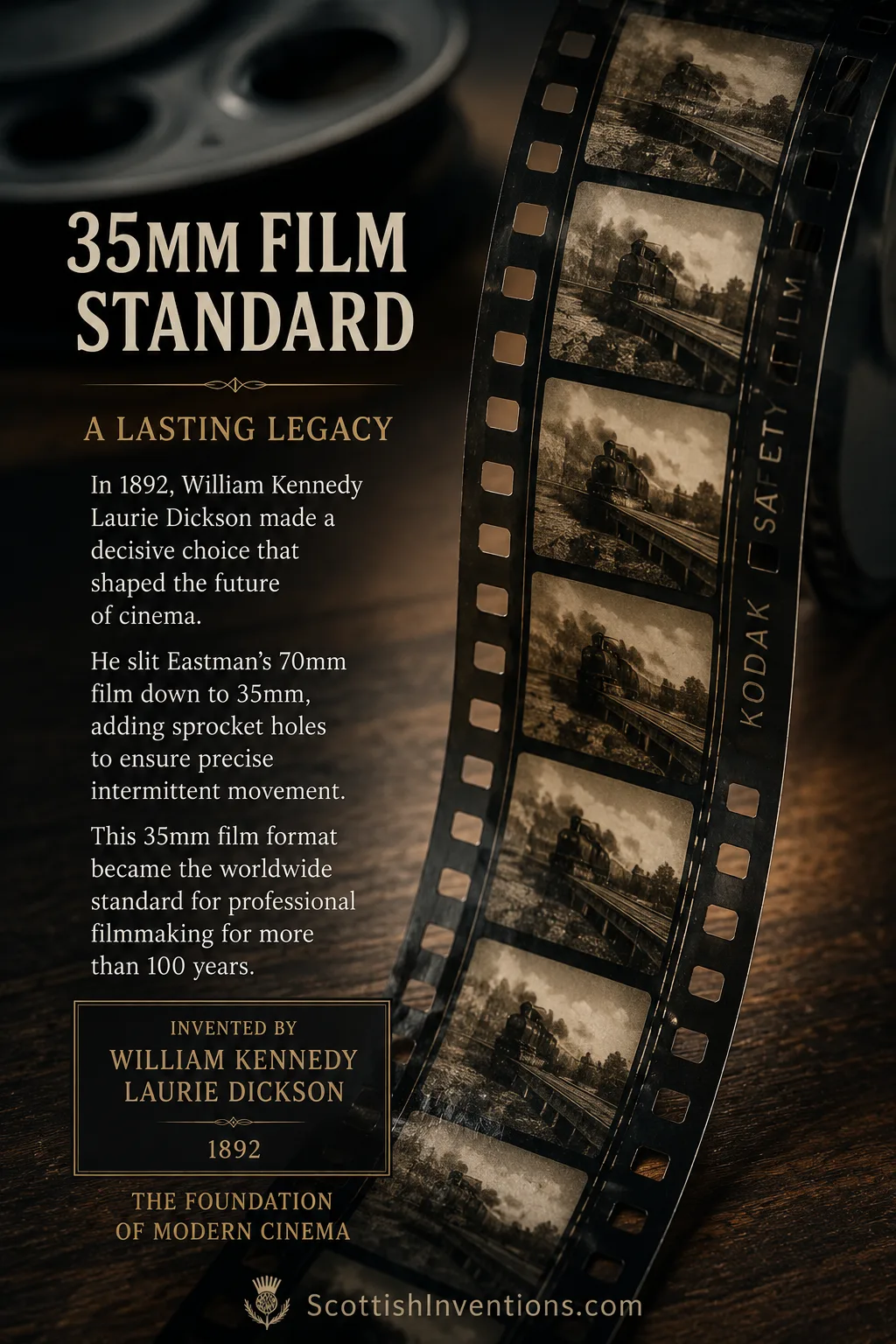
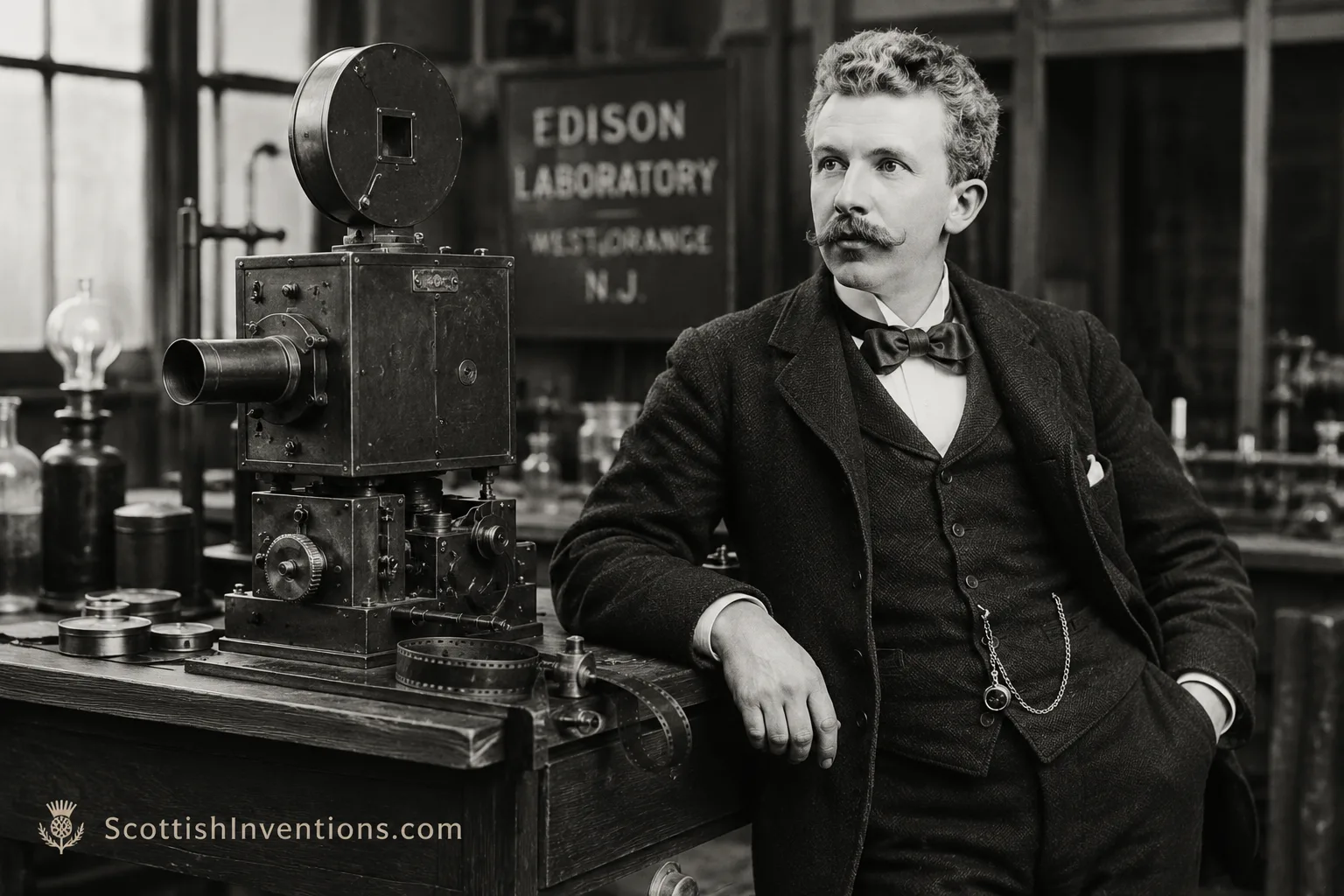
After early dead-ends with cylinders and a horizontal-feed 19mm film, Dickson made his decisive move. He slit Eastman's 70mm celluloid down to 35mm, punched perforations along both edges, and used a sprocket mechanism to advance the strip in precise, intermittent stop-and-go jerks past the lens. The final 35mm camera design, with its 4:3 picture, was settled by the autumn of 1892. It is his single most important contribution — the pattern of every professional movie camera that followed for a century.
The Kinetoscope
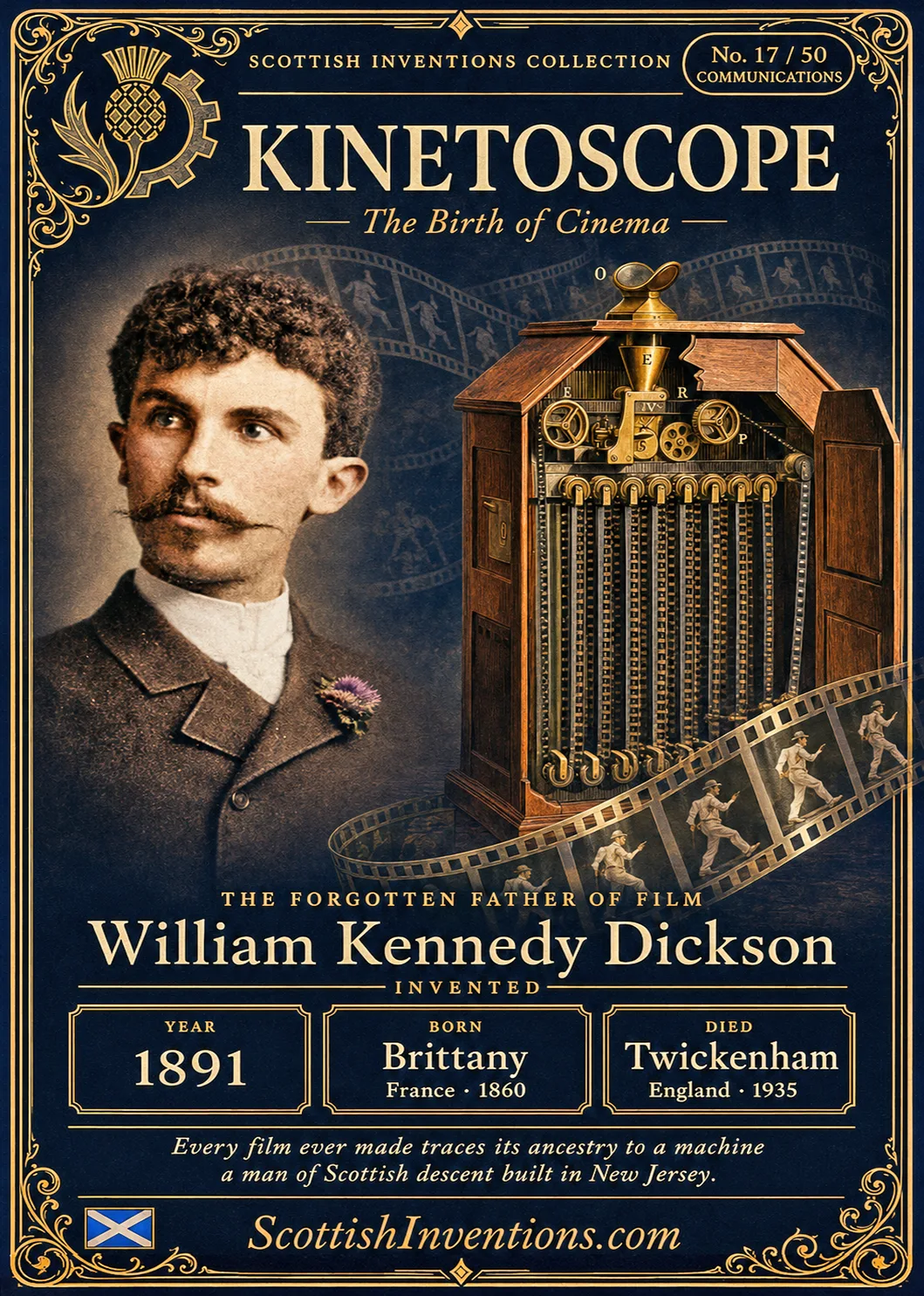
If the Kinetograph was the camera, the Kinetoscope was the viewing device that played the images back. It was a tall wooden cabinet with a peephole at the top. One person at a time looked down through the eyepiece at a continuous loop of film — about 50 feet of it — running over rollers, lit from below by an electric lamp, with a rapidly spinning slotted shutter creating the illusion of motion. Crucially, the Kinetoscope was a peep-show, not a projector — a single solitary viewer, not an audience.
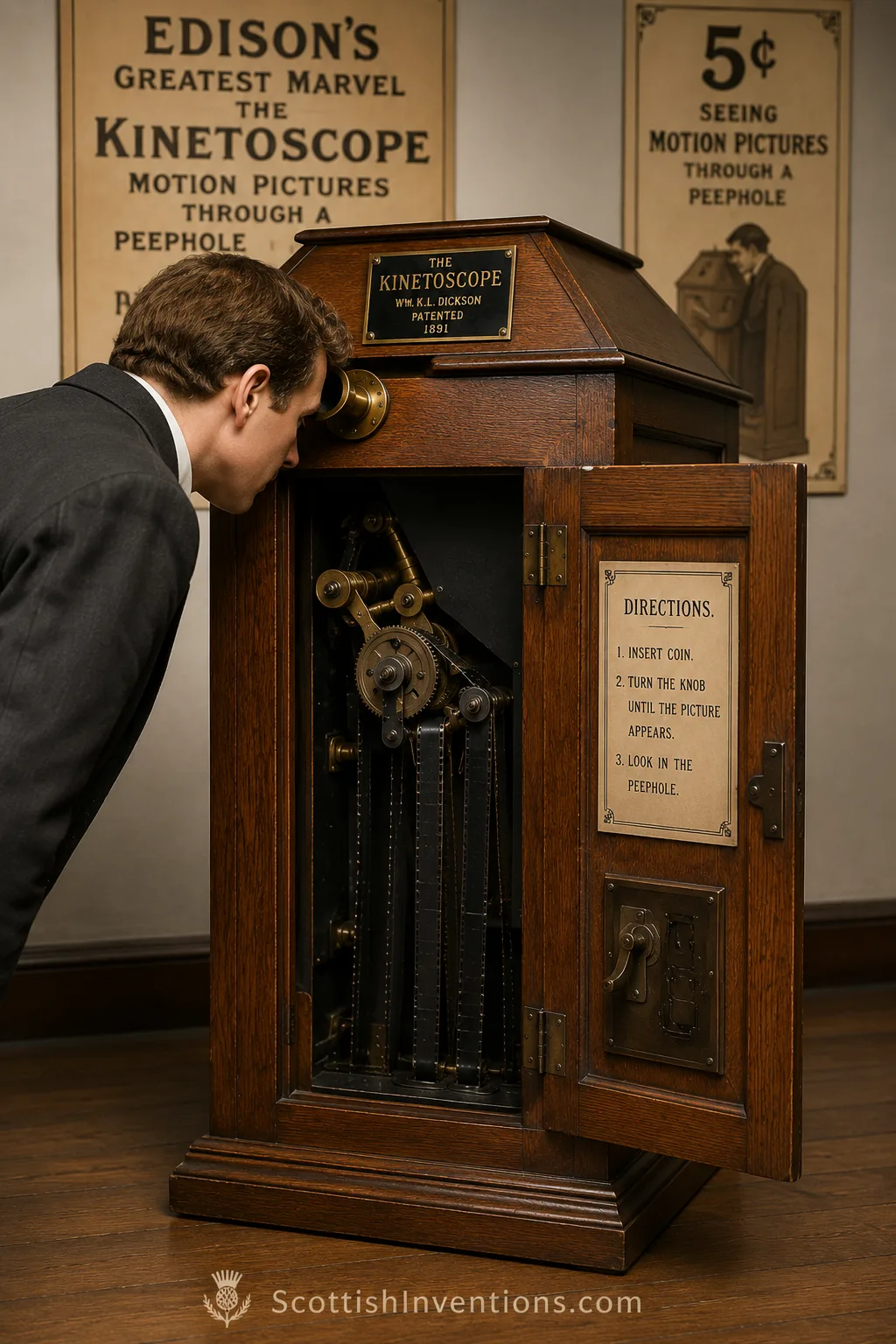
The completed Kinetoscope was unveiled at the Brooklyn Institute of Arts and Sciences on 9 May 1893, and on 14 April 1894 the first commercial Kinetoscope parlour opened at 1155 Broadway, New York, run by the Holland Brothers. Patrons paid 25 cents to view a row of machines. Within months, Kinetoscope parlours opened across America and Europe. Cinema as a paying business had begun.
The Black Maria Studio
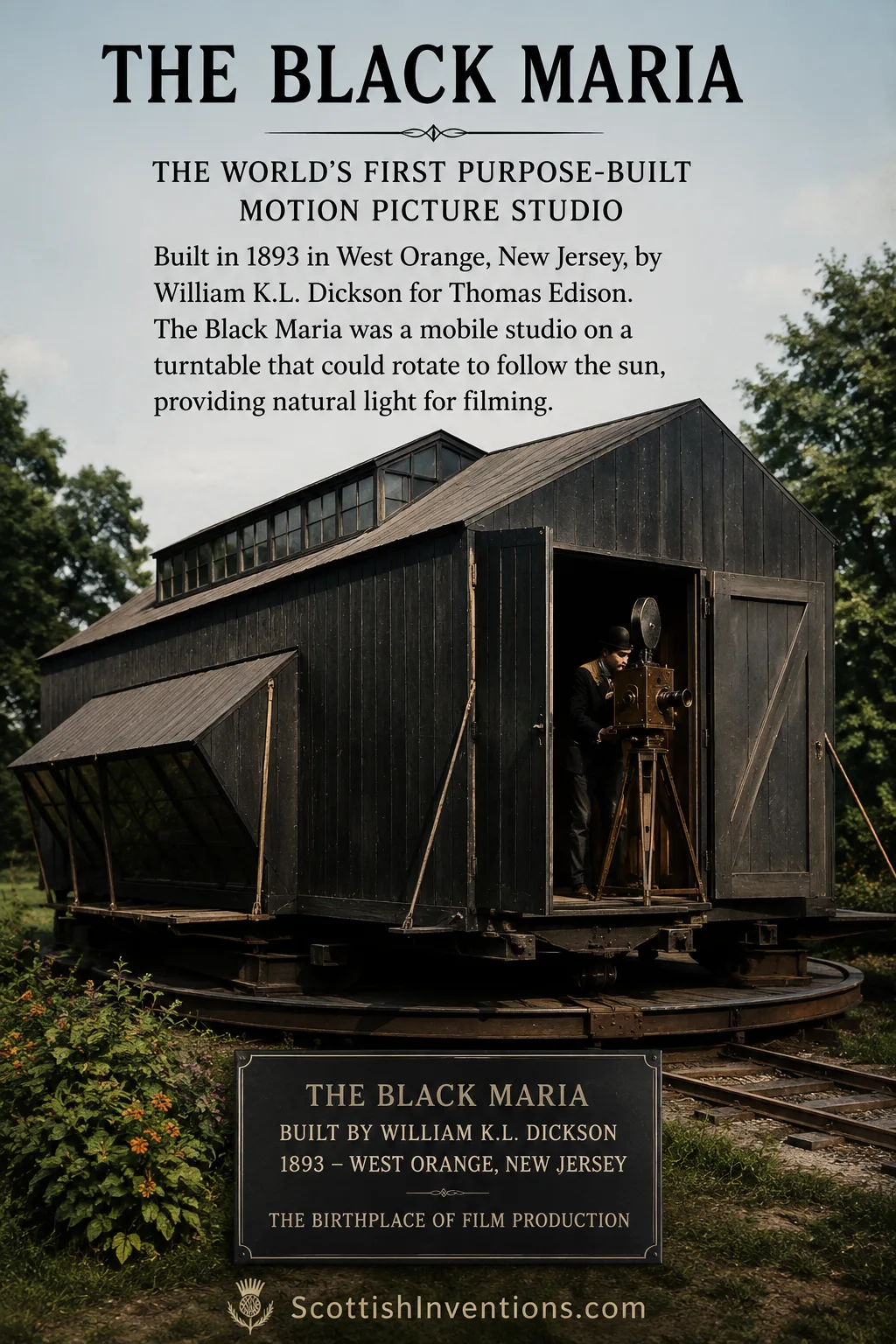
To make films for these machines, Dickson designed the world's first purpose-built film studio at West Orange, New Jersey: the Black Maria, completed in early 1893. It was a tar-paper shack with a hinged roof to admit sunlight, built on a turntable so it could rotate to follow the sun. Edison's own meticulous records show it cost just $637.67 to build. The lab workers nicknamed it the "Black Maria" because its cramped, stuffy black interior reminded them of a police wagon.
Here Dickson filmed the short subjects that became cinema's first content — strongman Eugene Sandow, the dancer Carmencita, sharpshooter Annie Oakley, boxing matches, "Fred Ott's Sneeze" and circus acts. The very first film shown to the public was Dickson Greeting (filmed 20 May 1891), a three-second clip of Dickson himself bowing and passing a hat from hand to hand. It was screened to 147 members of the National Federation of Women's Clubs at the Edison lab. As The New York Sun of 28 May 1891 reported, "when 147 club women visited his workshop he showed them the working model of his new Kinetograph." It survives today in the Library of Congress.
The 35mm Film Standard
This is the quiet genius at the foundation of all cinema. By punching evenly spaced perforations along the film edges and engaging them with a toothed sprocket, Dickson ensured every single frame was spaced identically and could be advanced, stopped, exposed and projected with absolute steadiness. Without it, film would slip and the image would dance unwatchably.
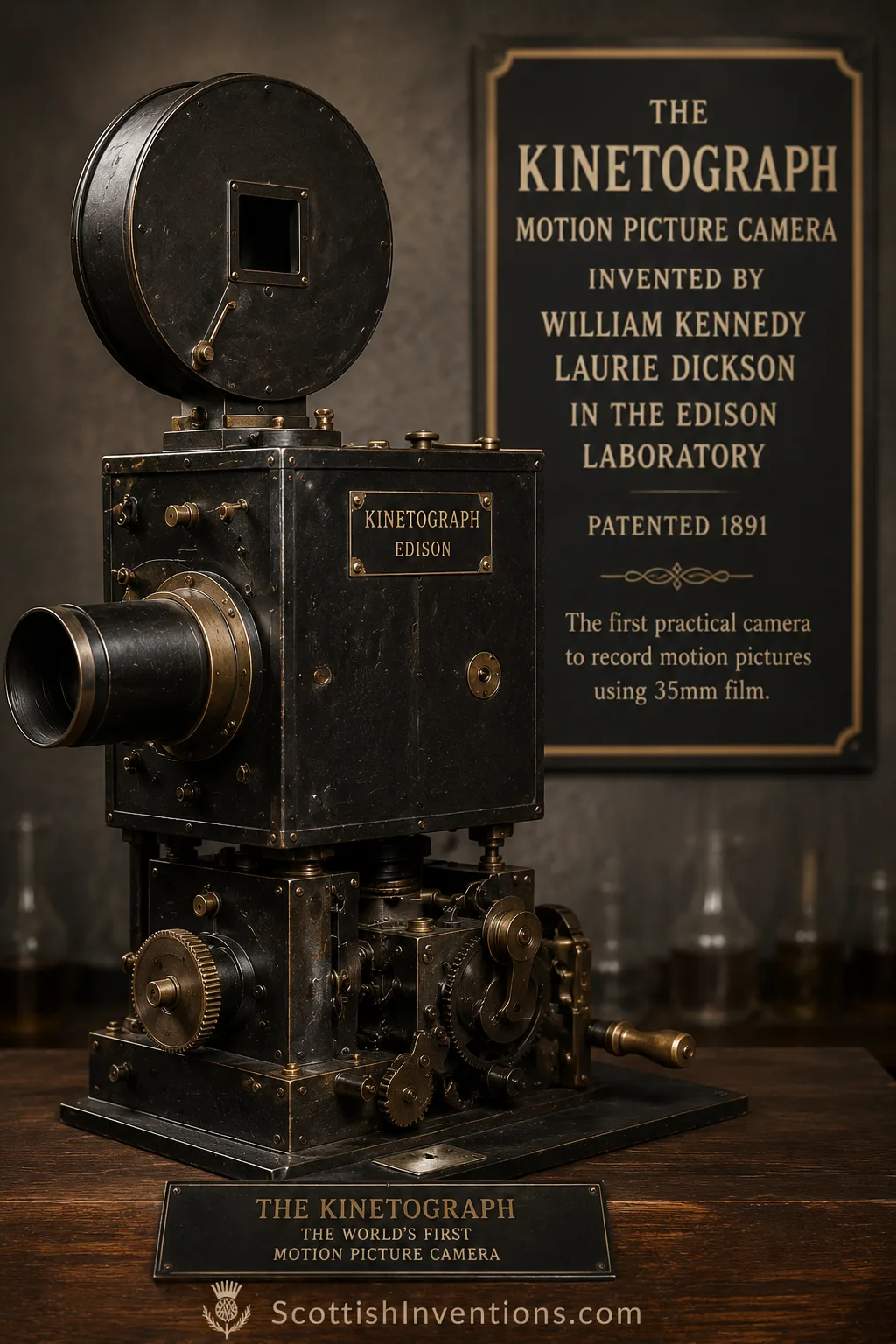
The marriage of Eastman's flexible celluloid (1889) and Dickson's sprocketed camera mechanism is, quite literally, the combination that created cinema. Dickson's choice of 35mm — established in 1891–92 — became and remained the international standard. For roughly a century, virtually every professional movie was shot on 35mm film, and it remains in use by cinematographers today.
The Dickson–Edison Split
By 1894 Dickson had fallen out with Edison. He became covertly involved with the rival Latham brothers. When Edison's general manager discovered the disloyalty, Dickson reportedly challenged Edison to choose between them — and lost. He left Edison's employ in April 1895 and helped found the American Mutoscope Company (later American Mutoscope & Biograph, then simply Biograph), which became Edison's most formidable rival.
Deliberately designing around Edison's patents, Dickson and his partners built the Mutoscope — a hand-cranked flip-card peep-show that became the origin of the British "What the Butler Saw" machines — and the Biograph projector, which used a wide 68mm film for spectacularly sharp, large images. It was the "IMAX of its day."
From 1897 Dickson was back in Britain running the European branch. With the outbreak of the Boer War he sailed to South Africa and, between November 1899 and 1900, filmed the conflict for Biograph — hauling a camera that weighed nearly half a ton by horse-drawn cart and once narrowly escaping a shell. His diary of the experience, The Biograph in Battle (1901), was the first book by a film cameraman and the first about filming a war.
The Lumière Brothers & Projected Cinema
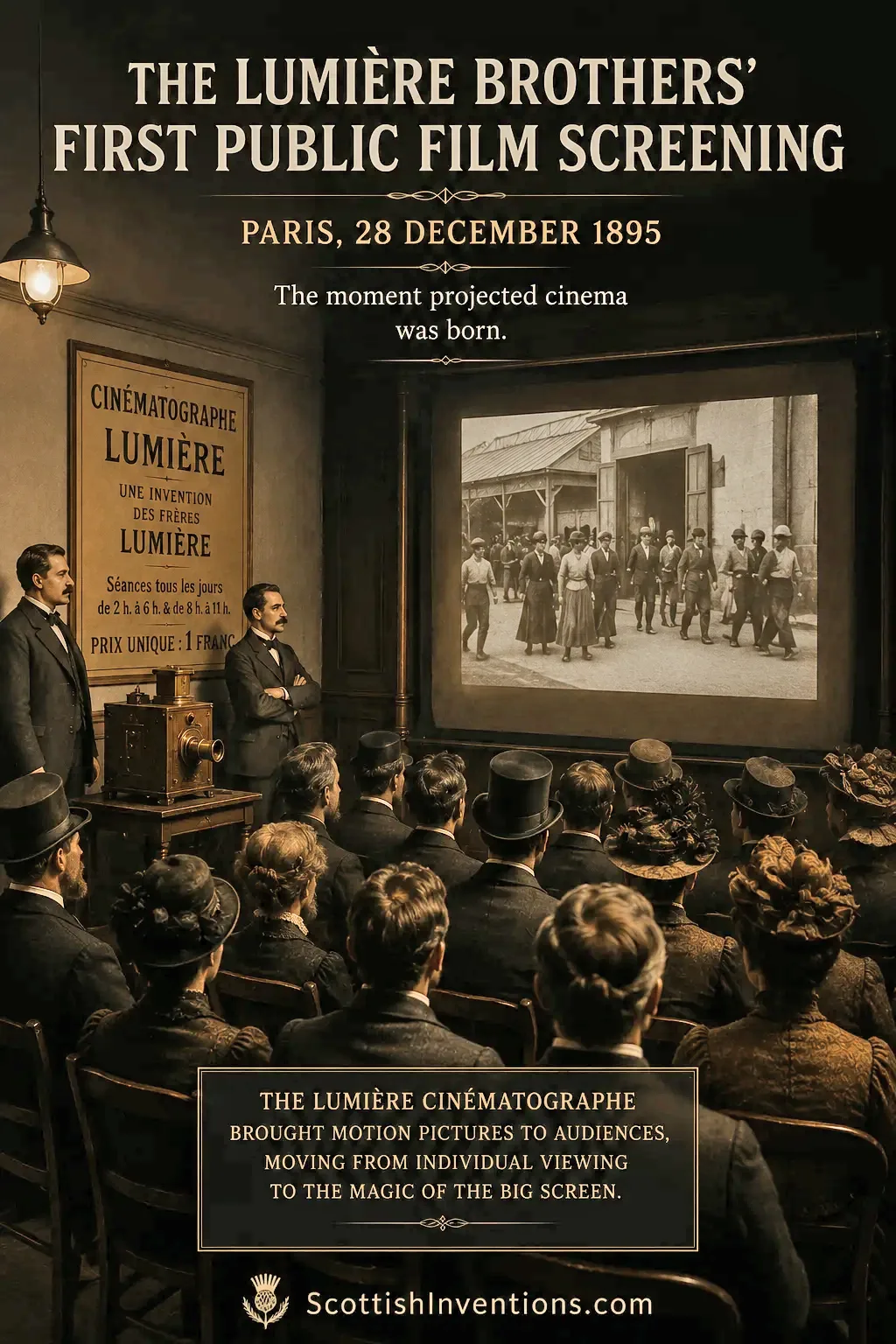
In Lyon, the Lumière brothers Louis and Auguste watched the Kinetoscope arrive in France and drew a natural conclusion: if one person at a time could see moving pictures, why not thousands? Antoine Lumière, their father, saw Edison's peep-show machine in Paris and challenged his sons to project the image instead. Their Cinématographe — a single portable device that acted as camera, printer and projector — did exactly that. On 28 December 1895 the Lumières charged one franc a head at the Grand Café in Paris to watch a programme of ten short films. Cinema as an audience experience had begun.
The honest distinction is this: Dickson and Edison had a working motion-picture camera, a viable film format and a commercial viewing device in place by 1893–94 — but for one viewer at a time. The Lumières were first to project moving pictures to an audience. Both were essential steps; neither alone is "the invention of cinema."
"Modern historians have established that both the Kinetoscope and the Kinetograph were essentially invented by Dickson."
Learn More: Interactive Panels
Tap any panel to expand.
+Learn more: Close: Why 35mm became universal
Dickson's 35mm gauge was not fixed by physics; it was fixed by success. The Kinetoscope, and then the Edison-licensed projectors that followed, spread across America and Europe in the mid-1890s, and every parlour needed reels of a single width to slot into its machines. When competitors designed rival gauges — 28mm, 68mm, 70mm — the sheer weight of installed 35mm exhibition equipment locked the standard in. By the 1909 Paris Congress the industry formally adopted 35mm; by the coming of sound in 1927 it was untouchable. It survived colour, widescreen, digital editing and multiplex distribution, and remains a benchmark for archival preservation to this day.
+Learn more: Close: Why Edison received more public credit
Edison was the celebrity, the boss and the patent-holder. American newspapers treated the Wizard of Menlo Park as an inventor-in-chief, and Edison himself was happy to accept the mantle. Company patents were filed in Edison's name. Histories written up to the 1960s repeated the framing uncritically. Dickson's rehabilitation came slowly, through the archival research of Gordon Hendricks, Charles Musser and — decisively — Paul Spehr, whose 2008 biography is tellingly titled The Man Who Made Movies: W. K. L. Dickson. In 1996 the US Postal Service issued a 'Pioneers of Communication' stamp for motion pictures; the face on the stamp is Dickson, not Edison.
+Learn more: Close: The Black Maria studio
The Black Maria was a small, tar-paper studio at Edison's West Orange laboratory in New Jersey, completed in early 1893 and paid for out of Edison's own pocket at $637.67. Its most striking feature was a roof that hinged open to admit direct sunlight — the only reliable light source powerful enough for early motion-picture film — and, ingeniously, the whole structure sat on a circular track and could be pushed around to follow the sun through the day. Inside, the walls were painted matte black to keep stray light off the subjects. It was ugly, cramped and hot, but from 1893 to 1901 it produced the world's first commercial films.
+Learn more: Close: Dickson Greeting (1891)
Filmed on 20 May 1891 and shown to 147 members of the National Federation of Women's Clubs at the Edison laboratory eight days later, Dickson Greeting is the earliest surviving film Edison's team ever showed to a public audience. It runs about three seconds and shows Dickson himself, in shirt-sleeves, passing a soft hat from one hand to the other and bowing. The Library of Congress preserves the original in its Edison collections; the American Film Institute has recognised it as the birth of the American film industry.
+Learn more: Close: The first commercial Kinetoscope parlours
On 14 April 1894 the Holland Brothers opened the world's first Kinetoscope parlour at 1155 Broadway, New York. Ten cabinets stood in two rows of five; patrons paid 25 cents to see a row of films — box, ballet, vaudeville acts, a barber-shop scene. Within months similar parlours opened in San Francisco, Chicago, London, Paris and Berlin. This is the moment moving pictures became a commercial industry rather than a laboratory experiment.
+Learn more: Close: The Lumière breakthrough
The Lumière brothers' Cinématographe of 1895 was elegant where Edison's rigs were brutal. It weighed only about 16 pounds, ran on a hand crank rather than a heavy electric motor, and doubled as camera, printer and projector — all using Dickson's 35mm gauge. Their first public paying screening at the Grand Café in Paris on 28 December 1895 packed in curious Parisians and drew queues within days. Cinema as an audience art form was born, but on Dickson's film format.
+Learn more: Close: Why projected cinema changed everything
Peep-show viewing capped audiences at one paying customer per machine per minute. Projection multiplied that by hundreds at a stroke: one operator, one print, one hall, one show. It transformed cinema from a novelty attraction into a mass medium capable of supporting scripted storytelling, star systems, feature-length works and, ultimately, a global cultural industry that generated roughly $30 billion in theatrical ticket sales in 2024 alone.
Timeline — From Photography to Cinema
3 August 1860
Born in Brittany
William Kennedy Laurie Dickson is born at Le Minihic-sur-Rance, Brittany, France, to Elizabeth Kennedy-Laurie of Kirkcudbrightshire and the English artist James Waite Dickson.
1879
Emigrates to the United States
After Edison rejects his letter offering 'patience, perseverance, an ardent love of science, and above all a firm reliance on God,' Dickson emigrates with his mother and sisters to Petersburg, Virginia. His mother dies within weeks of arrival.
1883
Joins Edison's laboratory
Dickson secures a position with Thomas Edison at Menlo Park, quickly rising to become the company's official photographer.
October 1888
The 'visual phonograph' caveat
Edison files his first patent caveat describing a device that would 'do for the Eye what the phonograph does for the Ear.'
June 1889
Formally assigned the project
The Library of Congress records that Dickson is formally assigned the task of turning Edison's vision into a working motion-picture system.
1889
Eastman's celluloid arrives
George Eastman puts flexible 70mm celluloid roll film on sale — the raw material Dickson has been waiting for.
20 May 1891
'Dickson Greeting'
The three-second film 'Dickson Greeting' — Dickson himself bowing and passing a hat — is shown to 147 members of the National Federation of Women's Clubs at the Edison lab. It survives today in the Library of Congress.
1891–92
The 35mm standard is chosen
Dickson slits Eastman's 70mm celluloid down to 35mm, punches edge perforations and adopts a 4:3 (1.33:1) picture — establishing the format that will dominate cinema for over a century.
Early 1893
The Black Maria opens
The world's first purpose-built film studio opens at West Orange, New Jersey. It cost just $637.67 to build and rotated on a turntable to follow the sun.
9 May 1893
Kinetoscope unveiled
The completed Kinetoscope is publicly unveiled at the Brooklyn Institute of Arts and Sciences.
14 April 1894
First commercial parlour
The first commercial Kinetoscope parlour opens at 1155 Broadway, New York, run by the Holland Brothers. Patrons pay 25 cents to view a row of machines. Cinema as a paying business begins.
April 1895
Dickson leaves Edison
After secret involvement with the rival Latham brothers is discovered, Dickson leaves Edison's employ and helps found the American Mutoscope Company — later Biograph — Edison's most formidable rival.
28 December 1895
Lumière projected cinema
The Lumière brothers hold the first public paying screening of projected motion pictures at the Grand Café, Paris, using their Cinématographe — inspired by seeing Edison's Kinetoscope.
1897
Return to Britain
Dickson takes charge of the European branch of Biograph, filming subjects across the United Kingdom and the Continent.
1899–1900
Filming the Boer War
Dickson sails to South Africa and, hauling a camera weighing nearly half a ton by horse-drawn cart, becomes one of the world's first war cinematographers.
1901
The Biograph in Battle
Dickson publishes 'The Biograph in Battle,' the first book by a film cameraman and the first about filming a war.
28 September 1935
Died in Twickenham
Dickson dies at Montpelier House, Twickenham, in suburban London.
1996
US Postal Service honour
The United States Postal Service honours Dickson — not Edison — on a 'Pioneers of Communication' stamp for motion pictures.
2025
UNESCO Memory of the World
The 68mm Mutoscope and Biograph films held by the BFI, Eye Filmmuseum, MoMA and France's CNC are inscribed on UNESCO's Memory of the World Register.
Key Takeaways
Dickson's Enduring Contributions
- The Kinetograph — the world's first practical motion-picture camera, using intermittent sprocket-driven film movement.
- The Kinetoscope — the peephole viewer that launched commercial film exhibition in 1894.
- The 35mm film gauge and sprocket-hole system — the technical standard that ran professional cinema for over a century.
- The Black Maria studio — the world's first purpose-built film studio and the birthplace of professional film production.
The Kinetoscope trading card
Card No. 17 of 50 in the Scottish Inventions Collection.
Frequently Asked Questions
- Who was William Kennedy Laurie Dickson?
- William Kennedy Laurie Dickson (1860–1935) was the hands-on inventor of practical motion-picture technology. Working in Thomas Edison's laboratory, he built the Kinetograph camera and Kinetoscope viewer, designed the Black Maria studio and settled on the 35mm sprocketed film format that became the global cinema standard for more than a century.
- Was William Dickson Scottish?
- By heritage and self-identification, yes. Dickson was born on 3 August 1860 in Le Minihic-sur-Rance, Brittany, France, but his mother Elizabeth Kennedy-Laurie was born at Portobello, near Edinburgh, in 1821, of the Lauries of Woodhall in Kirkcudbrightshire — the family behind the ballad 'Annie Laurie.' He proudly carried both Kennedy and Laurie throughout his life. His father was English, not Scottish.
- Did Dickson invent the Kinetograph?
- Yes. Edison filed the original 1888 patent caveat for a 'visual phonograph,' but the Library of Congress and modern historians agree that Dickson 'performed the bulk of the experimentation' and deserves 'the major credit for turning the concept into a practical reality.' He built the Kinetograph camera around 35mm film with edge perforations and an intermittent sprocket drive.
- What was the Kinetoscope?
- The Kinetoscope was a tall wooden peep-show cabinet unveiled in 1893. One viewer at a time looked down through an eyepiece at a continuous 50-foot loop of film running over rollers, illuminated from below and interrupted by a spinning shutter to create the illusion of motion. It was emphatically not a projector — it was designed for a solitary viewer, not an audience.
- What was the Black Maria?
- The Black Maria was the world's first purpose-built motion-picture studio, completed at Edison's West Orange laboratory in early 1893. Designed by Dickson, it was a tar-paper shack with a hinged roof and, most ingeniously, sat on a turntable that could rotate to keep the interior lit by direct sunlight all day.
- Why is 35mm film important?
- Dickson's decision in 1891–92 to slit Eastman's 70mm celluloid down to 35mm and punch sprocket holes along the edges created the world's dominant professional film format. 35mm remained the international cinema standard for well over a century and is still used by cinematographers today.
- Did Thomas Edison invent cinema?
- No. Edison directed the project, funded the work and took the public credit, but he did not personally build the machinery. Dickson designed and constructed the Kinetograph, Kinetoscope and studio. Histories up to the 1960s wrongly credited Edison alone; modern scholarship — from Gordon Hendricks to Paul Spehr — has corrected the record.
- Did the Lumière brothers invent cinema?
- The Lumière brothers Louis and Auguste were the first to project moving pictures to a paying audience, in Paris on 28 December 1895. Their Cinématographe was directly inspired by seeing Edison's Kinetoscope in Paris. So the Lumières invented public projected cinema — but the camera, the film gauge and the sprocket mechanism that made all cinema possible were Dickson's.
- What is the difference between the Kinetograph and the Kinetoscope?
- The Kinetograph was the camera that recorded the moving images on 35mm sprocketed film. The Kinetoscope was the viewing device that played them back through a peephole for one person at a time. Both were designed by Dickson and are the two linked inventions at the heart of early cinema.
- Is 35mm film still used today?
- Yes. Although digital capture now dominates, many directors — including Christopher Nolan, Quentin Tarantino and Paul Thomas Anderson — still shoot on 35mm for its unique aesthetic. Millions of feet are exposed every year, and 35mm remains the archival benchmark for long-term motion-picture preservation.
Legacy
Cinema became one of the defining art forms and industries of the modern world. The UK film-research firm Gower Street Analytics estimates the global theatrical box office at around $30 billion in 2024 — and that is only the ticket-sales tip of a vastly larger film and screen economy encompassing streaming, home video and licensing.
So who invented cinema? The honest answer is that it was a collaborative, international achievement with many hands — Muybridge, Marey, Edison, Dickson, the Lumières, Le Prince and others. But within that story, Dickson's specific contributions — the Kinetograph camera, the 35mm gauge and the sprocket system — are foundational and enduring.
For decades he was nearly written out of the story; histories up to the 1960s gave Edison sole credit. His rehabilitation came through the research of Gordon Hendricks, Charles Musser and especially Paul Spehr, whose definitive 2008 biography is tellingly titled The Man Who Made Movies: W. K. L. Dickson. In 1996 the US Postal Service honoured him on a "Pioneers of Communication" stamp for motion pictures — notably choosing Dickson, not Edison. In 2025, the 68mm Mutoscope and Biograph films held by the BFI, Eye Filmmuseum, MoMA and France's CNC were inscribed on UNESCO's Memory of the World Register.
His memorials are modest. There is no major statue or plaque to him in Scotland, and he never actually lived there. The strongest civic recognition is in Brittany, where his birthplace region around Le Minihic-sur-Rance and Dinard celebrates him as a native son and co-inventor of cinema. The Library of Congress holds his most important surviving films — including Dickson Greeting and the Dickson Experimental Sound Film — within its Edison collections.
"A friendless and fatherless boy… patience, perseverance, an ardent love of science, and above all a firm reliance on God."
Continue Exploring
Discover More Scottish Innovations That Changed the World
William Kennedy Laurie Dickson helped create modern cinema, but his achievement was only one of Scotland's many remarkable contributions to science, engineering and communications.
Explore More Scottish InventionsSources
- Library of Congress — Motion Picture History collections and Edison Papers.
- Paul Spehr, The Man Who Made Movies: W. K. L. Dickson (John Libbey Publishing, 2008).
- Alvy Ray Smith, "The Ancestry of William Kennedy Laurie Dickson" (2019).
- British Film Institute — biographical materials on W. K. L. Dickson.
- Linda Hall Library — history of science collections on the Kinetograph and Kinetoscope.
- W. K. L. Dickson, The Biograph in Battle (1901).
- UNESCO Memory of the World Register (2025) — Mutoscope and Biograph films.
- Gower Street Analytics — 2024 global theatrical box-office estimate.