Scottish Inventions · Science & Imaging
James Clerk Maxwell & the World's First Colour Photograph
How an Edinburgh-born physicist and an English photographer made a piece of tartan ribbon the founding artefact of every colour screen, camera and television on Earth — and why the experiment should not, on the physics of 1861, have worked at all.
Introduction
On the evening of 17 May 1861, in the lecture theatre of the Royal Institution of Great Britain on Albemarle Street, London, an Edinburgh-born physicist named James Clerk Maxwell turned on three magic lanterns and projected a fluttering bow of Scottish tartan ribbon onto a screen in colour. It was the first time in human history that a photograph had reproduced colour by combining red, green and blue light. Everything you have ever watched on a television, every photograph on your phone, every cinema frame, every pixel of this article — all of it descends from that demonstration.
The theory was Maxwell's. The photographs were made by the English photographer Thomas Sutton, who in the very same year patented the first single-lens reflex camera. The subject was a piece of tartan, almost certainly chosen by a proud Scotsman to flatter his new method. And the most astonishing fact about the experiment is that — given the photographic chemistry available in 1861 — it should not have worked. This is the definitive, evidence-led story of the world's first durable colour photograph: the science, the people, the patriotism, and the lucky ultraviolet accident that took a hundred years to explain.
On this page
- Key Takeaways
- Quick Facts
- Early Life & Edinburgh Roots
- Maxwell's Interest in Colour
- How RGB Colour Theory Works
- Thomas Sutton's Contribution
- The Demonstration that Changed Photography
- Why the Experiment Should Not Have Worked
- The Famous Tartan Ribbon
- Myth vs Fact
- Legacy of RGB
- Did You Know?
- Timeline of Colour Imaging
- Related Scottish Inventions
- Further Reading
- Frequently Asked Questions
Key Takeaways
- James Clerk Maxwell (1831–1879), born in Edinburgh, proposed the three-colour (RGB) method of colour reproduction in 1855 and demonstrated it at the Royal Institution in London on 17 May 1861.
- The photographs themselves were taken by the English photographer Thomas Sutton, inventor of the first single-lens reflex camera (also 1861). Always credit them together: Maxwell's theory, Sutton's photography.
- The subject was a Scottish tartan ribbon tied as a bow on black velvet — the founding artefact of every colour image you will ever see.
- It is correctly the first durable colour photograph and the first by the additive RGB method — Edmond Becquerel's 1848 colour images existed but could not be permanently fixed.
- The 1861 demonstration succeeded partly by accident: the wet-collodion plates were blind to red, but red dyes happened to reflect ultraviolet light that Sutton's filter and the plates could record — a "lucky alignment" only worked out by Kodak's Ralph M. Evans in 1961.
- Maxwell's three-colour principle is the foundation of colour film, colour cinema, colour television, computer monitors, digital cameras and every smartphone display in the world.
Quick Facts
Scientist
James Clerk Maxwell (1831–1879), Edinburgh-born physicist; first Cavendish Professor at Cambridge.
Date
Friday 17 May 1861 — projected demonstration at the Royal Institution, London.
Location
Royal Institution of Great Britain, Albemarle Street, London (not King's College London).
Photographer
Thomas Sutton — also patented the first single-lens reflex (SLR) camera in 1861.
Subject
A Scottish tartan ribbon tied as a bow on black velvet, photographed outdoors in sunlight.
Significance
First durable colour photograph; first physical demonstration of the additive RGB method.
Theory
Three-colour method first proposed by Maxwell in 1855; published Royal Society of Edinburgh, 1857.
Legacy
Every screen, digital camera, TV, monitor and phone pixel is built on Maxwell's RGB principle.
Early Life & Edinburgh Roots
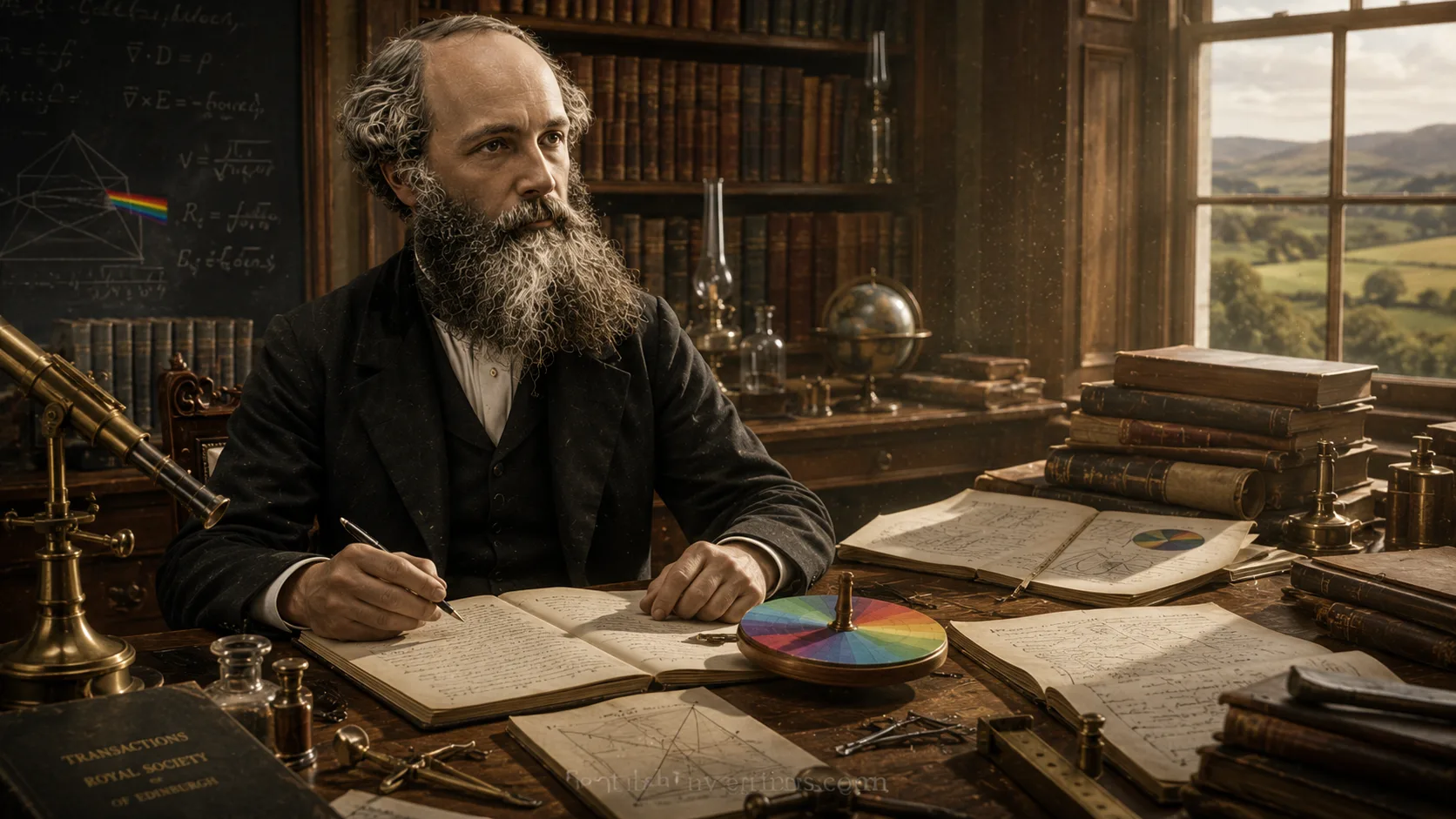
James Clerk Maxwell was born at 14 India Street, Edinburgh, on 13 June 1831, the only surviving child of John Clerk Maxwell, advocate, and Frances Cay. He spent his early childhood at the family estate of Glenlair in Dumfries and Galloway, where his mother died of cancer when he was eight. He entered Edinburgh Academy at ten, published his first scientific paper — on a method for drawing oval curves — at fourteen, and then read mathematics and natural philosophy at the University of Edinburgh (1847–50) before moving to the University of Cambridge (1850–55), where he placed Second Wrangler and was joint First Smith's Prizeman.
He took the chair of Natural Philosophy at Marischal College, Aberdeen (1856–60), moved to King's College London (1860–65) — where he was working at the time of the 1861 colour demonstration — retired briefly to Glenlair, and returned to Cambridge in 1871 as the first Cavendish Professor of Physics and founding director of the Cavendish Laboratory. He died in Cambridge on 5 November 1879, aged just 48. Many physicists rank him third only to Newton and Einstein; on the 1931 centenary of Maxwell's birth, Einstein wrote that the change in the conception of reality wrought by his field theory "is the most profound and the most fruitful that physics has experienced since the time of Newton."
Maxwell's Interest in Colour
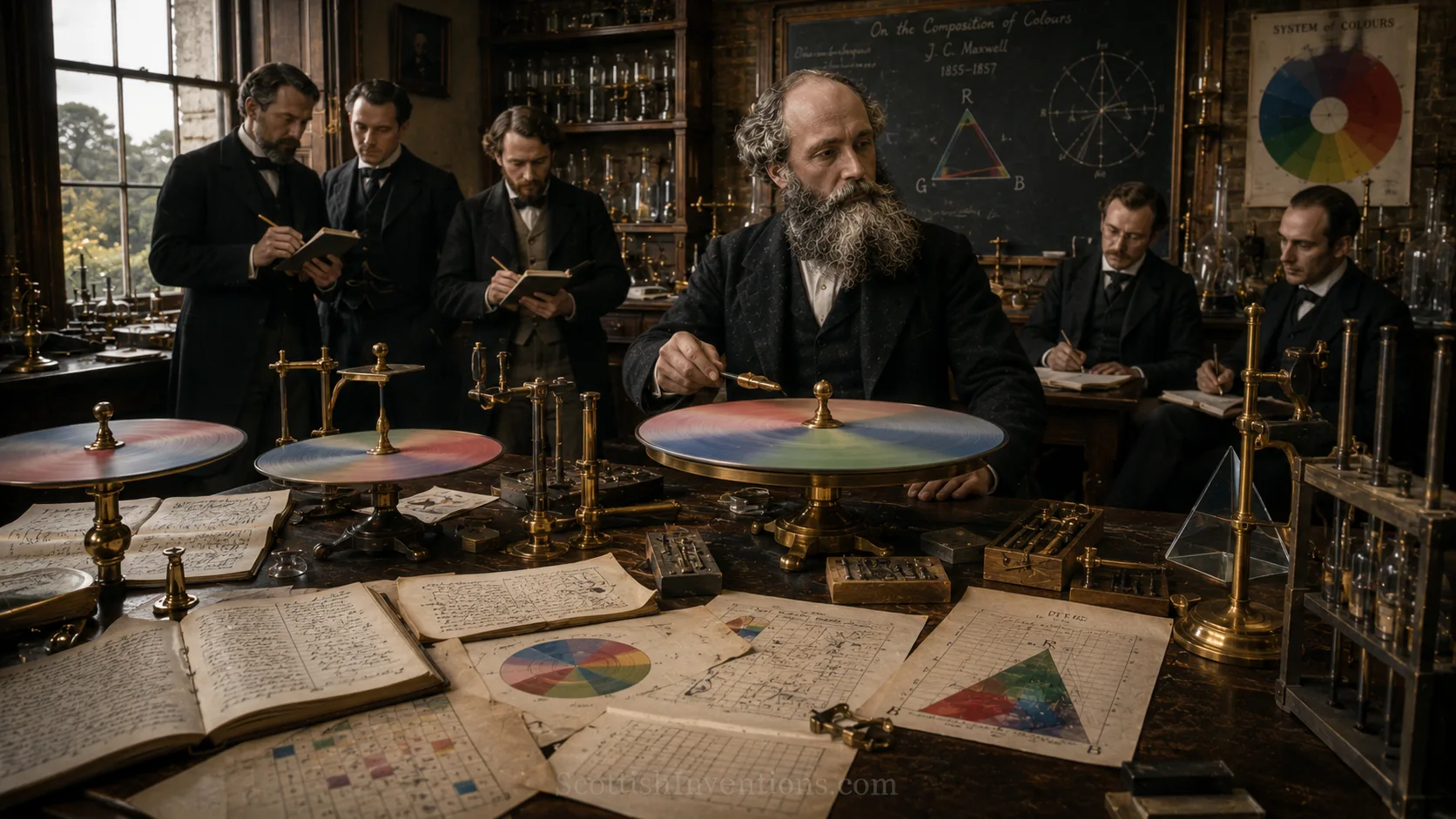
Maxwell's lifelong fascination with colour began as a student in Edinburgh, where his professor James David Forbes introduced him to the spinning colour top — a disc of coloured paper sectors that, spun fast, blends into a single perceived colour. Maxwell turned this children's toy into a quantitative instrument. By adjusting the proportions of red, green and blue sectors to match a grey or a target colour, he could express colour relationships as equations and plot them on a colour triangle, with the three primaries at the corners. His wife Katherine — the anonymous observer "K" in his papers — and a self-described "good specimen of colour blindness in my class" served as test subjects. This work convinced him of the essential correctness of the Young–Helmholtz three-receptor theory of vision.
From about 1858, while at Aberdeen, he moved beyond the top to a colour box — an optical instrument using prisms to disperse sunlight into a spectrum and recombine selected spectral bands of red, green and blue in measured amounts. Described in his 1860 paper On the Theory of Compound Colours, this apparatus produced the colour-matching data that underlies the modern chromaticity diagram. It won him the Royal Society's Rumford Medal in 1860 "for his research on the composition of colours." Crucially, in his 1855 paper "Experiments on Colour, as Perceived by the Eye" — read to the Royal Society of Edinburgh and published in its Transactions in 1857 — he had already proposed, as "a supposed case taken from the art of photography", that three black-and-white photographs taken through red, green and blue filters and projected through the same filters would recreate the colours of a scene. Six years later he asked a professional photographer to test it.
How RGB Colour Theory Works
Human colour vision is trichromatic. The retina has three types of cone cell, broadly sensitive to long (reddish), medium (greenish) and short (bluish) wavelengths. The brain infers colour from the ratio of stimulation across the three channels. This is the Young–Helmholtz theory, which Thomas Young proposed in 1802 and Hermann von Helmholtz developed; Maxwell gave it a quantitative, mathematical footing.
The consequence is powerful: you do not need to record every wavelength of a scene to reproduce its colour — you only need to record how much each of the three channels would be stimulated. Photographing through a red filter records "how red" each part of the scene is; the green and blue filters record the other two channels. The three black-and-white negatives become a map of the scene's RGB content. Projecting each through its matching colour and overlapping them adds the three coloured lights back together — this is additive mixing (red + green + blue light combine toward white, unlike paint, which is subtractive). Where the original was yellow, the red and green projections are bright and the blue is dark, so red + green light overlap to look yellow; and so on across the spectrum. The eye, itself trichromatic, is fooled into seeing the full range of original colours.
From three lanterns to every pixel
This is precisely how a television or smartphone screen works: each pixel is a tiny cluster of red, green and blue emitters whose relative brightness recreates any colour. Maxwell's 1861 screen demonstration was the first physical instance of the RGB model — three centuries of speculation about how the eye sees colour, distilled into a working piece of hardware.
Thomas Sutton and the Historic Photograph
Thomas Sutton (c. 1819 – 1875) was a significant figure in early photography in his own right. A Cambridge graduate (Gonville and Caius College, 1846), he opened a photographic studio in Jersey under the patronage of Prince Albert, partnered with the French calotype pioneer Louis Désiré Blanquart-Evrard, and in 1856 co-founded the influential journal Photographic Notes, which he edited for about eleven years. He wrote A Dictionary of Photography (1858), developed an early panoramic camera with a water-filled wide-angle lens (1859), and — in the same extraordinary year as Maxwell's demonstration — patented the first single-lens reflex (SLR) camera in 1861.
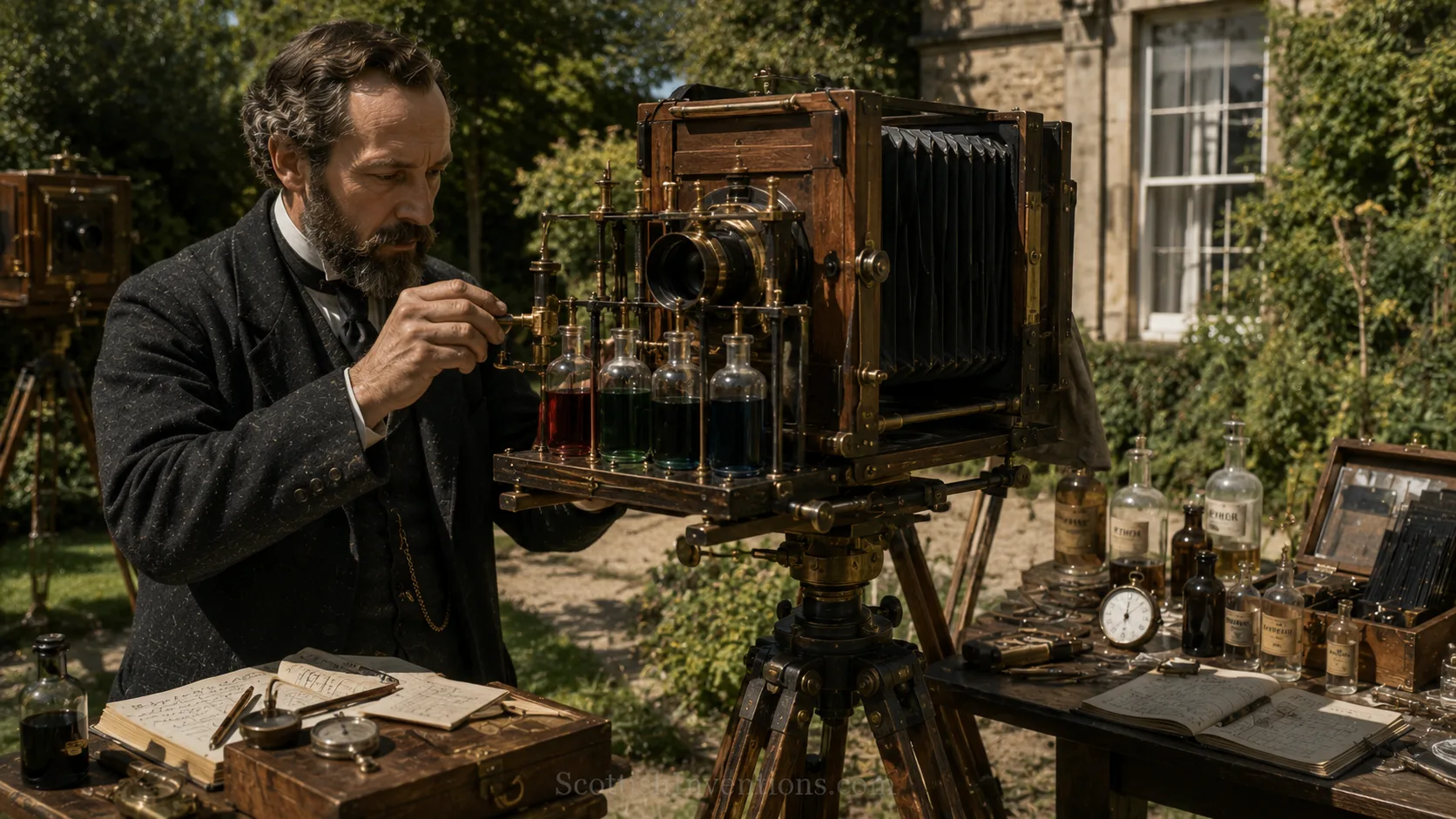
The historical record tends to compress the story into "Maxwell's photograph," which is unfair to Sutton. He solved the formidable practical problems — mixing the liquid filters, judging exposures of seconds to many minutes, hand-pouring and developing wet-collodion plates outdoors, and printing transparencies — that turned Maxwell's thought-experiment into something projectable. The fairest framing is a genuine collaboration: Maxwell supplied the theory and direction; Sutton supplied the photography. Sutton's own contemporary account appeared in Photographic Notes No. 125, 15 June 1861: "A bow made of ribbon, striped with various colours, was pinned upon a background of black velvet, and copied by photography" in good outdoor light, with "various coloured fluids" in glass baths placed in front of the lens.
Sutton's filters and exposures
- Blue / violet: ammoniacal sulphate of copper (copper ammonium sulphate) — about 6 seconds.
- Green: chloride of copper (cupric chloride), heavily diluted — about 12 minutes, and even then barely usable.
- Yellow: a sheet of lemon-coloured glass — about 2 minutes (not used in the projection; later lost).
- Red: sulphocyanide of iron (ferric thiocyanate) — about 8 minutes.
The negatives were printed by the Tannin process onto glass transparencies. The same coloured solutions used to take the photographs were re-used as the projection filters.
The Demonstration that Changed Photography
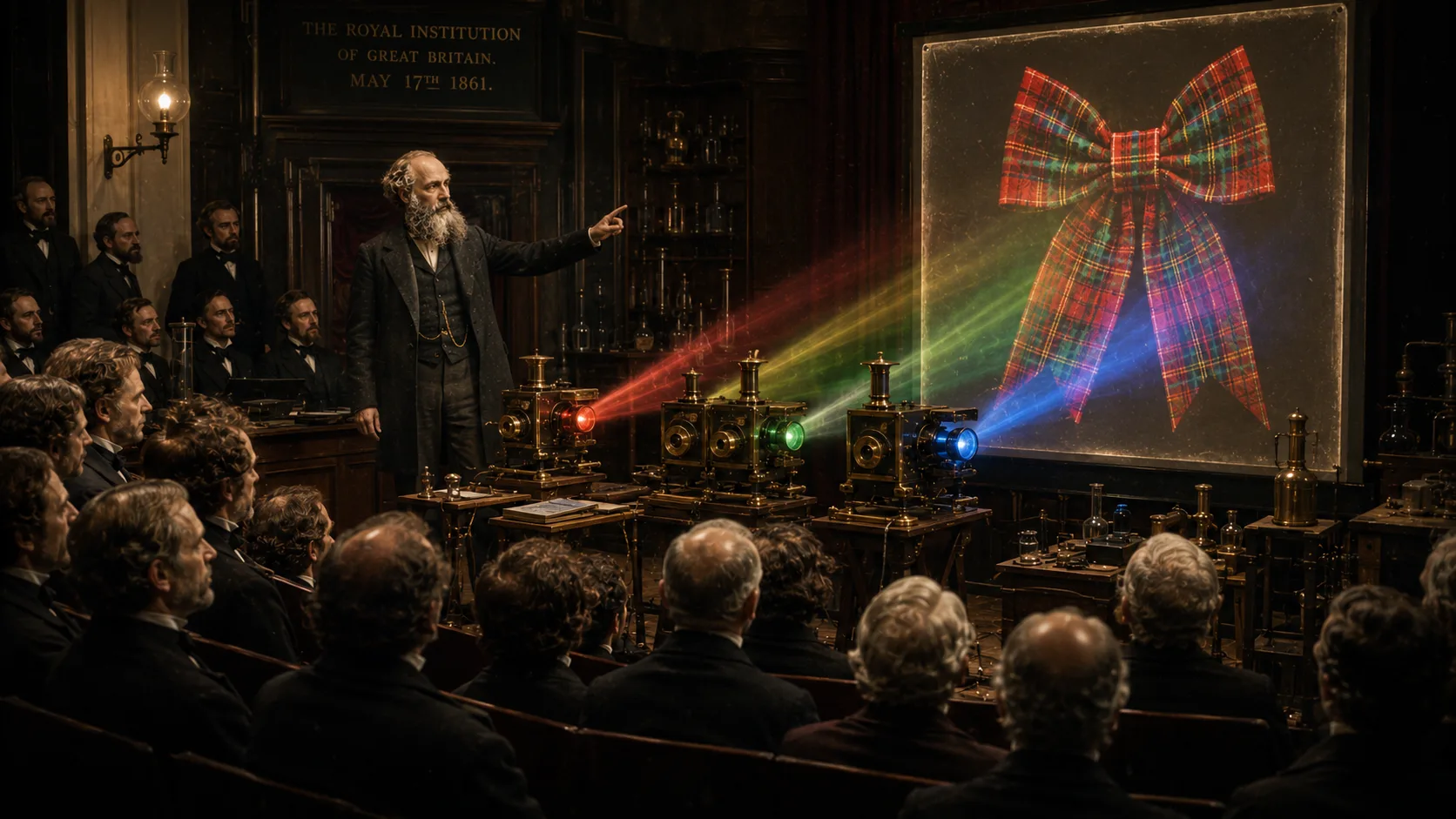
On Friday 17 May 1861 Maxwell delivered a discourse, "On the Theory of Three Primary Colours," to the Royal Institution of Great Britain at Albemarle Street, London. He first explained Young's theory of vision and the principles of additive colour mixing, then demonstrated them by placing three positive photographic transparencies into three separate projectors (magic lanterns), each fitted with the same red, green or blue filter through which it had been taken, and registering the three projected images one atop another on a screen. Where the three overlapped in register, the audience saw a recognisable colour image of the tartan ribbon.
Some Scottish sources, including National Museums Scotland, place the demonstration at King's College London — almost certainly conflating Maxwell's professorship there with the lecture venue. At least one peer-reviewed paper has erroneously named the Royal Society. The contemporary record is unambiguous: it was the Royal Institution.
"With materials more sensitive to red and green, it would have been a truly-coloured image of the riband."
Why the Experiment Should Not Have Worked
Here is the strangest and most beautiful detail in the entire story. The wet-collodion plates of 1861 were, for practical purposes, sensitive only to blue and ultraviolet light, marginally sensitive to green, and essentially blind to red. A truly red-sensitive ("panchromatic") emulsion did not exist for several more decades. So the red-filter photograph — the one supposed to capture the red stripes of the tartan — should have recorded almost nothing. A faithful three-colour image should have been impossible. Maxwell and Sutton both regarded the result as a partial failure, and the demonstration was largely forgotten for over thirty years.
A century later, for the 1861 centenary, the Kodak colour scientist Ralph M. Evans and colleagues recreated the experiment in chemical detail and published the explanation as "Maxwell's Color Photograph" in Scientific American (Vol. 205, No. 5, November 1961, pp. 120–128), with a companion paper in the Journal of Photographic Science. Their conclusion: the red image was recorded not by red light but by ultraviolet. Many red dyes reflect ultraviolet as well as red; Sutton's red filter (ferric thiocyanate) did not fully block UV; and the collodion plates were sensitive to UV. Light from the red portions of the ribbon registered on the "red" plate via an invisible ultraviolet signal that happened to coincide with the red areas — a kind of fortunate false-colour image.
Why this matters
This does not diminish Maxwell's theoretical achievement, which was correct and fundamental. As Evans's own textbook put it, Maxwell's ideas "were accepted in spite of, rather than because of, his demonstration." The principle was sound; the 1861 hardware simply wasn't up to it, and got the right answer by the wrong route. It is one of the most instructive "useful errors" in the history of science.
The Famous Tartan Ribbon
The charming and well-documented Scottish detail is that the subject of the world's first colour photograph was a piece of Scottish tartan. The choice was almost certainly practical and patriotic at once. Practically, tartan is woven from many differently coloured threads — red, green, blue and yellow among them — giving a subject rich in distinct colours that was ideal for showing off a three-colour reproduction. Patriotically, it is difficult to imagine the proudly Scottish Maxwell choosing such a quintessentially Scottish cloth by accident; commentators reasonably describe the choice as "a fitting tribute to his heritage." A small caveat of intellectual honesty: the surviving primary record (Sutton's note in Photographic Notes) describes only "a bow made of ribbon, striped with various colours" and does not spell out Maxwell's motive — so the "deliberately patriotic" reading, while charming and plausible, is inference rather than documented fact.
The original three glass slides survive at the Cavendish Laboratory, University of Cambridge — the laboratory Maxwell himself founded and first directed. A set of his black-and-white slides is displayed at the James Clerk Maxwell Foundation at 14 India Street, Edinburgh, the house where he was born. The full-colour image reproduced in countless books and websites is actually a VIVEX colour print made in the 1930s by Dr D. A. Spencer from Maxwell's originals — not a direct 1861 artefact. The three things — surviving slides, displayed slides and the modern print — are routinely conflated.
Myth vs Fact
| Claim | Reality |
|---|---|
| Maxwell took the first colour photograph. | No. The exposures were made by Thomas Sutton, working from Maxwell's theory. |
| It is the first colour photograph, full stop. | It is the first durable colour photograph and the first by the three-colour additive method. Edmond Becquerel made unfixable colour images in 1848. |
| The demonstration was at King's College London. | It was at the Royal Institution of Great Britain, Albemarle Street. Maxwell was a King's professor, but that was his post, not the venue. |
| The experiment worked because the plates captured red light. | They did not. The red image was captured by reflected ultraviolet — a fortunate accident only explained by Kodak in 1961. |
| The famous colour image we all see online is the 1861 photograph. | It is a 1930s VIVEX print by D. A. Spencer made from the originals. The 1861 glass slides themselves live at the Cavendish Laboratory. |
Legacy of RGB
After Maxwell, the three-colour idea was reinvented and refined many times over. Louis Ducos du Hauron and Charles Cros independently developed three-colour processes from the 1860s (both presented in 1868–69); Sergey Prokudin-Gorsky produced his superb three-filter colour images of the Russian Empire from around 1909 once panchromatic plates existed; and the Lumière brothers' Autochrome (patented 1903, marketed 1907) became the first commercially practical colour process, using a mosaic of dyed potato-starch grains as millions of tiny additive filters. Modern integral-tripack films such as Kodachrome (1935) and today's silicon image sensors all ultimately rest on the same three-colour foundation.
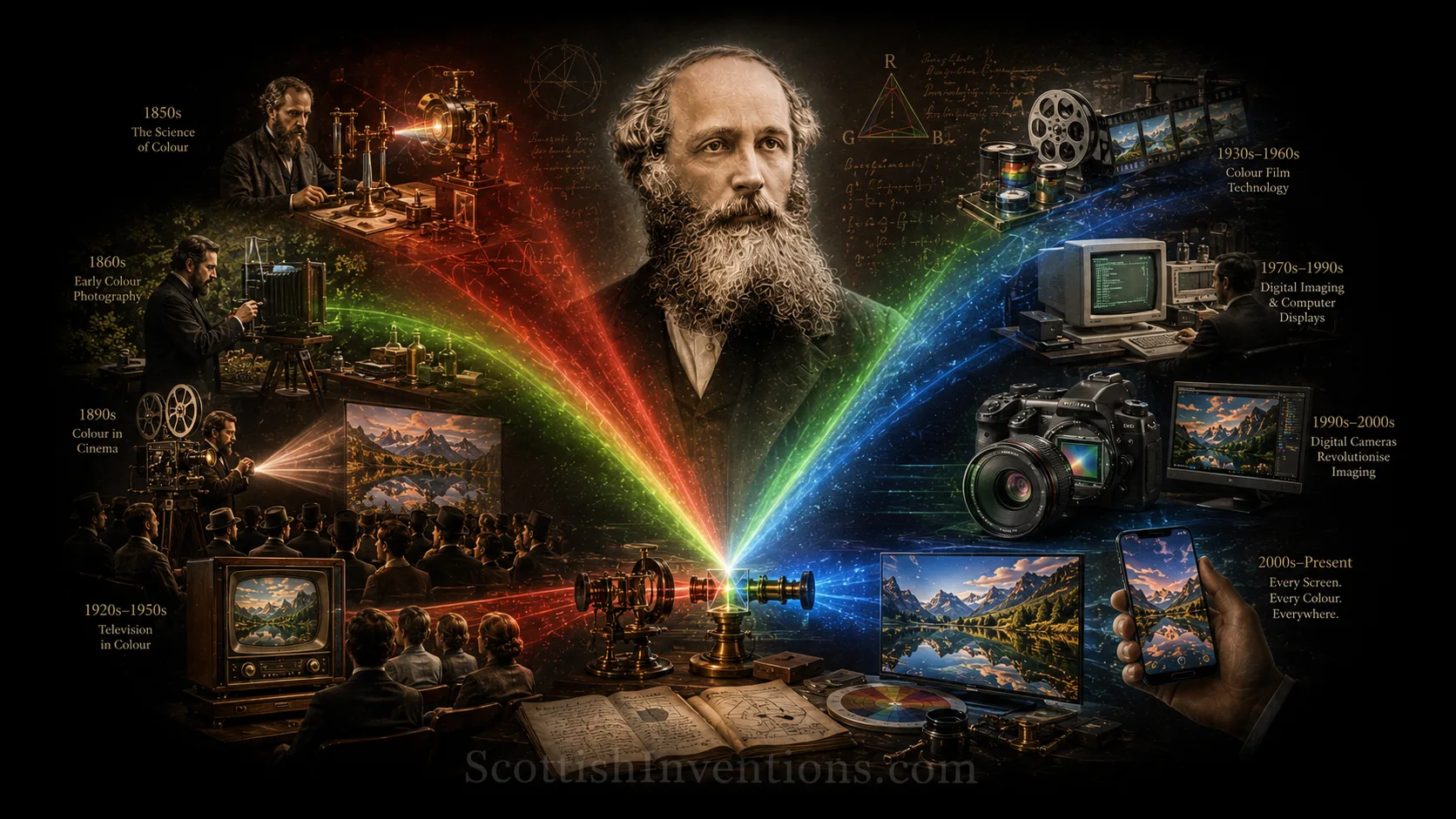
Colour film, colour cinema, colour television, computer monitors and the RGB pixels of digital cameras and smartphones all reproduce colour by analysing a scene into red, green and blue components and recombining them — exactly the analysis-and-synthesis Maxwell demonstrated in 1861. Even the wire transmission of news photographs through the twentieth century used RGB separations on Maxwell's principle. Maxwell's colour work was only one facet of a towering career best remembered for Maxwell's Equations, which unified electricity, magnetism and light and predicted the entire electromagnetic spectrum.
Did You Know?
- 🎀 The world's first colour photograph is a bow of Scottish tartan ribbon, chosen by a proud Scotsman to show off his new colour method.
- 📷 Maxwell didn't take the photo. The actual photographer was Thomas Sutton, who in the same year (1861) patented the first single-lens reflex camera — ancestor of every SLR and DSLR.
- 🟣 The photograph should have been impossible. The plates of 1861 couldn't "see" red, so the red part of the image was secretly captured by invisible ultraviolet light that the red dye happened to reflect — a fact worked out 100 years later by Kodak.
- 📝 Maxwell first described the three-colour trick in 1855, six years before anyone tried it — calling it "a supposed case taken from the art of photography."
- 📱 The same RGB principle Maxwell demonstrated with three magic lanterns is in the screen you are reading this on — every pixel is a tiny red, green and blue light.
- 🏛️ The original 1861 slides live at the Cavendish Laboratory in Cambridge; the colour version everyone shares online is a 1930s VIVEX print, not the 1861 object.
Timeline of Colour Imaging
1831
Maxwell born in Edinburgh
James Clerk Maxwell is born at 14 India Street, Edinburgh, on 13 June 1831, and raised at Glenlair in Dumfries and Galloway.
1855
Three-colour method proposed
Maxwell describes the RGB approach in 'Experiments on Colour, as Perceived by the Eye', read to the Royal Society of Edinburgh — six years before anyone tries it.
1857
Research published
Maxwell's colour-vision paper is published in the Transactions of the Royal Society of Edinburgh.
1858
Colour box
At Marischal College, Aberdeen, Maxwell builds his colour box — a prism instrument that recombines measured RGB spectral bands and underlies the modern chromaticity diagram.
1860
Rumford Medal
Awarded the Royal Society's Rumford Medal 'for his research on the composition of colours'.
17 May 1861
Royal Institution demonstration
Maxwell delivers 'On the Theory of Three Primary Colours' at the Royal Institution, projecting Sutton's three transparencies through red, green and blue filters.
Mid-1861
Sutton photographs the tartan ribbon
Thomas Sutton makes four filtered exposures (blue, green, yellow, red) of a tartan bow on black velvet using liquid colour baths.
1861
Sutton patents the SLR
In the same year, Sutton patents the first single-lens reflex camera — the ancestor of the modern SLR and DSLR.
1868–69
Ducos du Hauron & Cros
Louis Ducos du Hauron and Charles Cros independently develop three-colour photographic processes, refining Maxwell's principle.
1873
Maxwell's Equations
Maxwell publishes A Treatise on Electricity and Magnetism, unifying electricity, magnetism and light.
1907
Autochrome
The Lumière brothers' Autochrome — a mosaic of dyed potato-starch grains acting as millions of tiny additive filters — becomes the first commercially practical colour process.
1909
Prokudin-Gorsky
Sergey Prokudin-Gorsky produces his famous three-filter colour photographs of the Russian Empire — Maxwell's method, with panchromatic plates.
1935
Kodachrome
Kodachrome integral-tripack colour film launches — still an RGB analysis-and-synthesis at heart.
1961
Evans solves the UV mystery
Kodak's Ralph M. Evans recreates the 1861 experiment and proves the red image was captured by reflected ultraviolet light (Scientific American, Nov 1961).
Modern
RGB powers digital imaging
Every screen pixel, every camera sensor, every colour image — Maxwell's principle made universal.
Further Reading
- James Clerk Maxwell, "Experiments on Colour, as Perceived by the Eye," Transactions of the Royal Society of Edinburgh, 1857.
- James Clerk Maxwell, "On the Theory of Compound Colours, and the Relations of the Colours of the Spectrum," Philosophical Transactions of the Royal Society, 1860.
- Thomas Sutton, dispatch on the tartan-ribbon experiment, Photographic Notes No. 125, 15 June 1861.
- Ralph M. Evans, "Maxwell's Color Photograph," Scientific American, Vol. 205, No. 5, November 1961, pp. 120–128.
- Ralph M. Evans & colleagues, "Some Notes on Maxwell's Colour Photograph," Journal of Photographic Science 9 (1961), pp. 243–246.
- Basil Mahon, The Man Who Changed Everything: The Life of James Clerk Maxwell (Wiley, 2003).
- James Mussell & others, Oxford Dictionary of National Biography, "Maxwell, James Clerk."
- James Clerk Maxwell Foundation, 14 India Street, Edinburgh.
- Royal Institution of Great Britain — venue of the 1861 demonstration.
- Cavendish Laboratory, University of Cambridge — where the original 1861 slides are preserved.
- National Museums Scotland and the Science Museum, London.
Frequently Asked Questions
Who invented colour photography?
The scientific foundation of colour photography was established by Scottish physicist James Clerk Maxwell, who proposed the three-colour (red, green and blue) method in 1855 and demonstrated it publicly at the Royal Institution of Great Britain in London on 17 May 1861. The actual photographs of the famous tartan ribbon were taken by the English photographer Thomas Sutton, working from Maxwell's theory. Earlier 'colour' images by Edmond Becquerel (1848) and others existed but could not be permanently fixed, which is why Maxwell's tartan ribbon is correctly described as the first durable colour photograph and the first by the additive RGB method.
Did James Clerk Maxwell take the first colour photograph?
No — Maxwell devised the theory and directed the demonstration but did not personally take the photographs. The exposures were made by Thomas Sutton, a professional photographer (and inventor of the single-lens reflex camera, also in 1861), using three different coloured liquid filters in front of the lens. Maxwell himself never claimed to have taken the picture and explicitly called the result imperfect. The fair framing is a genuine collaboration: Maxwell's theory, Sutton's photography.
Who was Thomas Sutton?
Thomas Sutton (c. 1819–1875) was a Cambridge-educated English photographer who ran a studio in Jersey under royal patronage, co-founded the influential journal Photographic Notes (1856), wrote A Dictionary of Photography (1858), patented a panoramic camera with a water-filled wide-angle lens (1859) and — in 1861, the same year as Maxwell's demonstration — patented the first single-lens reflex (SLR) camera. He took the three filtered photographs of the tartan ribbon that became the world's first durable colour photograph.
What is the world's first colour photograph?
The world's first durable colour photograph is an image of a Scottish tartan ribbon, tied as a bow on black velvet, photographed in mid-1861 by Thomas Sutton through three coloured liquid filters and projected as three superimposed transparencies by James Clerk Maxwell at the Royal Institution in London on 17 May 1861. The original three glass slides survive at the Cavendish Laboratory, University of Cambridge — the laboratory Maxwell himself founded.
Why was the tartan ribbon photographed?
Tartan was an almost perfect subject for an RGB demonstration. It is woven from many differently coloured threads — red, green, blue and yellow among them — making it an ideal test of whether three filtered exposures could recreate a full colour image. The choice was also fittingly Scottish: Maxwell was a proud son of Edinburgh and the Glenlair estate in Dumfries and Galloway. Sutton's own contemporary account (Photographic Notes No. 125, 15 June 1861) describes it simply as 'a bow made of ribbon, striped with various colours', so the patriotic reading is widely shared inference rather than documented fact.
What happened at the Royal Institution in 1861?
On Friday 17 May 1861, Maxwell gave a Friday Evening Discourse titled 'On the Theory of Three Primary Colours' at the Royal Institution of Great Britain on Albemarle Street, London. He explained the trichromatic theory of vision and then projected the three positive transparencies of Sutton's tartan ribbon through three magic lanterns, each fitted with a red, green or blue filter, superimposing the images on a screen. The audience saw a recognisable colour image — the first successful demonstration of the additive RGB method.
How does RGB colour work?
Human vision is trichromatic: the retina has three types of cone cell broadly sensitive to long (red), medium (green) and short (blue) wavelengths. The brain infers colour from the ratio of stimulation across the three. Maxwell realised you do not need to record every wavelength of a scene to reproduce its colour — only how strongly each of the three channels would respond. Photographing through red, green and blue filters captures those three channels separately, and projecting the three images back through the same filters re-adds them as coloured light. Where the original was yellow, the red and green channels are bright and the blue dark, so red+green light overlaps to look yellow. This is additive mixing — the basis of every screen pixel today.
Why is Maxwell important to digital photography?
Every digital camera sensor and every colour screen on Earth uses Maxwell's principle. A camera's Bayer-pattern sensor captures three filtered (RGB) channels at each pixel cluster; a display's pixels emit red, green and blue light in carefully chosen ratios. The 1861 tartan ribbon is the first physical instance of the additive RGB model that now powers smartphones, televisions, computer monitors, cinema projection, AR/VR headsets, professional photography and broadcast video. Maxwell wrote the theory; modern silicon implemented it at scale.
How do televisions and smartphone screens use Maxwell's ideas?
A modern LCD, OLED or microLED pixel is a tiny cluster of red, green and blue emitters. By varying the relative brightness of those three, the display can reproduce essentially any colour the human eye can see — exactly what Maxwell did in 1861 with three magic lanterns. Colour television (electronically pioneered by fellow Scot John Logie Baird in the 1920s and 1930s), colour film, computer monitors and phone screens are all direct technological descendants of the tartan-ribbon demonstration.
Why is the tartan ribbon famous?
Because it is the artefact at the origin of every colour image we see. The 1861 tartan ribbon is the first photograph made by analysing a scene into red, green and blue light and recombining them — the founding experiment for colour film, colour cinema, colour television and digital imaging. The original glass slides are preserved at the Cavendish Laboratory in Cambridge; a set of Maxwell's black-and-white slides is displayed at the James Clerk Maxwell Foundation at 14 India Street, Edinburgh, Maxwell's birthplace; and the familiar full-colour reproduction is a 1930s VIVEX print made by Dr D. A. Spencer from the originals.
Why should the 1861 experiment not have worked?
The wet-collodion plates of 1861 were sensitive mainly to blue and ultraviolet light, barely sensitive to green and effectively blind to red. A truly red-sensitive ('panchromatic') emulsion did not exist for decades. By rights the red-filter photograph should have recorded almost nothing. A 1961 centenary investigation by Kodak's Ralph M. Evans — published in Scientific American (Vol. 205, No. 5, November 1961) — re-ran the experiment and found that the red image was secretly captured by ultraviolet light that many red dyes reflect, passed through Sutton's imperfect ferric-thiocyanate red filter. The theory was right; the demonstration succeeded by a lucky alignment of three independent material quirks.
Is Maxwell's tartan ribbon really the first colour photograph?
Strictly, it is the first durable colour photograph and the first colour image made by the three-colour additive method. Edmond Becquerel produced photochromatic images of the solar spectrum on silver plates in 1848 at the Muséum d'Histoire Naturelle in Paris — the CNRS itself calls these 'the world's first colour photograph' — but they could not be permanently fixed and faded on viewing. Sutton's tartan-ribbon photographs stored the colour information as stable black-and-white silver images, making the record durable and light-fast.