Scottish Inventions · Transport · Card No. 32 of 50
Joseph James Coleman & the Bell-Coleman Refrigeration Machine
The Scottish Engineer Who Froze the World's Food Supply
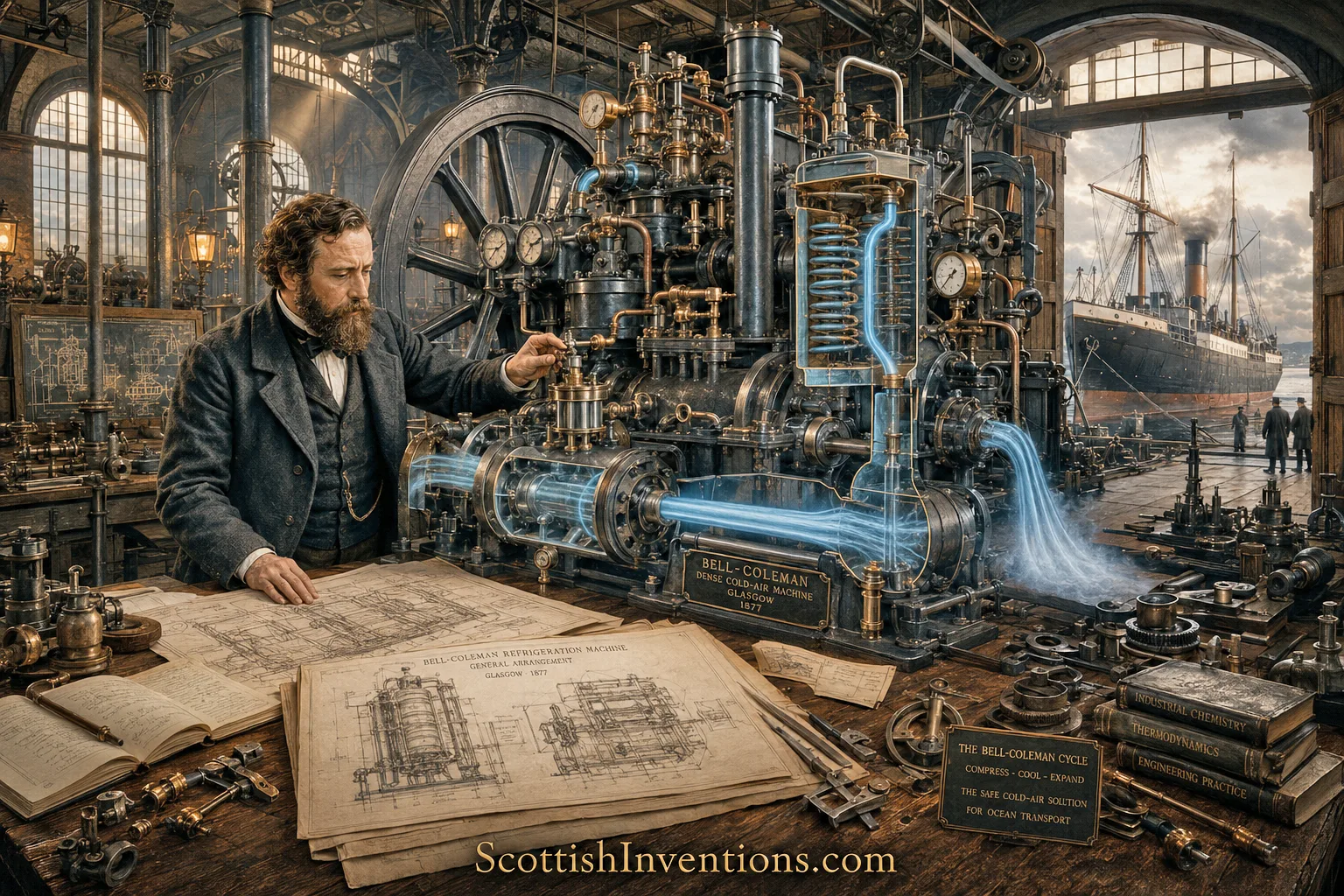
In 1877, in a Glasgow workshop, an industrial chemist trained in the West Lothian oil fields patented a machine that used ordinary air to freeze cargo aboard ships. Within five years, refrigerated meat from New Zealand was landing in London — and the modern global cold chain had begun.
TL;DR
- Joseph James Coleman (1838-1888), an industrial chemist trained in Scotland and working in Glasgow, invented the Bell-Coleman dense cold-air refrigeration machine in 1877 — the first refrigeration technology safe and robust enough to work continuously aboard a ship.
- The machine powered the three commercially decisive refrigerated voyages: SS Circassia (1879, chilled beef to Glasgow), SS Strathleven (1880, frozen meat from Australia to London), and SS Dunedin (1882, launching New Zealand's frozen meat export trade).
- Coleman is the overlooked giant of the story: the machine is often credited to the Bell brothers who commissioned it, but the engineering was his. The refrigeration cycle he perfected is still called the Bell-Coleman cycle.
Key Findings
- The inventor was Joseph James Coleman — English-born but Scottish by career. He trained at James Young's Bathgate oil works, patented the machine in Glasgow, was elected FRSE (proposed by Lord Kelvin), and died at Fern Villa, Bothwell, Lanarkshire.
- The Bell brothers were merchants, not engineers. Henry and James Bell of Glasgow ran the meat-importing firm John Bell & Sons. They financed and commissioned the project; Coleman built it.
- Scotland's refrigeration story begins long before Coleman. William Cullen demonstrated artificial cooling at Glasgow in 1748; James Harrison built the first commercial ice machines in Australia in the 1850s; Alexander Carnegie Kirk built the first practical cold-air machine at Bathgate around 1862.
- The critical insight was safety. Ammonia poisons and ether explodes. Coleman used ordinary air. At sea, surrounded by food, that was essential.
Joseph James Coleman at a glance
- Inventor
- Joseph James Coleman FRSE
- Born
- Boston, Lincolnshire — 4 October 1838
- Died
- Bothwell, Lanarkshire — 18 December 1888
- Invention
- Bell-Coleman dense cold-air refrigeration machine
- Patented
- Glasgow, 1877
- Working fluid
- Ordinary compressed air (safe at sea)
- First ship
- SS Circassia (1879, chilled beef)
- First frozen voyage
- SS Strathleven (1880, Australia to London)
- Landmark voyage
- SS Dunedin (1882, New Zealand to London)
- Legacy
- The modern global cold chain
Early Life: From Lincolnshire to Bathgate to Glasgow
Joseph James Coleman was born on 4 October 1838 in Boston, Lincolnshire, England, the son of a pharmaceutical chemist. His birthplace was English; his career was entirely Scottish. He came to Scotland to train as an industrial chemist, and Scotland is where every significant event of his professional life took place.
His formative years were spent in the industrial heart of the Scottish Enlightenment's second wave — the central Scotland shale-oil industry founded by James "Paraffin" Young at Bathgate, West Lothian. Young's works were a crucible of applied chemistry and mechanical invention in the 1850s and 1860s, and it was there that Coleman developed the industrial-chemistry skills that would define his career. His fellow worker at the same enterprise was Alexander Carnegie Kirk (1830-1892), who built what is generally regarded as the first practical cold-air refrigeration machine around 1862 — a direct forerunner of what Coleman would perfect for shipboard use.
By the 1870s Coleman was operating as an independent industrial chemist, based in Glasgow. This is where his most important work happened. In 1877 he was approached by Henry and James Bell, the Glasgow brothers who ran the meat-importing firm John Bell & Sons. The Bells had been acting as British agents for the American meat exporter Timothy C. Eastman; they wanted a mechanical solution that could keep meat fresh over longer voyages from Australia and beyond. Coleman's cold-air machine was the answer.
The patent was filed in 1877 in Glasgow. The Bell-Coleman Mechanical Refrigeration Company was formed in Glasgow with Coleman as the technical mind behind the machine. In his later years Coleman lived at Fern Villa in Bothwell, Lanarkshire, where he died on 18 December 1888, aged just 50, a Fellow of the Royal Society of Edinburgh and one of the most consequential industrial scientists of the Victorian era.
What Was Wrong With Earlier Refrigeration?
To understand Coleman's achievement, it helps to understand the state of refrigeration technology in the 1870s and why earlier systems had not conquered the sea.
The earliest artificial refrigeration had been demonstrated in Scotland more than a century before. In 1748 the physician-chemist William Cullen (1710-1790) used a vacuum pump to evaporate diethyl ether at the University of Glasgow, producing measurable cooling and a small quantity of ice. Cullen made no practical application, but his demonstration was the conceptual origin of the science.
The next great Scottish figure was James Harrison (1816-1893), born at Bonhill near Renton in Dunbartonshire, who emigrated to Australia in 1837. Harrison built the first commercial vapour-compression ice-making machine in Australia, using ethyl ether as the refrigerant, and is rightly called the "father of refrigeration." In July 1873 he attempted to ship frozen meat from Melbourne to England aboard the sailing ship Norfolk, packing the cargo in an insulated hold surrounded by natural ice. The attempt failed: the ice was exhausted too fast and the cargo was ruined before the ship reached England.
The vapour-compression systems that followed Harrison's — using ammonia, carbon dioxide or methyl ether — were mechanically more sophisticated, but they carried a fatal risk at sea: ammonia is highly toxic and ethyl ether is explosive. A leaking refrigerant pipe in a ship's hold, surrounded by food, was not merely a mechanical problem; it was a public-health catastrophe waiting to happen. French engineer Charles Tellier proved the concept in 1876-77 aboard Le Frigorifique using methyl ether, but the system never achieved wide commercial adoption for exactly this reason.
Coleman's Solution — The Bell-Coleman Cycle
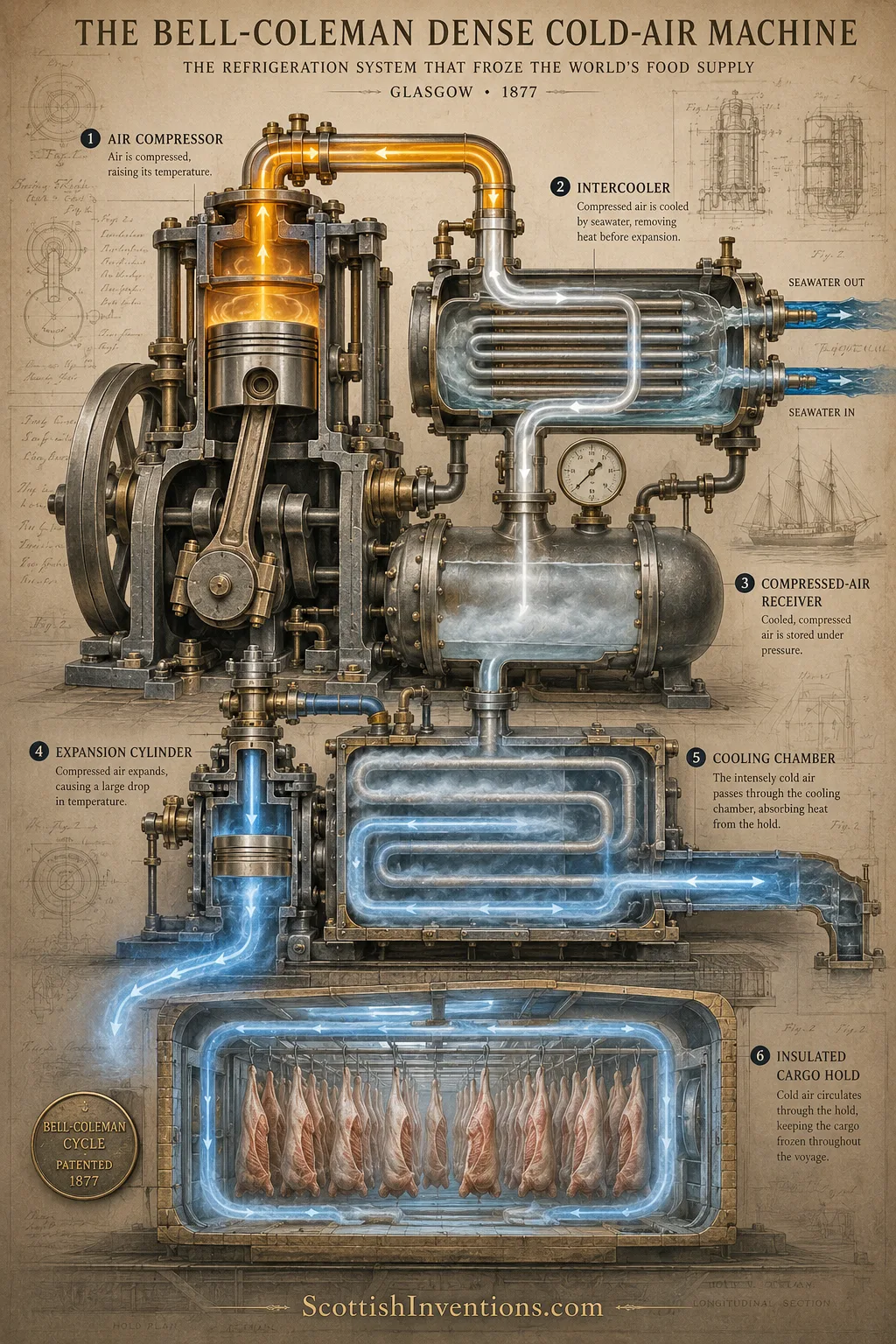
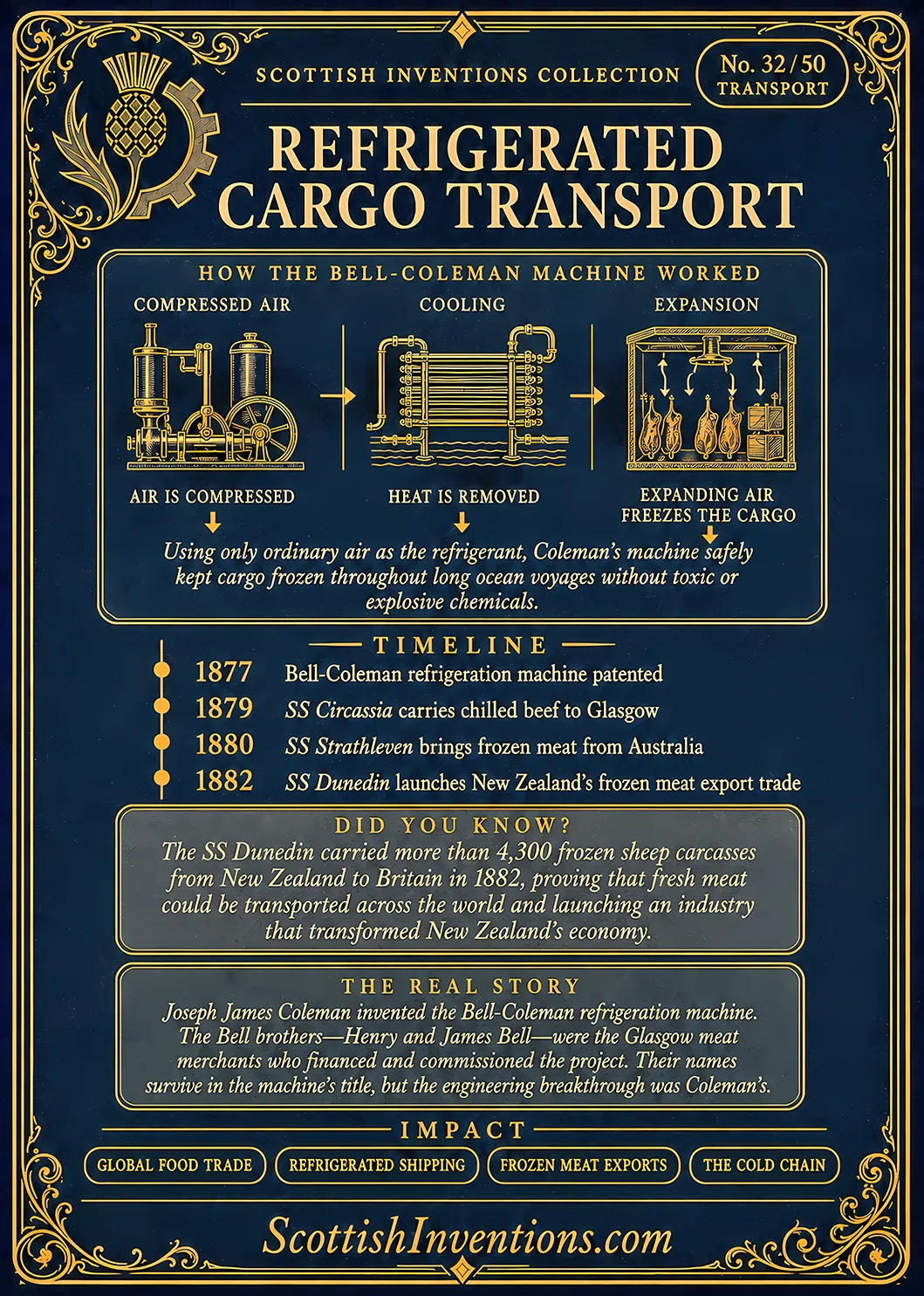
Coleman's solution was elegant in its simplicity. His Bell-Coleman machine used compressed ordinary air as the working fluid. Air cannot poison a cargo; it cannot explode; it is inexhaustible at sea. The principle was thermodynamic: compress air (which heats it), cool it against seawater (the ship had an abundant cold heat-sink), then expand it through a nozzle (which cools it dramatically). The resulting very cold air was circulated through the cargo hold. The machine ran continuously, maintaining the hold temperature regardless of voyage length or weather.
The cold-air cycle itself had been explored by others — notably John Gorrie in Florida (1851) and Kirk at Bathgate (c.1862). Coleman's achievement was to refine Kirk's dense-air variant into a commercially viable, shipboard-scale machine: compact, reliable, and capable of maintaining the sustained low temperatures needed to keep meat frozen rather than merely chilled.
Compress → Cool → Expand
The Bell-Coleman Cycle
01
Compress
Ordinary air is compressed, heating it dramatically.
02
Cool
Hot compressed air is cooled by an abundant supply of seawater.
03
Expand
Expansion drops the temperature far below freezing — cold air circulates through the hold.
The Three Voyages That Changed the World
SS Circassia, 1879
The Anchor Line steamer Circassia was the first ship to be fitted with a Bell-Coleman machine. In 1879 she carried a cargo of chilled beef from the United States to Glasgow, with the hold maintained at approximately 38°F throughout the crossing. A contemporary newspaper report recorded 1,216 quarters of beef and 250 carcasses of mutton landed in perfect condition. The voyage proved the machine worked at sea; the scale of the cargo proved it was commercially viable.
SS Strathleven, 1880
The decisive proof came on the Strathleven, a 2,400-ton vessel chartered by the Melbourne shipping firm McIlwraith McEacharn and fitted with Bell-Coleman machinery for the first frozen-meat shipment from Australia to Britain. She left Melbourne on 6 December 1879 and arrived in London on 2 February 1880 carrying approximately forty tons of frozen beef, lamb and mutton. The cargo arrived in excellent condition and sold quickly at around five pence per pound. The Times covered the arrival; the trade recognised at once what it meant.
SS Dunedin, 1882
The voyage that truly transformed the world. A sailing ship refitted with a Bell-Coleman plant, the Dunedin carried the first frozen-meat cargo from New Zealand to London. She sailed on 15 February 1882 with 4,331 mutton carcasses, 598 lamb, 22 pig carcasses, 250 kegs of butter and 2,226 sheep tongues, arriving in London on 26 May after a 98-day voyage with just one carcass condemned. The Times called it "such a triumph over physical difficulties, as would have been incredible, even unimaginable, a very few days ago."
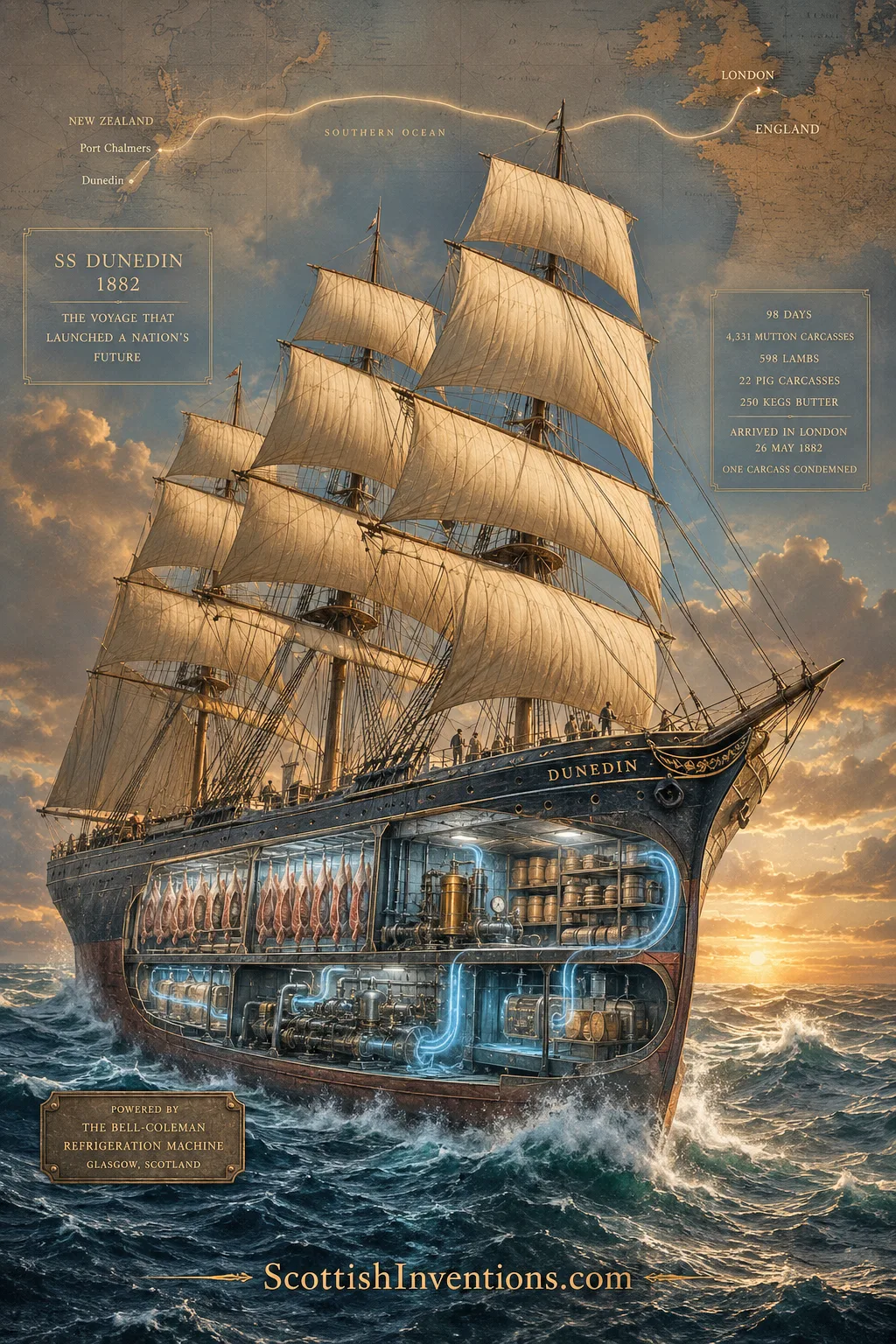
98
Days at sea (Dunedin)
4,331
Mutton carcasses landed
1
Carcass condemned
What Coleman's Machine Made Possible
Before mechanical refrigeration aboard ships, the world's food trade was constrained to preserved, salted, tinned or dried goods, or to live animals (which lost weight and condition on long voyages). Fresh meat was a luxury available only locally. The British working class ate very little beef; most families could not afford it.
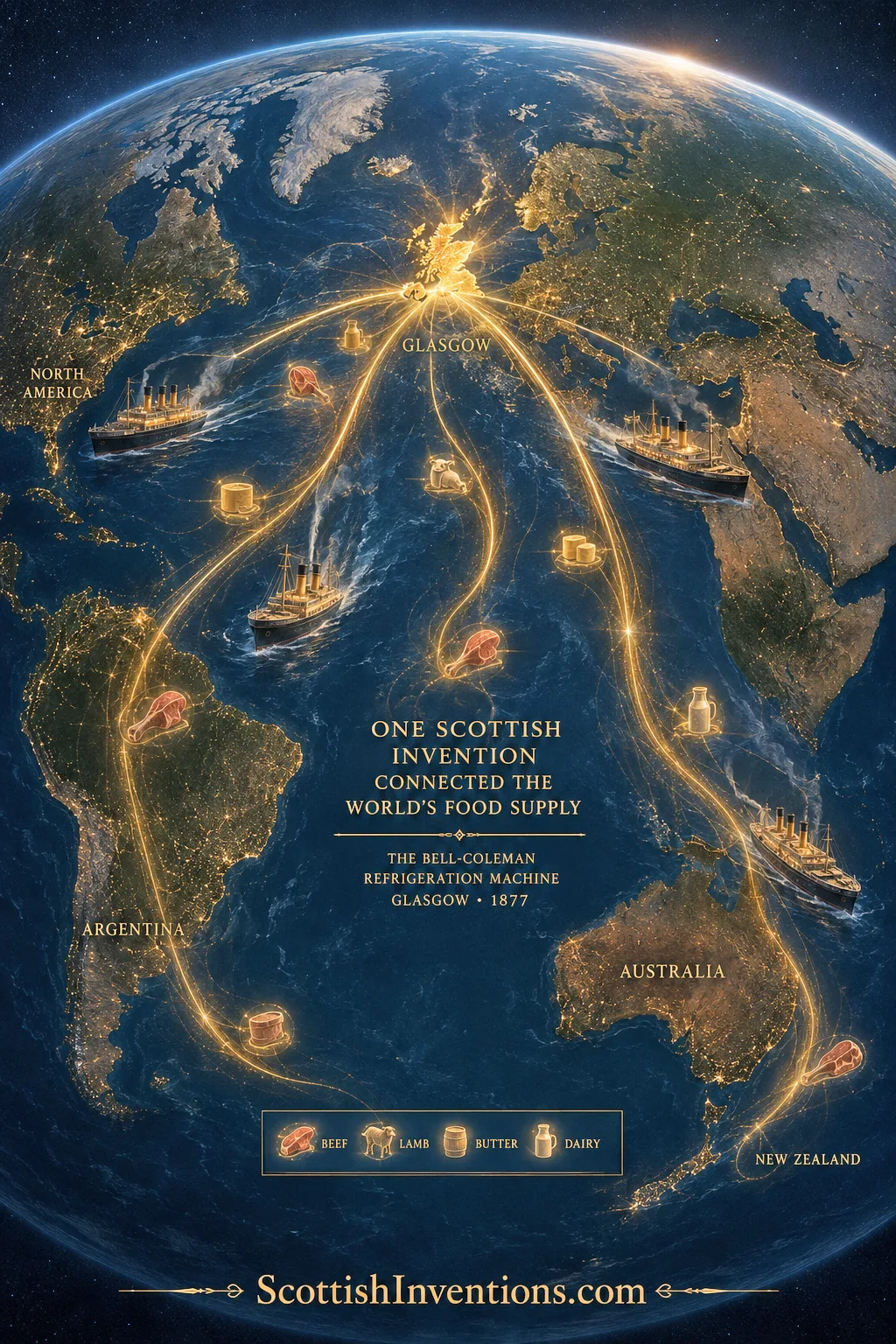
Coleman's machine broke the geographic constraint entirely. Once frozen meat could travel from Australia or New Zealand or the Americas without spoiling, the economics of food changed for tens of millions of people. From the 1880s onward, the price of beef and mutton in Britain fell dramatically as antipodean supply entered the market. By the early 20th century the refrigerated ship — the "reefer" — was a standard vessel type, and the global cold chain that today moves roughly 1.6 billion tonnes of temperature-sensitive cargo per year had begun.
The agricultural transformation was equally profound. New Zealand, Australia and Argentina built entire export economies around refrigerated meat. The Bell-Coleman machine was the physical foundation of that trade.
The Bell-Coleman Company & Coleman's Recognition
The Bell-Coleman Mechanical Refrigeration Company grew rapidly after the Circassia and Strathleven voyages, fitting machines to ships across the major shipping lines. Coleman was elected a Fellow of the Royal Society of Edinburgh in December 1886, with his proposers including Lord Kelvin — testimony to the genuine scientific standing of his engineering work. He published a definitive technical paper on "Air Refrigerating Machinery" the same year. He died on 18 December 1888 at his home, Fern Villa, Bothwell, Lanarkshire, aged just 50, before seeing the full global transformation his invention had set in motion.
A point of naming honesty: some popular accounts describe "Henry and John Bell" as the inventors, or conflate the Bells with Coleman. The brothers who ran John Bell & Sons were Henry and James Bell — meat merchants and entrepreneurs, not engineers. Coleman's name belongs first in this story. There is also no connection whatsoever between this episode and the separate, famous Henry Bell (1767-1830) of Torphichen, who pioneered the Clyde steamboat with the PS Comet in 1812.
"Such a triumph over physical difficulties, as would have been incredible, even unimaginable, a very few days ago."
The Broader Scottish Context
Scotland's contribution to refrigeration is a continuous thread. William Cullen (Glasgow, 1748) established the theoretical possibility. James Harrison (Dunbartonshire-born, working in Australia) built the first commercial vapour-compression machines. Alexander Carnegie Kirk (Bathgate shale-oil works) produced the first practical cold-air machine. Joseph James Coleman — English by birth, Scottish by career — perfected that cold-air design for global commercial shipping at Glasgow in 1877, and died in Lanarkshire in 1888. The Scottish central belt industrial ecosystem — Young's oil works, the Glasgow engineering trade, the Clyde shipbuilders — was the incubator for the technology that put cheap food on tables around the world.
The framing here is the same as for other figures in this collection: Peter Higgs was born in Newcastle but spent his entire career at Edinburgh and is claimed by Scotland with justification; Sandford Fleming was born in Kirkcaldy but invented Standard Time in Canada. Coleman was born in Lincolnshire but invented the Bell-Coleman machine in Glasgow, lived in Lanarkshire, and died a Fellow of the Royal Society of Edinburgh.
Timeline
1748
Scotland's refrigeration story begins
William Cullen demonstrates artificial refrigeration at the University of Glasgow, freezing water using ether evaporation — the conceptual origin of the science.
4 October 1838
Born in Boston, Lincolnshire
Joseph James Coleman is born in Boston, Lincolnshire, England, the son of a pharmaceutical chemist. His birthplace was English; his career was entirely Scottish.
1850s-60s
Trained at Young's Bathgate works
Coleman is trained as an industrial chemist at James 'Paraffin' Young's shale-oil works at Bathgate, West Lothian, alongside Alexander Carnegie Kirk.
c.1862
First practical cold-air machine
Alexander Carnegie Kirk builds the first practical cold-air refrigeration machine at Bathgate — a direct forerunner of what Coleman would perfect for ships.
1873
Harrison's failed Norfolk voyage
Scottish-born James Harrison attempts to ship frozen meat from Melbourne to England aboard the Norfolk using natural ice; the ice runs out and the cargo is ruined.
1877
Bell-Coleman machine patented
Coleman patents his dense cold-air refrigeration machine in Glasgow on commission from the meat-importing firm John Bell & Sons. The Bell-Coleman Mechanical Refrigeration Company is formed.
1879
SS Circassia carries chilled beef
The Anchor Line steamer SS Circassia becomes the first ship fitted with a Bell-Coleman machine, carrying chilled American beef into Glasgow at about 38 degrees F.
2 February 1880
SS Strathleven arrives in London
The Strathleven completes the first frozen-meat voyage from Australia to Britain — about 40 tonnes of beef and mutton, sold in London at around five pence per pound.
26 May 1882
SS Dunedin lands in London
The Dunedin arrives in London after a 98-day voyage from Port Chalmers, New Zealand, with 4,331 mutton carcasses and only one condemned — launching New Zealand's export meat industry.
1886
Fellow of the Royal Society of Edinburgh
Coleman is elected FRSE, proposed by Lord Kelvin, and publishes his definitive paper on 'Air Refrigerating Machinery'.
18 December 1888
Died at Fern Villa, Bothwell
Coleman dies at his home in Bothwell, Lanarkshire, aged just 50. The refrigeration cycle he perfected remains known in engineering as the Bell-Coleman cycle.
Today
The global cold chain
The industry Coleman set in motion now moves around 1.6 billion tonnes of temperature-sensitive cargo per year and underpins global food security.
Key Takeaways
Coleman's Three Enduring Contributions
- A safe refrigerant for ships — using ordinary air instead of toxic ammonia or explosive ether, Coleman made refrigeration compatible with cargo, crew and food.
- A continuous, self-renewing cycle — where Harrison's 1873 ice-hold attempt failed as its ice melted, Coleman's machine ran indefinitely on air and seawater.
- The birth of the global cold chain — from the Dunedin's 1882 voyage flow refrigerated ships, warehouses, containers, trucks and supermarket displays worldwide.
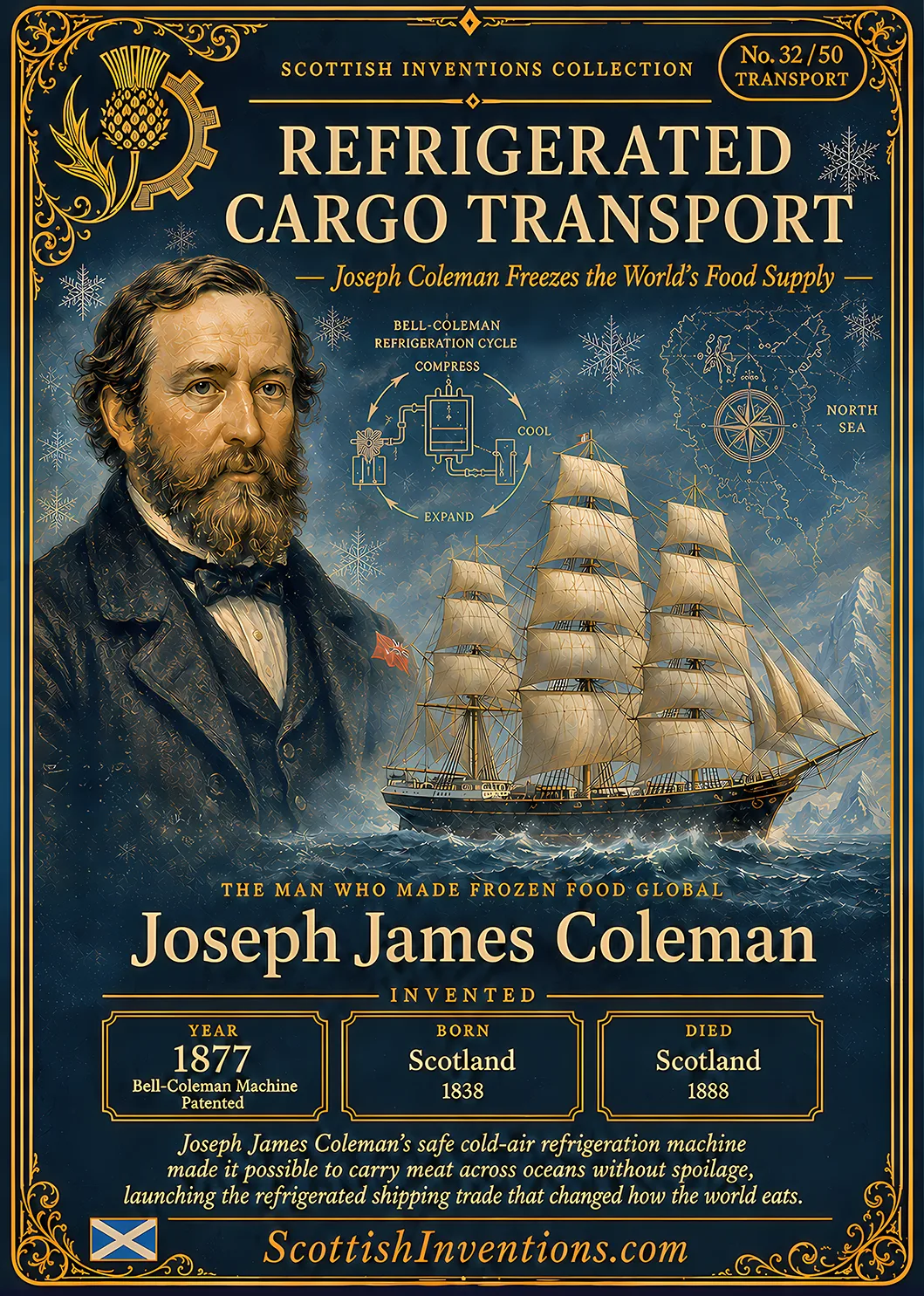
The Refrigerated Cargo Transport trading card
Card No. 32 of 50 in the Scottish Inventions Collection.
Frequently Asked Questions
- Who was Joseph James Coleman?
- Joseph James Coleman (1838-1888) was an industrial chemist born in Boston, Lincolnshire, England, whose entire professional life was spent in Scotland. He trained at James Young's Bathgate oil works, worked in Glasgow, invented the Bell-Coleman dense cold-air refrigeration machine in 1877, and died at Fern Villa, Bothwell, Lanarkshire, a Fellow of the Royal Society of Edinburgh proposed for membership by Lord Kelvin.
- What was the Bell-Coleman refrigeration machine?
- The Bell-Coleman machine was a dense cold-air refrigeration system patented in Glasgow in 1877 by Joseph James Coleman on commission from the Glasgow meat merchants Henry and James Bell. Instead of ammonia, ether or CO2, it used ordinary compressed air as its refrigerant, making it uniquely safe for refrigerating cargo aboard ships. It was the first refrigeration technology robust enough to keep meat frozen through months-long ocean voyages.
- How did the Bell-Coleman cycle work?
- The Bell-Coleman cycle compresses air (raising its temperature), cools the compressed air against seawater in an intercooler, then expands it through an expansion cylinder. Expanding air cools dramatically, producing a stream of very cold air that is circulated through the insulated cargo hold to freeze the cargo. The cycle runs continuously and requires no consumable refrigerant.
- Why was compressed air safer than ammonia at sea?
- Ammonia is highly toxic and ethyl ether is explosive. A leaking refrigerant pipe in a ship's hold, surrounded by food and confined crew, could poison a cargo or ignite catastrophically. Air cannot poison food, cannot explode, and is freely available at sea. That safety advantage made Coleman's air machine the only refrigeration technology of its generation truly fit for ocean transport.
- Why was the SS Dunedin important?
- The SS Dunedin was a sailing ship fitted with a Bell-Coleman refrigeration plant that in 1882 made the first successful shipment of frozen meat from New Zealand to Britain. She sailed from Port Chalmers on 15 February 1882 with 4,331 mutton carcasses and arrived in London on 26 May after a 98-day voyage with only one carcass condemned. The voyage launched New Zealand's export meat industry.
- What was the first successful refrigerated voyage?
- The SS Circassia, an Anchor Line steamer fitted with a Bell-Coleman machine, was the first ship to carry a chilled cargo across the Atlantic, landing beef in Glasgow in 1879 with the hold held at about 38 degrees Fahrenheit. The SS Strathleven followed in 1880 with the first frozen-meat voyage from Australia to London, and the SS Dunedin completed the trio in 1882.
- Why was Glasgow important to refrigeration?
- Glasgow and its West Lothian hinterland were the incubator of practical mechanical refrigeration. William Cullen demonstrated artificial cooling at the University of Glasgow in 1748; Alexander Carnegie Kirk built the first practical cold-air machine at James Young's Bathgate shale-oil works around 1862; and Joseph James Coleman perfected the shipboard cold-air machine in Glasgow in 1877. The Clyde shipbuilders then fitted those machines to ocean-going vessels.
- What is the modern cold chain?
- The modern cold chain is the unbroken chain of refrigerated storage and transport — refrigerated warehouses, containers, ships, trucks and supermarket displays — that keeps perishable food and medicines at controlled low temperatures from producer to consumer. Today it moves around 1.6 billion tonnes of temperature-sensitive cargo per year, and its practical starting point is the Bell-Coleman shipboard refrigeration machine of 1877.
- Why is Joseph James Coleman considered a Scottish inventor?
- Coleman was born in Lincolnshire but spent his entire working life in Scotland. He trained at James Young's Bathgate works, invented and patented the Bell-Coleman machine in Glasgow in 1877, ran the Bell-Coleman Mechanical Refrigeration Company from Glasgow, lived at Fern Villa, Bothwell, in Lanarkshire, was elected a Fellow of the Royal Society of Edinburgh, and died in Scotland in 1888.
- How did refrigeration change global food supplies?
- Before Coleman's machine, world food trade was limited to salted, tinned, dried or preserved goods, or live animals shipped at great cost. Once frozen meat could travel from Australia, New Zealand and the Americas without spoiling, meat prices in Britain fell dramatically and the diets of tens of millions of working people improved. Whole economies — most obviously New Zealand — were built on refrigerated exports.
Legacy
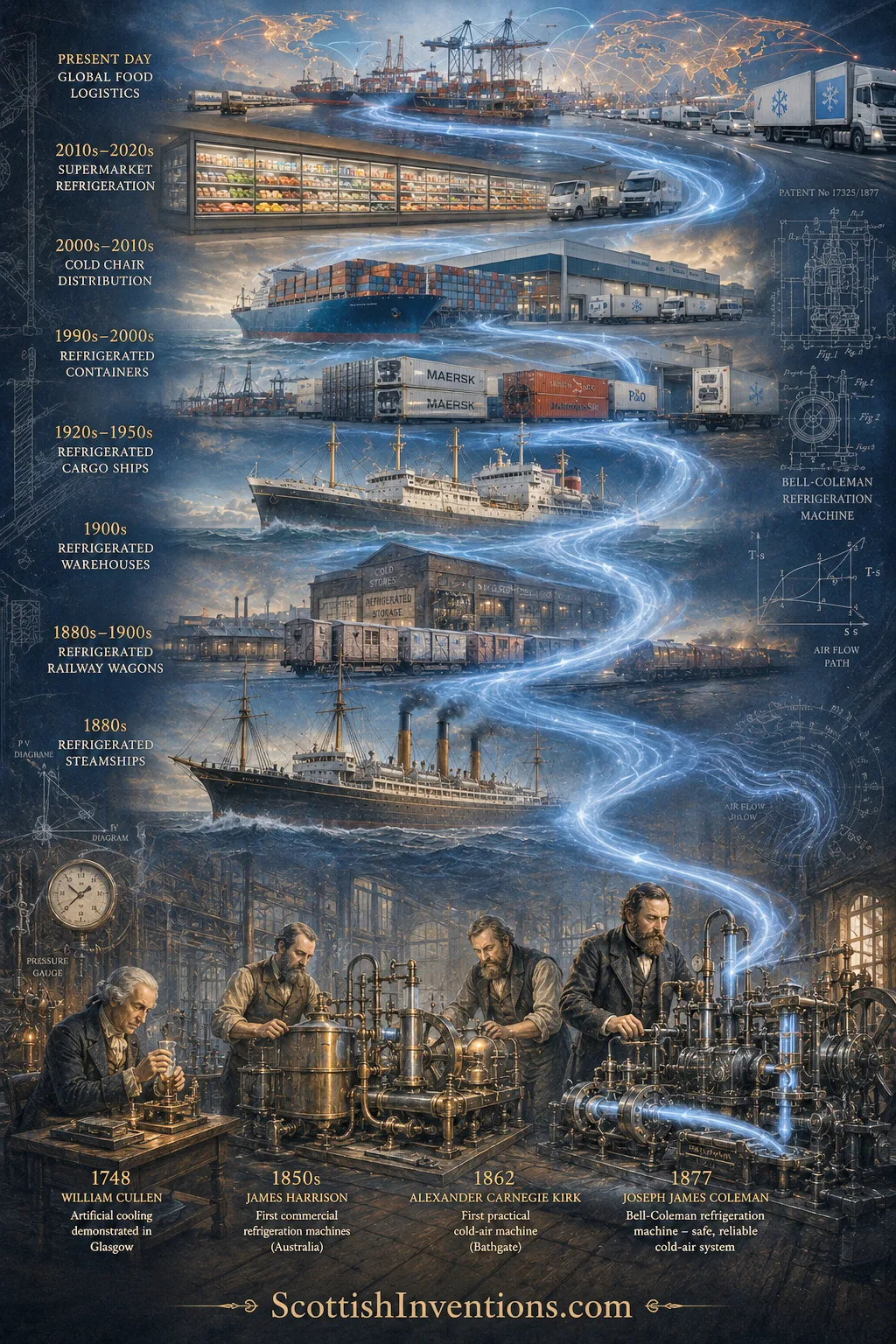
The Bell-Coleman machine's direct descendants — vapour-compression reefer ships, containerised refrigeration, refrigerated railway wagons, distribution warehouses and supermarket chillers — carry Coleman's fingerprints. The physical hardware evolved, but the principle of a continuous mechanical refrigeration cycle able to operate wherever cargo travels came out of Glasgow in 1877.
The engineering lineage is equally clear. The Bell-Coleman cycle is still catalogued as the reference open-cycle air-refrigeration system in thermodynamics textbooks, and reverse-Brayton (air-cycle) refrigeration remains in service today for aircraft air-conditioning and cryogenics — a technology that began, in earnest commercial form, with Joseph James Coleman's 1877 patent.
Continue Exploring
Continue Exploring Scottish Engineering Innovation
From refrigeration and steam power to bridges, ships and industrial machinery, Scottish engineers transformed the modern world. Discover the remarkable inventions that changed global industry, transport and everyday life.
Explore More Scottish Engineering InventionsSources
- Joseph James Coleman, "Air Refrigerating Machinery" (1886).
- Obituary of Joseph James Coleman, Transactions of the Chemical Society, 1889.
- Royal Society of Edinburgh — Fellowship record for Joseph James Coleman (elected 1886, proposed by Lord Kelvin).
- Critchell & Raymond, A History of the Frozen Meat Trade (1912).
- Australian Dictionary of Biography — James Harrison; entries on the Strathleven and Dunedin voyages.
- Grace's Guide to British Industrial History — Bell-Coleman Mechanical Refrigeration Company.
- Contemporary reports in The Times on the arrivals of the SS Strathleven (1880) and SS Dunedin (1882).