Scottish Inventions · Engineering
James Beaumont Neilson and the Hot Blast Process
How a Glasgow gas engineer's 1828 patent slashed fuel use, transformed iron production and powered the Industrial Revolution.
Introduction
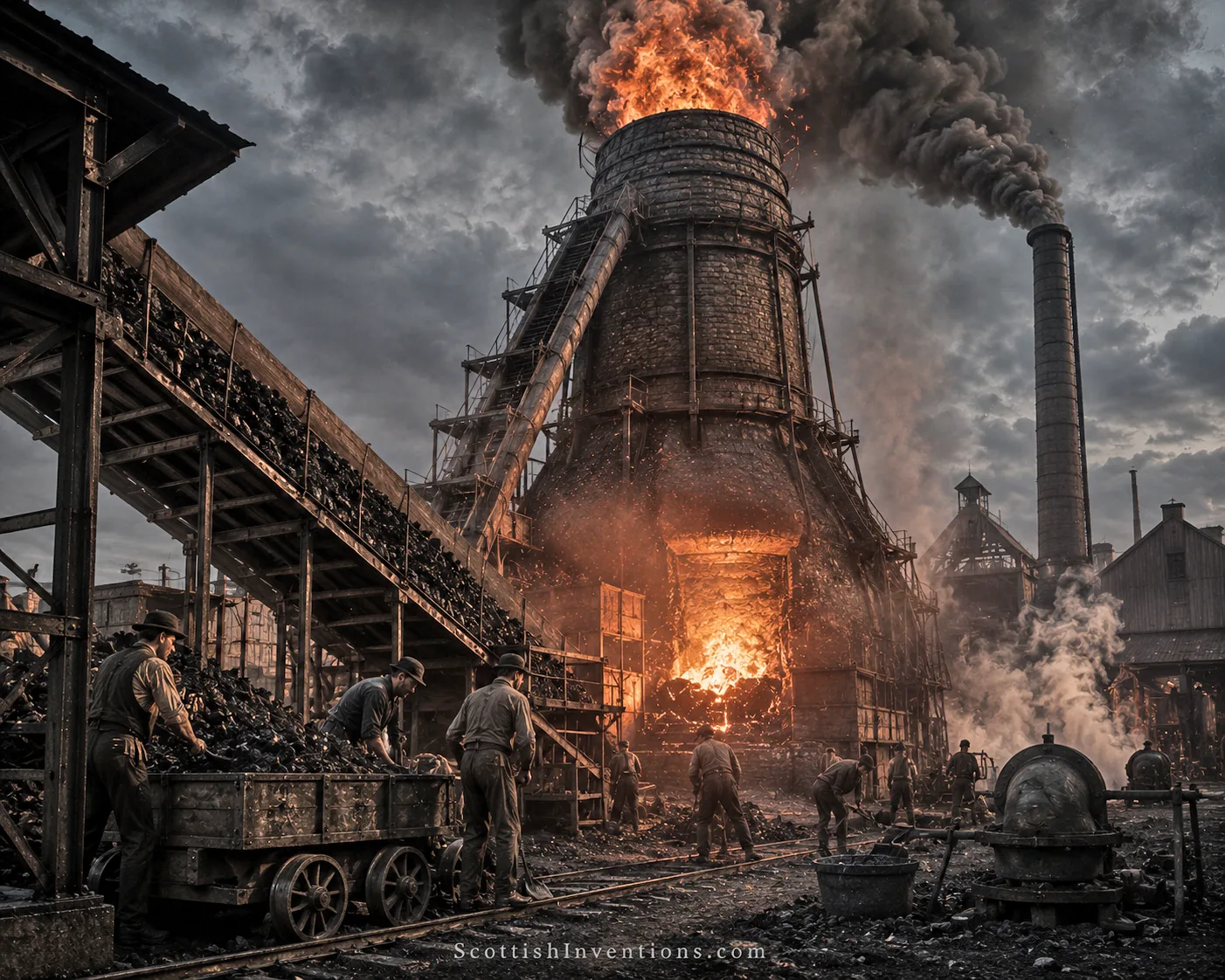
In the early decades of the 19th century, Britain's iron industry was throttled by a single problem: fuel. Smelting iron demanded enormous quantities of charcoal and then coke to reach the temperatures needed to draw metal from ore. Then, in 1828, a self-taught Scottish engineer named James Beaumont Neilson introduced a deceptively simple idea — preheat the air before it enters the furnace — and changed iron production forever.
Neilson's Hot Blast Process cut fuel consumption by 30–50% or more, raised furnace temperatures, boosted output and helped fuel the expansion of railways, shipbuilding and heavy engineering that defined the Victorian age. It is one of the most important and under-appreciated contributions of the Scottish Industrial Revolution.
Key Takeaways
- James Beaumont Neilson patented the Hot Blast Process in 1828 in Glasgow.
- Preheating the blast air cut fuel use in iron furnaces by 30–50% or more.
- The process let furnaces run hotter, produce more iron and even burn cheaper raw coal.
- It powered railways, bridges, shipbuilding and Victorian heavy industry.
- Every modern blast furnace still preheats its air — a direct descendant of Neilson's 1828 idea.
The Challenge of Iron Smelting Before 1828
Iron had been produced in blast furnaces for centuries. Air was blown into the furnace to raise the temperature high enough to separate iron from ore. For most of that history this "blast" was cold air drawn straight from the atmosphere. The process worked — but it was wasteful. Much of the heat generated inside the furnace was lost up the chimney, and enormous quantities of fuel were required to maintain smelting temperatures.
By the early 19th century, Britain's iron industry was racing to meet demand from canals, bridges and early machinery. Coke had largely replaced charcoal, but consumption remained punishing. Ironmasters constantly hunted ways to cut costs, and many believed further major improvements were unlikely — until Neilson proved otherwise.
James Beaumont Neilson: Engineer and Innovator
James Beaumont Neilson was born in 1792 in Shettleston, near Glasgow. He came from a modest background and received little formal education. Like many Scottish engineers of his generation, he was largely self-taught, gaining practical knowledge through work and experimentation.

Neilson began his career in the gas industry, eventually rising to manage the Glasgow Gas Works. His daily work with gases, combustion and heat would prove decisive. In the mid-1820s he turned his attention to iron and wondered whether preheating the air blast could improve furnace performance. At the time the idea seemed radical: most ironmasters assumed cold air was necessary, even beneficial.
Undeterred, Neilson conducted small-scale experiments and discovered that heating the air before it entered the furnace produced remarkable results. The hotter blast raised internal furnace temperatures more efficiently, allowing iron to be smelted with significantly less fuel.
The Invention of the Hot Blast Process
In 1828, Neilson patented his Hot Blast Process. The concept was elegantly simple. Instead of blowing cold air into the furnace, the air was first passed through a heating apparatus — initially a simple iron pipe or chamber heated by waste gases from the furnace itself. The preheated air entered the furnace at much higher temperatures than before.
The results were dramatic. Neilson's early trials showed that fuel consumption could be reduced by 30 to 50 percent or more, depending on conditions. Furnace output rose because higher temperatures allowed more ore to be processed in the same period, and the process even made it possible to use raw coal in some furnaces rather than more expensive coke.
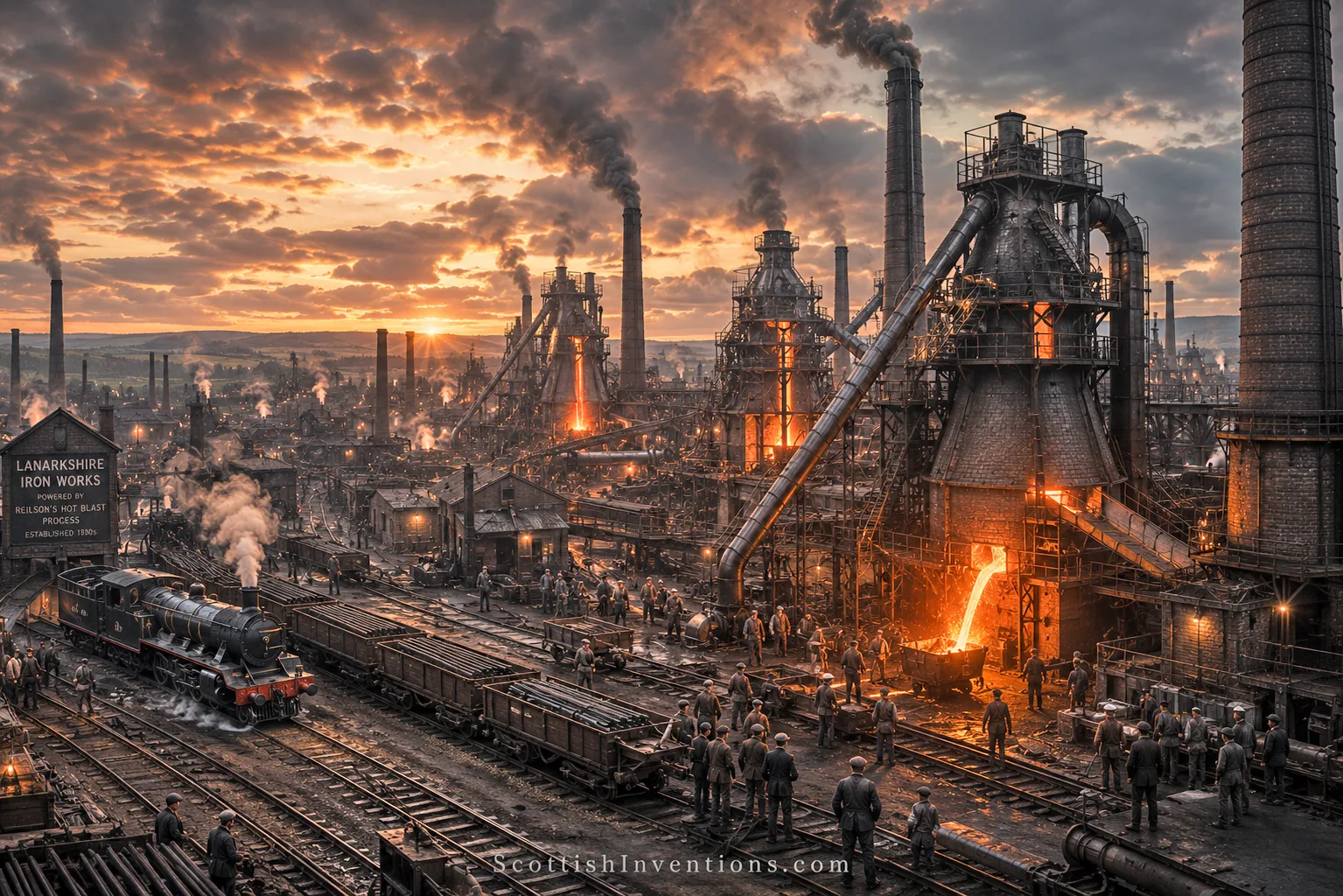
Neilson's patent covered the principle of heating the blast air. He worked with ironmasters to install the system, though he met considerable resistance. Experienced ironworkers were sceptical of the new method and reluctant to abandon tradition; some feared the hotter blast would damage furnace linings or yield inferior iron. The results spoke for themselves: furnaces fitted with hot blast produced more iron at lower cost, and within a few years the process was being adopted across the industry.
How the Hot Blast Process Worked
The Hot Blast Process recovered heat that had previously been wasted up the chimney, and used it to preheat the incoming air. Five linked stages turned a small change in air temperature into a revolution in efficiency.
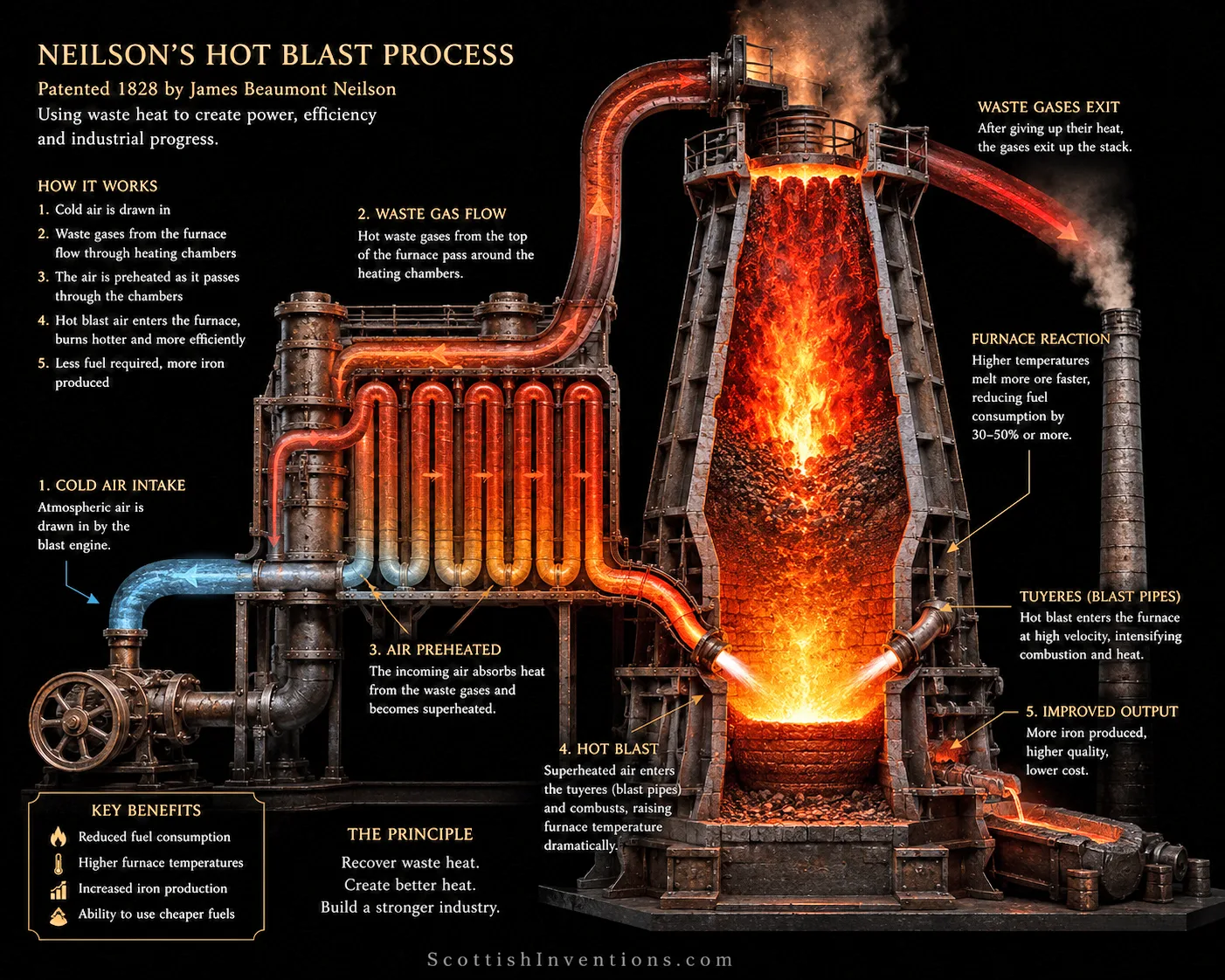
- Cold air intake. Atmospheric air was drawn in by a blast engine — the same engine that previously fed cold air straight to the tuyeres.
- Waste-gas capture. Hot gases rising from the top of the furnace were diverted around a set of heating chambers instead of being lost to the sky.
- Air preheated. The incoming air passed through those chambers, absorbing heat from the waste gases and arriving at the furnace already superheated.
- Hot blast injection. The preheated air entered the furnace through the tuyeres (blast pipes), combusting more violently and lifting internal temperatures far above what cold air could produce.
- Improved output. Higher temperatures melted more ore faster, slashed fuel use, and let furnaces accept cheaper fuels such as raw coal. Less coke. More iron. Lower cost.
Industrial Impact: Railways, Bridges and Shipbuilding
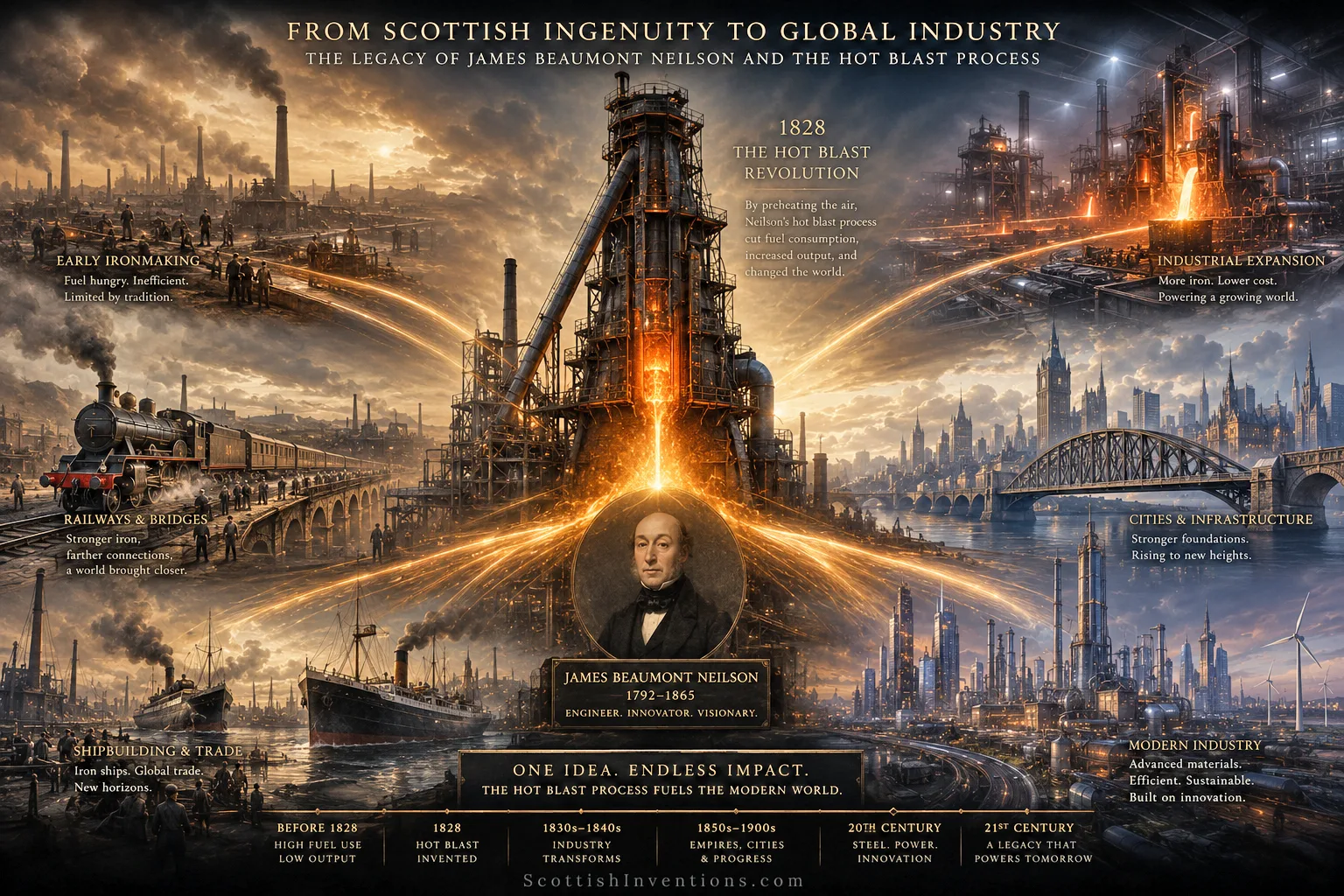
The Hot Blast Process arrived at the precise moment Britain needed it. Railways were spreading across the country, demanding vast tonnages of iron for rails, locomotives and bridges. Shipbuilding, machinery and construction all wanted more iron at lower prices. Neilson's process helped meet that surging demand without runaway cost inflation.
Scotland benefited enormously. The Scottish iron industry expanded rapidly after 1828, with major centres developing around Glasgow and in Lanarkshire. Hot blast helped Scottish iron compete with — and often undercut — production from other regions, turning Lanarkshire into one of the great iron heartlands of Europe.
Global Influence: Europe, America and Beyond
Although Neilson held a patent, enforcing it proved difficult and some ironmasters adopted the process without licence, leading to long legal battles. Over time his contribution was recognised, and by mid-century virtually all blast furnaces in Britain — and many across Europe and America — used some form of hot blast.
As iron and later steel became the structural materials of the modern world, Neilson's idea travelled with them. It joins a roster of Scottish breakthroughs — James Watt's improvements to the steam engine, the Carron Ironworks carronade, and James Young's first oil refinery — that quietly built the industrial world.
Timeline of the Hot Blast Process
1792
Born in Glasgow
James Beaumont Neilson is born in Shettleston, near Glasgow.
1817
Glasgow Gas Works
Joins the new Glasgow Gas Works, eventually becoming manager and gaining deep expertise in combustion and heat.
1828
Hot Blast patented
Neilson files his patent for preheating blast-furnace air — the Hot Blast Process.
1830s
Rapid adoption
Scottish and Welsh ironmasters adopt the process, then spread it to England, Europe and America.
1865
Death
Neilson dies, having lived to see his invention transform global iron production.
Today
Living legacy
Every modern blast furnace preheats its air — the Neilson principle still drives the global steel industry.
Legacy and Lasting Significance
Today, the Hot Blast Process is taken for granted in iron and steel production. Modern blast furnaces use highly sophisticated regenerative stoves to preheat air to extreme temperatures, building directly on Neilson's original insight. The principle of recovering and reusing waste heat remains central to efficient industrial processes across many sectors — from steelmaking to power generation and even hydrogen production.
Neilson's achievement also illustrates an important truth about technological progress: the greatest advances do not always require entirely new inventions. Sometimes the biggest leaps come from rethinking how existing technology is used. By questioning the assumption that blast air should be cold, Neilson opened the door to a more efficient industrial future.
Did You Know?
Patented in 1828
Neilson's hot blast patent transformed iron smelting almost overnight.
Up to 50% less fuel
Preheating the blast air cut coal and coke consumption dramatically.
Self-taught Scot
Neilson started as a colliery engineman and rose to manage the Glasgow Gas Works.
Powered the railway age
Cheap Scottish iron built rails, locomotives, bridges and ships.
Made Scotland an iron giant
Lanarkshire became one of the world's leading iron-producing regions.
Still used today
Modern blast-furnace stoves are direct descendants of Neilson's principle.
Frequently Asked Questions
▸Who was James Beaumont Neilson?
James Beaumont Neilson (1792–1865) was a self-taught Scottish engineer from Glasgow who managed the Glasgow Gas Works and, in 1828, patented the Hot Blast Process — one of the most important fuel-saving innovations of the Industrial Revolution.
▸What was the Hot Blast Process?
The Hot Blast Process preheated the air blown into a blast furnace before combustion. Instead of using cold atmospheric air, Neilson passed it through heated chambers (often warmed by the furnace's own waste gases) so it entered the furnace already hot, dramatically improving combustion efficiency.
▸When was the Hot Blast Process invented?
James Beaumont Neilson patented the Hot Blast Process in 1828 in Glasgow. It was adopted rapidly across Scotland and Wales in the 1830s and became standard practice in the global iron industry by the mid-19th century.
▸Why was the Hot Blast Process important?
It cut fuel consumption in blast furnaces by 30–50% or more, raised furnace temperatures, increased iron output, and made it possible to use cheaper raw coal instead of coke. This drastically lowered the cost of iron and powered the expansion of railways, shipbuilding and heavy engineering during the Industrial Revolution.
▸How did the Hot Blast Process reduce fuel consumption?
By preheating the blast air using waste heat recovered from the furnace itself, the fuel inside the furnace no longer had to warm the incoming air. Combustion was hotter and more complete, so less coal or coke was needed to reach smelting temperatures.
▸How did the Hot Blast Process impact the Industrial Revolution?
Cheaper, more abundant iron underpinned the rail boom, steamship construction, bridges, machinery and urban infrastructure of the Victorian age. Scotland's iron industry — especially around Lanarkshire and Glasgow — expanded rapidly on the back of Neilson's invention.
▸Where was James Beaumont Neilson from?
Neilson was born in 1792 in Shettleston, Glasgow. He spent most of his career in the Scottish gas industry before his hot blast work transformed iron production worldwide.
▸Is the Hot Blast Process still used today?
Yes. Every modern blast furnace still preheats its air using huge regenerative stoves — direct descendants of Neilson's 1828 idea. The principle of recovering and reusing waste heat remains central to efficient iron, steel and heavy-industrial production.
Conclusion
James Beaumont Neilson's Hot Blast Process is one of the quietest and most consequential inventions of the Industrial Revolution. By preheating the air before it entered the blast furnace, a self-taught Glasgow engineer cut fuel use almost in half, raised iron output and helped lay the metallurgical foundations of the modern world. Every train that ever rolled on iron rails, every iron-hulled steamship, every steel-girdered bridge and skyscraper owes something to that 1828 patent — a quietly Scottish answer to a global question of fuel, fire and progress.