Scottish Inventions · Science
James Dewar & the Vacuum Flask: How a Scotsman Chased the Cold and Invented the Thermos
The honest, evidence-led story of Sir James Dewar — the Kincardine chemist whose vacuum flask defeated heat, liquefied hydrogen, and quietly became the Thermos that now lives in every kitchen, laboratory, MRI scanner and rocket.
Introduction
In the basement of the Royal Institution on a winter evening in December 1892, a bearded Scottish chemist named James Dewar snapped the tip off a small glass vessel of liquid oxygen. The audience in the famous Faraday lecture theatre watched in-rushing air boil the super-cold liquid furiously — and watched, almost without noticing, the modern world's most familiar piece of insulation make its public debut.
The vessel was the vacuum flask. Scientists would soon call it a Dewar. A decade later, after a Berlin glassblower patented a rugged version of the same idea and a Munich naming competition christened it Thermos, the world would call it that. Dewar himself, born in Kincardine-on-Forth, Fife in 1842, never patented it. He went on to become the first human being to bottle liquid hydrogen, was knighted, was nominated for the Nobel Prize eight times — and never won. This is the definitive story of how a Scotsman's pursuit of the cold ended up keeping your soup warm.

On this page
- Key Takeaways
- Quick Facts
- The Man from Kincardine
- The Problem Dewar Needed to Solve
- How the Vacuum Flask Works
- The Race to Liquefy Hydrogen
- The Patent That Never Was
- From Laboratory Instrument to Thermos
- Dewar vs Commercialisation
- Modern Scientific Uses
- Everyday Impact
- Myth vs Fact
- Did You Know?
- Timeline
- Lasting Legacy
- Related Scottish Inventions
- Further Reading
- FAQ
Key Takeaways
- Sir James Dewar (1842–1923), born in Kincardine-on-Forth, Fife, invented the vacuum flask around 1892 as a tool for his pioneering low-temperature research at the Royal Institution in London.
- The flask defeats all three modes of heat transfer at once: a vacuum kills conduction and convection, silvered walls reflect radiation, and a narrow neck minimises the residual heat path.
- Using vacuum flasks to hold his super-cold liquids, Dewar became the first person ever to liquefy hydrogen on 10 May 1898 — 20 cm³, in the basement of the Royal Institution — and the first to solidify it in 1899.
- Dewar never patented the flask, partly soured by his earlier patent fight with Alfred Nobel over cordite. When Berlin glassblower Reinhold Burger patented a rugged consumer version in 1903 and the brand "Thermos" was registered in 1904, Dewar sued and lost.
- Scientists still call laboratory vacuum flasks "dewars"; everyone else calls them Thermos flasks — a textbook case of a trademark so successful it dissolved into ordinary language (US 1962–63).
- The same invention now underpins MRI scanners, cryopreservation, cryogenic rocket fuel for NASA's Saturn V and modern launchers, and your morning flask of coffee.
Quick Facts
Kincardine 1842
Born 20 September 1842 in Kincardine-on-Forth, Fife. Educated at Dollar Academy and the University of Edinburgh.
Royal Institution
Fullerian Professor of Chemistry from 1877; held the Jacksonian Chair at Cambridge concurrently from 1875.
Vacuum flask, 1892
Double-walled, silvered, evacuated vessel publicly demonstrated at the Royal Institution in December 1892.
Liquid hydrogen, 1898
First person ever to liquefy hydrogen — 20 cm³ collected on 10 May 1898; first to solidify it in 1899.
Co-inventor of cordite
With Sir Frederick Abel in 1889 — the smokeless propellant at the centre of the famous Nobel patent case.
Never patented
Dewar never patented the flask. Burger patented a domestic version in 1903 and trademarked 'Thermos' in 1904.
The Man from Kincardine
James Dewar was born on 20 September 1842 in Kincardine-on-Forth — then in Perthshire, now in Fife — the youngest of six sons of Thomas Dewar, a vintner and innkeeper, and Ann Eadie Dewar. A formative misfortune shaped the most famous pair of hands in Victorian science: aged about ten he contracted rheumatic fever and spent roughly two years convalescing, during which he learned to make violins. He later credited this with the manual dexterity that made him an "experimental wizard"; he made or designed much of his own laboratory apparatus.
Orphaned at fifteen, he went from Dollar Academy to the University of Edinburgh in 1858, studying under, and then assisting, the chemist Lyon Playfair, with a spell in August Kekulé's laboratory in Ghent. In 1875 he was elected Jacksonian Professor of Natural Experimental Philosophy at Cambridge; in 1877 he became Fullerian Professor of Chemistry at the Royal Institution in London. He held both chairs, in two cities, until his death in 1923 — at Cambridge working on spectroscopy with George Liveing, at the Royal Institution concentrating on the cold.
He was, by every serious account, brilliant and difficult. The standard modern biography, John Rowlinson's Sir James Dewar, 1842–1923: A Ruthless Chemist (2012), does not soften it: Dewar's bad temper was legendary, he quarrelled with colleagues — notably William Ramsay and his assistant Siegfried Ruhemann — and he was "a fierce and sometimes unscrupulous defender of his rights and his claims to priority". That combative streak is essential context for the patent story that follows.
The Problem Dewar Needed to Solve
By 1891 Dewar had built machinery at the Royal Institution capable of producing liquid oxygen in quantity. His problem was not making the cold — it was holding on to it. Liquefied gases greedily absorbed heat from the surrounding air and boiled away faster than he could study them. The first attempts at insulation were almost comically domestic: boxes of powdered cork, hay, even — by one account — one of his wife's hat boxes.
The breakthrough came around 1892. Heat moves three ways, and Dewar realised he could block all three at once with the right vessel. The result was the Dewar flask — a piece of laboratory glassware so quietly elegant that, more than a century later, the basic design has barely changed.
Defeating Heat: How the Vacuum Flask Works
The genius of Dewar's flask is in its architecture, not its materials. Two glass vessels, one inside the other, joined only at a narrow neck:
- 1. Evacuate the gap. Pumping the air out of the space between the inner and outer walls leaves a partial vacuum. With almost no gas left, there is nothing to carry heat across by conduction or convection.
- 2. Silver the walls. Coating the facing glass surfaces with a thin silver film turns each wall into a mirror for radiation, reflecting infrared heat back where it came from — out from a hot liquid, or in from a warm room.
- 3. Narrow the neck. The only place the inner and outer walls touch is the neck. Making it as narrow as possible minimises the one remaining conduction path.
- 4. Add charcoal — optional, brilliant. Dewar later discovered that placing charcoal granules in the vacuum space soaked up residual gas, especially when cold, sharpening the vacuum further and making sturdier metal vessels practical.
Dewar exhibited his first vacuum flask at the Royal Institution in December 1892. He had form here: he and the Edinburgh physicist Peter Guthrie Tait had built a vacuum-insulated goblet to keep things warm back in 1872. The 1892 vessel was the inverse idea, perfected for keeping things desperately cold — and given a showman's debut in the tradition of Faraday himself.
The Race to Liquefy Hydrogen
The flask was the enabling tool for Dewar's defining achievement. By the late 1890s every common gas had been liquefied except two: hydrogen and helium. Hydrogen was the harder of the pair, with a boiling point near −253 °C (about 20 kelvin) and an inversion temperature that made naïve cooling counter-productive. The breakthrough cycle that solved industrial gas liquefaction was developed independently in 1895 by the German engineer Carl von Linde (filed 5 June 1895) and the British scientist William Hampson (filed 23 May 1895) — the Hampson–Linde cycle. Neither had managed hydrogen.
Dewar got there first. Using a high-pressure hydrogen jet exploiting the Joule–Thomson effect, pre-cooled with liquid air and a large regenerative cooling machine, he collected liquid hydrogen for the first time on 10 May 1898. As the historical record puts it: "On 10 May 1898 Dewar had produced 20 cm³ of liquid hydrogen boiling quietly in a vacuum glass" in the basement of the Royal Institution. He announced it to the Royal Society on 12 May 1898 in his Preliminary Note on the Liquefaction of Hydrogen and Helium. Solid hydrogen followed in 1899.
"On 10 May 1898 Dewar had produced 20 cm³ of liquid hydrogen boiling quietly in a vacuum glass."
The work was dangerous. The Royal Institution records that "Robert Lennox, one of his assistants, was caught in an explosion and lost an eye" during the hydrogen experiments. And the cold war had a sting in the tail: the last unliquefied gas — helium — fell not to Dewar but to Heike Kamerlingh Onnes at Leiden in 1908, using Dewar's own flask technology and methods. Onnes won a Nobel Prize. Dewar, nominated eight times — five in Physics, three in Chemistry — never did.
The Patent That Never Was
Here is the irony at the heart of the story. Dewar did not patent the vacuum flask. The Royal Institution itself draws an explicit, slightly pointed link: "after falling out with Alfred Nobel over the patent for cordite, Dewar never patented his invention of the flask."
In 1889, with the chemist Sir Frederick Abel, Dewar had co-invented cordite — a smokeless propellant of 58% nitroglycerine, 37% guncotton and 5% petroleum jelly — adopted by the British military. Nobel, whose ballistite patent specified soluble nitrocellulose, sued. Abel and Dewar had used insoluble guncotton. The case ran through the courts up to the House of Lords and was resolved in 1895 against Nobel, on the technical phrase "of the well-known soluble kind". Many felt Nobel had been harshly treated. The episode is widely cited — and Rowlinson's biography agrees — as having soured Dewar permanently on the patent system.
So when the flask emerged from his laboratory bench in 1892, Dewar simply demonstrated it, published it, and got on with the cold. He did not file. That decision is the hinge of everything that followed.
From Laboratory Instrument to Thermos
The opening was spotted by Reinhold Burger, a Berlin glassblower whose firm manufactured scientific glass apparatus and who is often described as having made flasks for Dewar's circle (the firmer description is "scientific glassblower", not "Dewar's personal assistant"). Burger and his collaborators re-engineered the delicate laboratory vessel into a rugged consumer product — a vacuum flask protected by a metal outer casing that could survive ordinary life — and crucially, they patented it.
The dates matter, because most popular retellings garble them. Burger received a German patent in 1903. The brand "Thermos" — from the Greek therme, "heat" — was chosen via a public naming competition won by a Munich resident and registered as a trademark in 1904. Thermos GmbH was then formally founded in Berlin in 1906 by Burger with Albert Aschenbrenner and the Viennese businessman Gustav Robert Paalen. The American Thermos Bottle Company was incorporated in 1907.
Dewar vs Commercialisation
The popular version — "Dewar sued the Thermos company and lost because he hadn't patented" — is right in spirit but wrong in detail. The best-supported reconstruction is that around 1904 Dewar brought a suit in the United Kingdom against A.E. Gutman, the holder of the British distribution rights, challenging the Burger patent. The case failed; the decisive point was that Dewar had never patented and had taken no prior steps to protect his priority. He did not sue Thermos GmbH directly, and he did not sue the American Thermos company; both are anachronistic claims that have crept into the legend.
The brand he lost out to then turned around and lost its own grip. In King-Seeley Thermos Co. v. Aladdin Industries, the Connecticut district court (1962, Judge Robert P. Anderson) found that "thermos" had become "a generic descriptive word in the English language … as a synonym for 'vacuum insulated' container" (207 F.Supp. 9), and the Second Circuit affirmed on 11 July 1963 in an opinion by Circuit Judge Leonard P. Moore (321 F.2d 577). The compromise still in force in the United States: anyone may use lowercase thermos, while capitalised Thermos® remains a registered, enforceable trademark. Genericide is jurisdiction-specific, and in much of the rest of the world the Thermos mark is still vigorously defended — the brand is today owned within the Japanese group Taiyo Nippon Sanso.
Burger and his partners had genuinely engineered a consumer product and taken the legal steps Dewar disdained. The fair line, then, is that Dewar lost the commercial prize through his own choices, not through theft. He kept the glory; they kept the gold.
Modern Scientific Uses
Cryogenics and the laboratory bench
The vessel is so ubiquitous in research that scientists simply call it "a dewar". Liquid nitrogen (−196 °C) is stored and dispensed from dewars for everything from fast-freezing food to shrink-fitting precision metal parts at CERN-scale physics facilities. Cryopreservation — storing sperm, embryos, vaccines and tissue samples at ultra-low temperatures — depends on liquid-nitrogen dewars; a single dewar of human vaccines can be worth more than a million dollars.
Medical imaging
MRI scanners rely on superconducting magnets cooled by liquid helium (4.2 K) inside a cryostat — a sophisticated, often multi-jacketed dewar — typically shielded by an outer envelope of cheaper liquid nitrogen. The scale of demand is striking: the roughly 50,000 MRI scanners in clinical service worldwide account for an estimated quarter to a third of global helium consumption, with each scanner using approximately 1,500–2,000 litres of liquid helium. Dewar's flask, in other words, sits at the heart of modern radiology.
Spaceflight and rocketry
Cryogenic rocket engines burn liquid hydrogen with liquid oxygen, both stored in vacuum-insulated tanks built on the dewar principle. The technology debuted on the American Atlas–Centaur, was central to the Saturn V that took astronauts to the Moon, and lives on in the upper stages of modern launchers. NASA used vacuum-flask-principle insulation extensively in the propellant tanks of the Saturn launch vehicles — a direct line from Dewar's basement in Albemarle Street to Apollo 11.
Everyday Impact
For most people, the vacuum flask is not a cryogenic instrument but a battered metal cylinder in a school bag, a tea flask on a hillside, or a stainless-steel travel mug on a commute. The same physics Dewar used to bottle hydrogen at twenty degrees above absolute zero keeps coffee hot and water cold for billions of people every day — surely the broadest reach of any Scottish invention in daily use, alongside the television, the telephone, and the ATM PIN.
Myth vs Fact
Common claims about James Dewar and the vacuum flask — and what the evidence actually says
Myth: Dewar invented vacuum insulation from nothing
Precursors exist. The German physicist Adolf Ferdinand Weinhold described a vacuum-jacketed vessel in an 1881 textbook, and Dewar himself had built a vacuum-insulated goblet with Peter Tait in 1872. Dewar's claim is to the practical, silvered, cryogenic vacuum flask of 1892 — "perfected and made practical", not "first ever conceived".
Myth: Dewar sued Thermos and lost in 1907
He sued — but the well-supported account is a c.1904 UK suit against the British distribution-rights holder A.E. Gutman, challenging Burger's patent. The frequently quoted "1907 ruling on priority" appears to be a conflation with corporate events that year (the founding of the American Thermos Bottle Company); treat it with caution.
Fact: He was first to liquefy hydrogen
Solidly evidenced. On 10 May 1898 Dewar collected 20 cm³ of liquid hydrogen in a vacuum flask in the basement of the Royal Institution, announcing it to the Royal Society on 12 May 1898. He went on to solidify hydrogen in 1899. The vacuum flask made it possible.
Did You Know?
- Dewar's manual genius may have come from a childhood illness: bedridden with rheumatic fever for two years, he learned to make violins — and later said the dexterity it taught him was the foundation of his laboratory work.
- He did not set out to invent a coffee flask. The vacuum flask was a tool to stop liquid oxygen boiling away, and he debuted it by theatrically snapping the tip off a flask of liquid oxygen during a public Friday Evening Discourse.
- Dewar was the first human being to make liquid hydrogen (1898) and solid hydrogen (1899) — but he lost the race for liquid helium to Leiden's Kamerlingh Onnes in 1908, who used Dewar's own flask technology to do it.
- He co-invented cordite, the explosive that propelled British shells for decades — and was sued, unsuccessfully, over it by Alfred Nobel, the man who endowed the Nobel Prizes that Dewar himself was nominated for eight times and never won.
- Because Dewar never patented the flask, scientists honour him in the lab — every "dewar" bears his name — while the shops honour the Germans who did patent it: every "Thermos".
- The word "thermos" is legally generic in the United States (1962–63) but still a protected brand name in many other countries — so the same flask can be a "thermos" in New York and a Thermos® in much of the rest of the world.
- A crater on the Moon is named after Dewar.
Timeline
- 1842
Born in Kincardine-on-Forth
James Dewar is born on 20 September 1842, the youngest of six sons of vintner and innkeeper Thomas Dewar and Ann Eadie Dewar.
- c.1852
Rheumatic fever — and violins
Aged about ten, Dewar contracts rheumatic fever and spends two years convalescing. He learns to make violins and later credits the resulting manual dexterity for his laboratory genius.
- 1858
University of Edinburgh
Enters Edinburgh, studying under and then assisting the chemist Lyon Playfair. Later spends time in August Kekulé's laboratory in Ghent.
- 1867
Dewar benzene
Proposes several structural formulae for benzene; one incorrect structure he did not advocate is still known as 'Dewar benzene'.
- 1872
Edinburgh vacuum goblet
With Peter Guthrie Tait, builds a vacuum-insulated goblet at Edinburgh to keep things warm — a quiet precursor of the famous 1892 flask.
- 1875
Jacksonian Professor, Cambridge
Elected Jacksonian Professor of Natural Experimental Philosophy at Cambridge.
- 1877
Fullerian Chair, Royal Institution
Appointed Fullerian Professor of Chemistry at the Royal Institution in London; he will hold both chairs simultaneously for the rest of his life.
- 1889
Cordite
With Sir Frederick Abel, Dewar co-invents the smokeless propellant cordite — 58% nitroglycerine, 37% guncotton, 5% petroleum jelly. Adopted by the British military.
- 1891
Liquid oxygen in quantity
Dewar has built machinery at the Royal Institution capable of producing liquid oxygen in quantity — but storage is the bottleneck.
- Dec 1892
The vacuum flask is born
Dewar publicly demonstrates the double-walled, silvered, evacuated vacuum flask at the Royal Institution. In one Friday Evening Discourse he snaps the tip off a flask of liquid oxygen so the in-rushing air boils it furiously in front of the audience.
- 1893–95
Nobel cordite case
Alfred Nobel sues Abel and Dewar over the cordite patent. The case runs up to the House of Lords and is resolved in 1895 against Nobel, on the phrase 'of the well-known soluble kind'.
- 10 May 1898
Liquid hydrogen
Dewar collects the first 20 cm³ of liquid hydrogen 'boiling quietly in a vacuum glass' in the basement of the Royal Institution. Announces it to the Royal Society on 12 May 1898.
- 1899
Solid hydrogen
Dewar is the first to solidify hydrogen, pushing the laboratory frontier within a few degrees of absolute zero.
- 1903
Burger's patent
Berlin glassblower Reinhold Burger patents a rugged consumer vacuum vessel in Germany, encased in metal.
- 1904
Knighthood — and 'Thermos'
Dewar is knighted. In the same year, a naming competition won by a Munich resident produces the brand 'Thermos' (from the Greek therme, 'heat'), registered as a trademark by Burger's circle.
- c.1904
The Gutman suit
Dewar brings a suit in the UK against A.E. Gutman, the British distribution-rights holder, challenging the Burger patent. He loses — the decisive point being that he had never patented and had taken no prior steps to protect priority.
- 1906
Thermos GmbH founded
Thermos GmbH is formally founded in Berlin by Burger with Albert Aschenbrenner and the Viennese businessman Gustav Robert Paalen.
- 1908
Helium falls — to Leiden
Heike Kamerlingh Onnes at Leiden becomes the first to liquefy helium, using Dewar's own flask technology. Onnes later wins the Nobel Prize.
- 1916
Copley Medal
Awarded the Royal Society's Copley Medal; he had earlier received the Rumford (1894) and Davy (1909) Medals and the French Lavoisier Medal (1904).
- 1923
Death at the Royal Institution
Dies in London on 27 March 1923, still in post as Fullerian Professor. Eight Nobel nominations; never a winner.
- 1962–63
'Thermos' goes generic
In King-Seeley Thermos Co. v. Aladdin Industries, lowercase 'thermos' is ruled a generic English word in the United States; the capitalised 'Thermos' remains a protected trademark in many other countries.
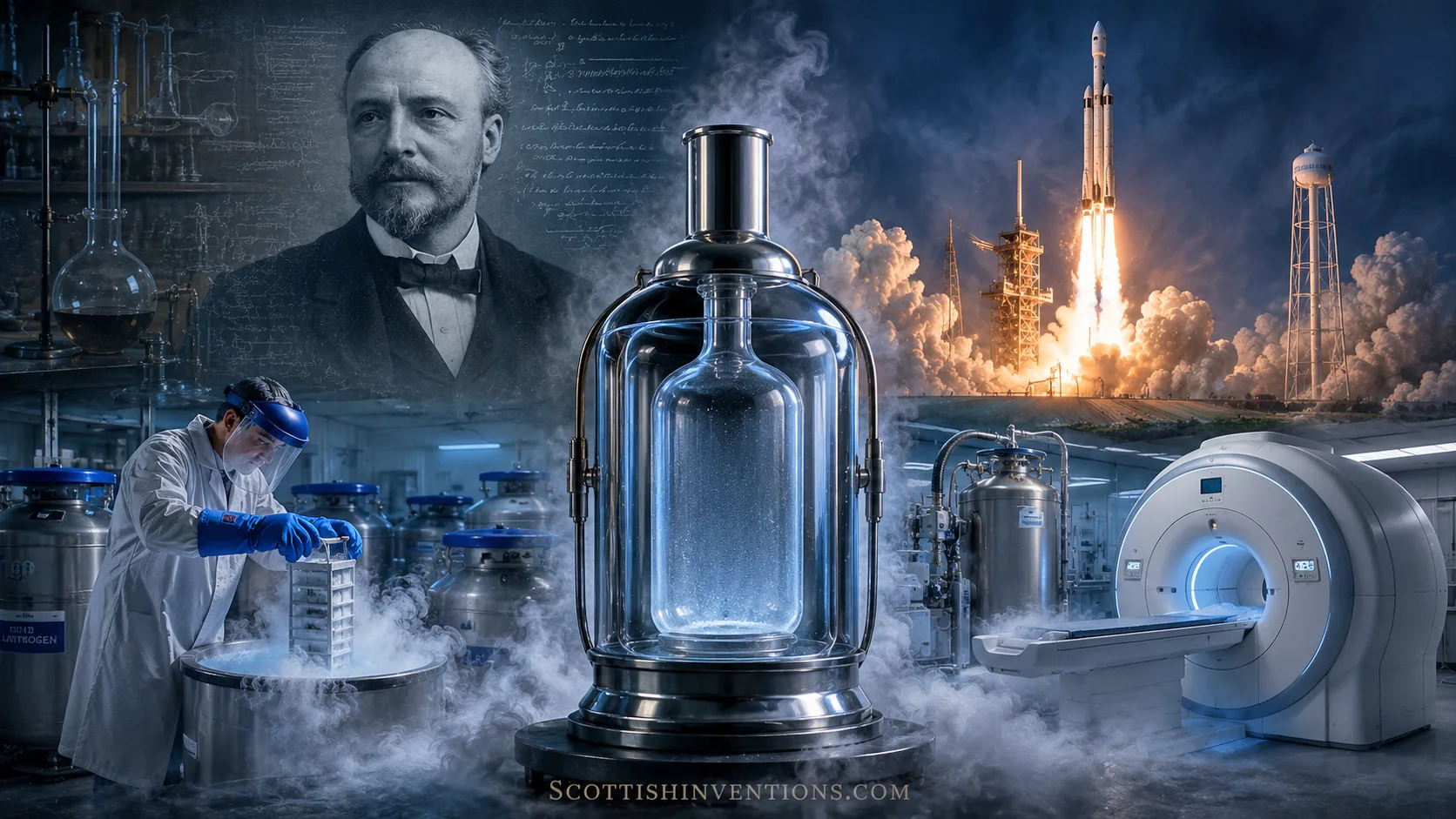
Lasting Legacy: From the Lab Bench to the Launch Pad
Few inventions span so completely from the everyday to the cutting edge as the Dewar flask. In the laboratory it underpins low-temperature physics, biotechnology and the cryopreservation of living tissue. In medicine it sits silently around every MRI scanner's superconducting magnet. In space it bottles the propellants that took humans to the Moon. In the kitchen, the lunchbox and the rucksack, its descendant keeps coffee hot and water cold for billions of people. Few Scottish inventors have reached so widely into modern life — and none have done so quite so anonymously.
Sir James Dewar himself died in London on 27 March 1923, still in post as Fullerian Professor at the Royal Institution, eight Nobel nominations and no prize. He has a crater on the Moon, a chair at the Royal Institution that still bears his work, and a name preserved every time a physicist asks for "a dewar of nitrogen". The shops will always say Thermos. The lab will always say Dewar. Both, in the end, mean the same Scotsman.
Further Reading
- The Royal Institution of Great Britain — primary archive on Dewar's Fullerian Chair, his Friday Evening Discourses and the December 1892 flask demonstration.
- The Royal Society — Dewar's 1898 Preliminary Note on the Liquefaction of Hydrogen and Helium and his Rumford, Davy and Copley Medal records.
- University of Edinburgh — Dewar's alma mater; archive material on his studies under Lyon Playfair.
- University of Cambridge — records of the Jacksonian Professorship and Dewar's spectroscopy work with George Liveing.
- Science Museum, London — holds early Dewar flasks, cryogenic apparatus and cordite material.
- National Museums Scotland — Scottish cryogenics, chemistry and inventor heritage.
- NASA — technical history of cryogenic propellant tanks built on the dewar principle, from Atlas–Centaur to Saturn V.
- CERN — modern industrial-scale cryogenics for superconducting magnets and detectors.
- Rowlinson, J. S. (2012), Sir James Dewar, 1842–1923: A Ruthless Chemist, Ashgate.
- Dewar, J. (1898), Preliminary Note on the Liquefaction of Hydrogen and Helium, Proceedings of the Royal Society.
Frequently Asked Questions
›Who invented the vacuum flask?
The vacuum flask was invented by Sir James Dewar (1842–1923), a Scottish chemist and physicist from Kincardine-on-Forth in Fife, who first demonstrated it publicly at the Royal Institution in London in December 1892. He built it as a laboratory tool to stop the liquefied gases used in his cryogenic research from boiling away. In science it is still called a Dewar flask, or simply a 'dewar'.
›Was James Dewar Scottish?
Yes. James Dewar was unambiguously Scottish. He was born on 20 September 1842 in Kincardine-on-Forth, then in Perthshire and now in Fife, the youngest of six sons. He was educated at Dollar Academy and the University of Edinburgh under the chemist Lyon Playfair, and held the Jacksonian Professorship at Cambridge from 1875 and the Fullerian Professorship of Chemistry at the Royal Institution in London from 1877 — concurrently — until his death in 1923.
›Why did James Dewar invent the vacuum flask?
Dewar invented the vacuum flask to solve a practical problem in cryogenics. By 1891 he could produce liquid oxygen in quantity at the Royal Institution, but ambient heat boiled the liquid away faster than he could study it. After trying boxes of powdered cork and hay, he designed a double-walled glass vessel with the air evacuated between the walls and the inner surfaces silvered, defeating all three modes of heat transfer at once. The flask was a tool to chase the cold, not a kitchen gadget.
›What is a Dewar flask?
A Dewar flask is the scientific name for a vacuum flask: a double-walled vessel with the gap between the walls evacuated and the facing surfaces silvered, used to store materials at temperatures very different from their surroundings. Laboratory dewars hold cryogenic liquids such as liquid nitrogen at −196 °C, liquid hydrogen at around −253 °C and liquid helium at −269 °C, while everyday vacuum flasks descended from the same design keep coffee hot and water cold.
›What is the difference between a Dewar flask and a Thermos?
They are the same invention in two different forms. A Dewar flask is the original, delicate, glass scientific vessel demonstrated by James Dewar in 1892. A Thermos is the rugged commercial version, encased in metal, that German glassblower Reinhold Burger and his partners patented from 1903 and trademarked as 'Thermos' in 1904. Scientists kept Dewar's name; consumers got the Thermos brand.
›Why didn't James Dewar patent the vacuum flask?
Dewar never patented the flask. The Royal Institution links the decision to his earlier bruising patent fight with Alfred Nobel over the smokeless propellant cordite, which Dewar had co-invented with Sir Frederick Abel in 1889; Nobel sued and lost up to the House of Lords, but the litigation was so draining that Dewar appears to have lost his appetite for patents. When Burger commercialised the flask a decade later, that decision proved extremely costly.
›How does a vacuum flask work?
A vacuum flask defeats the three ways heat moves. Conduction and convection are killed by evacuating the air from the space between two glass walls, so there is no medium to carry heat across. Radiation is reflected back by silvering the facing surfaces, like a tiny one-way mirror for heat. The neck — the one place the inner and outer walls join — is kept narrow to minimise the residual heat path. Together these features can keep liquids near absolute zero stable for hours and your tea hot for a day.
›When did James Dewar first liquefy hydrogen?
Sir James Dewar produced the first liquid hydrogen on 10 May 1898 in the basement of the Royal Institution, collecting 20 cubic centimetres of the liquid 'boiling quietly in a vacuum glass'. He announced the achievement to the Royal Society two days later, on 12 May 1898, in a paper titled 'Preliminary Note on the Liquefaction of Hydrogen and Helium'. He went on to solidify hydrogen in 1899.
›Did Dewar sue the Thermos company?
He tried. Around 1904, after Reinhold Burger had patented the rugged commercial vacuum flask in Germany (1903) and registered the 'Thermos' trademark (1904), Dewar brought a suit in the United Kingdom against A.E. Gutman, who held the British distribution rights, challenging Burger's patent. The case failed, the decisive point being that Dewar had never patented his invention and had taken no prior steps to protect his priority. The popular claim that he sued 'Thermos GmbH' or the American Thermos company is not accurate.
›How is the vacuum flask used today?
Dewar's invention is everywhere. In hospitals, MRI scanners depend on dewars of liquid helium to cool their superconducting magnets — by some estimates the world's 50,000 or so MRI machines account for roughly a quarter to a third of global helium consumption. In rocketry, cryogenic engines burn liquid hydrogen and liquid oxygen stored in vacuum-insulated tanks built on the dewar principle, a technology used by NASA from Atlas–Centaur through the Saturn V and into modern launchers. In laboratories, liquid nitrogen for biotechnology, cryopreservation of embryos, vaccines and tissue samples, and high-vacuum physics all rely on dewars. In the kitchen, the Thermos descendant keeps coffee hot and water cold for billions of people.