Scottish Inventions · Transport & Industrial Revolution
The Charlotte Dundas: How William Symington Built the World's First Practical Steamboat
In the winter of 1802–1803, a Scottish engineer working on the Forth and Clyde Canal proved that steam could replace wind and horsepower on the water — and quietly launched the age of steam-powered transport.
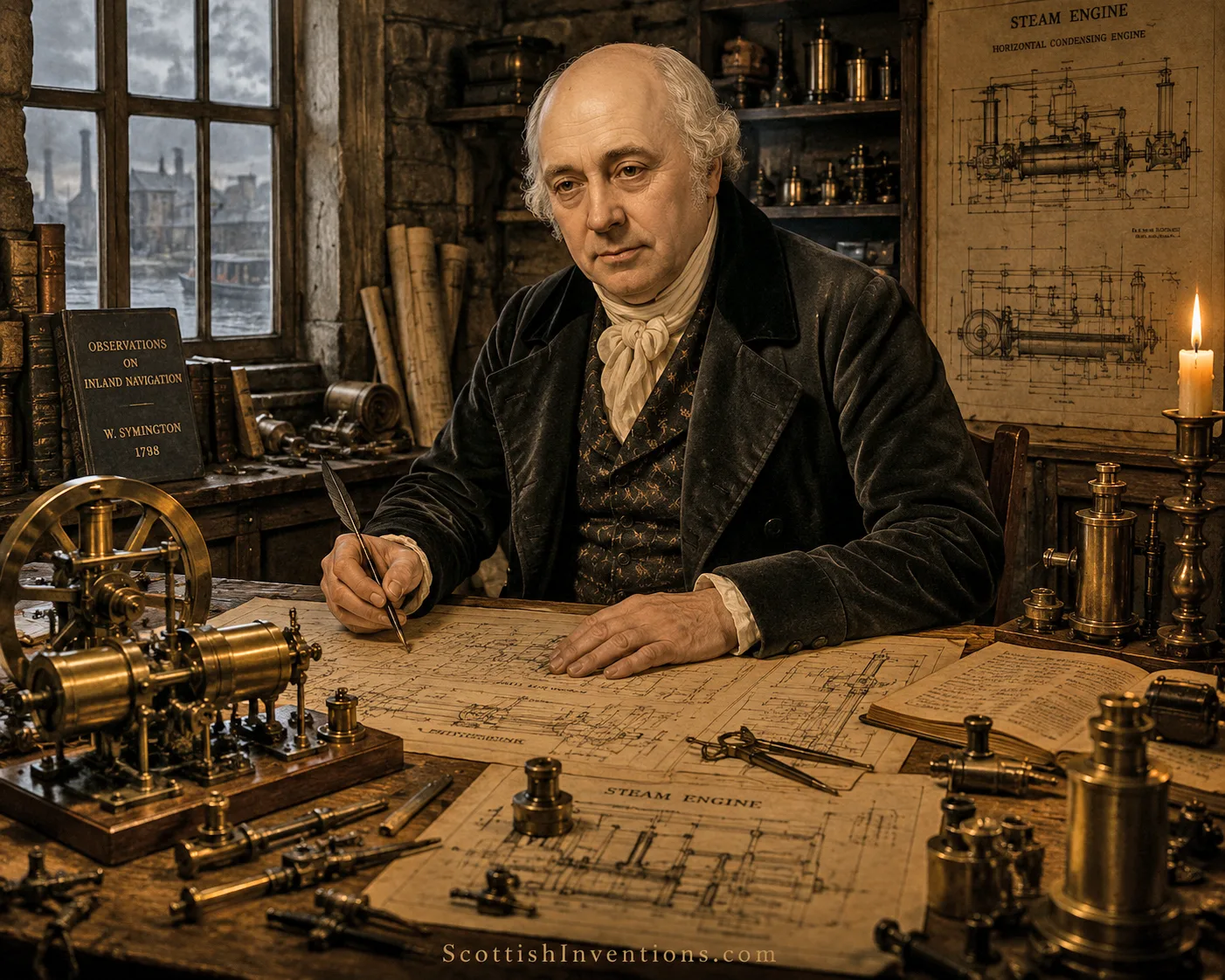
For centuries, the movement of goods and people on rivers and canals depended entirely on wind, current, or the muscle power of horses and men. Sailing vessels were at the mercy of the weather, and horse-drawn barges were slow and expensive to operate. The idea of using steam power to propel boats had tantalised inventors for decades, but most attempts ended in failure or remained little more than interesting experiments.
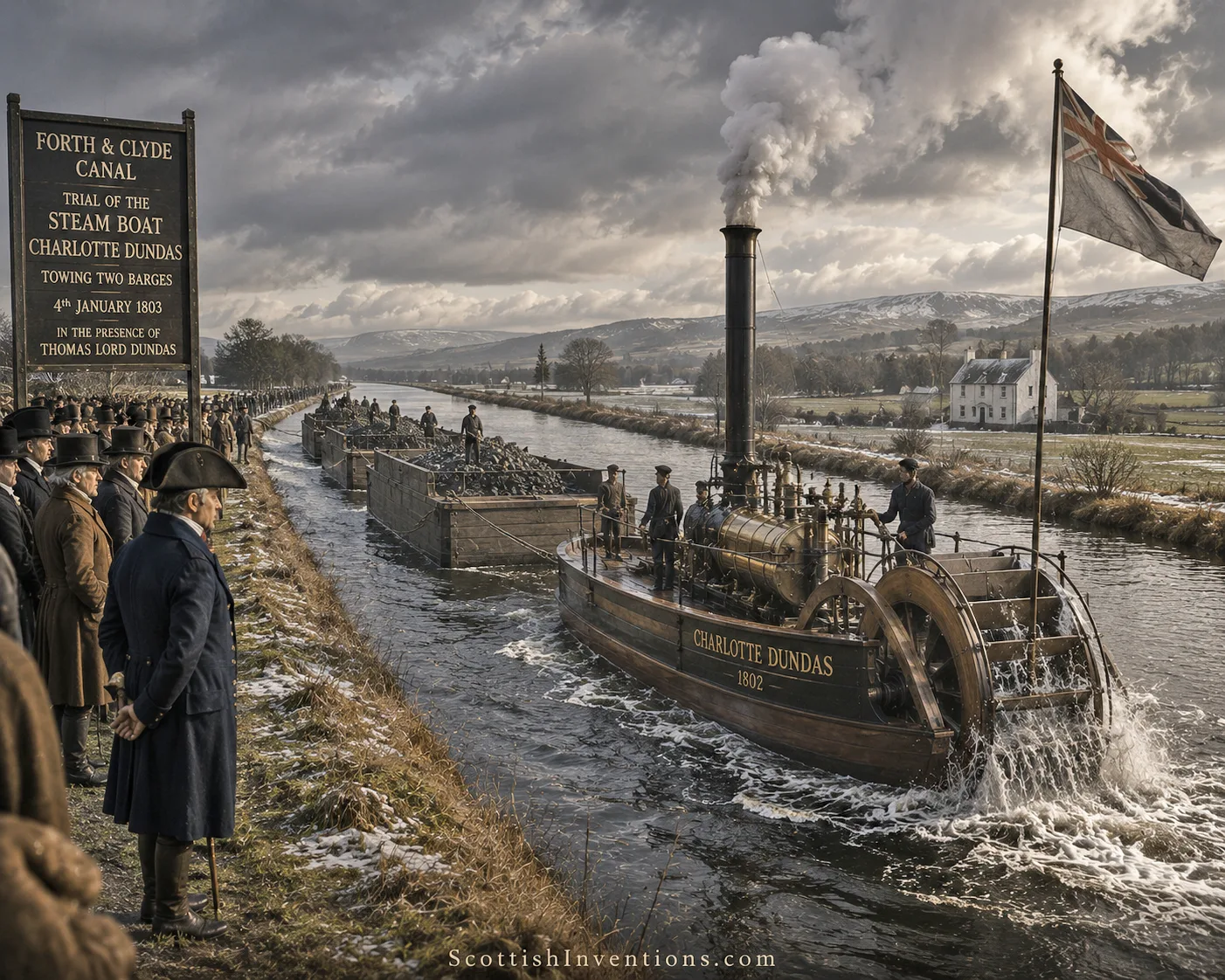
Then, in the winter of 1802–1803, a Scottish engineer named William Symington achieved something that changed history. On the Forth and Clyde Canal, he demonstrated a steam-powered vessel that could reliably tow heavy barges against wind and current. That vessel was the Charlotte Dundas, and she is now recognised as the world's first practical steamboat.
Symington did not invent the idea of steam navigation, but he was the first to build a steamboat that actually worked in real commercial conditions. His achievement laid the foundation for the global revolution in steam-powered shipping — and complements the work of fellow Scots James Watt, James Nasmyth and James Beaumont Neilson in powering the Industrial Revolution.
Key Facts
Born Leadhills, 1764
William Symington trained as an engineer in Scotland's lead-mining country and rose to design Britain's first practical marine steam engine.
Completed 1802
The Charlotte Dundas was built at Grangemouth on the Forth and Clyde Canal and named after Lord Dundas's daughter.
4 January 1803
Towed two 70-ton barges 19.5 miles in six hours against a headwind — the historic trial that proved steam navigation worked.
Horizontal condensing engine
Symington's own marine engine — compact, reliable and better suited to boats than earlier upright designs.
Inspired Robert Fulton
Fulton observed the Charlotte Dundas in 1803 and built the commercial Clermont four years later on the Hudson River.
Died in poverty, 1831
Symington never received the recognition or reward his pioneering work deserved during his lifetime.
A Scottish Engineer with a Vision
William Symington was born in 1764 in Leadhills, Lanarkshire, in the heart of Scotland's lead-mining country. He trained as an engineer and showed early talent for mechanical innovation. In the 1780s he became associated with Patrick Miller, a wealthy Edinburgh banker and inventor with a strong interest in improving inland navigation.
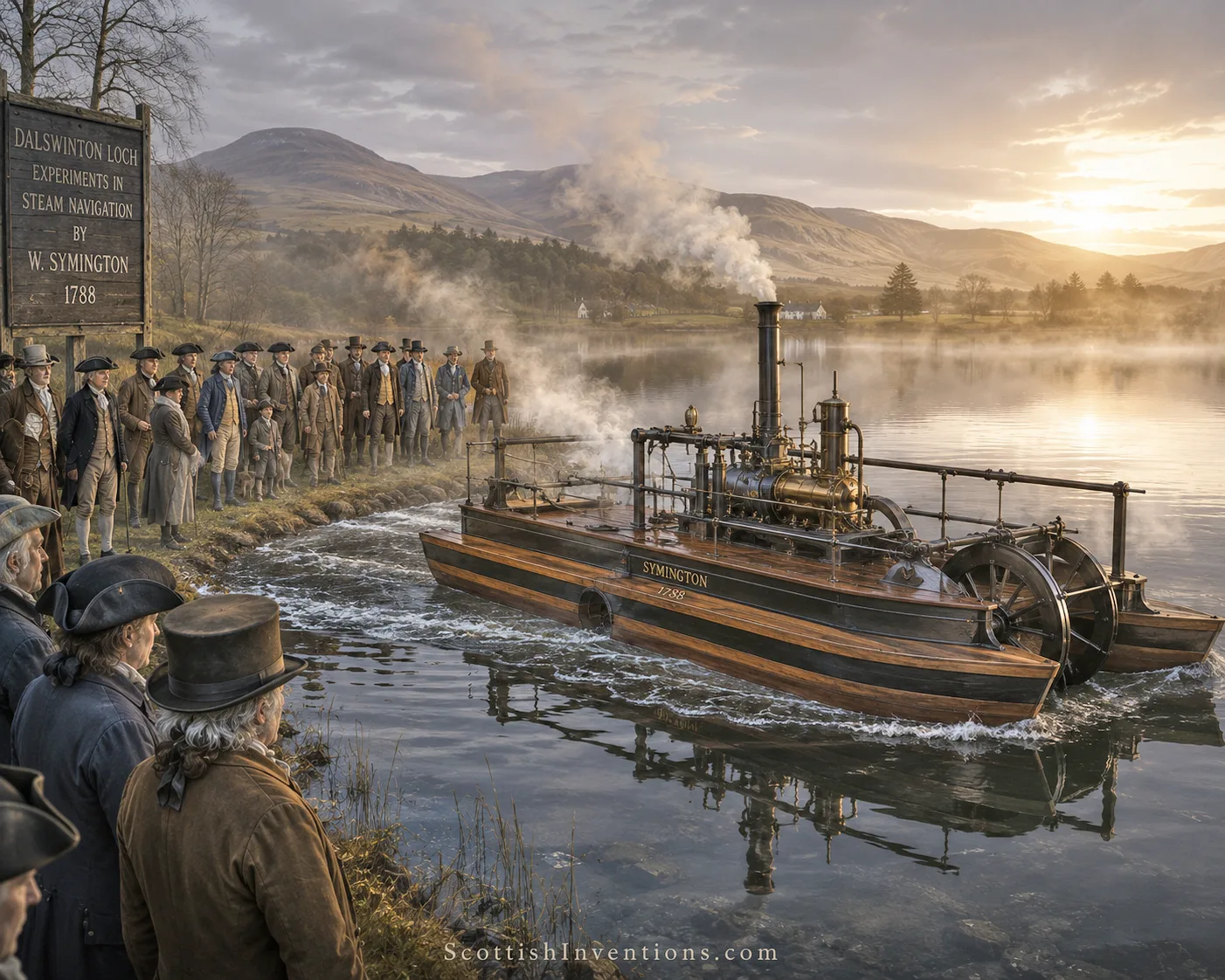
Miller had already experimented with manually powered paddle boats. He saw potential in using steam instead of human power and approached Symington to design a suitable engine. In 1788, Symington built a small steam engine that powered a double-hulled boat on Dalswinton Loch near Miller's estate. The boat achieved a speed of around 5 mph. While it proved the concept could work, the engine was too heavy and inefficient for practical use.
Symington continued refining his ideas over the following years. He understood that for steam propulsion to succeed on canals and rivers, the engine needed to be compact, reliable, and powerful enough to overcome wind and current without damaging canal banks with excessive wash from paddle wheels.
The Breakthrough: The Charlotte Dundas
In 1800, Symington found a new and powerful patron in Thomas, Lord Dundas, Governor of the Forth and Clyde Canal Company. Lord Dundas was keen to improve transport on the canal that linked the Firth of Forth and the Firth of Clyde. He commissioned Symington to build a steam-powered tugboat.
The result was the Charlotte Dundas, named after Lord Dundas's daughter. Completed in 1802 and launched at Grangemouth, she was a stern-wheel paddle steamer powered by a horizontal condensing steam engine designed by Symington. This engine was a significant improvement on earlier designs — more compact and better suited to marine use than the upright beam engines of the day.
This was not a short demonstration on a calm lake. It was sustained, practical work under real operating conditions. The Charlotte Dundas proved that steam power could provide dependable propulsion for commercial transport on inland waterways.
Why the Charlotte Dundas Was "Practical"
Earlier steamboat experiments had shown promise but failed to deliver consistent, useful performance:
- The French Marquis de Jouffroy d'Abbans had demonstrated a steamboat on the Saône in 1783, but it was not developed further.
- American inventor John Fitch operated steamboats on American rivers in the late 1780s, but they were not commercially successful.
- Symington's own earlier boat with Patrick Miller had been too underpowered for serious work.
The Charlotte Dundas succeeded where others had struggled because Symington combined three crucial elements: a well-designed horizontal condensing steam engine of his own design; a practical stern paddle wheel configuration; and a vessel built specifically for the demands of canal towing. She demonstrated that steam could replace horse power on canals and offered the possibility of faster, more reliable transport independent of wind or weather.
Before & After the Charlotte Dundas
⏳ Before Steam
Wind, Water and Muscle
- Wind dependent — sailing ships were at the mercy of weather.
- Horse-drawn canal barges, slow and expensive to operate.
- Unreliable schedules: no fixed timetables possible.
- Weather and current frequently halted trade for days or weeks.
- Limited cargo capacity per voyage.
🚢 After the Charlotte Dundas
Reliable Steam Propulsion
- Reliable propulsion independent of wind and current.
- Heavy cargo towing — 140 tons over 19.5 miles in six hours.
- Commercial schedules became possible.
- Foundation of industrial bulk transport on canals and rivers.
- Direct ancestor of modern marine engineering and ocean shipping.
The Missed Opportunity
Despite the successful trials, the Charlotte Dundas did not lead to immediate commercial success in Scotland. The Forth and Clyde Canal Company's committee was concerned that the wash from the paddle wheel might damage the canal banks. They decided against commissioning a fleet of steam tugs.
Symington was disappointed. He had hoped the demonstration would lead to widespread adoption of his technology. Instead, he faced financial difficulties and struggled to find further backing for his marine steam engine designs. In the years that followed, Symington continued to work on steam engines and other inventions, but he never achieved the commercial success or recognition his pioneering work deserved during his lifetime. He died in 1831 in relative poverty.
Influence on Robert Fulton and the Global Steamboat Age
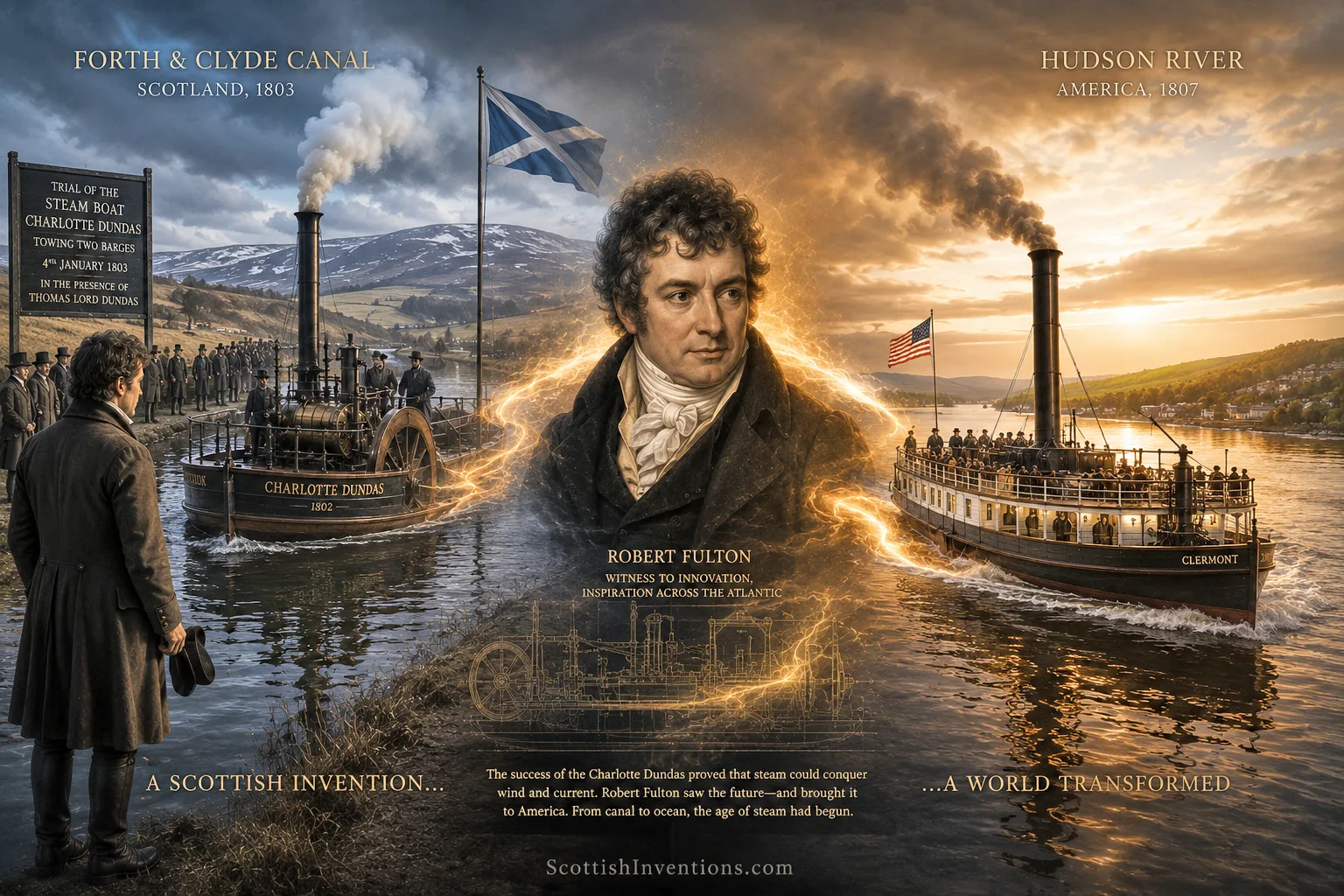
Although the Charlotte Dundas did not immediately transform British inland navigation, her influence spread across the Atlantic. In 1803, the American inventor Robert Fulton visited Britain and saw Symington's steamboat in operation on the Forth and Clyde Canal. Fulton was already interested in steam navigation and had been experimenting with ideas of his own. The demonstration of the Charlotte Dundas convinced him that steam-powered boats were viable.
Fulton returned to America and, with the financial backing of Robert Livingston, built the North River Steamboat — commonly known as the Clermont. In 1807 she began regular passenger service on the Hudson River between New York and Albany. She was a commercial success and is often celebrated as the vessel that began the age of steam navigation in America. While Fulton's Clermont receives much of the historical credit for launching commercial steamboat travel, it is clear that he benefited significantly from having seen Symington's practical working example. Many historians now recognise the Charlotte Dundas as the true pioneer that proved the concept could work in everyday service.
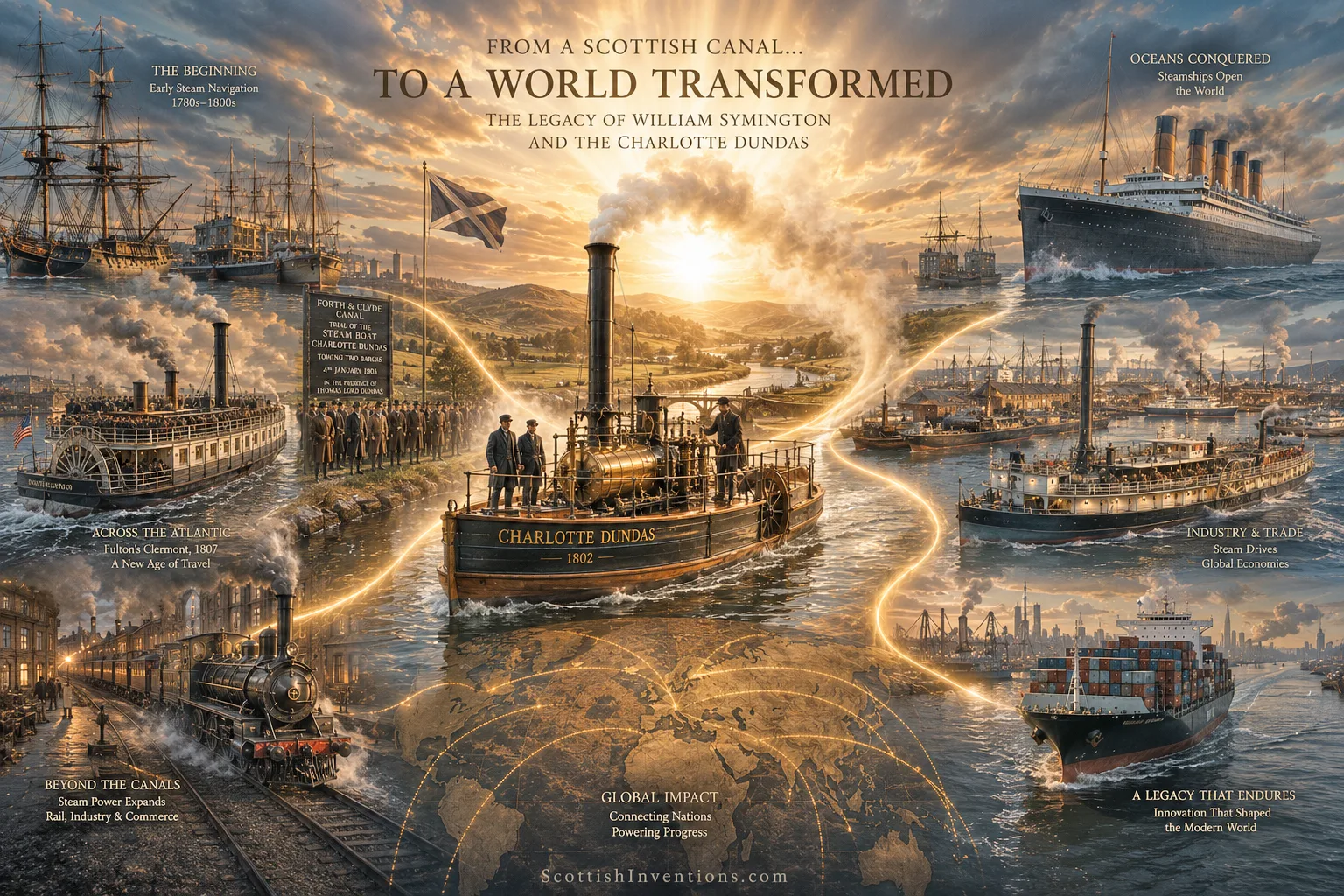
From a Scottish Canal to a World Transformed
The principle Symington proved on a quiet canal in central Scotland in 1803 went on to reshape the modern world. Within a few decades, steam was driving river transport, ocean liners, global trade and the railways — fuelled by Scottish iron from Neilson's Hot Blast Process, lit by William Murdoch's coal gas, regulated by Watt's centrifugal governor, and timed to Sandford Fleming's Universal Standard Time.
🌊 River Transport
Steam tugs and packet boats on every navigable river by 1840.
⚓ Ocean Liners
Cunard, P&O and White Star — Clyde-built, steam-powered, world-spanning.
🛤️ Steam Railways
The same engineering tradition powered rail networks across the British Empire.
🏭 Industrial Revolution
Bulk transport of coal, iron and grain made mass industry possible.
🌍 Global Trade
Reliable schedules between continents transformed nineteenth-century commerce.
📦 Container Shipping
Modern container ships are direct mechanical descendants of Symington's marine engine.
🏛️ Marine Engineering
The Clyde became the world capital of shipbuilding for over a century.
🇸🇨 Scottish Legacy
From Symington to Watt to Henry Bell's Comet — a single national engineering tradition.
Timeline
- ●
1764
William Symington born
Born in Leadhills, Lanarkshire, in the heart of Scotland's lead-mining country.
- ●
1788
Dalswinton Loch experiments
Working with Patrick Miller, Symington powers a double-hulled boat with a small steam engine on Dalswinton Loch — reaching around 5 mph and proving the concept.
- ●
1800
Commissioned by Lord Dundas
Thomas, Lord Dundas, Governor of the Forth and Clyde Canal Company, commissions Symington to build a steam-powered tugboat.
- ●
1802
Charlotte Dundas completed
Built at Grangemouth as a stern-wheel paddle steamer powered by Symington's horizontal condensing steam engine.
- ●
4 January 1803
Historic towing demonstration
Charlotte Dundas tows two laden 70-ton barges 19.5 miles in six hours against a strong headwind on the Forth and Clyde Canal.
- ●
1803
Robert Fulton observes the trials
The American inventor visits the Forth and Clyde Canal and sees Symington's steamboat in operation — convincing him steam navigation is viable.
- ●
1807
Clermont enters commercial service
Fulton's North River Steamboat (the Clermont) begins regular passenger service on the Hudson River between New York and Albany.
- ●
1812
Henry Bell's Comet
Scotland's Henry Bell launches the Comet on the Clyde — Europe's first commercially successful passenger steamboat.
- ●
1831
Symington dies in London
He dies in March 1831, having never received the financial reward or public recognition his pioneering work deserved.
- ●
Mid–Late 1800s
Steamships dominate
Paddle and screw steamships dominate canals, rivers and oceans; Clyde shipyards become the heart of world marine engineering.
- ●
Early 1900s
Steam powers global trade
Ocean liners and steam railways connect continents — a global revolution rooted in a single Scottish canal trial.
Legacy and Recognition
For many years, Symington's contribution was under-appreciated. Robert Fulton and later inventors received more public attention. It was not until the late 19th and early 20th centuries that historians began to properly credit Symington with building the first practical steamboat. Today, the Charlotte Dundas is acknowledged by most serious historians of technology as the vessel that demonstrated steam propulsion could work in commercial service. A full-scale replica of the boat has been built, and Symington's achievement is commemorated in Scotland.
William Symington was not a wealthy industrialist or a famous public figure. He was a working engineer who solved a difficult technical problem through persistence and ingenuity. Like many Scottish inventors of his era, he received only limited reward for his efforts during his lifetime. Yet his work helped launch the age of steam on water — a transformation that would reshape economies and societies around the world.
The age of sail did not end overnight. But on a Scottish canal in the winter of 1802–1803, William Symington showed that the future of water transport would belong to steam. The Charlotte Dundas may have been a modest vessel, but she carried within her the beginnings of a global revolution. Coming soon to Scottish Inventions: the Scottish Discoveries Collection and the Scottish Institutions Collection.
Frequently Asked Questions
- Who invented the first practical steamboat?
- Scottish engineer William Symington (1764–1831) built the Charlotte Dundas, demonstrated on the Forth and Clyde Canal in January 1803. Most historians of technology now recognise her as the world's first practical steamboat — the first steam-powered vessel to perform sustained, useful commercial work under real operating conditions.
- What was the Charlotte Dundas?
- The Charlotte Dundas was a stern-wheel paddle steam tugboat designed by William Symington and commissioned by Thomas, Lord Dundas, Governor of the Forth and Clyde Canal Company. Completed in 1802 at Grangemouth and powered by Symington's horizontal condensing steam engine, she was named after Lord Dundas's daughter.
- Was William Symington before Robert Fulton?
- Yes — by four years. The Charlotte Dundas made her famous towing trial on 4 January 1803. Robert Fulton's North River Steamboat (commonly called the Clermont) did not begin commercial service on the Hudson until 1807. Fulton visited Britain and personally observed Symington's steamboat in operation before returning to America.
- Why is Robert Fulton more famous than William Symington?
- Fulton achieved the first sustained commercial passenger service with the Clermont in 1807, while Symington's Charlotte Dundas was sidelined by the Forth and Clyde Canal Company over fears of bank erosion. Commercial success — not technical priority — is what built Fulton's reputation. Symington built the world's first practical steamboat; Fulton built the first commercially successful one.
- Where was the Charlotte Dundas tested?
- On the Forth and Clyde Canal in central Scotland. Her historic trial began near Lock 20 and saw her tow two laden barges of around 70 tons each over 19.5 miles in six hours, against a strong headwind.
- What made the Charlotte Dundas revolutionary?
- She combined three breakthroughs: a compact, efficient horizontal condensing steam engine (Symington's own design, far better suited to marine use than earlier engines); a practical stern paddle wheel; and a hull purpose-built for canal towing. Together they delivered sustained, reliable propulsion against wind and current — something no earlier steamboat had achieved.
- Did the Charlotte Dundas inspire the Clermont?
- Most historians believe so. Fulton was in Britain in 1801–1806, visited the Forth and Clyde Canal in 1803, and is documented as having observed the Charlotte Dundas in operation. He returned to America convinced steam navigation was viable and built the Clermont with Robert Livingston's backing.
- Why wasn't the Charlotte Dundas commercially adopted?
- The committee of the Forth and Clyde Canal Company feared the wash from the paddle wheel would erode the canal banks. They declined to commission a fleet of steam tugs, and Symington struggled to find further backing. It was a missed industrial opportunity for Scotland.
- What happened to William Symington?
- Despite his pioneering achievement, Symington never received the financial reward or public recognition his work deserved. He continued to design steam engines and other inventions but died in London in March 1831 in relative poverty.
- Why is Scotland important in the history of steamships?
- Scotland gave the world the rotative steam engine (James Watt), the first practical steamboat (Symington's Charlotte Dundas, 1803), the first commercial passenger steamboat in Europe (Henry Bell's Comet, 1812), the Clyde shipbuilding industry that dominated nineteenth-century marine engineering, and many of the great Cunard, P&O and White Star liners. The age of steam at sea is, in large part, a Scottish story.
Sources
- W. S. Harvey & G. Downs-Rose, William Symington, Inventor and Engine Builder (Northgate, 1980).
- James Rennie, "Symington and the Charlotte Dundas", Transactions of the Newcomen Society.
- Forth & Clyde Canal Company records — Lord Dundas correspondence (1800–1803).
- Robert H. Thurston, A History of the Growth of the Steam Engine (1878).
- Cynthia Owen Philip, Robert Fulton: A Biography (Franklin Watts, 1985).
- National Museums Scotland — collection notes on Symington and the Charlotte Dundas.
- Encyclopædia Britannica — entries on William Symington, Charlotte Dundas and Robert Fulton.
Newsletter
Discover Scotland's hidden inventors
One short, beautifully illustrated story a fortnight. No spam, ever.
Sign up free