Scottish Inventions · Engineering
The Steam Hammer: How an Edinburgh Painter's Son Forged the Industrial Age
The honest, multinational story of James Nasmyth, François Bourdon and the machine that shook a building a mile away — yet could crack an egg in a wine glass.
Introduction
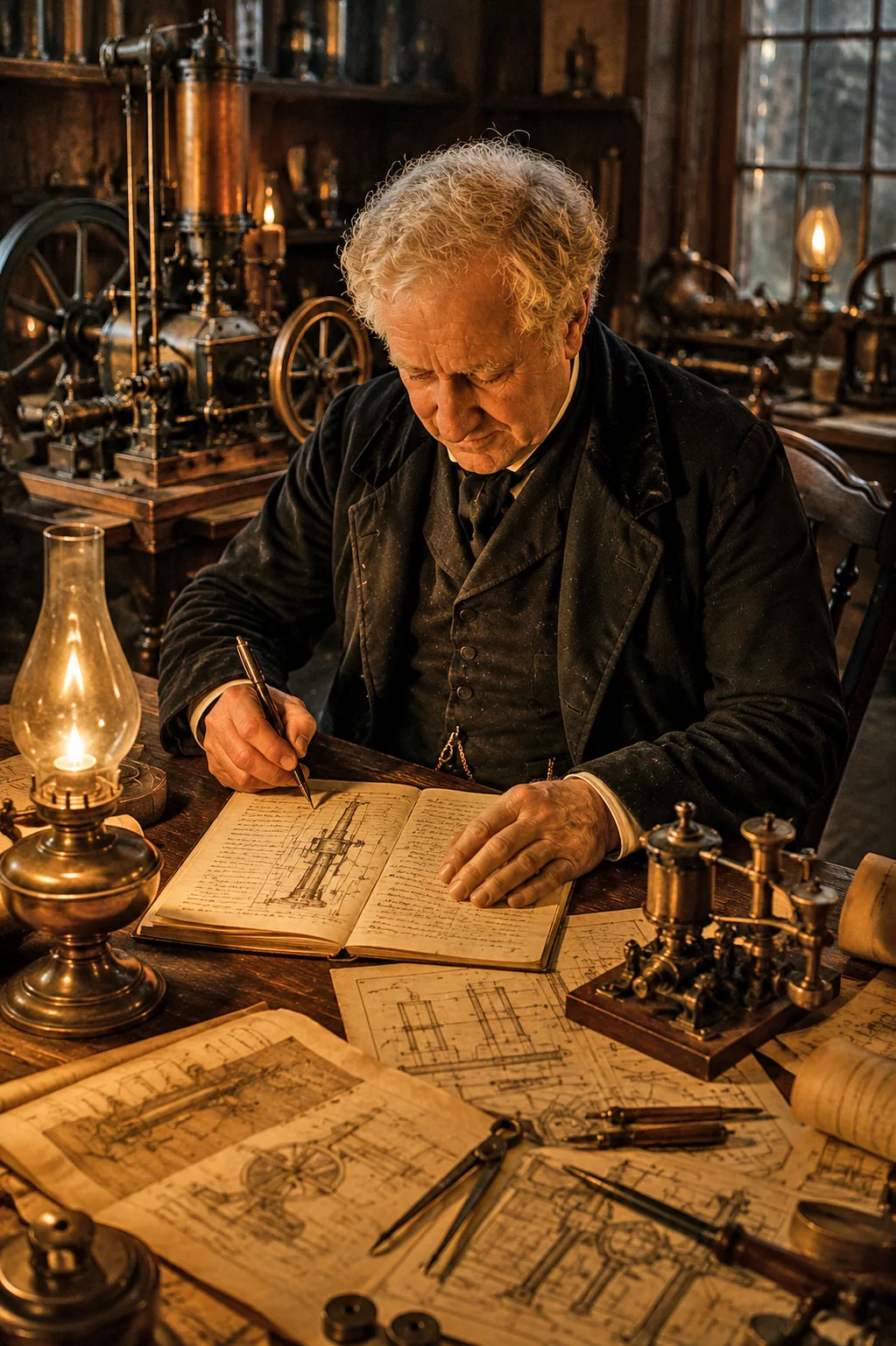
On the night of 24 November 1839, in a brick-built foundry beside the Bridgewater Canal at Patricroft, a young Edinburgh-born engineer opened a notebook he called his "Scheme Book" and drew a hammer. Not a hammer swung in an arc, as smiths had used since the Bronze Age, but a hammer hung straight beneath an inverted steam cylinder, lifted by steam and let fall by gravity onto an anvil. Within five years that sketch would be reshaping iron across Europe.
That engineer was James Nasmyth (1808–1890), youngest son of the Edinburgh painter Alexander Nasmyth. The machine was the steam hammer, one of the defining engineering inventions of the Industrial Revolution. The story usually ends there, with a tartan flourish. The truth is richer: a French engineer named François Bourdon conceived the same machine in the same year at Le Creusot in Burgundy and built the first working example in 1840. And the famous precision that let Nasmyth crack an egg without breaking the glass beneath it owed much to a quietly brilliant works manager named Robert Wilson. This is the honest version — and a better one.

On this page
- Key Takeaways
- Key Facts
- From an Edinburgh Studio to Maudslay's Bench
- The Famous Origin Story
- How the Steam Hammer Worked
- Bridgewater Foundry
- The Nasmyth–Bourdon Priority Debate
- Robert Wilson's Contribution
- The Egg in the Wine Glass
- Engineering Legacy & Global Impact
- Myth vs Fact
- Timeline of Development
- Related Scottish Inventions
- Further Reading
- FAQ
Key Takeaways
- James Nasmyth (1808–1890), the Edinburgh-born son of painter Alexander Nasmyth, designed the steam hammer in his "Scheme Book" on 24 November 1839 at Bridgewater Foundry, Patricroft.
- François Bourdon independently conceived the same machine in 1839 at Le Creusot and built the world's first working steam hammer there in 1840.
- The honest verdict: independent, near-simultaneous invention, with Bourdon first to a working machine and Nasmyth first to commercial dominance.
- Robert Wilson's self-acting valve gear made the hammer a precision instrument and underpins the famous egg-in-a-wine-glass trick.
- Between 1843 and 1856, Bridgewater Foundry produced around 493 steam hammers, exported across Europe, Russia, India and Australia.
- Retired wealthy at 48, Nasmyth designed the telescope Nasmyth focus still used on major research observatories.
Key Facts
Edinburgh 1808
Born 19 August 1808 at 47 York Place, son of the painter Alexander Nasmyth.
Scheme Book 1839
Sketched the steam hammer on 24 November 1839 — the page survives in the IMechE archive.
Patricroft 1836
Opened Bridgewater Foundry beside canal and railway, near Manchester.
Patent No. 9382
British patent granted 9 June 1842 after Bourdon's French patent of April 1842.
Egg in a wine glass
Famously cracked an eggshell without breaking the glass beneath it.
Nasmyth Focus
Retired at 48 and designed the telescope focus still used on major observatories.
From an Edinburgh Studio to Maudslay's Bench
There is a lovely Scottish symmetry to James Nasmyth's beginnings: he was raised among paintbrushes but reached for a file. Born on 19 August 1808 at 47 York Place, Edinburgh, he was the youngest son of Alexander Nasmyth, a portrait and landscape painter so influential that Sir David Wilkie called him "the founder of the landscape painting school of Scotland". Alexander kept a well-equipped workshop alongside his studio, and James grew up with drawing and observation — the tools of the artist — already becoming the tools of the engineer.
He was educated at Edinburgh's Royal High School and from 1821 at the Edinburgh School of Arts — making him one of the earliest students of the institution now known as Heriot-Watt University, which fittingly named its mechanical engineering building after him. As a teenager he built working model steam engines, and by 1828, at twenty, a full-size steam carriage capable of carrying eight people for a mile.
Unable to afford a formal apprenticeship, Nasmyth hand-built a working steam-engine model to demonstrate his skill to Henry Maudslay, London's greatest machine-tool maker. It worked: in 1829 Maudslay engaged him as personal assistant at ten shillings a week. Under Maudslay — the man who had perfected the screw-cutting lathe — Nasmyth absorbed a near-religious devotion to precision that would later distinguish his own work. He stayed until Maudslay's death in 1831, then worked briefly for Maudslay's partner Joshua Field before striking out on his own.
The Famous Origin Story — and How Much to Trust It
The story, as Nasmyth tells it in his 1883 autobiography, is irresistible. The Great Western Steamship Company was building Isambard Kingdom Brunel's SS Great Britain and needed a paddle-shaft some 30 inches in diameter — bigger than any forging then possible. The company's engineer, Francis Humphrys, wrote in despair:
"There is not a forge-hammer in England or Scotland powerful enough to forge the paddle-shaft of the engine for the Great Britain! What am I to do?"
The trouble with the existing tilt-hammers was geometric: they swung in an arc, so a large workpiece on the anvil left the hammer almost no room to fall — it could not strike a heavy blow when one was most needed. Nasmyth says the letter "immediately set me a-thinking", and that he reached for his Scheme Book and "in little more than half an hour … had the whole contrivance in all its executant details before me". His solution was elegant: turn the hammer upright, hang it from the piston of an inverted steam cylinder, lift it vertically with steam, and let it drop straight down onto the work. The sketch he reproduced in his autobiography is dated 24 November 1839.
It is a wonderful tale, and essentially true in outline — but it should be told with care, because it comes very largely from Nasmyth's own pen. The original Scheme Book survives in the archive of the Institution of Mechanical Engineers (catalogued as NAS/1/2), and no historian has documented that the famous page was backdated. Equally, the surrounding chronology is inconsistent in popular retellings: Humphrys's letter is variously placed in 1837–39, and the "half an hour the day the letter arrived" romance should not be presented as established fact. A second, deflating detail: the paddle-shaft was never needed. Brunel switched the Great Britain to screw propulsion, and Nasmyth's design sat unbuilt for years.
How the Steam Hammer Worked
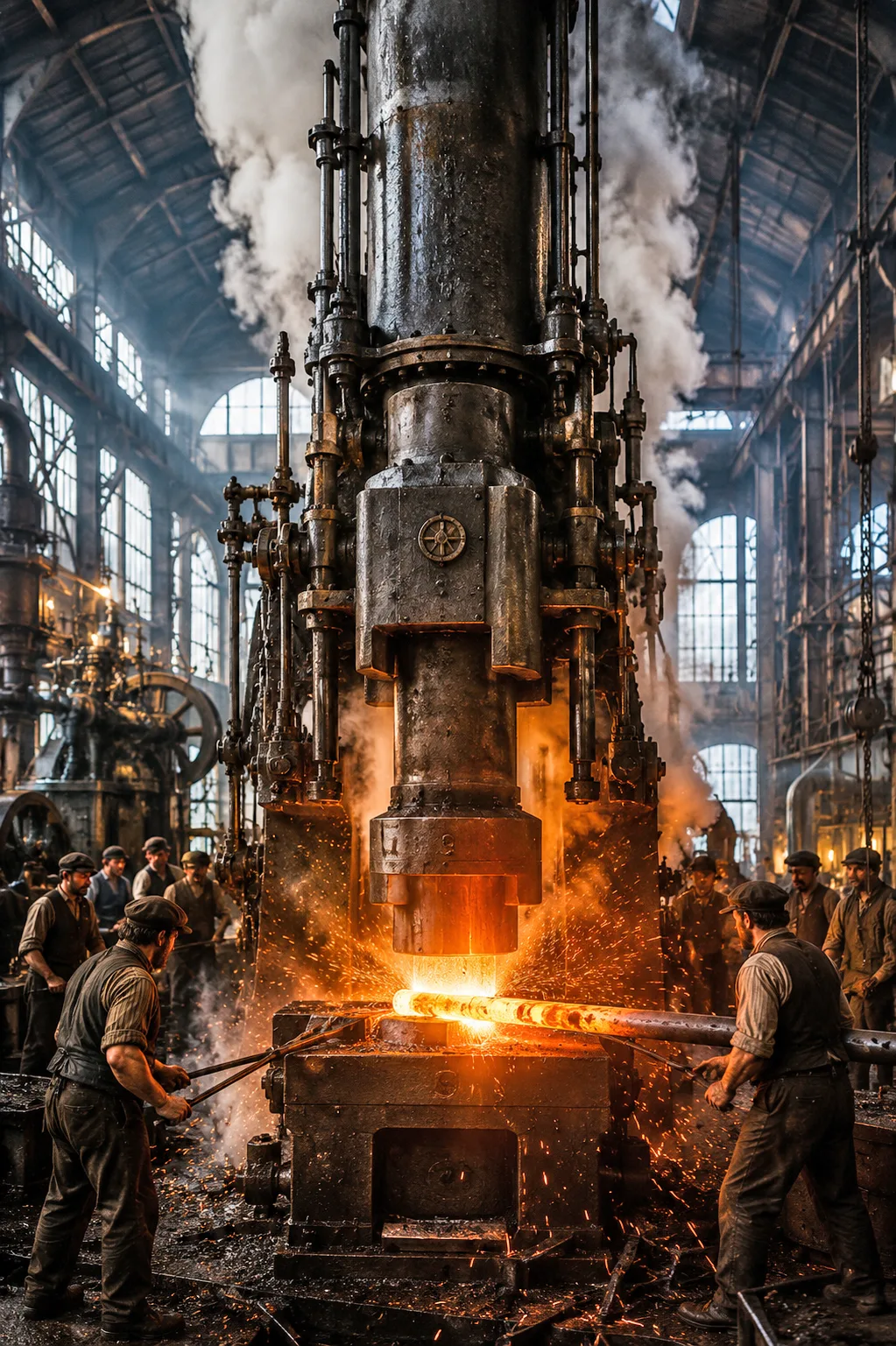
The principle is beautifully simple — "a steam engine hanging from its cylinder", as one Victorian description has it.
- 1. The tup. A massive hammer-block (the "tup") was bolted to a piston rod running up into a vertical steam cylinder.
- 2. Steam lift. Steam admitted beneath the piston raised the hammer to a chosen height.
- 3. Gravity strike. Releasing the steam let the hammer fall under gravity onto a workpiece resting on a massive anvil and bedplate.
- 4. Double action (from 1843). Steam admitted above the piston on the downstroke drove the hammer down with far more force than gravity alone, multiplying the energy of each blow.
- 5. Operator control. Working a slide-valve lever — and, after Robert Wilson's self-acting gear, automatically — the hammer-man could "think in blows", varying force across an enormous range.
Single-acting vs double-acting
The earliest hammers were single-acting: steam only lifted the tup, and gravity did the striking. The double-acting refinement Nasmyth dates to 1843 turned the steam hammer from a heavy thumper into a true forging instrument capable of immense, controllable energies.
Bridgewater Foundry: A Cathedral of Engineering
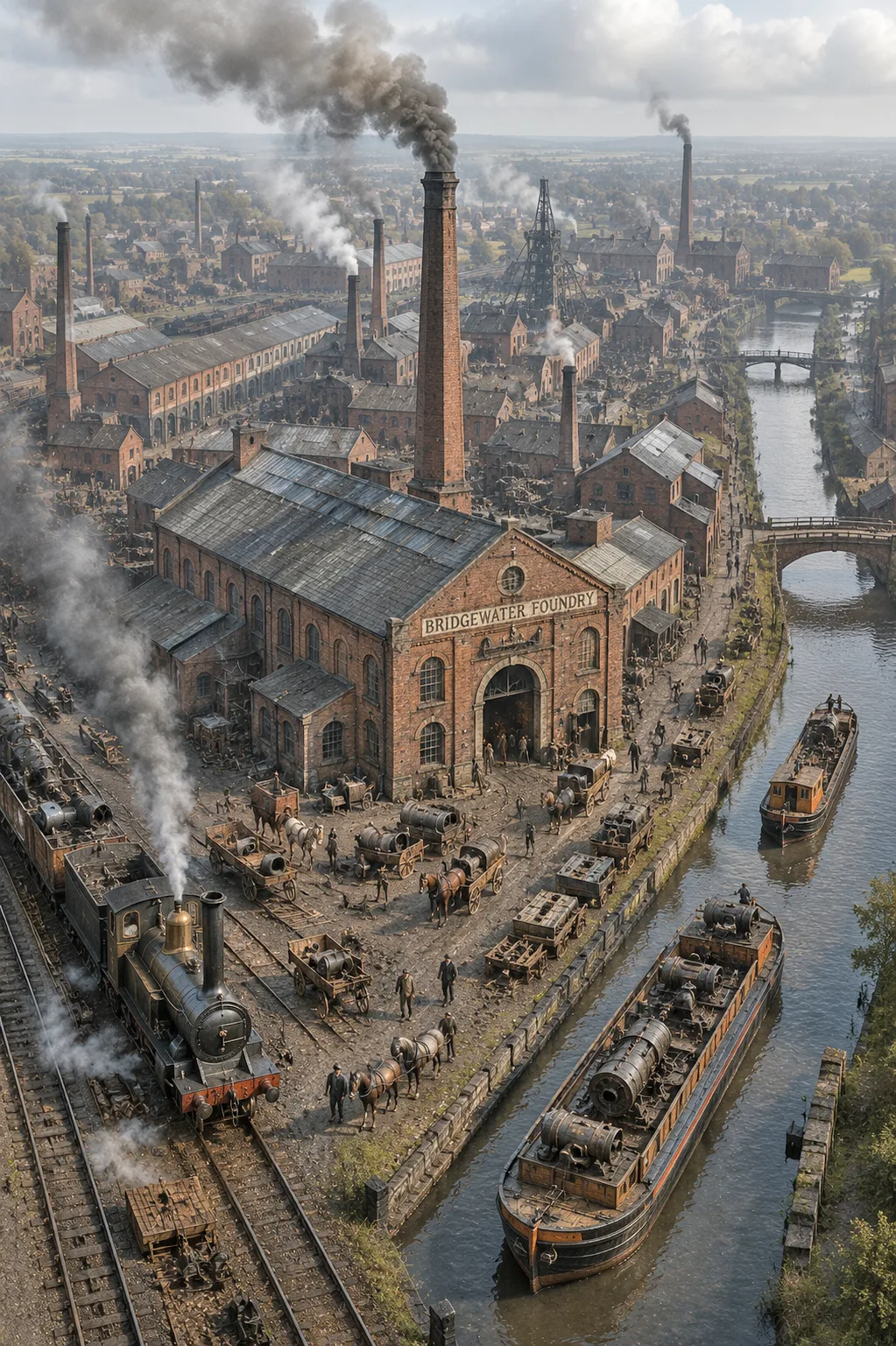
With savings of just £69, Nasmyth had set up in business in 1834, renting a flat in an old cotton mill on Dale Street, Manchester. After a heavy casting crashed through the wooden floor into the premises below, he sought sturdier ground. In August 1836 he opened the Bridgewater Foundry at Patricroft, near Eccles, in partnership with Holbrook Gaskell and his brother George Nasmyth — trading as Nasmyth, Gaskell and Company.
The site was shrewdly chosen, wedged between the Bridgewater Canal — Britain's first true industrial canal — and the Liverpool & Manchester Railway, the world's first inter-city passenger line. Raw iron arrived by barge; finished machine tools, locomotives and, from 1840, steam hammers left the gates by both canal and rail. The works was laid out around a single long machine shop with overhead cranes — a model of modern factory practice — and it was here that the steam hammer was developed, built and exported. Between 1843 and 1856 the foundry produced around 493 steam hammers, accounting for some 40 per cent of the firm's revenues, alongside more than 100 locomotives.
The Nasmyth–Bourdon Priority Debate
Here is where patriotism must yield to accuracy. At almost exactly the moment Nasmyth was sketching in Patricroft, François Bourdon (1797–1865), chief engineer of the Schneider brothers' ironworks at Le Creusot in Burgundy, conceived the same machine — which he called a "Pilon" — in 1839, to solve the same problem of forging shafts and cranks for ever-larger steam engines and ships.
- Bourdon made detailed drawings in 1839, but the cautious Schneiders hesitated to build his radical machine.
- In mid-1840, Bourdon and Eugène Schneider visited Nasmyth's works at Patricroft and were shown the Scheme Book sketch. Seeing two leading engineers had independently reached the same idea reassured Schneider, who authorised construction.
- Bourdon built the world's first working steam hammer at Le Creusot in 1840 — it weighed 2,500 kg (5,500 lb) and lifted to 2 metres (6 ft 7 in). He filed his patent on 30 September 1841; Schneider frères et Cie took out the definitive French patent on 19 April 1842.
- Nasmyth visited Le Creusot in April 1842 and found his "own child" at work; he later wrote, "there it was, in truth — a thumping child of my brain!"
- Nasmyth rushed home and patented his design (British Patent No. 9382) on 9 June 1842 — after Schneider's French patent.
So who "invented" the steam hammer? The honest, consensus answer among historians is: both men, independently and almost simultaneously, in 1839 — with Bourdon first to a working machine and a patent, and Nasmyth first to commercial dominance. It is also worth noting that the basic idea was not wholly new: James Watt described fixing a hammer directly to a piston in his 1784 patent, and W. Deverell patented a more direct-acting version in 1806. Neither built a practical forging hammer, but they muddy any claim of pure originality. The Science Museum puts it bluntly: Nasmyth "was a highly talented machine builder, but he did not invent the steam hammer, nor was he the first to build one." Schneider's own works, incidentally, went on to build 110 steam hammers between 1843 and 1867.
Robert Wilson's Contribution: The Unsung Hero
Robert Wilson (1803–1882), manager of Nasmyth's Bridgewater works (and an early screw-propeller pioneer in his own right), devised the self-acting motion that automatically admitted steam beneath the piston to raise the hammer immediately after each blow — and, crucially, allowed the force of the blow to be adjusted at will. By common consent this was the improvement that turned the hammer into a controllable, repeating, precision tool.
Nasmyth patented self-acting gear in 1843 (No. 9850), but contemporaries credited the invention to Wilson; one early engineer reportedly said he "would be prouder to say that I was the inventor of that motion, than to say I had commanded a regiment at Waterloo". The firm's later name — Nasmyth, Wilson and Company — preserved the partnership long after Nasmyth's retirement. The historian J. A. Cantrell's 1984 study James Nasmyth and the Bridgewater Foundry documents how Nasmyth's autobiography — written as told to Samuel Smiles and submitted to Nasmyth for "final approval" — underplayed Wilson's role. The most honest reading is that the steam hammer at its precise, controllable best was the product of two minds, not one.
The Egg in the Wine Glass
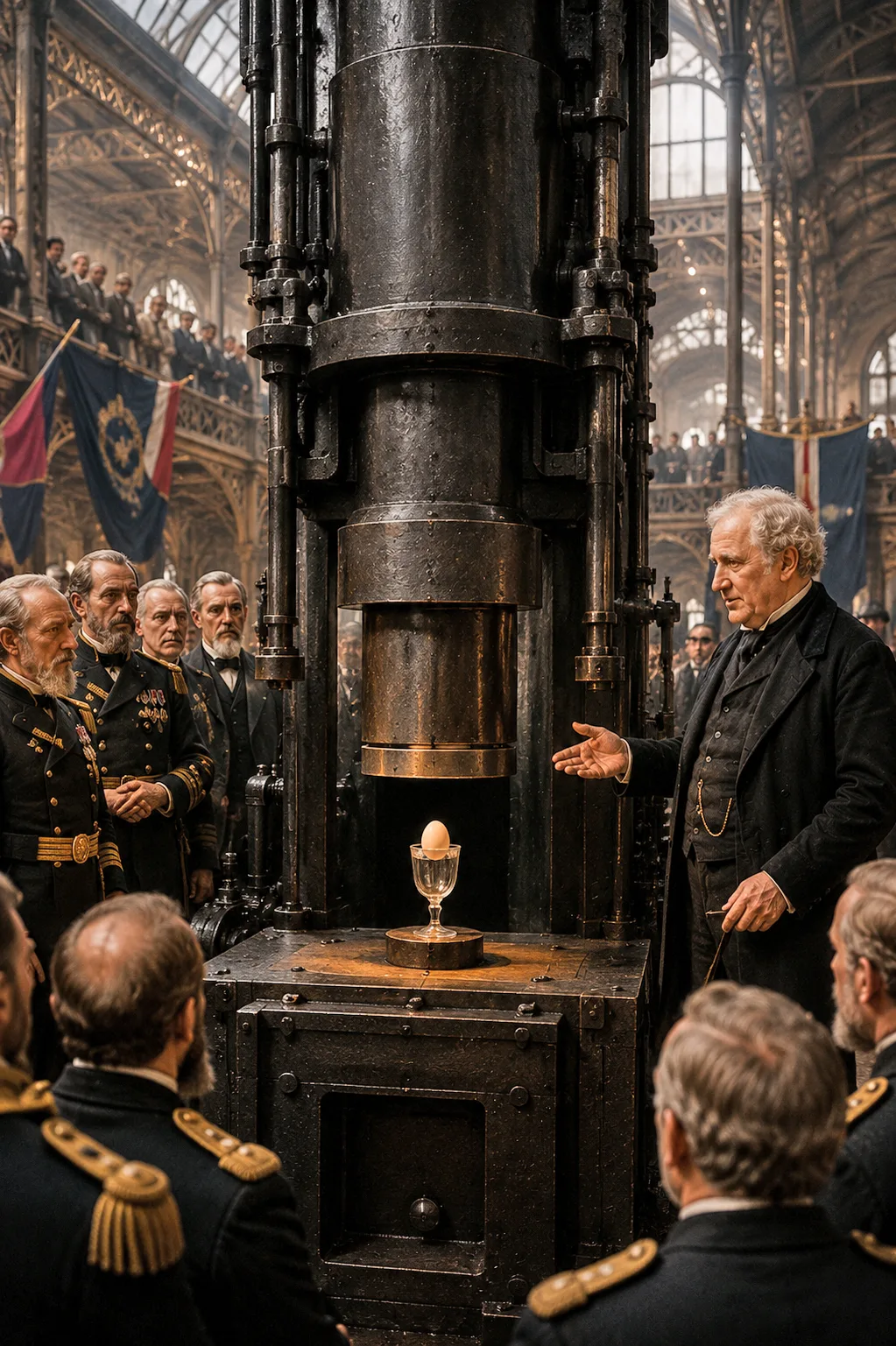
The most famous Victorian engineering demonstration of them all is well documented. Nasmyth describes it himself in his autobiography: demonstrating the hammer to the Lords of the Admiralty, "I made it break an eggshell in a wine-glass without injuring the glass", adding that "the next blow would shake the parish". It became his signature sales demonstration — proof that a machine which could shake a building two miles off could also be feathered to a whisper.
"Gentle enough for an eggshell, heavy enough to shake a building."
The Institution of Mechanical Engineers notes that the hammer could deliver "a blow gentle enough to crack an egg in a wine glass whilst leaving the glass intact, and heavy enough to shake crockery in homes a quarter of a mile away". The demonstration is real and from Nasmyth's own account — but, like all good salesmen's set-pieces, it accreted variant tellings (sometimes a walnut, sometimes the precise distance of the building-shaking blow stretched to two miles), and the precision it advertises is largely Wilson's gear at work.
Engineering Legacy & Global Industrial Impact
Before the steam hammer, large forgings such as ships' anchors had to be built up "bit by bit", small pieces forged and welded together — slow, costly and unreliable. Nasmyth's machine let smiths forge huge components in one sound piece, with a vee-anvil that improved internal structure. The economic case was overwhelming: production costs fell by more than half while quality improved.
The result was a tool that underwrote the heavy-industry phase of the Industrial Revolution. Steam hammers forged marine engine shafts for ocean liners and warships, ever-larger gun barrels, and the wrought-iron armour plate of the new ironclads. They were adapted into pile-drivers — Nasmyth's first, demonstrated at Devonport on 3 July 1845, drove a 70-foot pile in four-and-a-half minutes against the twelve hours of the old method — and used on works from the High Level Bridge at Newcastle to the Nile barrage in Egypt.
Bridgewater Foundry produced 493 steam hammers between 1843 and 1856, sold across Europe and as far as Russia, India and Australia. A Nasmyth hammer was a star prize-winning exhibit at the Great Exhibition of 1851. The machines grew to monstrous size — culminating decades later in the 100-ton Creusot hammer of 1877 and the 125-ton Bethlehem hammer of 1891 — before being displaced in the twentieth century by hydraulic and mechanical presses. The steam hammer stands alongside other Scottish engineering landmarks such as the Watt steam engine, the Hot Blast Process, and Henry Bell's Paddle Steamer.
A life among the stars
True to his maxim, "I have now enough of this world's goods; let younger men have their chance", Nasmyth retired in 1856 at just 48, settling at a house near Penshurst, Kent, which he renamed Hammerfield. There he indulged a lifelong passion for astronomy. He built his own 20-inch reflecting telescope and, in routing the light out through the hollow altitude axis to a fixed eyepiece, devised what is still called the Nasmyth focus — a configuration used on many large modern research telescopes. He made meticulous studies of the Moon, building plaster relief models and photographing them under raking light, published as The Moon: Considered as a Planet, a World, and a Satellite (1874) with James Carpenter. A lunar crater bears his name. He died in London on 7 May 1890 and is buried in Dean Cemetery, Edinburgh, beneath a monument carved with a model of his steam hammer.
Myth vs Fact
Three claims that keep being repeated — and what the evidence actually says
Myth: Nasmyth invented the steam hammer alone
Not defensible. Watt described the idea in 1784; Deverell patented a version in 1806; Bourdon conceived and built the first working machine independently at Le Creusot in 1840 and patented it in France in April 1842 — before Nasmyth's British patent in June 1842. The correct framing is independent, near-simultaneous invention.
Myth: He designed it in half an hour to forge Brunel's paddle-shaft
The Scheme Book sketch dated 24 November 1839 is real, but the "half an hour" claim is Nasmyth's own and the surrounding chronology is inconsistent. And the paddle-shaft was never needed — Brunel switched the SS Great Britain to screw propulsion.
Fact: The egg-in-the-wine-glass demonstration
Real, self-documented by Nasmyth, and corroborated by the Science Museum and the Institution of Mechanical Engineers. The precision it advertised, however, owes much to Robert Wilson's self-acting valve gear.
Did You Know?
- Nasmyth came from a family of artists — his father Alexander and several siblings were professional painters — and James was himself an accomplished artist who painted a dramatic oil of his own steam hammer at work.
- The paddle-shaft that supposedly inspired the whole invention was never needed: Brunel switched the SS Great Britain to a screw propeller.
- The very first hammer Nasmyth built and sold ended up being used by Muspratt & Sons to break stones — a humble fate for a revolutionary machine.
- The Nasmyth focus on telescopes — invented by an engineer, not a professional astronomer — is still used on some of the world's largest research observatories.
- Nasmyth retired at 48 a wealthy man and spent more than thirty years studying the heavens; there's a crater on the Moon named after him.
- A steam hammer's blow could be felt like an earth tremor a mile or two away — yet the same machine, in skilled hands, could crack an eggshell without chipping the glass it sat in.
Timeline of Development
- 1808
Born in Edinburgh
James Hall Nasmyth is born 19 August 1808 at 47 York Place, Edinburgh, youngest son of landscape painter Alexander Nasmyth.
- 1821
Edinburgh School of Arts
Enrols at the institution that would become Heriot-Watt University, learning metalwork and drawing alongside formal study.
- 1828
Builds a steam carriage
At twenty, builds a working steam carriage capable of carrying eight passengers a mile.
- 1829
Henry Maudslay's assistant
After hand-building a model steam engine to impress London's greatest machine-tool maker, Nasmyth becomes Maudslay's personal assistant at ten shillings a week.
- 1834
Manchester workshop
Sets up in a Dale Street cotton mill on £69 of savings — until a heavy casting crashes through the floor.
- 1836
Bridgewater Foundry opens
Opens his foundry at Patricroft in August 1836 with Holbrook Gaskell, between the Bridgewater Canal and the Liverpool & Manchester Railway.
- 1839
The Scheme Book sketch
Sketches the steam hammer on 24 November 1839 to solve the forging crisis around Brunel's SS Great Britain paddle-shaft. The same year, François Bourdon conceives an identical machine at Le Creusot.
- 1840
Bourdon's hammer at Le Creusot
Bourdon builds the world's first working steam hammer — 2,500 kg, lifting to 2 metres — after he and Eugène Schneider visit Patricroft and see Nasmyth's sketch.
- 1842
Patents on both sides of the Channel
Schneider's French patent (19 April 1842) precedes Nasmyth's British Patent No. 9382 (9 June 1842). Nasmyth visits Le Creusot and finds his 'own child' at work.
- 1843
Self-acting gear
Robert Wilson's self-acting valve gear is fitted at Bridgewater. Nasmyth patents the motion (No. 9850), turning the hammer into a precision instrument.
- 1845
Steam pile-driver
At Devonport on 3 July, a Nasmyth-derived pile-driver sinks a 70-foot pile in four-and-a-half minutes against twelve hours by the old method.
- 1851
Great Exhibition
A Nasmyth steam hammer is a star prize-winning exhibit at the Crystal Palace.
- 1856
Retires at 48
Having sold 493 steam hammers since 1843, Nasmyth retires wealthy and settles at 'Hammerfield' near Penshurst, Kent.
- 1874
The Moon
Co-authors with James Carpenter the celebrated work The Moon: Considered as a Planet, a World, and a Satellite.
- 1890
Death in London
Dies on 7 May 1890; buried in Dean Cemetery, Edinburgh, beneath a monument carved with a model of his steam hammer.
Conclusion: The Edinburgh Engineer Who Helped Forge an Age
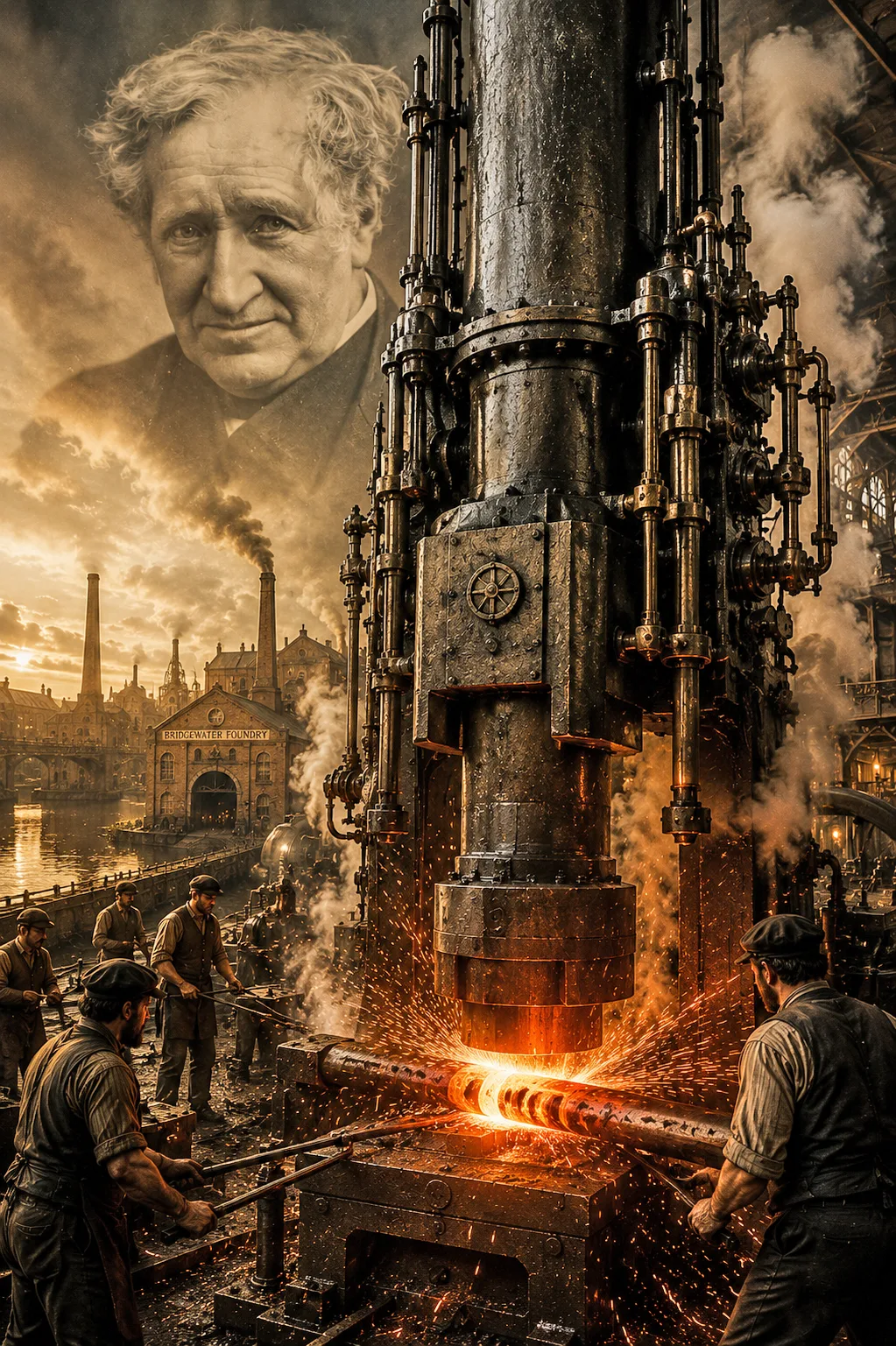
The steam hammer is one of those rare machines whose silhouette became shorthand for an era. To stand in a Victorian forge as a Nasmyth tup fell on glowing iron was to feel the Industrial Revolution as a physical force in your chest — the heat, the spark-shower, the boom that rolled through the building and across the fields beyond. That James Nasmyth designed it on a November night in 1839, that François Bourdon dreamed the same machine in Burgundy the same year, that Robert Wilson taught it to whisper as well as roar — together, these are the truer story. Nasmyth's real claim to greatness was not solo invention. It was the engineer's eye that saw the elegant solution, the artist's hand that drew it, and the entrepreneur's grip that put 493 of them to work shaping a new age of iron.
Further Reading
- Institution of Mechanical Engineers — holds the Nasmyth Scheme Book (NAS/1/2), including the 24 November 1839 sketch.
- Science Museum, London — displays a working Nasmyth steam hammer and a balanced account of the Nasmyth–Bourdon priority debate.
- Heriot-Watt University — successor to the Edinburgh School of Arts where Nasmyth studied; its mechanical engineering building bears his name.
- National Records of Scotland — Edinburgh civic and family records for the Nasmyth family.
- Royal Society of Edinburgh — biographical resources for Scottish engineers of the period.
- Cantrell, J. A. (1984), James Nasmyth and the Bridgewater Foundry: A Study of Entrepreneurship in the Early Engineering Industry, Chetham Society / Manchester University Press.
- Nasmyth, J., ed. Smiles, S. (1883), James Nasmyth, Engineer: An Autobiography, John Murray, London.
Frequently Asked Questions
›Who invented the steam hammer?
Two engineers — Scotland's James Nasmyth and France's François Bourdon — independently conceived the steam hammer in 1839. Nasmyth sketched his design at Bridgewater Foundry near Manchester on 24 November 1839. Bourdon built the world's first working steam hammer at Le Creusot in 1840 and was first to patent it (French patent, 19 April 1842), with Nasmyth's British patent (No. 9382) following on 9 June 1842. Historians today treat the steam hammer as a case of independent, near-simultaneous invention.
›Who was James Nasmyth?
James Hall Nasmyth (1808–1890) was a Scottish mechanical engineer born at 47 York Place, Edinburgh, the youngest son of the landscape painter Alexander Nasmyth. Educated at the Royal High School and the Edinburgh School of Arts (now Heriot-Watt University), he became personal assistant to Henry Maudslay in London in 1829 before founding the Bridgewater Foundry at Patricroft in 1836. He designed the steam hammer in 1839, retired wealthy at 48, and spent his later life as an accomplished astronomer.
›Did James Nasmyth invent the steam hammer?
Not on his own. The concept had been outlined by James Watt in his 1784 patent and by W. Deverell in 1806, neither of whom built a practical machine. In 1839 Nasmyth and Bourdon independently designed working versions. The honest verdict is that Nasmyth was first to publish a detailed sketch, Bourdon was first to build and patent a working machine, and Nasmyth was first to commercial dominance through his Bridgewater Foundry.
›Who was François Bourdon?
François Bourdon (1797–1865) was chief engineer of the Schneider brothers' ironworks at Le Creusot in Burgundy. In 1839 he conceived a near-identical 'Pilon' to solve the same problem of forging large shafts and cranks. After visiting Nasmyth's foundry in 1840 and seeing the Scheme Book sketch, the Schneiders authorised construction. Bourdon's 2,500 kg hammer was working at Le Creusot in 1840 — the first true steam hammer in operation anywhere in the world.
›What was Robert Wilson's contribution?
Robert Wilson (1803–1882) managed Nasmyth's Bridgewater works and devised the self-acting valve gear that automatically admitted steam to raise the hammer after each blow and, crucially, allowed the operator to vary the force of the blow at will. This is the innovation that turned the steam hammer into a precision instrument capable of the famous egg-in-a-wine-glass demonstration. Nasmyth patented the self-acting motion in 1843, but contemporaries credited the invention to Wilson — and the firm later changed its name to Nasmyth, Wilson and Company in recognition.
›How did the steam hammer work?
A heavy hammer-block (the 'tup') was bolted to a piston rod running up into an inverted vertical steam cylinder. Admitting steam beneath the piston raised the tup; releasing it let the tup fall under gravity onto a workpiece resting on a massive anvil. From 1843, steam could also be admitted above the piston on the downstroke, driving the hammer down with far more force than gravity alone. A skilled operator working a slide-valve lever — later aided by Wilson's self-acting gear — could vary the blow from a feather-light tap to a building-shaking strike.
›Why was the steam hammer important?
Before 1839, large iron forgings such as ships' anchors and marine engine shafts had to be built up piece by piece, slowly and unreliably. The steam hammer let smiths forge huge components in one sound piece, cutting production costs by more than half while improving quality. It became the defining heavy-engineering tool of the Victorian age, underpinning shipbuilding, railways, armour plate, gun barrels, bridges and the new heavy industries of the Industrial Revolution.
›What was the egg-in-the-wine-glass demonstration?
Nasmyth's signature party trick. Demonstrating his hammer to the Lords of the Admiralty, he had the tup brought down so gently that it cracked an eggshell sitting in a wine glass without breaking the glass — then warned the next blow would 'shake the parish'. The story is documented in Nasmyth's own autobiography and corroborated by the Science Museum and the Institution of Mechanical Engineers. The precision it advertised owes much to Robert Wilson's self-acting valve gear.
›What was Bridgewater Foundry?
Bridgewater Foundry was Nasmyth's engineering works at Patricroft, near Eccles, opened in August 1836 in partnership with Holbrook Gaskell and Nasmyth's brother George. Shrewdly sited between the Bridgewater Canal and the Liverpool & Manchester Railway, it traded as Nasmyth, Gaskell and Company and became one of Britain's greatest engineering works. Between 1843 and 1856 it built 493 steam hammers — about 40 per cent of the firm's revenues — and exported them across Europe, Russia, India and Australia.
›How did the steam hammer change the Industrial Revolution?
By making large, sound iron and (later) steel forgings practical for the first time, the steam hammer enabled marine engine shafts for ocean liners and warships, wrought-iron armour plate for ironclads, the largest gun barrels of the Victorian era, and pile-driving for bridges and harbours. A Nasmyth-derived pile-driver demonstrated at Devonport on 3 July 1845 drove a 70-foot pile in four-and-a-half minutes against the twelve hours of the old method. The steam hammer was a symbol — and a working tool — of the heavy-industry phase of the Industrial Revolution.